
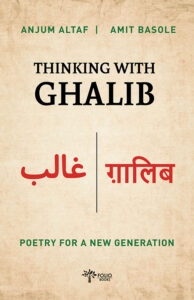
Ghalib for Gen Z

This review was originally published at The Friday Times.

Publisher: Folio Books

Publishing date: 2021

Authors:  Anjum Altaf & Amit Basole


“For Ghalib, life is an unending search. Neither the holy of holies in Mecca nor even the attainment of paradise is the end of it.” ~Ralph Russell

We’ve all heard of that crooked genius, Mirza Asadullah Beg Khan Ghalib — whether through our school Urdu courses (unfortunately encountered at an age when our consciousness is still unripe) or through pop culture. Sometimes it’s his well-known fantasy for mangoes; other times it’s when someone shares a couplet whose slightly convoluted vocabulary immediately earns it the label of “a Ghalib shayr”; and other times, his destitution and scrambling for a pension.

As a Gen Z myself, I can say that most of today’s youth are largely alienated from the Urdu language, let alone Persian. And of course, this doesn’t mean we’re reading Byron or Eliot instead; rather, it’s the excess of TikTok. Decoding Ghalib feels like a Herculean task for us. This dilemma not only distances us from a rich poetic tradition but also from the timeless lessons it has nurtured.
Continue reading Ghalib for Gen Z

Why Indian English Loves Long Sentences

If China endured a century of humiliation, India has lived through a thousand years of it. Invasions and exploitation left it poor in wealth but rich in culture; intricate, adaptive, and resilient. That depth shows in Desi English, which often favours long, ornate sentences over plain ones.

This habit echoes Persian’s former role in the subcontinent: a prestige language whose mastery signalled rank. Even Ghalib’s vast Persian verse drew less love than his Urdu. In India, Persian was the colonial language of power; today, English plays that part.

In Iran, Persian changes fast. Slang, borrowed terms, and foreign tones reshape it so quickly that many in their forties struggle with teenage speech. My own Persian, kept alive in Kuwait and India, is closer to Shirazi and Tehrani standards than to the language my ancestors spoke. I’m self-conscious with Iranians, but with diaspora Persians, I speak freely; we share a looser, accented form of speech. Continue reading Why Indian English Loves Long Sentences

Brown Pundits