
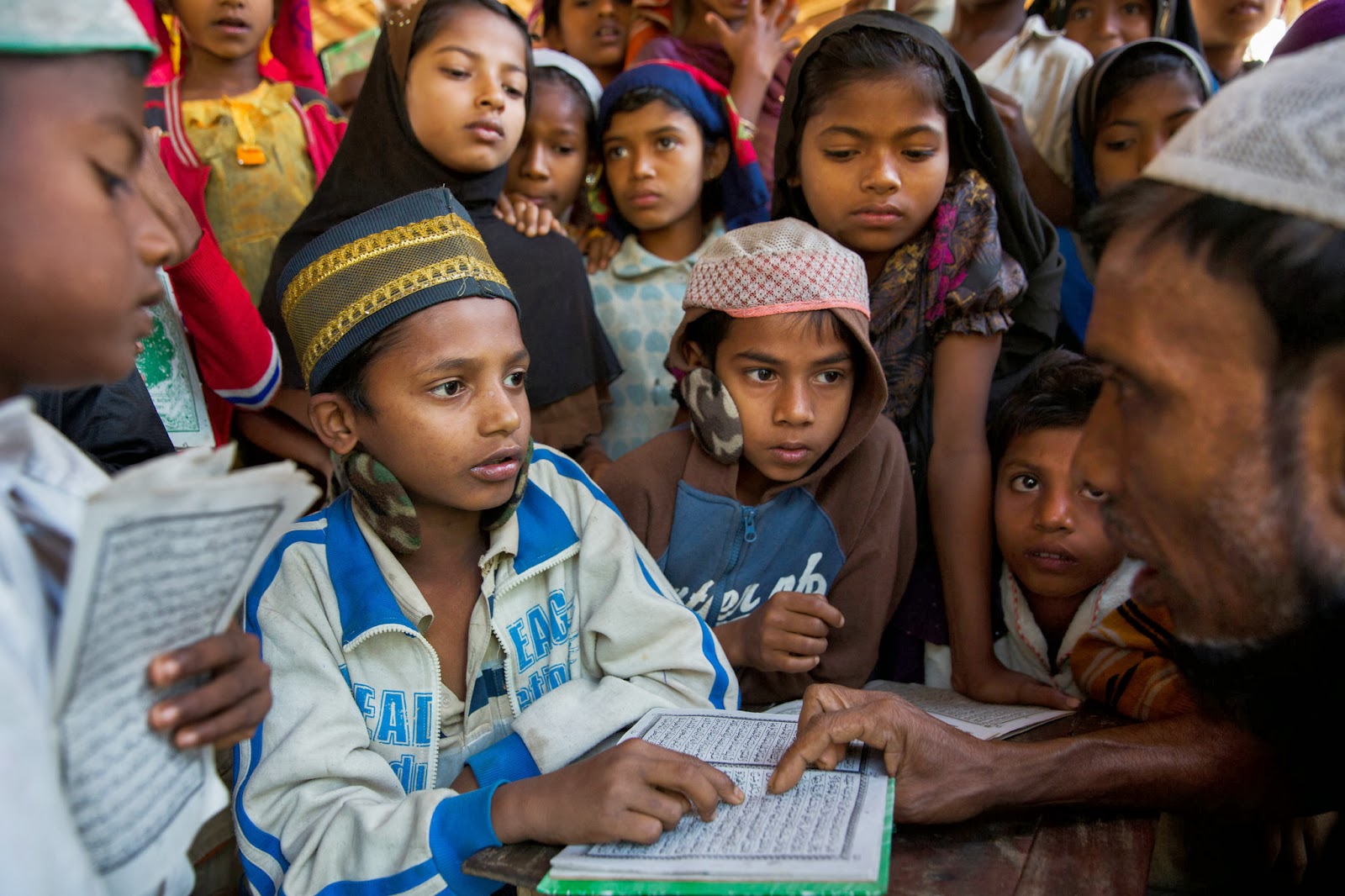
The New York Times has an article up which surveys the situation of Rohingya Muslims in Burma, which is without hyperbole perhaps analogous to that of Jews in 1930s Germany. The title, “Rise in Bigotry Fuels Massacre Inside Myanmar,” emphasizes I think the fact that this is not a conflict driven solely, or even primarily, by religious difference. Because of the lack of good data it is difficult to say with any confidence, but it seems likely that Rohingya are only around ~50% of the Muslims in Burma. Many of the rest are likely descended from people who intermarried with the majority Burmese community (I have read that Aung San Suu Kyi is descended in part from such a lineage), and exhibit no difference aside from religion. Though the ethnic Burmese (Bamar) are the majority of the population, it is not an overwhelming one. More unifying is the fact that on the order of 80 to 90 percent of the population adhere’s to Theravada Buddhism.
But the issue with the Rohingya’s is not just their religious difference, but that to all practical purposes it seems that they are Bengali peasants of relatively recent origins. This is the accusation that the Buddhists, who are mostly ethnic Rakhines, make in Arakan.

as i had earlier asked, how peaceful are buddhists are in actual life and politics?
srilanka, thailand, cambodia, laos, north vietnam ( ho chi min was a buddhist), parts of japan and china are/were hardly peaceful.
of late the nava yana buddhists are following the same path!!!.
And the point I made was that in most cases religion was not an issue for war in Buddhist Countries. The best example was a Ho Chi Min, a nationalist who fought the French and then The US to liberate Vietnam.
In Burma the Burmese were against the Rohingya because of separatism.
There is no confirmed organizational link between the main Rohingya separatist group and ISIS. The primary Rohingya militant group, the Arakan Rohingya Salvation Army (ARSA), has explicitly denied any affiliation with transnational jihadist organizations like ISIS or al-Qaed
If you read Sam Dalyrmple’s book “Shattered Lands” you will find the Burmese are against the Rohingya because they consider them to be Indian (specifically Bengali). These tensions go back to the partition of Burma from British India.
my contention is, can’t these struggles been non violent like gandhi’s?