
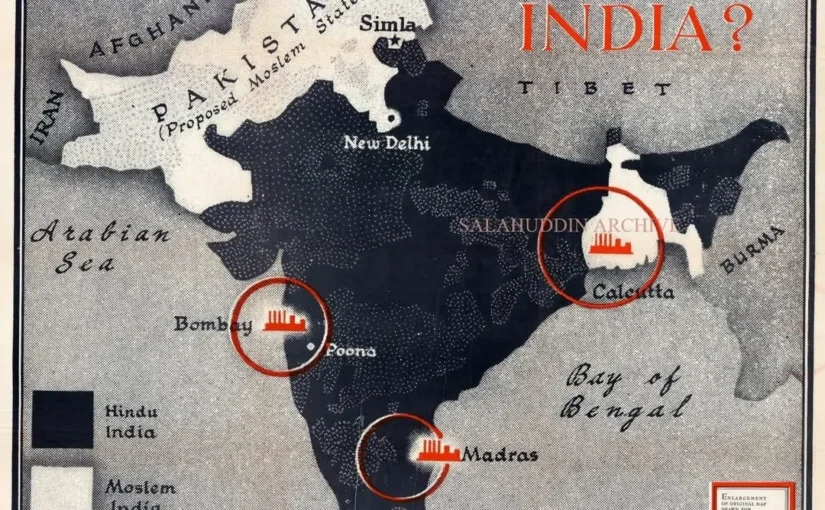
The useful conversations at a conference are never in the room. They happen in the corridor, over bad coffee, among the people who did not get a panel.
What we heard there over the weekend was a single proposition, stated with varying degrees of anger. The subcontinent is held down by two post-imperial states, each of which inherited the Raj’s administrative logic and neither of which has any intention of loosening it. The languages, the peoples, the small nations inside the big ones are being quietly extinguished. The activists who said this were Baloch, Sindhi, Kashmiri and Punjabi (as well as Pushtun, Hazara, and Urdu-speaking).
We should also say at the outset that this essay is about Pakistan. The two-hegemon frame is the activists’ frame, and we have not necessarily adopted it.
I. Ethnicity versus the Pakistani state.
It is acute in Pakistan, and the reason is not that Pakistan is crueller. It is that Pakistan is more religiously homogeneous, and homogeneity does something specific to identity.
Consider what a Baloch nationalist can now say that he could not have said in 1947. He can say that Balochistan is Muslim. Overwhelmingly, unarguably, to a degree the Pakistani state itself cannot dispute. Religion has been settled. It has been taken off the table. And once religion is off the table it can no longer do any distinguishing work, which means it can no longer do any binding work either.
Ethnicity is not resurgent in Pakistan despite Islam. It is resurgent because Islam has become the floor rather than the ceiling. When everyone is Muslim, being Muslim explains nothing about who governs whom, or who takes the gas revenues out of Sui.
II. The racial contention.
The activists say that ethnicity is a foreign import into Islam, a colonial residue, a European infection. Pakistani officialdom says the same thing from the opposite direction. Ethnic feeling is fitna, divisive, un-Islamic.
The argument is thirteen centuries old and has already been had.
Islam never abolished ethnicity. It repeatedly subordinated it without ever eliminating it, which is a different achievement and a more fragile one. The Umayyad state ran an explicit ethnic hierarchy in which non-Arab converts, the mawali, paid taxes their Arab co-religionists did not. The revolution that destroyed the Umayyads was raised in Khurasan and carried by Persians who had had enough of Arab precedence. The shu’ubiyya of the following century was a literary and political movement of Persians asserting cultural parity, conducted entirely inside Islam, in Arabic, by devout men. The Delhi Sultanate reserved its high offices for a Turkish and Persian slave elite and kept Indian Muslim converts out of them.
The Ottomans came closest to a genuinely supra-ethnic Muslim political identity, and they sustained it for centuries. But their subjects were sorted into millets by confession rather than by blood, which is to say that even the great supra-ethnic empire needed a religious cleavage to organise around, and when that cleavage stopped distinguishing anyone; the Arabs went their own way.
Ethnicity survived contact with the profession of faith every time it was tested. Transcending ethnicity was an aspiration about Muslim politics.
III. What India conceded and Pakistan refused.
Potti Sriramulu starved to death in December 1952 demanding an Andhra state. Nehru gave way. Andhra was created the following year, and the States Reorganisation Act of 1956 redrew the country along linguistic lines. This was widely called a capitulation and a threat to national unity. It was in fact the single most successful act of Indian statecraft after independence. It converted linguistic pride from a secessionist force into a routine mechanism of provincial politics.
Pakistan did the reverse. Jinnah told Dhaka in March 1948 that the state language would be Urdu and only Urdu, in a province where almost nobody spoke it. Students were shot in Dhaka in February 1952 for saying otherwise. In 1955 the western provinces were merged into a single unit, precisely to neutralise Bengali demographic weight.
One state decided that language was administrative. The other decided that language was anti-national. Only one of them still has all its provinces.
IV. Bangladesh.
Bangladesh exists. It is the proof that an ethno-linguistic nation can secede from a post-imperial Muslim hegemon and be recognised, and it is the fact that has quickened residual Pakistani nationalism. Bengal was not lost to Hindu conspiracy. It was lost because the state insisted that Muslimness answered a question that Bengalis (proto-Bangladeshis) were no longer asking.
V. Post-Muslim ethnic activists
The activists believe their identities are being snuffed out. We would put it differently. Their identities are what remain after the state has succeeded at everything it set out to do.
It did not make everyone Muslim. That was never the project, and the state’s most famous religious act was a subtraction rather than an addition. The Second Amendment of 1974 legally unmade the Ahmadis as Muslims, and the ordinance of 1984 criminalised their calling themselves so. What the state pursued was not conversion but the policing of a boundary, and it policed that boundary until Islam became the only politically legible identity in the country.
The pattern is not Pakistani. It is what happens whenever an ideology neutralises one axis of identity and mistakes that for having abolished identity. The Soviet Union manufactured a supra-ethnic Soviet man with more force and more success than any state in history, and then dissolved precisely along the borders of the ethnic republics it had drawn to administer him. Arab nationalism unified the Arabs and left behind Iraqis, Syrians, and Egyptians. In each case the ideology did not fail. It won, and the victory removed the thing that had been holding the next question down.
Ethnicity is not the rival of the ideological state. It is its residue.
Very interesting. I did not realize that ethnicity is seen as a liability of sorts in the great homogenization project. Somewhat similar to what LKY did in Singapore. Mandarin completely subsumed any other linguistic identity including Cantonese, Hokkein and of course Peranakan (LKY himself had Peranakan blood which he downplayed). This was done to give a strong sense of a homogenous national identity in a newly formed country.
India is one place where the religious, linguistic, regional identities overlap without friction. One does not take precedence over another. This flexibility is attributable to Hinduism. The flexibility and comfort in allowing seemingly contradictory affiliations to sit together without the need to justify is attributable to the philosophy. It has something to do with being comfortable with discomfort. The Pakistani state should try it, they’ll be surprised at how it might help cohere different ethnicities instead of driving them apart.
looked up the Perankan’s; what a fascinating ethnicity.
Oh yes. I love the cuisine. Best places to try it apart from SG are Penang and Melaka. Katong which is along the East Coast of SG has (had?) a lovely Peranakan store. The beaded handmade slippers and the lunchboxes are absolutely delightful.