Looking at the Y chromosomes in the Indian subcontinent, it seems that haplogroups C (found in lots of Patels) and F are the only ones with “eastern” affinity that deeply rooted in the subcontinent. Thoughts? H is found in a lot of Adivasi, but seems more related to West Eurasian populations.
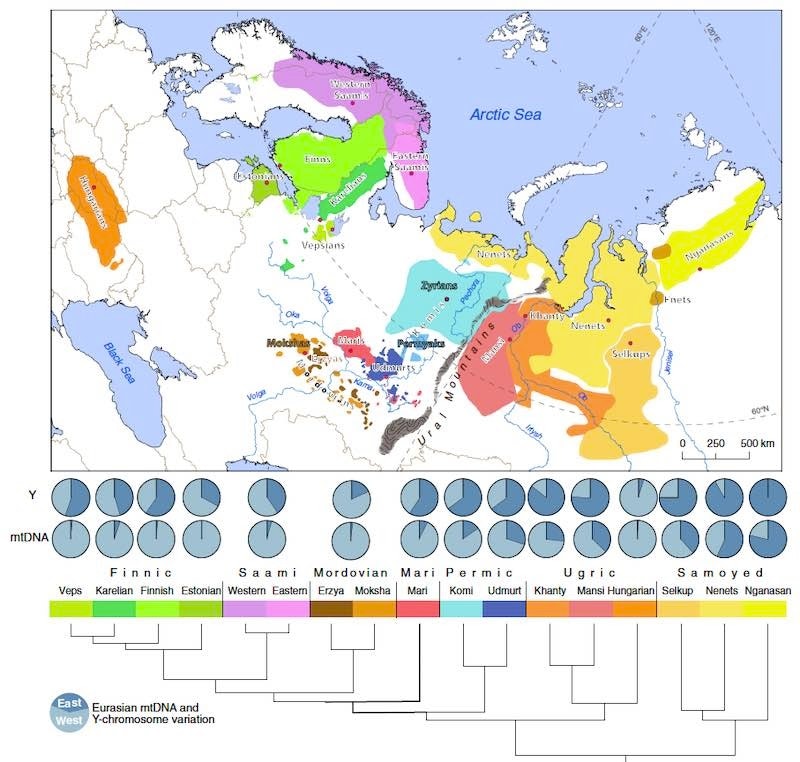
This is on my mind because the Uralic populations show the strong male-based spread of eastern Y chromosomes. Finns are 60% eastern on the Y and less than 1% on the mtDNA.
Published by

Razib Khan
Razib Khan is a Bangladeshi-American geneticist and writer. He is co-founder of Brown Pundits and runs Unsupervised Learning, a Substack on population genetics, evolution, history, and politics with more than 55,000 subscribers, alongside the accompanying podcast. He has blogged at Gene Expression since the early 2000s.
His writing has appeared in The New York Times, The Guardian, National Review, Slate, India Today, Quillette, and UnHerd. He is Director of Operations at FUTO in Austin, Texas, and co-founder of GenRAIT, a life-sciences platform company. Earlier in his career he developed ancestry algorithms for Gene by Gene, the Genographic Project, and Insitome, and was among the first employees at Embark Veterinary.
Born in Dhaka and raised in upstate New York and eastern Oregon, he holds degrees in biochemistry (2000) and biology (2006) from the University of Oregon, and undertook doctoral work in genomics and genetics at UC Davis. He lives in Austin.
View all posts by Razib Khan

My honest opinion is that these “South Eurasian” lineages have ridiculously low resolutions on them compared to well studied and dissected East Eurasian ones. The only equivalent I can think of is if all K-derived lineages were labelled as K, and both Indo-Europeans and Uralics were labelled as being from the same Y-lineage.
H, C, F etc are pretty ancient and show a good deal of diversity. It wouldn’t surprise me if certain clades were split across various areas of South Asia, including the Mountain Corridor (my belief is that a sizeable portion of the Panca-jana didn’t migrate from the Northwest, but instead through the Himalayan region through what is now Kashmir and Himachal Pradesh.)
Some “South Asian/ East Eurasian” clades may have been autochthonous from mesolithic inhabitants, others introduced from Neolithic agriculturalists, and others by the Indo-Aryans themselves (likely picking up some groups in Kashmir/Himachal Pradesh)
How do I join your weekly Clubhouse? I clicked on your twitter link and it says clubhouse is setting up the account.
South Asian C is mostly not C2, it is mostly C1b and a distant sibling of the Melanesian C1b subclade. In India, there are occasionally K2a (xNO) individuals found usually in the south. A lot has changed since the late Pleistocene or at least the Holocene, so I think that pre-LGM South Asian DNA would feature plenty of K2 and C1b. Both linked to those found further east of South Asia because South Asia at the time was inhabited by Eastern non-Africans.
Does anyone have anything to add to this ^. As in anything new that wouldn’t be common knowledge regarding rare and deep local lineages.
Kashmir and Himachal are not migration routes. You can migrate to Kashmir, but hardly beyond. Kashmiris are ancient migrants from Punjab mainly with a sprinkling of Central Asian blood. The few who migrated out went back to Punjab or escaped to the even more remote areas of Kishtwar/Banihal. Same for Himachal.