Persian & Ranjit Singh

When Ranjit Singh established a sovereign Punjabi kingdom in 1799, he did make serious efforts to encourage the teaching of Punjabi. According to some accounts, he ensured that every household was supplied with a free qaida, a primer of Punjabi language. As a result, there was massive increase in literacy, especially female literacy, in Punjab. One estimate, perhaps an exaggeration, suggests that there was nearly 100 per cent literacy by the end of the Punjabi kingdom in 1849. However, even Ranjit Singh did not give the official status to Punjabi in spite of it being a highly developed literary language. The Persian language continued to be the language of the court and official administration. Since no formal explanation of this contradictory approach by Ranjit Singh to Punjabi language — promoting its use but not giving it an official status — is available, we can merely speculate that it could be due to sheer administrative convenience that the use of Persian continued for official purposes.

From: When future of Punjabi language was secured

Sikhism & Iran’s Symbol

Image may contain: text
No automatic alt text available.
I saw this in an Iran forum and was immediately intrigued but it turns out to be simply a coincidence. However it’s a nice segue to this article on the Sikhs of Iran, Iran’s Sikhs get a better deal than many other minorities.
The strong relations between India & Iran is no joke; I remember on my second trip to Tehran last year the queues to the Indian embassy for visas were literally bursting. Sadly (or not) the relationship between Pakistan & Iran seems to be a very one-way affair, Pakistani’s are more enamored and the Indo-Pak Shi’ite pilgrims in Iran don’t make the best impressions of themselves with their excessive fawning (or so I’ve heard).

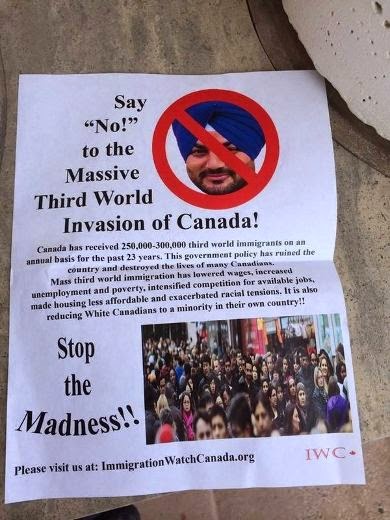
Third World Invasion of Canada (by Sikhs)

We all know that Canada is welcoming of immigrants, but something like this is still a matter of concern. …

Sikhs are noted as a prosperous community in India (and in the West) but they are facing considerable violence, recently three Sikhs died in Saharanpur, Uttar Pradesh, India and one in Peshawar, Khyber Pakhtunwa, Pakistan. Six members of a Sikh congregation were killed and four injured two years ago (August 05, 2012) in an attack on a Gurudwara in Oak Creek, Wisconsin. One Sikh veteran (Gulf War) was killed by the police in Lodi, California in January, 2014. Sikhs (two) were also killed in Sacramento in 2011.
 …………

 ….
It is clear that being a model minority will not save Sikhs, especially when native (white) populations are feeling threatened everywhere by the changing face (more and more browns, blacks) of their communities, in the Americas and in Europe.

……

 …….
It is also interesting to speculate on how much animosity is directed against Sikhs because they are being confused with Muslims. Indeed, Sikhs in USA and UK have from time to time campaigned on the theme of Sikhs are not Muslims!!! Needless to say, brown-on-brown ill-feeling has been brought over from the old country. When the time comes, it is wise to remember, the crocodile will be unsparing.
…….
Police are investigating a racist anti-immigration flyer recently distributed in Brampton. “Peel Regional Police have become aware of the most recent flyer that
is now in circulation in our region depicting insensitive and racially
intolerant messaging,” a police release put out Saturday stated.
Cops don’t know who the creator of the flyer is, Const. George Tudos said. “Obviously we’re going to look at all avenues,” he said.


According to a statement by the Canadian Race Relations Foundation,
the flyer in question singles out the Sikh community that resides in
Brampton.
“By crossing out the image of a Sikh individual while raising the
fear of a ‘massive third-world invasion of Canada’ and claiming that
‘white Canadians’ were being reduced to a ‘minority’, the creators of
the flyers have crossed the line from dialogue into outright racism,”
the CRRF statement said.


….
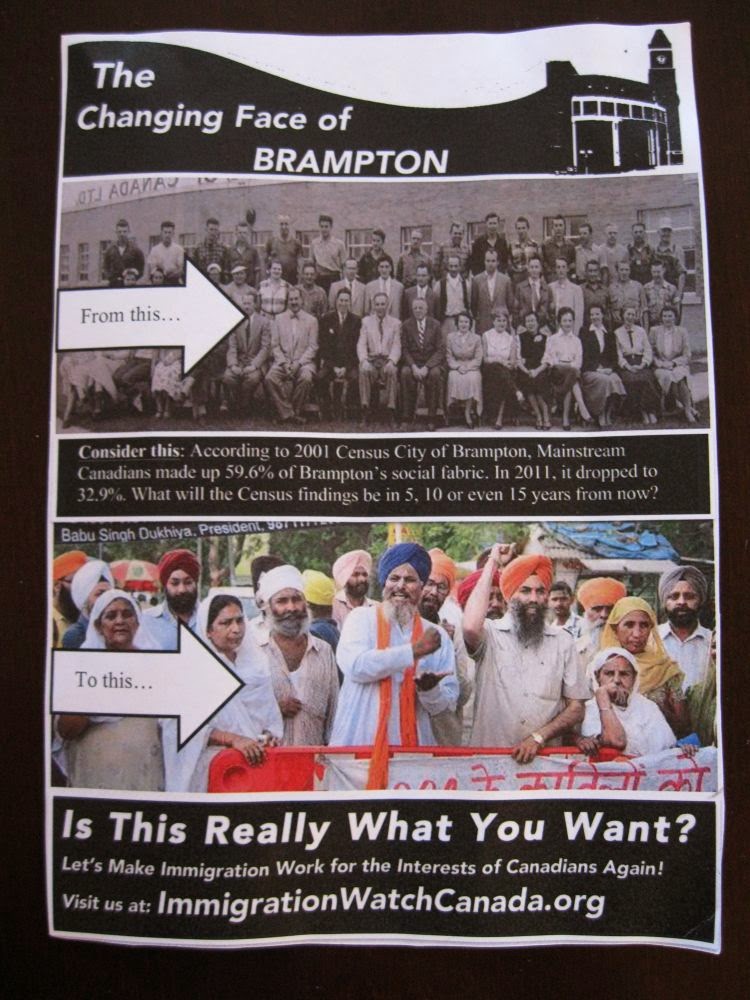
This is not the first time an anti-immigration flyer has been spotted in Brampton.

In April this year, a group called Immigration Watch Canada
distributed pamphlets showing a picture of white people and a picture of
Sikhs, with numbers indicating immigration population growth as well as
a caption: “Is this what you really want?”


….
IWC spokesman Dan Murray said Saturday the group “did not authorize the distribution of the flyer in Brampton.” Tudos said police still plan to speak with IWC andthe author of the latest flyer is still unknown.

….
Once the investigation is complete, “investigators will be consulting
with the Ministry of the Attorney General to seek the authorization, if
applicable, to lay hate-crime-related charges,” Peel police said in
their statement.


….
Brampton NDP MPP Jagmeet Singh criticized the flyer in a tweet on
Thursday: “Brampton, let’s reject this racist flyer’s message of hate
& instead stand united for diversity & acceptance of all.”


A Rally Against Racism – organized by a group called Brampton United
Against Racism and attended by Singh – was held on Friday outside
Brampton City Hall in response to the flyer. 

….

Link (1): http://www.torontosun.com/police-probe-racist-flyers-in-brampton

Link (2): http://antiimmigration_flyers_single_out_sikh_community_in_brampton.html
….

regards

No country for young Sikhs (or old)

Last week (July 26) we had three Sikhs dead in Saharanpur (Uttar Pradesh, India). Due to the way these action-reactions occur in South Asia (in the words of a very famous and powerful person), this week we encounter a repeat action in Peshawar (Khyber Pakhtunwa, Pakistan).
……

…. 
We extend our deepest sympathies to all minority communities without a safe haven to call their own. The list even includes Hindus (Pandits) in India, Muslims (Biharis) in Bangladesh, and many others…….

No one should have to die before their body and/or mind dies a natural death.
……………….
Members of the Sikh community in Peshawar came under attack on Wednesday, with one killed and two injured in a firing incident.
…… 
Police
officials said unidentified armed men opened fire at members of the
Sikh community when they were at Shabab market in the Hashtnagri area.

DawnNews
reported that Jasmot Singh, Bahram Singh and Manmit Singh were attacked
when they were at their respective shops in the market. The victims
were rushed to the Lady Reading Hospital immediately after the attack,
where one died.

Members of the Sikh community took to GT
Road to protest the attack on their community, with some burning tires
and vowing not to leave till they were given justice.

A large number of protestors shifted the
body of the deceased Sikh man to GT Road and demanded that the
government give them security. One member said that this is not the
first time the community has been attacked and that the government
should tell them an alternative if it cannot give them security.

After
a number of kidnappings from among the Sikh community in
Khyber-Pakhtunkhwa (KP) and other tribal areas, some members have
decided to wind up their shops in KP and relocate to Rawalpindi.

In a report
published earlier this week, one Sikh man Saroop Singh said,
“Hasanabdal is a much safer place for the Sikhs to live, as it is one of
our holiest sites. Our families feel much secure there, living among
other Sikhs in Gurdwara Punja Sahib. Peshawar is not safe,” said Singh.

…….

Link: gunmen-shoot-at-sikh-men-in-peshawar-market-one-dead

……

regards

Secularism (no exceptions please)

Indian secularists supposedly have a soft spot for muslims (sweet), while ignoring other minorities such as Sikhs (why? perhaps because they are successful and can look after themselves). Thus we have honest liberals like Mukul Kesavan (reluctantly) white-washing the 1984 anti-Sikh pogrom (as opposed to the 2002 anti-muslim one). MK makes the case that Congress kills because of opportunity while BJP kills because of ideology. Yes…..but so what?

Meanwhile, in Saharanpur three Sikhs (officially) have just been butchered by a muslim mob (led by an ex-Congressman) and the predictable Twitter wars have been launched.
………

….
When people are murdered do they really feel better that they are being killed on account of ideology or because of opportunity? How about the claims for justice, in which case are they more (or less) valid? Is it really true that the appointment of Man Mohan Singh as Prime Minister (who then issued a mealy-mouthed apology) is all that is required to wash away the blood-stains?
….
We do not see the difficulty in laying blame equally on opportunity and ideology. And we see considerable virtue in not suppressing the truth and being impartial. Thus when Hindus kill Muslims or Muslims kill Sikhs, such actions should be condemned with equal intensity.

We already know how the bigots will behave. If left-liberals also choose to be economical with the truth, they will lose credibility. People will then feel free to ignore their bleatings the next time the big bad wolf shows up at the door..
……
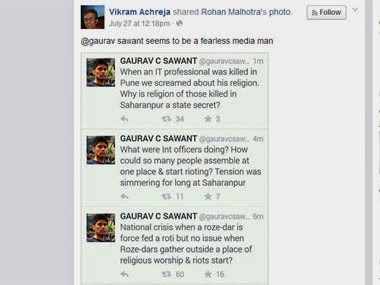
Even before Indian politicians could cause the Saharanpur riots to
snowball into a secular party versus communal party war, guess who took
their spot? The country’s media. A day after riots in the Western UP
town claimed four lives, Gaurav Sawant, a journalist with English news
channel Headlines Today tweeted questioning the reportage of the riots
by the mainstream media

He asked why the victims in the Saharanpur riots were not identified by their religion.

He also questioned why, while there had been a huge furore over a Shiv
Sena MP shoving a roti into a fasting Muslim worker’s mouth, there had
been no anger over fasting Muslims gathering to pray and leading to a
riot.

His comments kicked off a Twitter storm with people lining up on either side of the debate.

Twitter then saw a series of  squabbles over allowing him to carry on
his job as a journalist. Several petitions and counter petitions were
filed in the course of the day, with colleagues and friends tweeting
pictures in support of the journalist.


…….
This is how a Facebook friend responded to the exit polls predicting an
easy victory for Modi:  

“One good thing about Modi becoming PM will be
the daily opportunity to dissent.”

He seems to have missed the
daily opportunity to dissent provided by the Manmohan Singh-led United
Progressive Alliance’s second term. UPA-2 did a lot of things people now
fear a Modi government will do.
 

There was the corruption of the
Commonwealth Games, they blamed the auditor for exposing the telecom
scam, they put Anna Hazare in jail for asking for a Lokpal and even
killed a Baba Ramdev supporter making the same demand. Students came out
to protest against rape and they responded with tear gas. 

They passed a
draconian anti-terrorism law and put Muslims in jail for fake terrorism
cases. They hanged Ajmal Kasab and Afzal Guru to appear strong, weren’t
able to do anything about anti-Muslim violence in Congress-ruled Assam,
let the situation in Kashmir deteriorate,
allowed the economy to
tumble, let Maoists get the better of them, slapped sedition cases
against people who didn’t want a nuclear power plant next to their
homes, put people in jail for criticising the government online, and
created a Central Monitoring System to snoop on all phone and internet
communication. Acts like this, if committed by a BJP government, will be
more vehemently opposed in the name of fascism.

To each crisis,
the Congress leadership responded with arrogance, compounding their
mistakes, losing the trust of the judiciary and the media, reviving the
moribund BJP. Had it not been for the self-destructive performance of
UPA-2, Modi would arguably not have chosen this election to make a bid
at the top job. If the independent Left sees Modi as a problem, it
should criticise the factors that encouraged the BJP leader’s rise in
2013-2014: the failure of Sonia Gandhi, her son Rahul and her chosen
Prime Minister Manmohan Singh.

Instead, when Modi was sharpening
his knives, Left-leaning intellectuals and activists were attacking the
Anna Hazare-Arvind Kejriwal-led Jan Lokpal movement. They said that the
Lokpal movement was a Rashtriya Swayamsevak Sangh conspiracy to make the
Congress look bad, as if the Congress needed any help with that.
 

Over
the past three years, I have seen more bile, fear and frustration over
Hazare and Kejriwal on my social media timelines than over Modi. Rants
about how the Lokpal movement was proto-fascist and full of RSS workers
all served to show how the Indian Left is still traumatised by the Babri
demolition.

Perhaps it is only fair that the Hindutva brigade
gets to rule a country whose liberal intelligentsia has shown such great
poverty of political imagination as to trap itself in the Congress-BJP
binary, ceding altogether the once-vibrant space for anti-Congressism to
Hindutva supporters, and thus falling into their trap.

One thing
is clear. The Left still matters. While the party Left – the world’s
first communists to contest democratic elections – have been in
self-destruction mode, the independent Left plays a crucial role in
shaping political discourse. They used that power to the hilt to
discredit the Hazare movement.
 

They propped up dalit politician Udit Raj
to suggest that dalits are opposed to the Lokpal bill. (Udit Raj has
since joined the BJP.) They said the Lokpal movement was not questioning
corporate corruption but then Kejriwal took on the Ambanis. They said
Kejriwal was not speaking against BJP corruption but then he took on the
BJP president, Nitin Gadkari, accusing him of a scam that forced him to
resign from his post.

It was only when Kejriwal demonstrated in
the Delhi assembly elections that he could take on the BJP that secular
intellectuals started showing sympathy for the Aam Aadmi Party. A “No
More” campaign on Facebook has argued for tactical voting to elect the
candidate who can defeat the BJP in every constituency. Leftist
activists from across the country descended upon Varanasi to tell the
people to not vote for Modi.

This is the wrong way to go about
it: simply backing the candidate that can keep the BJP out is not going
to take them anywhere. Keeping the BJP out cannot constitute an entire
political imagination. The Left needs an agenda, an idea, a cadre.
Perhaps the AAP is not that option either, but India does need a
substitute for the Congress. 

The Congress will keep making mistakes,
keep showing its elitist arrogance and being blasé about corruption, and
the BJP will keep exploiting its mistakes. This is how the BJP first
came to power, defeating Narasimha Rao after he liberalised the economy
and put it on the right track. And that is repeating itself. The party
that opened the gates of the Babri Masjid cannot be the guardian of
secularism.

……

The stock response of the Bharatiya Janata
Party to the argument that Godhra makes Narendra Modi politically
untouchable is “What about 1984?” There are several inadequate comebacks
to that question and the best of them is that no one should use one
pogrom to justify another.

The problem
with this response, though, is that it doesn’t answer the questions that
fly in close formation behind the “What about 1984?” question, namely,
“Why is the BJP worse than the Congress?” and, relatedly, “Why is
Narendra Modi any worse than Rajiv Gandhi?” specially given the latter’s
infamous comment, “When a big tree falls, the earth shakes,” which
seemed, retrospectively, to rationalize the systematic killing of Sikhs
in the days that followed Indira Gandhi’s assassination.

These are
important questions regardless of who asks them. The fact that they are
often asked by Narendra Modi’s unlovely supporters isn’t a good reason
for not taking them seriously.

1984 had two
major consequences. First, it radically undermined the Congress’s claim
to being a secular party that respected the political tradition of
pluralism pioneered by its colonial avatar and consolidated by Nehru in
the early years of the republic. The willingness of the Congress under
Indira Gandhi to use sectarian issues for political ends had been
evident before 1984 but the party’s willingness to sell its pluralist
soul for immediate political advantage was most vividly illustrated in
the days and months after her death.
The Congress, after 1984, stood out
more and more clearly as a party that couldn’t even be accused of not
having the courage of its convictions because it didn’t have any
convictions at all. Pluralism and its traditional opposition to
majoritarianism became labels that the Congress used for brand
management in particular political contexts, not as principles that
shaped its political agenda.

Let us
return to our question, namely, “What makes Modi and the BJP worse than
the Congress and its dynasts, given the horror of 1984?” The answer is
simple and unedifying. 
The Congress, by a kind of historical default, is
a pluralist party that is opportunistically communal while the BJP is
an ideologically communal (or majoritarian) party that is
opportunistically ‘secular’.
The difference between the Congress and the
BJP doesn’t lie mainly in the willingness of the former to express
contrition about pogroms it helped organize; it is, perhaps, best
illustrated by the fact that twenty years after the 1984 pogrom, the
Congress assumed office with a Sikh at the helm who served as prime
minister for two terms.

Try to
imagine a BJP government headed by a Muslim ten years from now. It
doesn’t work even as a thought experiment. And the reason it doesn’t
work is that the BJP’s ideology is essentially the encrustation of
prejudice around an inconvenient and irreducible fact: the substantial
and undeferential presence of minority communities in the republic,
specially Muslims who, for the sangh parivar, are the unfinished
business of Partition. The idea that the BJP might appoint a Muslim head
of government (as opposed to, say, the nomination of President Kalam to
titular office) is unthinkable.

It doesn’t
follow from this that Manmohan Singh’s prime ministership is a sign of
the Congress’s political virtue; it isn’t. It is, if anything, a symptom
of the dynastic dysfunction that has diminished the Congress. But the
reason his prime ministership is possible is that the Congress isn’t
ideologically committed to anti-Sikh bigotry (despite 1984) in the way
that the BJP is committed to Hindu supremacy and the subordination of
Muslims. That’s why Narendra Modi so excites the sangh parivar’s
rank and file: the Gujarat Model is the BJP’s test run for India, and it
isn’t the economics of it that sets the pulses of its cadres racing.

So the
reason the dynastic Congress isn’t as dangerous as Modi’s BJP is
dispiriting but straightforward: while the Congress is capable of
communalism, it isn’t constituted by bigotry. With Modi, even when he’s
talking economics and good governance, we get the “burqa of
secularism” and Muslims as road kill. It’s not his fault; from the time
that Golwalkar sketched out his vision of an India where religious
minorities were docile helots, bigotry has been Hindutva’s calling card.

…..

Link(1): http://www.firstpost.com

Link (2): http://scroll.in/article/664400/Why-the-Indian-Left-wants-Narendra-Modi-to-be-prime-minister

Link (3): http://www.telegraphindia.com

Sikh-Brahmins of Chakwal

…“When I first went to a local college two years ago, students and
teachers gave me a strange look…
..They gave me a bizarre
glance because being a Hindu I was an alien to them and such a
situation always hurts me but I don’t express my feelings”…
 

Fascinating life story of the Mohyal Brahmins. When people talk about syncretic culture they should keep such examples in mind.

So….one fine day, the leaders of British India joined hands to declare that the nation-body must be partitioned (it so happens we are refugees from both East and West Pakistan) . Just like that, people were forced to abandon the lands to which they have belonged for eons.

When they arrived as refugees in a foreign country they were often bewildered and without hope. Some people turned back knowing full well that they are walking towards their funeral. Now they are just aliens in the place they used to call once call home. Nice.

We have to accept this for what it is. The successful application of two nation theory to a country of many communities who are now unable to co-exist even if they share the same faith. As a result there are people as “na ghar-ka, na ghat-ka” – those who come from nowhere and belong to no place. The poison of ideologies has made living ghosts out of all of us. The debts that are being accrued will need to be paid off with a lot of blood over a long long time.
………………….


“When I first went to a local college two years ago, students and
teachers gave me a strange look,” recalls 18-year-old Manisha Chhiber, a
Hindu girl whose family lives a secluded life in Kariyala village
located at the top of Surla Hill, some 10km away to the south of Chakwal
city.

Manisha’s family is one of the only two Hindu families
living in Chakwal district (the other lives in Kot Chaudhrian village
located some 40km to the west of Chakwal).

“They gave me a bizarre
glance because being a Hindu I was an alien to them and such a
situation always hurts me but I don’t express my feeling,” Manisha
continues.

But in village Kariyala she and six other members of her family live peacefully and do not feel isolated.

Manisha now waits for her BCom result and wants to become an officer by passing the Central Superior Services (CSS) exam.

“Although
we have mixed up with Muslim villagers in such a way that we do not
feel alienated, sometimes feeling of loneliness haunts us,” says
Manisha’s father Ravindar Kumar, the head of the family.

The
family of Ravindar Kumar belongs to Chhiber clan which is one of the
seven lineages of Mohyal Brahmins. Ravindar’s clan has a tumultuous
history replete with sufferings and bravery.

It was Baba Paraga
Das, a Chhiber who laid the foundation of the sleepy village Kariyala in
the 16th century and the village remained the hub of Chhibers till
partition uprooted them. 

As Mohyals were greatly influenced by the preaching of Sikh Gurus,
they played an active role during the formative years of Sikh religion.

Many notables of Mohyal Brahmin caste remained the disciples of Sikh Gurus and they still worship Sikhism along with Hinduism.

The
Aurangzeb rule was a bit hard for those Mohyals who devoted themselves
to Sikh Gurus. The three revered martyrs of Sikhism Bhai Mati Das and
his two brothers Bhai Sati Das and Bhai Dyal Das who were killed by
Aurangzeb were also Chhibers and belonged to Kariyala village.

The three brothers were the disciples of Guru Tegh Bahadur, the ninth Guru of Sikh religion.

Their
sole crime was that they supported the newly emerging Sikhism and
refused to embrace Islam. The three brothers were bestowed the title of
‘Bhai’ and Sikhs revered them.

Later, all the Chhiber men in Kariyala village added the word ‘Bhai’ to their original name.

Ravindar
Kumar’s father Bhai Jaggat Singh (who was given a Sikh name due to the
family’s devotion to Sikhism) was not only a landlord but also a Zaildar
(an officer in-charge of a Zail, an administrative unit comprising 40
villages) during British Raj.

One could imagine how one can
migrate to an alien land by relinquishing such a great social position
leaving a vast agriculture land behind.

Jaggat Singh never wished
to migrate but when his uncle Bhai Daleep Singh was assassinated by
Muslim rioters, he surrendered to other family members and set out for
Delhi.

“Life in Delhi refugee camp was painful for such a man who
lived a luxurious life. This forced my father to come back,” tells
Ravindar Kumar. But Jaggat’s two sons and wife refused to accompany him,
he said adding that he had to return alone.

After returning from
India, Jaggat resettled in Kariyala and contracted a second marriage.
Although he managed to preserve his land, the high social position which
he used to hold before partition was lost forever. He had two sons from
his second marriage – Ravindar Kumar and Surindar Kumar.

At present, Surindar Kumar lives with his elder brother Ravindar Kumar.

Living
in a thickly Muslim populated society, Ravindar Kumar and his family
members observe Muslim, Hindu and Sikh festivals. “On the occasion of
Eid, I decorate my hands with henna as my Muslim friends do. I visit
homes of my Muslim friends and they too visit my home.

On the
occasion of Diwali, my Muslim friends join me in the celebration,” says
Manisha, but she adds hastily: “Had I been able to celebrate Diwali with
my community, it would have been a different feeling.”

Being a sole Hindu family in the village, they do not celebrate Holi. Ravindar also mixes up with Muslim on their rituals.

“Whenever, any of my Muslim friends dies, I go to offer his/her funeral prayer,” Ravindar says.
“The
old people of the village treat us in a normal and friendly way but the
migrants and the youth’s behaviour is always skeptical towards us,”
Manisha explains.

Ravindar and his family members also visit Panja Sahib and Katas Raj regularly.

Being
a hub of Hindus, Kariyala had a number of Hindu temples but many of
them were damaged in riots. The state of two surviving temples was
deplorable till Musharraf’s regime.

The local bodies system came
as a blessing for Ravindar who was elected as member of the district
council on a reserved seat for minorities. He managed to get some funds
for the renovation of one of the temples where now he and his family
members worship.

But if one wants to visit the temple, heshe is
greeted by buffaloes tied in front of the temple. The buffaloes are
owned by a Muslim family who lives next to the temple.

“I
requested them many a times to find some other place for their animals
but they did not pay any attention. I could not do nothing but plead,”
says a distressed Ravindar.

The other abandoned temple has been
rented out to another Muslim family by Evacuee Trust Property Board and
this temple has become a goat pen.

“Humanity should not be slaughtered at the altar of religion and we should take care of each other’s feelings,” says Manisha.
“It is very painful to bear the desecration of our temples but we prefer silence,” says Ravindar.
……

Link: http://www.dawn.com/news/1118926/chakwals-lone-hindu-family-leads-peaceful-but-secluded-life/

……

regards

Sikhs (UK): Gandhi ‘racist’, ‘sexual weirdo’

The reaction you can expect when a minority community has been denied justice by the uncaring majority. The Sikhs have waited patiently for a long 30 years…enough is enough.

There is also that subtle fear of being subsumed by the Hindu majority sooner or later.

That said it is ironic that the Sikh political leadership in Punjab is represented in the main by the Badal family (patriarch: Parkash Singh Badal) and is allied with the BJP. Thus you have the conservative groupings (Hindus and Sikhs) allying against (not-so-conservative) Hindus and Sikhs represented by the Congress. This bipolar state of affairs has changed dramatically with the arrival of the Aam Admi Party  which allied with an extreme Sikh organization- Dal Khalsa (another Hindu-Sikh alliance).

So it matters not much, how you cut the sacred goat, the situation in the Punjab is (thankfully) not Hindu vs. Sikh (more like Punjabis vs. troublemakers seated in Delhi). 

Coming back to accusations against Gandhi, Sikhs are quite conscious of (and are divided by) caste and sect even though  the religion forbids it. Also, racism is endemic to all of India and Sikhs can hardly claim any superiority on that account. Finally, the Panth is not known to be very comfortable with “sexual deviancy” as has been attested in person by gay Sikhs (neither are any of the other religious groups).They need to upgrade the soft-ware.

It is clear that statue or not, the memory of Gandhi will continue to be honored in Britain and in the West. Not the (perhaps equally deserving) leader(s) of the Muslims, Tamils and Dalits and many others. Gandhi was the (self-described) role model of Martin Luther King (junior) and Nelson Mandela. The Gandhi brand is uniquely strong (aided in part by the Gujarati bio-sphere) and it is too late for the partisans to change that.
…………

Sikhs
in UK have announced a massive campaign to oppose Britain’s plan to
build a statue of Mahatma Gandhi at London’s Parliament Square.
The Sikh Federation (UK) has written to Britain’s culture secretary Sajid Javid who is leading the project.

Bhai Amrik Singh, chair of the Sikh Federation in his letter to Javid
called Gandhi “a blatant racist, a sexual weirdo or worse a child abuser
and someone discriminating on the basis of the Hindu caste system,
which is now outlawed in the UK”.
Singh said “it would therefore be totally inappropriate to have a statue of Gandhi erected in Parliament Square”.

The Federation has also written to Philip Jackson, the British sculptor
who has been approached by the British government to begin work on
Gandhi’s statue asking him to boycott the project.

The
Federation is also writing to anti-racists groups, campaign groups
opposed to paedophilia and organisations that have been working in the
UK to have caste discrimination outlawed in the UK.

They are
being urged to unite to oppose the statue and write to all UK
politicians that support their causes “highlighting the other side to
Gandhi’s life that many choose to turn a blind eye”.

The plan
to have a Gandhi statue at Parliament Square in London was announced by
British foreign secretary William Hague and Chancellor of the Exchequer
George Osborne on Tuesday.

They intend to have the monument in
place early next year. Once installed, the statue will provide a focal
point for commemoration next summer of the 100th anniversary of Gandhi’s
return to India from South Africa to start the struggle for self-rule,
as well as the passing of 70 years since his death in 2018, and the
150th anniversary of his birth in 2019″.

The memorial will stand alongside those to other international leaders such as Nelson Mandela and Abraham Lincoln.

Hague said “Gandhi’s view of communal peace and resistance to division,
his desire to drive India forward, and his commitment to non-violence
left a legacy that is as relevant today as it was during his life. He
remains a towering inspiration and a source of strength. We will honour
him with a statue alongside those of other great leaders in Parliament
Square”.

Osborne added “As the father of the largest democracy
in the world, it’s time for Gandhi to take his place in front of the
mother of Parliaments. He is a figure of inspiration, not just in
Britain and India, but around the world. New Indian Prime Minister
Narendra Modi invoked his memory in his inaugural speech to Parliament. I
hope this new memorial will be a lasting and fitting tribute to his
memory in Britain, and a permanent monument to our friendship with
India”.

The Gandhi statue will be the 11th statue to be erected in Parliament square.

……

Link:  http://timesofindia.indiatimes.com/nri/other-news/Sikh-group-in-UK-calls-Mahatma-Gandhi-a-blatant-racist-sexual-weirdo/articleshow/38085777.cms

……

regards

Maharajah Ranjit Singh

 Today (June 30) is the 175th death anniversary of the Sher-e-Punjab.

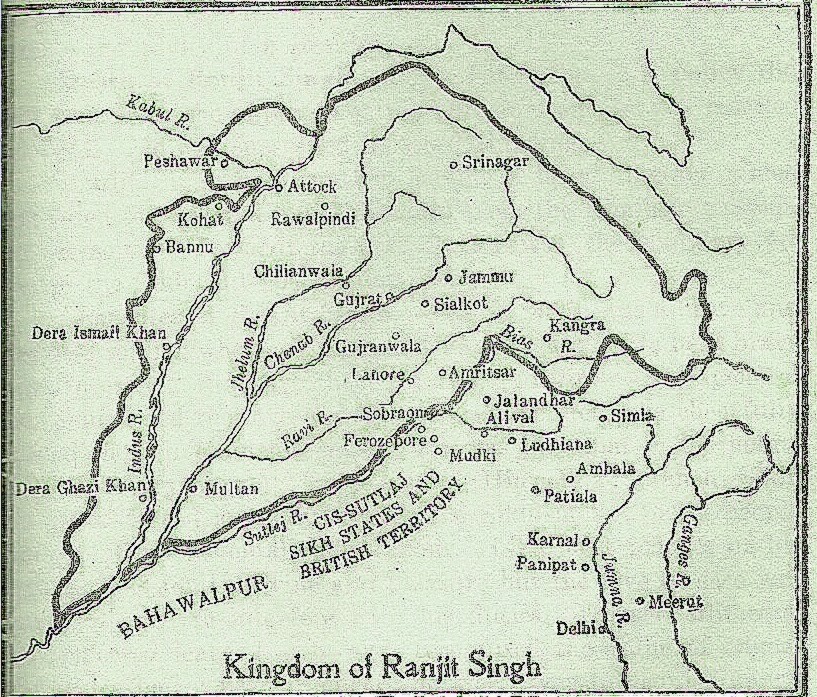
When the Sikh sun was at peak noon, the empire was bound by Peshawar (North-West), Srinagar (North-East), Amritsar (central), and Multan (south).

When the downfall came it was at the hands of the perfidious Albion. The Sikhs did not dwell much on this humiliation and became (along with the Gurkhas) a pillar of the British Indian Army. Then came Jalian Wala Bag, the hanging of Bhagat Singh, the brutalities of Partition,...… OTOH during the dark days of 1984, it was the BBC Foreign Service (and Mark Tully) which kept the Sikhs within India and outside informed about the true extent of crimes against God and men (and women).

As we understand the (mainly expat) Sikhs still dream of restoring the lost kingdom. The only problem is a corridor to the sea. During the peak revolution days of the 1980s there was a proposal to grab Karachi unbeknownst to patron-in-chief General Zia. Another proposal was to annex Gujarat and establish a corridor via Rajasthan.

The SGPC observed his anniversary at Dewan Manji Sahib hall in the
Golden Temple complex. A religious function was held and prayers were
offered in the memory of Maharaja Ranjit Singh, often described as the
greatest Sikh ruler, whose kingdom stretched from the Sutlej river in
the east to Kabul in Afghanistan.


Besides ‘bhog’ of the ‘Akhand Path’ , ‘hazoori ragis’ of the Golden
Temple performed ‘kirtan’. The religious function was well attended by
devotees and SGPC officials. Giani Balwinder Singh, a ‘granthi’ (priest) of Harminder Sahib
threw light on the mighty Sikh ruler. He recalled the Maharaja’s secular
vision and the respect he accorded to all religions during his reign.

He also recalled the Maharaja’s contributions to the Sikh community
and his role in gold plating and beautification of the Harmandir Sahib
and building several others historic Sikh shrines dedicated to the Sikh
gurus.

….
While Shiromani Gurdwara Parbandhak Committee (SGPC) and Pakistan Sikh
Gurdwara Parbandhak Committee (PSGPC) will observe death anniversary of
Maharaja Ranjit Singh on Sunday, monuments related to him in Amritsar –
Burj Vaniake, where the ruler used to stay and even hold his durbar, and
Pul Kanjari…, largely
remain neglected by the government.
Pul Kanjari has been preserved with
private efforts, but Burj Vaniake’s little fort-like structure is in
dilapidated condition and could cave in any day.


Once a lively
township, Pul Kanjri, about 35km from Amritsar, was built by Maharaja
Ranjit Singh and has a “baradari”, a “baoli” (bathing pool), a temple, a
gurdwara and a mosque. It also houses a tomb called Shah Sikandar ka
Takia.

….

Legend has it that Moran….from Makhanpur,
would entertain Maharaja Ranjit Singh with her dances whenever the Sikh
ruler would stay at the “baradari”. Once on her way from Lahore, she
lost her shoe in the canal, which used to provide irrigation water to
the king’s orchards in Shalimar Bagh, Lahore. When Maharaja Ranjit Singh
came to know that his favourite….. was upset after losing her
footwear, he ordered construction of a bridge (pul) across the canal.
Since then, the place is known as Pul Kanjari.

…..

Link: http://www.hindustantimes.com/punjab/amritsar/prayers-mark-maharaja-ranjit-singh-s-death-anniversary/article1-1235039.aspx

….

regards

July 1987: Reports from a different India


Posted: July 08, 1987

FATEHABAD, India -Terrorists
thought to be Sikh separatists attacked two more buses yesterday,
killing a total of 34 people, mostly Hindus, and bringing to 74 the
number of people shot to death in two days of highway ambushes.
On Monday, gunmen killed 40 bus passengers, nearly all of them Hindus, in Punjab state.
Police
said five extremists struck about 8:30 p.m. yesterday on National
Highway No. 10 in Haryana state, which borders Punjab. The attack
occurred about six miles from Fatehabad, a small market town in India’s
wheat belt, and about 150 miles southwest of Chandigarh.

The
attackers used a car and a jeep to block a bridge to stop one bus,
police said. They boarded the vehicle, began dragging out passengers,
and had killed four when a second bus came by from the opposite
direction, headed for New Delhi.
The terrorists then rushed across to the second bus and opened fire with automatic weapons, killing 30, police said.
When
the gunmen turned their attention to the second bus, survivors on the
first fled across nearby fields. Most of the dead were Hindus, and 15
people were wounded, authorities said.
Police said they believed
that yesterday’s attacks were carried out by the same group that staged
Monday’s ambush, in which several gunmen forced a bus driven by a Sikh
to stop on the main highway from Chandigarh to Delhi. They then drove to
a secluded spot before opening up on the passengers.
In that
attack, one gunman apparently was shot accidentally by his comrades. His
body was found later in an abandoned getaway car.
Punjab Police
Chief Julio F. Ribeiro told reporters that the bus driver in Monday’s
attack was detained for questioning. Ribeiro said that ammunition
recovered at the massacre site showed that the militants used
Chinese-made AK-47 assault rifles.
Yesterday was the fourth time
in a year that Sikh gunmen had targeted bus passengers. In attacks in
July 1986 and in November, a total of 38 people, mostly Hindus, were
killed. No arrests have been made in those attacks.
The massacre
Monday was the worst since extremists began a campaign five years ago to
establish an independent Sikh nation in Punjab.
Sikhs slightly
outnumber Hindus in Punjab. Officials say the random killings of Punjabi
Hindus are intended to drive them out of the state and in turn prompt
retaliatory Hindu killings of Sikhs elsewhere in India that would force
Sikhs to flee to Punjab.
In June 1984, the army attacked Sikh
militants holed up in the Sikhs’ holiest shrine, the Golden Temple at
Amritsar, killing hundreds. Four months later, Prime Minister Indira
Gandhi was killed by Sikh assassins, and her son, Rajiv, took over.
In
a statement after Monday’s slaughter, Gandhi said, “This atrocity
should redouble our resolve to fight against the extremists.”
He
took direct control of Punjab on May 11 when he fired the state’s
moderate Sikh government for failing to stem terrorist violence.
But
his seeming inability to manage the deteriorating situation in Punjab
was a key factor in the rout that his Congress-I Party suffered last
month in Haryana state elections. A peasant-dominated party swept to
power in Haryana in an anti-Gandhi backlash.
More than 500 people have died in separatist violence so far this year. About 640 were killed last year.
All three buses ambushed in the last two days were operated by Haryana
Roadways, the state transportation company. Yesterday, Haryana followed Punjab in suspending nighttime bus services.
Frustrated
officials in New Delhi said it was virtually impossible to prevent
attacks on buses, thousands of which are on the roads every day.
“You just can’t really be watching all the roads and all the buses,” one said.
Home
Minister Buta Singh, a Sikh and India’s top internal security official,
went to Chandigarh to visit wounded survivors of Monday’s attack and
called it “a brutal murder of human values.”
Political leaders in
the states of Punjab, Haryana, Himachal Pradesh, and Jammu and Kashmir
called for general strikes to protest the bus killings. Schools were
ordered closed in Haryana and shops in Chandigarh closed after the first
attack.
The right-wing and predominantly Hindu Bharatiya Janata
Party, defying a police ban on public assembly in New Delhi, said it
would organize a march on Gandhi’s heavily guarded residential compound
in the south of the capital city today.
After last night’s
attacks, security forces across northern India were put on maximum alert
and the army was placed on standby to assist police in preserving calm
in New Delhi, the scene of previous backlash attacks by Hindus on Sikhs.

Source: http://articles.philly.com/1987-07-08/news/26201308_1_sikh-militants-punjabi-hindus-independent-sikh-nation

Posted: July 09, 1987

FATEHABAD,
India — They lay on slabs of ice in the front corridor of the general
hospital, lifeless men and boys who only hours before had been on the
wrong bus at the wrong time.
At first there were 32 of them, so
many that the floor was covered with fresh blood. By yesterday afternoon
more than half were gone, claimed by relatives for cremation.
The
wiry corpses were the latest victims of the war raging between militant
Sikhs and India’s Hindu-dominated central government.
They
were gunned down Tuesday night – apparently by Sikh terrorists – on two
buses just outside this parched market town 150 miles northwest of New
Delhi. Were it not for a similar bus slaughter Monday, in which 40
passengers died, the killing would have been the bloodiest civilian
massacre since the beginning of the Sikh terror campaign.
The two
incidents touched off a round of revenge violence in several Indian
cities yesterday. Six Sikhs were reported killed, including one
Fatehabad merchant who was burned to death.
In addition to the
sheer numbers of dead, the Hindus were outraged because the Tuesday
massacres were the first outside the Sikh-dominated state of Punjab,
where militants have been fighting for five years to establish an
independent Sikh nation. That massacre was in neighboring Haryana state,
which is predominantly Hindu and increasingly anti-Sikh.
Fatehabad
is in Haryana, and 90 percent of its residents are Hindu. Although they
and their Sikh neighbors have lived amicably for years, the peace was
shattered yesterday morning.
Hindu rioters stormed Sikh-owned
shops and businesses, gutting about 15 of them, police said. A mob
chased a Sikh merchant and burned him to death, said Munish Chandra
Gupta, Haryana’s home minister. News photographers saw Hindus
dispassionately watching the victim’s death throes.
Seven Hindus in the town were injured when a Sikh storeowner opened fire on a mob coming to torch his business.
The
violence ended with the arrival of government soldiers, who imposed an
immediate curfew, emptying the streets and filling the town with an
eerie, frightened silence.
By mid-afternoon, shops were shuttered,
and soldiers patrolled the streets in convoys with their Sten guns
pointed outward. Occasionally a civilian could be seen scurrying across a
road on some errand before he was ordered back indoors.
Fires continued to smolder at a gas station and a general store, adding to the brutal heat and dust of India’s dry season.
Parked
in front of the hospital were the two buses attacked in Tuesday’s
massacre, one driven there by its uninjured driver and the other by a
16-year- old boy who survived the massacre by hiding under a seat.
Through a translator at a hospital, the terrified youth, Zile Singh, gave this account:
It
had just become dark as the bus traversed a plain – fertile when wet,
but now parched by the blazing, pre-monsoon sun – when it had to stop at
a small irrigation bridge, several miles outside Fatehabad, because a
car or jeep was in the way.
Four men stormed the bus, brandishing
weapons. They did not wear the turbans or long beards that usually
characterize Sikhs, but no one in Fatehabad appeared to doubt that they
were Sikhs.
The four then told two Sikh passengers to collect the
passenger’s valuables. Then, three women at the back of the bus were
ordered to come forward and take off their clothes.
After they had
done so, the boy said, the terrorists opened fire, ultimately killing
27 people on the bus and injuring two dozen, as well as killing a taxi
driver who stopped at the bridge. The women were abused, but no women or
children were among those killed.
Singh crouched under the seat
for about 10 minutes, then peered cautiously out. When he saw one of the
wounded people moving, he climbed into the driver’s seat and drove the
bus to the Fatehabad hospital.
He was not aware that a few minutes
later the terrorists attacked another bus at the same place, spraying
it with machine-gun fire and killing four people. The driver of the
second bus also brought his passengers to the hospital.
As news of
the latest killings spread, anti-Sikh violence exploded across Haryana
and another Hindu-dominated state in northern India, Uttar Pradesh.
Three
Sikhs died in Haryana, police said. Two more were slain in Rishiskesh,
the Himalayan Hindu city on the banks of the revered Ganges River in
Uttar Pradesh, the United News of India reported.
At least 25
Sikhs were injured in mob violence in Rishikesh, and at least 62 were
injured in Haryana and elsewhere in north India.
Along Highway 10
in Haryana, roving mobs of Hindus could be seen as shimmering objects in
the distance through the heat waves coming off the blacktop road. They
stopped and surrounded cars, peering in, wild-eyed and shouting, at
their occupants, hoping to find Sikhs they could kill with the bricks
and thick wooden clubs they carried.
Convoys of soldiers patrolled
the road, the major one in the state, trying to halt the cycle of
killing. Along the road the burning skeletons of trucks waylaid by the
mobs attested to their ferocity.
Back in the hospital, about a dozen men injured in Tuesday’s attack lay on hastily assembled cots in a hot, dusty side room.
Government
officials and dignitaries arrived at regular intervals to witness the
carnage. They were escorted over the corpses in the center hall and past
the mounds of bloody clothing left in the corridors.
Because the ice under the bodies was melting, they also had to endure a terrible stench.
“We
must do something with the bodies quickly,” said Kuldeep Kumer, chief
medical officer of the hospital. “It is a terrible thing, but if they
are not picked up by tomorrow morning, we will have to take them out
ourselves to have them cremated.”

Source: http://articles.philly.com/1987-07-09/news/26198088_1_independent-sikh-nation-fatehabad-haryana

PS: I was raised in the same town (Fatehabad). But by the time, I could follow the happenings, Punjab’s insurgency
had ended. But my Mother recalls armed Khalistan militants visiting her village
(in Rajasthan) every evening for area domination, while my father  barely escaped a militant attack in Abohar
(Ferozepur District of Punjab).  Apart from State and political actors
inside Punjab, ordinary Sikh community outside Punjab and ordinary Hindu community inside
Punjab feared for their lives all through 1980s & early 1990s- thousands of families had to leave their ancestral
places  (Hindus out of Punjab, Sikhs out of India
or into Punjab). At the height of militancy, our family too bought some land deeper inside
Rajasthan, just in case the shit hit the fan-which thankfully didn’t happen. Nevertheless, The brutal
insurgency and counter-insurgecy dragged on for
years, ending only by Mid 1990s.

Brown Pundits