Down memory lane with the life of PA-1 MG Muhammad Akbar Khan
Major
General Muhammad Akbar Khan
Hamid
Hussain
Major
General Muhammad Akbar Khan (1897-1993) was the senior most Muslim officer at the
time of independence in 1947. He was the son of Risaldar Major Fazal Dad
Khan (1847-1943). Fazal Dad was a Minhas Rajput from Chakwal area.
His family’s fortune was linked with Sikh durbar. After the demise of
Sikh rule and emergence of British Raj, family recovered some of the lost
fortunes under British patronage. Fazal Dad served with 12th
Cavalry and after a long service granted the title of Khan Bahadur. He
was granted a large amount of land by the British and had three estates in
Montgomery (Sahiwal), Chakwal and Lyallpur (Faisalabad). He established a
horse stud farm on one of his estate. Fazal Dad had cordial relations
with senior British army and civilian officers. Commander-in-Chief Field
Marshall Lord Birdwood, Archibald Wavell (later Viceroy) and Sir Bertrand
Glancy (later Punjab governor) had close relationship with Fazal Dad.
Fazal Dad married four times. Six sons of Fazal Dad Khan joined Indian
army and all were polo players.
Five
brothers of Major General Muhammad Akbar Khan served in the army. Major
General Muhammad Iftikhar Khan was commissioned in August 1929 and joined 7th
Light Cavalry. He was transferred to 3rd Cavalry when later
regiment was Indianized. During Second World War, he served with newly
raised 45th Cavalry. He was nominated as first Pakistani
C-in-C. He died in 1949 in a plane crash at Jang Shahi before assuming
the office. His wife and son also perished in the same crash.
Brigadier Muhammad Zafar Khan was commissioned in 1934. He retired as
Director Remount, Veterinary & Farm Corps (RV&FC). Brigadier Muhammad
Yousef Khan was commissioned in 1935. He also retired as Director
RV&FC. Brigadier Muhammad Afzal Khan was commissioned in 1935 and
joined 16thLight Cavalry. Later he transferred to Royal Indian
Army Service Corps (RIASC). Major General Muhammad Anwar Khan was commissioned
in 1936 in the Corps of Engineers. He was the first Pakistani Engineer-in-Chief
(E- in-C) of Pakistan Army.
Two
brothers didn’t join the army and settled in England. Muhammad Tahir Khan
was a lawyer and settled in England. Muhammad Masood Raza Khan was the most
enigmatic of all. He had BA in political science and MA in English
literature from Punjab University. He was enrolled at Oxford.
Although he inherited most of his father’s estate but he was ready to renounce
his feudal heritage at an early age. He was an intellectual but
psychologically disturbed. In an ironic twist, he made an appointment
with a psychoanalyst when he landed in London but by mistake they thought he
wanted to be trained as a psychoanalyst. He ended up a leading
psychoanalyst of his times, highly respected by other professionals and made
wide ranging friends from aristocracy, film and theatre. He lived in
London and travelled widely giving lectures on psychoanalysis.
Akbar
Khan enlisted in the army in May 1914 and served with his father’s regiment 12th
Cavalry. In July 1915, he was promoted Jamadar and served with the
regiment in Mesopotemia. After the Great War, commissioned officer ranks
were opened for Indians. A Temporary School for Indian Cadets (TSIC) was
established at Daly College at Indore. Forty two cadets started a one
year training course on 15 October 1918. On 1 December 1919, thirty nine
cadets qualified but thirty three were granted King’s commission with effect
from 17 July 1920. Of the six not granted King’s commission, three resigned,
two found unsuitable and one died.
Akbar
joined new war time raised 40th Cavalry as Second Lieutenant.
This regiment was raised in April 1918 by Lieutenant Colonel James Robert
Gaussen D.S.O. of 3rd Skinner’s Horse. Ist Skinner’s Horse
contributed one squadron, 3rd Skinner’s Horse two squadrons and 7th
Hariana Lancers one squadron for 40th Cavalry. Final composition of
the regiment was one squadron of Rajputs and half squadron each of Jats, Sikh,
Dogra and Hindustani Mussalmans. Nephew of His Highness Agha Khan, Captain Aga
Cassim Shah (originally from 3rd Horse) was one of the squadron
commanders of the regiment at that time. In December 1920, Akbar was Quarter
Master (QM) of the regiment. 40th Cavalry was disbanded in
1921. In 1921-22 re-organization, 11th Cavalry and 12th
Cavalry were amalgamated and Akbar was transferred to 11th /12th
Cavalry. This new amalgamated regiment was named 5th King
Edward’s Own (KEO) Probyn’s Horse. Akbar served with 5th Probyn’s
Horse from 1922 to 1934 and was regiment’s Quartermaster from 1927 to
1931. In May 1934, he transferred to Ist
Battalion of 14th Punjab Regiment (now 5 Punjab Regiment of Pakistan
army) and participated in the Mohmand Operation. He served as battalion’s
adjutant. A year later, he was attached to the Royal Indian Army Service
Corps (RIASC) to which he transferred on 5 February 1936 and served in
Waziristan operation in 1937. His newly commissioned brother Muhammad Anwar Khan was also
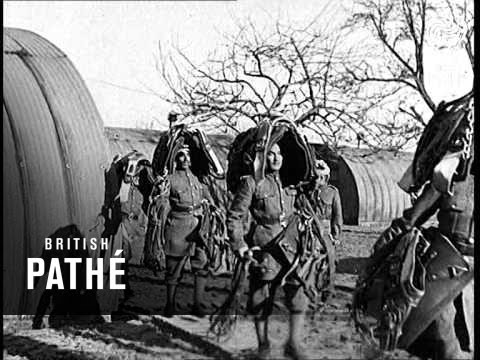
serving in Waziristan with 4th Field Company. In 1940, he went
to France with Force K6 in France. He was second-in-command (2IC) of No
25 Animal Transport (AT) Company. This force was evacuated to UK
and then returned to India. He later served in the Burma Theatre. He used the
suffix of ‘Rangroot’ after his name highlighting his rise from the
ranks. He was also known as Akbar Khothianwala and Akbar Khaccharwala
due to his service with mule companies of service corps.
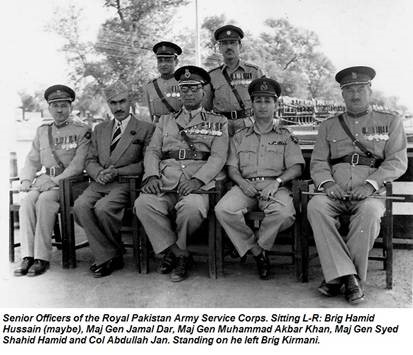
Photograph:
Courtesy of Major General ® Syed Ali Hamid from the album of his father Major
General ® Shahid Hamid.
In
April 1946, C-in-C Field Marshal Claude Auchinleck presided over a selection
board. Several Indian officers were recommended for senior appointments to
prepare them for command when British left. Akbar was recommended by the
selection board to be Army Commander but it was probably to have a Muslim among
the senior ranks of an Indianized army and not for professional
excellence. Akbar was the only senior Muslim officer at Brigadier rank
while the remaining six recommend for promotions and coveted postings were
Hindus. Kodandera Cariappa, Rajindra Sinhji and Nathu Singh were recommended
for army commander posts. S. S. M. Srinagesh was recommended for Chief of
General Staff (CGS), Ajit Anil Rudra as Adjutant General (AG) and Bakhshish
Singh Chimni as Quarter Master General (QMG).
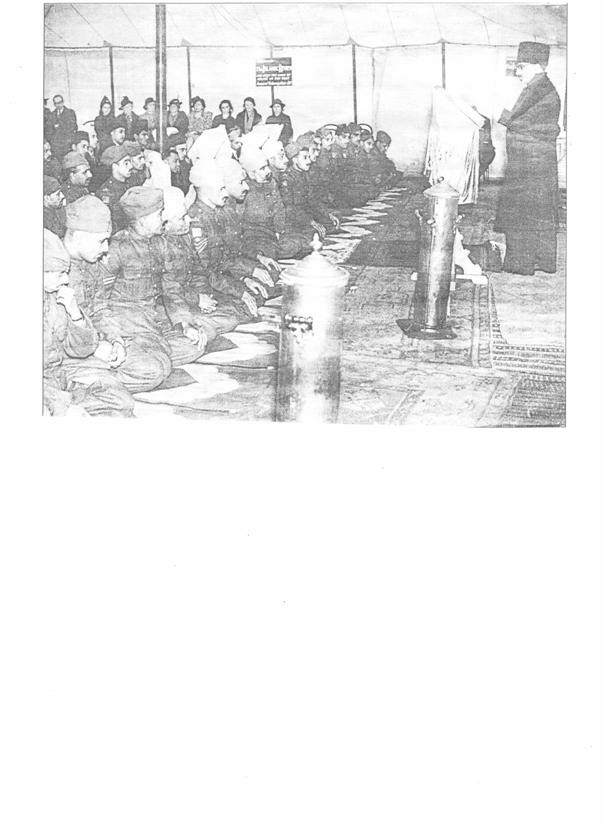
Photograph:
Courtesy of Major General ® Syed Ali Hamid from the album of his father Major
General ® Shahid Hamid.
On
15 August 1947, Akbar was promoted Major General and appointed head of the
formation called Sind and Baluchistan area. It was later re-designated
Sind area and on 1 January 1948, it was re-designated 8th Division.
Karachi sub area was designated 51st Brigade on 1 November 1947 and
Quetta sub area re-designated 52nd Brigade in September 1948.
8th Division headquarter was in Karachi and in May 1948, headquarter
was moved to Quetta. Akbar was in command during all these
transitions. His Indian Army (IA) number was 90 and Pakistan Army (PA)
number was 1 as he was the senior most officer of Pakistan army. He retired on
7 December 1950 handing over command of 8th Division to Major
General Adam Khan. In June 1930, he was appointed Member of the Order of the
British Empire (MBE).
It
is not clear why Akbar first transferred to infantry and later RIASC although
he had good annual reports when he was serving with 5th Probyn’s
Horse. Early in his career, his squadron commander wrote ‘a very capable
young officer …. commands the respect of all the Indian ranks’. His
commanding officer wrote, ‘Above the average in brains and energy …. keen on
his work and good at games …. a promising Cavalry officer’. Other
annual reports noted, ‘One of the most efficient King’s Commissioned Indian
gentlemen I have met’ and ‘an officer of distinct ability who should take a
prominent part in the process of Indianisation of the Indian Army’. Major
General commanding at Peshawar wrote in his Annual Confidential Report
(ACR),’One of the best of our Indians holding King’s Commission’. In
1946, Delhi area commander Major General Freeland wrote about Akbar ‘A level
headed and most staunch officer. He is more of a commander than a Staff
Officer. I have great confidence in him’.
Extra
Regimental Employment (ERE) with Frontier Scouts, Burma Military Police and
RIASC carried additional monetary allowance. Indian officers were not
posted to Frontier Scouts and Burma Military Police that left only RIASC for
any Indian officer looking for extra allowance. The first Indian officer
posted to Frontier Scouts was Lieutenant (later Lt. Colonel) Mohammad Yusuf
Khan of 6/13 Frontier Force Rifles when he was posted to South Waziristan
Scouts in 1937. Some officers who needed extra money transferred to RIASC
(Lieutenant General B. M. Kaul as a junior officer had some financial troubles
and decided to leave 5/6 Rajputana Rifles for RIASC). Akbar was from the
landed aristocracy and financial difficulty was not the likely motive for
him. One likely explanation is service consideration. For first
generation of Indian officers, the dream was to end the career with command of
a battalion at the rank of Lieutenant Colonel. Akbar was one of the first
Indian officers to join a cavalry regiment. Cavalry was a British
preserve and he may have concluded that it was not likely that he would ever
command a cavalry regiment.
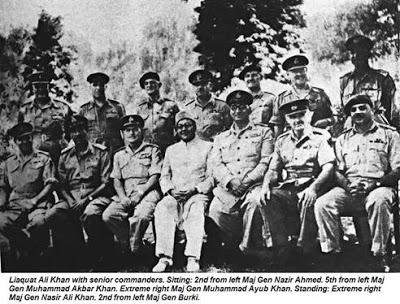
Photograph:
Courtesy of Major General ® Syed Ali Hamid from the album of his father Major
General ® Shahid Hamid.
Akbar
Khan was among the early generation of Indian lads given commission as officers
when officer rank of Indian army was opened to Indians in the aftermath of
First World War. He was from a family that prospered under the
benevolence of Raj. His father received large tracts of agricultural
lands for service and in return family sent its sons to serve in Indian
army.
Acknowledgements: Author thanks
Major General ® Syed Hamid Ali for providing many details as well as
confirmation of many facts from family members of Akbar Khan, Muhammad Afzal;
nephew of Akbar khan, Colonel Zahid Mumtaz for the details of careers of sons
of Fazal Dad and Ghee Bowman; a PhD candidate working on his thesis on RIASC
contingent in France and England for providing details of service comments in
annual confidential reports of Akbar Khan. All errors and omissions are
author’s sole responsibility.
Sources:
1-
Chris
Kempton. Pack Mules from India, Force K-7 and Force-6. Durbar,
Volume 29, No.1, Spring 2012.
2-
Lieutenant
Colonel Gautam Sharma. Nationalization of the Indian Army – 1885-1947.
(New Delhi: Allied Publishers), 1996
3-
Major
General Shaukat Raza. The Pakistan Army 1947-1949 (Lahore:
Wajidalis, 1989)
4-
Major
General Shahid Hamid. Disastrous Twilight (London: Leo Cooper),
1986
5-
Linda
Hopkins. False Self: The Life of Masud Khan, (New York: The Other
Press), 2008
6-
Ashok
Nath. Izzat: Historical Records and Iconography of Indian Cavalry Regiments
1730-1947 (New Delhi: Center for Armed Forces Historical Research), 2009
Hamid
Hussain
October
23, 2016
Defence
Journal, November 2016
Postscript:
Name Confusion – Two Akbars and two Latifs
Hamid Hussain
In the first decade after independence in 1947, several officers of Pakistan army were given rapid promotions. Officers with same names resulted in some confusion. Two Akbars and two Latifs were frequently confused. Two additional officers named Akbar served in different times. One was Khan Muhammad Akbar Khan, commissioned in different times in 1905 from Imperial Cadet Corps (ICC). He was attached to Malwa Bhil Corps. These were limited commissions only for Native Indian Land Forces (NILF). These officers could not command British soldiers and either served with state forces or attached as orderly officers to senior officers. He faded away and nothing much is known about him. Another officer named Akbar Khan was from Punjab regiment. He commanded 105th Independent Brigade in 1965 war. He was Director General (DG) of Inter Services Intelligence (ISI) from 1966-71. In 1971 war, he commanded 12 Division. He rose to the rank of Lieutenant General and served as Karachi Corps Commander. He was superseded in 1976, when General Muhammad Zia ul Haq was appointed Chief of Army Staff (COAS).
Two Akbars
Akbar the senior – PA-1 Muhammad Akbar Khan. His career dealt in detail in previous piece.
Akbar the junior– Akbar Khan (1912-1994) was a Pathan from Charsadda area of Khyber-Pukhtunkwa. He was from the pareech khel clan of Muhammadzai tribe that inhabits the village of Utmanzai. Akbar was from the last batch of Indian officers commissioned from Royal Military College Sandhurst in February 1934. Lieutenant General B.M. Kaul was his course mate at Sandhurst and they became friends during their service. Officers commissioned from Sandhurst were called King Commissioned Indian Officers (KCIOs). Akbar joined 6/13 Frontier Force Rifles (FFRif.). This battalion is now One Frontier Force (FF) Regiment of Pakistan army. He fought Second World War with 14/13 FFRif. (now15FF). This was a new war time battalion raised in April 1941, at Jhansi. In new war time raised battalions, officers and men were posted from different battalions, usually from the same group. Lieutenant Colonel Arthur Felix-Williams, DSO, MC of 1/13 FFRis. was the first Commanding Officer (CO). There were fourteen officers in the battalion and Akbar at the rank of Major was the senior most of the four Indian officers of the battalion. Lieutenants H. H. Khan, Fazl-e-Wahid Khan and A.K. Akram were other Indian officers (Wahid won MC). Battalion was part of 100th Brigade (other battalions of the brigade included 2 Borders and 4/10 Gurkha Rifles) of 20th Division commanded by Major General Douglas Gracey.
14/13 FFRif. was one of the few battalions well trained in jungle warfare and performed admirably. Battalion received three DSOs and 14 MCs. This included two MCs to Viceroy Commissioned Officers (VCOs); Subedar Bhagat Singh and Subedar Habib Khan. Battalion was patrolling about 1000 square mile area and many detachments were not in contact with battalion HQs. Akbar was commanding two companies (B & C) during Irrawaddy crossing and was quite independent in his command due to poor communications with battalion HQs. Battalion’s defenses fought against the onslaught of Japanese and suffered forty six killed and more than 100 wounded. Akbar withdrew his two companies into the lines of 9/14 Punjab Regiment. Akbar fought very well and won his Distinguished Service Order (DSO) in June 1945.
At the time of partition in 1947, Akbar was the only serving Pakistani officer with DSO. The most decorated Muslim officer inherited by Pakistan was now retired Captain Taj Muhammad Khanzada. He was from 5/11 Sikh and had won MC, DSO and bar. The most unusual aspect was that he had won DSO at the rank of Captain. DSO was usually awarded to Major and upward rank. 5/11 Sikh was captured by Japanese and many including Khanzada joined Subhash Chandra Bose’s Indian National army (INA) and was removed from the service. Khanzada’s battalion mate was Harbakhsh Singh who stayed away from INA. In 1965 war, Harbakhsh was Lieutenant General commanding western command of Indian army.
In September 1947, Colonel Akbar was appointed first deputy director of Weapons & Equipment (W&E) directorate. He got involved with Kashmir operations when he was appointed military advisor to Prime Minister. He used code name Tariq during Kashmir operations. He was given the command of 101 Brigade based in Kohat. He moved his brigade from Kohat to Uri sector in Kashmir. In addition to his own brigade, Akbar was also coordinating activities of the tribesmen operating in Kashmir. He commanded 101 Brigade from April 1948 to January 1950. After Kashmir operations, 101 Brigade was moved to Sialkot. In 1950, he attended Joint Services Staff College course in London. He came under suspicion of British authorities when he met some communists in London. This information was passed on to Pakistani C-in-C General Gracey who already knew about Akbar and some other officers and called them ‘Young Turk Party’. In December 1950, he was promoted Major General and appointed CGS.
Several officers involved in Kashmir operations were upset at the ceasefire and this resentment evolved into talk about overthrowing the government. Akbar took advantage of these sentiments and became the leader of the conspiracy. In March 1951, he was arrested along with several other officers. A special tribunal convicted and sentenced him to five years in prison. He was released in 1955. He joined Pakistan Peoples Party and served as Prime Minister Zulfiqar Ali Bhutto’s national security advisor. Akbar was married to Nasim Akbar. Nasim was a social, educated lady from a very affluent family of Lahore. She had leftist ideas and it was alleged that Akbar was under the influence of his wife. Nasim was an ambitious woman and allegedly aspired to become the first lady. Nasim was present in some of the meetings of the conspirators but she was not charged with any offence. In fact, many officers were upset when Akbar brought some civilians including his wife into the loop. The couple divorced in 1959.
Akbar has been a controversial figure in Pakistan army history. Some leftists believe that if Akbar had succeeded in 1951, Pakistan army would have been pushed into the ‘left lane’. Seven years later, Ayub Khan’s coup decisively put army and the country in the ‘right lane’. Akbar was well respected by his juniors for his professionalism, gallant performance in war and ease of interaction with juniors. On the other hand, he had a mercurial temper and at times behaved in a bizarre way. Several incidents are narrated as evidence of this bizarre behavior but two examples will suffice. When he was major general, he used to keep a rope at his office table declaring to visitors that some people need to be hanged with this rope. In February 1972, when he was national security advisor of Prime Minister Bhutto, there was strike by policemen in Peshawar. Akbar phoned commandant of school of artillery at nearby Nowshera asking him to send two 25 pounder artillery guns to sort out policemen. The order was cancelled by army headquarters. There was some violent streak in his personality and different interpretations have been offered. One suggests that in view of family trait of violence, he may have inherited some physical or psychological illness that made him prone to bizarre behavior. Another theory points towards his clan. Pathans are generally viewed as having short tempers and even among Pathans, pareech khels are known for even shorter fuses. The ironies of the times can be judged from the fact that before independence, Akbar portrayed himself as an ardent nationalist and had no love lost for the British. However, after independence, when he was given his dismissal order by Major General Mian Hayauddin (4/12 FFR), he wrote on the paper that he was a King’s commissioned officer and could not be dismissed even by Governor General. Long after independence, Akbar was now claiming to be the subject of the King rather than citizen of Pakistan.
Two Latifs
Latif I – Muhammad Abdul Latif Khan was a graduate of Prince of Wales Royal Military College (PWRMC) at Dehra Dun. He was from the last batch of Indians commissioned from Sandhurst in 1934. He was commissioned in 1/7 Rajput Regiment with army number of IA-262. In November 1945, he was awarded MBE and later, he was also awarded Officer of the Most Excellent Order of the British Empire (OBE). In 1947, Joint Defence Council (JDC) was formed to arrange for division of armed forces between India and Pakistan. An army subcommittee headed by Deputy Chief of General Staff (DCGS) Major General SE Irwin was formed. Latif, then Lieutenant Colonel was appointed secretary of this subcommittee. He opted for Pakistan and was appointed the first director of Military Intelligence in July 1948. He was promoted Brigadier and given the command of 103 Brigade (July 1948 to December 1949). He was promoted Major General and served as commandant of Staff College at Quetta from August 1954 to July 1957. In October 1958, when Lieutenant General Muhammad Musa was appointed C-in-C, Latif and Major General Sher Ali Khan Pataudi (7 Cavalry & 1/1 Punjab) were superseded and retired.
Latif II – Muhammad Abdul Latif Khan (1916-1995) was from the princely state of Bhopal. He attended Indian Military Academy (IMA) Dehra Dun and commissioned in 1936 (IC-105). He joined 5/10 Baluch Regiment (now 12 Baloch). In Second World War, he won MC for gallantry in April 1945. He was the first cadet battalion commander of Pakistan Military Academy (PMA) at Kakul. His brother in law Major S. Bilgrami (two sisters were married to Latif & Bilgrami) was appointed company commander at Kakul at the same time. He commanded 5/10 Baluch from November 1948 to February 1949. He was commanding 5/12 Frontier Force Regiment (FFR) in 1949. This battalion is now 2FF. This battalion was part of 101 Brigade based in Kohat and commanded by Akbar. In February 1950, he was posted GSO-I of 9th Division based in Peshawar, commanded by Major General Nazir Ahmad. In December 1950, he was promoted to the rank of Brigadier and given the command of 52 Brigade based in Quetta. He was arrested in March 1951 along with several other officers for conspiracy to overthrow the civilian government.
Latif’s role in 1951 conspiracy is interesting. In 1948-49, he was in agreement with Akbar about removing the civilian government. He was present in many important meetings of the conspirators. In the final plan conceived in late 1949, he was to play an important role and also to serve as member of military council after the coup. They planned to arrest Governor General in Lahore and Prime Minister in Peshawar during their visits to these two cities. Latif was then commanding 5/12 FFR in Kohat and he was assigned the task to bring two companies of his own battalion along with a squadron of Guides Cavalry to Peshawar to arrest the Prime Minister. He was present at the crucial meeting at Attock rest house on December 04, 1949. Later, he withdrew from the plan. In February 1951, Akbar wrote him a letter to clear misunderstanding between the two. The same month, Akbar came to Karachi to finalize the coup plan and asked Latif to meet him in Karachi. According to Latif, he tried to get out of the situation but when Akbar asked if he was disobeying orders, he relented. Government had some inkling about the activities of many officers involved in the conspiracy and tried to disperse some of the officers. Major General Nazir Ahmad was sent on a course to London. Akbar was asked to tour East Pakistan starting in early March and Latif’s name was added to the military mission planning to visit Iran. When Latif came to Karachi for his onward journey to Iran, he was arrested by military police. He was dismissed from the service and sentenced to prison. He was released in 1955. He led a quite life for the next several decades and died in 1995.
Notes:
1- Lt. Colonel ® Gautam Sharma. Nationalization of the Indian Army (New Delhi: Allied Publishers Limited, 1996)
2- Chris Kempton. Pack Mules from India, Force K-7 and Force K-6. Durbar,Volume 29, No. 1, Spring 2012, pp. 14-25
3- Daniel P. Marston. Phoenix from the Ashes: The Indian Army in the Burma Campaign (Westport, Connecticut: Praeger, 2003)
4- Major General ® Akbar Khan. Raiders in Kashmir (Lahore: Jang Publishers, 1992)
5- Zaheeruddin. Rawalpindi Conspiracy 1951 (Karachi: Oxford University Press, 1995)
6- Major General (R) Shahid Hamid. Disastrous Twilight (London: Leo Cooper, 1986)
7- Major General ® Shaukat Raza. The Pakistan army 1947-1949 (Lahore: Wajidalis, 1989)
8- Memoirs of Lt. General Gul Hassan Khan (Karachi: Oxford University Press, 1993)
Hamid Hussain
May 25, 2012