 Going back twenty years I have been fascinated by “alternative history” science fiction. This is often termed “Uchronia.” If you want to explore this genre, I suggest the Uchronia website.
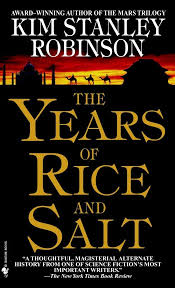
Probably the biggest breakout into “mainstream” science fiction of this sort of work is Kim Stanley Robinson’s The Years of Rice and Salt. Here the “Point of Departure,” where history forks from our timeline, is the Black Death. White Christian Europeans go extinct, with small groups getting absorbed by expanding West Asian and North African Muslims. Eventually, Europe becomes one of the outposts of the Near Eastern Islamic civilization. The world becomes defined by a “Cold War” between a Chinese-led bloc, and an Islamic-led bloc, with the Indian subcontinent, split between the two (though leaning toward the Chinese-led bloc).
The reason I’m bringing this up is that it presents a thought experiment: what if the Hindu Rajputs had managed to prevent the expansion of Turco-Muslim polities into the Indian subcontinent beyond the Sindh and parts of Punjab? If this had happened, the shock of the Mongol sweep south would probably be even more devastating for the Turco-Muslim polities of Persia and Central Asia (India being less of a fallback). One can imagine a scenario playing out where Islam and Muslims in the Indian subcontinent remain a small distinct minority, with higher concentrations in coastal areas impacted by trade. Islam would perhaps play the same role in India as it does in mainland Southeast Asia: a minority religion that serves mostly as an interface with the Indian Ocean trading network, rather than a religion of a dominant ruling class.
A more interesting question is what are the cultural ramifications of this historical fork? A comment was made on this weblog stated that to a great extent it is hard to imagine North Indian culture without Muslim (so Turkic and Persian) influence. One may disagree with this comment, but it is not a crazy assertion.
But the question of the nature of the alternative history is interesting. Because it is a way one can get at an answer as to what a reconstructed Hindu identity which genuinely strips away Islamicate accretions would look like. Something some people do aspire to…

