
In the post below a question comes up: what about the Indo-Aryans?.
First, before we move on, I want to stipulate that I am going to assume that the Indo-Aryans were intrusive around ~1500 BC. I believe this is true, though I understand not everyone does. Stipulating that this is true, was the intrusion brutal? Looking into the admixture coefficients it seems plausible that the Indo-Aryan ancestry genome-wide in the Upper and Middle Gangetic plains, the heart of Aryavarta, is in the range of 10-20%. For various reasons, I lean toward a higher estimate. This is lower than the proportion of “steppe” ancestry in Northern Europe, and in the range in parts of Southern Europe (though still lower than much of Southern Europe).
The contrast with Turco-Muslims could not be more striking. The distinct part of Turco-Muslim ancestry is East Asian. Some of this can be found in groups like Pashtuns, and in a few rare cases in Indo-Muslims, but it is entirely absent in the non-Muslim population. The exceptions are totally comprehensible; Indians from the Himalayan and Northeastern fringes. If the Muslims did rape Hindu women they killed them all. This is not implausible on the face of it, but in the context of human civilization, it seems unlikely. Rather, the situation more like the rape of the Sabine women is the norm (I believe most of the sexual exploitation of Hindu Indian women eventually resulted in Indian Muslims).
To be frank: I believe that the Indo-Aryan intrusion into what became Aryavarta resulted in more death proportionally than the Turco-Muslim intrusion. There are several reasons why this might be.
Like the migration of the Rohirrim into part of the fallen kingdom of Arnor, I suspect that the Indo-Aryans arrived in a landscape where the machinery of the Indus Valley Civilization (IVC) had already fallen apart due to the early Bronze Age climatic shock (which impacted West Asia as well). What the Indo-Aryans encountered probably resembled the petty kings of Dark Age Greece after the fall of the citadel culture.
In short, one reason that the Indo-Aryan impact was so strong is that Indian agricultural society was much thinner and less dense in the second millennium BC than in the second millennium AD. The threads which bound societies together were much more robust after thousands of years of institutional development, and economic advancement and technological innovation.
Another reason is that elite ideologies and outlooks had changed. It is entirely plausible that the Indo-Aryans and the native elites faced each other in a game of animal competition and elimination. The strategy of later barbarians, whether it be Huns or Khitai, was to extract tribute from agricultural societies which produced much more aggregate wealth and specialized luxury goods. This may not be a situation that occurred in much of Eurasia in the second millennium BC, as conquest elites perceived themselves to be primary producers rather than extractors of tax. As such, no accommodation may have been possible in many more cases than would be true later.
Peter Turchin has argued that violence probably peaks in the “pre-state polity” phase. The emergence of complex institutions and world religions in the first millennium BC was part of a process of smoothing over the autocratic brutality of the new regimes. The reality is that despite the ideological differences, the Turco-Muslims who arrived in India were primarily motivated by material considerations of extraction.
So what’s going on with the different views of the Turco-Muslims vs. the Indo-Aryans? Clearly time matters. The Turco-Muslim hegemony lasted into the early modern period. It is raw. In contrast, the Indo-Aryan fusion with the Indian substrate occurred before history. The keyword here is fusion. Despite what I believe are the violent antecedents of the pairing of fair Arjuna and dark Draupadi, out of the union was born the culture and people of North India. In contrast, the Turco-Muslims introduced a religion and culture which was incompletely digested and synthesized.
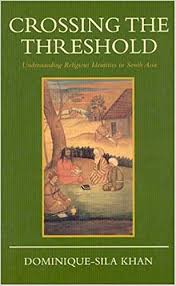 If the Turoc-Muslims and their Indo-Islamic descendants severed connection with West Asia and broader institutions such as the Naqshbandi tariqa, then a synthesis might have emerged. As it is, the synthesis was frozen and incomplete. The Muslim people of the Indian subcontinent are ancestrally no different than the non-Muslim people, and speak similar languages and eat similar food, but their identity is deeply different and distinct. In some ways, they exist as an inversion or negation of the native religious traditions, with their tacit polytheism and explicit idolatry (of course there are exceptions). Though some interaction has long occurred between Islam and Indian darshanas, it is not reciprocal and explicit. The metaphysical presuppositions diverge.
So there you go. At the end of the day problem is rather straightforward and plain. Like oil and water Indian Islam and non-Islam remain separate and wary, each unable to absorb or marginalize the other. If Muslims were a few percents of the population some level of synthesis would naturally occur. Conversely, if Muslims were more than 90 percent of the population, likely more liberal and progressive Muslims be curious about mining and rediscovering their Indian religious traditions and history. But as it is, we’re in an unstable equilibrium in between.