23rd March 2003. Twenty three years ago today, a Pakistani Operative Zia Mustafa of the Laskhar-e-Toiba walks into the village of Nadimarg, Jammu and Kashmir. Wearing fake uniforms, Zia and his accomplices wake up the the village, and then proceed to murder 11 men, 11 women and a boy after lining them up. Walking away, the terrorists hear a baby crying, and order to silence him. The baby becomes murder victim #24. Link
23 March 2026, I read a comment on a BP thread discussing the West Asia war and Iran’s defiance, and the question that is the the topic of this post is asked.
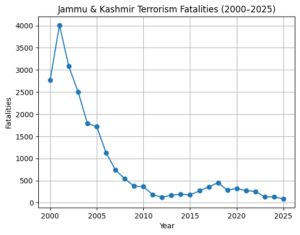
I feel obligated to answer it. The statistics of so-called ‘non-state actor’ victims inflicted by Pakistani groups on Indian soil, since the 1990s, into the 2000s and beyond are stark. For an Indian who has grown up to adulthood in these years, actually lived through multiple decades where hundreds if not thousands of Indians dying as a result of the Lashkars and Jaish of the world was just part and parcel of life – all given succor by the Pakistani military and state. The datasheet linked here shows the tragedy that has been slowly but surely being deterred – and this is only starting with the year 2000. According to SATP, more than 25000 deaths occurred in J&K between 1988 and 2000.
The change in the public response of the Indian government, starting with the surgical strikes in 2016, and then escalated with the Balakot Bombing raids, and the direct and sharp decrease in the number of terrorism incidents is unmistakable. Operation Sindoor, the 4 day skirmish that took place in May 2025 on the heels of unarmed tourists being murdered in cold blood – is the exclamation mark in a simple statement that demonstrates Indian resilience and response when challenged with terrorism. No more will such attacks go unanswered. And the ultimate sponsors of such evil – the Pakistan Military itself – will have to bear direct consequences delivered. Via Brahmos-Mail.
Nobody needs a degree in statistics, to spot the co-relation in the timeline – India starts executing public retaliation in the aftermath of terror attacks, the frequency of such attacks drops sharply.
As far as the spreadsheets accounting and the nuts and bolts of what targets were hit during Op Sindoor that would count as “actual accomplishments” – there is ample evidence available for any objective observer to get themselves informed. From satellite imagery of multiple PAF bases and runways ‘double-tapped’ into shutting down for months, to ‘hardened’ aircraft shelters being demolished and rebuilt months after the fact.
But what Op Sindoor accomplished goes beyond merely a largely one-sided ledger of inflicting losses to military bases and flagship bases of terrorist organizations – Op Sindoor was a demonstration of commitment by the Indian state – a resolve that no longer will the nuclear umbrella allow the Pakistani Military to continue waging its ‘jihad of a thousand cuts’ without the consequences of a military conflict. One that will inflict costs not just on the bankrupt Pakistani state, with FATF gray lists hurting its citizens. Send terrorists to murder Indians, and bombs will drop on Pakistani Military bases in response. Op Sindoor is a promise of resolve. The Indian government will respond militarily if you threaten the security of its citizens.
Post-script: Apart from making an unambiguous demonstration of Indian deterrence when facing up against terrorism emanating from Pakistan, arguably the greatest indicator of the success of Op Sindoor, is the Pakistani Military’s attempt at copy-pasting their own version on Pakistan’s Eastern Border. Unfortunately, the results for the second sibling that was birthed from ‘Cracking India’ in 1947, have been a lot more….mixed.