Open Thread – Brutal clampdown, protesters shot in Kashmir (Pak administered)

The ‘K’ word serves as a lightning rod in any discussions involving Indians and Pakistanis. And the BP space is no different. That there are diametrically opposing views, fiercely dug in, is an understatement.

Over the past few days, the portion of J&K that came under Pakistani suzerainty after the ‘tribal’ invasion of 1948, has seen massive political protests that have led to violence and deaths of civilians. This isn’t the first time for such incidents in what Pakistani refers to as “Azaad” (free) Kashmir. The old Pakistani playbook of deploying military force, banning political organizations, and media blackout has been deployed once again. This time however, ‘feels different’ somehow. It has become increasingly difficult for totalitarian states to execute media clampdowns in the social media age, and videos and information are steadily streaming out of Rawalkot, Muzaffarabad and elsewhere.

I would hope that this open thread stays away from the always contentious circular ‘debates’ on whether India/Pakistan are the ‘rightful owners’ of Kashmir, and focuses on the specifics of the ongoing protests instead.

Why is that over the last decade or so, such repeated outbreaks of protests show up repeatedly, often swiftly followed with brutal state clampdowns. I think its reasonably fair to say that a strong majority of the residents of Pak-administered Kashmir were and continue to be, willing subjects of Pakistan. What then, is triggering such unrest, repeatedly?

On Bigotry

“Unfortunately, my experiences dealing with Indians (not all Indians obviously) have shown me…”

“I find a large subset of Hindus extremely toxic and hateful. I’m glad I don’t have to share a country with them. …”

“The “Saffroniate” cannot now claim innocence. The fact is that they get off on loss of life in Pakistan. They have real psychological problems.”

“There seems to be a genuine bloodlust for war and the decimation of Pakistan among Indian nationalists.”

Replace the target ‘Hindu’ with black, or even muslim, and what would happen if such statements are repeatedly published?

Pakistani claims of “false flag” has been a consistent pattern going back to the Mumbai attacks of 26/11/2008, where the Pakistani government for years refused to accept that Ajmal Kasab and his co-murderers were Pakistani.

It is deeply offensive for Brown Pundits to platform such preposterous assertions regarding the brutal massacre of Hindu tourists in Pahalgam. It has barely been a year since the tragedy occurred.

Platforming such propaganda is an overt choice. This is not free speech. This is spitting in the face of trauma.

On “Press Freedom” and Prejudice.

This is what Norway’s leading newspaper chose for its coverage of the Indian Prime Minister’s visit to Norway.

https://x.com/_Tracer_Bullet_/status/2056737017460089173

While the usual suspects on BP chose to focus on an aspiring influencer’s stunts and dramatic heckling, I am not surprised that such blatant bigotry in the ‘mainstream’ newspaper of the supposedly Number one ranked Press has not been discussed on BP. Hilariously, a non-trivial subset of the Indian media and political opposition actually supported a rookie aspiring journalist’s publicity stunt.

Its a time-tested pattern. Rage-baiting and attacking Hindus and India earns notoriety, while the pushback and negative consequences if you push the envelope too far into nakedly racist territory, is minimal if there at all.

For all the cacophony and chaos that the Indian media landscape consistently generates, it has yet to demonstrate ability to even capitalize on such low-hanging fruit. A more capable media ecosystem wouldn’t allow such nonsense unpunished.

This is the overton window that needs to be shifted – the coverage ‘rules’ on India allow for a lot more mainstream ‘phobia’ and assault. And we see that on BP as well, the Pakistani tribal ‘patriot’ squad repeatedly find themselves facing pushback which to them is unexpected. After all, why shouldn’t they be allowed free rein in rage-baiting and plying bigoted stereotypes.

Does the average muslim ‘dislike hindus’?

Admin Note: This is a Precedent Post.

“You seem to be underestimating how much the average Muslim dislikes Hindus (and vice versa). This is a sad reality.”

This comment on a thread conversation – yet again discussing partition on BP, jumped out at me. And I think it deserves to be dissected.

I for one, strongly disagree with the projection of personal animus, extrapolated all the way into the ‘average muslim’. And vice versa. I’m going to assume that Kabir is ‘only’ deigning to speak on behalf of the ‘average muslim’ of the subcontinent, and not beyond. But even then, I think this assertion is utterly inaccurate.

I do not believe that ‘disliking Hindus’ is baked into the character or mindset of the muslims of the subcontinent, whether in India, or beyond it, into Bangladesh of Pakistan. Now, I am aware of the ‘kufr’ attack lines that those suffering from Islamophobia often deploy and may even believe. But I am confident that this is the usual weaponization of the fringe by those with ignorant, or intentionally jaundiced agendas.

The Problem with Monolithic Thinking

To say that “Muslims dislike Hindus” is to treat over 500 million people across multiple countries as if they share a single mindset. This kind of thinking ignores differences in geography, class, education, political views, and personal experiences.

Communities are not monoliths. A Muslim family in Kerala may have vastly different social interactions and attitudes compared to one in Lahore or Dhaka. The same is true for Hindus across regions. Reducing such diversity to a single emotional stance erases individual agency and lived reality.

Historical Context Matters—but So Does Interpretation

It’s true that the subcontinent has witnessed periods of conflict, most notably during the Partition of 1947. That traumatic event left deep scars and continues to influence inter-community perceptions. However, it is a mistake to project historical violence onto present-day relationships without acknowledging the decades of peaceful coexistence that have followed.

In fact, millions of Hindus and Muslims continue to live side by side, working together, forming friendships, and even intermarrying. Everyday life in much of the subcontinent is not defined by hostility but by routine interaction.

The Role of Politics and Media

Modern tensions, where they exist, are often amplified by political rhetoric or media framing. Narratives that emphasize division can serve specific agendas, making it appear as though distrust is more widespread than it actually is.

It’s important to distinguish between politically motivated discourse and the attitudes of ordinary people. The loudest voices are not always the most representative.

Lived Reality: Coexistence Over Conflict

Walk through neighborhoods in cities like Mumbai, Delhi, Karachi, or Dhaka, and you’ll find markets, schools, and workplaces where Hindus and Muslims interact daily. Festivals are sometimes shared, businesses are jointly run, and friendships cross religious lines.

These everyday examples rarely make headlines, but they represent the true fabric of society.

Why Generalizations Are Harmful

Broad claims about mutual dislike do more than misrepresent reality—they can actively contribute to division. When people are told repeatedly that another group harbors negative feelings toward them, it can create suspicion where none existed.

Challenging such narratives is not about denying that tensions exist, but about refusing to let those tensions define entire populations.

A More Nuanced Understanding

A more accurate perspective acknowledges that:

Historical conflicts exist, but so does long-term coexistence
Political narratives can distort social realities
Individual experiences vary widely
Cultural interdependence is a defining feature of the region

If we are to understand the subcontinent honestly, we must move beyond simplistic narratives and recognize the complexity—and humanity—of its people. Resorting to ignorant tropes about ‘muslims dislike hindus and vice versa’ not only should be avoided, but deserves to be countered forcefully.

On Censorship

We need to have a honest discussion about censorship on BP. We have a contributing author who demands and exercises the right to “ban” other contributing authors from commenting on ‘his’ threads. This, while continuing to spout distinctly one-eyed perspectives and cherry-picked regurgitated content.

Do we want BP to be a space with ‘dueling’ threads, or actual discourse? If Indians and Pakistanis can’t even manage a written conversation on a blog post via comments, without arbitrary petty ‘bans’ justified in the name of “I simply don’t like you” – this is the sort of thing that ends up having a disproportionate impact on the nature of what this space is.

“What did Op Sindoor actually accomplish”?

23rd March 2003. Twenty three years ago today, a Pakistani Operative Zia Mustafa of the Laskhar-e-Toiba walks into the village of Nadimarg, Jammu and Kashmir. Wearing fake uniforms, Zia and his accomplices wake up the the village, and then proceed to murder 11 men, 11 women and a boy after lining them up. Walking away, the terrorists hear a baby crying, and order to silence him. The baby becomes murder victim #24. Link

23 March 2026, I read a comment on a BP thread discussing the West Asia war and Iran’s defiance, and the question that is the the topic of this post is asked.

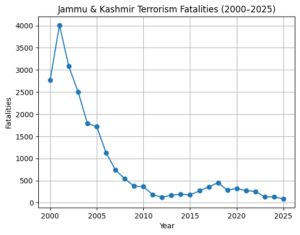
I feel obligated to answer it. The statistics of so-called ‘non-state actor’ victims inflicted by Pakistani groups on Indian soil, since the 1990s, into the 2000s and beyond are stark. For an Indian who has grown up to adulthood in these years, actually lived through multiple decades where hundreds if not thousands of Indians dying as a result of the Lashkars and Jaish of the world was just part and parcel of life – all given succor by the Pakistani military and state. The datasheet linked here shows the tragedy that has been slowly but surely being deterred – and this is only starting with the year 2000. According to SATP, more than 25000 deaths occurred in J&K between 1988 and 2000.

The change in the public response of the Indian government, starting with the surgical strikes in 2016, and then escalated with the Balakot Bombing raids, and the direct and sharp decrease in the number of terrorism incidents is unmistakable. Operation Sindoor, the 4 day skirmish that took place in May 2025 on the heels of unarmed tourists being murdered in cold blood – is the exclamation mark in a simple statement that demonstrates Indian resilience and response when challenged with terrorism. No more will such attacks go unanswered. And the ultimate sponsors of such evil – the Pakistan Military itself – will have to bear direct consequences delivered. Via Brahmos-Mail.

Nobody needs a degree in statistics, to spot the co-relation in the timeline – India starts executing public retaliation in the aftermath of terror attacks, the frequency of such attacks drops sharply.

As far as the spreadsheets accounting and the nuts and bolts of what targets were hit during Op Sindoor that would count as “actual accomplishments” – there is ample evidence available for any objective observer to get themselves informed. From satellite imagery of multiple PAF bases and runways ‘double-tapped’ into shutting down for months, to ‘hardened’ aircraft shelters being demolished and rebuilt months after the fact.

But what Op Sindoor accomplished goes beyond merely a largely one-sided ledger of inflicting losses to military bases and flagship bases of terrorist organizations – Op Sindoor was a demonstration of commitment by the Indian state – a resolve that no longer will the nuclear umbrella allow the Pakistani Military to continue waging its ‘jihad of a thousand cuts’ without the consequences of a military conflict. One that will inflict costs not just on the bankrupt Pakistani state, with FATF gray lists hurting its citizens. Send terrorists to murder Indians, and bombs will drop on Pakistani Military bases in response. Op Sindoor is a promise of resolve. The Indian government will respond militarily if you threaten the security of its citizens.

Post-script: Apart from making an unambiguous demonstration of Indian deterrence when facing up against terrorism emanating from Pakistan, arguably the greatest indicator of the success of Op Sindoor, is the Pakistani Military’s attempt at copy-pasting their own version on Pakistan’s Eastern Border. Unfortunately, the results for the second sibling that was birthed from ‘Cracking India’ in 1947, have been a lot more….mixed.

Archeological Society of India to work with Indonesia on Prambanan Temple Complex Restoration

A brief respite from war, death and bombings. Some encouraging news from South East Asia.

I have had the privilege to visit the Angkor Wat Complex in Siem Reap, Cambodia. The ASI has done some decent work there in restoring some of the buildings within. The Prambanan temple complex dates back to the 10th century and after Angkor, its the largest one in SE Asia. I would love to visit someday.

I did visit Bali briefly a couple of decades ago, which was a wonderful rabbithole to fall down into, in terms of Indic influence and syncretic culture in SE Asia. Balinese Hinduism is a fascinating fusion of what we Indians think of as ‘core’ Hinduism, along with local animist influences. What superficially can feel slightly alien and almost jarring – in terms of pooja thalis adorned with whole skinned chickens, is in fact, incredibly typical of how the Dharmic faith has spread all over the Indian sub-continent and beyond, absorbing local totems and figures into its mythology as manifestations and ‘Avtaars’ of its primary dieties.

Has anybody on BP or the commentariat visited Yogyakarta or any other Indonesian sites with Buddhist/Hindu influence?

The ‘Hindutva’ attack protocol

A tweet reposted by Azad Essa, attacking Priyanka Chopra as “Hindutva-fascist”, asserting that she is somehow ‘uncomfortable’ standing next to Javier Bardem while he delivered remarks in support of Palestine. This, in spite of the fact that Priyanka Chopra has publicly supported Palestine – signing letters demanding ceasefires, tweeting on Rafah and so on.

Azad Essa, is an author that was recently spotlighted on Brown Pundits itself, via his propaganda work on comparing Palestine to the Kashmir valley. This is a particular echo chamber driven by a very explicit agenda, that seeks to weaponize and co-opt the language of the left, in pursuit of demonizing India and Hindus. Facts do not matter, its Priyanka’s ethnicity that matters, and the fact that she dares to be publicly proud of her heritage, her religion and her nationality.

This is but an anecdotal example, but one that quite neatly spotlights the suspect credibility of aspiring ‘academics’ like Mr Essa. The question is how does the ecosystem of academia defend itself against such explicit bad actors that misuse concepts of ‘academic freedom’ and ‘journalism’ to peddle insidious agendas.

Open Thread – “Open War” breaks out between Pakistan and Afghanistan

This is a quote from Pakistan’s ‘defence minister’ from a couple of hours ago. There is a shooting war on the Durand line, and the PAF has bombed Kabul and Kandahar, including the airport, Taliban ministry buildings and other non-military targets.

This round of AfPak hostilities kicked off with a ‘surgical airstrike’ by Pakistan into Afghanistan that resulted in multiple civilian deaths. The Taliban retaliated by attacking Pakistani border outposts on the Durand Line, and claim to have captured more than a dozen of them, with Pakistani POWs and KIA. In response, the PAF has now bombed Kabul and Kandahar.

The Taliban, the erstwhile creation of the ISI, is now at war with Pakistan. Where does this go from here?

Pakistan, India – culture, music, movies

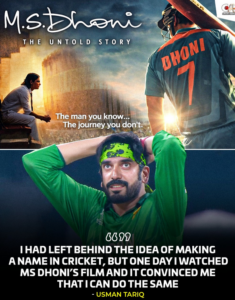
Usman Tariq Image from CricTracker

The last few days have really been dominated by a cacophony of ….tu, tu, mai, mai in the BP comment threads with competitive “patriotism” flying thick and fast. Amidst all the noise generated by …certain hostility focused agendas, its easy to lose sight of the fact that for all the problems and challenges faced by the 2 nation-states, the people that inhabit the subcontinent, still continue to have a bunch of things in common.

So allow me this …palette cleanser of a post. The ICC T20 Cricket World Cup is in progress, and the teams of both India and Pakistan have managed to qualify for the “Super 8” stage. Usman Tariq, is a rising star who has recently joined the Pakistani team, as a bowler who serves up ‘mystery spin’ from a unique bowling action, enabled slightly in part due to an anatomically exceptional elbow which has elicited some allegations of chucking (throwing). He has undergone test and has been cleared of this allegations already.

What I found notable about Usman, apart from his repertoire of unique googlies and arm angles, is him sharing the fact that watching an Indian movie inspired him to pursue his dream – a career in cricket. M.S. Dhoni a former India captain, had a biopic made about him a few years ago, which was a massive hit in India and beyond. Usman, as we know, is hardly an exception when it comes to Pakistanis consuming Indian content including movies. Pakistanis, in some ways, are arguably even more ardent consumers and fans of ‘Bollywood’ than Indians. As an Indian listener to Pakistani podcasts, you can’t help but notice how movie and song quotes from Indian films and pop culture, are seamlessly used by Pakistanis as metaphors to describe situations. Even more so than is common for Indians to do so.

On the flip side, Indians are enthusiastic consumers of Pakistani music – the popularity and opinions on the ‘quality’ of Pakistani Coke Studio abound, so does a sizeable number of fans for Pakistani soap operas.

The point is, as much as the interactions of India and Pakistan is dominated by the disproportionate shadow cast by the history of conflict between the two states, and especially the untenable history of PakMil sponsored multi-decade history of terrorism and “non-state actor” violence, we still see a common culture interwoven through the day-to-day existence of the …awaam

Brown Pundits