
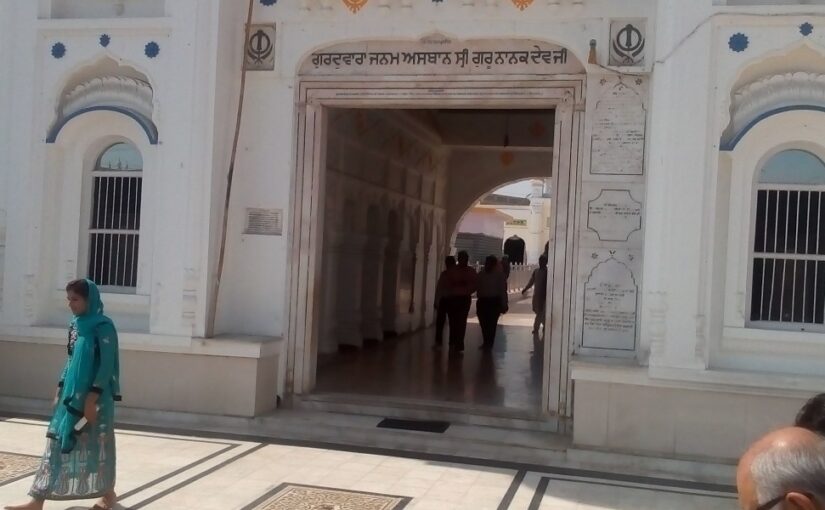
On the occasion of Vaisakhi, I want to share this travelogue of my trip to Nankana Sahab a few years ago. This is completely an apolitical post and should be treated as such. Going forward, I have decided to restrict my contributions to BP to non-political subjects such as Hindustani Music. I would appreciate if the Indian nationalists also do not write about the internal affairs of Pakistan (This is only a request).
According to Wikipedia, Vaisakhi was historically North India’s most important annual market. Wiki notes: “Although Vaisakhi began as a grain harvest festival for Hindus and its observance precedes the creation of Sikhism , it gained historical association with the Sikhs following the inauguration of the Khalsa”.
Recently, efforts have been made to revive Vaisakhi in Pakistan. An event was held in Lahore this past weekend hosted by THAAP (The Trust for History, Art and Architecture in Pakistan) in which I was invited to perform bhajans and shabads. The event was reported on in DAWN:
World Heritage Day marked with Vaisakhi celebrations
The travelogue is below
I had the opportunity to take a day trip to Nankana Sahab recently (about 50 miles west of Lahore). My mother had some work in the District Hospital there. Since my students had just written their assignments on Guru Nanak (along with Meerabai, Tulsidas and Surdas), my parents thought I might want to come along and see the city. It was also a chance to see some of Pakistan outside the major metropolitan centers of Lahore, Karachi and Islamabad.
Guru Nanak was born in Nankana Sahab in 1469 (the city was then known as Rai Bhoi di Talwandi). Since he was born in what is presently Pakistani territory, one can argue that he was a historical Pakistani. Of course, technically no one was Pakistani before August 1947- all four of my grandparents were born in British India, no matter which side of Wagah they happened to be on. In any case, Guru Nanak is a major figure on both sides of Punjab and it is my opinion that Punjabi Muslims should be more comfortable claiming him as part of their heritage as well (they aren’t but that is a separate debate I’m not going into here).
Guru Nanak famously preached the oneness of God, whether called “Allah” “Ram” or “Waheguru”. He was also firmly against the Hindu caste system (despite being born in the relatively high Khatri caste). He believed that all human beings can have direct access to God without rituals or priests (Wikipedia). One of his famous sayings was “There is no Hindu and there is no Muslim”. His teachings can be divided into 3 main categories: “Naam Japna” (meditating on God’s name), “Kirat Karo” (earning or making a living honestly) and “Vand Chakko” (sharing with others and helping those who are in need).
Nankana Sahab is a fairly typical Pakistani small city (it only has one bazaar) except that it is the center of Sikh spiritual tourism. The city has seven Gurudwaras. Most Pakistani Sikhs also live there. According to Wikipedia, there are 50,000 Sikhs in Pakistan out of a population of 200 million. As a side note, the Sikhs probably suffered the worst during Partition. Not only did they lose their homes and livelihoods (as did Hindus and Muslims on the “wrong” side of the Radcliffe Line) but they lost most of their holy places on the “wrong” side of the border—Nankana Sahab, where Guru Nanak was born, and Gurudwara Darbar Sahib Kartarpur (120 kilometers from Lahore) where he is said to be buried. Interestingly, since Kartarpur is only 3 kilometers from the India-Pakistan border, in the year 2000, the Pakistani government agreed to allow Sikh pilgrims to visit the shrine visa-free by constructing a bridge from the border to the shrine. In May 2017, an Indian parliamentary committee nixed this scheme, given the poor state of India-Pakistan relations. Instead the Indian government will install 4 binoculars for the viewing of the gurudwara (Wikipedia). A sad state of affairs all around. (EDIT: The visa-free corridor was eventually constructed but I believe it was closed down after “Operation Sindoor”)
I had the opportunity to visit Gurudwara Janam Ashtan in Nankana Sahab, which was a profoundly spiritual experience. I even bought a Sikh kara as a souvenir.
Since I am a musician, it is important to note that shabads (the hymns contained in the Guru Granth Sahab) are all composed in specific Hindustani ragas.
I will conclude this post with some links to my favorite shabads. “Sadho Man Ka Maan Tyago” and “Awwal Allah Noor Upaya”. It is also important to note that the latter shabad is attributed to Bhagat Kabir–as is evidenced by the verse “Kahata Kabir” (Kabir says)– much of Bhagat Kabir’s work is included in the Guru Granth Sahab,

Excellent post, thank you.
Absurd request; the Saffroniate must comment on Pakistan. Why should any country be spared scrutiny?
Also that somehow, an unelected dictator like Asim Munir, deserves any sort of respect or reverence. They are meant to be Servants of the Nation, not its Masters.
“they lost most of their holy places on the “wrong” side of the border ”
This is nonsense, and has been debunked many times on BP but Kabir keeps saying this.