
Breakfast in Delhi
There are a lot of things we would say. We are in Delhi, over a good South Indian breakfast, and the first thing we notice is our own silence. We have not been very active on Brown Pundits of late. However we do not have the option of a break or a hiatus; since we have to keep the blog foundationally alive.
We had not been in Asia since January. Six months, and a long six months at that. Ordinarily we would have broken it up with a visit in April, but the gap has made us appreciate India all the more.
One thing we realise in life is that everything is continuity: showing up, and how much work you put into a thing.
The Post-Factional Turn
What strikes us on our return is that Brown Pundits has entered its post-factional era. The two de facto heads of the various factions have bowed out, and the big personalities who used to occupy the space have now vacated it. In a way that is quite helpful, because it no longer allows for the intense communalisation of the space.
As the Gender thread shows, people are now disagreeing within their own factions, which before would never happen. The Brown Pundits dialectic is shifting under our feet. The heat has gone out of the tribes, and what remains is argument.
From Indus to Exile
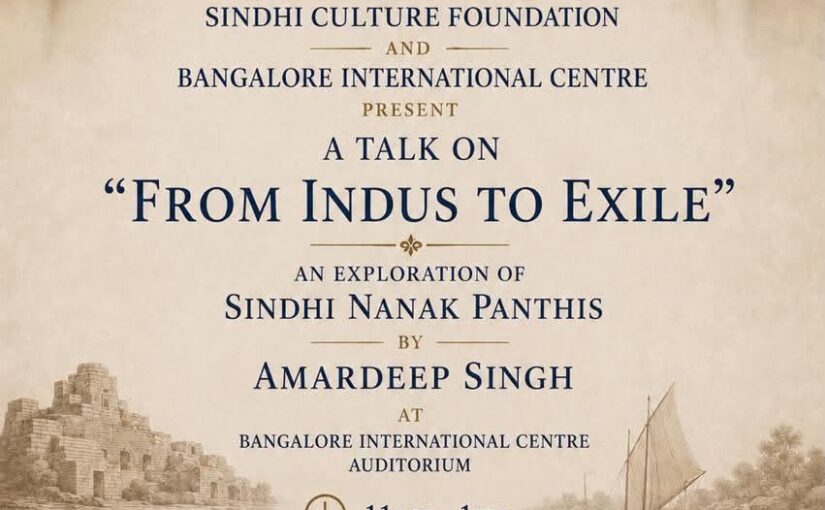
It is in that spirit that a talk in Bangalore caught our eye: From Indus to Exile, Amardeep Singh’s exploration of the Sindhi Nanak Panthis, hosted by the Sindhi Culture Foundation and the Bangalore International Centre on 8 August, complete with a ‘Taste of Sindh’ spread before the lecture.
Singh has spent the past decade documenting the Sikh and Nanakpanthi heritage stranded on the far side of the Radcliffe Line, and the Sindhi Nanak Panthis are among the subcontinent’s great in-between peoples: Hindus of Sindh who took Guru Nanak as their own, who carried the Indus in their veins and Partition on their backs, and who never fit neatly into anybody’s faction. That is precisely why they interest us now.
Since we are in India, we want to use the time to explore the cultural basis of Indian civilisation, which is uniquely so rich and so effusive (the only comparable seems to be China).
Geography & Politics
India, of course, is the hegemon. It touches almost every South Asian neighbour, Afghanistan excepted, and it borders each of them in a way that the other South Asian states do not border one another.
That, too, is fascinating. Bangladesh is hemmed in by India on three sides. Nepal is sandwiched between China and India. Pakistan sits between Iran, Afghanistan, China and India.
Even Sri Lanka, an island, finds that its closest neighbour is India. In the Indian Subcontinent, the geography is the politics; every road runs through Delhi whether one likes it or not.
Kept Its Soul
We are here in part for Bharat Tex, the textiles expo. The striking thing is not scale so much as specialisation: entire pavilions for products most countries would treat as a niche.
India has so much to offer that when it finally clicks together it will not rise slowly. It will explode, almost in the China way. But there is a difference. Hindu civilisation allows for a peculiar pluralism: it does not require homogenisation in order to win.
Hinduism, Sikhism, Jainism, Islam, Buddhism, Christianity and the rest jostle within the same frame, and it is quite an achievement, in its own way, that India has been able to make that happen. That is what we mean when we say that, unlike China, India has kept its soul.
After the Factions
Which brings us back to the blog. In the factional era we were essentially writing on what the commentariat was talking about, and it allowed us to build an Indo-Pak niche. That niche is rapidly waning, even as interesting news-flow pieces keep arriving. We now have to discover our own newsletter and our own writing, allowing for a broader basis of discussion, and to grow with the commentariat rather than against it.
Conferences, we find, are a great way to rapidly extend knowledge, and Sapan News very kindly wrote about the pieces we had published in this context: our meditations on India and Pakistan as imperial states. Anyway, let us see how we get on. Brown Pundits began as an argument about India and Pakistan. Perhaps its next phase begins with everything that survived it.

Fascinating. I was unaware of Sindhi Nanak Panthis.
How is Bharat Tex? Indian textile tradition has always interested me especially the lesser known weaves that are gradually making a comeback.
Yes the expo is fantastic – it’s fairly obvious the entire Indian Subcontinent has to “pour” into India one way or another..
Would love to hear more on the expo. Participants from the world over? Any interesting textile innovations that caught your eye?
Focus seems to be more on sustainable and recyclable textiles given that the over consumption of clothing has lead to dumping indiscriminately in landfills.