
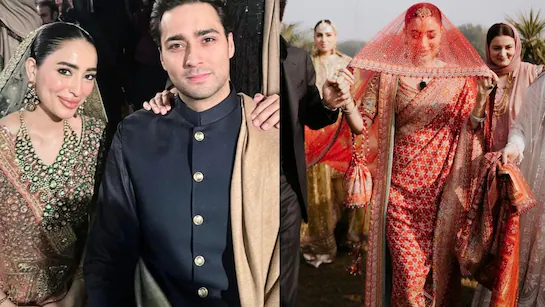
There is a tweet circulating of Nawaz Sharif’s grandson’s wedding. It is meant to be ordinary; the bride wore Indian designers, Sabyasachi and Tarun Tahiliani. Instead, it is revealing, the extent of Indic soft power. The colours are unmistakably Indian: red, gold, marigold. The symmetry is ritualistic rather than theological. The staging is ceremonial, not Quranic. The aesthetics are not Arab, Persian, or Turkic. They are Hindu-Indian; not in belief, but in form.
This is not a criticism. It is an observation. For seventy-five years, Pakistan has insisted that it is not India. That it broke away not only as a state but as a civilisation. That Islam did not merely replace Hinduism but erased it. Yet when Pakistan’s most powerful family marries its children, what appears is not a purified Islamic aesthetic but a recognisably Indic one.
Civilisation does not obey ideology.
Islam in Jambudvīpa did not enter an empty space. It arrived in a world already shaped by colour, hierarchy, procession, music, and spectacle. It adapted to that world. It did not abolish ceremony; it repurposed it. Nikah replaced vivah, but the social grammar remained. Weddings stayed long, public, ornate, and familial. They did not become austere. They became Muslim in name and Indian in structure.
The Sharifs are not an anomaly. They are representative. From elite homes in Lahore to village courtyards across Punjab, Muslim weddings in Pakistan follow an aesthetic logic rooted in the subcontinent rather than in Mecca. Dress, jewellery, music, and the choreography of family life all follow Indic patterns. This is not rebellion or syncretism. It is continuity through habit.
Calling this “South Asian” instead of “Indian” avoids the issue.
The aesthetic did not arise from a compass direction. It arose from a civilisation. India was never merely a polity. It was a cultural field that produced shared forms across religions. Islam did not escape that field when it entered it. It was shaped by it. This is why the wedding unsettles some observers. It exposes the fiction that Pakistan can be culturally Islamic without being Indian. It cannot. Pakistani Muslim life is post-Hindu in theology, but not post-Indic in civilisation.
There is an irony here. The same elites who guard identity in public revert to civilisational instinct in private. They know that legitimacy in South Asia is built through recognisable ritual, not abstraction. A wedding stripped of colour, music, and procession would feel alien. Not un-Islamic — simply wrong.
Pakistan rejected India politically, but it never exited Indian civilisation. It could not. Flags change. Scriptures change. Civilisational muscle memory does not.
The Wedding is not a lapse. It is a confession.
It shows that Islam here wears Indian clothes, moves to Indian rhythms, and celebrates life in Indian colour. This is not evidence of hidden Hinduism or religious confusion. It is evidence of cultural continuity and secularisation, especially among elites.
The song referenced, “Din Shagna Da Chadhdeya,” is a Punjabi wedding song that predates modern religious policing. In older versions, the line “Tera Vishnu aave ghodi chadhdeya” appears, treating the groom poetically as Vishnu arriving to claim the bride. This was metaphor, not doctrine — part of a shared Punjabi cultural world long before Partition.
Over the twentieth century, mass culture muted the explicit reference while preserving the form. The melody survived. The choreography survived. The sequence survived. The god-name did not. Bollywood and urban Punjabi culture did the filtering long before any conscious negotiation at weddings.
This pattern is common across the subcontinent. Muslim families retained wedding forms that were already culturally Indian while stripping overt Hindu markers as religious boundaries hardened.
The deeper truth this photograph reveals is not about theology but about class. Pakistan’s elite does not live by the ideological Islam the state projects. Their private lives favour beauty, continuity, and spectacle over doctrinal purity. This is not unique to Pakistan. What is distinctive is that moral seriousness is enforced downward while the ruling class quietly opts out. None of this means Pakistan is “secretly Hindu.” That is a crude misreading.
It means Islam never replaced Indian civilisation. It adapted to it. The wedding form is neither Hindu nor Islamic in a strict sense. It is Punjabi-Indic; older than Islamism, older than nationalism, older than the state. Civilisation outlasts ideology. That wedding did not fail to be Islamic. It refused to stop being Indian.
There is nothing unusual about this wedding. This is how Pakistani weddings are.
The problem with your framing is that you continue to use “Indian” as a civilizational term. India is a nation-state. Pakistan is by no means “Indian” and in fact that framing would be offensive to most Pakistanis.
Of course there are many cultural similarities between Pakistan and North India. I’ve never denied this. I’ve written an entire book about Hindustani music in Pakistan– which is obviously by definition part of a shared Indo-Islamic culture. Pakistan is 60% Punjabi. Punjabi culture is obviously shared. The creation of new nation-states in 1947 wasn’t going to remove Punjabi culture overnight.
But this culture cannot be called “Indian” since it is not the property of the Indian nation-state. It is a shared culture.
So Punjab is de novo and has no basis in a pre-existing Indian civilisation whatsoever??
“no basis in a pre-existing Indian civilisation whatsoever?”
Technically “Indian” is Greek name used by the British Conquerors for Jambudipa
May I introduce to you the wonderful world of endonyms and exonyms? Not that it would matter because I know your comment is in bad faith.
Hindustan?
Punjab predates the nation-states of India and Pakistan–both of which were created on August 15, 1947.
I have no issues with there being a shared culture. Nor do many other Pakistanis.
The issue is the use of the phrase “Indian civilization”. India is the name of a nation-state which is hostile to Pakistan. Our shared culture is not the property of that nation-state.
Pakistanis are not “Indian”. We have our own nationhood. That nationhood is very dear to us.
.
What’s so funny?
The shared culture is hundreds of years old and long predates both modern nation states of India and Pakistan.
what is the name of this shared culture?
If you’re referring to Punjab, you could just say Punjabi culture. Or you could call it Indo-Islamic culture.
The point is that use of the term “Indian” is just unnecessarily offensive to Pakistanis. If your intent is to provoke then congratulations. But if you want to have a serious conversation, then one must be respectful of Pakistani sensitivities.
And lest you accuse us of being over-sensitive: as long as there are people in India who swear by “Akhand Bharat” and attempt to deny us our nationhood, we will be sensitive about “Indian” subcontinent.
Also you titled this post “A Pakistani wedding that refused not to be Hindu”. There was nothing specifically “Hindu” about this wedding. Maryam Bibi would be appalled that you referred to her son’s wedding as “Hindu” She is a future prime ministerial candidate. Junaid will probably be a PM candidate after her. The fastest way to taint them is to label them “Hindu”.
Punjab is Indo-Islamic?
“taint” them?
Apparently the Kashmiri Butts (Lahore’s main ethnic group) are descendants of Pandits.
The point is that we need to find a different word for the larger culture. “Indian” refers to the nation-state and will be considered deeply offensive by Pakistanis.
You know very well that describing something the Sharifs do as “Hindu” is the fastest way to end their political careers. National leadership in Pakistan depends on being unimpeachably Muslim.
All ethnic Kashmiris are descended from Pandits. My own family is Kashmiri-Punjabi.
Indo Aryan Cuture.
Like it or not the Sindh is the center of Indo Aryam
For sure not Dravidian (South Indian)
Pakistanis have our own nationhood. That’s your real issue.
The nation state of India doesn’t own the entire culture.
Kabir has a right to define his nation hood on his terms ..
Most Pakistanis alas would agree with him (I disagree) but that’s what self-determination is about
As I was writing this comment it occurred to me a good post idea is whether Pakistan impeded India rise as a superpower and to what extent
It’s both. The post-1947 Indian nation wanted to keep that name precisely because it valued that ancient civilizational tie. The Indian Constitution actually uses two names for this ancient civilization: “Bharat” and “India”. The latter was retained as the name used for the country (and broader region) by Europeans and their descendants, starting with the Greeks. (Just like the Germans don’t mind using the name “Germany” in their interactions with foreigners, though they prefer to call their country “Deutschland” internally.)
I thought the point XTM was making (implicitly) was that this shared culture has its roots in the pre-Islamic past of the region. Hence why it’s practiced by people with very different religious traditions on both sides of the border. I suppose you can call it “Punjabi”, but I’m not sure that wouldn’t be anachronistic as Punjab as a defined region with a distinct language very likely does not pre-date the arrival of Islam (or even Ghori). So if you accept that Indian (or Indic) is the longstanding name for our shared civilization, then why not use that name?
The whole point is that “India” refers both to the modern nation-state and to the broader civilization. This is confusing. Qauid-e-Azam had suggested that the two new nation-states be called “Pakistan” and “Hindustan”. Alternatively, India could have called itself “Bharat”. Either choice would have avoided this confusion.
Your analogy with “Germany” doesn’t hold. There is one nation-state called Germany. No one refers to a broader German region.
As a Pakistani, I will never use the phrase “Indian” subcontinent. I find it extremely offensive. The entire subcontinent is not the property of India.
The Indian nationalists on this site find “South Asia” offensive. I’m not forcing anyone to use that phrase. The converse applies to me as a Pakistani nationalist.
Sure, as long as you are talking about the region. The article was talking about cultural aspects that well predate Partition.
I personally don’t find “South Asia” offensive (or even objectionable). I’m old enough to remember when the term “Indian subcontinent” was considered patronizing or pejorative (yes, this was a real thing in India in the 80s and 90s), because it seemed (according to nationalists) to deny the nationhood of (historical) India.
The problem that people have with “South Asia” (as far as I can glean) is that Western media outlets sometimes seem to play tricks with the term. Often, when they want to say something positive about an Indian or Indian-origin person, they call them a South Asian (thereby conflating them with Pakistanis, which Indians find very offensive). But if they want to say something negative, they call the person an Indian.
Maybe this doesn’t happen all that much, but it happens enough for people to notice, resent, and push back.
Excellent comment-
If Indians find it offensive to be conflated with Pakistanis, Pakistanis find it offensive to be conflated with Indians.
India is our arch-enemy. We want nothing to do with India. Whether one likes it or not, this is reality.
That’s a wee hyperbolic
No it’s not.
India is a hostile power that has never wanted Pakistan to succeed. From the very beginning, they refused to pay the share that was due to Pakistan from British India’s money. Gandhi ji had to literally go on a fast in order for this money to be given to Pakistan. Gandhi ji was murdered by a Hindutva fanatic precisely because he was “soft on Pakistan”. India broke Pakistan in 1971. The list goes on.
It’s a reality that Pakistanis consider India our arch-enemy. Indians consider Pakistan their arch-enemy.
So you should oppose terms like South Asia which conflate or hyphenate modern nation states in Indian subcontinent.
Why? South Asia is a term that applies to the region as a whole, which is not just India and Pakistan. South Asia includes Afghanistan (according to some definitions), Bangladesh, Nepal, Sri Lanka, Maldives etc.
“South Asia” as a term doesn’t invalidate the component nation states. “Indian” subcontinent implies that the entire subcontinent belongs to India. It is this implication that Pakistanis resent.
“South Asia” is equivalent to “Middle East”, “Southeast Asia” etc. Regional groupings exist. They don’t necessarily imply that all countries in a particular region like each other.
Trains arrived in Lahore with nothing but dead Muslims on board.
Did that happen by accident? No, it happened because you all were murdering Muslims.
But of course an anti-Pakistan troll would conveniently forget that part.
You don’t know what the word “genocide” means. That’s fine. We’ve clearly established English isn’t your first language.
“Genocide” is state led. What happened in 1947 was mutual ethnic cleansing.
wee eh?
Don’t get personal with me troll!
Pakistanis often speak impeccable hindustani and wear traditional clothes like salwar kameez. Urban Indians can be quite deracinated in comparison.
yes Pakistan is a hybrid nation; Indian like India and Muslim like Arabia..