
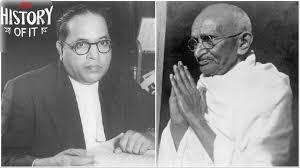
A Precedent Post on Gandhi, Ambedkar, and the Authority to Speak
Kabir is right to push back on the deliberately provocative, “pure evil.” It misses what QeA & Nehru were and what Gandhi & Ambedkar were.
This post sets four Precedents.
One. QeA and Nehru were men of state. Neither evil, neither saint. To be evaluated by the standards appropriate to men who build and run states.
Two. Gandhi was a man of Dharma. He is a saint. Comparing him with QeA and Nehru on their terms is a category error.
Three. Ambedkar is the fourth figure. Not a man of state in the QeA or Nehru sense; not a man of Dharma in the Gandhian sense. He is a constitutional saint, in the Mahatma’s register.
Nehru and QeA may be criticised. They may not be disrespected. Gandhi and Ambedkar are a different order. Discussion of them on this blog proceeds from profound respect for their achievement: the redemption of the soul of India after a thousand years of slavery.
*Thousand years of slavery is not Precedent but rhetorical flourish. It is worth noting that all of the Pakistani commentators on BP would be subordinated “Hindustani Muslims” in the hierarchical world of the Mughals, who explicitly favoured foreign-born Turani and Irani nobles over the converted Indian majority.
Four. SD is not to be quoted on this blog. Initials only where strictly necessary. Reasons at section XII.
Part I. The Distinction
I. The Man of State
The modern state is a Westphalian inheritance: territory, a monopoly of violence, legal personality. A man of state operates inside that frame. He does not step outside it.
QeA was a man of state. He was perhaps the finest constitutional negotiator the subcontinent produced in the twentieth century. He read the Government of India Act the way a master reads a score. In his Fourteen Points of 1929, drafted in response to the Nehru Report’s dismissal of the Muslim minority, he foresaw with brutal clarity that a Westminster majority in a plural society could become a permanent tyranny once the demographic count was fixed.
According to Mohammad Ali Jinnah, “The Committee has adopted a narrow minded policy to ruin the political future of the Muslims. I regret to declare that the report is extremely ambiguous and does not deserve to be implemented.”
There is a reason Pakistanis venerate him to the extent they do. Without QeA, the Muslims of the subcontinent would have remained a set of regional identities & class interests: Punjabi, United Provinces aristocrats, Bengali. He forged a single Islamicate identity out of them and politicised it into a state. In the history of the Ummah, and indeed the world, this is almost unique.
The Two Nation Theory was not his starting point. In 1916, at Lucknow, Sarojini Naidu called him the Ambassador of Hindu-Muslim Unity, and the phrase was earned. He reached for the Two Nation Theory two decades later, when the softer constitutional instruments had been closed off by Congress intransigence and Viceregal haste.
The tragedy of QeA is that the state he called into being never settled its founding question. A secular Muslim who ate pork and drank whisky summoned an Islamic state and then, on 11 August 1947, tried to unsummon it in a speech that Pakistan has spent the rest of its history editing out of its school curriculum. The confusion was structural from day one. It is structural still.
II. The Architect and the Scaffold
Nehru was a man of state of a different temperament. Harrow, Cambridge, Inner Temple. Fabian socialist. Scientific temper. Where QeA built a state around a community, Nehru built one around an idea: that a civilisation as old as India could be poured into a parliamentary republic and would accept the mould. It largely did. We owe him this.
Nehru’s achievement is that the Indian state has never collapsed. That is not small in the decolonised world. Compare Iraq. Compare Syria.
But Nehru’s state was a scaffolding for a civilisation he could not fully articulate in its own terms. He was too English to be Hindu, and too Hindu to be English. Hindustani, the composite register actually spoken from Lahore to Patna, was legislated into a Sanskritised Hindi that no street in the subcontinent had ever used. The imaginative vocabulary of the Republic, tryst, destiny, secular, socialist, reached its people through English rather than through any of the subcontinent’s own tongues. The highest articulations of the state required a translation.
He bequeathed an India that works administratively and stutters civilisationally. The Hindutva reaction of the last thirty years is the bill coming in.
Both men operated inside the same frame, the nation-state. Able men, educated men, consequential men. Men.
III. The Man of Dharma
Gandhi was not operating inside that frame. Dharma is older than the state. Older than the Mughals, the Delhi Sultanate, the Mauryas. It predates the Westphalian settlement by two and a half millennia. Dharma is the order of right conduct, right relation, right ordering of self to cosmos. The state can be its instrument, its obstacle, or indifferent. It cannot substitute for it.
Gandhi refused every office. He was never Prime Minister, never a formal Viceregal interlocutor, never elected to anything of consequence after the early Congress years. A barrister who had argued at the Bar in London dressed himself in a loincloth and made the charkha a political sacrament. The loincloth was a theological instrument, linking the body of the Mahatma to the bodies of the poorest through the simplest technology available. A man of state wears the sherwani, the suit, the uniform. A man of Dharma does not.
Satyagraha is not non-violence in the weak Western sense. It is soul-force: the insistence that the truth of one’s cause is sufficient to overcome the falsehood of the opponent’s, without destroying the opponent. Theology, not tactic. Satyagraha only works if the practitioner is willing to die and the opponent is not willing to kill an undefended man. When those conditions failed at Partition, satyagraha could not stop the killing. It never promised to. It promised to bear witness to the wrongness of the killing. These are different things.
IV. Dharma Is Not Only Hindu
The frame is civilisational, not sectarian. Every living tradition in the region has produced the same distinction. The commentariat should see the Precedent in its own inheritance before accepting or rejecting it in Gandhi’s.
The Buddha walked away from a throne. The entire structure of the Dhamma begins in the refusal of statecraft as the frame for the spiritual life. Ashoka, the one ruler who tried to be both man of state and man of Dhamma, is remembered for the tension that ran through him, not its resolution.
In the Persianate register, the pattern is sharper. Mansur al-Hallaj was executed by the Abbasid state in 922 for the statement Ana’l-Haqq, “I am the Truth.” The state did not kill him because it disbelieved him. It killed him because a man who is the Truth cannot be a subject. Al-Hallaj is the patron of every man of Dharma in the Islamicate tradition. The statesmen who executed him sit in the same category as Godse.
Guru Nanak was contained by no polity he passed through. Kabir (the Saint) refused Hindu and Muslim patronage alike. Shah Abdul Latif Bhittai sang in Sindhi a Dharma the Mughals and their successors could not recruit. The Bahá’í tradition, which is this writer’s tradition, is explicit: Bahá’u’lláh was exiled from every state that encountered him, founded none, and the administrative order of the Great Faith rests on the refusal of clerical and sovereign authority.
The distinction between man of state and man of Dharma is a universal feature of the civilisational inheritance of this region, recognised in every tradition that has produced saints. Gandhi’s Dharma is Hindu in idiom. It is not exclusively Hindu in substance. A Muslim commenter should locate al-Hallaj, Bhittai, or Kabir in the same category and recognise the claim for what it is.
The Inner Temple trains men to be men of state. It does not train them to recognise a man of Dharma when he shows up in a loincloth.
Part II. Gandhi Is a Special Case
V. Bengal, or the Single Man Who Stopped a War
In August 1947 Calcutta was the killing ground everyone expected. The Great Killings of the previous August (caused by QeA’s Direct Action Day) had left the city marinated in blood. Punjab was in open pogrom. Every serious observer expected Bengal to be much worse.
It was not, because Gandhi was there.
On 13 August 1947 Gandhi arrived at Hyderi Manzil, a derelict house in Beliaghata, a Muslim quarter that Hindu mobs were preparing to attack. He brought no troops, no police. He brought Suhrawardy, the former Chief Minister blamed for Direct Action Day a year earlier, and sat with him in a house without electricity or running water. He fasted. He met the mobs. He told the Hindus of Beliaghata he would die there before they harmed their Muslim neighbours.
Mountbatten called him a one-man boundary force. The phrase is exact. Fifty thousand British and Indian troops held the line in Punjab and lost the line. One seventy-seven year old man, unarmed, held Bengal.
On 15 August, while Nehru gave the Tryst with Destiny speech in Delhi, Gandhi was in Beliaghata, fasting. On the day of his own victory, the Mahatma was absent from the ceremony of the state.
VI. The Premiership He Was Offered, the Partition He Opposed
Gandhi was the only figure of national stature who opposed Partition to the end. By early 1947 Nehru had accepted it. Patel had calculated that a smaller governable India beat a larger ungovernable one. Congress had internalised the inevitability. QeA had demanded it, obtained it, and was moving to Karachi.
Gandhi alone refused. His April 1947 proposal to Mountbatten was to offer QeA the premiership of a united India. The whole country. Let the Muslim League form the Government. Hindus would serve under Muslim leadership if that was the price of keeping the subcontinent whole.
Nehru rejected it. Patel rejected it. Congress rejected it. QeA understood what was being offered and found it impossible to accept on his own terms. Mountbatten filed it away as an eccentricity.
Partition is presented as a tragedy without authors. It was not. Nehru, Patel, QeA, and Mountbatten all wanted it, each for their own reasons. Gandhi did not. The men of state made the state. The man of Dharma opposed the making. He was outvoted, not outargued.
VII. The Fast for the Enemy Nation
In January 1948 Gandhi undertook his final completed fast. The proximate cause was communal violence in Delhi. The deeper cause was the Government of India’s refusal to release fifty-five crore rupees, Pakistan’s share of the sterling balances under Partition. Patel had withheld the payment on the grounds that Pakistan was using it to fund the tribal raid on Kashmir.
Gandhi fasted until the Government of India, led by his own protege, released the money to the state that had just attacked Kashmir.
Read that sentence again. The Mahatma of India fasted on behalf of Pakistan, against his own Prime Minister and Home Minister, to force the Indian state to honour its contractual obligation to the enemy nation. He did this while Muslim Indians were being killed in Delhi, three weeks before his own assassination.
This is the act for which he was shot.
VIII. Why Only Gandhi Was Killed
QeA died in bed of tuberculosis on 11 September 1948. Nehru died in office on 27 May 1964. Patel died in Bombay on 15 December 1950. Gandhi was shot in the chest at 5:17 pm on 30 January 1948 by a man who had read him carefully and despised what he read.
Godse did not kill Gandhi because Gandhi was a Hindu saint. Godse killed Gandhi because Gandhi’s Dharma extended to Muslims and to Pakistan, and the Hindu state forming around him could not tolerate a saint whose ethics crossed the border. This is in Godse’s own defence at trial. He was clear. He was literate. He was not mad.
Men of state can be outvoted, out-negotiated, or waited out. A man of Dharma has to be killed.
The bullet was the recognition that Dharma could not be shouted down. It had to be shot. The Mahatma’s value to the Indian state begins at 5:17 pm on 30 January 1948. Before that hour he was a problem. After that hour he was a stamp.
Part III. The Other Exception
IX. Ambedkar, the Constitutional Saint
There is one more figure. Ambedkar.
Ambedkar was not a man of state in the QeA or Nehru sense. He did not build a state around a community or an idea. He drafted the document that allowed the state Nehru inherited to function. He did this as a Dalit, in a Congress machine that distrusted him, for a majority that had oppressed his caste for a thousand years.
He is also not a man of Dharma in the Gandhian sense. His disagreement with Gandhi on caste was substantive, permanent, and right on most of the substance. He never performed sainthood. He wore Savile Row. He quoted Dewey. He converted to Buddhism in 1956 and took five hundred thousand Dalits with him. A saint’s act, performed without the idiom of sainthood.
Ambedkar translated Dharma into constitutional law. He is a constitutional saint. A different kind of saint, a kind the subcontinent had never previously produced.
The Indian Constitution of 1950 is a sparkling piece of civilisational work. It has been amended. It has been stretched. In seventy-six years it has not been meaningfully violated. The Emergency of 1975 was a test, and the Constitution survived. The document held because Ambedkar had built it to hold.
X. Why Pakistan’s Constitution Did Not Hold
The comparison is unavoidable. Pakistan has had three constitutions and broken all of them. 1956. 1962. 1973. Military coups in 1958, 1977, and 1999. Judicial murders of Prime Ministers. The sitting Prime Minister is in jail as this post is written.
Pakistan began life with more industrial base, more arable land, more military inheritance, and arguably more administrative talent per capita than India. Eighty years on, the measure of Pakistani success is survival. That is the measure of a low power. India’s measure is constitutional continuity. The difference is not geography or demography. India had an Ambedkar. Pakistan did not.
QeA was a lawyer. Ambedkar was a constitutional architect. Not the same category.
Part IV. Authority and Line
XI. The Precedent Position
This blog holds the following positions on these four figures. Precedent. Not up for relitigation in comment threads.
Gandhi is a saint. The Mahatma. Not to be compared to QeA or Nehru on their terms.
Ambedkar is a constitutional saint. The fourth figure, in the register of the Mahatma, not of QeA and Nehru.
QeA is a man of state. Not evil, not a monster, not a bigot. The finest constitutional negotiator of his generation; the state he built has spent seventy-eight years unable to settle its founding question.
Nehru is a man of state. Visionary Architect of an Indian state that has not collapsed. His civilisational register was too thin; the reaction of the last three decades is the bill coming in.
XII. Who Reads the Subcontinent
The frame across Sections I through XI is civilisational: men of state, men of Dharma, and constitutional saints are not interchangeable categories. The same frame applies, in a lower register, to those who write about the subcontinent. The question of who reads the subcontinent, from what seat, and on what authority, is the question the four figures raise from within. The men of state built the states. The man of Dharma refused them. The constitutional saint disciplined them.
In December 2025 this blog engaged SD on a speculative claim that Indian rock-cut architecture, specifically the Barabar caves, derives from Lycian funerary models via Alexander’s march. The critique was narrow and factual. The Barabar caves are not tombs. The transmission mechanism is undemonstrated. The routing through Greece and Alexander was gratuitous where an Achaemenid frame was already available.
SD’s reply was a bibliography and a “Happy reading” sign-off. While we received it, the public text was being quietly amended in line with our objections, without acknowledgment. When we documented the edits, the defence shifted from Greek transmission to Achaemenid transmission, with the authority to explain India still in the same hands.
This operation has a name. Correct the record quietly. Lecture the critic loudly. Keep the chair.
The chair is the point. A Western author of the relevant pedigree is granted interpretive authority over the subcontinent by default, and the default is expected to survive his own factual errors. The grant is colonial in origin and postcolonial in form. It softens the accent. It adds the footnote. It retains the hierarchy.
SD is not to be quoted on this blog. Initials only where strictly necessary. His work is not to be cited as authority. This is not personal. It follows from everything above. The subcontinent has produced its own founders, saints, and drafters of law. It will produce its own interpreters.
Commenters who defend SD, or who argue that South Asian critics must first “earn academic credentials in the humanities” before contesting a Western author, will have those comments removed. The authority to speak about the subcontinent does not come from a chair in London. It comes from the subcontinent. That is not gatekeeping. It is editorial line.
XIII. On the Editorial “We” and Why Precedents Exist
Kishore has asked why this blog uses the plural. Not arrogance, not a royal we. It is the house voice of the masthead, and Precedents speak for the site. The line is the “we”.
Precedent Posts exist so the blog does not relitigate settled positions in every thread. Sacred geography established the founder-institutional distinction. Op Sindoor established that the operation was not a Pakistani defeat. Precedents can also be reversed in well-thought out posts like G.L’s seminal Dhurandhar post. This post establishes four. Precedents are not the suppression of debate. They are the grounds on which serious debate becomes possible. Fifteen years on, the vitality of this space is the record.
The wound of 1947 has not closed. The subcontinent inherited two states and lost the Mahatma and, in time, the constitutional saint as well. The states continue. The saints do not. They were men. He was Mahatma, the Great Soul of Mankind (who appear once every few Generations or so). Ambedkar sat beside him, in a register of his own.
While you are right that Gandhi’s ideas resonate beyond India’s ideas independence movement, his actions were very much in keeping with ‘man of state’. The Congress party was organized as a federalized national political party capable of social and economic reform. He actively mentored and promoted men of state like Nehru, Azad and Patel.
+1
//Without QeA, the Muslims of the subcontinent would have remained a set of regional identities & class interests: Punjabi, United Provinces aristocrats, Bengali. He forged a single Islamicate identity out of them and politicised it into a state. In the history of the Ummah, and indeed the world, this is almost unique.//
While unique is this a good thing though? Would Muslim interests have been served better through non Islamic identities and ethnic identities rather than a religious identity. Would a muslim have had a better life by fighting for it with a Hindu or Sikh or christian or jain than with a muslim from the other side of the subcontinent.
We can compare to christians in India who are equally widespread and divided by caste, ethnicity, sect and class. Even with acknowledging troubling trends thst sometime result in riots and social boycott, the prominence of other identities relative to their religion has enabled them to pursue their own interests in a much better manner than muslims. We can see this in higher literacy, greater focus on education amongst christians, presence of significant christians in the middle class and as a result benefitting from the growth India has experienced
Being cognizant of caste, has allowed greater integration in the ambedkarite movements and ambedkars ideals to seep into consciousness unlike with a muslims whete caste issues have not been acknowledged properly.
Where christians are a total majority as in many states in the northeast they have managed to secure their own control over the resources and lands beneath their feet, considering thst some of the insurgencies in places like this were ongoing before kashmiri militancy this is not a small feat. And it is not like the christians in northeast have not been xenophobic to both mainland hindus and Sikhs but even other christian tribes either
Finally the result of the elite being where they are aince centuries and not being displaced is not only do they benefit from Indias growth but also are much able to combat instances of religious violence meted out on christians elsewhere in the country. Having close social and cultural ties also means that even begrudgingly christians are forced to confront instances of religious discrimination from their side.
https://mattersindia.com/2017/10/bishops-denounce-burning-of-hindu-deities-in-mizoram/
Would a muslim community defined by caste , ethnicity and class have been better able to confront the issues facing them? The case of christians shows that other than nukes the subcontinental muslims seem to have gotten a raw deal.
_/He bequeathed an India that works administratively and stutters civilisationally. The Hindutva reaction of the last thirty years is the bill coming in.//
If India stuttered civilizationally it is only because the state that Nehru created lacked capacity to fulfill its duties, not entirely his fault though. We did not lack a civilizational mooring. What we did lack I feel is a broader perspective on the possibilities, and limitations. Nehru should have focused more on confronting the acrimony thst British colonisation created and even deal with any intellectual thoughts that promoted this acrimony. This refusal to do so is why we are having many problems todsy.
I dont think that we will be solving the second problem anytime soon though.
The highest quality of life enjoyed by Muslims in the subcontinent is in Kerala.
Decent representation in both politics and media as well as the highest education/income levels by Muslims anywhere else in South Asia.
We have discussed this several times BB.
This is simply trolling now – we removed your other Pakistan fuelled comment.
Please move on from that.
I disagree though and have a different viewpoint. Will make an entire post regarding that.
I don’t if it is a precedent but like GauravL’s Dhurandhar: The Revenge post, I should be allowed to make my point.
With all due respect, the demographics of Indian Muslims and Christians are not comparable.
Muslims are approximately 15% of the Indian population.
Christians are approximately 2.3% to 2.4% of India’s population.
There was no question of Indian Christians defining themselves as a “nation” and advocating for a separate nation-state.
I dont think numbers dilute the argument that is being made.
The argument is that diverse muslim populations interests would have been better served by arguing on ethnic,caste, or class basis rather than a religious basis.
The christian counterpart is just to show how doing so would have better equipped muslims all across the subcontinent to argue for their interests.
No reason to think a Muslim majority Sindh, punjab or nwfp would not have eventually gotten the autonomy they are seeking, similar to northeastern states in a united India. Ditto for other muslim majority regions in India like Nuh Obviously richer muslims would benefit more from being part of India instead.
Would pasmanda muslims in the subcontinent be better able to argue for their rights if they made common cause with ambedkarites?
It was the British policies that effectively treated Hindus and Muslims as competitors. This is the background of the Two Nation Theory.
As for “autonomy in a united India”– that was what the Cabinet Mission Plan was offering. The Quaid accepted it. Pandit Nehru said it could be re-negotiated in ten years. That’s when Pakistan became inevitable.
“Richer Muslims would benefit from being part of India”– With due respect, India has never had a Muslim PM. In Pakistan, Muslims are PM, President and Army Chief.
The choice for Muslims was basically did they want to be a permanent minority or a majority in a sovereign country. Obviously, a substantial section chose to be a majority in a sovereign country.
//Obviously, a substantial section chose to be a majority in a sovereign country.//
Most muslims could not vote, substantial sections were ineligible. And even those, in many of the areas, the majority was not overwhelming.
//Pandit Nehru said it could be re-negotiated in ten years. That’s when Pakistan became inevitable.//
How would we be sure this renegotiation would happen? And if it did would be to the detriment of muslims, I agree much of the autonomy currently enjoyed or promised is due to having to violently fight for the same but with the amount of integration, numbers and social capital muslims had what would make one thing the negotiations would not have been favorable to muslims.
//“Richer Muslims would benefit from being part of India”– With due respect, India has never had a Muslim PM. In Pakistan, Muslims are PM, President and Army Chief.//
Partition imo has a huge role to play in why this has not happened and has little chance of happening.
//The choice for Muslims was basically did they want to be a permanent minority or a majority in a sovereign country. Obviously, a substantial section chose to be a majority in a sovereign country.//
And has this choice worked out for the majority of subcontinental muslims is what I am trying to ask.
Indian muslims are largely poor. Pakistani and Bangladeshi muslims are also largely poor but under a muslim elite instead of hindu one. These muslims also did not have a say most often than not. Was allowing a few rich muslims who would anyways have been alright even as a minority, due to generational privelege, to partition and create a state where they are dominant in the name of Islam worth the sacrifise?
“And has this choice worked out for the majority of subcontinental Muslims”–
You are free to disagree with me but I will assert that 250 million Pakistanis are very happy to be citizens of a sovereign Muslim-majority state rather than minority citizens in a Hindu-majority one.
I can’t speak for Bangladeshis but I would assume they are also happy to be citizens of a Muslim-majority state.
You seem to be underestimating how much the average Muslim dislikes Hindus (and vice versa). This is a sad reality.
//You seem to be underestimating how much the average Muslim dislikes Hindus (and vice versa). This is a sad reality//
I dont think the average muslim in India, dislikes hindus. Maybe they dont agree with their religious views but indian musliks.dont dislike hindus as a group.
Pakistan and bangladesh muslims, dislike India and hindus due to TNT, and same with many hindus who dislike muslims.
A lot of this animosity is purely due to the actions taken by respective groups during partition. And many bad state actors have taken advantage of this for their own purposes
I know you are supportive of the Pakistani army but you also should be able to see how nationalism is stoked to cover up for our governments own failures.
>Was allowing a few rich muslims who would anyways have been alright even as a minority, due to generational privelege, to partition and create a state where they are dominant in the name of Islam worth the sacrifise?
Pakistan was always a project of the elites, for the elites, by the elites. Who cynically exploited an opportunity by selling the ‘opiate of them masses’.
Dressing this up in the rhetoric of ‘self-determination’, ‘different nations’ blah blah is de rigeur. But serious discussions shouldn’t be skewed by ‘patriotic’ arguments.
Arguably so was Indian Independence, which was spearheaded by Brahmins ?
Independence movements tend to be elite-driven as a rule.
And the preservation of High Culture is elite-driven.
>Arguably so was Indian Independence, which was spearheaded by Brahmins ?
not really. Indian Independence movement and its leadership, both before and after actual independence was transformatively egalitarian.
The fact that Ambedkar was empowered to write the constitution, universal adult franchise was the norm, across gender, religion etc, and the wide ranging spectrum of background that have risen to Indian leadership positions, bears evidence to this. Lal Bahadur Shastri became PM shortly after JN and was a famously poor man. As much as people can deride Narendra Modi, he infamously started out as a chai-wala.
Pakistan’s historical track record, by quite the contrast, shows how power has been captured by the elites, who have prospered not just independent of the average non-elite Pakistani, but often directly at their expense.
https://www.brownpundits.com/2026/02/26/open-thread-who-would-be-indias-best-prime-minister-and-why/
I have always held that the western/english educated Hindu elites fought for the freedom of India. There were a handful of Muslims in it. Brahmins had a large part in it and were suitably rewarded in the independent india.
Hindus were denied a famous victory by the seculars like Nehru, who conducted as if the upheaval was just a transfer of power.
Ambedkar was a Hindu when he drafted the constitution. He held radically different views (to that of gandhi) of Muslims, and even advocated transfer of population during partition.
Ambedkar, phule, EVR have become the holiest cows on today’s india. A relook at their position to the British rule needs to be done dispassionately.
The issue with this is that a large amount of hindu elites were not part of the independence movement, many elites were more than happy working in british bureaucracy, armies and as merchants and traders under the british.
If people of other religions who participated are just individuals then the handful of elites who did seek independence are as well. What is the reasoning for claiming this as a victory for hindus when for most of the colonial period, upper class hindus were amongst the biggest beneficiary and backbone of british rule in India.
Ps:Ambedkar had already written annihilation of caste and who were the shudras, he was already mentally detached from Hinduism and just had to formally convert. He was also not anti muslim and was talking about transfer of population as one possibility in which partition could be done.
Btw, I wrote up a post and somehow the ‘comments’ are turned off? Is that intentional?
No quirk of the site – we suspect it may do with mobile or laptop posting. We will switch it on.
The site architecture is fairly old so there are “quiet bugs” all about but on the whole fairly resilient and gets the job done.
Muslims are not equivalent to Christians. There is a good post on this; “who speaks for Indian Muslims.”
Indian muslims are different from Indian christians in that dedicatedly pro muslim states were controlling large parts of the country for centuries but there are other similarities that make this comparison instructive
– Converts from lower castes to islam and christianity have not achieved the promised equality and still deal with casteism. At least in the south, christians have been more enthusiastic about embracing ambedkar than muslims have. And the christian converts from these backgrounds are not necessarily separating themselves from bahujan politics in favor of a christian identity. It is instructive to ask if partition and the forces that encouraged it took this opportunity away
– Many Muslim elites like many hindu, christian, Sikh and others benefitted from offering their services to various Sultanates and even the british. The muslim elite took the path of religious revivalism and nostalgia and along with encouragement from the Britsh created Pakistan, where they are dominant but just that. It is instructive to think thst if these same elites like christians, Sikhs and others emphasized more on their caste or class identities would they be in a better position or worse off. A lot of pathways in corridors of power thst are completely closed to muslims is due to partition not the other way around.
With the tribal northeast, the only thing one can make a comparison is how are christians seen elsewhere because of insurgents in northeast vs how are muslims seen due to insurgency in kashmir. Here even if many muslims have not supported the insurgency in kashmir either morally, or physically they still need to face flak because of the insurgents actions, ditto for bigoted actions in bangladesh and Pakistan.
It is instructive to think why insurgents actions of christians in northeast dont necessarily lead to disgust or violence elsewhere, when these do happen are largely related to localized grievances.
We can look at how christians dealt with the prospect of being a ‘permanent minority’ with even lesser things going for them than muslims and see if the muslim.elites choice were reasonable or worth it
Well,
1) pre indepedent india was either under direct British rule or under 530 princely states. People under princely states worked for their Raja who in turn gave protection money to the British. This was lively hood in an understanding industrialized country.
Similarly a clerk or a watchman working for government cannot be accused of collobration.
All revolutionary struggles will not have 100% of population coming on streets. The silent majority goes with the winner/stronger party.
Struggles in Iran now is a case in the point.
2) after 1857, Hindus and Muslims realized that it was not possible to throw out the British by armed struggle.
Muslims elite under sir Syed realized that it was better to collobrate with British and get some power back which they had lost, by opting for ‘English’s education and formed Anglo mohammedan college, (alighar Muslim university )
This worked and alighar Muslim university produced the theoretical from work for partition.
More traditional Muslims like azad came with congress. Hence the handful numbers.
3) Hindu elite joined congress which was a ‘broad church ‘, with Hindu sentiment being the majority opinion.
That is where they had the overwhelming leadership.
4) the quintessential Englishman Nehru defeated this tendency and pushed the alien secularism down the throat.
Most of our problems today can be traced to this.
Of course they are. But the parallel that Calvin is attempting to draw is rational. And one worthy of consideration.
The fact remains that apart from assertions of questionable ‘sovereignty’, the HDP outcomes for the average subcontinental muslim beyond India’s borders are arguably worse than those within.
And Calvin’s conjecture, that perhaps subcontinental muslims as a group would have fared better, is a reasonable one.
Dismissing it in the name of ‘muslims are somehow different/special’ smacks of the so-called ‘soft bigotry of low expectations’, does it not?
Excellent comment – you should really reflect on Authorship.
A while back, I remember asking whether a strong argument can be made that Pakistan’s creation ‘saved’ Indian muslims from Muslim majoritarianism. The current fates of Pakistan and even post-pogrom independent Bangladesh, do support that argument, do they not?
At least pakistan and bangladesh, and all that Indian muslims face due to the activities in these two countries ensured that Indians muslims left behind the default combativeness that seems to have been prevalent amongst its elite.
But muslim majoritarianism, are still there, because the culture of revivalism and nostalgia is still present. The muslim community still does not see itself as many groups with shared cultural traits but one group with quirks based on a nostalgia driven set of values.
There is a notable lack of introspection amongst Pakistanis regarding the flaws and failings of their ‘successful’ majoritarianism. Its created quite the blindspot – one that allows for …normalization of overt prejudice towards the non-Islamic.
Kabir will take umbrage against the use of the word apartheid, but just Islamophobia and Caste are Indian issues, social and legal ‘mainstreamed’ discrimination against non-muslims, even non-mainstream sects, is a Pakistani issue that Pakistanis ought to have the moral courage to not just own up, but to dissect.
But India still has a liberal alternative path for Muslims to take which the Muslim Indian elite has embraced.
A liberal interpretation of Islam which does not disallow from celebrating non Muslim festivals or marrying with non Muslims without conversion. This is seen quite frequently in Bollywood/cricket circles.
There has been a precedent in historic times – Akbar’s Din I Ilahi.
Ideally, this should be the future of Indian Muslims and hopefully as India becomes richer and more “first world”, more and more join this fold.
I think we should stop making paragons of virtue amongst muslims based on how little Islam seems to matter to them.
Let muslims be as religious and as strict as they want. Just dont put it on others, you dont need to be Shahrukh khan to understand something like that.
The important thing those outside the community is to accept people as they are and describe their culture and community after actually talking to them.
But don’t you think there is a conflict of values/contradiction that needs to be resolved within Islam for this to actually happen? If dawah is a fundamental tenet that conservative Muslims take seriously then they have divine mandate to spread the word and be soldiers (not only in the martial sense) of their faith. That will inevitably conflict with the fundamental liberal value of live and let live.
Of course the same criticism can be made about Christianity as well but it has gone through reform and settled its contradictions with modernity, in a relative sense, far more than Islam has so it is no longer as much of a problem.
/_That will inevitably conflict with the fundamental liberal value of live and let live.//
No it wont. Talking to others about your religion even if unprompted, does not constitute a breaking of liberty. Going at it when someone had made it clear they dont want to speak on religious matters is. This is not a complicated thing and if muslims elsewhere csn get this, then I dont know why Indian muslims cant.
Indonesian muslims are as dedicated to Dawah as any indian muslim but this dedication does not lead to violation of personal space and liberty.
//Of course the same criticism can be made about Christianity as well but it has gone through reform and settled its contradictions with modernity, in a relative sense, far more than Islam has so it is no longer as much of a problem.//
Reform is not a silver bullet. Modern American evangelicism and deobandi, and Wahabi movements are also reform movements. What looks like reform is more often seperation of and adaption to living in a multi cultural world. Christians of today are as much determine to sharing the gospel as the ones before the only thing is that they dont have a state backing them, acknowledge that they live in a multi cultural society, whete they have to abide by certain behaviours and above all want to participate in public sphere. The last one is where either muslims dont wsnt to venture or are being stopped from doing so.
Additionally as mentioned above, christianity never really succeeded in building a pan christian identity and suppressing other identities of class, ethnicity or caste. At least in the subcontinent, the muslims succeeded to some extent in 1940s.
“Reform is not a silver bullet. Modern American evangelicism and deobandi, and Wahabi movements are also reform movements. What looks like reform is more often seperation of and adaption to living in a multi cultural world.”
Well put. Those beliefs never really go away, do they? They might be put on a backburner perhaps, but always present.
Though I disagree with the premise that they will not clash with the fundamentals of “live and let live”. They do, that’s why all the issues from centuries past!
//Though I disagree with the premise that they will not clash with the fundamentals of “live and let live”. They do, that’s why all the issues from centuries past!//
You missed my point entirely. Though I should have been more clear. In the first case there is nothing fundamentalist about fundamentalist islam or christianity whether it be evangelical christians or wahaabi muslims these are responses that seek to recover social dominance and political power by going back to some imagined pure state.
This quest for dominance, not belief are whst is the heat of conflict. If you abandon this and acknowledge you live in a multi cultural society, and need to act appropriately many problems get solved.
There are countless example of this, Indonesia Panchatra( or whatever its name is), ismaili-ism, christianity practised by malayai and native goan catholics, even the catholif church post Vatican 2 ars all example of embracing pluralism without letting go of your beleif that your religion is correct.
Any conflict on fundamentals cannot be solved by negotiation.
That fundamental tenet in any monotheistic ideology as you point out is pretty much the gorilla in the room.
Its also why Ambedkar rightly believed that partition was inevitable though workable only with a complete population transfer.
Except these fundamentals are different according to different groups.
Groups like evangelical christians or wahabbi whose primary religious beleif is to secure power and dominance will hav3 different fundamental than those which have abandoned these pursuits.
Essentializting in this regard only serves to help the above groups.
Muslims cannot have shariah for personal law, IE for marriage, divorce, inheritance etc and have civil law for punishment.
If they want shariah it should be hold all and not alacarte. This means that they should also agree for ‘chop chip’s on a public square after Friday prayers.
Why are you so interested in deciding islam for muslims?
To begin with why exactly is this wrong in the first place? What makes the Islamic jurisprudence that you are quoting more authentic, correct or appropriate than others that make these distinctions?
because Muslims insisted on Shariah for their personal law, although many Muslim majority countries have bypassed it.
I am just trying to extend it for spheres of their life.
Sharia is present in civil laws in many countries, malaysia for instance.
In Islamic countries.
India is a secular country and civil laws should be uniform without religious overtones and be progressive in a modern sense.
And I say this for all religions.
Having different religions have personal civil laws some of which are not compatible with modern liberal laws is illiberal.
The laws can be made more liberal by the members itself, why is this same urgency not shown with tribals, who get to keep their own customary laws?
Tribals don’t get to keep their laws all over India.
Only in select areas which fall under the scheduled areas.
Muslims got their scheduled areas during Partition (Pakistan) so those that left can enjoy their Islamic laws there but those that remain have to come under secular civil laws (like tribals living outside scheduled areas too).
In literally the first few lines there is a blanket exemption to tribal with no mention of where they live. Please have a look at the laws
And with this, your contention that it is area wise collapses.
If some communities can get exemptions but others dont it is not uniform and the fact that this law is being used to enable monitoring of live in couples, plus laws allowing restriction of housing and mandatory declaration of details in case of special marriage act still being on the books it is difficult to conceive some liberal motive behind promulgating these laws
Not a question of deciding Islam for Muslims. What they do in their personal lives is up to them.
But the laws of a country cannot and should not be based on religious edicts but should be universal liberal laws.
And that is true for people of all religions.
Again, why the exclusion of tribals then?
And this uniformity can be achieved within the community itself.
Answered above.
One thing I forgot to add, being against this because it is a massive exercise to keep muslims, is a reason in itself to not like the personal law, but arguing that its application is wrong is essentializing.
if this was an excercice to keep the Muslims out, why are the Muslims in other states not protesting? A law to keep out foreign Muslims led to all India protests.
Why are Muslims voting in bengal. They could have protested and boycott ed the polls.
Are you talking about SIR?
Protesting and boycotting the polls only work when the entire society thinks that the polls are rigged or that the vote does not matter. As of now, the electoral lists are being set up in such a way that places where there is a close fight either more voters for a particular dominant party are added or voters against a dominant party are removed or both. In such a case participating in polls is essential, as it is changing the voters list to to suit a party is also an attack on power of vote.
CAA was opposed because of the connection the HM made to NRC itself, an exercise many fear would at worst make many stateless and at best as seen in assam, normalizer the notion that many are illegal despite having all relevant documents, and hence open to harassment.
TMC is not a babe in the woods. It is ruling bengal for 15 years.tjey protest against every thing. If things were not real all hell would have broken out.
More Hindus than Muslims have been removed.
Most deletions are genuine. That’s why it is standing.
Most of the people removed from first round of SIR are deaths, duplication or shifting. It is the 27 lakh people who are removed under adjucation category that are concernin,especially because they target muslim majority constituency and most of the removals are muslims with matuas being the second most number of removals.
TMC maybe the worst party of all but it does not justify the EC starting this process months before elections, introducing a new category based on untested software and not giving any clarification why certain people have been marked as disputed.
any discussion of ‘concern’ about the SIR process that does not acknowledge the serious issue with demographic change and Bangladeshi migration, that is unique particularly to the states that border Bangladesh – Bengla, Assam etc – and the well known corruption that allows them to purchase fake documents, is one-eyed and ‘questionable’.
If you want to advocate for ‘maximum fairness’ and ‘protect’ voting rights, you cannot gloss over the serious challenge to democracy and community that is baked in.
No objective or even left-wing observer can attempt to deny that the TMC has engaged in illegal shenanigans, and knowingly courted undocumented migrants from Bangladesh as a voting constituency.
There simply is no fool-proof ‘perfect’ way to go about addressing this challenge. The perfect cannot be allowed to be the enemy of the good. No amount of chest-beating cherry picked propaganda is being allowed to hijack narratives.
That’s the bottom line.
Excellent comment
Where is the proof beyond social media rumours that the vast majority of bengali muslims in present day west bengal are illegal immigrants, since I dont think you are thinking about the matuas when thinking of the TMC courting immigrants from Bangladesh.
Assam was supposed to have close to 10 million illegal muslim immigrants, but we only got 19 lakh out of which at most half maybe muslims, there are other explnations as to why the bengali muslim populations has increased, from the fact that certain areas like Murshidabad and Malda already had close to 50% bengali muslims to even areas of lower assam also having substaintial muslims, followed by their poverty leading to growth in population as seen everywhere.
Yes people did move from Bangladesh in the 1971 war and this jump in muslim population is recorded but as the NRC process in Assam shows many of the modern bengali muslims have at least one Indian ancestor.
The way to start addressing this challenge is to actually take the time to know how many are there rather than depending on social media rumours that only serve to spread paranoia.
https://www.brownpundits.com/2026/04/24/two-colonisations-one-border-what-the-data-actually-says-about-bengals-post-1971-demographic-story/
Lets assume you are right and ’19 lakh’ is the right number. Is that a small number?
Are we to pretend that the 1971 migrants are not an unwanted, illegal non-trivial change in the demography of the region?
I am not pretending to know what the ‘right’ answers are here. But to simply fixate on procedural flaws that impact a minority percentage, to dismiss the entire exercise, or weaponize it as ‘democratic backsliding’ as our resident Baghdad Bob attempted to do, is …silly.
For the benefit of all-matuas are hindu
This is a great post.
I would also add Maulana Azad to this. See the following:
https://kabiraltaf.substack.com/p/review-the-muslim-secular-parity
Two points:
1) You referred to Imran Khan as the “sitting Prime Minister”. This is factually untrue. An election was held in 2024. IK was already in jail and not a candidate. He was removed through a no-confidence motion in 2022. We can disagree about IK but he is not the “sitting Prime Minister”.
2) I don’t agree with you about SD but I will honor the editorial line not to quote him. The broader point remains valid though. If South Asians (not just Indians) are so busy being engineers and computer scientists–not without reason– then we cannot complain when our history is interpreted by those who do earn degrees in History etc.
Also I just want to clarify if the ban on SD applies to WD as well?
It’s not a ban per se – it’s simply to initialise him (the son) rather than flaunt him especially when we have had a very unpleasant run-in (he edited the website with our suggestions while telling us we were wrong).
OK.
I was asking because I have a review of one of WD’s books that I wanted to share. Didn’t want to post it if it was just going to get deleted.
Indian nationalists love making the same critiques about Pakistan that triggers them when foreigners do the same to them. Funnily enough had SD said something negative about Pakistan you guys would be quoting him ad nauseam as Indians have done so with other western critics of Pakistan.
“Considering India is growing faster, Pakistanis shouldn’t complain if some Indian SD in the future starts writing books on Pakistan while they are becoming engineers.
For a more recent example, Pakistanis shouldn’t complain about the Dhurandhar movies. If Pakistanis are so busy being engineers, people who hone their craft in film will be the ones making movies on Pakistan.”
That’s what Indians have been doing for decades – several books, articles, podcasts, movies, social media content made about Pakistan. It has nothing to do with Indians being better than art than us, it’s just that it’s a one sided obsession. Dhurandar is one of several dozens of movies made about Pakistan, this is not a new trend – It’s a symptom of a deep rot in Indian society.
Funnily enough had SD said something negative about Pakistan you guys would be quoting him ad nauseam as Indians have done so with other western critics of Pakistan.
Don’t let facts come in the way of your hate.
Father has been criticized by Pakistani academics right from his first book.
I think you are a bit confused about what my comment is regarding.
SD’s issue is not that he said anything “negative” about India as you are insinuating but due to the resources available to him but not to most Indians, told an “Indian” story via his narrative.
Pakistani film fans always desired to make a gangster movie on Lyari (similar to RGV/Kashyap in Bollywood) but due to lack of funds/technical ability in Pakistan, that movie ended up being an Indian movie weaved into an Indian narrative.
Pakistanis’ frustration with Dhurandhar is not that it an Indian-Pakistan movie (of which there are many) but it is a “Pakistani” movie and “their” narrative which was co-opted by Indians.
Also I disagree the obsession is one-sided.
Pakistan makes plenty of media about India.
Issue is that it’s just not good and even Pakistanis don’t see it.
Jahannum Ba’raasta Jannat came out recently and clips are already going viral on X.
Has some sadhvi RAW agent lol.
Someone said – YRF makes better ISI propaganda than ISI
“Skill issue” like the kids say
YRF makes better ISI propaganda than ISI
Droll!
reread the bit on SD.. it wasn’t about him taking sides about what he actually did (misrepresented and secretly edited while lecturing us to read more)
Within a South Asian context, India being richer does better than Pakistan in these fields.
I don’t fully agree. Pakistan punches way above its weight when it comes to narrative shaping. Part of this comes down to Pakistani diaspora being committed soldiers of the cause while Indians (at least non-Muslims) tend to prefer to assimilate and leave behind conflicts of the homeland. See the narrative built around the Sudan buying Pakistani made jets with Saudi financing. There’s talk of how the deal is on hold because Saudis are withholding financing. Dive deeper and you know this whole thing was manufactured by some Pakistani/Pak origin journalists boosting their post Op. Sindoor propaganda and there was never a deal to begin with. Many such examples.
We have a long way to go before we catch-up on pushing our narrative. Another good example would be Chinese-Qatari sponsored bot farms run in Pakistan that have so successfully pushed racist hate against Indians across all social media for the last 2-3 years. The Indian state doesn’t even recognize the harms this has caused and will cause in the future.
Good post.
Thank you very much
@XTM – bunch of my comments from today across posts seem to have again gone in to spam.
All approved – sorry for hyperactive spam filters, can’t be helped
Still not seeing them. I guess it will take time to reflect?
We approved all?
It may be something my end – I still don’t see most of them.
I think if you ‘register’ as a user on BP, this may mitigate the problem of your comments going to spam as default, needing to be explicitly approved to be visible. I had the same issue earlier.
I just want to address this criticism that i am “mocking” South Asians for being computer scientists and engineers:
There is nothing wrong with being an engineer. My own father was trained primarily in engineering–though he went on to get a PhD in Economics. My mother is a medical doctor–as are many others in my family.
I will note that prior to becoming a civil servant my paternal grandfather obtained a Master’s Degree in English Literature. This was back in the 1930s.
Doctors, engineers and scientists are very much needed in any society. However, the fact remains that when South Asians don’t go into the Humanities, they shouldn’t complain when Europeans shape the narratives regarding our countries.
WD explored Urdu and Persian documents in the Delhi archives that Indians hadn’t looked at since 1857.
All I am advocating is a healthy respect for academics. Someone with a doctorate in a particular field is inherently more credible than a random person on the internet. This doesn’t mean that they are above criticism simply that such criticism must cite sources.
Disagree with a lot but i will keep this brief – Conflating texts with people’s behavior’s is the real culprit here.
No texts create instutions & neither can they make they make them function only people & norms do.Gandhi tappened into this resource while Ambedkar was too deeply embedded in colonial education theorization to ever breakfree out of it.
Same texts which claimed to grant highest equality of individual helped justified colonization in the civilizing missions, same texts which were used to claim suppossed freedoms have led to different more vicious forms of unfreedoms & so on.