
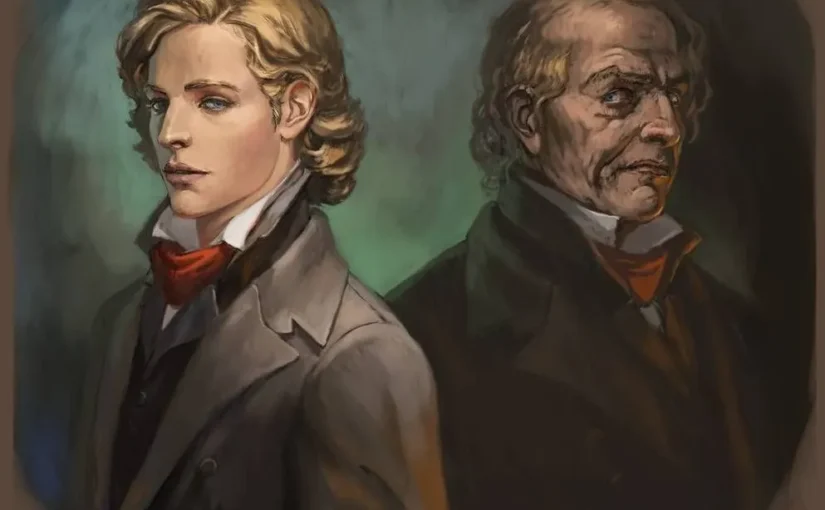
This essay has nothing to do with South Asia but I am sharing it in the interest of mixing up topics and discussing things that don’t have to do with Ind-Pak. For FlyDie specifically.
Oscar Wilde’s The Picture of Dorian Gray is a classic work of 19th century gothic horror. Initially published in the July 1890 issue of Lippincott’s Monthly Magazine, the novel became immediately controversial, primarily because of its “immorality”. In his “Introduction” to the annotated, uncensored edition (Belknap 2011)–based on Wilde’s original typescript– editor Nicholas Frankel quotes a contemporary review in the Daily Chronicle:
It is a tale spawned from the leprous literature of the French decadents–a poisonous book, the atmosphere of which is heavy with the mephitic odours of moral and spiritual putrefaction–a gloating study of the mental and physical corruption of a fresh, fair and golden, youth, which might be fascinating but for its effeminate frivolity, its studied insincerity, its theatrical cynicism, its tawdry mysticism, its flippant philosophizing…
Frankel argues that a large part of the reviewers’ outrage arose out of what they perceived to be the novel’s references to homosexuality. He writes:
That outraged British reviews of The Picture of Dorian Gray share the same coded language (unhealthiness, insanity, uncleanliness, and so on), while making allusion to criminal prosecution, shows very clearly that many early British readers were cognizant of the the ways in which the novel challenged conventional Victorian notions of masculine sexuality, particularly through its preoccupation with the homoerotic and emotional relations between the three main male characters (Dorian, Basil, and Lord Henry) and through its complex interest in the potentially corruptive nature of interpersonal influence.
As a response to this criticism, Wilde made substantial changes to the 1891 book-length version, substantially toning down the homoerotic content. However, during his 1895 trials for “gross indecency”, passages from the novel were often introduced into evidence, usually in the more scandalous magazine version. Thus, the controversy around Dorian Gray became inseparable from the scandal around Wilde’s sexual behavior more generally.
Many readers of this essay will be familiar with the basic plot, so I will not belabor the details too much. Suffice it to say that Dorian Gray is a variation on the Faust legend. Just as Faust sells his soul to the devil in exchange for unlimited knowledge and worldly pleasures, Dorian wishes that his portrait will grow old while he remains eternally beautiful. The novel’s central conceit is that this wish comes true. As Dorian leads a more and more decadent life, he outwardly retains his innocent and beautiful features. Meanwhile, all his sins are reflected in the portrait, which he keeps hidden away in the attic. At the novel’s conclusion, Dorian decides that he must get rid of the portrait and stabs it with a knife. The next morning, his servants break into the room and find a withered old man lying dead with a knife in his chest. The portrait then returns to its original form.
While Dorian himself is depicted as heterosexual– those of his lovers that are given names are both female– Basil Hallward (the portrait’s artist) clearly has romantic feelings towards Dorian. In one of the novel’s most scandalous passages, Basil confesses to Dorian:
From the moment I met you, your personality had the most extraordinary influence over me. I quite admit that I adored you madly, extravagantly, absurdly… One day I determined to paint a wonderful portrait of you. It was to have been my masterpiece. It is my masterpiece. But as I worked at it, every flake and film of colour seemed to me to reveal my secret. There was love in every line, and in every touch there was passion… (Wilde 172).
Wilde substantially toned down this passage in the 1891 version. During Wilde’s 1895 trial, this passage (in its original magazine version) was read aloud and Wilde was asked “Do you mean to say that that passage describes a natural feeling of one man towards another?” Thus, the chief cause of the book’s scandal was Basil’s feelings towards Dorian.
There are also suggestions that Dorian himself has engaged in homosexual relationships. Later in the book, Basil says: “ Why is it that every young man that you take up seems to come to grief, to go to the bad at once? There was that wretched boy in the Guards who committed suicide. You were his great friend. There was Sir Henry Ashton, who had to leave England, with a tarnished name…” (Wilde 215). This was another passage that Lippincott’s editor censored, replacing it with the more ambiguous “ Why is your friendship so fatal to young men?”. Even in this censored version, readers were able to understand the subtext, which perhaps contributed to the critical outrage.
In the 21st century, Dorian Gray comes across as a typical example of gothic horror. In our relatively more permissive age, references to homosexual relationships are not nearly as shocking as they were in the 1890s. Wilde is also more commonly associated with plays such as The Importance of Being Earnest than he is with his only novel. However, those interested in Victorian attitudes towards homosexuality will greatly benefit from studying the controversy around Dorian Gray.

Something about this book is oddly not as Gay or even sexual as one would expect from someone like Oscar Wilde. Weirdly, indian literature was strangely more gay and sexual than English literature despite trying to be very heterosexual. I remember this novel called “The Sound of the Kiss” by Pingala Suranna from the Vijayanagara empire, which had a translation by Velechura Narayana Rao. There is this one scene where a male and female couple switch genders for a day, which provides an oddly detailed experience of what it feels like to be female from the perspective of a male character. Mind, this book had a double catfish scene, where the male and female lead try to catfish (separately, mind you) a couple. They end up catfishing each other by accident, and the couple at the same time.
It kinda is fascinating how Indian (more broadly South Asian) literature went from oddly sexual to weirdly sanitized, while the West went in reverse. I remember Radhika Santwanam, a piece of literature that was popular in the Maratha kingdom of Tanjavore, but became controversial during the colonial period. It had lines like this. (Context here is that the female lead, Radhika, is explaining to Ila how to please Krishna; I am not even sure if this is supposed to sound this passive-aggressive.) :
Hard to believe this was written in a conservative culture at that.
As I said in the essay, “Dorian Gray” was de-gayed when he published it as a book. The original magazine version made the homosexual subtext much more obvious. The book was used as evidence against Wilde during his “gross indecency” trial.
Indian culture was much more sexually fluid before the colonial period. A lot of South Asian views on sexuality actually reflect our encounter with Victorian values. Madhavi Menon has written about this in her book “Infinite Variety: A History of Desire in India”.
Stories featuring homoeroticism exist in Urdu fiction as well. Ismat Chughtai famously faced an obscenity trial because of “Lihaaf”. Muhammad Hasan Askari published “Phislan” in 1941. Incidentally, Askari moved to Pakistan and by the end of his career had become quite religious and conservative.
I just came across this thesis last night. It’s entitled ” Gender and class: translation and analysis of “Phislan” and “Lihaaf”
https://repositories.lib.utexas.edu/items/8c645094-33c7-4199-84e2-232da54949fd