
Two flags fly over the subcontinent’s women. One says cover them. The other says protect them.
We do not think the two are equivalent in cruelty. We think they are equivalent in structure.
No Hindu Equivalent to Zia.
There is no Hindu-nationalist equivalent of Zia ul-Haq’s Hudood Ordinances of 1979, which for decades made a raped woman’s complaint the raw material of a charge against her. There is no Hindu-nationalist equivalent of the Qanun-e-Shahadat of 1984, under which, in certain documentary and financial matters, two women’s testimony is required to equal one man’s. Pakistan partially repaired the first in 2006. The second stands.
That is statutory. It is one-sided. Anyone who tells you the two flags are the same is lying to you, and we are not going to.
What follows is about something else.
I. Two Patriarchies.
By the Crescent we mean the political and clerical claim to speak for Muslims. By the Trident we mean the political project that claims to speak for Hindus, which is to say the RSS and the organisations of its family, together with the mobs and the caste panchayats that act in its idiom. We use the trishul as shorthand and we do so with a warning label, because Shiva’s weapon became a party symbol only when the VHP handed it out, and lifting a god’s iconography to name a political movement is precisely the trick this essay exists to expose. The same warning attaches to Kinder, Küche, Kirche, which we take from Wilhelmine Germany to describe the Crescent’s position and which fits it too well to be safe.
The Crescent states its position plainly. A woman’s sphere is the home, and her titles are daughter, wife, mother. Because it is stated, it can be argued with.
The Trident never states its position, and so it passes for progress. Saffron discourse does not seclude women. It claims them. In September 2013 the mahapanchayats of Muzaffarnagar mobilised under bahu-beti bachao, save our daughters-in-law and our daughters, and sixty people died and fifty thousand were displaced. The slogan is not decoration on that violence. It is the engine. Once a woman is our daughter, an injury to her is an injury to us, and the remedy belongs to us.
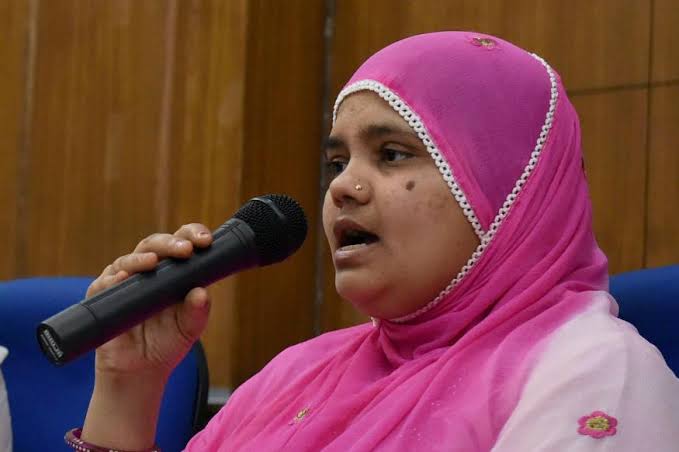
Consider what this produced. Bilkis Bano was twenty-one and pregnant when a Hindu mob gang-raped her and killed fourteen of her family, among them her three-year-old daughter. Eleven men were convicted. On 15 August 2022 the Gujarat government released them under its remission policy, they were met with sweets, their feet were touched, and a BJP legislator who sat on the panel that approved the release observed that some of the men were Brahmins of good sanskaar. India’s Supreme Court quashed the remission in January 2024 and sent them back.
Bano’s statement, issued through her lawyer, made one observation before it made any other. Nobody had asked her. No one had inquired about her safety or her wellbeing before the decision was taken. Then: “how can justice for any woman end like this?”
II. The Hazrat Khadija test.
The Crescent’s defenders have a list, and we will produce it ourselves rather than let it be produced against us.
Khadija was a merchant who employed the Prophet before she married him. Razia ruled Delhi from 1236. Nur Jahan’s name was struck on imperial coin. Four Begums governed Bhopal in succession for more than a century. In 1905 a Bengali Muslim woman, Rokeya Sakhawat Hossain, wrote Sultana’s Dream, in which the men are shut in the mardanaand the women run the state, and she wrote it in English, in Bhagalpur, while her husband was alive.
Khadija was a trader in Mecca and she died around 619, before the hijra, before there was an Islamic polity of any kind. The strongest evidence for Islam’s regard for women is a woman formed entirely by the commercial pagan society that Islam replaced.
III. The map does not match the faith.
World Bank figures put female labour force participation across North Africa and the Middle East at 18.7 percent, the lowest of any region on earth, against 28.1 percent for South Asia. That gap is real, it is enormous.
Deniz Kandiyoti’s 1988 paper on the patriarchal bargain drew the belt of what she called classic patriarchy, and it runs from North Africa through the Middle East, across North India, and into China. It does not halt at the Khyber. It crosses the Hindi heartland without slowing. It excludes Muslim Indonesia and Muslim Malaysia. If you want a map of where women in Asia are least free, religion will not draw it. Land tenure, patrilocal marriage, and the clan economics of honour will.
Then there is Bangladesh, ninety percent Muslim, whose female participation reached 44.15 percent in 2024, up from 24.08 percent in 1990. It got there through garments. Export industrialisation put women in factories and paid them.
IV. The female favour.
In 1985 the Supreme Court awarded Shah Bano maintenance from the husband who had divorced her. In 1986 Rajiv Gandhi’s government legislated the judgment away, because the clergy demanded it and Congress wanted the votes. In 2019 the BJP criminalised instant triple talaq, and Muslim women gained a protection they had not held the year before.
Read the two together and something ugly stands up. A secular party sold Muslim women to buy Muslim men. A Hindu-nationalist party defended Muslim women in order to prosecute Muslim men. In neither case was the woman the client. In both she was the instrument.
The 2019 Act was not worthless. It was real. But a right delivered as a weapon can be withdrawn as a weapon, and the woman holding it should know whose hand it is in.
V. The invisible kind.
Now the point on which we part company with almost everyone who writes about this.
Visible patriarchy has an address. Purdah, guardianship, the rule against travelling alone: these are rules, and rules can be struck out. Pakistan’s Aurat March knows exactly what it is marching at, and its placards are legislative documents. Mera jism meri marzi. Khana khud garam kar lo. Lo baith gayi sahi se. Ghar ka kaam, sab ka kaam. Every one of those names a specific man doing a specific thing, and can be answered. The clergy called the march immoral, a National Assembly panel called it the same, and two High Courts declined to ban it. That is what an argument looks like. The Crescent’s patriarchy is the ugly kind, and precisely because it declares itself, it is the kind that can be repealed.
Invisible patriarchy has no address. It lives in the second shift and the marriage market and the unpaid field. You cannot repeal a father-in-law.
Watch it operate inside a statistic. India’s female participation rate has climbed steeply, and this has been reported as an achievement. Meanwhile the share of rural women working in agriculture rose from 71.1 percent in 2018-19 to 76.9 percent in 2023-24, and the new work is largely unpaid or self-employed. The women did not enter the economy. They went back to the family plot. The number counts her. Nobody pays her.
That is why bahu-beti bachao is the more dangerous of the two slogans. Seclusion tells a woman she may not leave the house. Protection tells her there is nothing to leave it for, that the street belongs to men who will avenge her and the home belongs to men who will keep her, and it says this while calling itself her defence. There is no clause to strike down. There is no cleric to name. There is a flag, and it is held by her brother.
VI. Back to Bilks
After the eleven men walked free, Bilkis Bano said she had exhausted her reservoir of courage. She had not. She went back to the court that had freed them and she won.
A red line around misogyny is worth nothing if it is drawn only around the other side’s territory.
The Crescent tells a woman what she may not do. The Trident tells her what she is for. Both are in writing. Only one of them can be repealed.
Neither has ever asked her.
Men fighting over women’s bodies is a tale as old as time.
Women end up doing anywhere between 5-7 hours of “invisible ” work at home on a daily basis. This begins in the way girls are asked to help in the housework from a young age while her brothers get a free pass. She learns responsibility and he learns entitlement.
Then comes the cage of marriage where the man child gets a free glorified housemaid to continue with his carefree life. Only now, its a double whammy for the woman. She has a day job at office and a second job at home. She continues to pay the price health wise, monetarily with the increased burden of children and in-laws while the male flourishes having literally a single job. I mean who wouldn’t want a housewife juggling it all while he gets to go do the one job he’s meant to!
Patriarchy means “allowing” the dil to work but controlling her finances. Its all about subtle mind control, one that the patriarchy has fine tuned. It is also in the artful way the woman who endured it herself now enslaves the new entrant. The men deny complicity since it is the woman who enforces the patriarchy.
Religion gives primacy to the gilded cage, challenging it is an option in a plural state, unlikely in a theocratic one?
Very very good comment and true
Thank you. 🙂
The next obvious point is, does legislation actually assist in gradually chipping away at patriarchy or is it counterproductive?
Indian families seem to have circumvented the dowry law and use subtle coercion to get what they believe is rightfully theirs.
What is the best way to approach this? I personally believe that access to the internet and diverse opinions have accelerated the process of questioning these “customs” and the inherent unfairness towards the woman.
To all the male readers out there, and this is a question I have not to stoke the fire but as a genuine conversation starter. Are you willing to be to your wife’s parents what she is expected to be to yours?
That question deserves its own thread.
This is an excellent question;
Our setup is anyway fairly matriarchical; we are very intertwined with our in-laws.
this was our 900th post for BP btw huzzah
Yayy! 🥳
yes quite a milestone!
How lovely! A matriarchal setting just seems far more natural atleast to me given that it’s easier to adjust with one’s own family. I pretty much prefer a matriarchal set-up.
it’s much much easier since anyway the maternal grandmother is often the most important grandparent
I’m not sure I understand how you both are using “matriarchal”.
The effect of legislation on patriarchy is largely speaking marginal. It doesn’t matter how strict or progressive the legislation is if it is imposed on a society whose large sections are living in poverty. I maintain the reality that large portions of upper to upper-middle class women live largely equal lives with their partners with some exceptions. This is because of the economic reality of those women being on the same order of magnitude as economically productive.
The reason women remained glorified “housemaid” according to you is because someone needed to get those tasks done. In the absence of technology like washing machines, modern stoves, mixer grinders, etc these tasks are extremely labor intensive and therefore, women had to take up those roles as they were thought to be the gender more inclined to those tasks. Even during that era it wasn’t as if the male gender had it much better, farming was backbreaking labor and rarely was life even fair to the males. Male rates of poverty, and crime remain elevated in comparison to women even now.
Today we live in a unique industrial era where the significance of physical strength has been made largely irrelevant by chemical and electrical power and therefore we can imagine a society of equals. The only true path for equality is to be economically independent, otherwise you open yourself up for coercion in one way or another. Once economic equality is established it takes society one or two generations to adjust to the new standards, although this is slow progress for many individuals on the grander scale it is significant.
Finally, I think you underestimate how many marriages take place to manage parental issues for both genders. In cases where both individuals make around the same ballpark of incomes the parents tend to live a stones throw away from the family in a nuclear family+ kind of set up. Because parental interference in relationships has led to too many divorces recently in my family, so many prefer to keep them at a hands distance while ensuring they aren’t troubled by any health or mental issues by visiting frequently for both set of parents.
Interesting comment but women do a lot of invisible burden in a marriage..
This comment might not be directly relevant to the topic on hand but I believe one of the major casualties of rampant capitalism is the family unit. Dual income pressures are high and time spent together is at a premium. Children can then become a very difficult “overhead” when it should be the opposite.
This invisible burden is real for women in south asian societies where despite an increase in such pressures, the traditional role definitions remain rigid.
yes absolutely- but the nuclear family is an outcome of capitalism..
human beings aren’t meant to live in smaller units but much larger ones (which need trained facilitators to ensure justice & equity for all parties and avoid toxification)).
what happens in traditional model; trauma is passed own the generations.
Interestingly, in the United States, until the 1920s the families were all overwhelmingly joint. Today their society is an another extreme where the state fulfills many of the responsibilities that families would general bear by themselves and the family unit itself is broken. The greatest rise is the single parent family unit. This acceleration in the growth of the nuclear family happened during the Nixon era due to what now with hindsight seem to be consequential economic decisions.
Yes, legislation does not overlap with societal trends. It does not mean that regressive social norms should be allowed to continue unchecked. Patriarchy isn’t going to vanish overnight. But legislation can keep in check some extreme manifestations and act as a deterrent in the majority of cases.
Do you believe that unpaid labour at home that primarily falls on a woman is fair? Also, when you go to study abroad or away from home; anyone be it man or woman manages everything? Why should this change after marriage and the load fall unfairly on the woman?
You will be surprised that outdated gender norms and traditional gender stereotypes still exist across social strata. A few exceptions do not disprove the norm. Yes, nuclear families are becoming the norm for multiple reasons. This is true as both partners move away from hometowns for economic opportunities. Economic independence has given women a more equal say with regards to living independently and an equal say in all marital decisions including whether to have children or not. This is a positive step. Can you see why the alternative is greatly unfair to the woman? From living as the father’s dependent to her husband’s? Absolutely no agency as a human being first and foremost. Gender cannot define your entire life, that is what women have been fighting against for such a long time.
the more invisible injustice is; the more difficult it is to root out.
for instance how does one go into the bedroom.
Capitalism is a function of Patriarchy
I’d disagree with the statement that Capitalism is a function of Patriarchy. Because it is only because of Capitalism that feminism is possible. It is economic independence obtained through the freedom of capitalistic employment that is going to free the vast majority of women. The women who earn a living wage are much less likely to be coerced. If anything Capitalism is a feminist ideology as it wishes to have as many possible workers in a society to drive down the price of labor.
Why is it only because of Capitalism that feminism is possible? Capitalism has indeed facilitated the cause of women’s independence along with other factors but it’s not the only driving factor.
I agree with your premise that the nuclear+ family unit has alleviated some of the issues associated with a traditional joint family unit. It is gradually catching on. I would attribute this to higher education amongst women and also a refusal to endure what their mothers had to. One does not need to be educated to see the unfairness of the traditional family unit. If anything social reform to open up formal education to women and curbing child marriage created a situation which enabled women to seek a path away from being enslaved in a marriage. Capitalism created opportunities to utilize the education and become financially independent. This by itself was not sufficient to overthrow the mental chains of women still being required to defer to the wishes of their own family or those of their marital home. That pushback has only just begun maybe a decade back. Why you may ask? Because the myth of the superwoman who could have it all was then created. Truth is there can be no such superwoman. The price paid by a woman juggling it all is only obvious once the vitality of youth starts wearing off, leaving a train wreck both physically and mentally. Besides the other obvious question that arose is why are men at the periphery of child rearing and home making? Is their job considered done once the child is born? As per traditional patriarchy, the woman is the invisible vessel that just carries the offspring, nurtures and raises it but the child is known exclusively by the father’s parentage. How is this even remotely fair? Do all the hardwork and get invisibilized.
So to summarize, women are no longer interested in putting up with such a blatantly unfair system which ends up unfairly rewarding the other party at a very high cost to them.
I get the hue and cry regarding fairness underlies your whole argument. I’m going to argue that the system’s never been fair for the other side either. If we trace the human genome we’ll find that the number of female ancestors a person has is almost double that of the number of male ancestors they might have. This means that a large portion or the majority of males in history never had a child. Women by default have a privileged existences due to the fact that their ideas, and genetics are much more likely to be passed down than the equivalent male’s. Furthermore, this sexual selection pattern of males is reinforced by females themselves. Agni I need you to realize that from the moment you are born none of it is fair or an level playing field even for men.
The reason the child traditionally gets named after the father is that due to the heavy attrition among males the number of sexually selectable males in a society are an order of magnitude lower than the number of sexually selectable females, therefore to ensure those males feel some kind of a belonging to the child, the child is given their name or their family name. It also acts as a mechanism of social shaming if they decide to abandon their families.
None of these mechanisms are fair. They simply were necessary for the times they were created for. As time goes by new traditions will emerge more suitable for our current times but I don’t believe that they will be fair either. Therefore, if fairness was ever a precondition for human procreation we would never be here in the first place.
Of course it is unfair. You could have just agreed 🙂 in the first place. Being born male gives you a biological advantage. Doesn’t mean it ought to be converted into an unfair advantage across the board.
My primary point is that women are trying to correct the unfairness. And are facing backlash for it.
The point of these conversations is primarily to challenge your priors (yours meaning the readers). Have more such uncomfortable conversations with the women in your families.
Mitochondrial DNA that is passed from Mother to child is the only unchanging genetic material unlike the Y chromosome passed from father to son which also degrades over time. The mitochondrial DNA in turn is passed on only via the female line. That’s why the maternal grandmother is the most important grandparent. Epigenetics pretty much ensures that. So much for patriarchy.
As far as male giving the identity, look no further than the Mahabharata: Kaunteya, Radheya. So the logic of giving the father’s name is a relatively newer one, also ascribed to patriarchy in my opinion.
I thought my earlier comments implied that the system was unfair from the start. I can understand the feeling of constantly having to contend against set traditions making life feel unfair. But I genuinely think feminist could have less of an uphill battle on this journey if they highlighted some of the positives of a more equal world. Because many young guys end up being anti-feminist simply due to feeling that the feminists are trying to take some of their privileges away instead of creating a better world even for them.
That’s why have those uncomfortable conversations. Young men have had it easy. Unlike young women. Young men should not feel threatened just with women voicing their opinions. Hear them out without prejudice and without thinking they are anti-men. Feminism literally means equality.
The term male privilege is against inherent equality literally and figuratively. Perhaps you meant it differently?
You want equal partnership, then sons must be raised just as daughters are; same responsibility and freedoms. Women should not shrink to make place for men. It really is that simple.
Again there’s the issue with your ideas rhetorically. They come from a place of dragging someone else down instead of elevating both genders. If you wish to convince someone of a new idea or create a new tradition you need to portray its positives. Instead many feminists such as you believe that bringing down men is whats going to create a better world. That is an inherently flawed idea and it only leads to more “gender wars” and “culture wars”. You need to understand that women being treated better has no impact on the status of men. Male status is inherently dependent on male hierarchies which are independent of women.
Both sexes compete primarily within their own. Male status games are very different than female status games. I’m fine with having sons learn to cook and clean as well however saying things like young men have it easy undermines your ideas more than it does anything to give young women a better shot. Both sexes have their own set of privileges and maybe males shouldn’t have primacy to the degree that they do today. But if you come to specifically come to take the place of men in society you should expect resistance and hostility. Nobody will have sympathy in that battle as everyone will have their own interests.
Give me one good reason to elevate both genders especially when men have dragged women down for the most part of human history.
Men need to introspect, else they will be left behind as most are already. Women will not carry a burden that’s not theirs to shoulder.
Men have had it easy is a fact, not an opinion. Nobody is bringing men down, just asking them to finally own responsibility not just privilege. Both are two sides of the same coin.
**Male status is inherently dependent on male hierarchies which are independent of women.**
Then why are women the ones upholding male honour in this great game? Leave women out of it.
Both genders compete within each subset? Where’d you get that notion? Gender doesn’t determine competence, merit does.
That’s a stupid take. Males have provided for most of history while females have had to take care of the household. If females were capable of creating a perfect amazon utopia without men we would’ve seen or heard about it.
You seem to be interested in creating negative framings about half of society. Does that lead to positive outcomes for women or is that rhetoric pointlessly caustic? Your talking points are a net negative for feminism. For most of history male dominated civilization was willing to burden share even in rather toxic joint households. If your ideals won’t survive a single generation they are bound to fail.
Again what are you even talking about? Is there any point in this discussion or just female grievances being verbalized. There is no indication that you desire any positive outcome for the other sex. If thats the case you are arguing the same argument as Q is just from the other side.
That is an obvious misunderstanding on your part. In status games the males compete among themselves for mate selection and so do women. The idea that there is widespread competition between males and females for mate selection is stupid and ahistorical. The only reason both sexes compete in terms of status has been for the sake of mate selection.
You need to watch your tone OM-3. You sound like a young person with very little experience. A formal education clearly does not translate into basic etiquette or common sense.
Engage respectfully. Your arrogance does not reflect well and all your talking points are well, utter rubbish.
What alternative do I have? To engage with an ideology so destructive that it pits one half of humanity with the other half.
Please enlighten me on how it is destructive to expect men to take responsibility for themselves?
Rhetorically you are more interested in making the world worse for men than you are interested in creating a world in which women can have it better. You will find me completely onboard in more burden sharing in a household but instead what you strive for is to put forward misandrist notions for the sake of moral domination of the other party. These are some examples of open misandry:
It is obvious to me that if men were brought down in status further it would somehow benefit women is a mistaken notion. Even rhetorically if looked at these statements we will find that your ideas have limited support among women. Personally, I’ve got 4 nieces for whom I wish to create a world that is away from this pointless mental toxicity. A world ideologically divided among the sexes is an objectively worse world. The ideas you seek to proliferate have no appeal among men and will end up creating pointless conflict where none needs to exist. Women and Men primarily work together not apart, as in a household where participating in it makes it better, this is a collective responsibility of both sexes. If you keep looking at it from a negative sum lens of one party being the burden you’re not suitable for it.
Re-read those quotes in the context of your responses to me. To anyone objective enough reading it would see your responses as clear misogyny because of the fear of dismantling male privilege. How would you not expect pushback?
Instead of quietly accepting the historical injustice, and continued repression you are busy whinging about males feeling insecure about females even expressing their frustration and unhappiness at inequality. Isn’t it ridiculous? And you accused me on the other hand of whining!!!
Debate the facts, not the woman.
I reiterate feminism means equality across the board. Equality is not just in those spheres where it suits you. You really need to re-think your maximalistic positions especially the way you express them and if your intent is not quite that.
Its quite clear to me that the status quo of a subservient woman ( though not as extreme as Q) is the one you seek. Say it openly instead of pretending to seek progress.
What worries me is that you are young and yet you believe that throwing a few crumbs at a woman will automatically result in her capitulation to your continued dominance.
Even RNJ was uncomfortable with your takes on men. I’m fine if they were simply personal feelings, however they do seep into the ideas you have about gender relations. Eventually those ideas are bound to lead to fractures. Today’s men can’t be expected to carry the cross for sins of men who are generations past. Furthermore, you quietly sidestep the repeated instances of misandry. You can accuse of several things however I am not a adherent of the status quo by any chance.
I wish I did find a subservient woman. My life would’ve been much easier if that what it has been until now. Regardless, I’ve never known such a woman to exist, even in joint households women are the origin of almost all ego battles. I’ve known women to be many things subservient they are not.
Let’s be clear you don’t want equality either you want an unconditional surrender from the other side. One which you won’t even use to perpetuate your own progeny according your own admission. This is the main issue with your ideas is that they are bound to disappear after you as there won’t be any succeeding order if you get your way.
I think you are perpetuating a dangerous idea that women are some kind of a superwomen who can exist independently of all male contact and that males are some kind of barbaric lesser creatures that need to be abolished to history.
A realistic look at history would tell us that vast majority of all people were heavily restricted, i.e., they were slaves, serfs, or unlanded peasants. These folk some how banded together or utilized another technological and societally advanced ideas from outsiders to uplift themselves to free citizens. In this process of upliftment males had primacy over females and that is an injustice between the sexes. However, the period of slavery was 1000s of years while the gap between the upliftment of males and females was maybe a 100-200 years. Therefore, what I argue for is a generationally incremental change in tradition, not a revolution as you would prefer but something that preserves the society while making space for women. You will always wish for a maximalist position but you will have to compromise based on the society you will live in. That is the nature of this bargain we make.
We have already come quite far as a society in our upper strata. Women for the most part enjoy equality in status in this part of the population, and I’m personally for further progression of norms as well. However, social changes need to rely on economic progress to make the bitterness of change palatable.
I disagree that my statements are misandrist. I own my statements, please point to me exactly why you see them through a man bashing lens. They are simply an expression not to mention fully factual at my exasperation of having to continually fight for basic equity.
Along with Q who’s delighted at this turn of events only RNJ is discomfited. Just the three of you in the same boat. Think about it.
I do not wish to elaborate on my personal situation, but it should suffice to know that my ideas will not die with me. Besides, what you think is an extremist view, is actually one that a majority of women espouse. They won’t say it aloud, but they will vote with their feet. Why do you suppose more young women are choosing not to get married? It isn’t because they hate men, it is because they don’t see the benefit of that social obligation anymore.
And I don’t hate men contrary to what you believe. I have been fortunate to have exemplary men in my life from my father to my advisor to my spouse, so my bar is just very high.
Why are you arguing with me? Enjoy your life!
“That’s a stupid take. Males have provided for most of history while females have had to take care of the household. If females were capable of creating a perfect amazon utopia without men we would’ve seen or heard about it.”
Don’t know about history but this is really a stupid take in today’s India. 2/3rd workforce in agriculture in India is women today. In Haryana, this number is even higher. Add to that the obvious biological restriction that only women can have children and they also take care of the household, the picture is clear on who is doing the providing.
In Maharashtra, women are officially classified as unpaid labourers despite working in the fields and their operational holdings in the land their labour on completely negligible. The Gokhale institute has an entire report on this and numerous studies by the state government also mention clear statistics on all of it.
Did you not see history in that comment?
I don’t notice your comments in general.
Then don’t reply.
Too much know it all stupidity is difficult to let pass :).
Archer at least try to get the grammar right. I’m having trouble even understanding what the hell you’re trying to say.
dude take it easy with the snobbery..I am not here to wrestle with you…
Are you OK? This…..sounds quite OTT, to put it mildly.
I’m surprised this is the first time you’ve heard a viewpoint like this? I’m genuinely asking why does it feel OTT to you?
To be clear, this is not meant to be taken personally, it is an observation. Certainly doesn’t imply that I’m making that observation about any specific individual(s).
Last month I was branded a ‘misogynist’ for stating the obvious, now it’s amusing to see everyone else coming around to my point about modern women.
Men are simply more powerful, more violent and have more willingness to commit violence. All female rights are granted by men, as a favor to them, because females on their own cannot achieve them.These rights can be easily taken away (case in point: Afghanistan) and the most women are going to do is yap about it and then adjust to the new reality.. Human history is full of men killing other men and taking their women (and land, and sheep and other property). This is why humans today have twice as many female ancestors. Our history and even our biology is shaped by this bitter truth – it should never be forgotten but modern society has given imbibed undue confidence in many who should tread carefully.
Women are property’ – no wonder the likes of Andrew Tate find so many incels willing to follow them.
No matter how many ‘gotcha’ strawmans you come up, the most amusing part is you calling me an ‘incel’ when I seem to be the only one here who has reproduced several times.
Is that last line meant to be a threat Q? I don’t take kindly to veiled threats.
The whole point of progress is for men to move away from being more violent instead of reverting to the crude middle ages. But that argument is lost on you.
yes we thought Q was simply being clunky but it was really bad phrased. we leave it to your moderation.
Yes, very clunky, very Q. Will just leave it as is.
He has a point though. No wonder he’s gleeful. A couple of commentators are proving him right. That they are on the same gender spectrum as him is what has been the revelation. Not as extreme as him for sure, but tilting towards the continuation of male privilege while simultaneously expressing horror at his extremist stance.
such viewpoints are seen occasionally on the fringe, but I generally tend to start with the assumption that folks on BP aren’t….quite so extreme until they show me otherwise.
To be clear, your ‘observation’ is that men have ‘dragged women down for most part of human history’ and that there is “no good reason to elevate both genders”?
Rest assured, I don’t take opinions and debates ‘personally’. Debate the topic, not the ‘man’ (or woman) – is something I’m quite confident about practicing, not just preaching.
Men and women are fundamentally equal. Different roles do not mean different status. Any society that disregards this is doomed. The Indian subcontinent’s downfall is directly linked to its treatment of women.
As far as Q’s views are concerned: His view that women are chattel is abhorrent but unsurprising.
Q isn’t very clear on his views of women. considering that he has women in his life; it would be interesting to see whether he would want them to be university educated etc..
we are not here to judge but simply trying to understand.
for us the life of the mind is fundamental and sacral
True..I shouldn’t have been so judgemental..I too would like to know more from him about his views on women and their role in society, apart from only reproduction..some nuance, If any from him, would be insightful
You have taken both my quotes out of context of the conversation I was having with OM-3. Funny that you have fixated more on my response to his assertion of the fear of loss of male privilege as the primary pushback against feminism.
I wonder if it is indeed a euphemism to protect what ironically Q believes, the continuation of the subservience of women. That is how it sounded to me.
Historically what I have stated is a fact, so if it unnerved you, it would imply there’s a grain of truth there. So, debate the facts disprove what I have said.
On elevating both genders, women who are pushing back against inequality primarily as a function of male dominance should now factor in the male unhappiness at it? How ridiculous!
I’m shocked that on BP, a woman talking openly about the obvious poor treatment of women historically should elicit such a virulent response.
I’m even more appalled that men (clearly not all men — XTM, BB and Archer among the exceptions on this forum) seem to want to push back against revoking male privilege even though that comes at the expense of the woman.
It appears that instead of actually addressing any point I make, people seem to attack the person behind the idea, not the idea. I have not attacked anybody personally but restricted it to arguments about ideas.
Nobody seems to address actual fatcual talking points and nobody here seems to ask the all important question: ‘Why?’
Why do you think this is a threat? A threat can only be made through power, and I don’t have any power heren and I am not in the business of making threats online – don’t think I was ever riled up online in decades to be making any ridiculous threats.
Take off your biased sunglasses and read the argument presented before: all female rights are granted by men (a minority of men, to be precise) and they can be taken away as easily as they are granted for reasons also presented above. Does anyone seriously doubt this assertion? Religious people can pretend those rights come from god/gods/goddesses.. but none of you here are actually religious so where is this entitlement coming from?
Okay, but again I must ask why? What’s in it for men? Why should the average man want such progress to sign away his privileges and his advantage? What is the appeal?
Males only complete with each other, they don’t compete with females. The only reason for males to ever want ‘progress’ is to put down another competing male. Once you understand this, you start to understand why the world works the way it works. Women are not in the driving seat, they never were, and they will never will be. Women only get power by controlling the males in their lives, via sexual or emotional blackmail.
Today the centralized state created by men acts as the ultimate provider for females doling out resoruces and protection, which allows women all these freedoms. When they need help protecting, they call a three digit number and men with guns show up to protect. When the state gets weak you see how quickly the women start finding the men in their lives more useful, and everyone starts self arranging into a patriarchical setup.
Over here, you deintegrate men but keep appealing to their emotional protective side that they should give you what you want in the name of progress, even at their own detriment, even when you insult them. This can work for a while, but a bad strategy long term.
Rights are not granted by men to women; they are inviolable and inalienable in law.
By your logic the state grants rights to the dispossessed ..
This Hobbesian contention is a bit extreme.
Once again, I must ask, why are they inviolable?
Intelligent men enshrined these rights in religion, so men would not question them. But what about non-religious people, what stops them? Outside of near kin, there is no evolutionary reason for humans to ever be so generous.
unfortunately it looks like we won’t be able to write anything tonight (we will try but a bit swamped).
natural rights aren’t just embedded in religion (though you are correct) but we will also live in civilised society.
For instance “old men” are physically much weaker than young men in their prime but it is the Old Men who send the Young Men to war..
it’s the same in Sports; more often than not power rests in Coaches and Captains and Team Owners who aren’t as physically robust as the younger players (who are often exploited)
IK was 39 when he won the World Cup.
so Physical strength isn’t an exact barometer..
They aren’t inviolable. They are simply a necessity if you wish to make your country to competitive and industrial. Pakistan is neither therefore it can continue not have any effective women’s rights. The reason to have women’s rights to have a larger tax base, to create larger population for mobilization in case of war, to have better pools of talent, and various other tertiary benefits. None of these matter in an economy which is not industrialized and has an excessive unemployed male population as physical power remains cheaper than chemical and electrical power.
Again intelligent according to you, not to a vast majority who disagree.
Nobody “grants” anyone rights. Rights are taken by force. How do you think women have come so far in the fight for equality. By batting their eyelashes at the few men in power? Your analysis is incredibly naive if you believe that women are still some sort of damsels in distress. In case you’re unaware of the phrase, the female of the species is deadlier than the male.
How long do you think the male dominance in Afghanistan will last? They’re gradually killing women off by denying everything a human being there needs. And we all know what happens when women die. No more baby making machines? The fools are doomed to extinction. Yes, the TFR is high but so is infant and maternal mortality. This all assumes that the majority won’t revolt in due course. Which too shall happen.
Women don’t “need” emotionally stunted men for any favours. Please wake up and smell the flowers.
Now it’s becoming increasingly tenous at all levels of society.
Ok, you do realize that there are multiple other ways to take something by force, right? Or are all the historical queens and female army leaders made up of fairy tales? Oh right, you don’t read history only the 7th century book that you must. Which is funny since I distinctly recall you agreeing with me on “nothing is permanent but change”. You are delusional here, not me.
Please look up all the movements which have given women the rights that they took along with sensible male allies.
Your positioning is so extreme that you tend to oversimplify every argument. Sometimes I wonder if you’re an actual caricature. You are particularly hung up on disenfranchising women as humans. What is your motivation beyond the humanity will die angle. Where’s the nuance?
Which ones? And which ones of those were violent where rights were ‘taken by force’ by forcing men to surrender?
What are these ‘multiple other ways’ to take something by force?
There is no motivation here, it’s just laying out the basics since modern society is so coddled that they do not understand base reality.
Did these queens fight for capitalist modernity?
I certainly did not imply that?
However, the Arthashastra (Kautilya), approaches wealth (Artha) as the foundational pillar of society, essential for both state security and human happiness. While it embraces a profit-oriented, market-driven economy, it diverges from modern capitalism by enforcing strict state regulation and prioritizing the community’s collective welfare above individual profit.
In fact, as per Hindu philosophy Artha is one of the goals of human life. True?
Kings and Queens of the past would have presumably adopted this in the way they ruled their kingdoms? This is more of a hypothesis on my part, not having done an in-depth reading of the same.
Ayn Rand influenced Alan Greenspan, the father of modern American capitalism. Fountainhead and Atlas Shrugged amongst her bestselling works.
Oh sorry, I think I misread your comment there. I think I read the opposite of what you did. Yes, I would agree with you here generally speaking.
I have consistently and repeatedly criticized Q’s … incel-esque takes on women and gender, the fact that you are attempting to club my perspective with his, suggests a…strawman motivation.
What pray tell, is a historical fact? I specifically quoted and challenged your grossly OTT assertion – poor treatment of women is not in question here, historically or even contemporary. But to claim that there is some sort of intentional masterplan patriarchal ‘conspiracy’ throughout time immemorial to ‘keep women down’ is….far-fetched.
And so is a needlessly ‘gender-war’ attitude of deeming the male gender as ‘undeserving of being ‘elevated’.
One can be honest about gender discrimination and the genuine challenges faced by women, even in the 21st century, across all societies, modern or otherwise, without going full “feminazi”.
And simply because one challenges one aspect of a perspective, does not render them “defenders of male privilege” or whatever nutty strawman you are so loosely throwing around.
Let it be man. She isn’t going to be convinced by any talking point. She’s like a Tamil atheist who decries god in public and then does pooja in private. The talking points are more of a fashion statement for her than a matter of principle. On one hand she calls all men violent and evil, on the other hand she’ll carve out exceptions in that statement for her close relatives. There is no point in this conversation, I just realized it too late.
we have not been interfering but surely you are aware Agni is Admin on this blog?
Does that make commenting against her sacrilege or blasphemy?
Thanks XTM. We shall let this pass by attributing it to the bluster of youthful arrogance combined with a narcissistic, insecure personality type. One that presumably lives in a joint family set-up and attributes all family problems to the women in the house.
You have obviously been stewing :). But you should reflect on your condescending tone and responses.
“Your late realization” and assertions regarding giving “relatives a pass” is absolute rubbish. Firstly, you know nothing of her experiences with the men in her life and yet assume there is a double standard here. Secondly, we all shoot from the hip, that doesn’t mean there is no nuance to the argument. Her response to Kabir’s comment should make that perfectly obvious.
What you are doing now is passing judgement rather than forwarding an argument. What is good for the goose is good for the gander. A response in kind might come your way as well given some of your comments such as ” I wish i had a subservient woman in my life, it would be so much easier”.
Grow up young man. Your know-it-all attitude along with the subtle misogyny that drips in your comments not just on this topic is there for all to see. You need to reflect on how to engage with women or men whom you disagree with.
This comment of yours attacking me personally has actually proved my point beyond any reasonable doubt.
Statistically, you have no argument. It is indeed a historical fact that women in the subcontinent have had a raw deal for centuries. This is one of the primary reasons for the downfall of the subcontinent.
You don’t have to take my word, here are a few quotes from Swami Vivekananda.
On oppression of women by men. No strawman argument here.
“If you do not allow one to become a lion, he will become a fox. Women are a power, only now it is more for evil because man oppresses woman; she is the fox, but when she is not longer oppressed, she will become the lion.”
On the condition of women in the subcontinent.
“Can you better the condition of your women? Then there will be hope for your well-being. Otherwise you will remain as backward as you are now.”
On equality between women and men. In “The Republic”, Plato too has written about the inherent equality between men and women. T
“The best thermometer to the progress of a nation is its treatment of its women. In ancient Greece there was absolutely no difference in the state of man and woman. The idea of perfect equality existed. No Hindu can be a priest until he is married, the idea being that a single man is only half a man, and imperfect. The idea of perfect womanhood is perfect independence. The central idea of the life of a modern Hindu lady is her chastity. The wife is the centre of a circle, the fixity of which depends upon her chastity. It was the extreme of this idea which caused Hindu widows to be burnt. The Hindu women are very spiritual and very religious, perhaps more so than any other women in the world. If we can preserve these beautiful characteristics and at the same time develop the intellects of our women, the Hindu woman of the future will be the ideal woman of the world.”
“Statistically, you have no argument. It is indeed a historical fact that women in the subcontinent have had a raw deal for centuries. This is one of the primary reasons for the downfall of the subcontinent.”
It’s a historical fact that almost everyone living in pre-modern, pre-industrial times has had a “raw deal” for centuries both from the point of view of objective material standards of living available and the other subjective ones that liberalism leans on. This isn’t a “both sides” had it tough argument, but an argument that there weren’t only two sides before modernity. There wasn’t an overarching idea of solidarity among men or women. It was one’s clan and culture navigating a social space inhabited by other families and their traditions.
The reason for the “downfall of the subcontinent” is actually pretty clear, historically, and doesn’t require the use of supernatural beliefs about morality by political fundamentalists. The Buddhists of Sindh betrayed the Hindus to Arab invaders, leading to the conquest of that land and the eventual absorption of those Buddhists into Islam. This, combined with the lack of a totalizing ideology like Islam or Nationalism among Hindu rulers, as well as them still recovering from Hunnic invasions from a few centuries earlier and their continued (albeit largely individual) struggles against Islamic armies (which were still largely successful until the 1100s or so), and their lack of technology in the form of firearms are far more explanatory about why the subcontinent went the way it did.
No. The deeper and more fundamental causes of weakness in Hindu society can be well inferred from the writing of Megasthenes and Al Beruni.
So you’re agreeing with me yet not agreeing with me?
Of course you will push back against Q. He makes you uncomfortable with his extreme position. It is the less visible patriarchy that is the system that has suited all men whether you care to admit it or not. How many men push back against this subtle domination very honestly? It may not even strike you obviously since its a stye in the eye.
Just because the system runs without a glitch at a compromise that works for you doesn’t mean it works for women. This is the nuance that your meaningless bluster lacks in entirety.
A few enlightened ones saw the unfairness in the system and fought alongside “feminazis” like me for women to have come so far. You can continue attacking me personally, it really doesn’t change the facts.
Why Kabir and I had a far more civil conversation despite the fact that our opinions on the topic couldn’t be more divergent.
I think….its possible to have strong opinions without either being abrasive, or making sweeping extrapolations about who you are having a disagreement with.
I don’t disagree with this at all. It holds true for all parties in the disagreement.
to be fair BP has gotten a lot calmer now; there haven’t been any precedents for a while 🙂
it really seems the Gender Precedent was quite the landmark
…………..or, the exit of a certain bad-faith participant.
Anyway.
BP is constantly evolving 🙂
“Capitalism is a function of Patriarchy”
How so?
Human agency and progress are both deleterious brainworms that need to be discarded for the benefit of both the world and people themselves. Everything you describe is at least correlated with the erosion of culture and civilization, not least because they are acidic solvents that are useful to Capital to capture desire globally.
Legislation can definitely affect culture, but it seems like in the present day, economic incentives have been much more impactful on shaping culture. But, I don’t think it’s one or the other. It’s more like a feedback loop between the three imo.
I agree with this.
“Women end up doing anywhere between 5-7 hours of “invisible ” work at home on a daily basis. This begins in the way girls are asked to help in the housework from a young age while her brothers get a free pass. She learns responsibility and he learns entitlement.”
I don’t see how this is true. Boys were, in the past, expected to learn the family trade, and are, now, expected to study and get a good job. There was a transitional period between the pre-modern and modern capitalist economies where this may have been true, but it sounds just as ignorant of men’s responsibilities as men are of women’s. Furthermore, the increasing dominance of capitalism and the social consequences that have precipitated as a result of this have necessitated that men also take up many of the responsibilities that were previously considered women’s work, especially as marriage and fertility rates decline and people increasingly live away from their families to pursue economic opportunities. This already happened in the West, and I think it is happening in India and in other parts of the developing world now. Men and women have to compete against each other in the workplace and this drives changes in culture such as sharing chores, which is culturally becoming more common. Again, this change is underway in the West, and it will probably begin in India soon enough if it has not already.
The quoted statement is unfortunately very true even today in the subcontinent. The whole point of the argument in this thread is the need for a new social contract between men and women. The Pakistanis say no because (a) their society is too traditional and/or (b) women don’t have their own agency so men will decide. The Indians in this thread acknowledge women have their own agency but still prefer the traditional structure. Which is why within sections of Indian society where women are able to exercise their choice, either the family unit collapses because the woman walks away, or women choose not to enter into it in the first place. The changes you are referring to in the west are slowing happening in the subcontinent as well but it is still miniscule in scale.
Well articulated. In agreement. The movement might have started slow in India but it is increasingly catching up. Just a couple of decades, and the number of DINKs not to mention single people has risen dramatically.
It’s obviously not. Men and boys didn’t sit around doing nothing all day, which is what the original statement says.
“The Pakistanis say no because (a) their society is too traditional and/or (b) women don’t have their own agency so men will decide. The Indians in this thread acknowledge women have their own agency but still prefer the traditional structure.”
I think they are both wrong. There is no such thing as human agency, much less agency for women or men. There are material and spiritual realties and forces that go largely unseen by us, in whose flows we are forever sinking and rising. If agency exists, it is the in the ultimate choice to renounce this, which is, anyways, not something a conditioned being is capable of doing on their own. I think even in the world, the ultimate and probably only act of agency is pure exit. Trying to swim and using your voice might be valid methods of mediation but they are no guarantee of liberation.
“Which is why within sections of Indian society where women are able to exercise their choice, either the family unit collapses because the woman walks away, or women choose not to enter into it in the first place.”
I agree, but I don’t know if this is women making the choice. I think it’s the modern capitalist subject that happens to inhabit a female body. I think those are two different things. Not to mention that this seems to be correlated to wealth in many times and places, and correlated to education especially in modernity.
1) these days families are having 1 or 2 children. I have seen boys getting attached to the girls families so much that many feel that they have become ‘ghar jamai’.
odd expression; ghar jam. what’s wrong with the matriarchy
But the pressure is on the boy to take care of his family also!!
Why can’t both be true? Girl takes care of her parents and boy of his. Only fair no?
also parents do need to pull their weight; the concept of old age in the Global South and the Global North is so radically different.
Very true. Parents in the global south tend to make their lives all about their children instead of living their own lives to the fullest.
Before somebody objects, yes there are folks who have moved away from this expected child centric positioning and do live their own lives.
Paradoxically in the Indian set-up, this parental independence is also funnily frowned upon. Once your children are all grown up and independent, why should parents hover? It leads to stifling the younger generation and unnecessary resentment possibly at both ends. In reality both parties both young and old get to live their own lives if there are no such underlying expectations both ways
yes to be honest everyone should pull their weight and avoid emotional labour.
we notice in traditional culture; people rarely speak openly?
Indians don’t speak openly. Something I personally have a huge issue with. Just because one is candid, does not mean they are rude. But to be candid is unfortunately conflated with rude abd worse yet, disrespectful especially if the disagreement is with an older individual.
Yes, it has a very negative connotation. Funny how a daughter-in-law has to listen to / is fully answerable to her in-laws but if the son-in-law so much as behaves properly with his in-laws, the barbs start.
I agree why is it a problem if the sil gets attached to his in-laws? It is literally expected of the dil to get attached to her in-laws, why is the reverse frowned upon?
exactly – we’ve always found this to be very odd. but then that’s why we always try to avoid the herd instinct..
hinduism is changing or adapting to current situations very fast. yesterday, s.janaki’s grand daughter stood in for her late father, for the cremation. this is welcome and is becoming widely accepted.
south indian hindu weddings are becoming more north indian ( sangeeth, mehendi etc), and in south karnataka most communities follow brahminical procedures. some sort of sanskritization.
Very heartening to hear. Yes, customs are gradually democratizing in a positive manner. In MH, upanayanams have become a regular feature for girls, something relatively unheard of even a couple of decades back.
I am finding this gender discourse very interesting. To me, it does seem like a war where men and women are on opposite sides.
I do think–with great respect– that referring to marriage as an arrangement where a “man child gets a glorified housemaid” does come across as a misandrist opinion.
Women also benefit from marriage. There is a social status that comes with being the wife of a wealthy man. In South Asian culture, the man is accepted to provide for his wife and children. The woman’s side of the bargain is that she is accepted to produce children and raise them as well as take care of the home. Whether we like it or not– heterosexual men and women cannot do without each other. There is also the fact that–in most conservative societies– unmarried people are not supposed to be having sex. So, in order for legitimate sexual activity to occur people do need to marry.
Being an unmarried woman in one’s father’s house (in which now one’s sister-in-law is the person calling the shots) is not really fun for anyone. A lot of people find it preferable to enter into a marriage and at least gain legitimacy in society as someone’s wife.
I’m not at all religiously or socially conservative. In fact, most of my views are those of a center-left American. I’m all for people living their lives as they choose. If they don’t want to get married, don’t. Don’t want to have children, don’t.
But feminists do need to deal with the fact that women cannot do without men. And women cannot have it all. Those who focus too much on their careers etc miss the window for child-bearing. If that’s a consequence that the woman is willing to take, good for her. Not everyone needs to be a mother. But those who do want to be mothers need to find a man and produce offspring latest in their thirties or it’s never going to happen.
Even in Pakistan it’s not like all women are child producing machines. There are plenty of upper middle class women who are doctors, lawyers, engineers etc. Yet, they are also good wives, mothers and daughters-in-law. There are women in positions of political power–not just those who come from political dynasties but even people like Sherry Rehman (ex-ambassador to the US).
While men should certainly contribute to the household, nurturing offspring is fundamentally the job of the mother. It’s the father’s job to provide an income for his wife so she can do her job. This arrangement has to work for both parties.
Women cannot do without men?
But they can get sperm donors and their families to help raise their kids..
Are we discussing this in a Desi or Western or global context ..
Haha true. A lot of expat desi women that I know have indeed taken this path.
If a woman is heterosexual she needs a man at least for sex. Just as heterosexual men need women for sex.
In conservative societies, the only legitimate sexual partner is one’s legally married husband or wife.
Again, I really do not care how people live their lives. But generally men require women and vice versa.
It’s fairly easy to scratch the itch in most parts of the world..
My point is that if you are heterosexual you need the other gender for sex if for nothing else.
Marriage is needed if one wants to raise a child. Of course, in the West one can raise a child out of wedlock.
I do agree that this is indeed the majority position in most societies. It is also true that women aren’t buying into it anymore. They are increasingly choosing to stay unmarried or getting divorced instead of staying in a bad marriage.
Unless there is mutual understanding and conversation on what each partner expects in a marriage especially in today’s day and age, more women will exercise their choice to walk away. Traditional gender based roles will have to be re-evaluated by both parties. Women who are financially independent will demand a more equitable arrangement in the marriage.
A lot of progress that women have made so far is in no small part due to the men who recognised practices as unfair and supported their daughters, wives or sisters. Even when society was against them.
I must also say that some opinions here are quite unlike what I’m used to hearing. It’s always good to know views different from your own, independent of whether you agree with them or not.
I had expected the traditional / old-fashioned views perhaps from an older generation. It took me by surprise to see a presumably younger person express those.
Here is where I’m in agreement with OM-3. Men and women have to work together to see what parity works for both. The choice should exist for both to walk away if it doesn’t work.
I don’t think anyone should stay in a “bad marriage”. Obviously, there has to be mutual understanding.
At least in Pakistan, staying unmarried is not really a good option. The only legitimate sexual partner a woman can have in Islam is her legally married husband. If a woman wants to stay celibate forever or engage in illicit sex then I guess OK. But that’s far outside society’s norms. Most decent families will want their daughters (and their sons) to make a good marriage.
Divorcees usually aim to marry again. There is a certain social status that women can only get through marriage–at least in conservative societies.
Even in the West, women look for financially successful men. The bargain is that men provide financially while women agree to play the role of wife and mother. Obviously, if people don’t want to enter into that bargain, they don’t have to.
Even a financially successful woman has to agree to be a wife and mother. Otherwise, what’s in it for the man?
I do think that your contention that marriage is “men children looking for glorified housemaids” is reductive. It does seem to reflect a certain contempt for men.
In India atleast the stigma that used to be associated with staying single no longer exists. There obviously continue to be safety concerns in such situations, but city living in gated communities does provide a reasonable sense of security. Indian society is not as conservative as it used to be even a couple of decades back both in urban and rural areas.
I won’t dispute that my wording “man child with glorified housemaid” does sound contemptuous. It wasn’t meant to, rather it was supposed to convey the unrealistic expectation of the dil to take the responsibility of even daily tasks which includes basic stuff like folding clothes, or chopping veges, doing the laundry, cooking etc while her hubby’s life just goes on unchanged. The baton being passed from mother to wife seamlessly while the man enjoys the privilege of not ever having to do chores that add up to anywhere from 5-7 hours daily for the woman.
In today’s age with both parties working, both need to step in with household chores just like both contribute to the financial running of the household.
I expect any individual irrespective of gender to be fully independent and self-sufficient in financial and household matters before getting into a relationship let alone marriage. Partners choose to live together not because one lacks financial independence and the other lacks household skills. It may have been the case in the past, but it doesn’t hold true anymore.
To be honest householders need to be as large and expansive as possible with trained facilitators to handle interpersonal conflict; to ensure justice & equity for all..
Very true
If men are expected to provide financially for their wives, it is not too much to ask that when they are home they are not burdened with childrearing and running the household. This is the woman’s task in a marriage. Otherwise, what is the point of marriage from the man’s perspective? It’s not sexual satisfaction because in our culture men have many more avenues for getting that without all the emotional demands that a wife makes.
When it comes to financial management, I have seen in my own life that my father is responsible for all that. My mother makes sure the house runs and the meals are given on time etc. Of course, in upper middle-class Pakistani households that mostly means managing servants. No one is asking her to actually chop vegetables. Even if my mother wants travel arrangements made, she gets my dad to do it. She’s of course capable of doing it if she needs to but it’s the husband’s job.
I don’t disagree that women have a double burden of having to achieve in the workplace as well as run the household. But at least in Pakistan, if a woman wants to be a stay-at-home mother that option is entirely available to her.
The main reason for marriage is procreation and raising the next generation. If a woman doesn’t want to do that then she shouldn’t get married.
But a man who wants a “housemaid” can just hire a servant. Asking someone to become the mother of your children is a whole different thing.
geebus, this sort of view of ‘desirable’ gender roles is …a throwback to the 1960s.
Sir, this is a ceasefire violation.
I have absolutely no interest in dealing with you or your views on any topic.
Leave me alone and do not reply to my comments.
I…. think a center left liberal would be aware on how public comments work on a blog post thread.
Your…n’th iteration of “leaving BP” as contributor means all of that drama is a closed chapter.
Comments on a public thread are a public discussion. You of course are free to ignore my comments.
And have a fantastic friday.
We are meditating on this- about the Online Safety Precedent in light of Kabir’s return.
However RNJ, you must not be rude to Kabir (who is acquitting himself fairly well); we removed that line. You must not repeat that line again (you know which one we are referring to).
We are sorry to be harsher than normal but it is not a good inference at all.
We have reflected on this over dinner at one of Delhi’s oldest restaurants.
(1.) the Online Safety Precedent is there to protect actual online safety; not just disagreeable views.
(2.) for instance one of RNJ’s lines, which was edited, was genuinely unsafe and we have now issued a formal warning never to repeat that line.
(3.) however the Online Safety Precedent cannot be used to stifle dissent.
(3a.) as our late & great Badshah mentioned, “we” are basically Bharat. We expended a lot of emotional energy in “levelling” the playing ground, when we tend to be 70-30 Saffroniate-Cresceniate.
(3b.) for instance our views most align with Nive’s on gender issues but we don’t interfere much.
(3c.) we want to avoid refactionalism now; with the resignation of the Team Captains, we prefer now a space that is high signal and has more light than fire.
RNJ may reply to Kabir etc however must not cross the line, that we have asked him not to.
Hope this is satisfactory to all.
Amendment to the Online Safety Precedent.
This is not satisfactory to me. I’m sorry.
RNJ has a history of personal nastiness towards me (both direct and passive aggressive). I will not tolerate disrespect.
So if there is no ceasefire, it leaves me with two choices. Either withdraw completely or respond to his nastiness with nastiness of my own. Both choices are suboptimal.
I don’t really see the need for RNJ (or anyone) to insist on engaging with someone who has made it clear that they do not want to engage with him.
This is not about “dissent” but common courtesy.
If you truly want to avoid refactionalism, then people must be told in no uncertain terms that they cannot disrespect each other.
I have not responded to a single comment of RNJ’s until he broke the ceasefire. As far as I am concerned, that ceasefire never ended.
where has he been specifically disrespectful?
it is trivial to email in instances of disrespect at which point I’ll investigate it and revert back?
if RNJ crosses the line; I will tell him and caution. Same for you.
Being nasty to nastiness is not an appropriate response; the appropriate response is flagging the complaint in the correct channel as I’ve been asking for months..
My point is that it is inherently disrespectful to insist on engaging with someone who doesn’t want to engage with you.
He needs a Pakistani to fight with. It must serve some psychological purpose.
Singling out my views on gender (when there are people with much more extreme views) is not on. Neither is putting “center-left” in quotes. That is passive aggressive.
I don’t have the time or the inclination to constantly email in complaints. It’s simply better for the man to avoid me. I’m not pushing his buttons.
Listen Kabir, not all of us care that much about Pakistan or whatever goes down there. If you’re willing to be a bit less inflammatory you’ll find that the other side has a lot more people willing to pass an olive branch. But let’s be real you haven’t even done. So in good faith I’ll go forth with dropping the ceasefire if that’s fine with you. If it doesn’t work we can go back to the status quo ante.
How is 0M an Islamophobe?
What is the evidence for this slur?
He has a long record of comments that are anti Pakistan and anti Muslim. I’m not going to search them out one by one.
If “Islamophobe” is a slur than so is “Hinduphobe”. And I’ve been called that multiple times. So let’s not go down this road.
I really don’t think it is too much to ask for people to not engage with someone who has repeatedly expressed that he doesn’t want to engage with them. Whether you call it a “ceasefire” or just common courtesy it comes to the same thing.
Courtesy is a two way street. I will be removing your comment to 0M as you haven’t been able to back up your slur towards him.
If “Islamophobe” is a slur than so is “Hinduphobe”. So next time this word is used towards me, I have the right to take umbrage.
point taken
Thank you
I don’t care what you think.
It is extremely disrespectful to insist on engaging with someone who has made it clear that they do not want to engage with you.
Don’t refer to me in any way shape or form. I don’t need certificates of being “center-left” from you.
Ironically, according to Agni all the men here agree more substantially on gender than they disagree.
You don’t need to single me out. I’m not interested in fighting with you. You need a Pakistani to fight with.
You do not get to impose unilateral ‘ceasefires’ and weaponize them to silence others’ opinions. That’s ….oppressive.
I will try and avoid interacting with you, but I generally engage with comments without really paying much attention to ‘who’ is writing them. That is my prerogative, in open discussions.
I recognize that there’s…a history of friction between us, and will make a pro-active effort to avoid it. Beyond that, with all due respect, you simply do not get to dictate terms to me or others in how and when to interact on BP.
+10
The Online Safety Precedent is there to protect abuse of the individual not mockery of their opinions.
It then stifles free speech entirely and then slips this discourse to how 60’s gender norms are really quite acceptable, when they are in fact not acceptable and quite triggering to polite modern society ..
We are all entitled to our own views on gender.
I was simply pointing out that both parties need to get something in a marriage. Men want someone who will be a good wife and a mother to their children. Women want someone who will protect them and offer social status as well as provide an income. These views are quite normative–in Pakistan and other conservative countries.
I also said that people who want a different arrangement are free to do so.
I don’t need to be singled out. Not everything needs to become a referendum on me.
Everyone is entitled to their views, but also their views being scrutinised and potentially mocked..
Women advocating for basic rights in Pakistan, is not a good look..
You do realize that India is also a very conservative country.
Marital rape is not a crime in India. Need I mention dowry deaths? Acting like India is a Western feminist paradise is not intellectually justified.
But please do persist in looking down at Pakistan.
“Mocking” people’s views is disrespect. I, for one, will never put up with disrespect.
A whole post has just been written on the Rise of India; these sort of reflexive comparisons aren’t really justified..
Building India up by tearing down Pakistan is tiresome.
Most Indian women are in arranged marriages (just as most Pakistani women are). Dowry is still an issue in India as is marital rape.
The irony is that there are Indian men on this forum who substantially agree with me on gender norms. But somehow it’s easier for people to single out the Pakistani for derision.
Do the Indian men on this forum agree with you & Q; it seems there is a substantive gulf there.
You can just look at the acrimonious exchanges between OM-3 and Agni or even at the exchanges between RNJ and Agni.
Also, don’t conflate my views with Q’s. I have never advocated for women to be denied education. All the women in my family and social circles are very highly educated. Yet, they are still good wives, mothers and daughters-in-law. That is what Pakistani (and Islamic) culture encourages.
My only point is that both parties need to get something from a marriage. Historically speaking marriage as an institution exists to control sexuality and ensure reproduction. Women get social status and male protection while men get someone to take care of their emotional and sexual needs and nurture their offspring.
If either party is not getting what they need from this arrangement, the arrangement breaks down.
Even in the Western context, there is an increasing movement towards “tradwives” on the American right.
You have articulated the mainstream position very well. I recognise that there’s a difference between your personal opinion and the mainstream one.
I felt that there was a continuum on the spectrum of maintaining male privilege (observation not judgement, notwithstanding my exchanges with a few) with the *exception* of XTM and Archer and formerly brown to a lesser extent.
Yes, there is a spectrum of views on gender.
My point was it doesn’t make sense to single out Pakistani views for derision.
No doubt, they shouldn’t be singled out.
In fact Archer’s comment on this gender by nationality also captures that snapshot pretty well I’d wager.
It’s really not that hard to refrain from engaging with someone who has made it clear that they do not want to be engaged with.
As far as I am concerned, you are persona non grata.
“I recognize that there is a history of friction between us”– Sir, I will never ever forgive “taqqiya”. No non-Muslim should ever use that word towards a Muslim.
You have repeatedly singled me out, mocked my center left credentials, called me “feudal”, insulted the Pakistan Army etc. “History of friction” is putting it mildly.
You have also broken the ceasefire by referring to me indirectly and have been told to stop doing that.
Since we are discussing feminism, Sophia Khan (“Pink Samosa” on Substack) is doing a whole series called “Women, Life, Freedom”.
Part 6 (“Feminism and the Tawaif”) was just published today.
https://apinksamosa.substack.com/p/feminism-and-the-tawaif
Her whole series is interesting since it represents a centrist female Pakistani perspective.
I really liked this essay! Thank you for sharing such a refreshing perspective from Pakistan
You’re welcome 🙂
“The Trident never states its position, and so it passes for progress.”
I do think this is key. It seems to me that a lot of Indian Hindus, especially anglophone, urban, educated ones, are, to use a phrase, “temporarily embarrassed liberals”. As other commenters have mentioned, I think, a lot of Hindu Indians online like to use liberal, progressive, and feminist judgements as beatsticks to try to shame Muslims, not realizing that this reveals far more about their own unstated preferences than it hurts people who don’t even buy into that belief system in the first place. Of course, to make this make sense to themselves, they need to convince everyone that Hinduism is actually [insert whatever ideology they subscribe to] and always has been that way until Muslims and Europeans made them corrupt their religion.
“Invisible patriarchy has no address. It lives in the second shift and the marriage market and the unpaid field. You cannot repeal a father-in-law.”
There is a reason leftists oppose marriage and the idea of the family itself. And, ironically, it is precisely capitalism which has done the most to advance leftist social goals than probably anything else. The case of Bangladesh seems like a good example of that.
The unfortunate reality is that it seems like the modern economy has set men and women at odds with one another.
I think there is a huge role in urban vs rural cultural divides, and the speed at which life demands and imposes progressive shifts in folks, regardless of age, gender and personal preferences.
I agree.
The only comparison i can think of is of Pakistan and Israel. and even in that Israel seems very sane compared
Israel is saner than Pakistan in what sense?
Had to put this in for anyone who confuse women wanting to achieve their svadharma through the narrow prism of gender and caste and any other convenient prism to justify a narrative.
Adi Shankaracharya and Maṇḍana Miśra debate. The two top philosophers.The debate needed a judge fit for both men.
So Maṇḍana Miśra proposed the only person impartial and learned enough for the task: his own wife, Ubhayabhāratī, a scholar in her own right.
“The Wife-fication of Women”
By Sophia Khan
https://apinksamosa.substack.com/p/the-wife-fication-of-women