The Crescent and the Trident clash over their women

Two flags fly over the subcontinent’s women. One says cover them. The other says protect them.

We do not think the two are equivalent in cruelty. We think they are equivalent in structure.

No Hindu Equivalent to Zia.

There is no Hindu-nationalist equivalent of Zia ul-Haq’s Hudood Ordinances of 1979, which for decades made a raped woman’s complaint the raw material of a charge against her. There is no Hindu-nationalist equivalent of the Qanun-e-Shahadat of 1984, under which, in certain documentary and financial matters, two women’s testimony is required to equal one man’s. Pakistan partially repaired the first in 2006. The second stands.

That is statutory. It is one-sided. Anyone who tells you the two flags are the same is lying to you, and we are not going to.

What follows is about something else.

I. Two Patriarchies.

Continue reading The Crescent and the Trident clash over their women

Pakistan & India as Imperial Nation States

The useful conversations at a conference are never in the room. They happen in the corridor, over bad coffee, among the people who did not get a panel.

What we heard there over the weekend was a single proposition, stated with varying degrees of anger. The subcontinent is held down by two post-imperial states, each of which inherited the Raj’s administrative logic and neither of which has any intention of loosening it. The languages, the peoples, the small nations inside the big ones are being quietly extinguished. The activists who said this were Baloch, Sindhi, Kashmiri and Punjabi.

We should also say at the outset that this essay is about Pakistan. The two-hegemon frame is the activists’ frame, and we have not necessarily adopted it.

I. Ethnicity versus the Pakistani state.

Continue reading Pakistan & India as Imperial Nation States

June Readership Numbers

In June 2026 Brown Pundits drew just under fifty-four thousand visits (nearly 2,000 visits a day), down about twelve per cent on the month.

The shape of that traffic is more interesting than its size:

  • Five readers in six arrive on a phone.
  • Close to six in ten come directly, by bookmark, habit or feed: they already meant to be here.
  • Organic search brings a further third.
  • Social accounts for one visit in fifteen, all of it from Quora.
  • Four in a thousand now arrive through the AI answer engines.
  • The typical visit lasts a minute and a half and covers just over two pages.

Our most-visited page in search is our notice on Dhurandhar, which sits on the first page of Google for a term several thousand people look up every month. As well as a 2015 piece on Patricia Crone, an old conversation with Edward Luttwak, a note on Rajaji.

Our geographic breakdown is:

🇨🇦 CANADA ████████████████████████ 42%

🇮🇳 INDIA █████████████ 25%

🇺🇸 UNITED STATES ██████ 11%

🇦🇺 AUSTRALIA ████ 8%

🇬🇧 BRITAIN ███ 6%

🌍 OTHER ██ 8%

The numbers say that reader is loyal, numerous, and scattered across continents, which is no small thing to have built.

Reading Dawn in Delhi.

Notes on the closing talks of “Divergent Voices of South Asia: Rethinking Partition, Reimagining Peace”; Mela Nordic, Filmcentrum Riks, Stockholm, 4 July 2026. Second of two parts.


Part I of this essay took Anuradha Bhasin’s blueprint, cross-border journalism, a shared archive, the arts as empathy machines, and held it against the graveyard of prior attempts: Aman ki Asha, decapitated after 2014; Himal Southasian, strangled in 2016 by withheld paperwork. The open question it ended on was survivability; who funds the structure, and where does it live, such that no single ministry can starve it?

The woman who followed Bhasin to the podium is, conveniently, the field test. Beena Sarwar, Boston-based journalist, documentary filmmaker, journalism teacher, helped run Aman ki Asha from the Jang side through its best years; the campaign’s achievements are credited in large part to her stewardship. She watched it stall. And in March 2021 she co-founded Sapan, the Southasia Peace Action Network, explicitly on the lessons learned, followed in August 2021 by Sapan News, a syndicated features service. The arc from mega-campaign backed by two media conglomerates to volunteer-driven network is not a decline; it is an adaptation to the kill mechanism. Her talk, “Think like a Journalist, Build Peace,” was the day’s answer to its own hardest question.

The minimum common agenda

Continue reading Reading Dawn in Delhi.

The Meltwater Carries No Passport

Notes on the closing talks of “Divergent Voices of South Asia: Rethinking Partition, Reimagining Peace” – Mela Nordic, Filmcentrum Riks, Stockholm, 4 July 2026. First of two parts.

(Quotes are drawn from a rough live transcript and lightly edited for clarity; read them as close paraphrase rather than verbatim.)


There was something quietly apt about the calendar. On the Fourth of July, the day one republic celebrates the border it drew for itself, a room in Stockholm spent ten hours mourning a border drawn for someone else. Mela Nordic’s day-long commemoration of the 1947 Partition, Divergent Voices of South Asia: Rethinking Partition, Reimagining Peace, earned its title honestly. The programme ran from Sarah Gilley questioning the manufacture of “normalcy” in Kashmir, through Farooq Sulehria’s provocation “India as Media Subimperialism!”, to the launch of Amrita Ghosh’s India’s Imperial Formations: Race in South Asia, to Shaukat Ali Kashmiri of the United Kashmir Peoples National Party; a man whose politics manage the rare feat of being equally inconvenient to Islamabad and to Delhi. Divergent voices in the strict sense: nobody in that room agreed on everything, and the organisers plainly did not want them to.

The late afternoon saw two back-to-back talks by two of the subcontinent’s most stubborn journalists. Anuradha Bhasin, executive editor of the Kashmir Times, joined by video link for “Bridging the Noise: Media and the Art of Solidarity in South Asia.” Hers is the name on the Supreme Court petition that forced the January 2020 ruling that indefinite internet shutdowns are impermissible and that any shutdown must answer to proportionality and be published; a judgment that wrote the rules without lifting the blackout, which tells you most of what you need to know about the terrain she works. She was followed, in person, by Beena Sarwar, journalist, filmmaker, teacher, co-founder of the Southasia Peace Action Network, whose talk is the subject of Part II.

Heard in sequence, the two talks assembled themselves into something neither quite was alone: Bhasin supplied the blueprint, Sarwar the working prototype. This first part takes the blueprint, and holds it up against the graveyard of everyone who has tried to build it before.

The one story

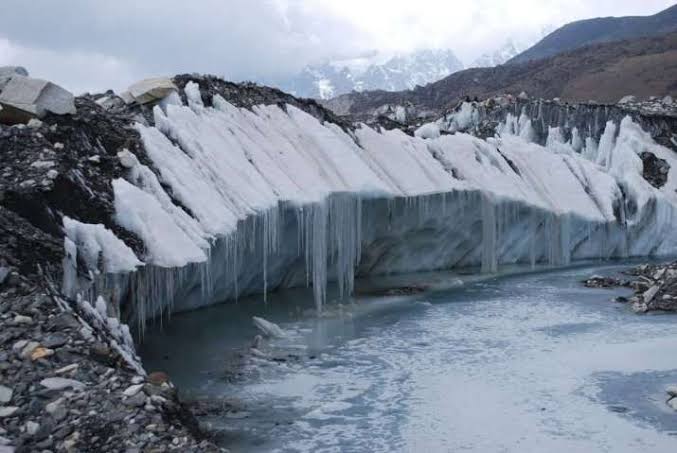
Bhasin’s talk built to a set of concrete proposals, and the sharpest of them was a reframing so simple it is astonishing how rarely one hears it. The single most important story in South Asia right now, she argued, is the melting of the Himalayan glaciers; and it is being covered entirely through national lenses. Pakistan’s floods. India’s heatwaves. Nepal’s vanishing ice. The poisoned politics of the Indus Waters Treaty. Four national stories, four national blame games. “These are not separate stories,” she said. “They are one story“; the story of a shared ecosystem under shared threat. The meltwater, after all, does not stop to have its papers checked at Wagah.

From that reframing flowed her first proposal: well-funded, editorially independent cross-border journalism collaborations; joint investigations, joint reporting on shared rivers and shared climate data, joint coverage of health crises, literacy, and what is actually happening inside each country’s universities and laboratories. Not from the nationalist angle, not from the blame angle, but from the angle of what is actually happening.

Continue reading The Meltwater Carries No Passport

Two House Precedents

We apologise for overriding 0M-3’s excellent post, on Geography is Power, but we are pushing it up and allowing it to breathe.

We also second Kabir’s proposal for a book club, with Midnight’s Children as our inaugural read ahead of India and Pakistan’s Independence anniversaries in mid-August.

One. Online-safety reports go by email. From now, any online-safety violation must reach us by email. That is the investigative channel. If it does not land in the inbox, it is not in front of us, and for our purposes a violation we never see did not happen. Send it to us directly.

Two. What Brown Pundits is about: biodiversity and bio-density. Two aims. Density: a 20 comments per post. Diversity: five voices per thread, not a closed loop of a handful names. A hundred comments from a small circle is a monologue. A hundred from ten is an ecosystem, and the ecosystem is what we are here to keep alive.

A post unlikely to reach either metric may be held in abeyance or returned for reworking.

We have felt the losses. BB stepping back, and Indosaurus before that, cost us more than volume. They were bridges. BB in particular always found the connective tissue to sports and the economy that the rest of us missed. So read this as an open invitation home. We will be reaching out, and if either of you is reading, the room is still yours.

Geography is Power

The goal of this post will be to act as a counter to XTM’s post about geography not being power. It will rely on realism as a doctrine of international relations to de-cypher the significance geography has had on the Indian Subcontinent and how it has affected the trajectories of the nations within it.

Geography initially reared its head in discussions of strategy during the times of Mackinder and Mahan in the early 1900s. Where Mackinder so boldly stated that “Who rules East Europe commands the Heartland; who rules the Heartland commands the World-Island; who rules the World-Island commands the world.”. However, these words were written in colonial era Britain as a device to fear monger about the Russians as they were the perfect counter to their strategy of controlling the world with sea power through internal lines of transportation through Cold Siberia. With that cold logic Russia which had been the ally of British through the two world wars became a target. Continue reading Geography is Power

Pink boots

1.oh God!! Germany out.
2. Brazil scrapping through. Japan gave Good fight.
3. Morocco hanging on. Netherlands out. What a game!! 
4. Can’t believe and understand why grown up men should wear pink boots.
5. Kick and run northern European football is out, south European irritating tiki-taka is the normal now.
6. People are commenting on the large number of African-descended individuals in the game.

Continue reading Pink boots

Geography Is Not Power

The Indus Waters Treaty and the Nile

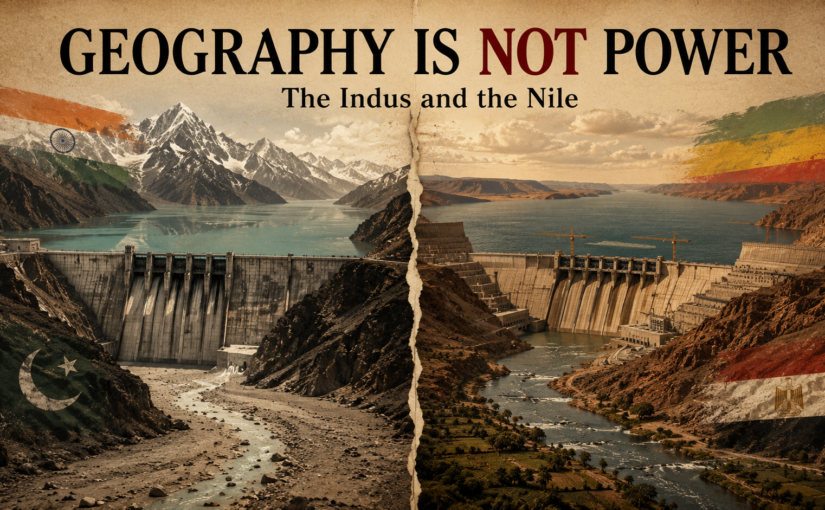
While the previous thread argues about whether Panini held a Pakistani passport, a more useful quarrel is flowing past us. In April 2025, after the Pahalgam massacre, India held the Indus Waters Treaty in abeyance. It did this the day after the attack, a fortnight before the missiles of Operation Sindoor. The water came first. That order tells us something: New Delhi reached for the river before it reached for the air force, because it believes the river is the better weapon. We think it is wrong about that, and the reason why takes us a long way from the subcontinent, to the Blue Nile.

The instinct underneath India’s move, and underneath most of the commentary on it, is that the country upstream holds the whip. Sit at the top of the river and you control the tap. It is a tidy idea and it is false. Whether the upstream state is master or supplicant depends not on the map but on which side can make the other bleed.

India is running a bluff it cannot yet call. The treaty India suspended was built to survive exactly this. Signed in 1960 under World Bank mediation, it gave Pakistan the three western rivers and India the three eastern ones, and it contains no exit door. A party cannot lawfully walk away or hold it in abeyance; it stays in force until both sides agree to change it. India knows this, which is why, when it asked twice, in 2023 and 2024, to renegotiate, and Pakistan refused to come to the table, India was left with grievance and no remedy. The Court of Arbitration has since ruled, more than once, that the suspension has no standing and that the limits on India’s water control still bind. India calls the court illegal and presses on.

Continue reading Geography Is Not Power

Brown Pundits