
A textbook currency crisis, triggered by a bunch of policy mistakes.
Category: Uncategorized
Open Thread – 07/11/2022 – Brown Pundits
What’s going on?
The Toda are different
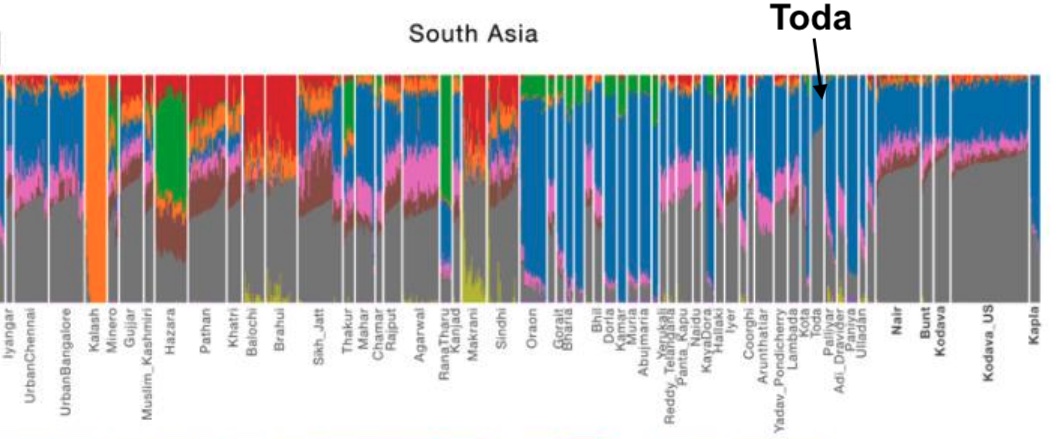
A new paper on Southwest Indian genetics highlights the Toda sample from Genomes Asia. People in the comments of this weblog have asserted this small southern tribe may have the most “Indus Valley Civilization” ancestry in the subcontinent. This is perhaps an exaggeration, but, looking at the admixture plots the Toda clearly have hardly any steppe ancestry, but a lot less “ASI” ancestry than their tribal neighbors, with the balance being something like the IVC ancestry.
Genomes Asia doesn’t make it’s data public, and for ancestry purposes I don’t think they’ve done the best job.
Global 25 is good, but a minor issue

ArainGang, has posted a pretty interesting map of various ancestry components in the subcontinent by population. It’s pretty good, especially for the south and west of the subcontinent. But, there is something weird going on in the northeast: a lot of these populations have “Ancestral Indian” (Andamanese) ancestry but hardly anything else East Asian. This seems wrong. In fact, the Khasi are on a cline to Bengalis. I ran a few analyses on samples with the Andamanese and I just don’t see that Global 25 is doing this right.
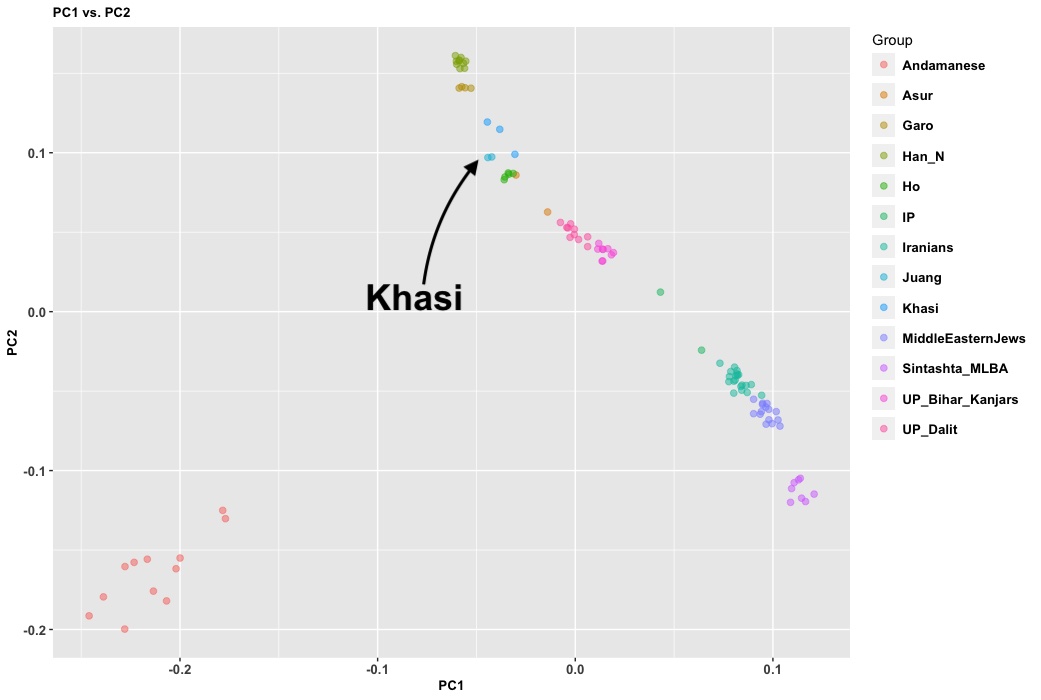
In the Global 25 model above the Khasi are 33% Ancient Indian, proxy for AASI, who are most closely related to the Andamanese. But you see in the analysis here the Khasi are along the India cline, but very shifted to the Han Chinese.
I ran a three-population test with a bunch of populations. You can see here that though the Andamanese are in the data set, the Khasi are best thought of as a mix of Han Chinese with an on-elite North Indian population.
| pop a | pop b | f3 stat | error | Z-score | |
| Khasi | UP_Dalit | Han_N | -0.0012727 | 0.000328938 | -3.8691 |
| Khasi | UP_Bihar_Kanjars | Han_N | -0.0010221 | 0.000334709 | -3.0537 |
| Khasi | IP | Han_N | -0.00120191 | 0.000481175 | -2.49787 |
| Khasi | Sintashta_MLBA | Han_N | -0.00080455 | 0.000392122 | -2.05179 |
What does this mean? I don’t think it’s a big deal. If the population does not have East Asian ancestry to a great extent the plot by Araingang looks fine. But, obviously, Global 25 has some kinks that people need to consider. This is important because people often come to me with Global 25 as if it’s authoritative. It’s not. It’s just another way to reduce genetic variation in a human consumable fashion.
On being an “upper caste” “Muslim”
So I was talking to a friend, a Guju bania who visits their “family temple” now and then. This person is from a very tight-knight community. We were talking about whether I am “upper caste,” and their point was that most of my ancestors were from the bhadrolok literate elites of Bengal. It seems I’m mostly Kayastha, with a recent Bengali Brahmin in the mix, and reputed Iranian (Pathan and Persian) ancestry on both sides a very long time ago.
But, as I thought through the issue and reflected, I realized why the appellation annoyed me. There is no community of people of Muslim background who are mostly Kayastha with some Brahmin and ashraf ancestry. Yes, there are Muslim cates groups, like Ismailis who are clearly from banias or literally Muslim Kayasths (though most now intermarry with other Muslims). But that’s not me or my family; we are from a well-off background, but our identity is that of generic Bengali Muslims. Our origins are upper caste, but caste is irrelevant to our social reality (class though, is).
This is worth a post because I think this is going to be the case with later generations of Indian Americans. Because of the class and caste backgrounds, Indian Americans descend from ancestors will tend to be upper caste and upper-middle class. But their identity will be a new one, unrelated to the solidities of the Indian subcontinent. In this way, Indian Americans may have upper-caste privilege, but caste as a social institution just doesn’t function as it does in the subcontinent. The privilege is carryover, not operational.
So when a lot of Lefty commentators accused me of defending upper caste people because I’m an “upper-caste Muslim” I didn’t even know what to say. That’s just not part of my identity, or that of my family, though in a heritage sense that’s true. In the near future young Indian Americans who are half-Khatri and 1/4th Iyer and 1/4th Reddy would be verbally abused as “upper caste” and be just as confused as to what that even means.
If you have a hammer, everything is a nail
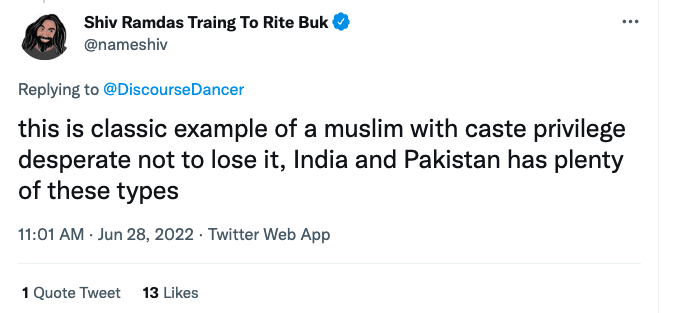
The reaction to my piece on caste by the Indian and Indian American Left has been interesting, and fraught with confusion.
First, the reaction by this Indian (now in America) Leftist is to accuse me of being an upper-caste Muslim. This is not that far from how Hindu nationalists react to me, which illustrates that certain mentalities are general, and the specific instantiations simply flavors on top of the common base. Most Indians are “identitarian” in such a deep way, whatever their ideology, that Americans would have to be impressed (if they are cultural liberals and racialists). If you scratch an Indian Leftist they aren’t that different from a Indian Hindu nationalist in their cultural presuppositions.
I am not an upper-caste Muslim in a literal sense, because a quick scan of my genome will show I’m a generic eastern Bengali, and more concretely caste is not a thing in Bangladesh anymore. I do have ancestors who are Hindu, as all people of subcontinental Muslim background do, and all I know is that most were Kayastha (on my mom’s side) and my paternal grandmother’s father was from a lineal Bengal Brahmin family (her father was very young when his father converted the family from what I recall, so he did not remember being a Hindu, though he did pass on some Hindu customs to my grandmother like the utilization of separate dishes). My paternal lineage, from where I get “Khan,” were landholders in their region of Bengal for a long time, and traditionally provided the ulema for the villages in the locality. We also funded the construction of many of the oldest extant masjids in the area.
It’s hard to deny that I have class privilege, given that my family was present in the professions or owned land for centuries. This, despite the fact that partible inheritance means that my “ancestral desh” (which I have never physically been to, I was born in Dhaka, and my mother’s ancestral village was far closer) is populated by many poor relatives who barely have any land-holdings to speak of left. People in my family who are economically advantaged all migrated to Dhaka in the 20th century. This migration was enabled by privileges accrued from the past, as we were literate, and had some assets that we could presumably turn into cash to finance a move to Dhaka. But once we got to Dhaka no one cared we were big shit in rural Comilla. Arguably, to a mild extent, we were second-class citizens, being migrants from a rural area, though this is the norm in Dhaka so I don’t think it was a big deal.
The migration to Dhaka from rural Comilla anticipates later migrations, as branches of my family on both my maternal and paternal side reside in the US, UK, Japan, Northern Europe, and the Middle East (with sojourns in Latin America; hi cousin Pablo!). The reason we were able to make these journeys was due to a combination of financial means and educational qualifications. These emerge from our class background. But once in the US, UK, let alone the Middle East, no one gave a shit that we were “Khans.” I am socioeconomically an upper-middle-class American, but that’s not because anyone gave me privileges because I was an “upper-caste Muslim.” Most of the people who were in a position to advance me happen to be white, and to them, I was just another brown person. Perhaps it was even a demerit that I was an “upper-caste Muslim,” since that just meant I was a brown person.
This truth is generalizable. 99% of Americans do not care at all if you are an Iyer or a Mehta or a Reddy. They don’t even know what that means. You are just a brown person to them. Suhag Shukla once told me that when she went to Congress in the 2000’s to lobby for Hindu American rights, hill staff asked if they were “Sunni or Shia.” This is to illustrate that Americans don’t give a shit about what your background is and barely understand it. Malcolm X’s quip about a black man with a Ph.D. isn’t totally applicable, as America isn’t that racist anymore, but it gets to the heart of the fact that in America brown is brown, caste no consideration.
Second, there is the issue that people who are brown in America often do benefit from caste privileges and hierarchy ancestrally. This is a problem and confusion, because it seems obvious, but it gets conflated with the situation in America. The American immigration system is not caste-conscious because Americans barely understand this, but 80% of Hindu Indian Americans are from the 25% of Hindu Indians who are upper-caste. I personally get annoyed with Indian Americans whose families were elite back in India who bring up their stories of discrimination and penury in the US, because their experience is distinct from the social, cultural and human capital they inherit to various degrees from their families. On some level, caste does matter who gets to America, but that is not because the US is caste-conscious, but because Indians are. The US immigration system values particular education and skills that are not equitably distributed among Indians. There are also “push” factors like reservations that mean some upper-caste professionals have far better opportunities abroad, so they leave (this is, for example, a much bigger dynamic in medicine than software engineering, from what I have heard).
Third, the trend now is to argue that Indian caste dynamics are replicating themselves in the US. I don’t think this is true, and I explained why in the UnHerd piece. The minority of Indian Americans raised in the US barely understand what caste is beyond an abstraction. One of the contributors to this weblog proudly asserts their “sudra” status half-seriously, but Indians have told me that usage of that term is somewhat taboo in the subcontinent. The difference here is context, as varna categories are mostly academic, and outside of a few communities (Jats and perhaps, some Patels) jati doesn’t really exist as lived experience. Caste isn’t really a serious matter in America, so who cares if you are a sudra? No one else really does who matters.
It might be somewhat different for the majority of Indians who migrated to the US in the last few decades, as they grew up in a country where caste does matter, and some of their attitudes do replicate. I do assume that most of these people are prejudiced against Muslims and “lower castes” to some degree like the Leftists Indian Americans say (who are usually upper-caste Hindu by background, and so are aware of what things are said “behind the veil”), but these people rarely operationalize their biases because the American racial and social context is totally different from India. When I go to buy alcohol at Indian-owned mini-marts sometimes I get mild third-degree from the owners when they see my last name on the ID, and sometimes it gets to the point I have to tell them I’m an atheist and stop bothering me (this seems a problem during Ramadan in particular, but I often don’t know when it’s Ramadan so don’t blame me). But this is only an inconvenience, and guess what, I can buy alcohol from places without overly curious Indian aunties minding the counter.
Finally, there is the issue of caste discrimination in Silicon Valley, the one place where people argue Indian cultural dynamics are replicating due to the critical mass of immigrants from the subcontinent. People bring up the Cisco case as is if it’s case-closed, but it’s a single case, and the reality is that we don’t really know everything about the dynamics of the case and there’s been no verdict. Believe it or not, not all allegations of discrimination are found to be valid.
But many non-Indians (white people) now routinely tell me there is caste-discrimination in Silicon Valley, this is just a “truth” that is “known.” I’ll be candid that I think some prejudices naturally imbibed from high school, where the caste system is widely taught as constitute to Indians, along with Leftist media narratives about Indian American caste discrimination, are coloring peoples’ perceptions. The reason I wrote the UnHerd piece is that this is becoming the standard narrative and accepted truth for third parties who don’t have any biases or priors on the issue.
For example, when people say there is pervasive discrimination against Dalits in the Valley, I have to ask, what Dalits? Dalits are 15% of Indians, but 1% of Hindu Indian Americans. It could be possible that this 1% is suffering pervasive discrimination from the non-Dalit majority, 25% of whom are Brahmin and 80% as a whole are upper-caste, but there are opportunities in the US to work for non-Indians who won’t care or know. Indian American society, when it is caste conscious, is overwhelmingly upper-caste and privileged, so they’d have to discriminate against each other!
Yes, there is a level of nepotism and clannishness among Indian Americans, but this is not unique to them. Mark Zuckerburg famously recruited from his dorm and Harvard, and if you are not part of particular elite educational or professional circles you are on the “outside” in the startup world. The same seems true of Indian American entrepreneurs, but their particular ingroup preferences are always reified as “caste.” Though I”ve heard of the “Telugu mafia,” this seems to be the exception, not the rule. And, it is not uncommon for Indian Americans to have some affinity for each other (the majority born and raised in the US still marry Indians), but often this cross-cuts region and caste, rather than reinforcing them.
Additionally, what caste consciousness there is going to be transient. If you are an Indian immigrant to the US, and you are raising children here, there is a 50% chance your grandchildren will have non-Indian ancestry. There is a far lower chance that all four of their grandparents will be from the same jati-varna, in large part because a lot of Indian immigrants themselves are couples in “mixed” marriages (I put the quotations there because in the US Census the marriage of a Tamil Brahmin and a Punjabi Khatri is endogamous).
I will end with an exhortation: the US is a country where you can be reborn anew. Do not buy into the regnant narrative and recreate yourself as a victim. Grasp the world with both hands and make of yourself what you want to be. Some Leftists are trying to replicate Indian dynamics with oppressive upper-castes and oppressed lower-castes in a racial and ethnic context where it’s irrelevant. But some upper-caste Indians are also embracing victim status, whether because they were persecuted in Tamil Nadu (Brahmins), or because they were subject to racial discrimination in the US. I know it’s easy. But I don’t believe it’s the path of honor. Sometimes you do the right thing, even if it’s the harder thing, the socially less acceptable thing. Whatever your caste, religious or regional background, you’re American now. You are now part of a different, great, national project. Make your own narrative, don’t recycle old ones or adopt new ones.
Reactions to caste piece in UnHerd
It’s out, America’s fake caste war.
Quick thoughts
– The piece is illustrated with a photo of Aziz Ansari, an atheist from a Tamil Muslim background. This shows you that caste-in-the-West is a racial issue, and non-subcontinental people will view it as such.
– Some people of Caribbean and other Diasporic backgrounds are complaining that I ignored them. Yes, I did. This is focused on the overwhelming majority of Indian-origin people in the US, who are mostly immigrants from India.
– Some Indians are complaining I don’t talk about caste in India. Yes, I don’t talk about it except as a baseline or starting-off point because this is about Indians in America.
– Some upper-caste people are complaining that I make them seem privileged and submitting that there are poor temple priests who are Brahmin. These sorts of objections disabuse me of the notion that upper-caste people are more intelligent because this is a stupid point. Upper caste people who complain about their persecution in India and how “actually they’re underprivileged” get tiresome for a whole host of reasons, and I wish you people wouldn’t engage in the oppression Olympics, but I guess it’s just too tempting. Do some math. There are even good Indian statisticians.
– Some people are complaining that Indian Americans who are immigrants are often conscious of caste, and they care. I don’t disagree with that, though it varies (guess what, someone who is an extremely caste-conscious Hindu is probably less likely on the whole to immigrate to a whole new country where beef is the luxury meat of choice). My point is that the structural institutions and norms that allow for the salience of caste identity and privilege are just not operative in the US. To a great extent, this is true in places like Guayana too, and there the Indian-origin population is more than an order of magnitude larger than in the US. Gujarati Patels might have enough critical mass to create a marriage market that’s endogamous, but few other groups do.
– Some people are saying I’m totally denying discrimination. I’m not. I’m just pointing out that anti-Dalit discrimination is rate-limited in the US because there are hardly any Dalits here. The 1% of Indian Americans who are Dalits are more likely to interact with Indians than the average person, but there are many (most) situations where they’ll interact with non-Indians who don’t know/care.
– Finally, over time the native-born Indian population is going to get much larger. This will change the balance of cultural power within the community, and so the saliency of caste will decline even further. I know several people who are even in mixed religious (Muslim/Hindu) marriages who are raising their children “spiritual.” This sort of thing in America is much rarer in India, but “communal” identities in the US that are salient are white, black, etc., not the particular religious ones.
Epoche and detachment in analysis

I want to make a short and quick comment about a style of argumentation that I’ve noticed in people from the Indian subcontinent (though not exclusive to them). In addition to verbosity, there tends to be an aggressive hyperbolic emotionality. That’s fine if you want to scream on cable television, but it’s really hot air that doesn’t move a conversation forward.
I’ll bring up the class example with the Mughals.
Muslims in the subcontinent admire the Mughals, on the whole, and take pride in their accomplishments. Whether you think that that pride is warranted or not, it is there, and it makes it difficult for Indian Muslims to evaluate the Mughals with any degree of detachment. The fundamental reality is to a great extent the Mughals were a colonial and alien power that control the subcontinent for centuries. To some extent, they were more foreign than some of the post-Delhi Sultanate Muslim kingdoms. The Mughals imported Turkic warriors and Persian bureaucrats for many centuries, and for decades continued to speak Chagatai Turk among themselves. Up until Aurangzeb, they were keen on conquering their ‘ancestral’ homeland. The Mughals had a racial caste system, and continued to differentiate between the foreign Muslims, and those of native subcontinental stock (arguably native Indian Muslims did better under some of the Delhi Sultanate successor states).
But what about Hindus? Whereas Muslims get very defensive about their “Mughal ancestors,” many Hindus detest them because they were colonial interlopers. I think it is a reasonable assertion, but then Hindus take a step further. Along with their precursors, the Delhi Sultanate the Mughals killed millions and engaged in a campaign of mass rape and murder. Often if the Hindus are talking verbally there is a lot of emotion in their voice, and I wonder if they are going to cry. The reality is the genetics is clear that Hindus have almost no West Asian ancestry, and the fraction of Indian Muslims is quite small. If the Mughals were raping a lot, they were quite sterile.
The reality is it seems to me that though the Mughals synthesized themselves with India, for much of their early and mature period they were more a colonial skein over the substrate of India, the vast majority of which remained loyal to its indigenous religious traditions. This means that their interaction with the natives was mostly a matter of resource extraction, that is, rents.
I don’t know if more discussion with help India resolves its internecine religious fractures. Probably not. But I wish people would comport themselves like they were actually trying to discuss, rather than emotionally screaming at each other.
Browncast episode 194: Caste, Hindus in America and Hinduphobia
On this episode of the Brown Pundits Browncast I had a long conversation with Nikunj Trivedi and Pushpita Prasad of the Coalition of Hindus of North America. One of the things we talked extensively about during this podcast is the Carnegie Endowment study Social Realities of Indian Americans: Results From the 2020 Indian American Attitudes Survey. The survey is rich with data that might surprise (for example, there are as many Bengali speakers as Punjabi speakers in the US, though I suspect this might be due to many ethnic Punjabis putting Hindi down as their mother tongue). But for the purposes of this episode, we were interested in caste identity, and how it relates to Hindus in America.
The Carnegie study takes a shot at the 2018 Equality Labs survey that argues for the pervasiveness of caste discrimination:
A 2018 survey of 1,500 South Asian Americans found that many low-caste members of numerous diaspora communities had endured firsthand experience of caste discrimination. However, the study is not based on a representative sample, raising questions about the generalizability of its findings.
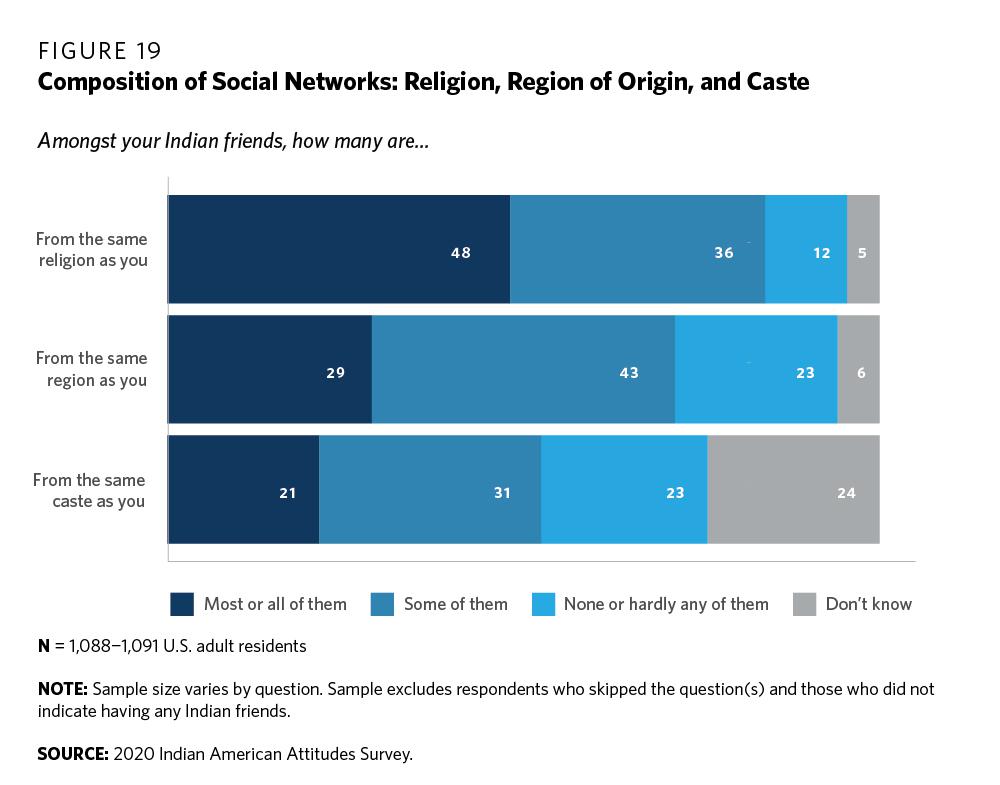
The figure above shows that most Hindu Indian Americans do not live in a caste-homogeneous environment. There are reasons for this. From the text:
Forty-seven percent of Hindu respondents report identifying with a caste, which means the majority (53 percent) said that they do not personally identify with a caste group of any kind. However, there is marked variation by place of birth. Whereas 53 percent of foreign-born Hindu Indian Americans affiliate with a caste group, 34 percent of U.S.-born Hindu Indian Americans do the same.
…
…Overall, there are 632 respondents in the IAAS sample who belong to the Hindu faith but only 293 who report identifying with a caste group. Of this latter group, the overwhelming majority—83 percent—categorize themselves as General or upper caste. Sixteen percent identify as a member of OBC and 1 percent each identify as Adivasi/Scheduled Tribe (ST) or Dalit/Scheduled Caste (SC).
The latter number, that about 80 percent of Hindu Indian Americans are not OBC, Dalit or Adivasi is exactly what I’ve seen in other data. But perhaps a more important aspect is that large numbers of Hindus in America don’t “affiliate” with a caste group. Some of the American-born individuals may not actually even know their caste group, though the foreign-born ones clearly know their origins as noted in the text:
Figure 21 looks more closely at the caste composition of social networks among Hindus. Seventy-four percent of Hindu respondents who report not identifying with a caste nevertheless know enough to be able to identify the caste identities of their social networks. Only 26 percent of Hindus who do not identify with a caste respond to questions about the caste composition of their social networks by answering “don’t know.” This indicates that even though a large proportion of Hindu respondents say they do not identify with a caste, only a small fraction are unaware of the caste composition of their networks.
What is also striking is how relatively small the differences are between respondents who identify with a caste versus those who do not. While the former report that a slightly higher share of their social network comprises people of the same caste, if one sets aside the “don’t know” responses, the relative differences between caste identifiers and non-identifiers is marginal. For instance, 27 percent of Hindu respondents who identify with a caste report that all or most of their Indian friends share their caste affiliation. Nineteen percent of those who do not identify with a caste group answer similarly. Respondents who acknowledge a caste identity are only slightly more likely to report that some of their social network is made up of people of the same caste (41 percent versus 33 percent for those without a caste identity).
So here is the subtle point: people who do not identify with a caste group nevertheless can often assess whether their social circle is mostly of their caste group or not. The dynamic here is that people are proactively disavowing or denying caste identity personally, but they clearly still know the provenance of their own lineage and that of their friends.
The landscape of caste and America is complex. Nevertheless, today’s social justice activists are trying to reframe it as just another black-white dichotomy, with oppressed Dalits, etc., against oppressive Brahmins.
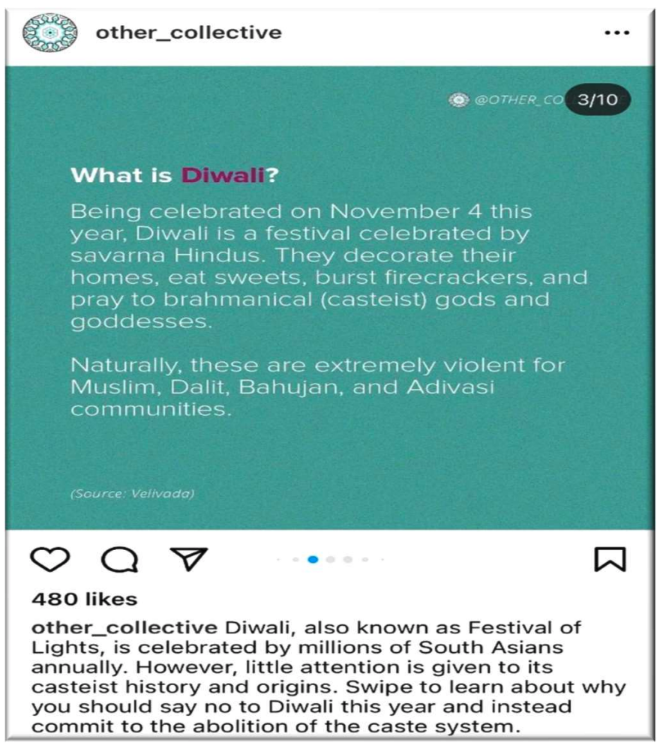
Finally, we discuss the casual and not-so-casual anti-Hindu comments that are spreading across mainstream discourse. For example, an organization at UC Davis called the Other Collective has said some really bizarre things about Diwali:
Open Thread – 06/10/2022 – Brown Pundits
What’s going on?