Review. Field Marshal Sam Manekshaw

From Dr Hamid Hussain. 
Recently came across a great book
about an officer and gentleman of a bygone era.  Quite a timely
reminder.  In the environment of general deteriorating standards of both
Pakistani and Indian societies, armed forces cannot  be removed from their
environment.  Many officers are simply foraging in the same pastures.
 A pause and looking at the conduct of upright officers and gentlemen may
provide a different set of role models for young officers.  Respect is
earned by the character and not by the amount of brass on one’s shoulders.
Enjoy the reading.
Hamid
Book
Review
Field
Marshal Sam Manekshaw: The Man and His Times by Brigadier ® Behram M. Panthaki
and Zenobia Panthaki
This
book by the husband and wife team provides a window to the personality of an officer
and genetleman Field Marshal Sam Manekshaw.  Brigadier ® Behram Panthaki
served as ADC to Sam and Behram and Zanobia had a life long association with
Sam and his family.  This gives authors a unique vantage point.  They
have done an excellent job of introducing the readers to the human side of Sam.


Sam
Hormusji Framji Jamshedji Manekshaw was the most popular soldier of
India.  He passed out from Indian Military Academy (IMA) at Dehra Dun in
1934 and commissioned in elite 4th Battalion of 12th
Frontier Force Regiment (4/12 FFR).  This battalion went through various
reorganizations through its one hundred and fifty years history.  It
started as 4th Sikh Local Infantry after First Sikh War in
1846.  In 1901, it became 4th Sikh Infantry and in 1903 became
54th Sikhs. In 1922 reorganization, it became 4th
Battalion of 12th Frontier Force Regiment.  In 1947, on
partition of India, battalion was assigned to Pakistan and in 1957
reorganization became  6th Frontier Force (FF) Regiment of
Pakistan army.   Battalion is nick named ‘Charwanjah’
referring to its old number 54. Battalion has the unique honor that an Indian
and a Pakistan army chief belonged to this battalion. Eighth Chief of Army
Staff of Indian army Sam Manekshaw (1969-1973) and fifteenth Chief of Army
Staff of Pakistan army General ® Raheel Sharif (2013-2016) of Pakistan army
were commissioned in charwanjah.
In
Second World War, Sam then a captain was leading Sikh company of 4/12 FFR in
Burma.  A small group of Japanese soldiers surprised the troops and
sneaked into the perimeter of the battalion at night.  This caused a panic
and a number of soldiers bolted from the scene.  Sam’s Sikhs firmly stayed
in their positions.  Sam had threatened them that he will personally
distribute ‘bangles’ if any of them moved from their position.  Later, in
one of the attacks on a Japanese position, Sam was severely wounded when seven
bullets of a Japanese machine gun hit him in his stomach.  His orderly
Sher Singh put Sam on his back and evacuated him to Regimental Aid Post where
Regimental Medical Officer (RMO) Captain G. M. Diwan tended to him.  Sam
was awarded Military Cross (MC).  Death was closely lurking around
him.  When Sam was being treated at a hospital at Pegu, Japanese planes
bombed the hospital and Sam’s bed was moved to the lawn. Severely wounded Sam
was moved to Mandalay and then to Rangoon.  Sam was on the last ship which
left Rangoon before Japanese overran it.  The ship was also bombed by
Japanese planes but Sam made it to Madras.  This association with the
battalion during combat and fighting some of the most difficult battles had a
lifelong impact on the young man.
Sam
had a special affection for the battalion despite it being allotted to rival
Pakistan.  In 1950s, his battalion mate Brigadier (later Lieutenant
General) Atiq ur Rahman nick named ‘Turk’ (4/12 FFR) was commanding a brigade
in Kohat that was brought to Lahore for internal security duties.  Turk
and another PIFFER Brigadier (later Lieutenant General) Bakhtiar Rana
(commissioned in 6/13 Frontier Force Rifles and now 1 FF of Pakistan army) went
to Ferozpur to visit Sam who was commanding 167th Brigade. Old
PIFFERS had a great time together reminiscing about their days together. 
In 1965, Sam was GOC-in-Chief of eastern command and he had another interesting
meeting with his paltan mate Major General Fazal Muqeem Khan (4/12 FFR)
who was GOC of Dacca based 14th Division. After 1965 war, a meeting
was arranged for the two commanders.  Sam landed at Dacca and after a warm
and brief welcome told Fazal ‘let’s go home to meet the Begum Sahiba’. 
Sam and Fazal left leaving their bewildered staff officers to sort out all the
mundane tasks of the meeting.
When
Sam was army chief, there was a standing order to all the staff, guards and
sentries that whenever an ex-serviceman of 4/12 FFR came to the army
headquarters, he should be brought to the chief no matter what chief was
doing.  In 1971 war when he was Indian army chief, he kept an eye on
performance of 4/12 FFR (now 6 FF) which was fighting from Pakistan’s
side.  His staff would notice a certain pride in his eyes when the
briefing officer would give some account of 4/12 FFR.  He commented to his
military assistant ‘I should like to see one of my 8th Gorkha
battalions fighting the 4/12 Frontier Force Regiment’.  When Major Shabbir
Sharif of 6 FF got the highest gallantry award of Nishan-e-Haider
fighting from Pakistan side, Sam wrote to one of his old British Commanding
Officer (CO) of 4/12 FFR in England that he was so proud that an officer of ‘his
battalion’ got the honor although Sam’s forces were fighting against
Pakistan.  Another sign of his association was his love for local footwear
of North West Frontier Province; Peshawari chaplis.   Long
after he left the frontier, he preferred Peshawari chaplis when wearing
casual dress.  He also named one of his dogs PIFFER. 
Book
provides details about Sam’s family and personal life in addition to highlights
of his professional career.  A large number of photographs from family
album never published before make it a wonderful pictorial catalogue of
evolution of a young cadet through various stages of his life.  While
looking at the photographs, one cannot ignore one thing and that is whenever
Sam is with other people, everyone is laughing.  Sam had a great sense of
humor and in most of these photographs, he is in his usual jovial and naughty
mood.
This
book is a timely reminder to young officers of Indian and Pakistan armies about
a generation of officers of a bygone era. It is a welcome addition to the work
done about Indian army officers. This work is different as it provides a window
to the human side of Sam. It should be in the library of anyone interested in
Indian army. 
Field
Marshal Sam Manekshaw: The Man and his times by Brigadier Behram M. Panthaki
and Zenobia Panthaki  (New Delhi: Niyogi Books, 2014)

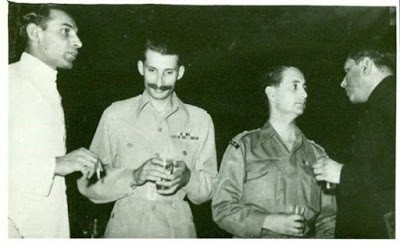
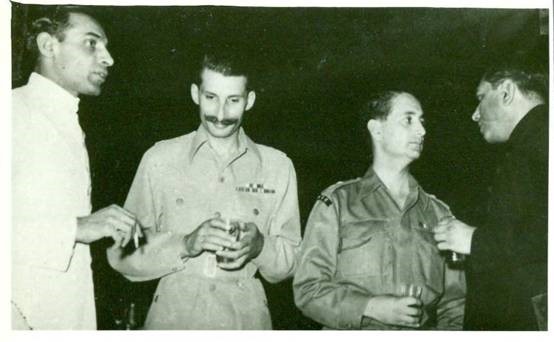
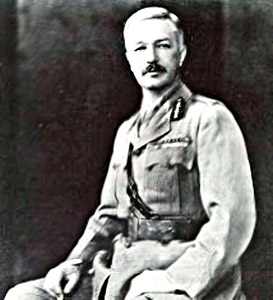
Sam
as Lieutenant Colonel standing next to Colonel (later Major General) Shahid
Hamid, 1946. Sam and Shahid were friends from staff college days. (
Picture courtesy of
Major General ® Syed Ali Hamid son of Major General ® Shahid Hamid)
 
Hamid
Hussain

Defence Journal, Aril 2017 

A Few Questions re Trumpistan..

Now that we are living in the age of Trump, I have a few random thoughts and questions and I hope some of you will answer with comments (here or on social media).

A. It seems to me that Trump (and his truly trusted advisers, Bannon, Coulter etc) were not just cynically using the “coming war with Islam”, they really truly believe that the United States (the most powerful nation on earth) is in a fight to the death with “Islamdom” (the weakest and least coherent “civilization” on the planet; well, maybe stronger than Hindu Rashtra, but not by much) and that Putin is their great ally in this world war, which otherwise teeters on the edge of being lost. This is the most economical explanation for their obsession with Putin and their hatred of fellow NATO allies (well, as long as you discount the golden shower tape as being a fantasy; otherwise that too is a pretty economical explanation).
This whole notion is a joke to the intelligence establishment, the great capitalist corporations, the Western European powers and yes, also to China and Russia; though some of them (Putin, maybe even China) have good reasons to encourage Bannonists on this path. Long before conquering Islamdom, Putin has more important things to do in the Baltics, Ukraine, Belarus, even Poland…
I would add as an aside that there are probably Hindus and Middle Eastern Christians who DO face a real battle with Islamists and who may regard him (and/or Bannon) as potential saviors. I think they are wrong (not because they face no threat from Islamists, but because their faith in Trump will prove to be a mistake) but that is an argument for another day. For now we are talking about the United States and the threats it realistically faces (or does not face). Also, some commentators below have pointed out that Western Civ does face very serious problems and the Democrats (or mainstream Republicans for that matter) seem to want to paper over the problems and continue with business as usual and so on. True. But again, that you have problem X, does not mean Y is the solution. An incompetent conman is not the answer
Anyway, here is the thing, IF the Western elites all shared the Bannonist view (even if it was wrong), the US would remain their leader, but given how little this view is shared in the world, it can only be carried forward by undermining existing elites and alliances. Bannon is probably ready for whatever that leads to, but even Trump may not be up for it. The rest of the Western elite is even less likely to join in. Yet, here we are. So my questions:

1. Can Trump and company establish control over the existing resources of the Western powers AND then use them to prosecute this war to the finish (whatever that means in their minds) OR

2. Can the old elites (the so-called deep state, though I dont think that is a good term for this loosely organized elite and their even looser ideological meme-cluster) manage to get rid of Trump without too much damage being done? OR

3. Will the infighting, incompetence and confusion proceed apace and where will that lead to in four years?

Anticipating some objections, I would add that:

1. I think Islamist insurgencies are real and reflect widespread desire for an “Islamic civilization” that is a coherent and powerful presence on the planet. But I dont think they have much of a chance of getting anywhere. See my article here for some background.

2. I think Muslim migrants in Europe are and will remain a headache for the host populations, but not an unmanageable one. The high point of airy-fairy European multiculturalism has long passed. Without electing any Wilders or Le Pens, the European states will still reduce Muslim immigration and will force (with varying success) increasing degrees of assimilation. They will be troubled, but they will not be over-run. They may overshoot in the other direction, but they will not be over-run. 

3. The Islamicate world will see much anti-American sentiment and some anti-American actions but more important will be wars on the borders. Some of the borders (Nigeria? Sudan? India??) may even see non-Muslim populations being overrun. And non-Muslim populations within Islamic states will continue to face major threats and maybe extinction in some cases. None of that will be enough to conquer Europe or invade America. And in the midst of all this, all major Islamic countries will remain dependent on outside powers (USA, China, Russia) or will face internal and border problems (Turkey) that will overwhelm any dream of leading the new caliphate. Bannonism and Coulterism are still a joke.

B. Those of you who supported Trump in the election on some single-issue, do you still hope he will achieve X or are you losing hope? and why (in either case)?

   The thought here is that several smart people I know supported Trump because they expected him to be great for one or two causes near and dear to their heart. For example, Zionists who thought he would be great for Israel; or small business people who thought whatever small business people think, and so on. For the Zionists, I guess the answer may well be yes, though I would lean towards the thought that Israel’s rosy outlook is due to the weakness of Israel’s adversaries, not due to any new strength provided by DJT. But anyway, for those who voted because they wanted X domestic policy, now that he is in power:

1. Will his mainstream Republican agenda (cutting taxes, cutting regulations, giving more to rich people, less to poor people, “unleashing business”, etc) still get enacted in spite of his personal incompetence? OR

2. Do you actually need a smart president to get things done? (those who think he IS a smart president can call in to infowars for some free airtime).

3. And even if it gets enacted, does this just set up for a bigger Democratic victory next time around? or are the Dems too far gone into La-la land (SJWs, etc) to be able to make a comeback?

Inquiring minds want to know..

PS: Trumpists may be very incompetent, but in a fight, its who is MORE incompetent. Exhibit A:

The INA (Indian National Army)

From Dr Hamid Hussain
Forgotten
Chapter of Indian Army: Indian National Army
Hamid
Hussain
Indian
National Army (INA) was formed during Second World War from Indian Prisoners of
Wars (POWs) captured by Japanese. Later, it was re-named Free Indian Army (FIA)
but it remained known by INA name.  Second World War saw rapid expansion
of Indian Army to participate in another global conflict.  On the eve of
Second World War, the strength of Indian army was 189’000.  During the
war, it expanded to 2.3 million men. On the eve of Second World War, there were
less than five hundred Indian commissioned officers and by the end of the war
there were 9540 Indian officers. Nine thousand Indian officers were Emergency
Commissioned Officers (ECOs) with only six months of training.
In
Malayan theatre, British command quickly collapsed under Japanese
assault.  More than 60’000 British and Indian officers and soldiers were
captured by Japanese. British officers were separated from Indian officers and
soldiers and kept in a separate camp.  A number of Indian officers and
soldiers joined INA.  Some volunteered for INA while others were coerced
to join it to avoid hardships of captivity. Japanese soldiers wrote new
chapters of barbarity for inhumane torture and execution of thousands of
POWs. 

Japanese
motives for establishment of INA were different.  They didn’t envision any
significant role for INA in their grand strategy for Asia.  Japanese
military ethos was different where martial tradition was interwoven with racial
superiority and a divine monarchy.  Japanese soldiers very rarely
surrendered and fought on till death or committed suicide rather than
surrendering to the foe.  They had very little respect for any soldier who
surrendered.  In this environment, a racially inferior Indian soldier who
surrendered rather than dying for his cause put Indian POWs at a very low level
in Japanese eyes.  From practical military point of view, a soldier who
surrendered and now offered to fight his former comrades was viewed with
suspicion and Japanese were not ready to properly arm and equip such a lot as
there was no guarantee that if the tide turned again, they may also shift their
loyalty. Their main objective was to use INA for propaganda purposes and try to
infiltrate Indian army and cause disaffection and tamper with loyalty of Indian
troops. This was the main reason that only a handful of junior Japanese
officers were attached to INA project. British called them Japanese Inspired
Fifth Columnist (JIFSs).
There
were two distinct periods of INA.  First INA was formed under the auspices
of Indian Independence League (IIL) headed by Rash Behari Bose.  First INA
was organized in September 1942 and Captain Mohan Singh (1/14 Punjab Regiment)
was appointed General Officer Commanding (GOC).  By the end of the year,
INA strength was about 17’000.  This force was organized as No: 1 Hind
Field Force into three brigades;
  • Gandhi
    Brigade commanded by INA Major H. S. Betar.
  • Nehru Brigade
    commanded by INA Major Inayat Jan Kiani (5/2 Punjab Regiment)
  • Azad Brigade
    commanded by INA Major Prakash Chand
A
special service group headed by Captain Taj Muhammad Khanzada (5/11 Sikh
Regiment), intelligence group headed by Captain Tajjammal Hussain and several
small Motor Transport (MT), engineer and medical support units were also
established.
In
the first three months, main efforts were geared towards propaganda to enlist
more POWs for INA and some rudimentary training.  There was multipronged
friction between main players on the scene.  Several members of the
council of action had no confidence in President Rash Behari Bose.  IIL
and INA had serious differences with Japanese occupation authorities as
Japanese objectives were different.  Indo-Burmese animosity was also at
play.  Indian laborers and business interests were dominant in Burmese
economy.  Burmese resented this Indian presence and were openly
hostile.  Those Burmese who were now cooperating with Japanese wanted to
limit the influence of Indians.  On 8 December 1942, senior most INA
officer Naranjan Singh Gil (4/19 Hyderabad Regiment) was arrested by Japanese
and Mohan was helpless to do anything.  Mohan Singh sent a secret letter
to all formation commanders of INA that if he was arrested, INA would stand
dissolved.  He was arrested on 29 December and first INA ceased to exist
as a functional entity.  Mohan Singh was later moved to Sumatra and he
faded away from the scene.  After Japanese surrender, he was brought back
to India. 
In
February 1943, Rash Behari Bose after meeting with several officers and Non
Commissioned Officers (NCOs) reformed INA but under his own control.  A
committee worked on re-organization and in April, a new organization named
Directorate of Military Bureau (DMB) of IIL was established.  Lieutenant
Colonel J. K. Bhonsle (5/5th Mahratta Light Infantry) was appointed
Director DMB and several officers including Captain P. K. Sehgal (2/10 Baluch
Regiment), Captain Shah Nawaz Khan (1/14 Punjab Regiment), Lieutenant Colonel
A. D. Loganadan (Indian Medical Service), Captain Habib ur Rahman (1/14 Punjab
Regiment), Lieutenant J. C. Stracey (1/14 Punjab Regiment), Lieutenant Krishna
Murti, Captain Mata ul Mulk (2/15 Punjab Regiment), Captain K.P. Thimmaya (2/10
Baluch Regiment) and Major B. C. Allagappan (Indian Medical Service) were
assigned to head various departments of the bureau. Lt. Colonel A. C. Chatterji
(Indian Medical Service) and Captain Ehsan Qadir (5/2 Punjab Regiment) were
also given senior positions in IIL.
In
July 1943, Subhas Chandra Bose took the leadership role of IIL and renamed INA
as Azad Hind Fauj (Free Indian Army) in Singapore.  This was the
second INA.  Earlier, when Bose was in Germany, he had tried to enlist
Indian POWs.  There were about 15’000 Indian POWs captured on North
African front but only 800-1000 had been co-opted to join Free Indian Legion
(FIL).  The INA was now organized as No: 1 Division with four brigades;

  • Subhas
    Brigade commanded by Captain (INA Major General) Shah Nawaz (1/14 Punjab
    Regiment)
  • Gandhi
    Brigade commanded by Captain (INA Lt. Colonel) Inayat Jan Kiani (5/2
    Punjab Regiment)
  • Azad Brigade
    commanded by Captain (INA Colonel) Gulzara Singh
  • Nehru brigade
    commanded by Captain (INA Colonel) Gurbakhash Singh Dhillon (1/14 Punjab
    Regiment)

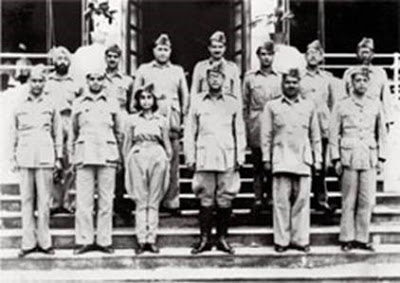
Photograph: 1:  1st Row (L to R): Lt Col Chatterjee, Lt Col
J K Bhonsle, Dr. Lakshmi Swaminathan, Chandra Bose, A. M. Sahay and S. A. Ayer.
2nd Row (L to R): Lt Col Gulzara Singh,
Lt Col Shah Nawaz Khan, Lt Col Aziz Ahmed, Lt Col M. Z. Kiani, Lt Col N. S.
Bhagat, Lt Col Ehsan Qadir and Lt Col Loganathan.
No:
1 Division was sent to Assam front and two more divisions were also
formed.  No: 2 Division was at Rangoon while No: 3 Division consisting
mainly of civilians remained in Malaya.  A special service group was named
No: 1 Bahadur Group and commanded by INA Colonel Burhanuddin and No: 2 Bahadur
Group was commanded by INA Major Fateh Khan.  Intelligence group was under
the command of INA Colonel Shaukat Ali Malik (Ist Bahawalpur Infantry). By
early 1944, the second INA was 40’000 strong.  In February 1944, INA had
its first encounter with Indian army in Arakan campaign. Japanese used it
mainly to cause confusion among British Indian army and try to subvert the
loyalty of Indian troops.  No: 1 Division was withdrawn from Imphal front
in August 1944.  No: 2 Division was later launched on Burma front. 
In the context of Second World War, the military aspect of INA was just a
sideshow of a sideshow.  Real clash was between a million men strong
British 14th Army (Four Corps) and Japanese 15th
Army. 
Military
performance of INA was not significant due to a number of factors.  Total
of 750 INA men were killed in action, 1500 died of disease, 3000 surrendered or
deserted, 200 escaped to Siam and 9000 were captured after final Japanese
defeat.  In comparison, some Indian army battalions engaged in heavy
combat suffered more casualties than the whole INA.  In fact, 1/14 Punjab
Regiment before the surrender lost one hundred and forty soldiers and officers
killed in action.  Bose and many in INA believed that as soon as they made
contact with their Indian army colleagues, they would simply cross over and
join them.  This didn’t happen and Indian units fought very well against
INA.  Indian soldiers who were fighting INA considered them as
traitors.  There were several cases where INA soldiers were shot by Indian
army soldiers rather than being allowed to surrender.  This problem was
significant enough that British high command had to issue a special order to
Indian soldiers to prohibit this practice.
Bose
was disappointed at the performance of INA.  After hundreds of desertions,
he lashed out at INA officers stating that it was ‘the loose conduct, luxury
and corruption of the officers that had been responsible for the state of
morale in which desertions were possible.  The disaster had been a failure
of leadership’.  There is no question about Bose’s commitment to his
ideals.  He resigned from the coveted Indian Civil Service (ICS) position
and forced out of the leadership of Congress party as he didn’t compromise with
even Gandhi and Nehru; the icons of Indian leadership.  He escaped from
India via Afghanistan and dedicated his whole remaining life for armed struggle
for freedom.  His charismatic personality and charming manners won many
adherents among Indian POWs.  However, he was disappointed in INA project
as he didn’t get enough committed volunteers from POWs who had similar zeal for
the armed struggle. 
Two
Indian officers who played a prominent role in INA wrote about their experience
in 1946 just before independence.  These accounts are confusing as these
officers tried to justify their actions but gave contradictory evidence about
what they actually believed in.  Captain Shah Nawaz Khan was serving with
the 10th training battalion of 14th Punjab Regiment at
Ferozpur when his own battalion embarked for Malaya.  He arrived in Malaya
on 29 January 1942, only two weeks before the surrender of British
forces.  He narrates in his autobiography that he felt let down as he was
not allowed to fight against Japanese.  He narrates about the surrender
order ‘I resented this order, especially when I felt that I had not been given
a fair chance to fight the enemy, and to have brought me to Singapore so late
in the fight, only to be ordered to lay down my arms, which I considered a
crime and an injustice to my honour as a soldier to lay down my arms and
surrender’. 
He
also claims that during captivity he organized a block of Indian officers to
resist enrollment in INA.  He gives the following reasons for joining INA:
  • Giving protection
    and help to P.O.W.
  • To stop it
    being exploited by the Japanese
  • To sabotage
    and wreck it from within, the moment we felt that it would submit to
    Japanese exploitation.
He
claims that ‘personally I wished to get out of the I.N.A.’ but ‘I had committed
myself too far and could not retrace my steps ‘.  He claims that he worked
hard to keep rank and file out of INA.  He goes on to give the bizarre
argument that ‘I set about to find such men for the I.N.A. as would be willing
to fight the Japs if they were dishonest with us’.  He elaborates on this
theme by stating that ‘I also realized that if on going into India which was
probable due to poor British defences, the Japs were dishonest, I would be much
more useful to my country with a rifle in hand  in India, than as a P.O.W.
in Malaya’.  He also claimed that he advised Mohan Singh to disband INA
because Japanese were exploiting it.  In defense of awarding death sentence
to Sepoy Muhammad Hussain for desertion from INA, Shah Nawaz very eloquently
described that ‘if in spite of voluntarily joining the organization and
accepting its rules and regulations and given ample opportunities of staying
behind, away from the front, the man still insisted on betraying his country
and his comrades he well deserved the punishment he received’.  He didn’t
comprehend that the same rule applied to him when he deserted. 
In
May 1942, he joined first INA and in February 1943, he joined the second INA. 
Shah Nawaz in his statement during his court martial alluded to friction
between Indian officers.  Captain Mohan Singh was made commander of INA
and Shah Nawaz resented this fact.  He considered Mohan Singh an ‘average
officer’ and too junior.  There were many senior and more capable Indian
officers with 15-20 years service compared to only eight years service of Mohan
Singh.  He also considered Mohan weak and that ‘he would not be able to
cope with Japanese political intrigues’.  After Japanese defeat, Shah
Nawaz surrendered on 16 May 1945 to Second Lieutenant Tehel Singh of 2nd
Battalion of Ist Punjab Regiment. 
Captain
Prem Kumar Sehgal was commissioned in 1939 in 5th Battalion of 10th
Baluch Regiment.  This was an Indianized battalion but next year, he was
transferred to 2nd Battalion of 10th Baluch Regiment and
sailed with the battalion to Malaya.  He was captured by Japanese in
February 1942. He states that ‘I felt terribly let down by the British, who had
handed us over to the Japanese and told us to obey their orders same way as we
had been obeying the orders of the British’. 
He
gives bizarre reasons of joining the INA.  He claims that ‘if sincere and
patriotic officers kept out of it, it would be quite easy for the Japanese to
exploit their army’.  He narrates that ‘I finally made up my mind to join
the Indian National Army because I felt that the Japanese were absolutely
determined to go to India and if they were accompanied by a really strong
I.N.A. the Japanese would not be permitted to commit the same atrocities as
they had committed in Malaya and other countries in East Asia and also if they
did not honour their pledges regarding Indian independence, a well armed and
organized I.N.A. would be in a position to put up an armed opposition against
them’.  It was naïve on his part to believe that a victorious Japanese
army that had defeated the mighty British empire will be kept in check by a
handful of Indian officers and soldiers who were essentially going to India as
coat hangers of a military juggernaut.
A
mere Lieutenant of Indian army with less than three years of service under his
belt, Sehgal held some lofty positions in INA.  He started as Military
Secretary to Directorate of Military Bureau and then Assistant Chief of Staff,
Deputy Adjutant General, Commanding Officer of 5th Guerrilla
Regiment (later re-organized as 2nd Infantry Regiment) and ended up
as temporary GOC of 2nd Division of INA.  In April 1945, he
surrendered to 4th Battalion of 2nd Gurkha Rifles.
Lieutenants
and Captains became Brigadiers and Major Generals and VCOs became Captains and
Majors in INA.  Most had the actual experience of commanding only a
platoon but now assigned to command battalions and brigades.  They neither
had the personal experience nor training for commanding higher
formations.  In addition, the formations existed mainly on paper with no
proper equipment and no logistical support to sustain combat operations. The
outcome was a foregone conclusion.  On first contact with their former
comrades of mainly Indian formations, INA disintegrated. 
After
Japanese defeat, former INA members were captured and interrogated.  3880
who were designated White were reinstated in the army without loss of seniority
and 13’000 Greys were discharged with the loss of pay during captivity but with
retention of pension.  6000 Blacks were scheduled for court martial but
only less than two dozen faced court martial.  Mohan Singh never faced the
court martial.  Later during INA trials, lead Defence Council, Sir
Bhulabhai Desai claimed that 23,000 volunteered to serve as combatants for
INA. 
In
November 1945, court martial proceedings were held at Delhi against three INA
officers.  There were seven members of the General Court Martial presided
by Major General A. B. Blaxland.  Indian members of the General Court
Martial were Lieutenant Colonel Nasir Ali Khan (7 Rajput Regiment), Major
Pritam Singh (IAC) and Major Banwari Lal (15 Punjab Regiment).  Of three
members in waiting, two were Indian; Major S.S. Pandit (1/1 Punjab Regiment)
and Captain Gurdial Singh Randhawa (13th DCO Lancers). 
Congress had steadfastly opposed Bose and his INA.  However, now it
decided to take full political advantage of this crisis of the Raj. 
Congress provided seventeen top notch lawyers for the defense.  The list
included India’s top legal minds including three former justices of high
courts.  Main charges against three officers were waging war against the
King and in case of Shah Nawaz also abetment in murder by passing death
sentence to INA deserter solider.  Defence argued that when the struggle
for freedom reaches a stage where there is an organized government and
organized army, and then it must be accorded all rights, privileges and
immunities of a fighting army.  In case of capital punishment, defense
argued that these sentences were never carried out.  All three were
convicted and awarded various prison sentences.  Later, their sentences
were set aside by C-in-C due to enormous political pressure. 
In
July 1945, army conducted a survey of Indian soldiers and officers about
INA.  Field Security Section (FSS) and Criminal Investigation Department
(CID) conducted the survey.  In addition, regimental and battalion
adjutants were tasked to inquire about the feelings of Indian rank and file
about INA.  In general, the opinion was that INA was nationalist but they
had violated their oaths.  However, they should be treated differently and
not punished excessively.
 After
sentencing of some INA personnel, Congress and Muslim League members of Central
Assembly demanded release of all INA prisoners.  Congress decision to
support INA officers was purely political.  It wanted to use the trial to
speed up British departure with the aim of getting the power without first
solving their problem with Muslim League.  An interview of one of the lead
counsel of defense Committee Asaf Ali with a former POW Captain Hari Badhwar of
3rd Cavalry clearly proves this point.  Asaf Ali told Badhwar
that based on all the facts he had learned, ‘if Congress were in power, it would
have no hesitation in removing all INA from the services’ and that ‘Congress
would not hesitate to put INA leaders on trail when they come to power’. 
Badhwar asked Asaf that now that they knew all the facts they should not
champion INA cause.  Asaf replied that they ‘dare not take that line’ as
they ‘would lose much ground in the country’.  Muslim League stance was
even worse.  It first stayed aloof from the trial but when it saw that
general public interest was aroused, it also jumped on the bandwagon. 
Muslim League decided to provide its own defense committee to one of the
accused Captain Abdur Rashid.  His defense gave the absurd argument that
he didn’t join to fight British.  He joined it to thwart the Hindu
conspiracy of ruling whole India at the exclusion of Muslims with the help of
Japanese.  After sentencing, Muslim League claimed that Rashid was victim
of religious discrimination. 
Congress
and Muslim League championed the cause of INA on their own terms but their
later actions proved that it was only for political gains and had nothing to do
with any specific principle.  Once in charge of government after
partition, neither Nehru nor Jinnah re-instated any INA officer.  In early
1948, Prime Minister Nehru consulted with three people about the INA
issue.   Lieutenant General Srinagesh, Major General J. N. Chaudhuri
and P.V.R. Rao of Defence Ministry were unanimous in their view that INA
personnel should not be re-instated in the army.  Nehru’s response was
that of a politician stating that ‘I disagree with your reasons but I agree
with your conclusions.’ 
Many
ex-INA soldiers and officers became actively involved in militant Hindu and
Muslim organizations.  Some reports suggested that many incidents of
organized violence against civilian population during mutual bloodletting of
partition were committed by these ex-INA men.  Once breach of discipline
is tolerated and condoned then soldier is no better than a brigand. Ex-INA
found no future and drifted towards their respective political or religious
organizations. Many were responsible for participating in the killings of
unarmed and innocent civilians during partition holocaust. In Pakistan, many
ex-INA officers participated in 1947-48 Kashmir war. This operation was
conducted outside the normal chain of command of the army in a very immature
fashion with far reaching negative consequences.  Use of ex-INA soldiers
for Kashmir operations in 1947-48 had a negative effect on the discipline of
Pakistan army. Three years later, several officers were arrested for the
conspiracy to overthrow the civilian government.  Most of these officers
had participated in Kashmir operations.
Indian
POWs joined INA for a variety of reasons.  Rapid war time expansion of
Indian army meant that majority of soldiers and Indian officers were
inexperienced with few years and in many cases few months experience of
military service.  Surrender of large number of Indian and British
soldiers in Malaya was a bewildering experience for everyone.  Only few
officers joined INA from patriotic motives.  Most were either coerced or
joined INA to avoid hardships of captivity.  A large number of officers,
VCOs and other ranks remained loyal to their oath and suffered horribly. INA
consisted of POWs and there were very rare cases of actual desertion and almost
no case of active effort to cross over to the Japanese held areas to join
INA. 
Regimental
loyalty was a major factor of esprit de corps and if a regiment had a good set
of officers and VCOs, then it had good discipline during captivity.  This
factor was not lost on their captors and resistant officers and VCOs were put
in an ‘Officer’s Separation Camp’ to force them to join INA with the hope that
Other Ranks (ORs) will follow them.  If Indian officers and VCOs were steady,
then rank and file followed their example. 
Two
Indian officers and VCOs of 3rd Cavalry set an example for the rest
of the regiment and it stayed out of INA.  Captain K. P. Dhargalkar,
Captain Hari Badhwar and Subedar Major Ismail Khan of 3rd Cavalry
set personal example and kept their men steady during captivity.  On the
other hand, 1/14 Punjab Regiment underwent several major changes in few years
that eroded regimental bond.  As process of Indianization, VCOs were
posted out and more senior Indian officers had been milked away for newly
raised war time battalions.  Battalion had only junior Indian commissioned
officers and no time tested VCOs to keep the soldiers steady.  First shock
of combat, quick collapse and surrender shattered the battalion and most of the
Indian officers and soldiers joined INA. 
2/10
Baluch Regiment was a non-Indianized battalion with British officers. 
Only three Indian officers not originally from the battalion were posted to the
battalion during the war.  Captain P.K. Sehgal with only two years of
service was transferred to the battalion just before the war.  Lieutenant
Burhanudin was the scion of the princely family of Chitral.  He was
serving with Royal Indian Air Force (RIAF) and during the war attached to the
battalion.  Captain K. P. Thimayya was running his family’s plantation and
was a reserve officer.  He was posted to the battalion when war
started.  All three ICOs joined INA but they were not able to convince
fellow battalion mates.  In the absence of British officers, seasoned VCOs
kept the battalion steady during captivity and three ICOs were not successful
in convincing soldiers to join INA.  In the absence of British officers,
proud Punjabi Muslims, Pathans and Dogra VCOs and ORs remained loyal to their
oaths. 
Large
numbers of 4/19 Hyderabad Regiment joined INA. This was an Indianized battalion
and not a happy one.  In 1940, battalion was in Singapore and old
Commanding Officer (CO) was transferred.  New British CO was unpopular and
had problems with officers and men.  British and Indian officers were not
on talking terms.  Uncontrolled drinking and brothel visits took the toll
on battalion’s discipline. Lieutenant Zahir udin was on a detached duty with a
company of Ahirs.  He was living with a German woman strongly suspected to
be a German spy. There was enough evidence that she was undermining the loyalty
of Ahirs.  Zahir was moved out of the battalion and Ahirs protested. 
CO asked for help and a Gordon Highlanders detachment disarmed Ahir guards,
removed all arms and surrounded the barracks.  It was tactful handling by
Thimayya that open mutiny was avoided and crisis was resolved.  However,
Thimayya asked for transfer and only two months before war, one of the most
effective and respected Indian officer was not with the battalion. It was no
surprise that many soldiers of the unhappy battalion joined INA during
captivity.  On the other hand 2/15 Punjab Regiment remained steady during
captivity.  Legendry Subedar Major Sher Dil Khan was the tower of strength
and in the absence of British officers held the battalion together during
captivity.  Subedar Makhmud Anwar was tortured to death for refusing to
join INA.  With the exception of few Sikhs, Punjabi Muslims, Jats, Sikhs
and Pathans (Khattaks) remained loyal to their oaths. 
The
story of INA is a little known chapter of Indian army.  Most
post-independence work on the subject is polemic with very little insight or in
depth analysis.  A rapidly expanding army with a large number of junior
officers and recruits was thrust in a global battlefield in the background of
political awareness of India. Sudden collapse of Malayan command with surrender
of thousands of soldiers en mass and removal of their British officers
bewildered everyone. INA was viewed as a life line thrown by their Japanese
captors and a number of officers and men joined it from different
motives.  In military terms, INA was not successful but it’s impact on
British civil and military decision making process indirectly provided stimulus
to the independence movement.
Notes:
The
I.N.A. Heroes: Autobiographies of Major General Shah Nawaz, Colonel Prem K.
Sehgal & Colonel Gurbax Singh Dhillon of Azad Hind Fauj (Hero Publications:
Lahore), 1946
Ram
Singh Rawal.  I.N.A. Saga (Allahabad: New Literature), 1946
I.N.A.
Defence Committee.  (Delhi: Delhi Printing Press), 1946
Philip
Mason.  A Matter of Honor (Norwich: Fletcher & Son Ltd.), 1974
History
of The Ist Battalion of 14th Punjab Regiment
.  (East
Sussex: The Naval and Military Press Ltd.), Reprint of 1946 Edition
Mahmood
Khan Durrani.  The Sixth Column (London: Cassel & Company),
1955
Lieutenant
General Sir Francis Tuker.  While Memory Serves (London: Cassell
& Company Ltd.), 1950
Brigadier
(R) R. P. Singh.  Rediscovering Bose and Indian National army (New Delhi:
Manas Publications), 2010
Fergal
Keane.  Road of Bones: The Epic Struggle of Kohima 1944 (London:
Harper Press), 2010
Daniel
Marston.  The Indian Army and the End of the Raj (New York:
Cambridge University Press), 2014
Humphrey
Evans.  Thimayya of India (Dehra Dun: Natraj Publishers), 2009
Edition
Lieutenant
General ® S. L. Menezes.   Fidelity and Honour (New Delhi:
Oxford University Press), 1999 Paperback Edition of 1993 Edition.
Kundu,
Apurba.  Civil-Military Relations in British and Independent India,
1918-1962 and Coup Prediction Theory.
PhD Thesis, University of London
School of Economics and Political Science, 1995
Osborn,
Robert Bruce.  Field Marshal Sir Claude Auchincleck: The Indian Army and
the Partition of India.
  PhD Dissertation, The University of Texas at
Austin, May 1994
General
J. N. Chaudhury Lecture at Cambridge Trust, 5 May 1973.  https://www.cambridgetrust.org/assets/documents/Lecture_5.pdf
Hamid
Hussain
26
February 2017
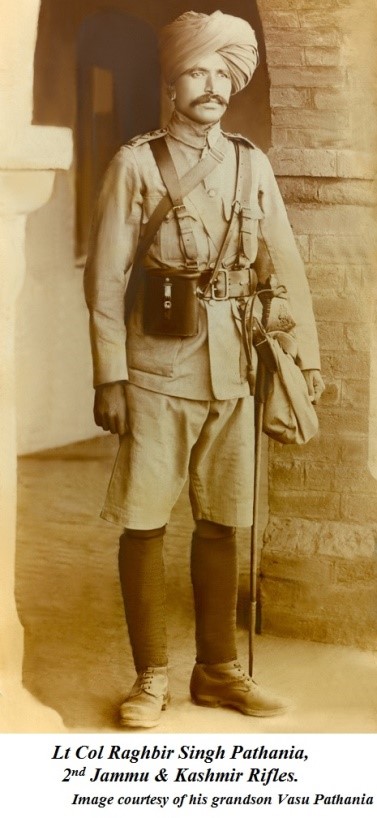
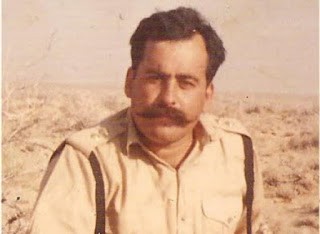
Major General Anant Singh Pathania MVC, MC

From Dr Hamid Hussain

Major General ® Syed Ali Hamid of Pakistan army wrote an excellent profile of MG Anant Singh Pathania.  Absolute delight for folks like me. My comments in red.
————————————————–

Great profile of an officer and gentleman. How could I resist as it opened so many windows of a bygone era. My few cents in red.  I’m circulating it to my list.
Hamid

FROM A FAMILY OF WARRIORS – 
MAJ GEN ANANT SINGH PATHANIA, MVC, MC.
By Maj Gen Syed Ali Hamid (Retired)

The clan of Pathanias were originally Tomars from Rajasthan and for a while they ruled Delhi. They moved up north after being defeated by the Moguls and their name is an abbreviation of Prathishthana, the ancient name of Pathankot, which was the capital of the hill state of Nurpur. They have a proud record of service in the armies of Maharajah Ranjit Singh, the State Forces of Jammu & Kashmir, the British India Army and the Indian Army. The clan boasts of one Vir Chakara and two Maha Vir Chakaras (the second highest gallantry award in India), and one of the recipients was Anant Singh Pathania who was twice decorated for bravery and retired as a major general.

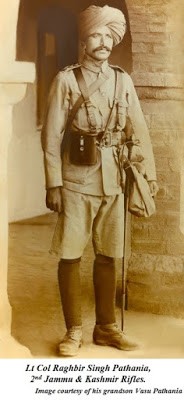
He was born in Kangra, Himachal Pradesh in 1913, just two years before his father Lt Col Raghbir Singh Pathania, 2nd Jammu & Kashmir Rifles was killed in action while commanding the battalion in Jassin, Tanganyika. (Kashmir contributed one and a half battalion for Expeditionary Force B for East African campaign.  One complete battalion 2 J & K Rifles and half battalion (4 companies) 3 J & K Rifles.  Class composition of 2 J & K Rifles commanded by Lt. Colonel Raghbir Singh was 50% Muslims and 50% Gorkhas.  Class of composition of half the battalion of 3 J & K Rifles commanded by Lt. Colonel Durga Singh was 50% Dogra and 50% Gorkha. Raghbir Singh was killed at the head of his troops defending an outpost on 18 January 1915. State troops fought well but post was overrun next day.  Out of 135 Kashmir troops captured, 115 were wounded that tells a lot about the fight.)  His mother was the daughter of Gen Baj Singh, Kashmir Imperial Service Troops, a fine old soldier and gentleman who was always keen to be in the thickest of a fight. He was shot down next to Capt. Townshend, leading an assault during the Siege of Chitral, 1895. (Three battalions of Kashmir Rifles; 4, 5 & 6 were deployed in northern areas in 1895 campaign.  4 Kashmir Rifles commanded by Colonel Jagat Singh was at Gilgit and when Chitral was threatened, it was dispatched to Chitral. That old soldier General Baj Singh although not required went with the battalion to make sure that is was steady in a crisis.  Captain Townsend with 400 soldiers was besieged in the fort.  During a heavy attack a number of Kashmir troops were killed including Baj Singh and Major Bikham Singh of 4 Kashmir Rifles. Charles Verre FerrersTownsend was an interesting character and also present at the battle of Ombdurmam in Sudan.  He rose to become Major General and during Great War commanded 6 Division in Mesopotamia. After initial successes, his command was destroyed at the siege of Kut al Amara and he surrendered to Ottoman forces )  Anant Singh was raised under the tutelage of his grandfather Maj Gen, Sardar Bahadur, Nihal Singh Pathania, OBI, the C-in-C of Jammu & Kashmir Forces.

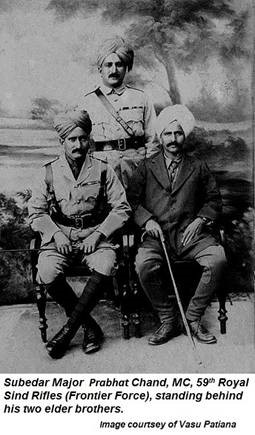
It was around this time that he was engaged to a lady whose family could boast of an equally strong military heritage. Her father, Col Bakshi Chand Katoch was awarded an IDSM in Mesopotamia when he was the Subedar Major of the 56th FFR. He was subsequently commissioned with the first batch of KCIOs from the Cadet College, Indore in Dec 1919.Maj Gen Akbar (Rangroot) who was PA-1, was also commissioned in the same batch. Her younger sister was married to Ghanshyam Singh who was in the last batch of KCIOs commissioned from Sandhurst in 1934 and was posted to 16th Cavalry. My father Maj Gen Syed Shahid Hamid was in the same batch.Her uncle (father’s younger brother) was Subedar Major Parbat Chand Katoch, the first Indian officer (VCO) to be awarded a MC in WW1. When all the British officers became casualties at Neuve Chapelle,  Prabhat Chand then just 30 years old, splendidly led the remnants of his regiment, none other than the 59th Royal Sind Rifles (Frontier Force), which in the reforms of 1921/22 would be renumbered as the 6/13thRFFR. Her grandfather was Sardar Bahadur, Honorary Captain Bidhi Chand, the first Subedar Major of 38thDogra (now 2 Dogra. The recruitment pattern during necessity of Great War is very interesting.  On the eve of Great War, infantry battalions consisted of eight companies. In 1915, a Jat K company and later two L & M companies of Garhwali Brahmins were added.  Later, during four company re-organization battalion had four Dogra Rajput companies but also retained K Jat and M Garhwali Brahmin companies.  In Second World War, other regiments with Dogra component also recruited new classes.  5th Probyn Horse recruited Dogra Brahmins and Baluch regiment Brahmins from non-Dogra areas. This added to administrative headache as in Probyn’s Horse instead of squadron mess for a single class troop messing had to be implemented as Brahmin Dogra would not eat with Rajput Dogra.) who held the appointment for 18 years till he retired in 1909.

His fiancés parents were keen to quickly tie the knot, since girls in their family wed as young as fourteen, but Anant’s battalion was fighting in Waziristan and he did not want to take a chance. The family agreed to wait. He joined his unit at Razmak along with his course mate, Bakhtiar Rana who was promoted to a three star rank in the Pakistan Army. Most of the Muslim officers that he served with in the battalion during this campaign including Shaukat Raza, Sher Khan, Nazir Ahmed, Akbar Khan and Muhammad Musa, would also rise to prominence in the Pakistan Army. When the campaign terminated in 1939, Anant Singh was detailed for the Junior Staff Course. By the time he returned to the battalion it had moved to Secunderabad as part of the newly raised 5th Indian Division. The formation was under equipped as it was foreseen that the British India Army would not fight a ‘first-class enemy’.  However whatever might have been said against the Italians, the Battle of Keren in Eritrea was one of the toughest engagements fought by the 5th Indian Division. To a large extent the division owed its success to the experience of a number of its battalions like the 6/13th RFFR who had operated on the North-West Frontier.

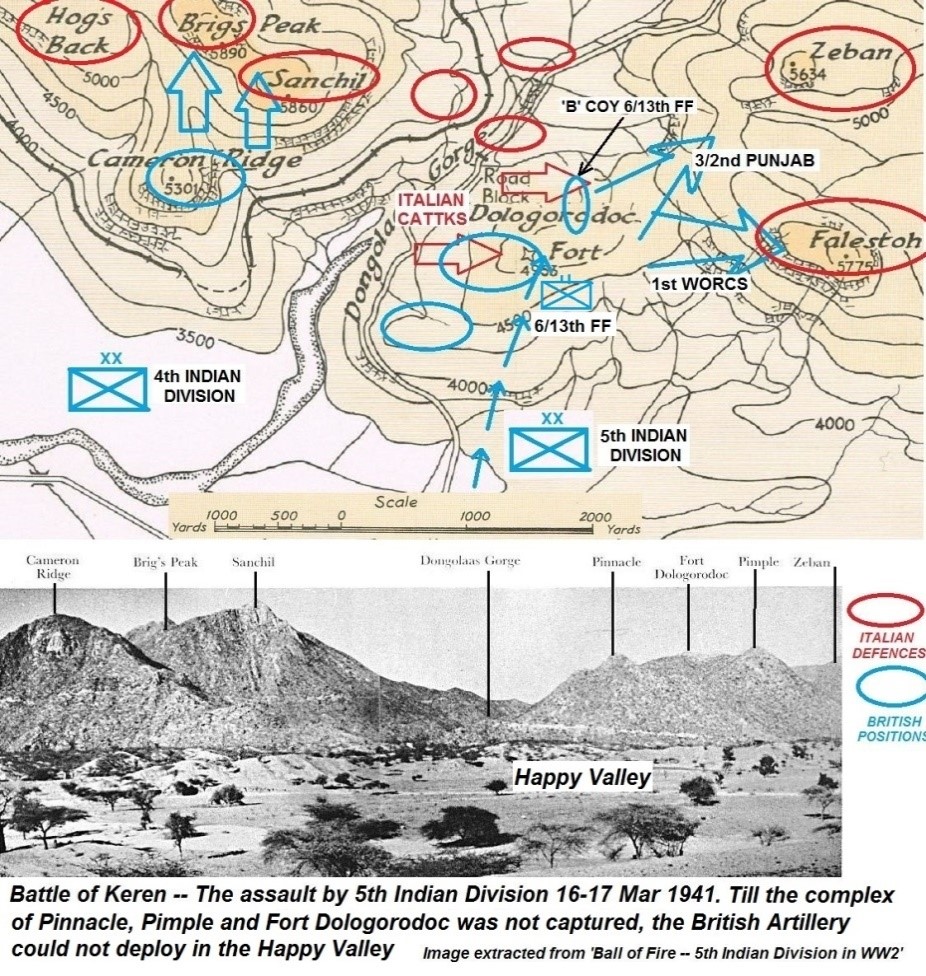
The division was shipped to East Africain Sep 1940. By the time the battle for Keren was fought in early 1941, Anant Singh had advanced to a temporary captain and was commanding a company. Keren is located on a plateau 4,300 ft above sea level and astride the only route that led to Asmara. A formidable barrier of bleak and jagged peaks guarded the approach through the narrow Dongolaas Gorge which took the road and railway up to the plateau. The initial attacks in Feb and early March by the 4th and 5th Indian Divisions on the mass of mountains which rose some 2,500 ft above the Happy Valley, met very limited success. The Italians were too well entrenched and from their excellent observation posts they could detect and engage every movement. Moreover, the physical effort of climbing through prickly bush, spear grass and rocks with no foothold, so exhausted the attackers burdened with equipment, weapons, ammunition etc. that on reaching the crests they were momentarily too exhausted to make further effort. That’s when the Italians counterattacked.

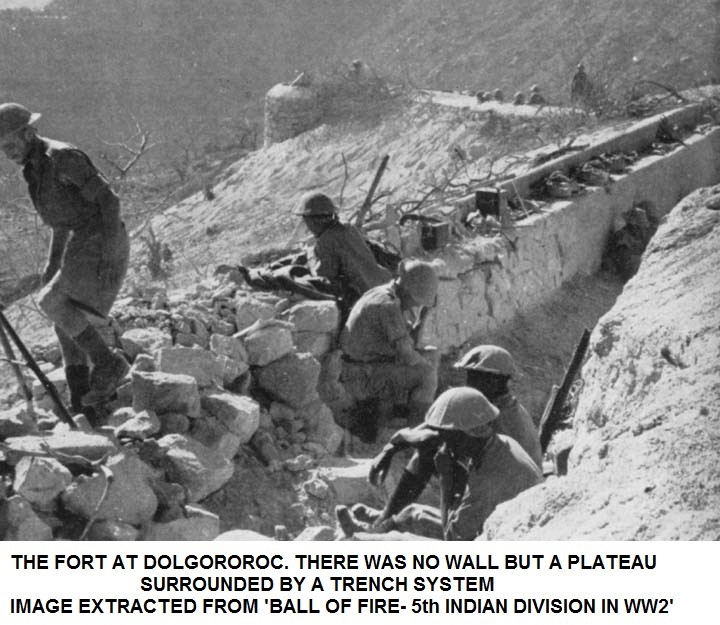
Ultimately the British commanders decided to force a passage by narrowing the frontage of the attack to just 3000 meters astride the gorge. A renewed effort by the 4th Indian Divisionon the left to capture Brig’s Peak and Sanchil again failed. However, a brigade of 5th Indian Division commanded by Frank Messervy managed to ascend a spur on the right and after some bitter fighting captured Dologolodoc Fort. That night the next brigade of which 6/13th RFFR was the reserve battalion passed through to assault Zeban and Falestoh. The attack was held-up halfway and early next morning, the flank of 3/2ndPunjab (the left forward battalion) was counterattacked. ‘B’ Company 6/13thRFFR commanded by Anant Singh was sent forward to assist in repulsing the Italians. The ground over which it had to pass was swept by machine gun fire from across the gorge but the company made a rush, captured forty Italians and held ground. Throughout the morning in temperatures touching 40°C and amidst heavy shelling, the rest of 6/13thcarried water, rations and ammunition up to the forward battalions. Its HQ was heavily shelled but with coolness and diligence, the adjutant Maj Sher Khan kept is operating efficiently. In spite of the best efforts of 6/13thRFFR and air supply mission,the Worcestershire Battalion on the right was critically short of ammunition and in the evening withdrew to a depression ahead of Fort Dologoroc.

As it was withdrawing, Anant’s company out on the left flank was heavily counterattackedby the better part of a battalion of Savoy Grenadiers who were among the finest troops the Italians had. In spite of losing a third of its strength the company gallantly held its ground. The history of the division records that the company commander ‘displayed magnificent courage and leadership in this action’. When the Italians succeeded in penetrating the centre of his sector, he led his company HQ and a few men whom he had collected to the counter attack and at the point of the bayonet pushed the Italians out from his company’s position.Though wounded in the face and both legs, Anant Singh was not prepared to be evacuated and only did so five hours later under orders. The command passed to his company officer, Lt. Sadiqullah. The Savoy Grenadiers rallied and launched another attack but the officer handled the situation very well. In the nick of time the company was reinforced by two platoons and Sadiqullah led a charge and again drove the Italians back at the point of the bayonet. For conspicuous bravery and devotion to duty, Anant Singh was awarded a Military Cross. Young Lt. Sadiqulla was also awarded a MC in a subsequent battle but that is another story to be told.
(Lieutenant, later Brigadier Sadiqullah Khan Orakzai is another fine officer and gentleman of a bygone era. His family also has connection with proud Rajputs.  His father Roohullah Khan was inspector general of police of Alwar state.  Sadiqullah joined 6/13 FFR in ranks in 1932.  Commissioned from IMA Dehra Dun 1938 and won his MC with the battalion.  He was one of the first batches of Indian officers posted to frontier scouts.  He served with South Waziristan Scouts and Tochi Scouts.  Briefly commanded 2/13 FFR (now 8 FF) after partition. Ended his career as Inspector General Frontier Corps – IGFC. His son-in-law and grandson also commanded 8 FF.) 

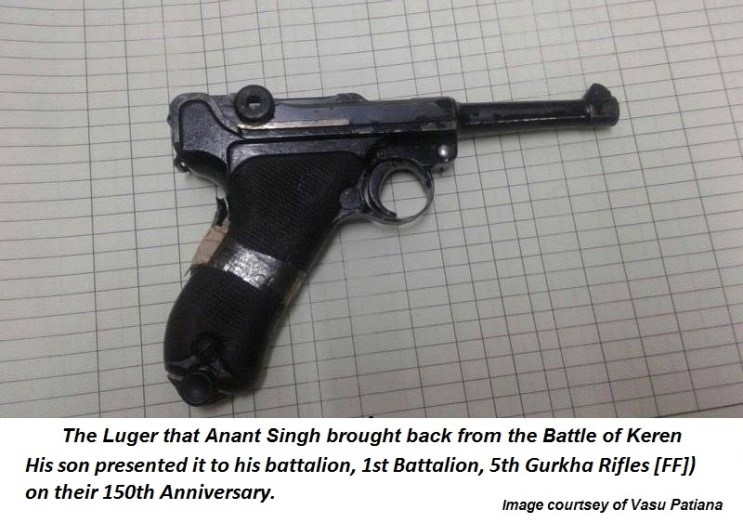
Anant Singh returned to India to recover from his injuries. While in hospital, he was visited by Maj Gen Inskip who commanded 6/13th RFFR in Waziristan from 1932-34 and was now commanding the Rawalpindi District. Inskip had been awarded an MC in WW1 and he pinned a miniature of the medal on Anant’s shirt that had been presented to him by a Count. Anant confided to the general that he was still in possession of an Italian Lugar that he was grasping when evacuated from the frontline and the general replied “Keep your mouth shut and retain it as a memento”, which he did. It was rumoured that his leg had been amputated and his fiancés mother wanted to call off the wedding. Col Katoch was sent to the Pathankote Railway Station to meet Anant Singh (who was on his way to Jammu on medical leave) and confirm if the groom-to-be was whole and intact. That night two very drunk soldiers arrived home. The father-in law-to-be had pulled out a bottle of Scotch to celebrate and together they ‘killed’ it.

After a sojourn, Anant Singh returned to the front, this time to Burma and was the first Indian officer to hold the key appointment of a brigade major of an infantry brigade. At Independence, he opted to be transferred to the 1/5th Ghurkhas that had been part of the Punjab Frontier Force, and then commanded it in the First Kashmir War. In Nov 1948, the advance of the Indian Army through the Zojila Pass towards Drass and Kargil was held up, and the 1/5th Ghurkhawas tasked to clear the heights of Kumar and Ananton a ridge overlooking the Pindras Gorge. It was a hard fought battle and Anant Singh’s citation for MVC sates that ‘The success of this operation was due entirely to Lt. Col. Pathania’s personal recce of enemy defence. Throughout the recce stage and during the attack, this officer personally led his men.’

In 1949 Anant Singh was promoted brigadier. For the next ten years he held various command and staff appointments and was promoted major gen in 1959. While recently appointed as the Director General, National Cadet Corps in 1962, on a short notice of few hours, he was sent to command the 4th Mountain Division in NEFA. The debacle of the Indo-China War muddied the career and reputation of many officers of the Indian Army including Anant Singh who had so far a fine record of service. The General retired in early 1965 and the warrior breathed his last in Dharamsala on 19 Dec, 2007 at the age of 95 years. (Interestingly, his paltan mate Sadiqullah Khan also passed away at the ripe age of 99 in 2009. I’m sure Anant and Sadiqullah are enjoying each other’s company up there and looking down and smiling on the younger generation of PIFFERS).

Authors Note: I am immensely grateful to Vasu Pathania for having shared with me so much information, anecdotes and pictures related to his late father. My deepest thanks to Sushil Kumar for providing me the bio data as well as citations of the general as well as his relatives mentioned in this article. The major details of the Battle of Keren (including maps and images) have been extracted from ‘Ball of Fire’, the WW2 history of the 5th Indian Division.

Review of Crossed Swords; a History of the Pakistan Army

The following review was written by Major Amin in 2008. Things have changed since then and the Russians and Chinese are now said to be on board with Pakistan’s Taliban plan. We will see. But as usual, an acerbic but well informed review from Major Amin..

17 March, 2012 Crossed Swords-Shuja Nawaz Reviewed by Major Agha H Amin (Retired) September 2008 

Crossed Swords , Pakistan,Its Army,and the Wars Within-Shuja Nawaz , Oxford University Press,Pakistan , 2008 700 pages; 13 black and white photographs, 6 maps; ISBN13: 978-0-19-547660-6ISBN10: 0-19-547660-3

Crossed Swords is the latest addition to the list of books dealing with Pakistan Army . Written with an eye on the Western audience by a Pakistani who has settled in USA the book is a welcome addition to books on Pakistan Army.It contains some new sources and some new information .Unfortunately most of the information is anecdotal and the narrators are extolling their own performance. 

The author’s viewpoint is somewhat subjective as he is a brother of one of the ex chiefs of Pakistan Army General Asif Nawaz. The book contains some factual errors , some possibly typing errors,expected from Oxford University Press Pakistan which has a reputation of doing this.Some errors are however historical and factual and were entirely avoidable.On page 8 3rd Light Cavalry of Meerut fame is written as 3rd Light Infantry and on page 9 becomes 3rd Light Cavalry.On page 22 Ayub Khan is placed in Assam regiment though Ayub’s battalion officer Joginder Singh specifically stated that Ayub Khan was in Chamar Regiment in WW Two.On page 426 Naseerullah Khan Babar is promoted to lieutenant general and similar fate befalls Major General Sarfaraz Khan on page 223. 13 Lancers becomes 13 Cavalry on page 305.On page 470 he changes the ethnicity of Sardar Balakh Sher Mazari a Baloch Seraiki by calling him a Punjabi , an honour that no Baloch would like to have. A far more serious error Shuja makes while discussing the ethnic composition of Pakistan Army on page 570.He states that Sindhis and Baluchis are 15 percent of Pakistan Army.This is a serious distortion of history.The term Muslim Sindhi and Baluchi abbreviated to MS&B was given to
Ranghar/Kaimkhani/Khanzada Rajput recruitment in Pakistan Army in 1950s.The aim was to rationalise the recruitment of Ranghars in Pakistan Army. Later the usuper Zia in order to appease the Sindhis created the Sindh Regiment but Sindhis as far as my research reveals are far less than Ranghars/Kaimkhanis/Khanzada Rajputs in the army.The Ranghars are a significant class in fightig arms, being at least 35 % of armour and distinct from Punjabis.The Baloch are hardly represented in the army.As a matter of fact the Pakistan Army has such a reputation in Balochistan that no Baloch would like to join it.All thanks to General Musharraf,Zia and ZA Bhuttos policies. 


These are expected errors and more so from Oxford University Press Pakistan known for changing authors photograph with those of their uncles on jackets of books as they did with Colonel M.Y Effendi in his book Punjab Cavalry published by Oxford University Press in 2007.The old prince narrated to me the sad story when I met him and was also quite cheesed off by the fact that the princess running Oxford Pakistan is too arrogant to meet any author or to even discuss anything on the telephone. It is significant to note that so disgusted did Effendi become with this Ameena Syed of Oxford that he withdrew his books rights from Oxford University Press Pakistan.Its possible that Effendis book was deliberately sabotaged by Ameena Syed as her brother brigadier Javed Hussian was with Effendi in the tank corps and both did not get along well.

The above errors are insignificant.However Shuja has made some asertions which can be classified as serious errors or even distortion of history.On page 71 he asserts that calling off of Operational Venus by Pakistan’s civilian government was one of the reasons why the 1947-48 war failed.I state this because the sub title of the chapter is ” Why the War Failed”.On the other hand he fails to point out the major fatal decision when the Pakistani government refused to allow the armoured cars of 11 PAVO Cavalry to assist the tribesmen in breaking through to Srinagar.Those who are not familiar should know that the main reason why the tribals failed to take Srinagar was because Indian armour counterattacked them and destroyed them at Shalateng. This fact was discussed by Brig A.A.K Chaudhry also in his book. The Operation Venus plan came much later.At that time the Indian Army was well established in Kashmir and well poised to meet any threat.

Very few participants of the Kashmir War have left any written accounts of their war experiences. General Iqbal who participated in the war and later on rose to the rank of full general and Chairman Joint Chiefs of Staff Committee, long after the Kashmir War made one very thought provoking remark about the Kashmir War in an article in the Pakistan Army Green Book 1992. This particular publication was sub titled ‘Year of the Senior Field Commanders’. Iqbal wrote; ‘During 1948 Kashmir Operations I saw one senior officer sitting miles behind the frontline and counting availability of mules and rations. He had relegated the fighting to a senior battalion commander . 
In 1963 once Major General Fazal I Muqueem Khan in his book The Story of Pakistan Army .Fazal thus wrote; ‘To the Army’s horror, Pakistan during her greatest hour of triumph in Kashmir agreed to accept the ceasefire…it was difficult to understand why Pakistan let that opportunity pass. Was it assumed weakness; or as a result of pressing advice; or from misplaced chivalry towards an unfriendly neighbour in distress? Whatever the reason,Pakistan’s reluctance to accept the risks of continuing the war,cost her Kashmir at that time. It was a risk worth taking.” But note that the Pakistani attack force collected for Operation Venus consisted of about six infantry battalions and two armoured regiments. To oppose this the Indians had two infantry brigades (50 Para Brigade and 80 Infantry Brigade) .In addition there were two armoured regiments in the same area i.e. Central India Horse and the Deccan Horse . In addition the Indians also possessed more than 10 other armoured regiments which were not in Kashmir but in Punjab or Western UP and could move to Kashmir. We shall see in 1965 how Pakistani armour functioned and the reader can keep that as a yardstick in order to appreciate how Pakistani armour and infantry would have behaved in Operation Venus; had it ever been launched! Fazal does not explain how the capture Of Beri Pattan bridge would have led to complete collapse of Indian hold over Kashmir, apart from temporary severing of the line of communication to Poonch. Greater part of the Central India Horse was at Nowshera close to Beri Pattan while Deccan Horse in Chamb-Akhnur area was also within striking range and the battle would have been a hotly contested affair! 
Shaukat Riza did not take the extreme viewpoint similar to Fazal’s when he wrote his book on Pakistan Army.He merely said that ‘On December 30 both sides saw the wisdom of cease-fire’. Lately in an article General K.M Arif adopted a more rational viewpoint, when he stated that the Kashmir War of 1948 was mismanaged simply because Pakistan was not in a position to fight it successfully summing it up by stating ; ‘It is too hazardous a risk to fight a war on ad hoc basis’.
On the other hand, there is no doubt that Pakistan was in a favourable position to win the Kashmir War at least till the first week of November. Mr Jinnah exhibited great Coup de Oeil when he ordered Gracey to employ two brigades and advance with one brigade each towards Jammu and Srinagar. But Mr Jinnah was unlucky in possessing no one like Patel and his Prime Minister and his entire Cabinet proved to be an undoubted failure at least as a war cabinet!
Mr Jinnah’s decision not to have a Pakistani C in C, although taken in the best interest of the country and the Army as Mr Jinnah saw it, ensured that the British acting C in C procedurally blocked the execution of Mr Jinnah’s orders in October to attack Kashmir. Pakistan was unlucky in having a man like Iskandar Mirza at the Ministry of Defence.Mirza did not advise Mr Jinnah correctly and the fact that he had hardly served in the Army and did not understand military affairs further ensured that Mr Jinnah and the Prime Minister remained as ignorant as they were about military affairs as they were when they were in high school. 

But again, it is incorrect to criticise Liaqat for Operation Venus since in December 1948 the Indian position was much more secure than in 1947.Liaqat can be criticised for not ever visiting Kashmir while the war was on and for not standing by Mr Jinnah in pressurising Gracey in October 1947 to order the Army to attack Kashmir.Had a Pakistani C in C been appointed even in December or in March 1948 the Indians may not have held on to Poonch- Nowshera area at least. Had Major Masud been allowed with his armoured cars on Domel-Baramula Road despite Ghazanfar Ali and Sher Khan’s objections;Srinagar may have been captured by the Tribesmen by first week of November 1947. The Indians were lucky in having comparatively more regular army officers who led from the front as is evident from higher officer casualties among Indian Army officers above the rank of captain vis a vis the Pakistan Army. 
The treatment of 1857 is also very superficial.The author states that of the Bengal Army which rebelled, some 80 % were Purbias (page.7) , but fails to point out that the vast majority of cavalry which led the rebellion notably at Meerut i.e 3rd Light Cavalry which actually captured Delhi was Muslim and mostly Ranghar Muslim.His use of the term British for the pre 1858 period is also factually incorrect as India till 1858 was ruled by the English East India Company using mostly its private Bengal Army ,Madras Army,Bombay Army , its private European regiments and some regiments on rent from British Army to conquer entire India. In his discussion of Martial Races Theory the author totally ignores the fact that Punjab Loyalty in 1857 to the British was one of the main reasons why martial races theory was evolved.This is a simple point noted even by British writers like Philip Mason.The author also fails to note the politically important fact that the English East India Company’s army was the knight in shining armour which saved the Muslims of Punjab and settled areas of present Pashtun NWFP from the Sikhs who were using Muslim Mosques as stables and gunpowder magazines and plastering their walls with cowdung. Perhaps this fact does not suit the “martial races” who were ruled by a 10 % minority (the Sikhs) in the Punjab and settled Pashtun areas (for more than four decades in Punjab and some two decades in modern NWFP’s settled districts). 
The author talks about martial races theory and thinks that martial races theory was all about Punjab and Frontier as it is now but perhaps does not know that one of martial races theory’s most famous exponent Major General Macmunn regarded the Khanzada Rajputs of Firozpur Jhirka as the finest fighting race in India. The author also fails to note that the Sikhs were in majority in the fighting arms till First World War and were reduced to a minority by being replaced with Punjabi Muslims after First World War because the Punjabi Muslims were regarded as phenomenally loyal, even against Muslims, by the British.Thus the author conveniently ignores two important developments of WW1 i.e the Singapore rebellion of 5th Light Infantry by Ranghar Muslims and the tribal Pashtun mutinies against British as a result of which tribal Pashtun recruitment was reduced to the gain of Punjabi Muslims. 

In his discussion of Ayub Khan the author totally ignores allegations about Ayub’s tactical timidity in Burma.This incident was discussed by three writers of the time; Major General Joginder Singh of Indian Army who was Ayub’s battalion mate , Sardar Shaukat Hayat who was an ex Indian Army officer and Major General Sher Ali Khan.In an article Brigadier Nur Hussain a reliable authority did state that Ayub Khan was close to General Gracey because they drank together. The authors discussion of old officers is also partial.On page 31 he notes that Brigadier Gul Mawaz got an MC , a medal which many earned but fails to note that Major General Akbar Khan won a DSO which is higher in scale than MC.On page 33 he states that ” Akbar Khan who gained notoriety in Kashmir …..” .Akbar Khan was the pioneer of Kashmir war but Shuja thinks that he was notorious! A strange assertion. Mr Jinnah’s historic decision of creating two infantry battalions of Bengalis is also not at all discussed by the author.It may be noted that Ayub Khan refused to expand the East Bengal Regiment till 1966 as a result of which the Bengalis were further alienated for not being given the due share in the armed forces.this decision was reversed by Yahya Khan in 1966 but by then it was too little too late.

The authors analysis of the origin of the officer corps is also superficial.He fails to note the 50 % ranker quota that the British kept for Indian rankers in the officers selected for IMA Dehra Dun in order to keep the Indian officer corps slavish and backward. The author does note the fact that Pakistani SSG captured Indian War Plan on Samba Kathua road before the war actually started but fails to note the fact that it was Pakistan’s Military Intelligence led by Director Military Intelligence Brigadier Irshad who refused to give any serious thought to this discovery and dismissed it as an Indian ruse! This was revealed to this scribe in an interview by Major General Naseerullah Khan Babar in March 2001.

The most serious distortion of history committed by Mr Shuja Nawaz is on page 226 when he gives the credit of 25 Cavalry’s action of 8th September 1965 at Gadgor to Brigadier Abdul Ali Malik.The authority he quotes is Farouk Adam , then a very junior officer and not in 24 Brigade Headquarter. It must be clarified that a good military historian or analyst’s prime motivation in all writing has been to endeavour to write “what men did” rather than what “they ought ideally to have done” or what “someone later with the benefit of hindsight tried to portray , what they had done”. Thus the analysis of Chawinda Battle done with pure loyalty to service without any inter arm rivalry or nationalistic motivation. Pure and unadulterated military history filtered dispassionately separating fact from fiction and myth from reality. History as
Frederick the Great once said can be well written only in a free country and ours has been continuously under civil or military dictators since 1958. I maintain as one great master of English prose said that “all history so far as it is not supported by contemporary evidence is romance”! Battle of Chawinda was thus not romance! What many in this country wrote and was outwardly military history was essentially “Romance”! Inspiring, superhuman but a myth promiscuously mixed with reality!Chance plays a key role in battle and at Chawinda chance played a very important role! Nisar, when he deployed 25 Cavalry did not know what was in front of him ! KK Singh Commander 1st Indian Brigade also did not know what was in front of him! This mutual ignorance saved Pakistan on that crucial day ! Later heroes were created! I repeat “Heroes were created” ! The hero had to be from the Salt Range however ! At least Shuja Nawaz wants it this way ! What were the key facts? Most important tangible fact was “casualties” ! These were deliberately hidden since these would have let the cat out of the bag! Everyone would have discovered who really fought and who got gallantry awards on parochial,regimental or old boy links! How many were killed in the biggest military blunder “Operation Gibraltar”! This is Top Secret ! How many infantry men died at Chawinda? Again no mention of any figures! The real
motivation here is not national interest but to preserve or more important to “guard reputations” 

Now lets talk about the broad front deployment that Shuja Nawaz refers to .There is no doubt that the “broad front deployment” was done by Nisar and Nisar alone and Brigadier Abdul Ali Malik had no role in it. It is another matter that Nisar also did not know what was in front of him. It was like Jutland when both contending fleets were running towards each other at express train speed. Why Nisar behaved as he did and what actually happened even today is hard to understand, whatever anyone may claim now with the benefit of hindsight! Shuja Nawaz here in his 600 page book offers no tangible proof that the actions of 25 Cavalry had anything to do with what Brig A.A Malik told Nisar. Nisar was told to “do something” as clearly stated by an authority no less than Pakistan Army’s official historian Major General Shaukat Riza, apparently not from Jhelum or from North of Chenab by a twist of fate. There is no doubt that Nisar did something without the least clue of what was in front of him. The important thing is that Nisar did something rather than getting paralysed into inertia and inaction! The “Do Something” order by Brig A.A Malik to Lt Col Nisar CO 25 Cavalry should not have been glorified to something higher by Shuja Nawaz simply on authority of an article written by a person who was a company 2IC in an infantry battalion of 24 Brigade and that too only in 1992.This is a serious historical failing.At least in a military historian but is the Oxford University Press Pakistan run by professionals? One may ask Colonel M.Y Effendi. The fact that Abdul Ali Malik was a close relative of Shuja Nawaz’s wife makes this distortion a distortion par excellence. The same words of Brig A.A Malik ” Do Something” were repeated by Nisar in his article published in Pakistan Army Journal in 1997. Perhaps Shuja Nawaz did not read all the accounts of direct participants.Perfectly excusable as he is based in USA.But not good military history certainly.The fact is that the 25 Cavalry on 8th September 1965 was functioning in a vacuum.Brig A.A Malik had no clue about armour warfare and Nisar had no higher armour headquarter to guide him.. 24 Brigade had two infantry units, one which had been overrun and dispersed on 8th September i.e 3 FF and 2 Punjab which was at Chawinda. The crucial action took place at Gadgor few miles north of Chawinda in which 25 Cavalry faced the entire Indian 1st Armoured Division. This was an extraordinary situation and Nisar acted on his own best judgement since Malik had abdicated to Nisar by stating that he should “do something”. It is another thing that Nisar also did not know what was in front of him and acted boldly and unconventionally. Had he known what was in front of him he may have been paralysed by inertia and inaction! But this is speculation and some part of history always remains unfathomed and hidden! Nisar acted through sheer reflex and deployed his unit in an impromptu manner. The fire fight which took place at Gadgor between 0900 hours and 1200 hours was a pure tank versus tank affair. 25 Cavalry versus two leading tank regiments of Indian 1st Armoured Division! Thus the Indian Armoured Corps historian stated “The Armoured Brigade had been blocked by two squadrons of Pattons and in the first encounter had lost more tanks than the enemy had…the worst consequence of the days battle was its paralysing effect on the minds of the higher commanders. It took them another 48 hours to contemplate the next move. This interval gave Pakistanis time to deploy their 6th Armoured Division…in fact the golden opportunity that fate had offered to the 1st Armoured Division to make worthwhile gains had been irretrievably lost” (Refers-Pages-393- 394-History of Indian Armoured Corps-Gurcharan Singh Sandhu-Vision Books-Delhi-1990). Thus the Indians acknowledged “This regiment’s (25 Cavalry) performance was certainly creditable because it alone stood between the 1st Indian Armoured division and its objective, the MRL canal”.(Refers-Page-395-Ibid). This is not the only source.Major Shamshad a direct participant has already stated on record that SJs were awarded to some officers for an attack in which not a single man was killed on both sides! Here he refers to Major Farouk Adam.
This reminds me of an incident in armour school Nowshera in 1991.I was an instructor in Tactical Wing.The Senior Instructor incharge of the Young Officers Tactical course asked us , ” Should we give an Alpha Grade” . My lone reply was that no Sir , since Armour School gives Alpha to sons of generals only .This was a norm then .The Infantry School where I did the junior tactical course but later on it started giving alphas after 1985 to oblige some sons of generals.But that is how Pakistan Army is. The historical fact remains that 25 Cavalry was part of 24 Brigade but all that Nisar its CO did on the crucial 8th September at Gadgor was based on his own judgement. On 9th and 10th September no fighting took place as Indians had withdrawn their armoured division to the crossroads. On 10th September, 6 Armoured Division took over and 24 Brigade was a part of 6 Armoured Division. On 8th September there was a vacuum and Nisar acted in a sitaution which can be classified as one characterised by “absence of clear and precise orders”! Shaukat Riza’s book is basically a compilation of existing facts. It has historical value since Riza was allowed access to official records.Shaukat had no axe to grind . Shuja Nawaz by his own confession is a close relative of A.A Malik. Shuja also forgets Brig A.A Malik’s request to withdraw when Indian tanks had crossed the railway line on 16th September and occupied Buttur Dograndi and Sodreke. This fact was brought to light not by the much criticised Shaukat Riza but by the then GSO-2 of 6 Armoured Division Major (later General K.M
19. Arif), first more bluntly in Pakistan Army Green Book-1993 and again a little tactfully in his recently published book Khaki Shadows. Thus no connection with 3 FF, an infantry unit which as far as I know suffered more casualties than any other infantry unit at Chawinda. 3 FF fought admirably but was launched thoughtlessly as brought out by Major Shamshad in his letter published in Sept 2001 DJ and consequently suffered enormous casualties at Sodreke-Buttur Dograndi area. Shamshad was the tank troop leader in support of 3 FF when it disastrously attacked Buttur Dograndi. In opinion of Shamshad, the attack had failed not due to any fault of 3 FF but because of poor planning by Commander 24 Brigade. Even at formation level Chawinda was not a big battle in terms of casualties since the Indian 1 Corps suffered less casualties than 11 Indian Corps in Ravi Sutlej Corridor. A.A Maliks poorly planned counterattacks leading to bloody casualties for Pakistan Army were also discussed by Major General Fazal i Muqeem in his book on 1971 war. http://pakistan-army-interviews.blogspot.com/2010/11/bara-pind-jarpal-charge-of- pakistans.html 

On page 233 while discussing the main Pakistani offensive in Khem Karan, the author fails to point out that the Pakistanis had a 7 to 1 superiority in tanks and yet they failed. Further he fails to point out the fact that major failure of Pakistani 1st Armoured Division occurred in the 4th Brigade where its commander Brigadier Bashir ordered its tank regiments every night to return to leaguer at their start point every night thus abandoning all territory they had gained during the day. In the treatment of Chamb Operation of 1971 the most significant decision of Major General Eftikhar to switch from North to South is not discussed at all.This was one of the most landmark operational decisions in history of Pakistan Army.The author also fails to highlight the cowardly action of then Brigadier Rahimuddin Khan in not joining 111 Brigade on pretext of dealing with Shiekh Mujibs trial. Of course this great warrior later rose to full general in the Pakistan Army.

Shuja also gives no thought in his worthy analysis to Pakistan Army’s launching a pre-emptive attack on India in September 1971.This if done in the words of Indian Commander Western Command General Candeth would have thrown all Indian plans to attack East Pakistan to the winds . (Refers-The Western Front -Candeth). In the chapter dealing with Z.A Bhutto Shuja does not discuss the cadrisation plan proposed by ZA Bhutto and his tasking of Pakistan Army’s Military Operations Directorate to implement it. This plan if implemented would have reduced the standing army in size and enabled the Pakistani government to spend more money on training.This plan was scrapped by Zia in 1977. 

On page 477 he states that ” Abbasi was the man who had been removed from his command in the Kargil area of Kashmir…………after having undertaken an unauthorized and costly foray into Indian held territory in 1990‿.Now this comes straight from a man who repeatedly claims nearly total access to all direct participants. Now the facts of the above situation. Poor General Abbasi had done nothing in Kargil. First the use of the word Kargil by Shuja Nawaz is unwarranted and irrelevant and above all totally out of context! Abbasi’s command was not just Kargil only but a much larger area i.e. the entire Northern Areas of Pakistan. Second the foray he Shuja refers to was not launched in 1990 but in 1992 when Shuja Nawaz’s very own brother was the army chief! Third the foray was not as unauthorized as claimed by Nawaz. Abbasi was commanding the FCNA, part of 10 Corps Rawalpindi and his corps commander Lieutenant General G.M Malik,a man of extreme ambition had a tacit understanding with Abbasi that in case he succeeds he was a part of the team and if Abbasi failed G.M did not know about the attack ! A very typical and known phenomenon in all armies, organizations and bureaucracies all over the world. Fourthly poor Abassi’s unauthorized foray was not in Kargil but in Siachen an area far away from Kargil. Lastly Abbasi had been packed off to the FCNA in late 1990 a time when snow made any foray in Kargil or Siachen impossible. This happened once Abbasi expressed disagreement with the then corps commander 4 Corps Lahore Alam Jan Mehsud.The incident was narrated by this scribe to then Brigadier Salahuddin Tirmizi (later lieutenant general).Alam Jan thought that Abbasi should be posted to FCNA where he could catharsize his spirit of Jihad on those snowy rocky icy pinnacles of Siachen Glacier. Catharsize he did, with disastrous and bloody results in 1992., but not 1990 as this “privy to inside sources in the army” claims. And that too when his brother was army chief.A sad reflection on how an operation was mounted by an overzealous divisional commander, with secret authorization of his direct superior corps commander, while keeping a so called professional army chief in absolute darkness ! A sad but logical end to the career of Abbasi who was a more upright and internally motivated general officer and shoulders above most of the general officers that I saw in my army service. Shuja Nawaz repeats the above assertion again on page.509 when he states that “among the many attempts to gain advantage at Kargil was a failed attempt in 1990 by……Major General Zaheer ul Islam Abbasi. On the same page again Shuja once again repeats the same totally incorrect assertion “without clearance from the army chief General Mirza Aslam Beg, Abbasi launched an attack on the LOC. Poor Beg the target practicing range of Shuja Nawaz had no connection with Abbasi’s ill fated attack in 1992 ! Beg had retired in August 1991. 

Burhanuddin Rabbani promoted or demoted to Mullah Burhanuddin Rabbani by Shuja Nawaz on page.479 was the president of Afghanistan in 1992 and not “subsequent to 1994” as stated by Shuja. In footnote.2 on page.502 Shuja Nawaz has forcibly thrust the honour of being Chief of Staff 12 Corps on General Kakar, when he states that Kakar served as Chief of Staff of 12 Corps at Quetta under Rahimuddin (famous for not joining his command in Chamb in 1971 thus making his then commanding general Major General Eftikhar state that he would court martial this man after the war. To Rahimuddin’s good luck Eftikhar embraced martyrdom in the war and Rahimuddin survived).This is a factual error as 12 Corps at Quetta did not exist at that time. This corps was raised somewhere in 1985 when Rahimuddin was already the chairman joint chiefs. In the same footnote Shuja Nawaz states that Kakar was wounded at Chawinda in 1965 war .When the 1965 war started Kakar was at intelligence school in Murree.This assertion of Kakar being wounded, while possible, is questionable .Its possible that Kakar joined his unit in later part of the war. 

On page.508 Nawaz states that “one of the first actions in 1948 Kashmir war was the securing of Kargil heights by Pakistani forces.This is a serious factual error. The first major action of the 1947-48 Kashmir war was the attack on Muzaffarabad in October 1947 and the seizing of heights near Kargil happened much later in May 1948 by the Eskimo Force of Gilgit Scouts under Captain Shah Khan (later an air force officer).As a matter of fact Kargil itself was captured by the Gilgit Scouts and they had then captured Zojila Pass and advanced across it. But all this happened much later after October 1947. 

Good in details, written from the relative calm and safety of USA, this book possibly written with good intentions, got lost in the woods of details and failed to present the broad picture. Many Bhagwans of military history reviewed it and failed to find any fault with it! On page 471 Shuja glorifies General Kakar for having no liking for politics.He ignores the fact that Kakar was not groomed for higher ranks and was promoted because of ethnic biases.Simply because a Pashtun president was comfortable with a harmless compatriot.He also fails to note that General Kakar acted against Nawaz Sharif not because Kakar was a democrat but simply because he feared Nawaz as a threat to his chair of army chief. General Musharraf has himself acknowledged in his book that General Kakar was parochial and was favouring Pashtun officers.No compliment to an army chief who is supposed to be a much bigger man.No wonder that Kakar had been packed off to a backwater in Quetta by General Baig. Becoming chief was something that a man of Kakar’s mediocre intellect could never have imagined but this happened only because of party baazi in the army and the fact that Ghulam Ishaq Khan wanted a Pashtun brother. Fair enough in a backward and tribal medieval society like Pakistan ! It is my conviction based on a deep study of that period,that if Kakar would have been the army chief in 1996 and 1997 General Musharraf or any non Pashtun officer would never have become the army chief ! Why ? Simply because Musharraf was not a Pashtun ! Here it must be noted that Jahangir Karamat, Kakar’s successor was miles above Kakar in intellect as well as professionalism.Though a Punjabi he was not from the more parochial tract of area between Chenab and Indus and thus a man with a broader outlook. Its a tragedy of the Pakistan Army that he became a victim of a conspiracy made successful by his own brother officers in ISI , that too because there was that parochial net during that time between the then prime minister and the boss of the prime inter service security agency. The author lauds caretaker premier Moin Qureshi’s role in making the state bank independent but forgets Qureshi’s most controversial release of advance to Bayinder Turkey for Islamabad Peshawar Motorway while also stating that this project was uneconomical.This gained nothing but total loss for Pakistan as Bayinder repatriated many million dollars without doing anything and later successfully sued Pakistan for huge damages in International Court of Justice at Hague. 

On page 480 Shuja extols Talibans wild west justice in hanging Afghan President Dr Najeeb but fails to note the allegation that Pakistani agencies were suspected to be behind the assassination of Mulla Borjan, the most popular and independent leader of the Taliban. On page 481 Shuja quotes Benazir to prove that General Kakar was a brilliant strategist.What did Benazir know about strategy and what strategy did Kakar ever successfully execute other than removing a Punjabi Kashmiri prime minister against decision of supreme court just to assist a fellow Pashtun president? What is Shuja trying to prove . In discussing tenure of General Jahagir Karamat Shuja ignores totally the Ukrainian tank deal commissions. Nawaz Sharif the then prime minister tasked ISI to launch an investigation. Major General Zulfiqar then in ISI was tasked to investigate. He went to Ukraine and Azerbaijan and compliled a thick volume on the whole transaction and commissions taken.This was used by Nawaz later and was one of the reasons why Karamat quickly stepped down.The information was given by a staff officer from Corps of Engineers of major rank with DG ISI of that time and confirmed by an Intelligence Bureau officer. It is strange that Shuja Nawaz who seems to know everyone who matters fails to discuss this serious issue.Or perhaps he succumbed to the conspiracy of silence. Karamat was betrayed by his brother officers and that too just out of selfish motives to please the then prime minister.Not out of any national motives. 

As an officer who served from 1981 to 1988 how would I sum up the Pakistan Army. 1981 to 1983 a cheap emphasis on being good Muslim, growing a beard to get a good report from Zia. Further Zia used religion to get dollars.This was the basic motivation. Beg’s time saw for the first time a tradition of some criticism being accepted.An effort was made to introduce the culture of intellectual honesty in the army. Asif Nawaz time saw emphasis on starch but no change in the army.We did not see any professional change in Asif Nawaz’s time other than introduction of peak cap in the uniform! Kakar’s time saw parochialism par excellence with a chief at the head who used to count cherries in his garden and was upset when some guards ate some.( This first hand account was given to me in Okara in June 1993 when Kakar was the army chief and at the height of his power by a Lieutenant Colonel Feroz , an officer from FF Regiment , whose unit provided Kakars guard while he was a corps commander in Quetta). A petty man elevated to the highest rank.No wonder he was non political because in the heart of his hearts he must have thanked his stars that he became a four star general.An authority no less than General Musharraf has stated in his book that KAKAR WAS PAROCHIAL . In this case Musharraf has hit the nail right on the head.

Karamat I did not see in service and did not serve with so I cannot comment but is reported to be a mild man. Musharraf as I saw him as a major general was flashy,extrovert,egoistic but dynamic.The present army from what I learn from serving officers is again business as usual.Nothing much to write about.The agencies of course play the usual games for money and for their own naukri and Islam being misused for operational reasons. The most serious criticism of Shuja’s analysis is in treatment of Islamic fundamentalism in the army. Shuja on page 585 consoles the audience of his book that Islamic fundamentalism is still not a threat in Pakistan Army. Shuja ignores the more dangerous fact that the army has misused Islam as a slogan to mobilise the populace to achieve its narrow institutional agenda.This is more dangerous than being Islamist.Now this policy may go out of control. Right from Zia in 1977 the army generals used Islam as a slogan to fight a proxy war in Indian Kashmir and Afghanistan.Events may prove that this would be the undoing of Pakistan as it stands in its present form.Now Pakistan is perceived in the west as part of the problem and not the solution.Particularly its army and intelligence agencies are seen as the heart of the problem.India is continuously preparing for a war although a low intensity one and no solution has been achieved in Kashmir.Afghanistan is increasingly hostile and a strange but logical Indian-Russian-Iranian-NATO un-declared strategic alliance has come into place in Afghanistan against Pakistan.All these are serious developments.The coming ten years may vindicate this assertion. The Pakistan Army and its generals may be remembered in history as one of the reasons for Balkanisation of Pakistan.Not a good omen for Pakistan.The army’s involvement in Pakistan’s politics and government is now a serious reason of imbalance for Pakistan’s political system.No hope appears in sight as we hear rumours that the agencies are still active in destabilising Pakistan’s own elected government. Shuja has burnt his midnight oil.He has compiled and collected all the facts in a nice way but his analysis has been shallow.We expected something far more profound than this.600 pages written in vain. 

http://www.scribd.com/doc/61839666/Indo-Pak-Wars-A-Pictorial-History
28. http://www.scribd.com/doc/21686885/TALIBAN-WAR-IN-PAKISTAN- AFGHANISTAN-A-WRITERS-PERCEPTIONS-FROM-2001-TO-2011 http://www.scribd.com/doc/22457862/Military-Decision-making-and- leadership http://www.scribd.com/doc/22151765/History-of-Pakistan-Army-from- 1757-to-1971-PRINTING-ENABLED-Do-acknowledge-to-the-author http://www.scribd.com/doc/22455178/Letters-to-Command-and-Staff- College-Quetta-Citadel-Journal http://www.scribd.com/doc/23150027/Pakistan-Army-through-eyes-of- Pakistani-Generals http://www.scribd.com/doc/23701412/War-of-Independence-of-1857 http://www.scribd.com/doc/22107238/HISTORY http://www.scribd.com/doc/21693873/Indo-Pak-Wars-1947-71-A- STRATEGIC-AND-OPERATIONAL-ANALYSIS-BY-A-H-AMIN-THIS-BOOK- CAN-BE-PRINTED-FROM-THIS-SITE

Martial Races Theory. Myths and Consequences

Major Agha H Amin (retired)

About the Author: Agha H. Amin , Retired Tank corps major. His writings were published in Pakistan Armys prime journals , Pakistan Army Journal and Citadel Journal of Command and Staff College Quetta. Wrote The Essential Clausewitz in 1993, Sepoy Rebellion of 1857-59 in 1998 , Pakistan Army till 1965 in 1999 ,Development of Taliban Factions in Afghanistan and Pakistan (2010) ,Taliban War in Afghanistan (2009). Served as Assistant Editor of Defence Journal ,Executive Editor of globe and Founder Editor of Journal of Afghanistan Studies . An associate of the think tanks ORBAT and Alexandrian Defense group. Carried out various oil and gas and power transmission line surveys in West Asia. Editor in Chief of monthly Intelligence Review and monthly Military and Security Review. Heads the think tank Centre for study of Intelligence Operations established in early 2010.
Image result for major agha amin
Myths ,Distortions and Misconceptions of Indo Pak History-Part One
A Chapter of the book The Sepoy Rebellion of 1857-59 by Agha.H.Amin
(note: this post is from a transcript of the first chapter of the book. Formatting was an issue and if you want to see the whole thing, see here: http://www.slideshare.net/AAmin1/martial-races-theory )

The sepoy war of 1857 gave birth to a new theory in India. This theory was floated in the late nineteenth century: that the races living in the north west part of India i.e. present northern regions of Pakistan and parts of Indian Punjab were the “Martial Races of India”! This theory was partly (but as shown below, only partly) based on the “Punjab and Frontier” loyalty factor of 1857. Its most serious proponent was Lord Roberts, the British C-in-C in India (563).

When I joined the army in 1981 I observed that many of the officers and soldiers serving in Pakistan Army were convinced that the races or castes living in the area between Chenab and Indus Rivers were especially “martial”. Some Pathans originating from the NWFP were also regarded as junior partners of these martial races!
Most of the invasions of India took place originating from areas north of Khyber Pass or west of Quetta i.e. Persia etc. Then the Mughals after 1526 recruited from Hindu Rajputs, Muslim Pathans, Muslim Rajputs, some Muslim Punjabis and Muslim Baloch, but the preference was given to trans-Indus races, mostly Pathans or Persian speaking, or to Hindu Rajputs. The EEIC (English East India Company) since it made its entry from the east had no choice but to recruit from Oudh, parts of Bihar, North West Provinces Madras Bombay Central India etc. In the earlier part of this work we have seen that using a predominantly Hindu army recruited from the Gangetic plain and led by British officers, the pre-1857 Bengal Army defeated all races of India, Pakistan, Nepal, Afghanistan etc. A small contingent of the Bombay Army (made up mostly of Hindu Marhattas) quickly made Persia behave! A couple of Bengal Army Regiments reinforced by an odd European regiment successfully defended Kandahar and Jallalabad against vastly superior forces.
But the rebellion of 1857 changed British perceptions about Indian people and keeping in view the political reliability as well as the administrative convenience factor the British decided to recruit mostly from the north west i.e. Punjab and Frontier provinces of India plus the Gurkhas from Nepal. This change started from 1857 but became significant only around 1895. But loyalty and reliability were not the only factors, because the Madras and Bombay Armies had also stayed loyal. Partly based on the personal biases of Lord Roberts, and under his influence of some other British senior officers, the recruitment policy was changed.


Initially, following 1857 the British adopted the policy of non-reliance on any particular race and even the Punjabi Muslims and the Pathans who had remained loyal were mixed with other castes and religious communities, with only the Gurkhas and certain Muzhbi Sikh Regiments grouped together. An experiment of having pure Muslim or pure Hindu Rajput regiments was started from 1893 but abandoned by 1919, keeping in view the mutinies of 5th Light Infantry and 15 Lancers at Singapore /Mesopotamia.


Singapore Mutineers being shot. The Ranghar Muslims of 5th Light Infantry were superior in stature to any Indian soldiers who were mercenaries of British. Among Pashtuns their greatness was matched by Wazirs, Mehsuds, Afridis and Alizais who rebelled against the British in First World War.


The Bengal and Bombay Armies march through Bolan Pass to attack Kandahar in the First Afghan War

In the 1880 and 1890s it was widely believed that the Indian army was supposed to face the Russian threat originating from Central Asia. It was thus said that the Bombay or Madras soldiers who were shorter in height and smaller in physique were not fit for mountain warfare in India’s north west (564). Charles Chenevix Trench an Indian Army British Officer and a respectable military historian has given a reason for the British bias against east of Jumna and South Indian races. He says in his book on the Indian Army that “Reasons for preferring northerners were largely racial. To Kipling’s contemporaries, the taller and fairer a native, the better man he was likely to be. He looked more impressive on parade, he might be physically stronger, he would surely be braver and more loyal than the down country men. There was a general preference for the wild over the half educated native as being less addicted to unwholesome political thinking”. Charles Chenevix Trench went further in explaining this British bias, he said “Brahmins had been prominent in the Mutiny, and their diet and prejudices though somewhat illogical by stating as following: “The Madrasi soldier was smallish, blackish and rather low caste. The Mahratta was also in origin of no very high caste, and smallish to hoot. The fact that his grandfather had held India to ransom did not make him more acceptable to the Indian Army ” (567).

It must be noted that the first Afghan war was fought by a largely Hindu army. Whatever the initial British failures, the British won the First Afghan war, giving Afghanistan such a mauling that the Afghans dared not attack India in 1857 when the British were really highly vulnerable. It would be false and erroneous, however, to assume that the British immediately changed the class composition of the Indian Army (Bengal Army in particular) in the years following 1857. In this regard the British quality of patience and subtlety in terms of long-term thinking is admirable. They still continued recruitment from the areas around Delhi and east of Jumna; which had played a major role in the rebellion. The real shift and bias in British policy was a slower process; and had little connection with any war fought by a still largely Hindu majority and Hindustani heavy Bengal Army as evident in terms of 1885 statistics; in the period between 1880 and 1914.


Lord Roberts

The major factor in the anti-Hindustani/anti-Maratha/anti-Madrasi bias was the influence of Lord Roberts who remained the C-in-C of Madras Army and more importantly that of Bengal Army from 28 Nov 1885 to 7th April 1893 (568). Lord Roberts who was one of the principal fathers of martial races theory Robert played on the fears of Russian threat to India and succeeded in convincing the Viceroy and India Office to significantly change the class composition of the Bengal Army from a mixed affair to a largely Punjabised army dominated by Punjabi Muslims followed by Sikh Pathans and Gurkhas. Thus the “Martial Races Theory” had its origin in the mind of Lord Roberts and was not based on any significant and convincing conclusions deducted from war performance; and by this I mean comparative war performance of Hindu versus Muslim or Hindustani/Madrasi versus Punjabi/Pathan. Political reliability, however, became more serious as a factor as education increased in areas east of Jumna following 1857; by virtue of a deliberate British policy to educate Indians starting from 1857 when the three universities of Calcutta Bombay and Madras were established. Thus statistics show a major change in British recruitment policy in the period from 1885 to 1914 (569):- Composition of British Indian Army in 1885

Companies Percentage
Gurkha 53 26.63
Dogra Hindu 18 9.04
Other Hindu 56 26.63
Rajput Hindu 47 23.61
Brahmin Hindu 25 12.56
Total Hindu 199
Punjabi Muslims 25 32.89
Hindustani Muslims 36 47.36
Pathan Muslims 15 19.73
Total Muslim 76 21.59
Sikhs 77
Total Hindu 199 56.3
Total Muslim 76 21.59
Sikhs 77 21.87
Grand Total 352 100

Ethnically this came to the following Regional strength in terms of numbers of “Infantry Companies:– PUNJABI HINDUSTANI GURKHA/HILL MEN PATHANS Punjabi Muslims- 25 Muslims- 36 Gurkha- 53 Settled Area- 10 Dogra- 18 Hindu Brahmans – 25 Nefa Hill Men – 9 Tribal Area- 5 Sikhs- 77 Hindu Rajput – 47 Assamese – 3 Other Hindu – 44 Total- 120 Total- 152 Total- 65 Total- 15 34.09% 43.18% 18.46% 4.26%

Further another major change took place in 1895. The three armies i.e. in Bengal Madras and Bombay armies were amalgamated. The percentage of ethnic Madrases and Mahrattas from Bombay was systematically reduced as a strict matter of policy(570). Henry Lawrence one of the eminent Lawrence Brothers made a very subtle remark in late 1840s. He said “Courage goes much by opinion; and many a man behaves as a hero or a coward, according as he considers he is expected to behave. Once two Roman Legions held Britain, now as many Britons might hold Italy” (571).


Sir Henry Lawrence

Even many Britishers knew that there were no martial races. But Robert remains the culprit for having introduced a bias in recruitment. A bias which became a policy and has had a negative fact at least in the political situation in Pakistan in the post-1947 scenario. The theory of martial races was tested and convincingly disproved in the First World War. The Mahrattas who had been dismissed as non-martial before First World War performed well during the First World War. In this regard particularly prominent was the battle performance as a unit of the 103, 110 and 117 Mahrattas at Kut al Amara against the Turks. At Sharqat the 114 Mahrattas with just three British officers played a decisive role in the defeat of the Turks (572). In any case a major change took place in the class composition of the Indian Army which is evident from the class composition of Indian Army in 1914 573:- a. Infantry:-(Total Companies-1096) 1. 431 Companies- Wholly Punjabi. 2. 221 Companies-Paltry Punjabi b. Cavalry:- (Total 155 Squadrons) 1. 95.5 Squadrons- Wholly Punjabi
10. 2. 47.5 Squadrons-Partly Punjabi.  Despite this preponderance, the non-Punjabi Hindu Gurkhas and Hindu Garhwalis did well in the Indian Army in WWI. e.g. theoretically at least the Punjabi Muslims who were the largest community in the fighting arms should have won the maximum number of VCs, but this did not happen. The intention behind the whole argument is to prove that bravery has little connection with race or religion.

The theory of “Martial Races” influenced the post-1947 Pakistani Politics in a negative way. The new state was a federation composed of five nationalities. The army due to pre-1947 British policy was largely Punjabi. It was perceived by Sind, Baluchistan and East Pakistan largely as a Punjabi show in which the Pathans were junior partners. The army officers of that period were convinced that they were a martial race and the Hindus of the Indian Army were cowards. This myth was largely disproved in 1965 when despite having more sophisticated equipment, numerical preponderance in tanks and the element of surprise the Pakistan Armoured Division miserably failed at Khem Karn merely due to poor and irresolute leadership at the brigade and divisional level to a complete extent and even regimental level to a partial extent. Meanwhile the army employment in Baluchistan in 1950s made the Baluch think that little if any had changed since 1947. The officer from Potohar with limited grey matter perceived the Muslim Baloch as a foreigner as much as the British pre-1947 officer had thought. This was not the fault of the Punjabis as such, but the result of a British policy introduced during the period  Usurping of power while leading the largely Punjabi based army by Ayub Khan increased the East-West divide. Things in Pakistani politics were then judged on ethnic lines. The on ground realities were different. Ayub was not a Punjabi but later in 1971 the Bengali Muslims blamed the Punjabis for all their maladies! In reality the Punjabis being leaderless were manipulated by both Ayub and Yahya! Bhutto who played a major role in persuading Yahya to launch the military action was a Sindhi!

A complete tank regiment of Pakistan Army along with most of the officers was captured by the Indians at Khem Karan in 1965 1857-(1910).


General Yahya Khan

General Agha Mohammad Yahya Khan’s trigger happy use of excessive military force in 1971 precipitated a war which led to the creation of Bangladesh. It appears that the Two Nation Theory had ceased to exist in the killing fields of East Bengal in 1971. But why was the army so actively participating in the genocide? The same Britishers who were so active in criticising the Pakistani atrocities in 1971 had as a matter of fact created this machine following 1857 based on antiquated and irrational ideas of Robert in the post-1880 period. The disease started in 1857 when the British reaped the harvest of the policy of divide and rule when they employed the Gurkha against Indian, and within India the Punjabi (whether Sikh or Muslim) against the Hindustani. The Gurkha against the Punjabi. The Jallianwalla massacre in which Gurkha troops fired on the public meeting comprising Punjabi civilians in 1919 was a good example of the fact that the British did not love the Punjabis, but were merely using them. The Punjabis started learning this from 1919 but by the time the awareness was growing the Britishers were already winding up. The most glaring example of the policy of selective recruitment was in the old NWFP region of pre- 1947 India. Here the British deployed one Pathan against another. Sometimes from the same tribe and sometimes from the other. Sometimes the Turi Shia(574) against the non-Shia Wazirs or Mahsuds or Afridis.

RAF planes bomb Waziristan

The post-1947 rulers of Pakistan, instead of remedying a basically illogical recruitment policy which had no logical basis became its victim. Thus whenever army was used in a province other than Punjab it was perceived as “Punjab against Sindh” or “Punjab against Bengal” or “Punjab against Baluchistan”! The rulers were merely the instruments of a pre-1947 policy. The army outside Punjab was trigger happy because it was fighting in a foreign land. For short-term purposes this policy is viable but for how long? In the long-term it will only lead to creation of more Bangladeshes? The British divided us by their negative policies both in India and in Pakistan. In Pakistan the problem became more serious because the military usurpers were not interested in changing the recruiting policy. The same trend continues and it seems that little has been learnt from the 1971 tragedy. There are two unique shipwrecks lying at the bottom of the Bay of Bengal. One is the shipwreck of the “Martial Races Theory”, the other is the ship of the “Two Nation Theory”!

Once Pakistan was created in 1947 an endeavour at the official level was made to advance and prove a theory that Hindus and Muslims were two nations ever since the first Muslim conqueror landed in India in 711 A.D. I feel that the creation of Pakistan as an independent Muslim state in 1947 was the result of a conscious realisation among the Muslims of Indo-Pak sub-continent mostly in the post-1937 period about the necessity for an independent Muslim state in India. Till 1857 as we have seen the Hindus who were the majority accepted the Muslim political ambitions at least in Northern India. The post-1857 period saw a deliberate British policy of divide and rule. This policy as we have seen not only pitched the Muslims against Hindus but created divisions even among the Muslims. The Hindustani Muslim versus Punjabi Muslim rift has very clear cut origins in the post-1857 British policy., Firstly they conquered the Punjab and Frontier with a predominantly Hindustani army comprising some 75% up Hindus and some 25% Hindustani Muslims. Subsequently when largely the Hindustanis turned against the British, they very cleverly manipulated a largely Punjabi based army against the treacherous Hindustanis. They established a negative precedent by using Punjabi Muslim Pathan and Sikh troops in Sind during the Hur uprising. In 1919 they used Gurkhas at Jallianwala to give the South of Chenab Punjabi Muslims, Sikhs and Hindus a taste of hot lead. Dyre’s action convinced the too pragmatic Punjabis about the gross futility of martyrdom! The British cannot be blamed since their prime interest and; rightly so was to preserve their empire! The “Two Nation Theory” was not in existence in 1857. Muslims fought loyally for the British at Delhi in 1857 against a largely Muslim city led by a Muslim King. More Hindu Bengal Army sepoys fought at Delhi for the Rebel cause than Hindu troops in the British force attacking Delhi. In 1846 and in 1849 a largely Hindu majority army was used to destroy the independent country of Sikhs. Even among Hindus there were sharp divisions like the Mahratta Bombay Army fighting against a largely Hindustani army led by a Marhatta, Tantia Topi. The Madras Hindu of the Madras Army fighting against the Hindustani or Purbeah Hindu infantry man of the Bengal Army in Central India.

Theories cannot create nations or hold them together. Such theories are only the results of naive spinster-like imaginations of pedantic Indo-Pak professors teaching Indian history in Canadian or American universities! Today a ridiculous argument is presented to justify the partition by citing the figures of casualties during transfer of population. These historians forget that Russians who were all one race and belonged to one Christian sect killed some ten million Russians in the Russian Civil war (575) just because of the funny theory propounded by Karl Marx. Actually cleverly manipulated theories have divided nations regardless of religion more than uniting them.

Thus, in the Spanish Civil War some 600,000 (576) Spaniards were killed merely because one Spaniard believed in the socialist theory while the other was an anti-Republican! The Two Nation Theory did not protect the Muslim Bengali from being slaughtered by the Muslim Punjabi or the Muslim Pathan. It did not help the Baloch in 1974-76. It did not keep peace in Sindh in 1986 or in 1992 or 1995 or even today. The problem of Pakistan is that there is too much theory and too little practice and little effort has been made to rid the country of the pre-1947 cynical British policies whose harm a prophetic philosopher like Karl Marx could see as early as 1857. The civil servant or soldier of today’s Pakistan behaves like a British ICS or like Brigadier Dyer of pre- 1947 era. Although qualitatively the standard of both civil and military officials is poorer than the British, many ways in which they perceive the populace are similar.


The non-Bengali or non-Sindhi civil servant in Sindh or previously in pre-1971 East Pakistan viewed the local Sindhi or Bengali as a despicable native! In March 1971 the Dacca University massacre of the students was as vehemently approved in Punjab, as Dyers Jallianwalla Bagh massacre of 1919 in Britain! The North of Chenab Rangers inspector or soldier behaves just like the Sikh soldier or any other Punjab irregular soldier whether Pathan or Muslim roaming in the deserted streets of post-20 September 1857 Delhi city. The soldier on internal duty in interior of Sindh behaves in a manner remarkably similar to the British Indian Army soldier in 1940s during the Hur uprising. A judge of the highest court in Pakistan notes that there was uniform precedence and similarity in the behaviour and verdict of Supreme Court judges in dealing with petitions of dismissed Prime Ministers belonging to Sindh! The Pakistani Muslim judge of today is as much a loyalist to the status quo as his pre-1947 predecessors. Subconsciously Punjab loyalty of 1857 is the pattern to be followed even today. “Loyalty pays” is the unwritten law followed by judges, civil servants, army officers, journalists, etc.!!


Dhaka 1971

The British divided us into Hindu-Muslim or Sikh-Muslim or Punjabi Muslim-Hindustani Muslim or into Pathan- Punjabi or Afridi versus Turi or Pathan versus Baloch once they left in 1947. They divided us into Shia-Muslim when they used the Shia Turi tribesmen against Sunni tribesmen. The Britishers are very intelligent and brave people but their approach towards other nations is highly cynical and Machiavellian.


Brigadier General Dyer

Brigadier General Dyer,  the British Hero of Jallianwala was observing the following whose implications few Indian Muslims realised in 1918, Dyer thus stated”, it will be remembered that the Hazaras are Shias, hence their eagerness to blot out as many of the Sunni Sarhadis, per man as they could manage (577)”. Dyer was writing about his employment of the Hazara Shias of Quetta against the Sunni, Iranian, Baloch, tribes of Iranian Baluchistan against whom the British Indian government had sent an expedition to Persian Baluchistan during the First World War. Brigadier General Dyer used Hazaras like this devastatingly against Iranian Baloch in 1915-16 just because they regarded Sunnis as non believers and vice versa !

The Americans who are richer materially but a little naive intellectually at least in their State Department realized the strength of Shia sect only in 1979!! It is instructive to note that the first major British administrative decision after 1857 was placing Delhi and the area under the government of Punjab. This was a deliberate administrative manoeuvre aimed at increasing the Hindustani- Punjabi divide. The Punjabis were told that this was punishment to people of Delhi and the Muslim Ranghars for having participated in the Sepoy Rebellion of 1857 and a reward to the people of Punjab for the Punjab loyalty in 1857! What actually happened was that the Muslim majority in Punjab was reduced because of this measure from some 61% to 57%578 and also forced a culturally different Ranghars Muslim community to travel all the way to Lahore for settlement of their matters relating to the provincial government and provincial high court in Lahore. The people of Delhi also had to travel all the way to Lahore from 1858 to 1911. The injustice done by this decision was remedied only once the present Indian State was created.

Armwise Analysis of The Rebel Sepoys
The trouble started with the infantry but was contained with the successful disarming of the sepoy units in Calcutta and surrounding area. The significant move which led to the transformation of the series of mutiny into a full fledged political military rebellion aimed at ousting the English East India Company from India and achieving independence was, however, started by the cavalry. The role of cavalry as leaders can thus be seen :– a) The 3rd Light Cavalry’s rebellion at Meerut on 10 May 1857 and its lighting move to Delhi and the seizure of Delhi on 11 May 1857 was a coup de’tat and an outstanding example of initiative and courage. Had the Pakistani or Indian armour commanders possessed even 50% of this elan they would have been on the Amritsor Jallandhar Road bridge on the Beas River or in Gujranwala in case of the Indians in 1965 war! The British through some remarkable feat of military genetic engineering created a system which encouraged mediocre Indians to become officers! Perhaps even British generalship with few exceptions has always been mediocre! b) The decisive rebellion at Cawnpore was initiated and led by the 2nd light cavalry on 4th of June 1857. c) The rebellion at Sialkot was initiated and led by 9th Light Cavalry in July 1857. d) The 7th Light Cavalry played a leading role in the rebellion at Lucknow in June, 1857. e) The 1st Light Cavalry led to rebellion at Mhow and at Nimaeh in Central India and Rajputana. It must be noted that some 75% of the Bengal Regular Cavalry was Ranghar Muslim or Hindustani Muslim from the districts around Delhi. Thus the Muslims were the leaders in all the major rebellions whereas the bulk of infantry was Oudh, Hindu, Rajput or Brahman and these actively joined the predominantly Muslim cavalry in the rebellion. Concentration of predominantly Hindu infantry regiments at Delhi and Cawnpore illustrates that till 1857 the Hindus still regarded Muslims as the natural leaders. The role of artillery was crucial during the rebellion. The native artillery was a comparatively highly developed arm in 1857. It played a crucial role in the defence of Delhi and Lucknow. Two out of the total four horse troops of the Bengal Army artillery rebelled in 1857. Six out of the total 18 batteries of the Bengal Army also rebelled in 1857. Subedar Bakht Khan the famous sepoy leader was from Horse artillery and had served in the First Afghan War and in the Sikh Wars. The post-1857 reorganisation of the Indian Army resulted in abolition of native artillery on security grounds. Thus after 1857 the only Indian artillery retained were few insignificant mountain batteries. G.G.O. of 1861 dearly laid down that: “resolved henceforward with few exceptions as may be rendered necessary by local considerations, there shall be no Native Artillery” (579). Most of the infantry regiments of the Bengal Army also joined the rebellion. Just 11 of the 73 Regular Infantry Regiments of the Bengal Army survived the rebellion (580). Sikh artillery played havoc with British at Chillianwallah in January 1849.

Status of 1857 in Pakistan
In Pakistan this rebellion has by and large been largely ignored. Unlike India in 1857 no centenary celebrations took place in Pakistan. No governmental effort of any significance was made in Pakistan to study the rebellion. The reasons are obvious. The areas which comprised Pakistan both East and West were loyal to the British and actually Punjab and Frontier played a decisive role in providing cannon fodder to the British in suppressing the rebellion. Why this happened has been discussed under the heading “Punjab Loyalty”. Tribes of the Ravi especially the Kharrals and Fatianas did actually actively participate in the rebellion which was very creditable, keeping in view the fact that they had no representation in the EEIC army unlike the Hindustanis or the Punjabi Mussulman and Pathan soldiers of the North of Chenab river region. But the Kharrals and Abbasis were two glorious but isolated exceptions in Punjab. The grandfather of Liaqat Ali Khan, the first Prime Minister of Pakistan played an active role in protecting the British line of communication in the Karnal area. Ancestors of Malik Feroze Noon another Prime Minister of Pakistan rendered active service in assisting the EEIC forces during the siege of Delhi. The ancestors of Sir Sikandar Hayat and Sardar Shaukat Hayat two prominent Punjabi Muslim leaders were actively represented at the British camp opposite Delhi. Sikander Hayat’s grandfather was junior native aide de camp with the indomitable Nicholson. Sir Syed Ahmad Khan the leader of UP Muslims in particular and Indian Muslims in general in the post-1857 period rendered active service in loyally assisting the British cause in Bijnor in 1857. The Nawabs of Rampur, Bhopal, Hyderabad, Loharu, Pataudi etc. were all loyal and staunch to the British cause during 1857. The Nawab of Loharu actually told Blunt an Englishman who visited India during the Viceroyalty of Lord Ripon that “What he did not like about the mutiny was that most of them were Hindus” (581)! This is funny coming from a man whose ancestors served Hindu rulers. Those who do not know the background of this Mickey Mouse little state will be surprised to know that its founders owed their rise to loyal service under the Hindu Mahrattas. Subsequently these men transferred their allegiance to another Hindu i.e. Raja of Alwar (582)! The rebellion thus was largely ignored in Pakistan. Lip service was paid in history text books but only a limited attention was devoted to the event.

In the late 1980s and 1990s another tendency has surfaced. Many intellectuals have actually openly declared the Punjab loyalty to the British as correct and have devoted a considerable energy in vilifying and criticising the Hindustani Muslims as villains of 1857. Manzoor Ahmad Manzoor has written a book titled “The Pakistan Problem — Historical Backwardness of Punjab and Consolidation of Pakistan” published in 1993 by Frontier Post Publications Lahore. Manzoor Ahmad Manzoor has vehemently defended Punjab loyalty in this book. This is understandable and justified and as we have seen in the analysis of the “Punjab Loyalty Aspect”, there were reasons why Punjab remained loyal. Every action in history of a region has a background. Unfortunately Manzoor Ahmad Manzoor has avoided discussing the Sikh movement in greater detail. A dispassionate analysis of Punjab history convincingly proves that the most redeeming and reassuring part of Punjab history was the Sikh Guerrilla war against the Mughals and Afghans and the subsequent establishment of Punjab as a strong state by Ranjit Singh. Manzoor Ahmad Manzoor, however, in his hostility to Hindustani Muslims has lost sight of that scholarly balance which may have been the hallmark of his otherwise reasonable work of reinterpretation of modern Punjab history. He has, however, failed to offer a viable solution to the fact that centrifugal tendencies are on the rise in Pakistan. The other provinces of Pakistan are not viewing Punjab in as positive a light as they should have merely because of the fact that the province has failed to provide a leadership which is commensurate with the political representation, resources and potential of the province. A historian has to be forthright and even blunt but sheer ethnic hostility degrades a historical work to the level of a propaganda leaflet! How can historians remain historians when they start criticising Liaqat Ali Khan just because he was a Hindustani Muslim? The man may be criticised for being indecisive and incompetent in constitution making or in being a sycophant but to criticise him using labels like Urdas and Urdu vis reduce a historian’s level to that of a commercial writer who merely wants to sell his books to one particular province. Similarly Hindustani Muslims spend considerable energy in slightly deflating Iqbal’s role. The major problem of today’s Pakistan is lack of mutual understanding. The different ethnic regions must learn to respect and understand each other rather than despising each other. In this regard Manzoor’s opinion about the Hindustani Mussulmans who constitute some 20 to 25% of the population is extremely adverse. The Hindustani Muslims also suffer from an unfounded superiority complex which does not endear them to any of Pakistan’s other four nationalities. On the other hand the Punjabis have to get rid of the “Martial Races superiority complex”. The army has to be made more broad based so that its soldiers are not trigger happy in any region whether it is Karachi, Baluchistan or Northern Area. The politician must become responsible and adventurism in intelligence agencies which has destroyed the country’s foreign policy as well as internal political stability must be curbed. The Urdu speaking people should remember that a century ago UP was as afraid of open competitive examinations as the comparatively backward provinces of Pakistan. 100 years ago no one in India could compete with the Hindu Bengalis in competitive examinations! If the Urdu speaking populace of UP has a higher literacy level than other people it is merely because the EEIC annexed their area long before Sikh Punjab or Talpur Sind! The Punjabis also must remember that 150 years ago a mere 10% Sikhs ruled them and they became a so-called martial race only after 1857! A very deliberate effort is required to frame a sound policy to interpret the country’s history on rational lines. At the moment history is the most distorted and abused subject in the country’s educational institutions.

The 25 years of military rule have played a very negative part in this regard. A serious and devoted response is required to correct this deplorable state of affairs. In the first years of independence two groups of ICS officers started this process by giving all the credit to Aligarh or Lahore! Only one out of seven rebels of 1857 was a Muslim whether a Ranghar from Delhi Division or an east of Jamna Hindustani Muslim. Some four to five out of ten natives fighting for the British against the rebels were Muslims, either Punjabi or Pathan. This demolishes the connection that anyone in Pakistan may like to imagine between the rebellion and the “Two Nation Theory” or with the majority of races or ethnic groups in today’s Pakistan with the whole affair! The leadership of the rebellion thanks to the Light Cavalry regiments who took the lead in all major outbreaks at Meerut, Mhow, Sialkot, Cawnpore Lucknow, Jallandhar, Jhansi Neemuch was no doubt Muslim but only Hindustani Muslim or Ranghars from Delhi territory who do not even today identify themselves in any way with Punjabi Muslims. The same Ranghars who were a thorn in the eye of many politicians in 1947-48 since they were changing the constituency composition of many feudals in rural Punjab or Sindh! Whose camps in Sahiwal district were fired upon so as to discourage them from settling in as compact a way as they wanted.

What conclusions should be formed. The fact that the EEIC liberated the Punjabi Muslims from Sikhs and was the principal benefactor of Punjab should be acknowledged! The maximum damage done to Punjabi Muslims came from the Sikhs and Afghans. The leadership deficiency in Punjabi Muslims can be directly traced to the Mughal discriminatory policies. There is another myth in many circles in today’s Pakistan that the British did not trust Muslims in the army after 1857. The major component of the Indian Army in world war one in the fighting arms was Muslim. This dismisses and dismantles this ridiculous myth also. The majority of these were Muslims which constitute Pakistanis majority. There is another myth that the Muslims were more martial. If they were more martial then keeping in view their number in the fighting arms they should have won more Victoria Crosses than they actually did, but this never happened! There is another typically Pakistani myth that there were no all Muslim units. Many respectable Senior Generals who are writers also and other scholars writing their Ph.D. theses advanced this ridiculous myth. Even Cohen while writing
his history of Pakistan army committed this gross factual error.

Actual facts are as following:- a. The British trusted the Muslims. They successfully employed “All Pathan Muslim” units to economically punish the tribal areas Pathans very successfully from the 1880s right till 1947. Mark the words, “All Pathan” troops under an “all Pathan” JCOs! They knew the mercenary capabilities of at least the Muslims. b. Even in regular Bengal Army Infantry they trusted even the Muslims and particularly the Hindustani Muslims and Ranghars to allow creation of “All Muslim” and mind you “All Hindustani Muslim/Ranghar” Infantry Regiments. This is 1890-93 they converted the following “Bengal Native Infantry Regiments” and Bombay Pioneer units into “All Muslim” Regiments583:- (1) 5th Bengal Native Infantry (Ranghars and Hindustani Muslims) in April 1893.584 (2) 12th “ “ “ (Punjabi and Pathan Muslims) in April 1893.585 (3) 17th “ “ “ (Ranghars and Hindustani Muslims) in April 1893.586 (4) 18th “ “ “ (Ranghars and Hindustani Muslims) April 1893.587 (5) 33rd Bengal Native Light Infantry (Punjabi Muslims) in December 1890 588 (6) 40th Bengal Native Light Infantry (Pathan Muslims) in January 1892. 589 (7) 106th Hazara Pioneers (Pure Hazara Mongol Shia Muslim Unit) 590

What happened in the first world war to 5th Bengal Native Infantry, then known as 5th Light Infantry stationed at Singapore! The Regiment having four companies of Hindustani Muslims and four companies of Ranghar Muslims mutinied on 15th February 1915, killed their officers and were masters of Singapore for three days till their mutiny was crushed on 18 February 1915 (591)! After First World War they stopped trusting not only Muslims but all communities in India. c. In the cavalry they had all Muslim regiments like the skinners Horse (All Hindustani) and 15 Lancers till 1919. There is too much talk of Khilafat Movement in today’s Pakistan. The fact that Iqbal the philosopher of the Nation was more interested in Knighthood than the Turks is conveniently ignored. The fact that the 85 percent Indian Army units were involved in fighting against the Muslim Turk negates the theory that there was much of sympathy for the Muslim Turks in the Punjabi Muslim troops at least, who constituted some 75% of all Muslim troops fighting against the Turks. The only major rebellion/resistance against fighting the Turks was witnessed in the following cases:- a. The 15th Lancers composed of Dera Ismail Khan Pathans in Mesopotamia.
b. The Pathan platoons of 130 Infantry 592
c. The Ranghar Muslims of 5th Light Infantry who mutinied because they mistakenly thought that they were marked to be despatched to Mesopotamia or Egypt to fight against the Turks.
d. Jemadar Mir Mast Afridi the indomitable Tirah Afridi who so much sympathised with the Turks that he defeated the Germans in France with 14 other Afridi Pathans on the night of 3rd /4th March 1915 and came all the way back to Tirah to fight against the British 593.
e. Not a single Unionist leader who joined the Muslim League in 1946 participated in the 1919 agitation against the British in Punjab which was largely a Sikh or Punjabi Hindu dominated show. Amritser and not Lahore was the leader in the 1919 agitation!
Many Afridi Pathans deserted from the 40th Pathans to the German lines in France and East Africa (594).

The figures of Indian army illustrate that major part of Indian Army in World War One was deployed against the Turks 595:-
a. Against Germans-138,000 or 14.69%
b. Against Turks – 801,000 or 85.30%

Dangerous and highly erroneous conclusions have been drawn from the British Indian military history in Indo-Pak in general and Pakistan in particular! The latter was witnessed in the writers personal insignificant capacity! The Pakistan Army is the best army in the world! In the two world wars the Indian Army consisting of mostly Muslim Punjabi troops from Jhelum and Chakwal saved the British Empire! The ISI is the best intelligence agency in the world! The fact that it failed to discover location of the Indian Armoured Division in 1965 and the fact that Indians came 35 miles inside our territory in 1984 without the intelligence finding it out and which they still occupy today are perhaps regarded as feathers in the cap of the intelligence bosses! The fact that Afghanistan has landed into the biggest chaos in its history due to our pedantic intelligence agency is an event which posterity shall remember with reverence and respect! Ethnic nationalities who demand constitutional
rights are Indian agents! Human rights activists are Jewish agents! Anyone who questions the ruling Junta or the army or its quixotic intelligence agencies is a “terrorist”! The patriots are only in certain Martial Doabs and nowhere else! In the favoured Doabs also only obscurantists believing in certain medieval theories are in favour. The rest is fiction, a RAW agent or a Zionist agent etc. etc.

British Casualties in 1857 The highest number of casualties were suffered in the siege of Delhi. The casualties at Delhi exceeded the combined casualties in all the other following campaigns of 1857:-
a) Havelock’s campaign from date of leaving Allahabad to the first relief of Lucknow in September 1857.
b) Outram’s subsequent defence of Lucknow Residency enlarged position from September 1857 till relieved by Sir Colin Campbell in November 1857.
c) Sir Colin Campbell’s relief of Lucknow in November 1857.
d) Outram’s defence of Alambagh position South of Lucknow city from November 1857 to March 1858.
e) Windham’s defence of Cawnpore.
f) The complete Central India Campaign of Sir Hugh rose.
g) The siege and final capture of Lucknow by Sir Colin Campbell in March 1858.
h) Whitlock’s campaign from first to last in Central India.

It is interesting to note that all the combined total casualties of all the above mentioned campaigns do not come to within 200 of the total casualties sustained by the Delhi Field Force. The total casualties suffered by the Delhi Field Force were 3837 and the total casualties suffered in all other campaigns previously mentioned were less than 3637596! BRITISH CASUALTIES IN SOME BATTLES IN INDIA BATTLE TOTAL STRENGTH KILLED WOUNDED & Missing TOTAL KILLED % Age WOUNDED % Age TOTAL % Age Opponent ASSAYE 598 1803 4500 428 1156 1584 9.51 25.68 35.20 Mahratta Hindu + Mercenaries LASWARI 599 1803 6000 172 653 825 2.86 10.88 13.75 ” MIANI 6001843 1800 62 194 256 3.44 1077 14.22 Baloch Muslims MUDKI 601 1845 12350 215 657 872 1.74 5.32 7.06 Punjab Sikhs FEROZSHAH6021845 16700 720 2157 2877 4.31 12.91 17.22 Punjab- Sikhs SOBRAON 603 1846 16000 321 2064 2385 2.00 12.90 14.90 ” CHILLIANA 604WALA- 1849 13000 602 1755 2357 4.63 13.50 18.13 ” GUJRAT 6051849 2000 96 710 806 0.48 3.55 4.03 ” JALALABAD6061841- 42 2000 Less than 50 2.5 Afghan Muslims DELHI 607 1857 9366 922 2845 3837 10.59 30.37 40.96 Hindustani Muslims Ranghars & Hind LUCKNOW6081858 19771 127 608 735 0.64 3.08 3.72 ” AMBEYLA 609 1863 9000 908 1009 Hindustani Muslims GHAZNI 6101839 7800 17 165 182 0.20 2.32 2.33 Afghan Muslims

Percentage wise the British suffered more casualties at the siege of Delhi than in the siege of Sevastopol in the Crimean War of 1854-56 which was one of the bloodiest sieges in the history of the British Army. The total British casualties at Delhi were 40.96 of the total force whereas those at the siege of Sevastopol were 14.36 of the total force 597. The above mentioned clearly illustrates that Delhi ranges at the top among all battles fought in India by the British in terms of casualties suffered. Michael Edwardes has discovered another very interesting fact about the casualties of the
24. British. According to Michael Edwardes during the actual fighting some 2034 white officers and men were killed, but no fewer than 8,987 died because of heat stroke cholera etc.611.

END NOTES 
563 Roberts while describing the battles of the Second Afghan War in his book Forty One year in India made many references to the fighting qualities of various races in India dubbing the Bombay Army as one which could not be composed of the best fighting races of India (Pages-24 to 98-Forty One Years in India-Volume II-Op Cit). Under Roberts tenure as C-in-C the class composition of Indian Army was changed from largely Hindustani Hindu to Punjabi Muslim Sikh Dogra and Pathan (Page-346-Philip Mason-Op cit). As per Roberts the races from Punjab were more martial than all other races of India. Thus the Madras Army was for all purpose reduced to a Punjabised Army with very few Madrasis from 1885 onwards when Roberts became C-in-C Bengal Army and thus C-in-C India. Similarly the recruitment of Marathas from Bombay was also severely reduced (Pages-346, 347 & 348-Philip Mason-Op Cit).
564 Pages-12 & 13-The Indian Army and the King’s Enemies-1900-1947-Charles Chenevix Trench-Thames and Hudson-London-1988. 565 Page-11-Op Cit. 566 Ibid. 567 Pages-11 & 12-Ibid. 568 Page-534-Lieut Gen S.L Menezes-Op Cit. 569G.G.O Dated 20 January 1883-Reproduced by Lieut F.G Cardew-Pages-405, 406 & 407- Lieut F.G Cardew-Op Cit. 570Pages-349,350, 360 & 361-Philip Mason-Op Cit. 571Page-104-Quoted by T. A Heathcote-The Indian Army-T.A Heathcote-Op Cit. 572 Pages-89 & 90-C.C trench-Op Cit and Page-439-Philip Mason-Op Cit. 573 Pages- 51 to 58-India and World War One – Edited by S.D Pradhan-Columbia University-178. 574 Pages-12, 13, 35, 72, 73, 74 & 75- The Frontier Scouts — Charles Chenevix Trench-Oxford University Press-Oxford-1986. 575Page-988-Hitler and Stalin-Alan Bullock-Alfred. A Knopf-New York-1992. 576 Ibid. 577Page-184-Raiders of the Sarhad —Brigadier General R.E.H Dyer-H.F & G Witherby -326 High Holborn-London-1921. 578 Calculated from district — wise statistics of Punjab population as given on pages-58, volume- Two-Pages-62, 63 & 65-Volume-three- of The Partition of Punjab (Four Volumes) -National Documentation Centre-Lahore-1983. 579 Page-20 – The History of the Indian Mountain Artillery – Brigadier General C. A. L Graham-Aldershot-Ale and Polden- 1957. 580Page-78-Chapter Ten-Indian Infantry Colours-Op Cit. These were 21 NI, 31 NI, 32 NI, 33 NI, 42 NI, 43 NI, 47 NI, 59 NI, 63 NI, 65 NI & NI. Three Regular Infantry Regiments which did not openly rebel but showed positive signs of rebellion were disbanded.These were the 4t h NI, 58 NI and 73 NI (Page-110-The Armies of India-Op Cit). 581 Page-68-India under Ripon, a Private Diary -Wilfred Scawen Blunt-London-1909. 582 Page-478-Punjab Chiefs-Volume Two-Op Cit. 583 Page-428-Lieut F.G Cardew-Op Cit. 584 Page-4-60-Ibid. 585 Page-461-Ibid. 586 Page-462-Ibid. 587 Ibid. 588 Page-464-Ibid. 589 Page-466-Ibid. 590 Pages-185 & 186-The Armies of India-Op Cit. 591 Pages-278 & 279-Lieut Gen S. L Menezes-Op Cit. 592 Page-427-Philip Mason-Op Cit. 593 Page-77-The Frontier Force Rifles-Op cit and Page-425 Philip Mason-Op Cit. 594Pages-110 to 140 – the role of the Indian Army in World War One – S.N Saxena-New Delhi-1987. 596 Pages-150 & 151 – The Indian Mutiny-Volume One-G.W Forrest-Op Cit. 597 Page-151-Ibid. 598 Page-176-Wellington’s Campaigns in India-Intelligence Branch Army-India-Superintendent Government Printing India-Calcutta-1908 and Page-955-Henry Beveridge-Volume-II-Op Cit. 599 Pages-87 & 88-Lieut F.G Cardew-Op Cit and Page-169-The Battle Book-Op Cit. 600 Pages-196 & 197-Ibid. 601Pages-207-Ibid and Page-609-Henry Beveridge-Volume-III-Op Cit. 602Page-61-Henry Beveridge-Vol-III-Op Cit-Page-210-Klieut F. G Cardew-Op Cit. These were sub-divided as:- 39 British Officers Killed, 17 Native Officers Killed, and 664 Men Killed making a total of 720 All Ranks Killed. The break down of Wounded/Missing was as following:- British Officers-82, Native Officers-19, Men- 1,677 i.e. Total Wounded-1,778. In addition 379 Men were missing who in all probability were killed. In the statistics cited above those reported as missing have been included in Wounded. 603Pages -218 and 219 -Lieut F.G Cardew-Op Cit. 604Pages-127 & 128-S.S Thorburn-Op Cit. Pages-216 & 217-The Sikhs and the Sikh Wars-Op Cit. Page- 450-J.W Fortescue-Vol-XII-Op Cit. Thorburn places the British-Indian strength at men. Fortescue forever magnifying the odds against the British placed Gough’s strength at 12,000 men. In this case I have selected the middle figure of S.S Thorburn and followed the casualty figure given by Cardew (Page-234-Lieut F.G Cardew-Op Cit). 605Page-464-J.W Fortescue-Vol-XI-Op Cit and Page-240-F. G Cardew-Op Cit. Henry Beveridge put the British strength at 25,000 (Page-651- Henry Beveridge-Vol-III-Op Cit)Since Thorburn also put the British strength at 20,000 (Page-143-S.S Thorburn-Op Cit) the figure advanced by Fortescule has been accepted as correct. 606Page-146-The Battle Book-Op Cit. Page-184-Lieut F. G Cardew-Op Cit. Cardew placed the available strength when Jalalabad was relieved at 1,500. 607 Pages-150, 151, 152 & 153-History of Indian Mutiny-Volume One-G.W Forrest-Op Cit. 608 Pages-283 & 284-Lieut F. G Cardew-Op Cit. The Strength of 19,771 is taken from Strength Return as earlier referred in Forrest’s Selections from Letters Despatches and Other State Papers. Fortescue placed the British strength at 18,277 all ranks excluding General Franks 4th Division (Foot Note-Page-338-J.W Fortescue-Vol-XIII-Op Cit). 609Pages-654 & 655-Appendix-Four- Record of the Expeditions against North West Frontier Tribes – Lieutenant Colonel W.H Pages &
25. Lieutenant A.H Mason-First Published-1873-Revised Edition-1884-Whiting & Company Limited-London-1884. 610Pages-80, 81, 82, 84 & 85-J.W Fortescue-Volume-XII-Op Cit. 611 Page-209-Battles of the Indian Mutiny-Op Cit

General Raheel Sharif in Saudi Arabia

All The King’s Men 

Dr Hamid Hussain

“We don’t do operations.  We don’t know how.  All we know how to do is write checks”.  Saudi Intelligence Chief Prince Turki al-Feisal to Mark Anderson, CIA Directorate of Operations, Near East Division  (1)

 Pakistani Chief of Army Staff (COAS) General Raheel Sharif retired on 29 November 2016 handing over command to General Qamar Javed Bajwa.   Four weeks later, Saudi Arabia sent a special plane to Lahore to bring Raheel for a meeting in Saudi Arabia.  Even before his retirement, rumors have been circulating that he will be given some role in ongoing conflict in Yemen.  Saudi Arabia has cobbled together a thirty nine Muslim (all Sunni) nation coalition.  This is mainly a paper organization with majority of member nations not even sleeping partners.  All major military operations are conducted by Saudi Forces with sprinkling from Emirati and Egyptian forces.

 In summary, Yemen crisis emerged when in a fracturing state, Shia backed Houthi rebels took control of large swaths of the territory and finally overran the capital.  This was a disastrous move by a Zaidi Shia minority in a country divided along several lines.  This coincided with the death of Saudi King Abdullah bin Abdul Aziz and installation of a new King and re-alignments within the Saudi royal family (inner competition and rivalries among Royal family members is a whole different arena and I have done some work a while ago on the subject).  Saudi Arabia was already involved in Syria where majority Sunni rebel forces of all colors are fighting the minority Shia Alawi regime of President Bashar Asad.  In Yemen, a change of power dynamics on their doorsteps with Shia rebel forces getting an upper hand rattled new Saudi regime.  King Salman bin Abdul Aziz’s favorite son, Deputy Crown Prince and Defence Minister Muhammad bin Salman was the architect of the new aggressive posture and fully supported by Crown Prince and Interior Minister Muhammad bin Nayaf.  This resulted in an aggressive air campaign that devastated large swaths of urban centers.  Criticism from mounting civilian casualties and no end in sight resulted in second thoughts.  Operations were dialed down and Muhammad bin Salman made the right decision of quickly getting out of the limelight.

In my view, in the absence of direct channels of communications, Tehran and Riyadh usually overreact to each other’s moves.  This was one such case where Saudis over-reacted and embarked on a dangerous escalation (Naval blockade, air campaign and ground offensives mainly by Saudi and Emirati forces is a separate story).  Now, Saudi Arabia has two choices in Yemen.  The less risky approach is to accept a de facto partition of the country resulting in support of Yemeni partisans and less direct involvement of Saudi forces.  The high risk approach is to double down and try to push opposition through direct military means that entails increased involvement of Saudi forces. Saudis are mulling over their options and have not yet made the final decision. In my view, for a variety of internal, regional and international factors, Saudis will likely go for former option and conflict will be a protracted one.

 Now the equation of multiple conflicts in Middle East is squarely along sectarian lines.  Saudi Arabia and Iran are fully engaged in an all out proxy war spanning over a number of countries (the sectarian poison now reaching to the very souls of some communities is another little noticed dirty secret).  Both countries are equally responsible for a dangerous course without realizing extreme vulnerability of their own societies.  Iran and Saudi Arabia are presiding over fairly oppressive regimes in their own countries. On both sides, it started from deep suspicion followed by deep mistrust and now leading to outright hatred.  In this environment, genuine security interests get distorted at cognitive level resulting in flawed decision making. One of the major factors in Saudi decision making process was the fear that if Shia Houthi rebels are able to consolidate, then Iran will deploy long range missiles on Yemeni soil.  This will give Iran a foothold on Arabian Peninsula for the first time and able to directly target major Saudi cities.  This is just one example of the real dilemma for Tehran and Riyadh.  Now both regimes are presenting themselves as guardians of their respective sects and bulwark against the encroaching ‘other’ to resist any change at home.

 In such a complex and potentially volatile situation what are the re-percussions of appointment of a former Pakistan army chief in any capacity on Saudi soil with a lucrative benefit package underwritten by Saudi government? General Raheel Sharif is the only Pakistani army chief who left office with very high approval ratings.  There is genuine respect and admiration for his conduct among all segments of the society.  In army, he is respected for giving the final go ahead for North Waziristan operation and civilians give him the credit of taking back the initiative from terrorists.  Targeting criminal elements of political Mafiosi in the port city of Karachi was also lauded by general public.  If he decides to join the Saudi led coalition efforts many questions will be raised including taking a second look at his decisions while he was in office.

 –          Serving and retired Pakistani army officers work in United Nations framework in different conflict zones.  It is a well recognized and properly regulated role under the auspices of army’s General Head Quarters (GHQ).  Anything outside this framework is an unchartered territory.
–          There is also history of serving Pakistani officers working in Saudi Arabia in the framework of bilateral agreements and process was directly controlled by GHQ.
 –          When Raheel was army chief, it was the collective decision of army and civilian government that Pakistan will not join Saudi led coalition.  This was in line with general public opinion where all major political parties and independent media strongly advocated for staying away from the fires of Middle East.  In my view this almost general consensus of the society was the main factor that forced government to stay neutral despite very close personal and family relations of Prime Minister Nawaz Sharif with Saudi royal family.  Saudis were furious but later calmed down.  If he joins now then he will be working directly against the stated policy of his own country and army that was taken under his own command.  He has to explain what has changed now that he wants to be part of Saudi coalition.

–          The question will be raised about the motivation.  We all know that Raheel is not of religious bent and has no sectarian bias.   The only reason will be a very lucrative package offered by Saudi Arabia.  This will be linked with his decision not to push for his own extension as COAS (although many still believe that he tried to get one). It will be fair to ask that rather than retiring on a grade 22 pension, he wants an executive package even if offered by foreigners. Debt ridden poor Pakistani nation pays a very lucrative severance package to its army chief including prime residential, commercial and agricultural lands that is suffice to support him in his retirement and his next one or two generations.  It is more than adequate compensation for their services especially when it is compared with the benefit package offered to the army chiefs of neighboring India and Bangladesh.

–          The next question will be did he enter in this discussion about his future role with Saudi government while he was COAS and if yes did he inform his government?

 –          What can be his role?  He will be hired and paid by Saudi Arabia and not any neutral entity or a party that has no direct conflict of interest with the outcome.  His role will be essentially promoting and implementing official Saudi policy.  This leads to next question of whether he will be involved on military or diplomatic front or both.  Let’s dissect that.  If he will be involved on military front, obviously he will not be wearing Saudi army uniform.  His role could only be that of a military advisor.  What qualifications he has to fulfill this military advisor role?  He is an infantry officer who saw his force take back large swath of territory captured by militants in a totally different strategic and operational environment.  Success was due to combination of factors including a re-organized and re-trained army led by highly motivated junior and mid-level officers, highly professional input from senior commanders and planning by an excellent General Staff branch led by one of the most respected officer.  Raheel deserves the credit for some of his bold decisions.  Pakistani experience has no semblance with events on ground in Yemen.  He is not known for his intellectual brilliance where a scholar soldier can think beyond his own horizons and can give strategic insight in a different conflict.  Military operations are conducted by Saudi forces with their own chain of command.  They are not bound to follow recommendations of a non-Saudi advisor.  There is very high likelihood of friction between a foreign advisor and host government as well as local military commanders.   In such cases, advisor gets frustrated as no one is listening to his advice.  On the other hand, if anything goes wrong i.e. large scale civilian casualties, the advisor will share the blame even if no one is heeding to his advice.

If he is assigned a role on diplomatic front what can he offer? He is a retired general with no special skills for any diplomatic task.  As he will be employee of Saudi government, therefore he can only project his employer’s national interest and not as a mediator.  If he is tasked by United Nations or Organization of Islamic Conference (OIC) then he can have some credibility to act as a mediator.  In any case, we must remember that Pakistan army chiefs make on the list of influential persons of Time magazine only because they hold the baton.  Once you hand over the baton, you have no regional or international role.  My suggestion is that after hanging boots, Pakistani generals should focus on improving their golf game rather than venturing into unknown territories.

–          It is no secret that Pakistani civilians have been fighting on the killing fields of Iraq and Syria on both sides of the conflict.  Iran and Saudi Arabia have recruited Pakistani youths to be sacrificed on the altar of sectarianism.  As no serious research has been done therefore we don’t know the numbers.  Even if numbers are small it adds fuel to the sectarian fire inside Pakistan.  A former Pakistan army chief joining one party no matter in what capacity will invariably arouse anger among other partisans. If this door is opened, then will Pakistan also accept the notion that a Shia Lieutenant General who retires as Corps Commander and four weeks later hired by Iranian government as its defense advisor in Syria. Food for thought.

–          How Pakistan army brass will see Raheel’s appointment?  It is stated policy of Pakistan and collective decision of Pakistan army that Pakistan should stay away from the Yemen conflict.  This means that he will have no support from Pakistan and his role will be essentially as an employee of Saudi Arabia.  My own feeling is that Raheel’s visit was planned early but was delayed so that new army chief can have some input about the issue.  It is a known fact that Bajwa was not Raheel’s choice just as Raheel was not Kayani’s choice.  Bajwa brought in his own team quickly.  Bajwa was busy taking control of his institution and bringing his own team therefore Raheel issue was down the list.  Bajwa visited Saudi Arabia and although we don’t know what transpired between him and Saudi royal family but one can assume that Raheel’s role came up for discussion.  If Bajwa has vetoed this proposal for a variety of reasons then Saudis will re-think.  They will listen to a Pakistani army chief with baton rather than the one without it.  In this case, Saudis may modify their proposal and offer Raheel such a deal that he cannot accept it and everything fades away.  The other possibility is that they give him a consolation prize with an office, chauffer driven car and even a Gulfstream jet to fly around for one or two years but no real role in the game.  That will not be a good position for Raheel to get into. One the other hand, after listening to the Saudi position and expectations, Raheel may himself decide that it is not good for him or his country and walks away.  This will be the best case scenario.

–          In recent past, there has been lot of resentment among junior army officers where senior army officers immediately after hanging the boots take a flight abroad and stay for extended period of time in some cases courtesy of foreign rulers.  It is fair to ask the question that in what capacity they are working especially after serving at very high and sensitive positions where they are privy to state secrets?  This matter is more serious than the so called Memo Gate scandal when an ambassador was dragged on coals for his alleged indiscretions.

Pakistan needs friendly relations with Saudi Arabia in view of economic and other interests.  In view of trouble on both eastern and western borders, Pakistan also needs a working relationship with Iran.  It is not in Pakistan’s interest to have troubled relations with either Saudi Arabia or Iran.  Pakistan has to walk on a delicate line so that they are not entangled in Saudi Arabia-Iran rivalry as it is not good for Pakistan’s health.  The ‘bang’ part of Saudi led operations is completed and now it has entered in a stalemate and ‘dirty’ phase.  Any involvement of a senior retired army officer from a foreign country at this stage will only soil his own clothes.  

In summary, if Raheel accepts Saudi offer, the only benefit is a generous personal financial package with no meaningful contribution towards Yemen crisis and a lot of uncomfortable questions rising about him as well as complications for Pakistan and its army.  He retired on a very high note and he will be remembered by history how he faded away and not by balance in his bank account.

The Bokhari Brothers and Lionell Fielden

December 25, 2016
This summer on a visit to the
grave of Patras Bokhari, I spent some quite time at his grave.  I
reflected about the lives of two Bokhari brothers and an amazing character of his
times Lionell Fielden.  This piece was the outcome of that exercise. 
 Good time to pay tribute on the death anniversary month of December of AS
Bokhari and birth anniversary month of January of ZA Bokhari. 
Hamid
Bokhari
Brothers
Hamid
Hussain
Ahmed
Shah Bokhari and Zulfiqar Ali Bokhari were scions of Peshawar.  Both
brothers were very talented, had multiple interests and excelled in their
chosen fields.  Bokhari brothers are associated with the history of
broadcasting in India. 
Radio
service in India was started in July 1927 as a private and amateur venture when
Bombay radio station was established.  This was the birth of Indian
Broadcasting Company (IBC) about seven months after establishment of British
Broadcasting Company (BBC).  This private venture ended in a failure and
company was liquidated in 1930. 
In
August 1935, Lionell Fielden arrived in India on loan from BBC to start Indian
broadcasting.  When radio arrived in India, no one knew about the
importance of this new invention. In 1935, Marconi Company offered a radio
transmitter and fifty radio sets to Indian government but no one was interested
in it.  Central government asked provincial governments if anyone was
interested in the offer.  Governor of North West Frontier Province (N.W.F.P.)
Sir Ralph Griffith accepted the offer.  He chose a young recent Oxford
graduate Muhammad Aslam Khan Khattak in-charge of this project.  Later,
Fielden organized Indian broadcasting on a professional level and soon radio
became the main instrument of information and entertainment.

Ahmed
Shah Bokhari (25 October 1898 – 05 December 1958)
Ahmad
Shah Bokhari was educationist, writer, broadcaster and a diplomat.  He was
born in a lower middle class family in Peshawar city. He completed his early education
in Peshawar.  He learned English by reading old English newspapers
collected from soldiers stationed in Peshawar.  After completing his
maters in English from prestigious Government College Lahore, he started
teaching at his alma mater. He went to Cambridge and returned back to
Government College.  In 1936, he was offered the job of Deputy Controller
Broadcasting of All India Radio in New Delhi.  In 1940, he became the
Controller (in 1943, the designation was changed to Director General) and served
at this post until 1947.  In Delhi, towering personalities of the time
were frequent visitors to his house.  Ahmed’s guest list included
Jawaharlal Nehru, Sarojini Naidu, Abul Kalam Azad, Zakir Hussain and Faiz Ahmad
Faiz.  In 1947, he became principal of Government College Lahore. His
residence in Lahore attracted famous writers and poets. M.D. Taseer, Imtiaz Ali
Taj, Sufi Tabassum and Ghulam Abbas frequently visited his house in
Lahore.  In 1951, he was appointed Pakistan’s permanent representative to
United Nations (UN). In 1954, he became Under Secretary Information at UN and
served at this position until his death in 1958. His simple small house in New
York was full of books and he had a wide circle of friends from diplomatic and
literary society. 

Ahmed
Shah and American poet Robert Frost (Picture from Website about Ahmad Shah
Bokhari. 
http://patrasbokhari.com
He
is buried at Kensico cemetery at Valhalla New York.  This summer when I
visited his grave, I was gratified that he could not be buried at a better
place.  He is buried at a picture perfect serene place and surrounded by
graves of numerous artists.  Many stage, television and film actors, opera
singers, writers and poets including famous composer Sergei Rachmaninoff are buried
at Kensico cemetery. On his tombstone are inscribed words of his American poet
friend Robert Frost, “Nature within her innermost self divides to trouble
man with having to take sides from iron tools and weapons’
.

A.S.
Bokhari’s grave at Kensico cemetery New York.  Photograph by Hamid
Hussain, 14 August 2016.
He
wrote Urdu prose with pen name of Patras Bokhari and is known by his pen
name.  He published a small collection of short stories but it was a
masterpiece and gave him a place in the ranks of famous Urdu writers.
Zulfiqar
Ali Bokhari  (01 January 1904 – 12 July 1975)
Zulfiqar
Ali Bokhari popularly known as Z. A. Bokhari was younger brother of Ahmad
Shah.  He was the rebellious one and didn’t attend college.  He
completed oriental courses of munshi fazil and adeeb alim
He was employed in the office of board of examiners in oriental languages of
General Staff branch at army headquarter at Simla. Board of examiners evaluated
British officers who completed native language courses.  In Simla, Bokhari
became friend of ADC to Governor of Punjab.  When Lionell Fielden came to
India to start broadcasting, this ADC referred Bokhari to him.  Lionell
appointed him assistant station director at Delhi. In 1937, Bokhari went to
England for training.  In 1940 Malcolm Darling of BBC hired Bokhari at the
recommendation of Fielden.  Bokhari was in charge of Indian section of the
eastern service of BBC in London.  He covered Second World War in Europe
and returned to India in December 1944 to become station director at
Calcutta.  After independence in 1947, he served a long career in
broadcasting in Pakistan.  He served as director general of Radio
Pakistan.  In 1967 he became general manager of Karachi television
station. He was also a poet and also wrote a book on classical music. 

Z.
A. Bokhari as BBC Home Guards at Bedford College, 1941. (Picture from Imperial
War Museum).
Lionell
Fielden had great influence on the lives of both brothers.  Fielden is an amazing
character for his time period.  He was member of British aristocracy, a
relative of Viceroy Lord Linlithgow and personal friend of British Prime
Minister Stanley Baldwin.  He was raised on a Surrey family estate and
educated at Eaton but became rebel at a very early age. He was closely
associated with E. M. Forster and J. R. Ackerly.  His experience in First
World War when he fought at Gallipoli made lasting impression on him.  He
was intelligent enough to see the gross negligence of military high command and
developed disdain for authority.  He passed the civil service examination
but was so irked by his interview at Foreign Office that he denounced the
Balfour Declaration and told his interviewers that Britain had sold out the
Palestinian Arabs to Jews.  In 1927, he landed at BBC when it was
established.  In 1935, he came to India on loan from BBC to start
broadcasting service in India.  He was an outsider and frequently clashed
with authority.  He settled in Italy where he was involved in renovating
old buildings damaged during Second World War.  He died in 1974 in Italy.
There
was lot of speculation about relationship between Lionell Fielden and his young
Indian protégés.  The relationship was not a normal superior and
subordinate or even a friend.  Lionell was a homosexual and though he
admitted this fact later in his memoirs, there was enough evidence from his
behavior that this subject was talk of social circles in India and
London.  Lionell was member of a group of young British men and women disillusioned
with the slaughter of First World War.  Many were writers, intellectuals
and a number of these men and women were homosexuals.  It is an open
question whether they were naturally inclined or this was one of the symptoms
of rebellion against an established order.  Official British circles and
traditional aristocratic elites called these folks having ‘loose morals’. 
In India, Indian police special branch was keeping a tab on Fielden.  One
police official brought some intercepted letters to show to Fielden what was
being talked about him.  True to his character, Fielden refused to look at
the letters stating that it was inappropriate to look at private
correspondence.
It
is important to understand social conditions of India in 1930s to comprehend
why Fielden generated controversy both among British and Indians.  British
interaction with Indians was mainly in official context.  There was not
much social mingling between two communities although there may be few
exceptions.  British would unwind only in the presence of fellow
countrymen at exclusive civil and military clubs.  Fielden crashed on the
scene breaking all the rules.  He avoided British social circle and
interacted with Indians of different social backgrounds.  Indians had not
interacted with British in such informal, friendly and relaxed
environment.  Many Indians developed genuine respect and admiration for
Fielden even if there was no sexual aspect to the relations. Official British
circle was aghast at Fielden’s non-adherence to social norms as well as
personal indiscretions. 
Fielden
also faced criticism from Indian circles.  Fielden had personal relations
with Congress leaders and polarized politics of the time meant that some Muslim
League leaders were critical of his work.  Fielden had surrounded himself
with newly educated urban Muslim youth.  These young men saw Persianized
manners of old Mughal court and Urdu as a refined cultural heritage.  This
prominence of Urdu in emerging broadcasting arena aroused anger of Hindu
nationalists who saw old Indian Hindu cultural heritage as true beacon for
emerging nationalist India.  They constantly criticized Fielden for giving
preference to Urdu as the expense of old Sanskrit arts and literature.
Fielden’s five year stay in India was full of all these clashes at different
levels.
Z.A.
Bokhari’s own memoirs in Urdu provide enough evidence that he had special
relationship with Fielden.  Bokhari was close to Fielden and took care of
his personal chores and in charge of his household.  Bokhari went to meet
Fielden at Cecil Hotel in Delhi for the interview. He narrates his first
meeting with Fielden that when he entered the room, Fielden was naked only in
his underwear.  Fielden told him that it was too hot and that he should
also take off his coat. Bokhari states that ‘this meeting was like love on
first sight’ and that ‘after few minutes it felt like we knew each other for
long period of time’. Fielden hired Z.A. Bokhari but Bokhari’s boss a Colonel
at army headquarters at Simla refused to let him go to Delhi.  Fielden
wrote to Viceroy Lord Willington to remove all hurdles and brought Bokhari to
Delhi.  Fielden then took Bokhari to his house and summoned his own tailor
to measure Bokhari and ordered six suits for him.  When Bokhari went to
London for training, Fielden’s tailor in London stitched Bokhari’s suits. 
Bokhari describes Fielden’s dress on his first day of work ‘silk pants, half
sleeve open collar see through shirt’.  Bokhari was seriously injured
after a fall in a blind well.  When he woke up, he saw his room filled
with flowers and Fielden crying.  Later, Fielden took him to the hill
station of Almora to recuperate where they spent a lot of time together and in
the company of famous scientist Boshi Sen.  Bokhari writes about that time
together at Almora that ‘my heart was attracted towards Fielden like a
magnet’.  Fielden had gout problem and Bokhari narrates that while in
London at one time Fielden suggested to him that ‘let’s resign and settle down
in an Italian city’.  

Fielden
hired a number of young and handsome Indian men in their early twenties when he
came to India to start broadcasting service.  Fielden in his autobiography
recounts the disappointment when faced with choosing his personal bearer from
two old men.  He wrote, ‘Had I not pictured to myself something so vastly
different?  Slim, intelligent youth, with eyes of gazelles, worshipping me
with silence but so effective service’? In his memoirs, Z.A. Bokhari describes
the physical features of his colleagues.  He calls Sajjad Sarwar Niazi
‘dashing’ and goes on to describe him having ‘fair skin, sharp features and
thin rose petal like lips’.  Israr-ul-Haq Mejaz is described as having
‘long black hair, salty complexion and thin waist’.  Agha Ashraf (grandson
of famous Urdu writer Maulana Muhammad Hussain Azad) had ‘salty complexion and
white teeth that were blinding the vision’. These are unusual expressions for
male colleagues and suggest special attraction. 

Mohammad
Aslam Khan Khattak who was in-charge of first radio transmission project in
N.W.F.P. narrated in his memoirs that he was offered the post of deputy
director general in Delhi under Fielden.  He states that ‘I went to Delhi
for a look and found the people, who had taken over broadcasting, nauseating’. 
He didn’t elaborate what he found ‘nauseating’ but he may be referring to
twenty something youths in matching silk suits surrounding Fielden. 
Khattak instead opted for Indian foreign commercial service.

Z.A.
Bokhari with Risaldar Major Muhammad Ashraf Khan IOM, IDSM of RIASC  in
England 1940
A.S.
Bokhari was an educationalist, broadcaster, writer and diplomat.  Z. A.
Bokhari was an amateur theatre actor, poet and broadcaster. Bokhari brothers
were a very talented duo who excelled in their chosen fields and left a mark on
the pages of history of India and Pakistan.
Sources:
  • Z. A.
    Bokhari.  Sarguzhust (in Urdu). English translation of
    extracts used in the article is by the author.
  • Khalid
    Ahmed.  Pakistan Behind the Ideological Mask (Lahore:
    Vanguard), 2001
  • Raza
    Rumi.  Reclaiming the Legacy of ZA Bokhari.  The Friday Times,
    14 October 2014
  • Joselyn
    Zivin.  Bent: A Colonial Subversive and Indian Broadcasting.  Past
    and Present
    , No: 162 (February 1999), pp. 195-220
  • Lionell
    Fielden.  Natural Bent (London: Andre Deutsch), 1960
  • Kanchan
    Kumar.  Mixed Signals.  Economic and Political Weekly,
    May 31, 2003
  • Mohammad
    Aslam Khan Khattak.  A Pathan Odyssey (Karachi: Oxford
    University Press, 2004), p. 32)
Hamid
Hussain

December 23, 2016

PIA’s Black Goat Sacrifice

Genesis 8:21. And the LORD smelled a sweet smell; and the LORD said in his heart, I will not again curse the ground any more for man’s sake; for the imagination of man’s heart is evil from his youth; neither will I again smite any more every thing living, as I have done.

A few days ago a PIA ATR-42 aircraft crashed while on a routine flight; as a result, all ATR aircraft were grounded while PIA carried out some tests and made sure they were good to fly. Having conducted whatever testing PIA engineering considered necessary (and I have no doubt they did whatever testing is standard in the industry; they are a well established airline with many competent engineers), they resumed flight operations. But the engineering department at Islamabad international airport felt they should take some extra precautions before they sent off their first flight. They decided to sacrifice a black goat to ask for Allah’s blessings on this occasion. Pictures of this (necessarily blood-stained) ceremony went viral on the internet and excited considerable interest.

Westernized Pakistanis (and Indians for that matter) were almost universally derisive about the event. Some common themes included:

1. That this is rank superstition and shows us in a bad light, as it seems that PIA is relying on superstitious mumbo-jumbo instead of good engineering practice. 
2. That while quasi-religious or religious rituals (even this one) maybe OK for someone to do in his or her private life, a state owned corporation should not be indulging in them. 
3. That it looks gross and unsanitary and is a horrible image to put out there. 
And so on. 
There was also some comment from orthodox Muslims saying that sacrificing a black goat is “not our tradition” and is a form of “bidaa” (innovation); there was some discussion that this is a Hindu practice and not “really Islamic”
I had the following thoughts on this and wonder if people have any comments. 
1. We are obviously not the only people who perform some rituals to obtain divine favor, good luck or simply honor tradition, on such occasions. As the following pictures make clear, this kind of thing is nearly universal and most societies seem to have some rituals that are performed when any new or hazardous undertaking is begun. Airlines may not always perform any complicated ritual when clearing a fleet for operations, but it all seems to depend on how routine you feel your undertaking happens to be. In this case, PIA seems to have felt it was important enough. You can disagree with that, but it is not totally outside the realm of normal human practice to ask for divine favor at such a time. 

2. Nor is the shedding of blood that far outside traditional practice. Mary and Joseph offered two doves (Luke 2:21-24) for the birth of the prince of peace. Muslims offer two sheep for the birth of a boy and one for a girl (Sunan Abu Dawood 2836). If the clearance of an aircraft for flight sounds a bit less significant, consider that the hadith literature includes a hadith about the holy prophet advising a man to sacrifice a sheep to help get rid of head lice (the man was also advised to shave his head, so the sheep was NOT the only intervention) (Sahih Bokhari 71:604) . And of course, we sacrifice millions of animals on Eid every year. And of course, there are goat sacrifices (and chickens, and other animals) in Shaktist Hinduism and the horse sacrifice was a famous part of ancient Indo-European religion.

So, while many people may consider animal sacrifice outdated or cruel, it it neither uncommon, nor outdated, certainly not for Muslims (considering how many animals are sacrificed every year for various reasons).

3. I take it as a given that we all agree that rituals per se are an important part of any shared culture and no culture can really exist without any rituals. Whether a particular ritual is good or bad is another discussion.

4. So I propose that the opposition to this particular ritual really reflects something else about our culture. That it is not, in fact, a culture where there is wide agreement about what constitutes our culture. No culture has universal agreement on such things, and all cultures are hybrids and are constantly in transition, but ours is perhaps more so than most. Are we Indians? Ex-Hindus who retain some Hindu features? Arabs (or rather, neo-Arabs)? Westerners? Something else entirely?

When the PIA engineers sacrificed this goat, they thought they were doing something well established and even standard in our culture: i.e. sacrificing a black goat to ward off bad luck. They felt so easy about this that they did it in public and probably made videos and took pictures as they did it with no fear that they will be ridiculed and insulted for doing so. They turned out to be wrong (i.e. they were widely ridiculed). Now, there can be no doubt about the fact that many people in Pakistan do think sacrificing a black goat to ward off evil is not a bad idea. The ex-president of Pakistan, Asif Ali Zardari, is said to have sacrificed one every day of his presidency (and it worked, he completed his term). But equally clearly, there are many neo-orthodox Muslims who are convinced that his is, in its origins, a Hindu ritual (they may be right). These orthodox Muslims clearly do not approve of it. And then there are many Westernized Pakistanis (whether “moderate Muslim”, secretly atheist, semi-secretly agnostic or vigorously rationalist) who find this superstitious, distasteful and even laughable.

I am not too concerned in this post with “who is right”, but mostly with just bringing it up that we have very sharp divisions on this topic. If President Obama pardons a Turkey or Queen Elizabeth smashes a bottle on the Royal Navy’s few remaining ships, almost nobody finds it objectionable. Even rationalists will go along with it as a “harmless ritual”. Our culture is more conflicted. And when it comes to animal sacrifice, things start to get even more complicated. In a Muslim country, this is not yet a topic on which there can be strong public disapproval of ALL animal sacrifice as such; the practice is too firmly supported by classical Islam for anyone to risk a blasphemy or apostasy charge by going too far in their opposition, whatever their private feelings. But it is increasingly likely that animal sacrifices outside of Aqeeqa and Eid (two occasions on which the classical Islamic position is crystal clear, so no opposition can go too far) will become increasingly controversial. Those (like sacrificing a black goat) that can be accused of pagan roots will become less and less likely in official settings, though private use will likely continue for generations.
What do you think?

Is Islam the rock on which the liberal order broke?

(Triggered by this article about “Global Democracy in Danger“)

Back in 1992, Fukuyama wrote his (much maligned, frequently misunderstood) book about the End of History and had this to say:

What we may be witnessing is not just the end of the Cold War, or the passing of a particular period of postwar history, but the end of history as such…. That is, the end point of mankind’s ideological evolution and the universalization of Western liberal democracy as the final form of human government.

People jumped on Fukuyama for all sorts of reasons, but I don’t remember any broad feeling that the Western liberal project had failed. Its most visible Western critics at that time tended to be postmarxists and postmodernists, whose entire existence (from their university appointments to every detail of their lives) was itself an appendage of Western liberal democracy and had no meaning or safe existence outside of that system; and whose real-life ability to bring down Western liberalism was insignificant (i.e., if and when it falls, it will not fall to these clowns).

Another kind of opposition came from the “Confucian authoritarians” (or postmarxist fascists, or whatever you want to call them) in China (and in small but influential exemplars, like Singapore). But while these groups had power and economic success, they had no great legitimizing ideology. They may appear to be winning as long as they provide more and more goods to more and more of their people. But even while they do so, these same people are watching “Friends”, picking up liberal memes, and dreaming of making Shanghai “better than Manhattan”. It is hard to see them as a coherent alternative ideology. It was far more common (even WITHIN those systems) to think of them as authoritarian way stations on the long winding road to Western style “mature” liberal democracy and capitalism.

Some Right-wing opposition did come from people who rejected Western liberalism more deeply on religious or cultural-nationalist grounds. But currents like Great Russian Fascism or scattered illiberal Western ideologies (from the “almost inside the Overton Window” Pat Buchanan to Christian identity folks and a few hundred actual fascists) tended to be fringe affairs, or at least they were treated as such by most public intellectuals and the media. Triumphant liberal ideology had internal divisions and weaknesses (including the above-mentioned defection of many university trained intellectuals to postmodern/postcolonial/critical theory crap) and lacunae, but apparently, no serious competitor; The way of thinking that puts humanity, rationality, freedom and the free individual at the center of the world; and which includes memes (not necessarily unique to it, not necessarily derived from first principles, but aggregating in a recognizable meme-complex) like legal equality, secularism, democracy and human rights, was so dominant, it was taken for granted.  These were the legitimizing ideas that all modern states at least paid lip service to. Democratic socialism is just a variant of this dominant post-enlightenment meme complex; even Marxist socialism is a variant of the same complex (Marxist revolutionaries, for example, idealized the same memes of equality, liberty and rights, but claimed that mainstream liberal Democracy failed to match its ideals and was a sham, a betrayal of these very ideals, and so on).

The place where this whole meme-complex really hit a solid rock was in the Islamic world. It was not immediately apparent that this was so. Many Western post-enlightenment ideals were popular among the Westernized intellectuals of the postcolonial Muslim world. But the grip (and even the personal commitment) of these intellectuals was shallow. This was not easily visible to liberal contemporaries (and of course, to Muslim liberals themselves; it is doubtful whether someone like Jinnah ever really understood the illiberal nature of his demand for Pakistan for example). The difference between Muslim and non-Muslim intellectuals,whether in the third world or the first, if it was noticed at all, was seen as one of degree; i.e. Muslim and non-Muslim intellectuals both had older loyalties, ideas and identities that belied their liberal ideals, and any apparent difference was a difference of degree…but as it is easier to see now, the difference of degree was always in the same direction, and in fact, it was significant enough that it could be described as a qualitative difference; not just a quantitative one. But this was not the common intellectual view (and exceptions like Samuel Huntington just proved the rule, with their “problematic” status in mainstream discourse)


THIS challenge in fact proved most difficult for Western liberalism to process; the fact that large numbers (probably clear majorities) of Muslims simply did not accept the most fundamental assumptions of the post-enlightenment Western liberal worldview was hard to see because it was so hard to imagine. This was such an alien thought (especially to those on the Left side of the liberal spectrum) that it was repeatedly obfuscated under other categories (“poverty” , “colonialism”, etc). It was not seen because it seemed to undermine the universal validity of the whole liberal project. Better to not see it…But it continued to be inconveniently resistant to liberalism… And as events and examples multiplied, they evoked rethinking in other groups. Ultimately, the emperor started looking ragged, if not completely naked.  


One striking problem, for example, was the resistance of Muslim populations to joining the mainstream in countries they migrated to. SOME resistance to assimilation is certainly not unique and has been exhibited by many groups of immigrants, but it does seem that Muslim resistance remains greater than that exhibited by contemporary Hindu, Sikh or Buddhist migrants. Once is happenstance, twice is coincidence, but when the same thing happens again and again, people start looking for explanations. Unfortunately, not necessarily for good explanations..). 


Anyway, the point is that as Muslim resistance refused to go away, all the other alternatives to late-Western liberalism (many of them much stronger in material terms than any Muslim country or party) like Great Russian Nationalism and its Orthodox Christian backstop, Chinese nationalism with Confucian and fascist characteristics, nascent Japanese nationalism, Hardcore Hindutva in India; all of them became stronger because Islam had already wedged the door open and thrown open the possibility that the liberal project itself may be incoherent; may be hollow at the core; may not map to the real world; and may even be dangerous to non-Muslim groups who try to stick to it..

In short, here is the thesis question for the day:

If  and when modern humanism and liberalism (broadly defined) crashes and burns (who knows, it may not), will future historians look back and say that Islam was the rock on which it first and decisively broke?

Is Islam the kid who asked about the emperor’s clothes with such naive determination and clarity, and such stubborn unwillingness to accept “the facts”.. that it opened the way to the future? (which looks suspiciously like the illiberal past)..

Inquiring minds want to know.

(100s of nuances are left unexplored in this very tentative and very over-simplified post. Argument and events may clarify).

PostScript 1: One quick note: I used the “emperor’s new clothes” analogy deliberately. The point is not that some extremely powerful force called Islam single-handedly sabotaged the late-Westsern liberal order all by itself; or that free-market capitalism and Western democracy was about to put a chicken in every pot if Islam had not resisted… The point is that the system may have been threatened by failure because of its internal contradictions and its own limitations anyway (as a friend put it: “just to be clear liberal order is broken because it doesnt take cognizance of the fact that humanity is broken“. Maybe, maybe not) but whatever deficiencies existed WITHIN liberalism, Islam forced them into the open…and it did so in such a way that it put the whole project in doubt in OTHER minds as well, leading to a vicious cycle of internal doubt, further decay, bad solutions, more doubt, more decay.. 

And I take it for granted that every order has defects, but not all possible histories lead to the defects being exposed and the system crashing down. In a way, civilization maybe about the “soft landing” of various defects; their quiet or not-so-quiet removal and replacement while faith in the overall system still holds.. And so on… The failure to “account for Islam” (for what Shadi Hamid may call “Islamic exceptionalism”) exposed the liberal order to other critics and other doubts. These doubts can reinforce each other, there can be self-fulfilling prophecies of inevitable conflict and violence..until Humpty Dumpty has a great fall.

I still hope this is not the case. That we will have a soft landing, not another world war and an age of revolutions. Because if the system falls apart, it will not be pretty; the interlude will be painful and nasty and brutish and not so short. Still, the fact is, it may fall; history is not over.

I also want to point out that I do not share the Islamists own optimism about their coming triumph. A great reordering and a general war may be here. But if it is, it is likely it will be nasty and violent and most of the dead will be Muslims. Maybe there will even be a “scramble for Africa”, as more capable powers divide up the Middle East. The great Sunni hopes (Pakistan, Turkey, Saudia) all seem shaky and none of them have managed to create a new modern Islamic system yet.. In short, the collapse of the neo-liberal world order will have its winners and losers, but too many Muslims may end up as losers.

See some tweets around this topic here https://storify.com/omarali50/fukuyama-redux

Postscript 2: MANY people have raised the objection that Islam is really not that strong a force in the world, cannot defeat the West, etc. My second attempt at clarification follows:

That was not my point at all. As I tried to explain in the postscript, my thesis is not that Islam will defeat Liberalism. The thought process was more like this:

1.The weaknesses/incoherence/decay of the liberal world order are mostly internal to it. They may be simply a matter of the inevitable decay and corruption of any highly successful civilization (what may be called “catastrophic success”). Or they may be due to some blind spots in the world view, some failure to map adequately to human nature.  Whatever they are, they not caused by Islam.
e.g. the liberal order failed in Cambodia (as it did in many other places) without Islam playing any role, but that failure did not lead to any sudden collapse in self-confidence within the metropole, or even in widespread realization by those outside the liberal order that the emperor may be weaker than she looks)

2. But Islam/Muslims are a large enough phenomenon that their failure to line up and join the party, their almost naive refusal to accept the brutal facts (that they are weak, that the liberal order is very mighty, that the washing machines and iphones come from the modern world and everyone wants those, so how could large populations possibly consciously opt for alternatives that do not prioritize washing machines?) is harder to sweep under the rug. They are not killing the liberal order (at least not yet, maybe never), they are making its blind spots visible to many others who can do more serious damage.
They are creating doubt in the minds of the citizenry, but even more so, in the minds of the clerisy itself. Of course, the clerisy tries/tends to ignore or obfuscate the problem. “It is about poverty”. “It is a reaction to microaggressions”. “It is a revolt against imperialism or colonialism”. And so on. As it is, all these explanations (except maybe the microaggressions crap) have some truth to them. But not enough truth. Something else is also going on. It may be that human beings are not the convenience-maximizing homo economicus we assumed. Or they are not naturally egalitarian when it come to gender. Or whatever..the particular doubts engendered vary from person to person and group to group.. But the recurrent eruptions of events that do not compute undermines confidence in the software.

3. As the doubts spread, they lead to a search for alternative software. “Maybe the racists were right”. “Maybe the religious revivalists were right”. “Maybe the cultural nationalists were right”. Maybe even that president from Queens is right.. Whatever, the point is, the liberal order is losing the confidence of its own people. This can become a self-reinforcing downward spiral.

By the way, the alternatives being considered are NOT necessarily correct. That is part of the point. The liberal order could fail, not because its failure was inevitable or because its enemies are better, but because it lost asabiya, coherence, confidence, public support, shared delusion. Something like that.

4. Finally, I remain convinced that this is not the end. It is just another turn of the spiral. The enlightenment is always ongoing… Ideologies not centered on man, on this world, on rationality, on empiricism, will not take over the world.

5. This is supposed to be a kind of thought experiment. To be put out there to get feedback. To start a debate. To learn something. I hope.

Brown Pundits