Sikh stereotypes

In South Asia the small minority communities have it difficult (always the danger of getting swallowed by the majority) and easy (they are lionized for some or other outstanding qualities). When we see the high social indicators of Jains, Sikhs, and Christians (but not the neo-Buddhists) then we subconsciously connect the good in the J/S/C philosophy and link it back to the indicators. Simply put, J/S/C good, H/M bad.

There is a good and bad part of this “boosting.” The good part is that the value of being a minority, of increasing diversity is not (often) questioned. The bad part is that well, things are really not what they seem to be. The most egalitarian ideology fails the acid test of the caste system/biradiri. And the most useful test is to observe how behavior patterns change when the minority becomes a (local) majority.

The best (worst) example is the case of the North-East (Naga) Christians who have often led blockades of Manipur valley (mostly Hindus) including one mega-blockade which went on for 250 (+) days. It was part extortion and part black-mailing and full-scale terrorism. Sick people could not reach hospitals, children could not get to schools and the common people suffered terribly. Of course these incidents barely ever reach the national press let alone international press. 

“The life has reached its most difficult stage without food and
essential commodities. There is acute shortage of fuel, which has
affected students not being able to go to schools and colleges.
Hospitals have run out of oxygen, there is shortage of medicines,” it
said.

http://www.christiantoday.co.in/articles/christians-urged-to-pray-for-peace-in-manipur/5373.htm

Then there are the Sikhs, who in our opinion are the most outstanding people on earth. They have been horribly victimized in Partition I and again due to Mrs Gandhi’s machinations in the 1970s culminating with the high crimes of 1984 (we tend not to over-use the word genocide).

Frankly speaking our (wrongly held) opinion of the Akali Dal was that it is a grass-roots organization run by a passionate and close-knit circle. But we had no idea that it is basically just one family which controls every switch on the switch-board. At this level it is akin to Shiv Sena, one organization we are a bit more familiar with. Stereotypes are still mostly true, but the Akali Dal is just another SAsian “family business.”

……

Chief Minister Parkash Singh Badal runs the
northern Indian state of Punjab from his office in the secretariat
building. His son, a wealthy businessman, works next door as deputy
chief minister. A few floors away, the
deputy’s two brothers-in-law run key ministerial offices. Together, the
four men sit atop half of Punjab’s governmental departments, including
home affairs, justice, taxation and food supply.

Politics
in Punjab, a relatively affluent, agrarian state of 28 million, is
largely a family-run operation, which isn’t uncommon in a country
governed for decades by the Indian National Congress, the party of the
Nehru-Gandhi clan.
But frustration with family politics has
surfaced in India’s national elections, which end with the announcement
of results Friday. Political analysts and voters say this frustration is
an important reason why prime-minister candidate Narendra Modi—a critic
of dynastic politics who said he gave up family life for public
service—is the front-runner. He was leading in exit polls Monday. The father, grandmother and great-grandfather of his opponent,

Rahul Gandhi,

all served terms as prime minister in India’s postcolonial era.

While
the U.S. has its own dynastic family names—Kennedy, Bush and
Clinton—none match the depth of India’s family ties. A British historian
in a 2011 study found that two-thirds of India’s national
parliamentarians under 40 were related to other politicians. And voters
here have grown increasingly suspicious that such family networks use
policy-making and executive authority to enrich themselves and their
protĂŠgĂŠs.

In Punjab, a Wall Street
Journal review of financial and government documents, as well as
interviews, found Mr. Badal’s relatives have benefited financially
during his administration, with government decisions on transportation
and electric power favorable to family enterprises. Badal family
connections in regional TV news broadcasting, meanwhile, have had the
effect of squelching voices critical of the arrangement, according to
political opponents.

A spokesman for Mr.
Badal, Harcharan Bains, said, “there is no unwritten convention or
written law” in India that people in public life can’t have business
interests. The Badals say their business deals are kept at arm’s length
and deny any abuse of power. Voters support them, they say, because they
improve the lives of constituents, expanding infrastructure and
development, for example.

“This family system runs because of
credibility,” said deputy chief minister Sukhbir Singh Badal, age 51.
“Why do people want to buy a Mercedes car? Or a BMW car? Because they
know the credibility of that car. You come out with a new car that
nobody knows, nobody will buy it.”

The
Badal family hails from southern Punjab, where members have long been
affluent landowners. Mr. Badal, the 86-year-old patriarch, is an
energetic man with a long white beard who rose through the ranks of
Shiromani Akali Dal, an influential regional party formed in 1920 to
protect the interests of the Sikh community, who make up a majority of
Punjab residents.

Mr. Badal served two
brief stints as chief minister in the 1970s, and then a five-year term
from 1997 to 2002, earning a reputation as an effective grass-roots
politician. During visits, he would sit under a tree and ask villagers
their problems, residents recalled, then press officials to respond.

Badal
family fortunes turned up in the months after Mr. Badal’s re-election
to chief minister in 2007. The state cabinet, which he heads, overhauled
Punjab’s transportation policy, making it less expensive to operate
luxury buses.

Air-conditioned buses had
always been taxed at higher rates than ordinary buses. But a new
transportation policy slashed levies on air-conditioned buses and set
taxes—charged per kilometer—for a new category of luxury buses that was
lower than the tax paid by ordinary buses.

A
bus company owned by Sukhbir Singh Badal, the deputy chief minister,
saw profits grow to more than 105 million rupees, or $1.7 million, in
2013 from 2.5 million rupees, or $41,000, in 2007, according to the
company’s financial statements. He said his company, Dabwali Transport,
grew by acquiring other bus companies, and acknowledged the lower tax
rate helped his business.
The transport minister at the time, Master
Mohan Lal, told the Journal the change was made to improve services.
Sukhbir Singh Badal, who wasn’t in office when the change was made, said
it was designed “so that even the common man can travel in luxury
without paying high rates.”

The number
of air-conditioned buses has since grown, offering fares that are only
slightly higher than ordinary buses, according to transport department
officials. Fares of luxury buses are roughly twice the cost of ordinary
buses.

Since the tax cut, the family’s
business has grown to dominate luxury-bus travel in Punjab, particularly
in Bathinda, which has more than a million residents.

More
than half the permits for luxury and air-conditioned buses granted to
private operators by the regional transport authority statewide—and more
than 90% of those in Bathinda—belong to two transportation companies
owned by the family, according to government documents, and a third
company, Taj Travels, which is owned by a man who is a director in hotel
and real-estate companies also controlled by the family.

Sukhbir
Singh Badal’s declared assets have grown to more than 1 billion rupees,
or about $16 million, from 130 million rupees, about $2.1 million, in
2004, according to documents filed to India’s election commission. In
2009, his wife won a seat in the national Parliament.

Indian
government guidelines require ministers to fully disclose business
interests and step away from management after taking office. The
guidelines also say ministers must divest themselves of all interests in
businesses that supply goods or services to the government or rely on
official permits or licenses. In states, chief ministers are charged
with making sure the guidelines are met but, according to an official in
the home ministry, the guidelines are rarely followed.

The
elder Mr. Badal, in a written response to the Journal, said he doesn’t
take an active role in any family related business. If family businesses
have grown, he wrote, “it is only a part of the success story of all
Punjabis over the past 60 years.” After another re-election in 2012, Mr.
Badal’s term goes to 2017.

In 2008, two
months after Mr. Badal’s 80th birthday, party delegates elected Sukhbir
Singh Badal as party president to succeed his father. Mr. Badal said
his son was promoted for helping return the party to power.

A
year later, Mr. Badal appointed his son as deputy chief minister.
Sukhbir Singh Badal, who has a master’s degree in management from
California State University, Los Angeles, had previously served in
India’s national Parliament. He was later voted into the state
legislative assembly, a requirement for deputy chief minister.

Mr.
Badal said “it was natural” to give his son the job because of support
from voters and the party. Sukhbir Singh Badal said his father “wanted
me to take over, to share his responsibilities.” He also didn’t want to
abandon hundreds of thousands of party workers who feel more secure
under the Badals’ leadership, he said.

Mr. Badal’s daughter, Parneet Kaur, has also prospered during her father’s time as chief minister.

From
2009 to 2013, state-owned power enterprises awarded contracts valued at
3.9 billion rupees, about $64 million, to consortia that included a
company majority-owned by Ms. Kaur, her husband and her mother-in-law,
documents show. The contracts were first reported by the Tribune, a
regional newspaper, and viewed by the Journal, which verified them with
the Punjab State Power Corp.

Mr. Badal,
Ms. Kaur’s father, chairs the state’s power department, and Ms. Kaur’s
husband, Adesh Partap Kairon, works as Mr. Badal’s minister for food
supply and information technology.

Sukhbir
Singh Badal sought to revitalize Punjab’s power sector through policy
directives that resulted in bids for a government contract to install
and upgrade electrical infrastructure. A 2.3 billion rupee deal, or
about $38 million, was awarded a year ago to a team of three companies
that included Shivalik Telecom Ltd., which manufactures and installs
electrical infrastructure, and is owned by Ms. Kaur and her relatives.

Ms.
Kaur’s declared assets grew to $2.7 million in 2012 from less than
$800,000 in 2007. Ms. Kaur and her husband didn’t respond to requests to
comment.

“We have never favored any
company,” said K.D. Chaudhri, chairman of the Punjab State Power Corp.
The bids were judged on well-defined criteria, including technical
expertise, and the contract awarded to the lowest bidder, he said. He
didn’t identify the companies in contention.

Mr.
Bains, spokesman for Mr. Badal, the chief minister, said, “No law, or
even established rules of propriety have been violated, nor has there
been undue favor,” in contracts awarded to Shivalik Telecom.

The
Badals have also expanded their media interests. In 2006, they started a
local TV company with a 24-hour news channel, PTC News, which has
become one of the most popular in the state, according to residents.

Local
journalists say they also believe the family has tried to squeeze out
competition through close ties with Fastway Transmissions, which handles
the technical work of transmitting programs.

Fastway
and two other companies control about 85% of the market, according to
the Competition Commission of India, a national government watchdog
agency. All three companies are co-owned by a man with close ties to the
Badal family.

Punjabi journalist
Kanwar Sandhu said he and his backers decided to launch their own news
channel, Day and Night News, in 2009. They hired Fastway and the two
other companies to broadcast the channel.
The
program would be disrupted during the broadcast of news critical of the
government, Mr. Sandhu said, with the sound sometimes overlaid with the
audio track of cartoon shows.

Within
seven months, Fastway and the two other companies terminated their
contracts with Day and Night News, and the channel was taken off the
air. Fastway said the disruptions were caused by technical problems, and
the agreements severed for commercial reasons.

The
company that owns Day and Night News complained to the competition
commission, saying Fastway was establishing a monopoly and abusing its
position. In its complaint, the company alleged Gurdeep Singh, who had
ownership stakes in all three TV transmission firms, was “closely
affiliated” with the ruling establishment of Punjab.

Mr.
Singh has bought and sold buses from Badal-controlled transit
companies, according to Mr. Singh and public records. He has also done
work for the family’s political party, according to two party members
and two other people familiar with the matter.

A
person with firsthand knowledge of the formation of Fastway in 2007
said Sukhbir Singh Badal helped set up the firm and asked Mr. Singh to
run it. Mr. Singh said he knows Mr. Badal, but wasn’t influenced by him
or the Punjab government. Mr. Badal said he knows Mr. Singh, but denied
any connection with Fastway.

A probe
ordered by the competition commission found in 2012 that Fastway and the
two other companies had snapped up a number of smaller companies and
“eliminated free and fair competition” in Punjab, amassing more than
four million subscribers, leaving its next biggest competitors no more
than 10,000.
The commission’s
investigation also found the disruptions of Day and Night News were
frequent and deliberate. The body ordered Fastway and the two other
companies to pay a fine of 80 million rupees. A lawyer for Fastway and
the other two companies said he has filed an appeal.

The commission’s report didn’t address any alleged ties between Mr. Gurdeep and the Badals.

For
the family, it is business as usual. Billboard images across the state
show chief minister Parkash Singh Badal; his son, Sukhbir Singh Badal;
and Sukhbir’s brother-in-law, Bikram Singh Majithia. Official cards that
entitle Punjabis to subsidized grain bear the photographs of the chief
minister and his son-in-law, Adesh Partap Kairon, who is the minister of
food supply. An oval cutout of Mr. Badal’s face was added to the
baskets of thousands of free bicycles given to female students.

At
a recent rally in Amritsar, Gurudev Singh, 35 years old, said he was
voting for the coalition run by the Badal family’s party for a national
Parliament seat in the current election. “I come from a family of
shopkeepers,” he said. “Their career is politics. It’s a one-family
rule, yes, but that’s how politics works in India.”

……
Link: http://online.wsj.com/news/articles/SB10001424052702303417104579544033543762254
……
regards
(USA-Indus) man to (Mango-Ganga) man (and back)

Amad Shaikh is part of the new generation SAsian elite in the USA who also own the means of production (like many folks that we know @ BP) and has the experience of hiring mango-class working-class people (like us) so we have a rough idea of the background and where the author is coming from.

The letter that Amad has written – please read it first (in green) before coming back to our response (in pink) – carries our personal recommendation (in strongest terms) with some important caveats. We love (sincerely) people who do not hold back their thoughts and want to engage politely and positively even with (what they would consider) evil people.

That is a big big plus in today’s (online) world (where participants are only there to shout). This is in particular a problem with Desis and in this context we are always reminded of the famous, original BP saying from the one and only Sahar: SAsians are all on the short bus (meaning we have achieved very little, given our undeniable potential).


(1) Generally agreed that India-Pak is of great interest to many people but on the overall geo-politics scale we feel it is not so important. The fact that both sides are nuclear armed actually contributes to a lot of stability. Even in the worst case scenario of another Mumbai like attack, India is not able to do much except crying Uncle Sam (same as last time). As far as USA is concerned, East Asia (China vs. the rest), East Europe (Russia vs. the rest) and Middle East North Africa (MENA, Benghazi anyone?) are of much greater (and immediate) interest.

(2) Right now things look terrible for Pak vis-a-vis India, but in (not-so) earlier decades the boot was on the other foot, Pakistan was ahead by a mile, and that wheel can turn once more in the future.

(3) We strenuously disagree. (mis)Treatment of minorities is always a concern, it cannot be de-registered as an actions item simply because the country is going through a crisis. 

(4) It is always great news when people hire other people, also biased selections (muslims only) usually do not work out, the person you may be short-charging the most is yourself.

(5-9) Excellent, but with (very long and tedious) caveats. While Godhra should never, ever be used as a pretext it should not be brushed under the carpet as well. The complete back-story of Hindu-Muslim enmity must be honestly discussed as well. Many (millions) more Hindus and Muslims have been killed over the last few decades than in Gujarat 2002, for the sole reason that SAsian elites (Ummah-first, Dharma-first) have not figured out a just and fair way to co-exist. 

It is our humble but considered opinion that ideologies are more poisonous than events. And one of  the most pernicious ideologies that both U-F and D-F elites hold on strongly to is the two nation theory, which says in effect that Hindus and Muslims cant ever co-exist. One line which summarizes (for us) the power of TNT is the famous dictum: the heroes of one community are the villains of the other. On the face of it that charge is true enough. 

The TNT tinted fault-line in history becomes apparent if you consider the case of Aurangzeb and Dara Shikoh (there are a million other examples). It is our personal (fantasy) belief that if the line of Dara Shikoh was not terminated so brutally, India would have stayed for-ever under Muslim rule, and approximate to something like Indonesia today. Again it does not matter that Aurangzeb employed many Hindus (non-Muslims!!!) who even fought against other Hindus, in today’s lingo, Hindus see him as a hater while Muslims consider him as a savior. No amount of marxist re-interpretations (by Romila Thapar, Sumit Sarkar, Ayesha Jalal and others) will change this basic and deeply held conviction.

Today in Bangladesh we have muslims who are separated by their version of TNT. Mujib is a hero for half the country, villain for the other half. There is no end to misery because of theory.

We dont pretend to have a vaccine for TNT, but there should have been a Truth and Reconciliation Commission taking entire South Asia in its ambit and solved this problem to the satisfaction of the respective majorities. We believe, if Gandhi and Jinnah were alive this may have been possible. The next generation politicians have been all pygmies and the lobbies for eating grass and fighting for 1000 years in both countries are too powerful. All peace initiatives are doomed before they start. This is the challenge in SAsia going forward.

Speaking just for India, as long as there is a cold war with Pakistan (because that is what it really is, except on the LOC where there is a hot war) and a perceived bleed by a thousand cuts strategy deployed by Pakistan, Indian muslims will always be viewed by Hindus (and others) with suspicion. If that is an unpleasant thought, consider the case of an advanced nation like Northern Ireland (UK) and tell us why they have not been able to move beyond ghettos and hating and violence.

If we really believe that TNT is self-evident and unchangeable (and even something to be applauded) then BJP’s case for a Hindu India becomes unanswerable. The only thing that has till now protected muslims was the full faith and belief in their role as king-makers. This is why this election was so crucial. Muslims gave it their best shot and the majority still united to crush them (electorally). This is why Pankaj Mishra is so angry about the neo-Hindus, the OBC-shudras in urban and semi-rural areas who swung the election to the BJP. 

There will be no more high crimes like 2002 (of this we are almost sure). Indeed there may be less violence now that a Hindu party is in the ruling chair. But there will be a million ways that the minority community will be squeezed.

Take one important example. Given the dire economic situation of Indian (non-Ashraf) muslims, it is most desirable to have targeted reservations for muslims in education and in jobs. Affirmative action has done wonders for Dalits and Shudras, if nothing else it gives hope to the hope-less. However in this polarized atmosphere it will just not happen. Muslims will keep sliding backwards vis-a-vis all other communities.Riots are visible beasts, it is the invisible stuff (acts of omission) that is so bothersome.

(10) Modi ban: Please read the background by Zahir Janmohammed as well as the coverage in the Wall Street Journal. The ban on Modi was an unique event. It happened because it was considered a smart way to pacify muslims (human rights lobby as well as the GWB administration) and it also appealed to the much more powerful Christian lobby which worried greatly about Hindutva. 

(10a) That said, we dont question Modi’s role in the riots and in the aftermath, only a (morally) blind person can. It is the old question: were you criminally negligent or were you horribly incompetent (or both)? That question answers itself. The Supreme Court should have simply barred Modi from holding high office pending clearance of all charges. Then we would have all been better off.

(11) Godhra: ruled as an accident. Now you face the same charge as above (10a) and we mean it. It has been (mis)reported in a similar manner in many media outlets and by (biased) journalists who certainly know better than to propagate false-hoods. This is Wiki: 

The commission set up by the Government of Gujarat
to investigate the train burning spent 6 years going over the details
of the case, and concluded that the fire was arson committed by a mob of
1000-2000 people,
A commission appointed by the central government, whose appointment was
later held to be unconstitutional, stated that the fire had been an
accident. A court convicted 31 Muslims for the incident and the conspiracy for the crime, although the actual causes of the fire have yet to be proven conclusively.

It is an ugly, ugly story but basically the Gujarat Govt and the (then) Central Govt both played politics with the commissions. The truth was pre-determined before a single word was penned down. However the courts are a different matter altogether. If people say that the court judgement was biased (and they are within their rights to say so) then they should be making that argument, not a false/malicious/ignorant one that “it was ruled an accident.”

(11a) Having said that we are in complete agreement with you that Godhra does not justify anything. I am sure if the powers that be gave an ultimatum to the local leaders (and the stakes made clear) the murderers would have surrendered on their own.

(12) Agree whole-heartedly with every word. But remember what we said in (5-9). Why do you expect Hindus to show empathy when the Pakistan National Assembly states that every year 5000 Hindus are leaving Pakistan and the rest face forcible conversion or death. To a lesser extent the same thing is happening in Bangladesh. For sure, Indian muslims are not responsible for the plight of Pakistani Hindus. But the violence and the misery will only stop when both sides stop clapping. To demand one-sided empathy from Hindus is an immoral demand. For sure.

respectfully yours and with regards,

(a mango man in a banana republic)
…………….
Dear Friend,

Let this Pakistani-American first congratulate you on what went right
in the Indian Elections 2014— clean and fair voting in the world’s
largest democracy.
I wish and pray that democracies in neighboring
Pakistan, Bangladesh and newer ones around the globe can emulate this
achievement one day.


Now let me address some of the things that may bother you about me writing this:

  • That this is an Indian matter, who are you to talk about it?
  • Why don’t you focus on Pakistan, where minorities are far worse off and there is so much extremism and turmoil there?
  • You are biased against Indians and/or non-Muslim Indians.


(1) In today’s age of globalization, the leader of India is as important
as the leader of other global super-powers. His economic policies will
directly impact global growth, and his political policies will directly
impact his neighbors, including Pakistan
(note: my parents live only a
few miles away from the Indian border). I hope we can agree that this
isn’t just an Indian matter.


(2) On the second point, I agree with you that Pakistan is far behind on
most aspects of a successful nation. To be honest, this is not much of a
competition anymore; India is in a different league now.


(3) As for minorities in Pakistan, no doubt that the treatment of
minorities is atrocious, but for a country teetering on the edge of
failure, you must agree that this is hardly the highest priority.
Most
importantly, do you really want your country to be measured against the
failures of others? On a “Pakistan sucks more” scale?


(4) Thirdly, while prejudice against Indians has been rooted deeply in
most Pakistanis (and vice-versa), I hope and pray that we are moving
beyond the political roots of such hatred, especially those of us who
have lived in Western democracies and have befriended many Indians. And I
tend to walk the talk. When given the opportunity, I hired two Indians
to work for me, not both Muslims.


(5) I hope we can now focus on the message. You must admit that there are
wide-ranging concerns about BJP, and about Narendra Modi specifically.
As a member of the global community first, I would be concerned about
the rise of political right, be it in USA, Europe or India. Just as Le
Pen concerns me in France, similarly a party whose election manifesto
included building a temple on a disputed site in India concerns me
deeply. Not just for the Muslim minority in India, but also for what the
party’s impact could be on the global scene.


(6) I understand that you are really excited about the rise of Modi, and
that you believe he will take the country in a new economic direction. I
am sure that like many fair-minded Indian supporters of BJP, your
interest is not the subjugation of the Muslim minority.

(7) But there is a reason that so many Muslims are concerned about Modi.
It is not that all these Muslims hate India, it just cannot be. I am
sure that you have known enough Muslims in your life to know that the
vast majority of Indian Muslims love their country.


(8) We must address the elephant in the room—the Gujarat massacres,
although that is only the tip of the iceberg. You might think it has
been a long time since this horrible event, but do you believe it is a
long time for those who were torched alive and the families that they
left behind? Please see this documentary to be reminded of the horror. (Click here and continue seeing rest by going to this channel)


(9) Now you might say that the Supreme Court exonerated Modi and while
you would not be callous enough to bring up “Muslims burned passengers
in Godhra first”, I know that is something many others are indeed
bringing up.

(10) As for the Supreme Court decision, I admit Modi was given a clean chit. However, where there is smoke, there is likely fire (read this report from Tehelka).
It could not be that USA/UK barred Modi simply on whims, especially
since the Muslim lobby is hardly a force in the West. Even the Supreme
Court-appointed amicus curiae, Raju Ramachandran, observed on 7 May 2012
that Modi could be prosecuted for promoting enmity among different
groups during the 2002 Gujarat riots. At the least, most observers note
that Modi could have done more, and at least not inflamed emotions
further by not bringing back charred bodies of Hindu passengers from Godhra.


(11) As for the massacres being simply an act of vengeance, then you must
agree that that is a disgusting response. First of all, the Godhra fire
was ruled as an accident.
Even if it wasn’t, no fair-minded individual would allow killing of one
set of people for the crimes of others, even in vengeance! This sort of
mentality is no different from Al-Qaeda terrorists, who feel that they
are justified in killing all Americans because some Americans killed
some other Muslims.


Moving past 2002 massacres, had Modi simply done more to promote
communal harmony and not created a system of apartheid in areas of
Gujarat, one might be tempted to forgive him in the name of larger
interest. But he didn’t do much at all. He only visited the camps of
Muslims displaced by the Gujarat violence once. In this election, of the
nearly 450 BJP candidates, only 8, less than 2% are Muslims (vs. 15% in
the population) were Muslims, and the astronomic economic growth in
Gujarat seems to have escaped Muslim residents. As Basharat Peer’s article in NY Times illustrates:


But Ahmedabad ceases to swagger in Juhapura, a
southwestern neighborhood and the city’s largest Muslim ghetto, with
about 400,000 people…Mr. Modi’s engines of growth seem to have stalled
on The Border. His acclaimed bus network ends a few miles before
Juhapura.


And many Muslims are forced to live in Juhapura because separation of
Muslim/Hindus is systemized by the “Disturbed Areas Act”, which
restricts Muslims and Hindus from selling property to each other in
“sensitive” areas, areas that have been extended further and further as a
form of social engineering. My friend, can you imagine such a law in
any Western democracy?


Another article quotes the former editor of The Hindu, a leading Indian newspaper,

“Many of the things that are evil about India are not
going to find their solution with Mr. Modi,” Mr. Varadarajan said. “If
anything, they’ll get worse.”


(12) You might dismiss all these aforementioned reasons as Western or
worse Muslim propaganda. Or you might have good reasons to believe that
Modi as a national leader will move past communal biases.


However, I would like you to take a moment to empathize with those who are concerned.

Empathy is indeed very difficult
as you will have to put yourself in the shoes of concerned Indian
Muslims, concerned liberals (Muslims and non-Muslims) around the world
and feel what they are feeling. Many of us have nothing but good wishes
for India as a strong India is good for the world, not just for Indians.


So please spare us some benefit of doubt for what are real and valid
concerns and remember that the oppression by the majority is just as bad
as the usurpation of the majority.

……
Link: http://muslimmatters.org/2014/05/19/an-open-letter-to-modi-supporter-indian-friend-on-bjp-indian-election-victory-from-a-pakistani-american-muslim/
…….
regards

Hello Brown Pundits

Omar invited me to contribute to BP. I am Naveen
Kumar, a semi-urban self-employed youth of North-West India, was raised in
Haryana and few years back graduated from IIT-Kharagpur in Aerospace Engineering.  
I come from Bishnoi
community
and a highly politicised extended family.
Our culture is a mixed Punjabi-Haryanavi-Rajasthani
one. Before 1947, the clan was spread across both sides of what is now Radcliffe
line (Punjab-Rajasthan junction). Presently, most of our people settled in 2 districts
at Indo-Pak border: Firozpur in Punjab and Ganganagar in Rajasthan. 
From Indian polity, history, geography, technology, society
and statecraft; I’ll be posting on varied subjects (mainly focussed on India and broader South Asian region).
Cheers!                                                              
PS: If
this mishmash of an intro, doesn’t make any sense, happy to help 🙂

Dear Naveen, BB (Big Bosses): an appeal

1. We usually do a “ritual introduction” at BP for  the junta down below (where we dwell). Ekdum basics, you dont even have to disclose that you are holding the #3 position in some top organization (traditionally the USA considers the #3 man of Taliban, Al Qaeda to be the most important, they get caught repeatedly).

1a. We also have a “welcome Naveen” message from the BB

2. Please keep your titles short (else they run over on the right side).

welcome to BP and all the best with your postings.

warm regards, sid

RSS led by Modi in charge of India Part II: Domestic Policy

Where to look for the clue?

  • RSS world vision,
  • CM Modi led Gujarat Model
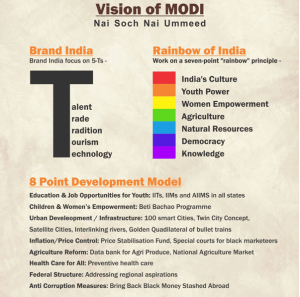
  • Modi’s Vision document,

Untitled


CULTURAL POLICY

Textbooks 

Changes likely in school texts. In past, NDA Government and UPA Government have been involved in TextBook Controversy  with NDA pushing for elimination of what it perceives as
Marxist biases while UPA pushing for elimination of what it perceives as
saffronisation. BJP has claimed that it will change the history books, if it comes to power to correct “distortions introduced by Marxist historians” .
Changes one can expect:
  1. In History texts: In Modern History, one can look forward to a
    diluted Role to some of INC icons  (Nehru and dynasty in particular),
    more emphasis on RSS icons (Tilak, Savarkar, Golwalkar, Shyama Prasad
    Mukherjee, and so on) ;   Medievel History- greater emphasis on ‘Hindu’
    part with projection of Muslim rulers as foreign invaders. Any such move
    will be resisted by academia, Congress and Left but with a simple
    majority in Lower House, one wonders what can stop BJP from pushing
    through these changes that it has always desired on ideological ground
    and can help it reap electoral dividends in future?
  2. Greater Stress on Indian Languages:BJP Manifesto talks about promoting Indian Languages:
Lang
English is not prefered by Modi himself. In Gujarat, Modi has denied
English education to the poor till age 10. Gujarat’s government schools
teach ABCD only in class 5. It may not possible to execute the same in
Central Boards but greater emphasis on Indian Languages likely to be
there.


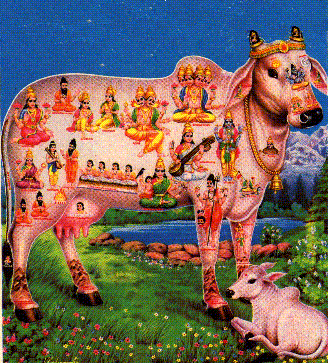
Protect the Cow


Good days ahead for Gau Mata. What BJP Manifesto says:
cow
Previous NDA Government’s effort to ban Cow Slaughter were defeated by her own allies . No such ally compulsion exists this time around. Mr Modi himself had raked up the issue of Beef exports in his election campaign . Beef Export Industry is already on tenterhooks 

A ‘Traditional’ and ‘moral’ media

BJP Art & Culture cell has already promised to promote Tradition in Bollywood.Previous NDA Government had reconstituted the Central Board of Film Certification that restricted on films/documentaries that showed Hindu Right in bad light or projected ‘immoral’ activities .Though UPA Government was no icon of liberalism on this front, things likely to worse under NDA.

Ram Mandir

If not handled properly, Things could get really ugly on this front. Under Previous NDA Government, Agitation for building Ram Temple
reached its peak in 2002- it turned so bad that PM had to ask RSS
to persuade VHP to back down (parallels here with Nawaz’s adventures
with Punjabi Taliban?). The raised Communal tempers provided the fertile ground over which Gujarat’s horrific rioting blossomed.
This time around, Ram Mandir was placed right at the top in Cultural
Heritage segment of BJP’s election Manifesto for 2014 elections,
Ram Mandir
RSS has gone to the extent of demanding a law for the same. Mr Modi himself got into a controversy for invoking Ram in Faizabad District (only a few kilometre from Ayodhya)
Whether a BJP led Government actually builds a Ram temple in Ayodhya
is not the real issue, the real issue is the all India communal frenzy
(polarisation and violence) that raking of this issue unleashes.
VHP stormtroopers will raise the heat on this issue (atleast by the mid
or end of the term, if not in the beginning itself). How the Indian society and
Modi led Central State machinery responds to the crisis is anybody’s guess.
Raam Ke Naam: Anand Patwardha’s documentary on Babri Mosque Demolition

UCC

UCC is a long pending demand of BJP. What BJP Manifesto says:
UCC
Like banning Cow Slaughter, Previous BJP led NDA Government’s UCC initiative was blocked by allies . No such ally reliance exists this time. Mr Modi has dropped hints of implementing it
but would be interesting to
see if BJP can actually get beyond the rhetoric. It will have to overcome severe criticism- Parliamentary as well as Judicial, to push it through. Also, it is not clear what BJP can gain by killing her golden goose- that exposes ‘Secular’ hypocrisy of Congress & Left and nourishes the Hindutva narrative of Muslims being an alien
barbaric community.


OTHER STUFF TO LOOK FORWARD TO

Big Infrastructure Projects

Likely to get a boost. Under
Vajpayee Govt: National Highway Development Programme and Gold
Quadrilateral of Roadways were launched. Among other things, Modi is promising a Golden
Quadrilaterial of Bullet Trains and 100 smart cities. Such mega-infrastructure
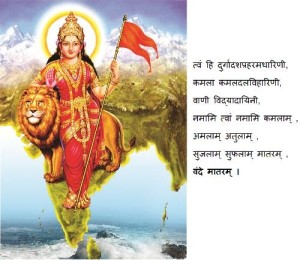
projects will serve well the core supporters of Mr Modi- Pro-Corporate/Business and Neo-middle classes of India and also polish the Global Power ambitions of Bharat Mata. 
PS: Large
scale River Linking projects however likely to be mere hot air. The challenges posed by a democratic federal structure of Governance, 
environmental costs and massive engineering put it beyond the capacity of Indian state.  

New States : 

One can look forward to newer states on India’s map.Carving out new states only requires a simple majority in both houses of Parliament. BJP, as a matter of principle, has been backing
formation of smaller states. Jharkhand, Chhattisgarh and Uttarakhand were
created during the previous NDA rule. In Jammu & Kashmir, giving Laddakh a UT status has been BJP’s dream but more autonomy to J&K as articulated by National Conference is a big No. Darjeeling Lok Sabha seat was won by BJP- which is perceived as a victory for GJM-an organisation that has been leading a powerful Gorkhaland state movement for years. In Maharashtra, although BJP has backed carving out of Vidharbha but ally Shiv does not like it. Splitting of UP however is possible.


Schemes, Statues, cities, infrastructure based on muscular Hindu leaders of Past, RSS icons and Ancient Indian personalities & places: 

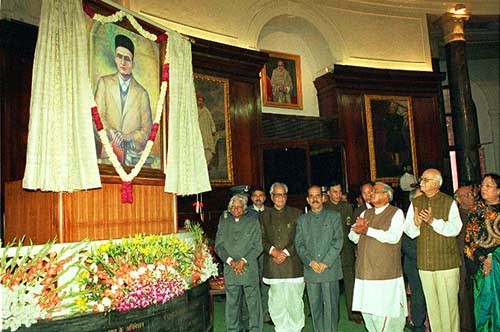
NDA is already talking about renaming or scrapping some of the present schemes. Among other things, Previous
NDA Government installed V D Savarkar’s portrait in Central Hall of
Parliament right in front of Mahatma Gandhi’s portrait. In past, BJP has also protested
for renaming certain cities (Ahmedabad to Karnavati and Allahabad to
Prayag). 

Savarkar’s Portrait, Parliament’s Central Hall, 2003


Sedition charges, Reinstatement of POTA,stringent Anti-Terror measures and assault on Free Speech: 

A Modi Government may worsen the already precarious conditions for Free Speech in India. Apart
from RSS’ narrow brand of nationalism, Mr Modi is perceived as an authoritarian administrator who muzzles his critics with full prejudice.


Jammu & Kashmir: 

What BJP Manifesto says:
J&K 

Mr Modi has already announced return of Kashmiri Pandits as his key issue of action.
Abrogating Article 370 has also been BJP’s stand
all along, however this would require Constitutional Amendment- which
in turn requires support of special 2/3rd majority in both houses, which
BJP
alone doesn’t have, though by bringing in some new allies broader
alliance of NDA may reach that figure in Lok Sabha. But even then, the
numbers may still not add up in Rajya Sabha. Another stumbling block
could be the Judicial Review as National
Conference has  insisted that abrogation of the Article would open
the case of State’s accession to India. Any autocratic step towards
abrogation of Article 370  holds potential of precipitating a major
crisis in Kashmir Valley. In Past, Modi has engaged in jingoistic acts in Kashmir. Will it be any different this time? Are we looking at a new mature Modi? Anybody’s guess
PS: Have covered only few broad points on domestic front where Modi’s policy may significantly differ from  UPA Government. Thoughts on Foreign Policy to follow in Part III…

Sponsoring Terrorism in Afghanistan; the early days..

Ikram Sehgal is supposed to be “close to the khaki establishment” (others regard him as closer to Uncle Sam, how would I know?).
 I have no idea what he is trying to say here and why, but the first half has some (well known, but not widely known) tidbits about recent AfPak history. Published in Pakistan Today

http://www.pakistantoday.com.pk/2014/05/21/comment/the-army-and-the-isi/

Army and the ISI

By Ikram Sehgal

The son of Late Brig Mohammad Ahmad (later DG IB and author
of “My Chief”, a biography of Field Marshal Ayub Khan) and one of my closest
friends since childhood, Col (Retd) Salman Ahmad has fought more battles than
anyone else in Pakistan Army’s history. Starting with Bedian with I E Bengal in
the 1965 war, this unsung hero participated extensively in counter guerilla
operations in former East Pakistan during 1971. His SSG Company supported our
(44 Punjab now 4 Sindh) counter-insurgency operations in Balochistan in 1973.
Subsequently in 1973 he trained Afghan dissidents in Peshawar under command of
Brig (later Maj Gen and Governor) Nasirullah Khan Babar, then Inspector General
Frontier Corps (FC) and later PPP stalwart. Ahmad Shah Masoud, Haji Din
Mohammad (presently Karzai’s Advisor), Engineer Ayub (former Minister) and a
whole host of Afghan dissidents belonging to Gulbaddin Hekmatyar, Burhanuddin Rabbani,
Abdul Rasul Sayyaf etc factions were among his students.

This clandestine outreach strategy was commissioned by none
other the than President of Pakistan, late Zulfikar Ali Bhutto. The next time
the PPP start fulminating about Ziaul Haq’s intervention in Afghanistan, they
should kindly get their facts right. Neither the Army nor the ISI started our
Afghan adventurism, this was a deliberate state policy crafted by PPP’s
founder. Those who sow the wind will reap the whirlwind, Indira Gandhi suffered
the Sikh backlash of Sanjay Gandhi’s ill-advised sponsorship of Bhindranewala,
Ms Benazir paid the price for her father’s interference in Afghanistan. Bilawal
Bhutto Zardari needs a tutorial on his grandfather’s “vision thing”.

After commanding 2 Commando in 1982-83, Salman transferred
to the ISI to take charge of training and operations for Afghan Mujahideen from
1983 to 1985. Codenamed “Col Faizan”, from 1985 to 1990 he ran all ISI/CIA
operations in the south of Afghanistan (including the area around Kandahar and
Herat). He took Sandy Gall, Carlotta’s father, deep into Soviet-occupied
Afghanistan to film the BBC documentary “Allah Against the Gunships” depicting
the Mujahideen fighting Soviet helicopter gunships with small arms (this before
the Stingers arrived).

Late Col Sultan Amir Tarar (codenamed Col Imam) operated
mostly in the north, the common perception that he discovered Mullah Umar is
not true. As Ms Benazir’s Interior Minister in her second term as PM, Gen Babar
tasked Sultan Amir, Consul General Kandahar in 1994-1995, to get Mullah Umar’s
help in recovering the Pakistani trucks hijacked by bandits on the road to
Herat west of Kandahar. Mullah Umar rode the momentum of this success, uniting
all Mujahideen factions and Afghan Army defectors under Taliban aegis in the
Kandahar area and eventually taking control of most of Afghanistan. Initially
with the Taliban, Mujahideen leader Abdul Rasul Sayyaf later defected to the
Northern Alliance, he was the one who invited Bin Laden back to Afghanistan. Having
switched sides, five years later Bin Laden misused his Taliban sanctuary to
commit 9/11, the most despicable of atrocities in modern history.

Col Sultan Amir’s brutal murder by late TTP Chief Hakimullah
Mehsud was shown on YouTube. Earlier former ISI official Sqn Ldr (Retd) Khalid
Khawaja was executed allegedly because of the telephonic misinformation fed to
the Taliban by Hamid Mir that he was working for the CIA, Khalid Khawaja’s
family members accused him of murder. Eye scans aside, “voice recognition” is
the most authentic identification in bio-metrics today.

The faulty post-Afghan war policies were crafted by
arm-chair strategists in the (then) ISI hierarchy having no experience
whatsoever of the Afghan War. Having an ingrained inferiority complex for not
having heard a shot being fired in anger, these “GT Road warriors” who rise to
high rank invariably resent obtaining counsel from field veterans. Protesting
this, Salman reverted to the Army in 1990, retiring two years later. He
repeated “I told you so” with great anguish over the years while Afghanistan
went from bad to worse (and Pakistan spiralling downwards from worse to
possibly “horrifying” post-2014).

The wrong perception of ISI being “a state within a state”
developed during the Afghan War when it was given a free hand, first under Lt
Gen (later Gen) Akhtar Abdul Rahman and then Lt Gen Hamid Gul, to partner CIA
in organizing the Mujahideen battling the Soviets. This perception of
intelligence agencies is similar all over the world because of the nature of
their business, their personnel are seemingly untouchable. Most ISI personnel
are on deputation from the Army mostly with a very small percentage from the
Navy and Air Force, the regular cadre of ISI officers are mostly in the junior
ranks. Officers and men from the Pakistan Army (mostly from the SSG) like
Salman and Sultan Amir joined ISI in droves to help the Afghans wage their
“fight for freedom”. Giving the ultimate sacrifice in the “Jehad”, many of our
unsung heroes lie buried in unmarked graves in Afghanistan, lamented only by
their immediate family and friends.

The DG ISI in Mian Nawaz Sharif’s last tenure, Lt Gen
Ziauddin, distanced himself from the Army in support of the then PM, when push
came to shove on Oct 12, 1999 the ISI rank and file abandoned their own boss in
support of the Army Chief. A not so well known fact, only Lt Gen Zahirul Islam
has served an earlier ISI tenure before he became its DG, no other Head of ISI
has been in the ISI in any rank in its entire history.

A motivated canard “floated” by vested interest is that the
Army and the ISI hierarchy are somehow at odds. Almost the entire ISI hierarchy being from the army, the Army and the ISI remain in
sync. This baseless mischief is totally wrong, a pathetic attempt to invent a
“truth” from a blatant lie. The detractors contradict themselves by
simultaneously accusing the ISI of engineering army take-overs (the so-called
“hidden hands”).

When the ill-intentioned motivated become desperate, they
resort to such blatant misinformation. The Army and the ISI have always been on
the same page, and will always remain so.

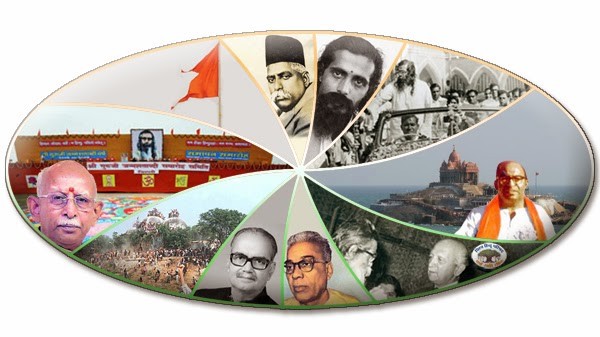
RSS LED BY MODI IN CHARGE OF INDIA PART I: LET IT SINK IN

Source: rss.org
The worst nightmare of India’s ‘Pseudo-Secularist’ crowd came true on 16th
of May 2014. BJP under Mr Modi annihilated her political opponents,
securing a simple majority on its own in the Lok Sabha (Lower House of
Indian Parliament) – first time in BJP’s history.
While some of us (including myself) were sceptical of  NDA (the broader BJP led alliance) victory, most Opinion Polls and exit polls did predict NDA’s triumph but only a select few could foresee such a colossal mandate in favour of BJP alone.
And So?
Given BJP’s own simple majority in Lower house, it (under supreme
command of Mr Modi) will have full control over Union Executive
(Ministries) for the next 5 years. Unlike past NDA Governments, BJP (Mr Modi and RSS) does not need regional allies to stay in power and the allies
themselves include no major self proclaimed ‘Secular’/ ‘Anti-Communal’
Party (TDP and Shiv Sena alone control 34 out of 54 Non-BJP NDA ally
seats).
For ordinary law-making, support of only a simple majority in both
houses is required. While BJP dominates the lower house, even her broader alliance of NDA does not have a simple majority in Rajya Sabha (Upper House) but can secure it by 2016 when a third of Rajya Sabha members retire. Also, for BJP there exist ways to sidestep the present the minority in RajyaSabha.
The point being- broadly speaking, BJP alone (RSS led by former
SwayamSevak Mr Narendra Modi to be exact) will be in complete command of
Indian Union’s 2 most powerful branches – Legislature (leaving out the tricky business of Constitutional Amendments) and the Executive
for the next 5 years. We have never been here before.
   
Now what India? 
A lot will depend on Mr Modi’s Personality. For all the doom and gloom, it has to conceded that BJP (unlike Maoist revolutionaries, Bodo militant gangs and Mujahideens)
is a recognised national political party that (in principle, if not
always in practice) takes part peacefully in elections under the
existing Constitution of India. Mr Modi has been elected to power by the
World’s largest electorate through a largely free and fair
elections(does not have the majority of votes but that’s how existing
FPTP system operates-if unfair, unfair for everyone). Be it due to
failures of Congress, Left and Regional satraps or due to of Mr Modi’s
brilliant campaigning or both; he has secured the popular mandate to run
Government of India. After 5 years, he will have to again win the popular mandate to secure another term, else peacefully pass over the crown to the opponents.
Having said that, A democracy based on mere majoritarianism is a Zombie Democracy.
BJP’s ideological and cadre base of RSS retains her long standing
commitment to the ideology of Hindu Nationalism which is at odds with
Indian State’s existing Constitutional commitment Secularism and
Minority Right. This is quite apart from blindingly obvious human right
issues given our bloody history of Partition, Riotings and ongoing Muslim Ghettoisation in urban areas of North and West India.
So while this is not a Fascist end of India scenario (as yet), there are legitimate concerns regarding
the policies that a Modi led RSS Government may pursue.  
A brief list of Cultural and other domestic policies that a BJP Government may go for, to follow in the Part II…

The Officer’s Advice

By Waseem Altaf
The fact that Hamid Mir received six bullets on his body is no more an issue. That Hayatullah, Musa Khankhel and Saleem Shahzad were brutally murdered was never an issue either. How terrorists infiltrated into airbases at Mahran and Kamra and the GHQ never caused a dent in the “dignity” of those responsible, nor did the mass surrender during 1971 war and the crushing defeat in Kargil ever shamed the ones involved. And nobody ever bothered how the disastrous effects of military rule for nearly half the life of this country played havoc with state institutions and impacted the society.
But when the brother of a man fighting for his life accused “an institution” and the picture of an army general was flashed on the TV screens, all hell broke loose.
It disturbed so many in the sacred land while the “dignity” of an institution was held at stake- and it was a national issue!
It perturbed everybody from anchorman Mubashar Luqman to terrorist Hafiz Saeed, to traders to groups of lawyers to Mullah Qadri and Imran Khan who came on the streets; being associates of the “powers that be” they were fully mobilized.
Advertisements with names of fake associations were splashed on national dailies, banners were hoisted praising ISI and army with pictures of serving generals and entire media groups were deployed to denounce Geo.
And today some extremely cheap measures are being employed. Right from severing cables of operators showing Geo to pressurizing private members of PEMRA to ban Geo to implicating its workers in a blasphemy case, every abhorable step is being taken by those who demand the nations’ unconditional respect.


The way the most organized institution of the state is behaving is pathetic. It’s like how a newly recruited cadet behaves with a policeman on a traffic violation. Unfortunately they never mature. Right from the rank and file to top leadership they exhibit the same immature behavior.
And they think that nobody understands who is behind Sarwat Qadri and Tahir Qadri, Imran Khan and Hafiz Saeed. Go to a barber shop and people are discussing ISI; such utter humiliation of a state institution. I recall its not long ago when nobody would even mention ISI during a discussion and today the talk of the town is the tussle between a private limited company vis-Ă -vis the army and ISI.
A British Superintendent of Police during pre-partition Lahore was wiser.
It so happened that a police officer by the name of Qurban Ali Shah was shopping in civvies at Anarkali Lahore when he spotted a policeman beating a tongawala with a lash, who had apparently made a traffic violation. He went to the policeman and without introducing himself asked him to stop that for beating someone like that was illegal. “Babu, mind your own business or I will do the same with you” was the constable’s response. The officer noted the identification number of the constable from his belt and left the place. He had thought of teaching him a lesson for insulting him.
In office, when he went to see his boss, an Englishman, he narrated the whole incident. He also informed him of his intention to “discipline” the policeman.
“Well you are a Superintendent of Police (SP) and have all the powers to punish the constable but let me tell you something” asserted the British officer. Only you know and I know that a constable insulted an SP and none else. Tomorrow when you will punish him, the entire Lahore police will come to know that a constable defied an SP. And let me say that not you but the constable would emerge as the hero. SP Qurban Ali Shah got the logic and immediately dropped the idea.
Any lapse on part of Geo could have been downplayed and a graceful apology on behalf of the company was sufficient. But today the army and the ISI are feverishly after a private limited company called Independent Media Corporation. They want to teach it a lesson. While completely oblivious of consumer rights, they want a complete ban on its transmission. Though the maximum they can achieve is a partial ban in cantonment areas.
In the process the khakis have completely forgotten that Geo is gaining everybody’s sympathies and that it would emerge as the hero out of this mess while the losers are all set to lose another war.
No doubt it was due to their farsightedness and wisdom that the sun never set on the British Empire.
Waseem Altaf

Drones flying over Mumbai

Dont worry, this is not a bomb the marriage party campaign….unless the groom has ordered a lot of pizzas to be air-dropped.

Next time any BPites care to visit Mumbai, please let us know in advance, the drone/pizza combo will be waiting for you as you exit the airport. Its a nice way of saying welcome:-)
….
The
financial capital, notorious for its traffic snarls, has achieved a
first in the country after a city-based pizza outlet used an unmanned
drone to execute a delivery by taking the aerial route recently.
 
….

“All of us had read about (global e-commerce giant) Amazon’s plans of
using drones. We successfully carried out a test-delivery by sending a
pizza to a customer located 1.5 km away from our outlet on May 11,”
Francesco’s Pizzeria chief executive Mikhel Rajani told today.


He stressed that this was only a test-flight but its results confirm that it can be used routinely in a few years. 
….
A four-rotor drone took off with the order from its outlet in central
Mumbai’s Lower Parel area and delivered it to a high-rise building in
adjacent Worli area, Rajani said, claiming that it is for the first time
that the ubiquitous drone has been used for such a purpose in the
country.
 

The eatery, which has been in operations for two years,
has made a video of the delivery, he said, adding an auto engineer
friend helped with making the flight possible.


Rajani, who comes
from a family that is into textiles, said the drone saves time and
costs for a company like his, which would otherwise depend on a
two-wheeler borne agent to deliver the pizzas.
 
….
“What we have
done now will be common place in the next four-five years,” he said,
adding every such customised drone costs around USD 2,000. At present,
there are certain restrictions on the regulatory front like the drone
not allowed to fly above 400 ft altitude and barred from flying over
security establishments, he said, adding the American Federal Aviation
Authority’s regulations on usage of drones, expected next year, will
help.
 

Apart from that there are technical difficulties like a
limited operating radius of 8 km
after which the batteries go dry, he
said, adding proper infrastructure like having charging stations can
help
.

Even though the four-rotor version drone had a limited
carrying capacity
, he said the payload capacity can be increased to up
to 8 kg in case of a an eight-rotor drone.

….
Link: http://timesofindia.indiatimes.com/city/mumbai/Mumbai-eatery-delivers-pizza-using-a-drone/articleshow/35440489.cms
….

regards

Mrs Menon goes to (two) Pakistan(s)

The first Pakistan (Pak-A) said hello with the warmest smile, while the second (Pak-B) ordered the Hindu reporter of The Hindu out of the country (Snehesh Alex Philip of Press Trust of India was also asked to leave, no reasoning was disclosed).

All the cliches in MM’s closing report (see below) are there for the consumption of sophisticated folks to think over a cup of (green) tea while sadly nodding in agreement. There is a comment from a (presumed) left liberal as to how India has now become just like Pakistan (presumably Pak-B). That leads to a very interesting and curious point – the quota of (2) Pakistani journalists (to be stationed in India) has never been utilized – hence the above point is not really testable/verifiable. OTOH many Modified readers are in a nasty mood, they keep asking why she does not have anything to say about the Hindus in Pakistan (MM was frog-marched out because she talked to a Baloch leader).  

Indeed Meena madam, what about the Hindus? Reports from the Pakistani National Assembly state that Hindus are departing by the thousands every year.  
Ethnic cleansing leading to population transfer has happened during the past partitions and in-between (alternatives being forced conversion and/or genocide). Sad to say that the future of these impoverished people – unlike elite expats such as Meena Menon – will be only a little less dark in India as it was back home.
..Around
5,000 Hindus migrate from Pakistan to India and other countries every
year due to religious persecution, ruling Pakistan Muslim League (Nawaz)
lawmaker Ramesh Kumar Wankwani has told the Pakistani National
Assembly
…..”During last two months, six incidents of religious
desecration happened only in Sindh province. In all incidents, religious
books of Hindu minority and their places of worship were burnt,” said
Wankwani, who also heads the Pakistan Hindu Council. 

The Pakistani Press concludes that the expulsions of Indian journalists were a subtle way for the Deep State to tell PM Sharif to not get any ideas about “normalizing” relations with India. The super-courageous Mian Sahib did not quite get the memo and was one of the first heads of state to congratulate PM-elect of India and also invited him for a state visit. Things may not be as one-sided as it seems. There is always a little hope, that South Asia will be a better place for all its denizens. 

As he looks at me with hope, my camera gives me away. He thinks I am a
tourist, which means dollars. He grins in disappointment when I tell him
I am from India, but he’s excited to have met one. Even the female
security guard asks me a lot of questions about India. In the women’s
section in the shrine, many of them tell me it is an honour to have met
someone from their favourite nation. Coming right after I was told to
leave Pakistan in a week’s time, it couldn’t have felt better.


This was how it was when I left for Pakistan in August 2013. After
landing in Islamabad around midnight, we went to buy a can of drinking
water from a chemist, where we experienced our first taste of welcome.
From then on there was practically no one who didn’t exude charm or
warmth; the sinister exceptions came much later. With a visa that was
restricted only to Islamabad, and which had to be renewed every three
months, the paperwork was enormous; the many trips to the External
Publicity (EP) Wing, our contact point, were meant to tire us out. Even
there they were nice, always ready to offer a cup of tea and words of
solace that the visa would be renewed.


Right from the time I reached, there was a constant flurry of activity
and plenty of news. The All Parties Conference which endorsed a dialogue
with the Taliban, the weeklong series of blasts in Peshawar, especially
the attack on the church which killed over 80, the sporadic attacks on
the media, the sectarian killings, the blasphemy cases, the Mumbai
attacks trial, Parliament and Supreme Court, apart from political party
press conferences and other meetings and seminars, all kept me busy.

In December, the federal government decided to prosecute the former
military dictator, General (retd.) Pervez Musharraf, slapped with
charges in many high profile cases but who had secured bail in most of
them. Covering the trial in the special court meant getting a pass which
was graciously granted to me. I had access to Parliament as well, with
my pass usually ready on the first day of the many sessions I attended.
There was the Jamaat-ud-Dawa’s Hafiz Saeed who had held some rallies,
the really large one being on ‘Defence of Pakistan’ day, and directed
largely against India and the United States. Covering the Mumbai attacks
trial was initially easy, with the lawyers and the prosecutor more than
eager to talk to you. Then, one day, I was told not to call anymore for
information as my reports were causing trouble.


A word on my spooks. Being an ardent admirer of the Thompson Twins in
Hergè’s classic Tintin comics, I didn’t think that I would have my own
experience with the bumbling duo. I first saw them at the visa office
where they made it a point to get so close to me that they almost bumped
into me. It soon became a regular affair. They didn’t stand outside my
house till the last two days, but always met the people I did interviews
with and asked them questions about me. My friends too were not spared.
They were keen on knowing whether my discussions had centred on the
Pakistan Army or defence, which was hilarious; with friends there are so
many other things to talk about.


The bumbling moment came when they followed my husband and I on Trail
six, a charming hike up the Margalla Hills behind the Faisal Mosque. It
was obvious that it was their first hike as they kept asking the others
on the trail the way back and thought we would return that way too. They
gave up halfway and decided to wait for us to return. At the top we
found a path that traversed all the way to Pir Sohawa, the highest point
in the hills and decided to follow it. I don’t know how long they had
waited for us in the blazing sun with no trees for shade and I am sure
they didn’t take to that kindly.


Early on in January, I was warned by the EP wing that my visa would not be renewed.
There was no reason given. I used to submit applications at regular
intervals to visit other parts of Pakistan such as Taxila, Lahore,
Peshawar and Mohenjo-Daro after the Sindh government had invited us to
cover the festival, but there was no reply.


But it was in March, after I had interviewed Mama Qadeer Baloch who had
walked over 3,000 km from Quetta to the capital with his small band of
followers, most of them relatives of missing persons, that things became
serious. A top official grilled me for an hour on why I had done an
interview which was “anti-Pakistan” and then demanded to see my notes.
He accused me of jeopardising my chances of a visa renewal with such
stories, and advised me to write on art and culture instead. Amused, I
told him that art and culture were limited in Islamabad and that I had
done my best. If the government was so keen that I cover only these
subjects, it should have sent me to places of great cultural interest in
Pakistan like Taxila, which it hadn’t. I had interviewed Abida Parveen,
a personal favourite, on her astounding new album, “Shah Jo Raag,” done
a feature on Haroon, the genius behind “Burka Avenger,” and other
stories.


One of the first people I had met was Shoaib Sultan Khan, a bureaucrat,
whose inspiring rural development initiatives and connections with India
made for a great article. He will remain for me the most interesting
person I met there and will leave behind a legacy of lasting ties with
rural communities in both countries. For a story on the oral history
project, on Partition, being collected by the Citizens Archive of
Pakistan (CAP), I had met Khalid Chima and his wife, Nasreen and Dr.
Naeem Qureshi, and it was among the memorable meetings I have had.
Nasreen lamented that she belonged to a really small minority which
still believed in secular values and that they were more endangered than
anyone else in Pakistan. 
The venerable Abid Hassan Minto had the most
interesting memories of the Left movement and he jocularly accused me of
taking down too many notes (doing a PhD) for a newspaper article.
Though I couldn’t visit the Murree Brewery, its CEO, Isphanyar Bhandara
was most gracious in granting me an interview in Islamabad. I was glad
to hear and know that the spirit of Pakistan lives on despite so many
restrictions.


Terror came close to home when the F-8 Markaz — which I used to visit
often, and just a stone’s throw away from my house — was bombed on March
3. I heard staccato firing followed by two deafening explosions which
shook the house and rattled the window panes. Scenes of devastation were
in store at the district courts with pools of blood and body parts
everywhere. Soon after, the bombing of the fruit market in the city was a
terrifying reminder that the peace talks with the Taliban were not
going anywhere.

More shocking news was in store with attacks on Raza Rumi, a kind friend
and host, and Hamid Mir, whom I used to often meet in Parliament. He
prayed there every Friday. It was shocking that journalists you knew
were now either out of the country or in hospital. Some of them were
dead too. Despite talk of there being a vibrant press in Pakistan, it
was under great stress with repeated attacks and a veiled censorship
which meant that certain things couldn’t be written about. Yet, brave
journalists and columnists continued with their writing, against all
odds.


As I was leaving Pakistan, my thoughts were on the warmth I had
received, the many friendly people I had met but equally so on the
intimidation I had faced from some quarters. However, I will cherish my
hikes, the long walks and some of the good friends I made. I will also
remember how the ‘other half’ lives in the capital, in sprawling slums
with their broad and stinking gutters; the women from Skardu collecting
firewood near an opulent hotel; the threatened Christians huddling under
tents after being displaced from their homes; the plight of the Ahmadis
and Shias, and a certain grimness that lay behind all that opulence.


And, finally, the subject of culture. The obsession with Bollywood and
Indian film music always threatened to dominate our conversations with
the only cinema in Centaurus Mall running to full houses even when the
most mediocre Hindi film was screened. This was the real Pakistan with
people always ready to welcome you and help you along. The salesman at
my favourite Khaadi store offered me loyalty points after some last
minute shopping. I told him it was too late, I was leaving the country
and Indians didn’t get loyalty points here!


Clearly, there are two states within this nation, two states of mind, and, regrettably, the twain shall never meet.

…….

Around
5,000 Hindus migrate from Pakistan to India and other countries every
year due to religious persecution, ruling Pakistan Muslim League (Nawaz)
lawmaker Ramesh Kumar Wankwani has told the Pakistani National
Assembly.

“During last two months, six incidents of religious
desecration happened only in Sindh province. In all incidents, religious
books of Hindu minority and their places of worship were burnt,” said
Wankwani, who also heads the Pakistan Hindu Council.

He said
the government has so far neither made arrests nor taken action against
any extremist group involved in attacks. “No one from the minority
community feels safe in Pakistan,” he said on Monday while commenting on
law and order situation in the country.

He blamed the
government for failing to control frequent attacks against Hindus and
maintained it was the community’s constitutional right to practice its
religion freely in Pakistan.

“But the rights of Hindus have
never remained a priority here. The problems of Hindus are multiplying
in Pakistan instead of decreasing. Are we not part of this country?” he
questioned.

He said it was the teaching of all the religions to
respect other faiths but the minorities had failed to get equal rights
in Pakistan.

The lawmaker informed the house that scores of
Hindu women have been abducted in last few years in Sindh province and
later married to their kidnappers after forcible conversion. He urged
the government to take steps to counter it.

Wankwani asked why
issues of minorities never came up for discussion in the house. “When
Jinnah’s residence was attacked and destroyed in Ziarat town of
Baluchistan, the National Assembly had debated on the issue for four
consecutive days,” he said.

“I request the house to spare some
time for taking up the problems faced by minorities.” He said Hindus
are also equal citizens of Pakistan and their holy books should also be
considered equally respectful.

Wankwani suggested the government to set up a parliamentary committee to discuss issues related to minorities in this regard.

There was a pin-drop silence in the house as all legislators attentively listened to his emotional speech.

Later, minister of state for parliamentary affairs Sheikh Aftab Ahmed
said the government will ensure the protection of minorities at all cost
as it is mentioned in the Constitution.

…….

Link (1): http://www.thehindu.com/opinion/lead/two-states-in-a-nation/article6030289.ece

Link(2): http://timesofindia.indiatimes.com/world/pakistan/5000-Hindus-flee-Pak-every-year-due-to-persecution/articleshow/35084313.cms

…..

regards

Brown Pundits