“Are you Priyanka?”

Priyanka Robert Vadra is the first beti (and sister of local MP, the first beta) and the voters dont even know who she is and what she looks like. The ultimate low-information voter, or is it? If a VIP constituency lacks power after 65 years of independence it will not come as a surprise that voters remain indifferent to VIP appeal.

We are ambivalent about the overall outcome in this general elections but not so about specific cases. It is our fervent wish that in the coming ballot in Uttar Pradesh, Rahul Gandhi (INC) loses from Amethi, and so does Sonia Gandhi (INC- Rae Bareilly), Varun Gandhi (BJP- Sultanpur) and Narendra Modi (BJP- Varanasi). This is the only time the voters can deliver a bloody nose and it is high time they do so in a very powerful and symbolic manner.
………..
Outside
the Ramlila grounds in Nasirabad, the weekly vegetable market is on.
Clad in sneakers, salwar-kurta and a BJP cap, Anu Chaudhary, the state
chief of BJP’s women’s unit in Haryana, distributes campaign material
and pamphlets to vegetable vendors. “You have a right to development. If
Amethi is a VIP constituency, question the vote-seekers on how your
lives have improved,” she says. People hear her out. Then someone asks,
“Are you Priyanka?”

…….
Hours later with a generator powering the
mike, in the same grounds, Priyanka Gandhi Vadra talks about the Gandhis
bringing electricity to Amethi. The mike fails several times and people
complain. “In this area, electricity supply is nearly non-existent.
She’s talking about educational institutions but we do not have an
inter-college,” Mohd Iqbal, a fruit vendor said. Priyanka acknowledges
that there are complaints but says it was the opposition that foiled
attempts to bring power.

In Gauriganj, the headquarters of
Amethi district, senior administrative officials are discussing the
latest entrant into Amethi’s political fray, BJP’s Smriti Irani. At
least a few times, she is referred to as Tulsi, TV’s most popular bahu, a
role Irani played about eight years ago before she entered politics.

“Her arrival created quite a stir in the initial days. As a celebrity, she drew large crowds,” says one of them. Traveling more than 200km every day, Irani has stationed herself in
Amethi since early April and plans to stay till May 7, polling day.

With the help of the Sangh Parivar, Irani has begun sharing space with
Priyanka in drawing room discussions over politics. Nudging the real
contestant – Rahul Gandhi – out of the picture, people say Amethi’s 2014
electoral battle is all about the real beti versus the reel bahu.

The beti invokes all that the first family has done for the people of
Amethi in the many decades it has ruled; the bahu harps on everything
else they could have done, but didn’t.
Both are using more than just
celebrity-hood and charm to strengthen their election campaigns. In
Irani’s case, she has craftily kept the old Jan Sangh hands close,
knowing they can help her build her base. In a more personal gesture,
Irani applies tilak to every supporter who goes out campaigning for her.
Anu Chaudhary, the Haryana unit volunteer, said, “Our focus is on
making personal contact with people. We’re touching villages the Gandhis
have not visited even once in all these years.”

As Irani goes
on a mission to bring down a 40-year dynastic rule, Priyanka is hard at
work trying to fortify it. Spending 15 hours daily campaigning, she’s
been on door-to-door visits, addressed corner meetings and made
unscheduled halts at villages.

………
Link: http://www.livemint.com/Politics/jCJKGgrT5FdGVkyd0b8MIL/Dont-need-a-56inch-chest-to-run-country-Priyanka-Gandhi.html
…….
regards

The real scam is the fake (pro-poor) image

South Bengal goes to elections just as the Saradha chit fund scam is exploding in the face of Mamata “Didi” Banerjee. Millions of poor were robbed, and the daku-in-chief Sudipta Sen cultivated favors with the one (wo)man ruling party by buying Didi’s paintings for a few crores. A most ingenious way to rob Peter to pay Paul.

What makes the hypocrisy so glaring is that this is the same lady who is supposedly fighting 24/7 for the poor. She refused to raise train fares and caused the Indian railways to nearly collapse from a lack of funds. As Chief Minister of Bengal she refuses to raise bus fares, so much so that bus owners have reduced frequency and even stopped plying their vehicles. In the absence of buses, poor people have  to pay ten times the cost and travel by auto-rickshaws (who are often non-cooperative and rude). It is difficult to believe that even Communists were not so moronic.


……….
Those training guns against the UPA-II for a
series of scams — 2G, Coalgate, the Commonwealth Games — may find it
amusing but in Bengal, the Rs 2,400-crore Saradha Ponzi muddle looms larger
than the other scams. Mamata Banerjee’s “honest” brand image has
taken a beating
in the last two phases of the LS polls spread over 23
constituencies in south Bengal where the “twin flowers”, the TMC symbol,
have a monopoly.

On Friday, a group of Saradha victims were
beaten up, allegedly by Trinamool supporters, when they blocked railway tracks
at Garia station.


“The government has cheated us. It
promised us compensation. But we are yet to get it,” said an injured Bijoy
Sapui. Ashim Chatterjee, a former Naxal leader who is now the president of the
Chit Fund Sufferers’ Association, lodged a complaint with the police.  The
Saradha story is not just about a Ponzi bubble that burst a year ago,
devastating 18 lakh people who had parked their money in the schemes. Bengal
had had a similar experience in 1980, when the chit fund Sanchayita Investments
mopped up more than Rs 120 crore from small depositors, only to shut shop
later.

But the recent Saradha scam has drawn into
its vortex a host of individuals and institutions — from senior politicians and
bureaucrats to football clubs, Tollywood and even the media, where some of the
ill-gotten money was sunk.

The embers of resentment were fanned by BJP’s
Narendra Modi during his campaign in Bengal. While Congress president Sonia
Gandhi had earlier harped on the loot by the Saradha Group and the alleged
inaction by the state, Modi touched a nerve because he hinted that
politicians had directly benefited from the Saradha money. Modi didn’t name the
Saradha Group, but he hit the right notes by raising an obvious question:
“Who bought Mamata Banerjee’s paintings for Rs 1.8 crore?”
Saradha
boss Sudipta Sen, now in custody, muddied the waters further by coming up with
a rebuttal: “I didn’t buy Mamata’s paintings. I don’t know who bought
them,” Sen said.

Taking a cue from Modi, former CPM minister
Gautam Deb hit the TMC chief where it hurt the most. Deb revealed the
income-tax returns filed by Trinamool that show that the party earned Rs 2.53
crore by selling Mamata’s paintings in the 2012-13 fiscal.
“How could
then Mamata give Rs 3.93 crore to party mouthpiece ‘Jago Bangla’ in the 2011-12
fiscal?” Deb asked.

…….
Link: http://www.dnaindia.com/india/report-will-the-saradha-scam-be-mamata-banerjee-s-achilles-heel-this-lok-sabha-poll-1984119
…….
regards

A million donors needed (registry for stem cells)

Garvit Goel is a lucky kid, he got a match for blood stem cells from a stranger and was saved from a life of pain. Wonderful news and hopefully more people will register with Datri (and the Tata Memorial registry) and qualify to save lives (too easy).

Given the complications caused in South Asia due to endogamy, health experts believe that at least half million donors required. NGOs should consider partnering with religious bodies (similar to the intervention for polio drops) to remove myths about stem cell donation (will cause pain and weakness in donors).
………

A
two-year-old Delhi boy suffering from thalassemia got a new lease of
life after a Bangalorean donated his blood stem cells to him.  
This is
the first reported case in India of a thalassemia patient receiving
blood stem cells from an unrelated donor.


Garvit Goel was
advised to go for a blood stem cell transplant a year ago. None of his
family members qualified to be potential donors. That’s when Sumeet
Mahjan (34), a software professional from MindTree, stepped in.

For Sumeet, the turning point came in 2011 when his colleague’s
11-year-old son was diagnosed with leukemia. MindTree requested Datri,
an NGO working on networking stem cell donors to help people suffering
from blood disorders, to look for a potential donor. Datri conducted a
workshop and awareness campaign at MindTree to make techies aware of the
life-saving benefits of stem cell donation. The boy died, but the
sustained campaign ensured many registered their names for blood stem
cell donation.

“In January 2013, I was asked by Datri if I
could donate stem cells for a two-year-old thalassemia patient from
Delhi. I was chosen as a potential donor. After consulting Datri and the
doctors, I felt responsible and went ahead with donation,” Sumeet told
TOI.

For five days Sumeet was given growth factor injections.
He then underwent a half day’s non-surgical procedure. “Garvit underwent
the unrelated peripheral blood stem cell transplant in April 2013 and
is now free from thalassemia and saved from the trouble of constant
blood transfusion. We need 3-5 million blood stem cells per kg of
recipient’s body weight. Over 150-200ml of blood was used,” says Dr
Dharma R Choudhary, director, BLK Super Specialty, New Delhi.

As per the rule book, the recipient’s details cannot be disclosed to the
donor till a year after the transplant. In March 2014, Sumeet met
Garvit in Delhi.

“I wanted to see him. After a year, I got the
chance. His parents were very humble and thankful. I was satisfied that
Garvit was healthy and normal like any other kid of his age,” says
Sumeet, himself a father of two. He was backed by his family.

Thalassemia is caused by variant or missing genes that affect the
production of haemoglobin. Nearly 12,000 babies are born in India every
year with this disorder. In fact, 10% of the world’s thalassemia
patients are from the Indian subcontinent, with 3-4% of them being
carriers.

With very few
registered donors in India, the possibility of finding a genetically
matching donor for an Indian anywhere in the world is low. Datri Blood
Stem Cell Donors Registry is working towards creating a wide and diverse
database of potential donors who can be accessed by any patient, living
anywhere in the world, in need of life-saving blood stem cells.

Datri has facilitated 51 transplants.

…….
Currently,
there are four registries in India but only two are functional – DATRI, a
south India-based stem cell registry started in 2009 which has around
56,000 registered donors, and Marrow Donors Registry India at Tata
Memorial Hospital in Mumbai.


“As
a result of evolutionary history, endogamy and consanguinity,
populations of the Indian subcontinent demonstrate high genetic
differentiation and extensive sub-structuring. Ancestry is unique to
India,” said Dr N.K. Mehra, head of Immunology and Immunogenetics at the
All India Institute of Medical Sciences (AIIMS).

“Indian groups have inherited different proportions of ancestry from
the ancestral North Indians and the ancestral South Indians. Hence,
consistent with social history, northern regions show closer affinities
with Indo-European speaking populations of central Asia as compared to
those inhabiting southern regions.”

Mehra said the southern Indian population may have been derived from early colonizers arriving from Africa. “This genetic matching is difficult to find for an Indian donor,” he said.

A
transplant from a healthy unrelated donor replaces flawed stem cells
with healthy ones that can generate healthy red blood cells and cure
Thalassemia. The goal of the transplant is to rebuild the recipient’s
blood cells and immune system and cure the underlying ailment, and avoid
or obviate the need for frequent blood transfusions.

“The existence of a large variety of alleles and haplotypes (genetic
components), both unique and representative of other ethnic groups in
the Indian subcontinent, poses additional challenges in the
transplantation context, particularly with regard to hematopoietic stem
cell transplantation,” Mehra said.

Even
after patients find suitable donors, there are low chances of the donor
turning up due to myths related to donation like pain and weakness,
doctors claimed.

For a
successful transplant, the donor and recipient should have a matching
set of genes known as Human Leukocyte Antigens (HLA). At least one third
of patients have a chance of finding an identical set of HLAs within
their family while two-thirds are dependent on unrelated donors.

…..
Link: http://www.dailymail.co.uk/indiahome/indianews/article-2600057/Wanted-half-million-donors-Indian-patients-miss-life-saving-stem-cell-therapy-lack-matches.html

……

regards

The many avatars of Veena Malik

a) Dancing away her first Holi in India with her lady-bits dangerously exposed (fun girl Veena)

b) FHM photo-shoot (celebrity girl Veena)


c) Murdering the Mullah for having dared to bare in Big Boss (liberal hero girl Veena)

d) Married to Pakistani businessman, leaves India for good (with gaalis as parting gift for her hosts), conservatively dressed with a dark shawl on head, says she has “matured” (sharif aurat aur patriotic girl Veena)

Famous actor Veena Malik returned to Pakistan for the first
time after her marriage, complete with conservative garb and claims of
having “matured”, DawnNews reported.

Upon her arrival at
the Benazir Bhutto International airport in Islamabad, Veena said the
country had given a lot to her, and she had come back as a “matured
girl” as it was time to give back to the country.

She did not
confirm if she would return to the showbiz industry, but the star, who
was visibly in an emotional state, said that whatever she would do from
now on, be it showbiz related or social work, would be inside Pakistan
only.

The actor, known to make headlines and court controversy, has returned following a long stint in neighboring India’s Bollywood industry and had claimed to have undergone “a change within” after marrying singer and businessman Asad Bashir Khan.

Recently, the actor had also caused a stir with her apparently anti-Indian remarks which were taken as an indication of her return to her native country.

The
star entered a controversy in 2011 when semi-nude photos of her were
published in Indian magazine FHM with the initials of Pakistan’s premier
intelligence agency appearing on her arm.

She had sued the magazine for damages claiming the published image had been morphed without her knowledge.

The actor made her debut in 2000 and since then has appeared in a number of Pakistani films and tv programmes.
After moving to India she performed in many commercially successful movies including, Daal mein kuch kaala hai, Zindagiu 50-50, Super model and Kannada.
She also appeared in a season of Indian reality show “Big Boss.”
……..
Link: http://www.dawn.com/news/1103267/matured-veena-malik-returns-to-pakistan

regards

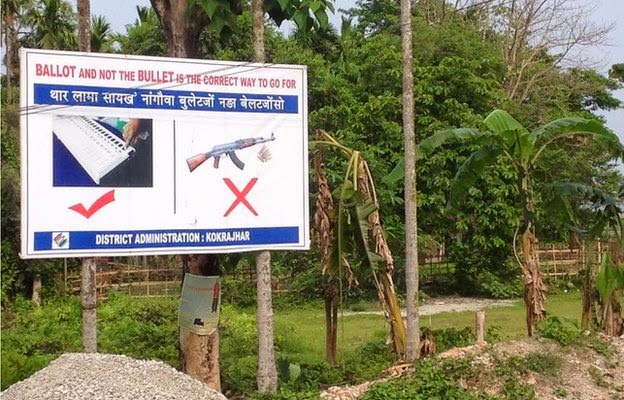
Bodo vs. Muslim battle restarts (Kokrajhar, Axom)

From now and forever it will be open season on muslims in India (and the wrong type of muslims in Pakistan). The Hindus in Pakistan and in Bangladesh are of course already dead or in the process of mass migration to India (where they will rot as non-recognized refugees).  

…..
These alliances will take all different forms, in Assam and in the North-East now there is considerable evidence that the tribals (Christians, Hindus) and the Hindu upper-caste Axomiya and Bengali populations have all united in their animosity against illegal migrants (as they see it) from Bangladesh. 
…..
It will be interesting to know what the Church and Christian activists (such as John Dayal) have to say about all this killings by Bodo forces. RSS is not a significant presence in  the North-East (except in the Barak valley, South Axom). The Church in Nagaland, Bodoland, and Meghalaya has been very active in stoking anti-muslim rage. Axom is ruled by a popular Indian National Congress chief minister (Tarun Gogoi) who seemingly has no credible opposition and is expected to deliver a handsome seat count towards the Mission 115 plan.
…….
Eleven Muslim villagers were killed and others wounded overnight when
suspected separatist militants opened fire on them in the high tense
northeastern Indian state of Assam.


The
police official was referring to an incident in which the militants
shot dead three members of a family, including two women, while wounding
a baby in the Kokrajhar district of Assam state.

In a second
attack in Baksa district in western Assam, eight people were killed by a
group of guerrillas as their sat in courtyard on Thursday night.

The dead included six women and two children.

Police said they suspected the militants behind the overnight killings were members of the Bodo tribe.
Bodo
people have frequently attacked Muslims they say have illegally entered
from neighboring Bangladesh and encroached on their ancestral lands in
the hills.

Police blamed the attacks on the National Democratic Front of Bodoland (NDFB).


The incident comes in the middle of India’s ongoing general election battle.
Muslim
groups feel that the community has come under attack because the rebels
feel that they had not supported Bodo candidates, Rakibul Islam of All
Bodoland Muslim Students Union said.

Local Muslims had been
threatened by Bodo groups “because they thought Muslims had voted for
non-Bodo candidates” during elections in Assam on 24 April, Islam told
BBC.

In recent years, Hindu and Christian tribes have vented strong sentiments against Muslims, calling them Bangladeshi immigrants.

In
August 2012, sectarian violence rocked the city after four youths were
killed by unidentified men in the isolated Kokrajhar district.

In retaliation, armed men from Bodo tribes attacked Muslims for suspicion of being behind the killings.
The violence spread to the neighboring Chirang and Dhubri districts, leaving at least 22 people dead.
Thousands of people were also left homeless as their villages were set on fire in the violence.
…….
Link: http://www.bbc.com/news/world-asia-india-27249949
……
regards

Remarkable!!!

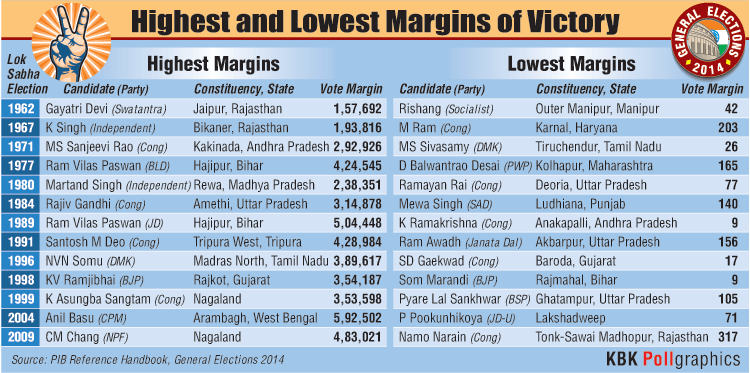
Just one number says it all. Marandi of the BJP won his seat by a total of 9 votes (as did Ramakrishna of Congress). And life went on as usual.

There are substantial flaws in the way the electoral game is played. A pure first-past-the-post system is difficult  to justify (as opposed to proportional representation). Then there is the problem of participating criminals and dynasts and also thorny campaign finance issues that may not improve over time. That said the Election Commission possibly has the most challenging job faced by any bureaucracy in the world and does it remarkably well.  

The real heroes are the aam aurat and aadmi, while the politicians co-operate for the most part (even petite Hitlers like Mamata Banerjee has to bow before the dictates of the commission- a good learning experience if any).

The “Gandhians with guns” will continue to terrorize their own people and inflict self-harm in the interest of ideology. But they do not realize that presently in the West, the right to self-determination in Palestine and elsewhere is viewed with apathy at best and suspicion at worst. With the dust settling down in Crimea (and East Ukraine) it is clear that the principle of big countries having a “zone of influence” is now accepted by the West. If nothing changes, Kashmir will be reduced to Afghanistan like state in a few decades.

…..

…..

…..

…..

……

…..
regards

The (gay) Tabla Player

The most interesting (and thought provoking) question in the essay was are girls free in India (in the way they are not in Pakistan)? This obviously cant be boiled down to hard numbers and everyone will come to the conversation with some inherent bias, thus there would be no satisfactory resolution.

But here is one more provocative thought. Pakistan was created to be a sanctuary for South Asian muslims. How much public acceptance (as opposed to private agreement) is there for atheists? Religion of all colors are inherently patriarchial, also with respect to tabla playing (and generally all music) we would imagine Islam would frown a bit more than Hindu-Sikh-Jain-Buddhism (we have always associated Christianity in India with music, but not with women playing percussions).  

While we cant prove this to be true but we are of  the opinion that freedom from religion gives you freedom of action as well. As the number of atheists will grow so will the number of female tabla players.

One final question which was on our lips: that shy, sweet, subtle boy in a sleeveless sweater, who stood out amongst all the other macho players (and encouraged the author in her playing with a soft smile), in liberal Holywood these would all be signs pointing to his gayness. Read on dear reader and make up your own mind. Though we think the author should not have just stopped with the hints and gone for full disclosure. Why have a barrier in your own mind as you struggle to remove it from the minds of others?
……

I went to a tabla and lecture demonstration at
Amherst College. I went because I love percussion, all percussion, but
tabla most of all. I went also in homage to the pair I left behind in
Lahore in 2008. The year before leaving, I’d taken the very tentative
step of learning how to play this daunting but thrilling instrument in
my ‘old’ age.

Music lessons and I have had an uneasy
past. My father loved South Asian classical music more than anyone I
know, yet he never put a South Asian musical instrument in my hands….Then
in 2007, not at age seven but 37, I decided to do it. My ustad’s name
was Ustad Ghulam Sabir. He was by his own admission not a professional
player, but he had an excellent ear and was often called upon by
professionals to tune their tablas.

Ustad Sabir was always patient. He kept adding more compositions (kaida, dadra, jhaptal), while I struggled with counting the beats and urging my fingers to keep up. Often, I did hear
the beats. I knew what I should have been doing. If only the tabla had
fallen in my hands 30 years earlier, instead of the piano I couldn’t
even hear!

After
about eight months, he said he couldn’t teach me more, not because I’d
learned much, but because he’d passed on all he believed he could. He
referred me to a music center where I studied with a professional ustad
and about a dozen boys, a lot younger than myself who’d been playing
since childhood. Though they never initiated a conversation with me, I
never felt any hostility from them. And though they had no reason to be
as attuned to my playing as I was to theirs, when I got something right,
there’d be a kind of silence in the room.

But there was
one boy who did more. He could have been 17 or 27, was always the one
called upon to bring the tea, and was generally treated differently.
More brusquely, yet also with more familiarity, as though there existed
between him and the ustad (and other musicians, for instance, the
harmonium player who sometimes accompanied us) an understanding.

I
never learned what this understanding was because he was the shiest of
us all.
However, he was usually the first in the room and would be
warming up when I arrived. When I also started to warm up, he’d join me.
It was subtle and sweet; we were having a conversation.
I remember well
the tilt of his head and his sleeveless mustard sweater and how the
head would tilt a little more when I stumbled, or else the fingers would
wait in the air, and when I found the beat he’d nod quite vigorously
and rejoin me at just the perfect moment and with just the smallest
smile.

But he would never, ever, meet my eye. I tried to, but
backed away when I feared I was crossing a boundary.
It was better to
stay within the boundary than to risk losing his friendship in music. A
music without borders.

Then, two days ago, I went to the tabla
lecture and demonstration at Amherst College. It was enormously
enjoyable, till the end. The pandit, a buoyant man from the
Benares tabla gharana gave us, his very small but eager audience, time
and care as he described the tablas – how they’re made, what the left
and right is called, etc.

The atmosphere was relaxed, so I decided to share what had
been going on in my head:

‘Why do you think women are still not playing the tabla, at least not publicly?’

He grew very serious, if not a little irritated, and said, ‘Oh, you can’t do it. It is just too difficult.’

I tried to say that of course now
it is too difficult, for me, but what if girls were urged to play from a
young age, the way he was? The way a few are encouraged to play other
instruments, or to sing?

He again said, ‘You can’t do it.’ And
then, ‘I had to practice for 14 hours each day. Could you do that?’ It
was obviously a rhetorical question. He didn’t pause. ‘My fingers would
grow bloody. You couldn’t.’

At this point I began to notice what
I’d never noticed in those months of learning tabla in macho Lahore, in a
room full of testosterone. Disapproval.

I kept on. ‘In Pakistan there aren’t even many women learning how to play.’

He
scornfully cut me off. ‘In India there is no restriction. Women can do
what they want. But they can’t play professionally. They can do it only
for fun. I have two women students. They are good. But they will never
be professionals.’
He seemed to think about this more for a moment, and I
foolishly grew hopeful. What he added was this, ‘Dance is difficult
too, but it is soft!’

I did not know what to say.

As a last point he offered, ‘The tablas weigh over 20 kilos. For how long are you going to ask someone to carry them for you?’

By this time, there were too many thoughts raging in my brain to know which one to speak, or even how.

For
instance, when or how did this turn into ‘India is free but Pakistan
isn’t’? Really, in India there are no restrictions on women? Do you not
know that you create can’t by saying it – that can’t is a restriction? And your poor women students! If you already know what they will never be, what can you teach them? Do it for fun. You mean, the fun you are having is more than fun – but their fun is somehow less?

I
wondered how much of the tension in the room had to do with a certain
etiquette that I, myself, had struggled to maintain, as I’d ventured
with the question. He was a pandit.
A master. He’d shown us that he could do what none of us could (certainly not the women).

A pandit must be shown deference, no matter what. The pandit/ustad/teacher-student
relationship is entirely different in the subcontinent to that in the
West. It is one of respect, intimacy, and absolute obedience.
Here I
was, a South Asian, a woman no less, asking pesky questions. The white
women in the room did not acknowledge these questions at the end either;
they went straight to the master to thank him, without looking at me
.

In the car, my exasperation only mounted. Bloody fingers? Really, pandit ji,
women are afraid of that?
Ask all the carpet weavers who work for at
least 14 hours each day, with astonishingly dexterous, bloody fingers.
Or the shrimp peelers. Or the textile workers. Or the cotton farmers.
They are women too.

As for not being strong enough, I couldn’t
even carry a five kilo bag of rice, let alone two tablas. But that’s
just me.
My particular body at this particular stage of my life. And
though I wish it weren’t so, I’m also lucky that I don’t have to throw
my back out several times a day. What about the women who do carry heavy
loads – and have to? Those who labour in the fields? What about the
bags of crops and fodder they heave, often along with their children?

Would you call that fun, or would you call them professionals? Would you
clap for them, or stand up for them?

I remember the boy
in the sleeveless mustard sweater. His head tilt. His enthusiasm when I
got something right. His willingness to share. Will he, will he, do the
same for his daughter?
And when she wants more, will both her parents give their blessings with
a kiss and a lifeline of grade A milk, so that she may find it wherever
she roams?

………
Link: http://www.dawn.com/news/1103287/where-are-the-women-tabla-players
……..
regards

Rice eating Indians

A Pakistani friend of mine told me that the stereotype was of rice eating Indians as opposed to bread eating Pakistanis (though of course Iranians are renowned for their rice dishes).

For some reason my greatest sin has always been rice, it’s something I find far more pleasurable than naans of any sort. Incidentally while I’ve always been a rice & curry partisan my middle brother has always been far more partial to tandoori dishes & naan.
I wonder where Muhajirs fall in the mix are they rice eaters like our original Gangetic culture or Naan lovers like Indus Man?

Gujarat model: a Pakistani perspective

Gujarat provides 24/7 electricity (which should be part of a basket of benchmarks of a Minimally Developed State or MDS- our words). As per this measure Tamil Nadu is more similar to Pakistan.

Gujarat (Amdavad/Juhapura) has a partition wall between H/M ghettos– 2-nation theory as practiced in Gandhi-land (also Jinnah-land -both old and new).
OTOH Gujarat has been riot-free since 2002, while Dravida/Shudra/OBC factions belonging to Tamil Nadu ruling coalitions frequently organize mass riots against Dalits.

Gujarat resembles Pakistan most in its application of anti-alcohol dictates.

A Pakistani travels through India as the world’s biggest
democracy votes in the national elections. Follow his journey to know
what happens and all the people that he meets on the way.


Electricity in Gujarat is completely uninterrupted. Nobody knows what
load shedding means. It is unbelievable for a Pakistani who have only
known 24/7 pizza home delivery!
People complain that electricity in
Gujarat is more expensive than other states. I tried to compare it with
what I pay back there, though not a sound way, and was surprised that
most here pay not much if not less than me. But probably the more
important fact is that all of them do pay — Prime Minister House and
Chief Minister House included.


Women are the safest in Gujarat and you do not need witnesses to believe
that.
It is evident. Just take a walk on the road side and you will see
women and young girls commuting all around freely and independently. I
was with a group late in the night out for an after dinner cup of tea
when a young female friend received phone call from her mother in Delhi.
“Mom says you are out so late. Ahmedabad is spoiling you,” she told her
friends and the party went on.


If development is a (political) party, then everyone is certainly not
invited. Nothing comes for free here and the fact that everyone cannot
pay is explained away in many ways. The poor remain unserved. But in
Ahmedabad there is another ‘class’ that remains unserved too — Muslims.

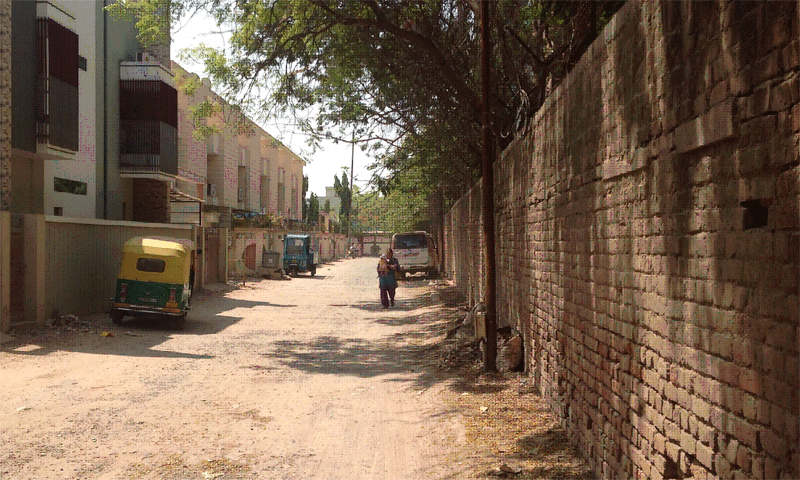
The picture is of a corner of Ahmedabad’s largest Muslim ghetto,
Juhapura. It has an estimated population of 200,000 and makes ends meet
without the state providing it any civic service.


The schism within: Ahmedabad’s biggest Muslim ghetto, Juhapura, is
separated from Hindu colonies by walls at most of the meeting points.
People tauntingly call it ‘the border of the mini-Pakistan’.
The walls
have not been constructed by the government but by the Hindu colonies
themselves and stand as the ‘concrete’ evidence of the deep divisions
that this state suffers from.


Housing apartheid: Each housing colony in Ahmedabad comes with a
religious label. Jains do not share living space with Hindus and Hindus
will hesitate giving their house on rent to Bengali Hindus who are not
vegetarians and exclusion of Muslims.


Communal ghettoisation: Juhapura is the biggest Muslim ghetto of
Ahmedabad. Though it looks like a slum, it is not an exclusive habitat
of poor Muslims. You can easily find impressive bungalows in every
street. Most of them took residence here after the 2002 anti-Muslim
riots as they do not feel secure living anywhere else.
Muslims do live
in other parts of the city but an increased tendency of living in close
clusters is more than evident everywhere in the city.


Election Commission in India is quite strict and all the stakeholders
have to take its words very seriously. I roamed around in Ahmedabad on
the polling day i.e. 30 April. The security staff at polling stations
was vigilant and their understanding of their election duties was
impressive.
A security man stopped a young man with a party flag in this
hands at the gate telling him to hide it as electioneering is not
permitted on polling day.


Under Indian election laws, electioneering has to be seized 48 hours
before the polling. I took a round of the city of Ahmedabad a day before
polling. There was nothing anywhere that could tell that there was
campaigning going on in the city. Billboards of the parties were taken
down as soon as the deadline expired and the only visible reminders of
elections were the Election Commission’s advertisements calling people
to vote.


Ahmedabadis are food fanatics. Every believer carries a list of items
that he/she cannot eat. While some would want to ensure that their
muffin do not contain any animal-based ingredient, everyone is not this
strict. Food ‘edicts’ reflect in socialisation as well in many
interesting ways as people cross boundaries to express their affection
for their friends from the other side of the divide or as a sign of
rebellion from their traditions. But others, like myself, are just
adventurous foodies.


Jains are the most finicky about what not to eat. If one goes by the
book, their negative list includes all animal-based products and
everything that grows under ground. So they don’t eat meat of any kind,
eggs, onions, garlic, etc. They have their grocery stores and won’t eat
out at places that serve both vegetarian and non-vegetarian. But a
friend jokingly told me that if you prepare chicken without onions and
garlic, it is called Jain chicken!


Cricket wars: Like most other parts of South Asia, cricket is a craze in
Ahmedabad too. But for Muslims here, it comes with a pinch of salt.
Their reactions to matches between India and Pakistan are closely
watched by others and any celebration of Pakistan’s success is seen as
‘an act of treason’.
“If I support Ricky Ponting, they have no problem
but any praise for Afridi’s sixer can make my Indian credentials
questionable,” said a Muslim school teacher in Ahmedabad.


There are many Muslim localities in old Ahmedabad city that has some impressive heritage sites.


Board game at Rani’s Hajira (probably meaning, hujra/living quarter) in
Ahmedabad old city. In Muslim localities, people were more apprehensive
about being photographed and these included not the women but younger
men. Every other person here has a story of police harassment to tell.


Gujarat is the only major state in India that is dry — alcohol trade is
banned. People belonging to other states and residing here get some
legal relaxation
but public drinking is not a norm. Alcohol though is
smuggled from other states, especially from Rajasthan. On this Ahmedabad
road, you can however stop to enjoy soft drinks at the cart that has
named itself Kashmiri Soda Center.

…………………….
Link: http://www.dawn.com/news/1103519/indian-elections-through-pakistani-eyes-from-ludhiana-to-ahmedabad
…………….
regards

A (muslim) man walks into a (hindu) barber-shop

A poignant film by Shlok Sharma. We advise viewer discretion.

It must be made compulsory viewing by all people who believe that dividing people by caste, religion, language and all other identity markers is a good thing. Remember, everytime you think you are winning by use of this strategy you are actually losing. When the genie gets out of the bottle it may wait to kill you till the (bitter) end but that will be a poor consolation prize.

South Asians should come together and deal with all the issues openly or be condemned to fight it out forever. Hindus have already been wiped out from a large part of the sub-continent, now it is the turn of muslims in India and the wrong muslims in Pakistan.

regards

Brown Pundits