What would ‘secularism’ mean in Pakistan?

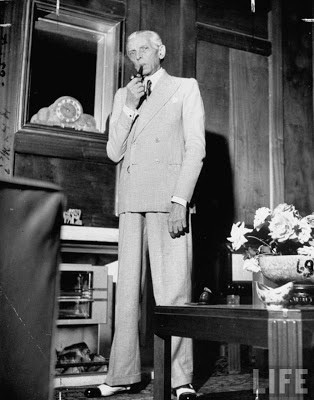
In his inaugural address to the Constituent assembly of Pakistan, Mr. Muhammad Ali Jinnah proclaimed, “You are free; you are free to go to your temples, you are free to go to your mosques or to any other place or worship in this State of Pakistan. You may belong to any religion or caste or creed that has nothing to do with the business of the State”. It was a vision of a state where religious practice is entirely separated from the functions of state – as enunciated by the man who almost singlehandedly brought that state into existence. Mr. Jinnah knew that a clear majority of people in Pakistan at the time were Muslims. He was also well aware of the fact that almost a quarter of Pakistan’s citizens (at that time in history) belonged to various non-Muslim faiths.
Changed contours
Over the years, the contours of Pakistan changed, geographically and demographically. According to the latest estimates, an overwhelming majority of Pakistan’s citizens are Muslims. This has led many to question whether secularism is a viable option for a polity that belongs to a particular religion.
Secularism is not atheism
Secularism as an idea has taken some beating in the Land of Pure. It is associated with atheism, debauchery and lawlessness. However, secularism, as a political ideology has nothing to do with a particular religion. It is true that secularism arose out of the Enlightenment in Europe as a counter to Papal theocracy. It evolved into different shapes based on geography thereafter. The French version of secularism (with its basis in the concept of Laïcité) is profoundly different from the constitutionally mandated secularism in India, Turkey and the United States. The charge that secularism is akin to atheism is frequently thrown by religious commentators in Pakistan. As a result, the popular narrative in Pakistan is that secularism means going against religion (Islam) which can be a dangerous notion for anyone claiming to be secularist. This misinterpretation was done with an aim to close the debate altogether about system of governance.
The challenge for proponents of secularism in Pakistan is to demonstrate how a Muslim-majority country that was conceived to be a place specifically designed to be a ‘laboratory of Islam’ would function as a secular country.
Secularism in Pakistan – a neutral state promotes coexistence
Secularism, in my opinion, would mean coexistence, tolerance
and a confessionally neutral state in a multicultural society such as Pakistan. Even within Islam, there are different strains of thought. In fact, sectarian conflicts within Islam over the last three decades are only one of the reasons as to why a neutral state is required to mediate the different schools of thought and the conflicts that arise from within.
Moreover, Pakistan still is home to millions of people who are non-Muslim. Biased policymaking and intolerant jurisprudence has made the lives of these minorities a living hell. In the age of modern technology, people in Pakistan are still arguing over interpretation of religious texts and killing each other over it. The state has abdicated its responsibility towards Hazaras, Ahmedis, Christians and Hindus. The only way we can protect the minorities and establish a rule of law is in the presence of a neutral state.
What needs to be understood is that the opposite of secularism is theocracy, in which religious figures control the reins of government. In countries with diverse populations, the rule of one faction over the other leads to brutality and in some cases, genocide. One of the major examples of this trend can be seen in Myanmar where Buddhist monks have aligned with the ruling government to wreak havoc on Rohingya Muslims.
In Pakistan, secularism would mean respect for existing religious identities
In a country like Pakistan, secularism would not mean erasing religious identities but a respect for existing identities and no efforts by the state to impose its version of faith on its citizens. The first attempt at reversing Mr. Jinnah’s secular message was the passage of Objectives Resolution in 1949 that foreshadowed an Islamization of Pakistan’s constitution. In the 1973 constitution, the resolution was kept as a preamble but a dictator (General Zia) made it part of the main text.
The importance of secularism for Pakistan can be understood by the way it has been opposed – tooth and nail – by the religious lobby since the very first day of Pakistan’s establishment. The poorly-constructed Nazriya-e-Pakistan (Ideology of Pakistan) was supposed to put Islam at the center of our politics. Currently, with exception of Jamaat-e-Islami and some factions of Imran Khan’s PTI, no major political party is willing to defend the ‘Nazriya’ as Zia defined it – and the sooner such a poorly thought-out concept is consigned to the dustbin of history, the better.
Pakistan deserves a secular, constitutional democracy, instead of a narrow-minded Mullah-cracy.

The right amount of Love

There was an interesting passage in this screed against Quaid-e-Azam:

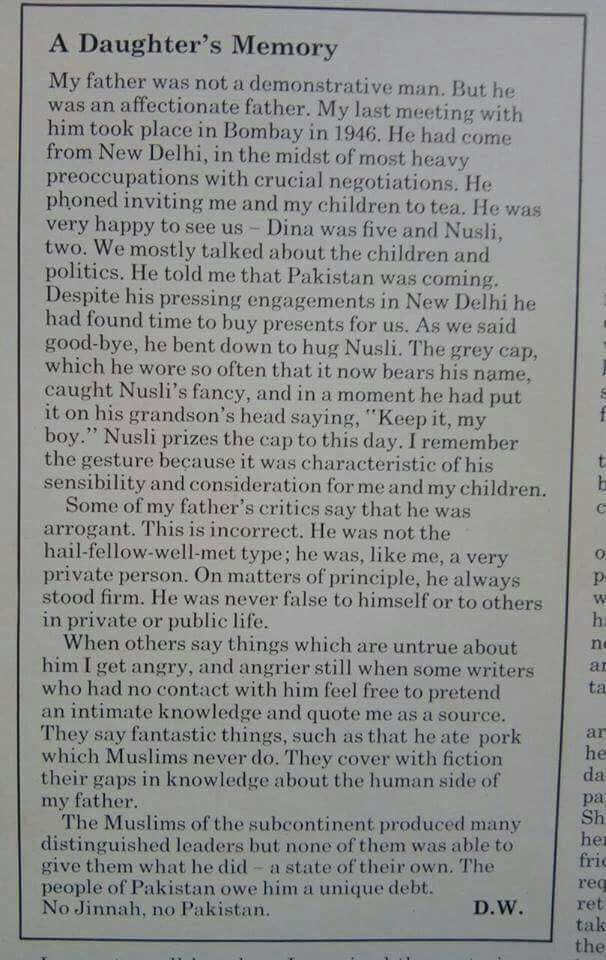
A man who cannot extend unconditional love to his children, who casts them out for following their hearts, is a cold and callous human being, and not a leader worth following.

I’m not condoning what the Quaid did with regards to Dina Wadia but even so I don’t think material attachments, as a rule, should override ideological underpinnings. Disowning one’s child for marrying outside one’s religion is foolish but there are reasons as to why one would want to disown one’s child.

As an aside South Asia (especially Pakistan) seems moribund in its obsessiveness with the past and after the jump I’ve posted a passage, which my wife sent me, about Mindfulness in the present. Her contention is that the Old World in general looks backward rather than forwards to a gleaming future hence why the best Research Institutes in the world are West Coast USA.

Continue reading The right amount of Love

Bhutto Hereticizes the Ahmedis

I saw this facebook comment from Ammar Qureshi, referring to the days leading up to the 2nd amendment to the Pakistani constitution (which declared Ahmedis to be non-Muslims).

The question was, did Zulfiqar Ali Bhutto, the prime minister of Pakistan and a vaguely leftist politician, but also a Paknationalist who dreamed of leading the Ummah, put this issue to the National Assembly because he wanted/intended this amendment to be passed (for political gain? for foreign policy objectives? to make himself Salahuddin?)?
 OR did he hope to defuse the issue but ended up having to get it passed against his own inclinations because of public pressure on this issue? (there was a nationwide agitation launched by Islamist parties on this issue, using Ahmedis as a wedge issue to regain their position in Pakistani politics).

I thought this comment should be preserved in a blog post, and other people can add their observations and opinions if they wish.

“My father as SSP Sargodha and later as DIG Quetta attended many law and order related meetings presided by Bhutto when anti-Ahmedi agitation was at its peak. He also accompanied Mirza Nasir to National Assembly as a security incharge for his presentation to the assembly. He attended meetings in which he remembered that Bhutto was not intially interested in declaring them non-Muslims and challenged Kausar Niazi and other members of PPP. However, Niazi told him that the foreign Muslims countries do not consider them Muslims so we have to take a decision as the agitation in streets had become a big issue for his government. ZAB was advised by his party members that he should take the matter to assembly in order to relieve the pressure on the streets. His party members in the meeting also flattered him that any decision he will take in this regard would be acceptable to the people. Bhutto since he enjoyed majority in the assembly thought that he would be able to get a grip on the issue to his liking if he takes the matter to National Assembly. However, his stength in the assembly became a big liability for him. Pressure on the streets subsided after the matter was taken to Assembly. However, now the pressure was on MNAs etc to declare them non-muslims. Initially it was assumed that PPP has majority in assembly so they can take any decision which ZAB likes. However, when MNAs came under pressure from their constituency on this subject, they told ZAB that they will become unpopular if they go against popular mood. Despite majority, Bhutto had to bow before the public pressure exerted on MNAs and declared Ahmedis non-Muslims as he realised that he will lose popularity due to this issue. “

.. my father attended the in-camera briefing in which Mirza Nasir explained his religion to the Assembly members. In fact there was no one sitting in the visitors gallery except my father and his team of police officials meant for security of Mirza Nasir. Mirza Nasir made presentation to the assembly and in his address explained the main tenets of his religion. However, the problem arose in the Q & A session. What proved to be the last question was asked by Kausar Niazi. He asked him as to what is the position of the Qadianis regarding those people who did not believe in the Qadiani’s belief regarding final prophet. Instead of being diplomatic to save his community, Mirza Nasir was very blunt and said that he considers them outside the pale of religion but consider them part of Millat ( community). All hell broke lose when he said this members of the assembly stood up and shouted Kafir Kafir in the Assembly. My father had to jump to the stage with his police escort to save Mirza Nasir- otherwise he would have been lynched by MNAs there in the assembly My father encircled Mirza Nasir and protected him for 20 minutes. He waited for 20 minutes but the uproar in the assembly did not die down so he sent a messenger to Kausar Niazi and asked him as to how long should he wait for the uproar to die down so that Mirza Nasir can resume his speech. Kausar Niazi said that there is no need to wait and he could take him. My father took him to a safe place and spent the whole day in that rest house with Mirza Nasir and at night took him in the car through unknown roads to Rabwah as there were reports coming on wireless that on all known routes to Rabwah there were security threats. On the way back, my father spoke with Mirza Nasir and told him that he should have been diplomatic and tried to save his community. However, Mirza Nasir was under the delusion that Ahmedis had voted for PPP and Bhutto had given him the assurance that he will go through the motions but not declare them non-Muslims. My father found Mirza Nasir’s reply quite strange if not delusional given what had happened few hours before and how could be sure that his community would not be declared non-Muslims. Even if ZAB had promised him something, he should have known that ZAB is a populist politician and will be guided, like any leader in a democracy, by the popular mood. When my father dropped Mirza Nasir safely at his Rabwah residence, he wrote in the log book that police gave him to sign- that SSP Police saved his life twice in one day- once in the National Assembly when he would have been lynched by the MNAs and second time when he took him through unknown route to Rabwah.

Quaid e Azam and Iqbal. A meeting of minds..

An Imaginary meeting.. 
By Pakistani-American writer Asif Ismael. 

“Didn’t I tell you, sir, this idea of yours: a separate homeland for the Muslims, is a bit fanciful? And you continued to press me to come to Bombay.” Jinnah said, arranging the crease of his pants over his knees. Through a slit in the curtains hanging behind his host’s back, a sunbeam streamed into the room and fell on the silver base of a hooka placed next to his feet–its reflection distorted in his impeccably shined black shoe. He sat on the rocking chair stiff as a board, for even a slight movement made the chair squeak.

His host, Iqbal, lying down on his side in a four-post bed, had his temple glued to his fist: a man in deep thought–a posture imprinted on the minds of the masses–the bed-sheet crumpled around the point of Iqbal’s elbow.

Iqbal, for the last several minutes, had been staring at the floor, lost in thought. Actually he’d been marvelling at Jinnah’s shoes, glistening, on his Isfahan, planted firmly, an inch or two apart, one slightly ahead of the other, but not too far ahead, reflecting a certain precision which his poetic sensibility had found challenging to grasp.

“Look, it’s not over yet,” Iqbal said. He closed his eyes, grabbed his hooka pipe and began inhaling through his fingers clenched around the tip. The embers turned crimson within the bowl. The room smelled of imported tobacco. The toking filled the room with gurgles.

Jinnah’s lips quivered without emitting a sound as he tried talking through the loud and prolonged guggle of the hooka; then pressing them together he waited for the old man to finish his noisy inhale. The gurgling stopped followed by a spell of raspy cough that brought the host’s eyes to tears. Raising his eyebrows Jinnah took a deep breath, like a sigh, and holding it in his chest he waited for the cough to subside. And when it did and as he slowly exhaled the trapped air in his chest, he noticed drops of tears rolling down on Iqbal’s cheeks. The smoke, the swirling blue haze caught in the sunbeam over the head of his host, thrown in turmoil when touched by his breath. He decided to stay quiet.

A man in his twenties, his hair held in a ponytail, appeared at the door holding a pigeon, white as snow. He held the bird next to his chest, petting it. “Allama Ji, today is the day, when the whole town will know what kind of pigeons we breed here in Mohalla Kashmarian,” he said. He stopped in his tracks at the door upon noticing the stare of Jinnah. He was unsure, though, if those two arrows of steel were directed at him or at the pigeon.

“Oh, don’t mind this chap: He’s my pigeon breeder, the best in Punjab,” Iqbal said, clearing his throat.

“I’d better be going–I’ll have to catch the train early in the morning from Lahore. Meetings and more meetings!–I wonder when this will end, if ever,” Jinnah said, getting up. “Think about what I’ve said. Have a nice Pigeon Day.” Putting his black overcoat on, he glanced at the pigeon breeder who stood in the doorway lost in his world, his eyes on the pigeon, petting it softly. Jinnah put his hat on, shrugged his shoulder to ease them into his coat, and left the room.

“Allama Ji, is he the only one you’ve been able to find in the whole world to lead the Muslims of India? Sometimes, you seriously make me wonder, Allama Ji,” the pigeon breeder said, sitting on the rocking chair where Jinnah had sat. The pigeon emitted a squeal.

“Oh Bashir, my son, you’re too innocent–To win you must find the best of the breed. When the pigeon is flying high, looking like a dot, darting across the vast blue sky, who cares if it has been bred in Sailkot, Daska, Lahore, London, Paris or New York,” Iqbal said, getting off from the bed and sliding his feet into a pair of slippers. “Lets go to the rooftop.”

“Allama Ji, hurry up! Wearing a yellow shawl bright as sun, she’s been waiting for you on her rooftop,” Bashir said. “I’m going to carry your hooka. How about some daaroo?”

“Oh Bashir, you are a bastard of the highest order. Don’t you see the sun is still way too high? Do you want me to see four pigeons flying in the sky, instead of two?” Iqbal said, taking the bird from him. The pigeon fluttered a bit before settling in a new set of hands. “What a beauty! Look at her eyes! Wells filled with water sweet and pure; the delicate nose, the straight neck putting even a shaheen to shame!”

“Today’s the day, when the pigeons fly high–when the eyes meet across the sky; when love fills the old boot; and water rises in the new shoot,” Bashir said, stepping behind Iqbal on the stairway.

“Okay! Okay! just get the damn daaroo,” Iqbal said, turning around. He looked up and said: “The wind blows lifting the yellow sand off the golden dunes, carrying the musk of the beloved.”

From the rooftop they both saw Jinnah, hunched like a bow, getting his skinny frame into his black Bentley, his chauffeur standing stiff holding the car’s door open for him. A gang of kids availing this godsent opportunity of putting their hands on such a shiny creature, had touched the car to their heart’s content, leaving streaks of dirt in the spotless glimmer of its black armor.

With one foot in the car, Jinnah turned around as if he felt their gaze on his back. He looked up for an instant, and saw Iqbal and his pigeon breeder standing at the rooftop. They waved at him, smiling. Shaking his head he slid into his car. The driver shut the door softly and yelled at the kids already planning to run behind this sleek creature that looked so foreign and new in their old Mohalla Kashmarian.

Inside, the car smelled of tanned hide, tobacco, English tweed, and dog.

The Tragedy of Imran Khan and the Insafian Revolution

Looking back at Pakistan’s history over the last forty
years, he represented the country’s best opportunity to transform itself from a
third-world kleptocracy to a modern democracy, which is why the failure of
Imran Khan and his revolution is such a tragedy. I do not mean to imply that he
has failed in narrow political terms: It is much too early to say that, and I
would not be surprised to see him as Prime Minister of Pakistan in the near
future. What has failed, rather, is the vision that he had once promised. It
has been tainted irredeemably by his alliances with obscurantist forces like
the Jamaat-e-Islami, his rationalization
of Taliban extremism
, his willingness
to act as the instrument of anti-democratic forces
, his poor judgment of
character, his limited
grasp of history
, his opportunistic
embrace of bigotry
, and his inability to organize his movement into a
meaningful force rather than a rabble of unthinking acolytes. Ultimately, Imran
Khan’s revolution has been limited by its leader’s inability to transcend the
limitations of his own character. At one level, this is just a tragedy, but at
another, it is an unforgivable betrayal because, by promising gold and
delivering dirt, Imran Khan has set back the cause of true reform and
strengthened the very forces he had originally wished to counteract. Many of
his supporters are delighted that he has weakened the current government, which
they see as corrupt and illegitimate, and indeed he has. But this government
represents only one aspect of the rot in Pakistani society – and not even the
most salient one. What Imran Khan’s actions have really weakened is the
institution of democracy in Pakistan.
Among the factors that have brought Pakistan to where it is
today, corrupt politicians may be the most visible, but are certainly not the
most significant. They are the scavengers picking at the corpse, not the
original killers. The true source of Pakistan’s problems are the forces that,
over the country’s entire history, have not allowed the institutions of
governance and socioeconomic organization to establish themselves, and have
precluded the emergence of a stable social contract between the state and its citizens.
These forces are given many names – “the Establishment”, “the Deep State”, “farishtay”
(angels), “secret agencies”, etc. – but the only thing certain about them is
that they pervade all aspects of the state. Corrupt politicians are, at best,
servants and enablers of these forces – a symptom, not the cause, so to speak.
And this is reflected in the fact that, while the political system in Pakistan
has been extremely unstable since the country’s inception, the ideological
orientation of the country has been remarkably stable, and has moved only in
one direction. This is evident in the policies towards India and Afghanistan,
the Kashmir issue, the nurturing of extremism as a geopolitical weapon, the untouchability
of the military-industrial complex, the use of the educational system as an
instrument of ideology, the suppression of civil society and civil rights, the
dehumanization of minorities, and – above all – in the periodic disruption of
the democratic system.
Democracy is a fragile thing and does not come naturally to
humans. Its success in the West and the East has depended on being given the
space and time to establish itself. Good democracy – if it arises at all – requires
many generations to take root, and is often preceded by decades of poor, imperfect,
corrupt and just plain bad democracy. Those decades of bad democracy are
absolutely necessary for the ultimate emergence of good democracy, which
explains why the latter has never occurred in Pakistan. Every time the
democratic experiment begins and takes its natural imperfect course, a possibly
well-meaning “reformer” upends it in the name of bringing order, thus resetting
everything to square one, which is where the process starts again after a period
of political stasis. There is no time for democracy to establish itself, and
for true reformers to emerge from within
the system, which is the only way the system can ever be reformed. And this
brings us back to the tragedy and betrayal in Imran Khan’s revolution. His
diagnosis of what ails Pakistan, while partial, was (and remains) correct: The
democracy that exists now is terrible. As the leader of the second most
powerful party in the Parliament, and the party in power in one of the four
provinces, Imran Khan the reformer had a golden opportunity to begin exactly
the kind of “reform from within” that Pakistani democracy needs. However, such
a process would take time – years and decades of bad but slowly improving
democracy, if the reformers could persevere. It is quite likely that, while he
would begin it, Imran Khan would not be the one to complete the process. And
this is where his character was tested and found wanting. Like many would-be
reformers, Imran Khan obviously believes that he, and only he, can accomplish what is needed. It is a delusion common in
the leadership business, but is seldom warranted. In this case, realizing that
he was already nearing “retirement age”, Imran Khan chose to short-cut the
process and to attack the system from the outside. The claim is often made (by
his supporters) that he first spent a year – a whole year! – demanding reforms
within the system, as if a process that requires decades can be judged on the
results of a few months of half-hearted noise-making! I have no insider
knowledge of who – if anyone – pushed him towards adopting this course, but it
is obvious who benefited from it: The forces that do not wish to see the
institutions of democratic government stabilize. Whether he has weakened the
PML-N government or not, he has done incalculable damage to these institutions,
which represent whatever future Pakistan might have. That is his greatest
betrayal … but it isn’t all.
Imran Khan emerged upon the political scene as a widely
admired sportsman, a determined fighter, a dedicated philanthropist and, above
all, an honest man. He is still all these things, though the last attribute
must perhaps be qualified now to apply only to financial matters. Those who followed
him enthusiastically and those, like myself, who wished him well with some
caution, all hoped that he would transform the social and political landscape
of Pakistan with a thoughtful, well-organized and systematic movement. What has
emerged instead is empty sloganeering, shallow thinking and dangerous
impatience. One would expect the leader of a true reform movement to surround
himself with thinkers, intellectuals, technocrats and organizers – people who
know, understand, think and act with judgment. Instead, Imran Khan is
surrounded by rank opportunists of little expertise but grandiose ambitions,
the refuse of the same system that he seeks to overthrow. One common theme that
unites them is their reluctance to criticize their leader and their willingness
to rationalize his most absurd actions. And there have been plenty of these.
One may recall the exhortation to
transfer money from abroad using a “hawala” scheme
that violated
international law
, or the ridiculous (and counterproductive)
edict
to stop paying tax and utility bills
, or forcing all his party’s members to
resign from Parliament (much to
their chagrin
). No prominent leader in the Pakistan Tehreek-e-Insaf (PTI) –
with the exception of the now departed Javed Hashmi – has dared to criticize these
ideas as impossible, counter-productive or both, though many of them must surely
know this. However, they also know the boundless narcissism of their leader who
cannot abide criticism any more now than he could when he was captain of the
cricket team. A little autocracy was not bad for Pakistan cricket, but it is
poison for national governance!
The party created by Imran Khan – the PTI – should have been
a haven for rational, thoughtful Pakistanis who could change the country
through the force of their ideas and their exemplary behavior. That has always been
the key to reform: Ideas and character. Instead, he has created a party characterized
by paranoia, demagoguery, defensiveness and abusiveness.
Every untoward event is quickly attributed by the party faithful to vast
international and domestic conspiracies, variously involving the US, India,
Israel, internal traitors, former judges and generals, government
functionaries, and Fakhroo Bhai’s lack of spine. Whatever befalls the PTI is
always someone else’s fault – the Dear Leader never makes a mistake. When – in spite
of many
irregularities
– the 2013 elections were deemed
to be generally fair
, and the results turned out to be almost exactly what all
serious pollsters – as opposed to PTI kool-aid drinkers – had predicted,
the response was to serially blame officials and politicians at every level. Every
journalist who criticizes PTI policies is immediately deemed a “dollar-khor” “lifafa
journalist”
traitor on the take from nefarious entities. Anyone who dares
to challenge Imran Khan’s “ideas” is labeled a bully, traitor, pervert, and
worse. The picturesque language that issues forth from the social media
accounts of PTI youth is just an amplified reflection of the attitudes implicit
in their leader’s rhetoric – the same lack of decorum, the
same inability to accept criticism, the same alacrity in blaming everything on
others, and the same lack of prior thought. The river of incoherence, factual
errors, empty threats and false predictions that has issued forth from the roof
of the PTI container on D-Chowk would long ago have drowned any rational
political movement, but froth floats even in a flood.
Then leaving aside style, let us turn to substance. Through
2012 and 2013, as Pakistan was engulfed in violence perpetrated by jihadi
Taliban, Imran Khan and his party kept up a
steady drumbeat of apologetics for the extremists
, calling them “our
alienated brothers” and suggesting
they open offices
in Pakistani cities. To be sure, the PML-N of Nawaz
Sharif was no better on this, though the two differed slightly in their choice
of preferred extremist outfits. However, this was a much more problematic
position for a party supposedly championing reform. When it came time to form a
government in the Khyber Pakhtunkhwa (KP) province, PTI forged an alliance with
the mother-ship of religious obscurantism and political thuggery in Pakistan,
the Jamaat-e-Islami.
They were given only two ministeries, but one of them was education – an area fraught
with ideological conflict. Predictably, the need to mollify Islamist coalition
partners has resulted in devastating
changes to the educational curriculum in KP
. PTI still does not dare to
criticize Islamist militants as terrorists. Even as I write this, PTI mouthpieces
are out on social media and TV news shows trying to deflect the blame for yesterday’s
deadly blast at Wahgah away from the Taliban (who have already claimed
responsibility) and towards India. One has to ask: Whom is this benefiting? And
once we have an answer to this question, many things will become magically
clearer.
 I am often asked why
I am so adamantly opposed to Imran Khan’s leadership if I think he is not
corrupt and means well (I do). Why not give him a chance as opposed to the
corrupt lot currently in power? My answer is that, given the stakes, I prefer corrupt,
incompetent opportunists to committed, single-minded ideologues. The former are
not harmless, but are incapable of being truly dangerous, because the success
of their “business” depends on the system’s survival. The latter scare me
because they are the type who would gladly burn a village to save it. I fear that Imran Khan today is unleashing forces within Pakistani politics that even he will not be able to control in the future, and sadly, they are mainly destructive ones.
In the hard-fought
and bitter American presidential election of 1960
, more than 68 million
votes were cast nationwide, and John F. Kennedy won by only 112,827 votes – 0.165%
of all the votes cast – and winning only 23 states to Nixon’s 26. It was
well-known that Mayor Richard Daley’s “machine” in Chicago had conjured up
thousands of questionable votes, including votes from dead people. The state of
Texas was delivered by JFK’s running mate, Lyndon Johnson, by means still
shrouded in mystery. Yet, that most greedy of politicians, Richard Nixon,
accepted defeat with grace and left the field to his opponent, living to fight
another day. Then in the election
of 2000
, the Democratic nominee, Al Gore, actually won half a million more
votes than his opponent, George W. Bush, and clearly should have won the state
of Florida – and thus the Presidency – had all votes been counted properly.
However, the US Supreme Court, with a majority of Republican judges – including
three appointed by Candidate Bush’s father or President Reagan (when Bush Sr.
was Vice-President) – arbitrarily stopped the recount and delivered the
Presidency to George W. Bush. Many urged Gore to challenge this, but he stepped
aside gracefully to show respect for the system. This is how mature leaders
behave. In both cases, the losers’ supporters (myself included, in the case of
Al Gore) gnashed their teeth and stamped their feet in frustration, but no one
talked of overthrowing the government. Contrast this with the behavior of the
Republican ideologues after 1994, who ended up impeaching Bill Clinton, or the
even more reckless ideologues of today’s Tea Party, who have repeatedly brought
the US government to the brink of disaster because of their personal hatred for
President Obama. In this, and in too many other things, the party created by
Imran Khan resembles the Tea Party of today and the ideologues of 1994: The
same unwillingness to listen to contrary facts, the same paranoid conspiracy
theories, the same indiscriminately abusive language towards critics, and –
most sadly – the same preference for ideology over Reason. The PTI has become
the party of “you’re with us or against us”, the party that trusts its gut feelings
more than objective facts, and the party that seeks to “reform” the system by
demolishing it. For all his claims of being an honest reformer, Imran Khan has
turned out to be yet another well-meaning authoritarian wannabe – albeit in
civilian clothes for a change.

Imran Khan: between a rock and a hard place

For the past one month, Imran Khan has been spending several hours a day on top of a container in the heart of Islamabad, demanding that the elected government must resign (because he says so) and pave the way for him to become prime minister and finally create the Pakistan that was dreamt of by Iqbal and that will be run according to the model of the State of Medina. (I am not kidding, he regularly evokes both Allama Iqbal and the model state of Medina and seems to be seriously impressed by both). Unfortunately, his sincere admiraition is not matched by any detailed knowledge of either Allama Iqbal or the state of Medina. This causes problems when someone who knows a bit about either of them shows up to bully him…poor IK has to cave in. Very fast.

This is Imran Khan promising that in his new Pakistan, “the best will be appointed on merit” and he has just heard that Atif Mian, a Pakistani economist at Princeton is among the top 25 economists in the world, so Atif Mian will be his finance minister:


Imran Khan wants “Qadiani” Atif Mian to be his… by PakistantvTV

Atif Mian is apparently an Ahmedi.
Oops.


Complete Interview IMRAN KHAN on MessageTv… by fame6

Why can Imran Khan not stand up to the Jamat e Islami or Hamid Gul or anyone with any Islamist credentials?

1. Imran Khan’s opinion of Iqbal and Islam is almost entirely based on what he learned in Pak studies and Islamiyat classes in Aitchison college Lahore. His knowledge of both may have progressed a little beyond that level …though only a little in the case of Iqbal: he still struggles to recite even one verse of Iqbal from memory..in fact, he tries the same verse repeatedly and has difficulty with it:
Sabaq Phir Parh Sadaqat Ka, Adalat Ka, Shujaat Ka
Liya Jaye Ga Tujh Se Kaam Dunya Ki Imamat Ka  (recite again the lesson of truth, of justice, of valor/ for you will asked again to lead the world)
OK, he may have difficulty reciting the verse, but he seems to genuinely believe in it. Maybe he is just one of those otherwise smart people who are not good with memorizing poetry, but there are other problems…

2. Based on what he learned in 6th grade (I know, because I learned the same things), he really believes there is an Islamic model, that model is perfect, that model was best understood and explained by Iqbal, and he can put it into practice if people will only make him prime minister. All the links in this chain are controversial, but let us assume that the first three are correct, is the fourth one also correct?

3. Unfortunately, no. Because even if the first three are true (An Islamic model exists, it is perfect, it is best explained by Iqbal), the fourth can only work if IK knows the first three links in some detail and is so smart and capable (in the sense of being able to do X) that he can maneuver past all the people who have bad versions of the model or who don’t want the model because they are evil or whatever, and put his vision (which is, of course, the correct vision) into practice. On current evidence, what would make you believe that? In hundreds of speeches he has never moved beyond the vaguest and most general bromides (“true Islam will provide justice to all”), what would make anyone think he actually has something more profound hidden somewhere? The Atif Mian flap is not just an example of IK withdrawing from a position double-quick once some bigot shows up to challenge him, it is also a good example of how his mind works. He read somewhere that Atif Mian is a famous economist and he is a Pakistani. Without knowing anything more about Atif Mian, the people who nominated him as a top economist or even about ecomonics, he jumped all in and decided someone like Atif Mian should be his finance minister?

He has been asked before about the topic of laws discriminating against Ahmedis. And he has made some encouraging noises (though even he knows enough to be stick to vagueness in this case)

Even if he has some Western/Modern/Secular liberal instincts, it is clear that he is unable to stand up for that particular vision of justice the moment someone shows up with Islamist credentials and bullies him to retract…

Quick rough translation (not every word is translated): I want to condemn this propaganda about me and my position about Qadianis (notice that he takes care to use the term Qadiani, not Ahmedi). This is propaganda by those who see their political death coming.  I am a Muslim. I have read the Quran (uses the feminine gender for the Quran repeatedly; his knowledge of Urdu is as shaky as his knowledge of Islam and Iqbal). I believe in the Quran. Whoever does not accept our beloved prophet as the final prophet is not a Muslim. So for someone to say that PTI will make some change in the 1973 constitution about laws relating to Qadianis after coming into power, this is a lie and it is propaganda. People who are giving fatwas about me without giving me a hearing are not being just. I am not a two-faced person. Wikileaks has said that I am the only politician in Pakistan who says the same thing behind closed doors as he does in public….this is my faith. This is the faith by which i live. “we follow Allah and we follow no one else”. This is challenging my faith. By which I live my life. 

Its not going to end well.

He was doing such good work with his hospital and his university. Another good man lost to Pakstudies and Islamiyat….

Storming the Red Zone…with human shields?

…..Imran
Khan’s terrible hunger for power is a frightening thing to see…his refusal to accept that system
can only be improved, not torn down……More than
convincing people of Nawaz Sharif being unfit to be Prime Minister, Imran has
made a more solid case for why he should never, ever be awarded that mantle….

….
We are outsiders…and this comment will probably give offense: Captain Sahib has gone completely bonkers. We agree with The Nation (Pakistan) editorial that Imran Khan should declare victory and go home.

It is bad enough that IK wears the mask of civil disobedience by urging his supporters to not pay taxes. Presently, just about 0.9% of Pakistan pays tax (he should know of this). How is such a step somehow enlightened?

But to encourage women and children to march to the Red Zone against the full might of the military…is insane. Add to this the crazy ultimatums. Nawaz Sharif has been asked to resign by Wednesday (Aug 20). What happens if he does not?
….

12:55am DawnNews reported sources as having said that the Pakistan Army has taken charge of the Interior Ministry’s control room. Former
Punjab law minister Rana Sanaullah however has rejected the reports,
saying that the Interior Ministry is still in charge of the control
room.


12:53am Amir Jamaat-i-Islami (JI) Sirajul Haq, while speaking to
DawNews said that both sides need to take a step back and resolve the
issues between them. He said that if the confrontation continues then it will be “Game over” for both sides.


12:33am ISPR spokesperson Asim Bajwa tweets: “Bldgs in red Zone r
symbol of State & being protected by Army, therefore sanctity of
these national symbols must be respected.
Situation requires
patience, wisdom & sagacity from all stakeholders to resolve
prevailing impasse through meaningful dialogue in larger national and
public interest.”


12:24am PTI chief Imran Khan said that he has given Prime Minister Nawaz Sharif till Wednesday evening to resign. “If Nawaz Sharif does not resign then we will enter into the PM House,” said the PTI chief.


12:14am “United States is keeping a close eye on political developments in Pakistan,” says State Department. “We
appeal to the PTI and PAT to pursue a non-violent approach
to resolve
the issue…Pakistani political parties should work out their
differences through dialogue,” the US State Department said.

……………………………………….
The Pakistan Tehreek-I-Insaf (PTI) has devised a dangerous strategy to march into the Red Zone and Constitutional Avenue.

PTI sources have said that women and children will be included in the march towards areas guarded by riot police, paramilitary forces, containers and barbed wire.

K-P
Minister Shaukat Yousafzai confirmed that women and children would
march in the second row, right behind key PTI legislators and Imran
Khan. The PTI Youth Wing would follow behind the women. When questioned
about the inclusion of women and children, Yousafzai said the march
would be peaceful, and the women and children were being placed in the
centre for their safety.

Abdul Qadir Baloch has termed the PTI’s
plan “inhuman”. He alleged that the PTI leadership was using the
children and women as a human shield. Speaking to media in front
of Parliament House, Baloch said including women and children in a
march – where violent clashes are expected – was unacceptable.

A PTI legislator on condition of anonymity said party members were clueless as to the logic behind Imran’s decisions. “He [Imran] is on his own. He doesn’t listen to anyone and party leaders are really annoyed, but they don’t know what to do”.
……

The numbers are dwindling, Imran’s buzz is wearing off, and really the
party at Serena Chowk has just been going on tediously long now. While
Tahir Ul Qadri restricts himself to speeches which magically change
meaning in translation, Imran can’t seem to make up his mind about what
he wants, or how to get it. Swinging from demanding an immediate
resignation, to one in seven days, then three days, until he finally
settled on two days, Imran Khan is trying even his followers’ patience.
Enough.
….

His latest call to civil disobedience is desperate, bordering
on manic. Having vastly overestimated his hand, perhaps Imran is hoping
to claw back some dignity in presenting the status quo as his great
victory. Incitement to sedition doesn’t really work in a country where
the state is already struggling to display it’s authority. 

….
A tiny sliver
of the population are taxpayers, and there’s nothing anyone seems to be
able to do about it. Will Imran be claiming this as his great miracle
in two days? Does he even know what date utility bills arrive? Does he
really think two days of people who don’t pay taxes, continuing to not
pay taxes is going to bring about any change at all? Enough.

……

Imran
Khan’s terrible hunger for power is a frightening thing to see. It is
troubling to see his refusal to accept that no matter how bad a system
is, that system can only be improved, not torn down like a pair of old
curtains. 

….
More than convincing people of Nawaz Sharif being unfit to be
Prime Minister, Imran has made a more solid case for why he should
never, ever be awarded that mantle. Planting misleading expectations,
leading people to violence, suffering from delusions of grandeur, Imran Khan’s behaviour is now simply embarrassing. 

………
He is doing the
government’s job for them: convincing the millions watching on TV that
they were wise to stay home. The PMLN are having a chuckle at the PTI’s
expense. And the opposition is shaking their head at the corpse of a
long march that Imran Khan is trying to whip life back into. 

….
A man
should know when he is beaten. Imran has not achieved what he came for,
nor will he. Any further adventures in Serena Chowk will further
undermine his already pitiful credibility, and are best avoided. The
sincerest advice anyone can give the PTI chief is: go home. Enough.

…….

Link (1): dangerous-game-pti-to-march-into-red-zone-with-women-children

Link (2): islamabad-march-imran-threatens-to-storm-pm-house-unless-nawaz-steps-down

Link (3): http://www.nation.com.pk/editorials/18-Aug-2014/go-home-imran
……

regards

Liaquat Ali Khan defies Amrika (and dies)

…..the US demanded Pakistan use its influence in Tehran and persuade it to
transfer control of its oil fields to the US….Liaquat Ali Khan declined to accede to the
request…..The US then threatened to annul the secret pact on Kashmir. Liaquat replied that Pakistan has annexed
half of Kashmir without American support and would be able to take the
other half too…..Liaquat also
demanded that the US vacate air bases in Pakistan….Liaquat’s demand was a bombshell for Washington…..

…………..
It is wonderful what we can learn from declassified documents- incontrovertible proof that American and Pakistan have been frenemies from birth. 

Apart from L.A.K. we also have (Tariq Ali) claims that ZA Bhutto was killed on instructions from the CIA. Osama-ji was definitely killed by the Great Satan (or was he?). And the show goes on……
……………
Declassified US document discusses the possible reason for the
disenchantment of the US and the UK governments with the Pakistan prime
minister and his government. Liaquat was not ready to toe the US line,
the newspaper pointed out and hence the US wanted him eliminated.


…….

While the UK was pressing Pakistan for support on the issue of Iran,
the US demanded Pakistan use its influence in Tehran and persuade it to
transfer control of its oil fields to the US (oil apparently has
remained a major issue with the Americans ever since, especially while
Mohammad Mosaddeq was in power in Tehran then).


According to the article, Liaquat Ali Khan declined to accede to the
request. “The US then threatened to annul the secret pact on Kashmir
(between Pakistan and the US). Liaquat replied that Pakistan has annexed
half of Kashmir without American support and would be able to take the
other half too.” Not only that, Prime Minister Liaquat Ali Khan also
demanded that the US vacate air bases in Pakistan.


“Liaquat’s demand was a bombshell for Washington. Americans who had been
dreaming of conquering Soviet Russia from Pakistan air bases were
flabbergasted,” the article emphasized. And hence the plot to kill
Liaquat was hatched, says the article.


However, “the US wanted a Muslim assassin, so as to obviate
international complications. The US could not find a traitor in Pakistan
(apparently for the reason that the new country was then brimming with
nationalistic pride and hope for future),” the article added.


The US then turned to Kabul. “Washington contacted the US Embassy in
Kabul. They in turn got in touch with Pashtoonistan leaders, pointing to
Liaquat as their only hurdle and assuring them that if some of them
could kill Liaquat, the US would undertake the task of establishing
Pashtoonistan by 1952.”


At this the “Pashtoon leaders induced Akbar to take the job and also
made arrangements for him to be killed immediately after so as to
conceal the conspiracy. The Pakistani currency recovered from the
assassin’s body also reveal that others were also involved. Due to
already strained relations between Pakistan and Afghanistan no currency
exchange was then taking place between the two countries. Hence only the
“American Embassy (in Kabul) could have supplied the Pakistani currency
notes to the assassin,” the summary argued.
 

The article also mentioned that the cartridges recovered from the body
of the assassinated Pakistani premier were US made. The type of bullet
used to kill the Pakistani prime minister were in “use by high-ranking
American officers”, and were “not usually available in the market”. The
rest is for us to deduce.


The article then summarized that all these facts prove that the real
culprit behind the killing was the US, which had committed similar acts
in the Middle East as well.
 

There are many parallels between then and now. And all this could not be
just a matter of chance. Oil, assassinations, dollars, Iran, air bases,
all these sound familiar even today. Fifty years have passed, yet
things may not have really changed.

…….

Link: http://defence.pk/threads/which-foreign-agency-killed-liaqat-ali-khan.234612/

…….

regards

Ghazi Ilm-ud-Din Shaheed

Raza Rumi has an extensive history of blasphemy (see below) and anti-blasphemy activism in Pakistan (even as part of an unified India). Apparently it all started with the actions of one deeply faithful man-child, Ghazi Ilm-ud-Din Shaheed of Lahore, who was cited for his courage by the likes of Iqbal and Jinnah.

It shines light (again) on that famous comment which in our opinion crystallizes the Two Nation Theory: Hindus and Muslims can never co-exist….their heroes are our villains and vice versa

There are shrines and roads and squares all over Pakistan commemorating the memory of Ilm-ud-Din. But sad to say, the grave of Dr Abdus Salam has been defaced. The nobel laureate was also a proud son of Pakistan and he belongs to the Ahmadi tradition – the same Ahmadis, who as a group were in the forefront of the Pakistan movement. Pakistan has honored one son but not the other. Too bad.
………………………
“As Iqbal placed the body of Ilm Din into the grave, he tearfully
declared: “This uneducated young man has surpassed us, the educated
ones.”


The 1920’s in India witnessed the publishing of an inflammatory book
vilifying Prophet Muhammad (SAW) thereby adding fuel to the existing
Muslim/Hindu tensions.
The British Raj ruled India and the creation of
Pakistan was still a distant dream in the hearts of the Indian Muslims.

The Muslim population was understandably incensed and mass protests were
held. Prashaad Prataab had authored Rangeela Rasool (The Colourful
Prophet), under the pen name of Pandit Chamupati Lal. The word rangeela
means ‘colourful’ but can be understood in this context to mean
‘playboy’.
[Nauzbillah]


….

Rajpal was a Hindu book publisher from Lahore. He took the
responsibility of publishing the book in 1923 and pledged not to
disclose the author’s real name. Pressure from the Muslim community
resulted in the matter being taken to Session court Lahore which found
Raj Pal guilty and sentenced him.


Subsequently Rajpal appealed against
the decision of Session Court in the Lahore High court. The appeal was
heard by Judge Daleep Singh who gave leave to appeal on the grounds that
on the basis of criticism against the religious leaders, no matter how
immoral it is, is not covered by S.153 of the Indian Penal Code.
Thus
Rajpal could not be sentenced as law did not cover blasphemous criticism
against religion. The High Court decision was widely criticised and
protests were made against it by Muslims of India. Little did anyone
suspect that one young man’s course of action would bring about a
significant change in the Law, ensuring that Islam would be covered by
blasphemy laws.


Ilm Din was an illiterate teenager from Lahore. His father was a
carpenter. One day he was passing near Masjid (mosque) Wazir Khan. There
was a huge crowd shouting slogans against Rajpal. The speaker
thundered: “Oh Muslims! The devil Rajpal has sought to dishonour our
beloved Prophet Muhammed (S.A.W) by his filthy book!”


Ilm Din was deeply affected by this passionate speech and vowed to take
action. On 6th September 1929 Ilm Deen set out for the bazaar and
purchased a dagger for one rupee.
He hid the dagger in his pants and
waited opposite Rajpal’s Shop. Rajpal had not arrived yet. His flight
had arrived at Lahore airport and he proceeded to phone the police in
order to request them to provide him security. Ilm Deen did not know
what the publisher looked like. He asked a few passer-by’s as to
Rajpal’s whereabouts and said that he needed to discuss something with
him. Rajpal entered the shop without detection but soon after a man
alerted Ilm Din that Rajpal was inside. The young man entered the shop,
lunged forward and attacked him. He stabbed his dagger into the chest of
Rajpal with such force that his heart was ripped from his body. Rajpal
fell dead on the ground. Ilm Deen made no attempt to escape. Rajpal’s
employees grabbed him and shouted for help.


The police arrived at the scene and arrested Ilm Deen. He was kept in
Mianwali jail. The case went to court and Quaid-e-Azam Muhammad Ali
Jinnah was his defence lawyer. Jinnah fought Ghazi Ilm Deen’s case on a
special request from Allama Iqbal.
Jinnah urged Ilm Din to enter a
plea of not guilty plea and to say that he had acted due to extreme
provocation.
The fact that Ilm Din was only 19 years old would have also
worked in his favour. Ilm Din refused to offer such a plea and insisted
that he was proud of his actions. This case was the only one that
Jinnah ever lost.
The Session Court awarded Ilm Din the death penalty. Against his wishes, the Muslims lodged an appeal, but it was rejected.


Ilm Din’s execution occurred on 31st October 1929. When asked if he
had any last requests, he simply requested that he be allowed to pray
two rak’at (units) nafl (voluntary) prayer, thus following the example
of Khubaib (RA) who also prayed 2 rak’ats nafl before the pagan Quraish
executed him.


As the noose was put around the neck of Ilm Din, he repeated before the huge crowd:
“O people! Bear witness that I killed Rajpal to defend our last
Prophet Muhammed S.A.W, and today they are going to hang me. I am
sacrificing my life whilst reciting the kalimah (shahadah – testimony of
faith).”


The young man was killed and the authorities buried him without any
Janazah (funeral) prayer being offered for him. Mass demonstrations
broke out and there the tension between the Hindu and Muslim communities
was palpable. 


The inhabitants of Lahore wanted Ilm Din’s body returned
in order to give him an Islamic janaza (funeral).
Two celebrated
activists — Dr. Muhammed Allama Iqbal and Mian Abdul Aziz — campaigned
to have the body of Ilm Din returned to Lahore for the Janaza prayer.
The British were worried that this would incite unrest. Only after
Allama Iqbal gave his assurance to the British that no riots would
erupt, was permission given.


When the body of Ilm Din was exhumed from its grave, it was found to
be the intact without any change whatsoever. The kaffan (shroud) had not
changed its colour. This occurred on 14th November 1929 — a full 15
days after the hanging. After a two-day journey, the body arrived in
Lahore. Muslims from the whole city and millions from adjoining areas
attended his funeral.
 

Ilmuddin’s father requested Allama Muhammad
Iqbal to lead the funeral prayer and this shivered Dr. Allama Iqbal who
replied that I am a sinful person not competent to do this job to lead
the funeral of such a matchless warrior. 200,000 Muslims attended the
funeral prayer which led by the Imam of masjid Wazeer Khan, Imam
Muhammed Shamsuddeen. Mawlana Zafar Ali Khan said ahead of the burial: “Alas! If only if I had managed to attain such a blessed status!”


Allama Iqbal carried the funeral bier along its final journey. As Iqbal
placed the body of Ilm Din into the grave, he tearfully declared: “This uneducated young man has surpassed us, the educated ones.”


The killing of Ilm Din had far-reaching repercussions. A provision
was added to the Penal Code, making insult to the religious beliefs of
any class an offense.
Allama Iqbal’s proposal of a separate Muslim
state in 1930 resulted in the creation of Pakistan in 1947. The Pakistan
Penal Code makes it a crime for anyone who “by words or visible
representation or by an imputation or insinuation, directly or
indirectly, defiled the name of the Prophet Muhammad”. 

In
1982, President Zia ul-Haq introduced Section 295B to the Pakistan
Penal Code punishing “defiling the Holy Qur’an” with life imprisonment.
In 1986, Section 295C was introduced, mandating the death penalty for
“use of derogatory remarks in respect of the Holy Prophet” in keeping
Islam’s hudood (prescribed punishments). 

Ilm Din’s legacy is still
visible across Pakistan, where parks, hospitals and roads carry his
name.

……………….

Human rights lawyer
Rashid Rehman was killed for defending a man accused of blasphemy [EPA]. The
recent murder of a brave human rights lawyer Rashid Rehman reminds us of the
society we have shaped. It is now an unregulated space where even defending the
rights of an accused is a crime. 
Rehman had made all the
threats, including those in the courtroom, public.  The local state authorities did next to
nothing to protect him or rein in the individuals and groups preaching violence.
It seems when it comes to religiously motivated violence the might of the
state disappears. Victims of blasphemy law are no longer fit for due process.
They need to be punished directly.
A few days after the murder of Rehman,
another accused of blasphemy was shot dead by a teenager in a police station
near Lahore.
Since the brutal murder
of Salmaan Taseer in January 2011, debates on the colonial blasphemy law have
disappeared from the public domain. Those who advocated against its misuse were
also silenced through litigation in courts by the right-wing lobbies that no
longer constitute the lunatic fringe. In fact, the idea of blasphemy as a
threat to Pakistan’s carefully constructed “Islamic” identity mixes
passion, politics and power. A state that quietly smiles at the success of its
project is now complicit in mob justice and even brutal killings such as the
one that took Rashid Rehman’s life.
Earlier in March, on the
eve of Hindu festival Holi, an allegation of blasphemy against a local Hindu led
to the attack on a community centre and a temple in the stronghold of liberal
PPP (Pakistan Peoples Party) Larkana in Southern Pakistan.
The scenes of
vandalisation in Sindh province, otherwise known as the land of Sufis and where
the largest number of the Hindu population lives, were chilling.
It is pointless to moan
the response of the state officials who are content with terming such issues
“sensitive” or in other words a no-go area carved in the public
imagination.
A report by Reuters states that March 2014 was the
“worst month for attacks on Hindus in 20 years with five temples attacked,
up from nine during the whole of 2013”.
Nearly a month ago, a
Lahore court awarded death sentence to another alleged blasphemer, Sawan Masih,
marking a new low in our legal and judicial system. A low income settlement in
Lahore – Joseph Colony – was attacked in 2013 and nearly a hundred homes were
torched. The mayhem was triggered by an ‘allegation’ of blasphemy. To give
credit where it is due the Punjab government promptly helped in rebuilding
these homes. However, its police and prosecution failed to nab those who were
involved in this kind of “collective punishment”. 
The ruling party even
failed to take cognizance of the reported involvement of its local leader from
the area. And the judicial system – trained in the curricula and discourse of
Islamisation and deeply afraid – meted out a tough sentence to another Christian.
The Punjab based
militant organisations according to reports maintain close surveillance of
Christian settlements. The results of this activism have been witnessed in
Gojra, Jospeh Colony and elsewhere. Collusion by political parties and
inability of law enforcement agencies have led to a state of confusion and
impunity.
Pakistan
has the unique distinction of abusing the controversial blasphemy laws and
according to a recent report (prior to Sawan’s sentence), 14 individuals were
on death row on blasphemy convictions and 19 convicts were serving life
sentences
There
are hundreds of others who have been arrested or charged with the crime. It is
not the execution of a sentence but the fear and mob justice that comes in the
wake of such charges. After Rehman’s murder, lawyers would think twice before
taking such a case. Judges would be afraid to deliver verdicts and the police –
already partisan – will further abandon its job.
After the sentencing of
Sawan Masih, a few parliamentarians raised this issue in the national assembly
but nothing changed. Outraged citizens protest, write op-eds in the English
press and few reckless types like me, who tried to raise these issues on
television, face bullets.
Currently, Pakistan’s
largest private TV network – GEO – is under attack for allegedly airing a
blasphemous morning show. The controversial content was a lapse of editorial
judgment but the charges have put thousands of workers’ lives at risk. The
channel that has been in a tug of war with Pakistan’s premier intelligence
agency – the ISI – has now been entangled in the ultimate crisis. It may mend
its relations with the state but charges of blasphemy will continue to risk its
staffers.
Pakistan has turned into
a society where even an allegation of blasphemy is enough to sentence and burn
people. In Sindh and Punjab mobs have burnt the accused reminding one of the
ugliest of practices in human history. The abuse of blasphemy law is nothing
but an issue of power and ideological supremacy by the fanatics in our society.
Ghazi Ilmudin Shaheed, who killed a Hindu writer for blasphemy
in the early twentieth century, is a national hero of Pakistan’s collective
memory.
It cannot be denied that the love and veneration for Prophet
Mohammad (pbuh) is a tenet of lived Islam across the Muslim world.  
However, in Pakistan’s
case, this is less of a religious obligation and more of a political project.
Implementing the blasphemy law with or without the due process is a means of
dealing with a pre-Islamic past, the colonial experience, and modernity.
Above all, it is a
direct result of a state project which has drummed Islamo-nationalism to build
widespread public support for “strategic” aims. The battle with
India is not about Kashmir or water but it is about believers vs infidels.
Similarly,
the engagement with the West can be managed by invoking the spectre of West
attempting to harm Islam and Muslims.
This is why a good
number of my countrymen view the debate on blasphemy law as “Western
agenda” and something that West sponsored “evil” NGOs propagate
to damage Islam and Pakistan.
 
Are we the only Muslim
country on earth? There are at least a billion Muslims living outside Pakistan
and we cannot assume the gatekeeping of Ummah. No one denies that the Western
aggression and misadventures haven’t helped either. But we are now trapped in
our own discourse, glued to an identity that values exclusion over pluralism.
The rise of such discriminatory discourses in Pakistan through publications,
media, militant groups – considered legitimate – have compounded our everyday
reality. Upholding human rights is now a sin punishable by death.
We do stand at an abyss
whether we like it or not.
In the short term,
Pakistan’s Parliament needs to change the investigative procedure of the
blasphemy law and institute safeguards against adverse police reporting. Most
importantly, it will need to protect the judges and lawyers who defend human
rights
.

…….
Link (1): http://www.aljazeera.com/indepth/opinion/2014/05/pakistan-blasphemy-law-2014523184543404502.html

Link (2): http://www.siasat.pk/forum/showthread.php?53028-The-Story-of-Ghazi-Ilm-Din-Shaheed
…….

regards

Brown Pundits