
On what Britain bequeathed, and what Delhi chose
- What did Britain actually leave in 1947, institutions or a franchise?
- Whose precedent was universal suffrage in 1950?
- Why did the wardrobe never decolonise?
- Are all South Asians natural democrats?
The Colonial Bequest
The parliamentary system across India, Pakistan and Bangladesh is Westminster’s. The founders, Gandhi, Nehru, Jinnah, were British-trained lawyers. Liberal democracy arrived in the West through revolutions and arrived in South Asia from the top down. Before the British, the subcontinent was ruled by monarchies, and the political parties are still run by royal houses in all but name, the Bhuttos, the Sharifs, the Gandhis. South Asians, on this account, are not natural democrats.
The chamber, the party system, the common law, the drafting language, the Inns of Court on the founders’ CVs are Albion’s gift. The Indian precedents, Chandragupta and Akbar are kings at scale, and pointing at them concedes the monarchy claim rather than rebutting it. The answer sits in the smaller polities.
The Dharmic republics
Panini, writing his grammar around the fourth century before the common era, records sangha and gana as forms of polity. Kautilya gives the sanghas their own chapter in the Arthashastra, advising that they cannot be conquered in the ordinary way and must be split from within. The Greeks who came with Alexander described communities in the Punjab and Sindh that had no king, and fought harder than the ones that did. The Yaudheyas struck coins in the name of the gana itself, victory to the assembly, not to a ruler.
The Buddhist Sangha describes the procedure in granular detail. A motion put formally, read up to three times, decided by wooden ballot sticks, counted by a teller appointed for impartiality, with quorum rules and provision for referral to committee. The Buddha’s advice to the Vajjian confederacy, meet often, meet in full, decide in concord, is advice to an assembly, recorded in the canon more than two thousand years ago.
Uttaramerur
The fullest single document is carved into the walls of a temple tank near Kanchipuram, from the twelfth and fourteenth regnal years of Parantaka Chola, early tenth century. Thirty wards. Names of eligible candidates written on palm leaves, the leaves into a pot, a young boy drawing the lots in front of the full assembly. Candidates needed land, a house, an age between thirty-five and seventy, and learning. A man who had not submitted his accounts was barred, and so were his relatives. Committees rotated annually; misappropriation disqualified for life.
However Uttaramerur was a brahmadeya village and the sabha was a Brahmin body. The franchise was narrow everywhere in the record, always propertied, always learned, always male and upper caste.
Which is the actual shape of the inheritance question. The subcontinent had deliberative procedure of considerable sophistication and a franchise that was never wide. What did Britain add?
The broadened franchise
The 1919 Act enfranchised about five million people, some three per cent. The 1935 Act took it to roughly thirty to thirty-five million, a tenth of the population, about one adult in six, qualified by property, income and education. Britain itself had reached full equal suffrage only in 1928, seven years before writing India’s.
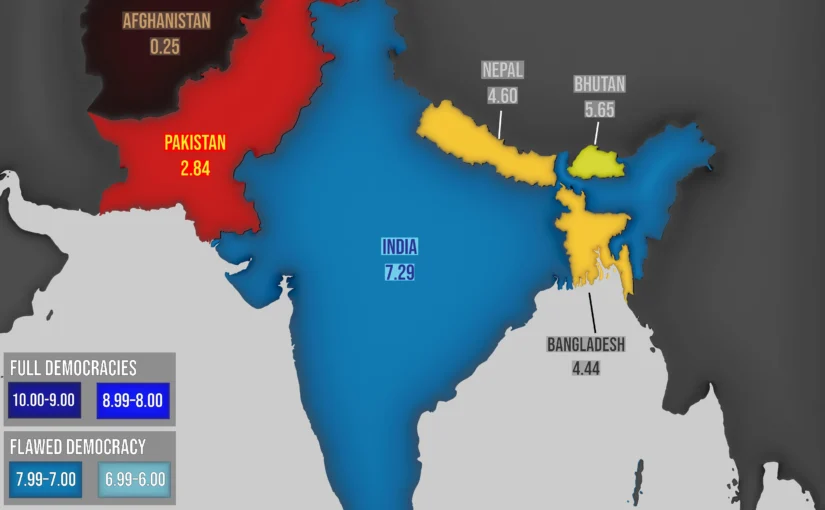
Then Delhi, in 1950, adopted universal adult suffrage at a stroke, with literacy under a fifth, and put 173 million names on the rolls for the first general election. There was no precedent for it in the indigenous record, which was procedurally rich and narrow, and none in the colonial record, which was procedurally borrowed and narrow. Universality was chosen against both inheritances at once.
Kabir claims India is an invented nation, and Pakistanis hear the same about theirs. All nations are invented. The test is which inventions take, and this one has been taking attendance every five years since 1952, through emergencies, assassinations and, this week, a minister conceded to a movement of first-time voters. An unnatural democrat who votes for seventy-five years is difficult to distinguish from the natural kind.
The lungi
I walk around the colony in a lungi and draw looks, because native dress has quietly stopped being patronised anywhere that thinks of itself as arrived. The suit survived 1947 without a scratch. So did the accent hierarchy, the school names, the holiday geography. The Constitution overrode the colonial precedent in one article and the culture kept every other one.
“The vanquished always want to imitate the victor in his distinctive characteristics, dress, and all his other conditions and customs”. Ibn Khaldun
India and Pakistan spent their first eight decades proving they could keep an inherited machine running and improve its most important part. The next test is whether anything else gets the treatment the franchise got, kept where it serves, overridden where it does not. The ballot was decolonised in 1950. However world-over the Western dinner jacket is apparently eternal (in the colony it is now the lungi that reads as exotic).
The India-Pakistan hyphenation is silly. Both have problems, one has common flu, the other has tuberculosis.
Parts of India that became Pakistan were colonized late. Muslim League being the collaborator’s party did not help. The seeds of Pakistan’s miseries today can be found in choices Jinnah made : communalism, autocracy, inflexibility, militias, aid, compromized sovereignty, double-talk …
Ancestors of majority of Pakistani muslim punjabis and sindhis were probably all haaris i.e. poor sharecroppers who themselves descended from pastoralists not that long ago. Most got some land late during canal colonization, and some stole it from their Hindu-Sikh landowning neighbors who they killed or drove away. This word, haaris, alone makes them uniquely amenable to feudal domination and limits their democratic urges.
Land reforms are a fundamental building block of functioning democracy in an agrarian society. In near future anti-trust, anti-monopoly regulations will hold the same importance.
The region outside of North Punjab was thinly populated and was trampled in the 18th century by foreign armies. Northern (Pakistani) Punjab people were able to reorganize under Khalsa Raj and became prosperous pretty late under the British via canal lands allotted for their mercenary services.
This is why you see nothing of note outside of Lahore-Sialkot, i.e. North Punjab. Havelis of no name private Hindu merchants shame what passes for palaces in the rest of Pakistan outside the core North Punjab region. Not a lot of grand mosques, or forts, that show long periods of prosperity except some monuments here and there which you can count on fingers: Shah Jahan Mosque in Thatta, the Suhrawardi mausoleum complex in Multan, that btw ‘happens’ to be suspiciously close to the demolished temple, the necropolis in Makli, and the mosque in Chiniot, thats about it unless you count somewhat minor sites like Seetpur.
Look at some truly great Pakistani painters ones who were scratching at the ground of reality: Sadequain, Jameel Nashk, Shakir Ali, Ahmed Parwaiz. All are mojahirs. When you see the cliched works of Pakistani, even core Northern Punjabi, artists: likes of Chugtai and Shazia Siakander, mind lets out a ‘meh!’. It is objectively not good enough : oriental, limited, craftsmen not world bending artists. This holds true in some degree in all fields of human pursuit. Mojahirs and Northern Punjabis do all the heavy lifting in Pakistan.
Also, primarily Pakistani army with deep roots in northern punjab suffers disproportional casualties in counter insurgency primarily because they are not shooting at their people out of kindness.
https://www.reddit.com/r/MapPorn/comments/1gh9ta9/land_revenue_of_provinces_under_the_mughal/
Comment went to spam. Fish it out.
You go through multiple examples of gana sanghas and then lastly Uttaramerur to settle on your almost predetermined line about ” The franchise was narrow everywhere in the record, always propertied, always learned, always male and upper caste.”. Were the Gana Sanghs also upper caste? Also you forget Panchayat and Gram Sabha.
It is almost like Pakistan liberals are retroactively trying to justify why their ancestors decided to throw away their dharmic inheritance.
To clarify what I meant about “natural democrats”:
Liberal democracy requires one to accept the premise “all men are created equal”. Of course, in the American context this statement didn’t include African-Americans, women or even men without property. But the idea was that the colonists were not subjects but citizens. This was the whole point of the Declaration of Independence.
The French Revolution produced the Declaration of the Rights of Man. The aristocracy was literally guillotined.
South Asians tend to be very feudal. We come from a culture in which having servants is very normal. These servants don’t eat at our table and live in “quarters” at the back of the house. Theoretically, they are our fellow citizens. In practice, no one likes servants who attempt to get above themselves. This is normal dialogue in every Pakistani upper-middle class household (and probably in Indian upper middle-class households too).
Our political parties operate according to this same model. If you question the Bhuttos, you get kicked out of the PPP. Question the Sharifs and you get kicked out of PML-N. The Indians here know that INC basically exists to serve the Gandhi dynasty. Even PTI is basically the cult of Imran Khan.
In the Hindu case, what makes this worse is caste. People who believe that Brahmins were created from God’s head and shudras created from God’s feet are not natural democrats. India has universal suffrage. Theoretically, a Brahmin and a shudra are fellow citizens. But does anyone actually believe this?