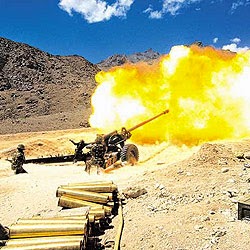
This topic comes up every once in a while on twitter, so I am reposting an old post with a few new links and videos added at the end.. The main point is simple: Musharraf and a few of his cronies (Javed Hasan, General Aziz, General Mahmood), without having thought it through, conducted a foolish operation in Kargil that cost hundreds of lives on both sides and set back (perhaps destroyed forever) the chances of peace between India and Pakistan (set in motion by Vajpayee’s historic bus journey to Lahore). The operation was not only a strategic disaster, it was a tactical disaster..
It is a popular staple in the Guardian (and elsewhere in the lefty press) that India cant afford to feed its children, yet boasts of a space (and other high budget) programs. It is tricky question that merits a multi-point response.
We are on-record being ambivalent about defense purchases (and the
fact that India is the largest arms purchaser in the world). India spends
way too much (to protect against Pakistan) and way too little (to
counter China). When push comes to shove, even miniscule Maldives
manages to shove India away. The military seems to have its most useful public face while helping out in natural disasters. Why not then have a self-defense force plus nuclear weapons to help secure the borders?
As
far as the space program is concerned the utility is without question. It is a profit making program and it gives us access to space in a way
even our friendly friends would not provide to us. The striving for self-sufficiency (a long time goal of people across the ideological spectrum) can be seen to be a fetish (and a
hang-over in response to our colonial past) but in this case it is fully warranted.
When
Pakistani troops took positions in Kargil in 1999, one of the first
things Indian military sought was GPS data for the region. The
space-based navigation system maintained by the US government would have
provided vital information, but the US denied it to India. A need for
an indigenous satellite navigation system was felt earlier, but the
Kargil experience made the nation realize its inevitability.
On
Friday, the Indian Space Research Organisation took the nation closer
to the goal, which it would achieve in less than two years. The result,
the Indian Regional Navigation Satellite System (IRNSS) will be as good
as any such space-based system, as India can keep a close watch of not
just its boundaries, but up to 1,500km beyond that. It works on a
combination of seven satellites which would ‘look’ at the region from
different angles, and, in the process, helps calculate from relative
data, real-time movement of objects by as less as 10m.
Isro
launched the first of the satellites in the group, IRNSS-1A, in July
last. “By mid-2015,” said Isro chairman K Radhakrishnan, “we will have
all the seven in place.” The system will be functional by the beginning
of 2016. Basic navigational services wouldn’t have to wait that
long—they can take off with just four satellites in orbit, which will be
this year. “When we have four satellites by the end of this year, we
will have an operational system and then we can go and test its accuracy
to validate it,” said K Radhakrishnan.
Three of the seven
satellites will be in geostationary orbits and the other four in
inclined geosynchronous orbits. From ground, the three geostationary
satellites will appear at a fixed point in the sky. However, the four
geosynchronous satellites moving in inclined orbits in pairs will appear
to move in the figure of ‘8’ when ‘seen’ from ground. Apart from
navigation, the system will help in precise time keeping, disaster
management, fleet management and mapping.
The first is called Standard
Positioning Service (SPS) which is for civilian use. This will have an
accuracy of 20m, while the second is called Restricted Services (RS),
which can detect movement of objects by less than 10m.
It will put India in the company of select nations which have their own
positioning systems. While the US operates the Global Positioning
System (GPS), Russia has its own GLONASS and European Union, Galileo.
China is also in the process of building Beidou Navigation Satellite
System (BDS).
This topic comes up every once in a while on twitter and I always regret having lost my old post about it when the old Brownpundits crashed and burned. So I just looked up a cached copy and am reposting it (with slight editing) so that it is available whenever another young Pakistani officer announces that we were robbed of a great victory in Kashmir by Nawaz Sharif (I am not kidding).
First, some links with details about the operations:
Back in 1999 I thought that Musharraf should have been dismissed and prosecuted for his role in the affair, but I also bought into the propaganda that the operation was a “great tactical success but a strategic blunder”. As time went on and more details came out, it became clear that the planning at the tactical level was as bad as the stupidities and mistaken assumptions that underlay the strategic vision of General Musharraf and inner coterie and in particular the commander of Force Command Northern Areas (FCNA), General Javed Hassan.
The men (primarily Northern Light Infantry (NLI) and Special Services Group (SSG) volunteers) who did the actual fighting from the Pakistani side performed with suicidal bravery, but once the Indian army learned from its early mistakes and brought all its resources to bear on the operation, these brave men were left to literally starve and bleed to death while Javed Hassan and his boss tried to bluster their way past their disastrous mistake. Musharraf’s coup protected the plotters from facing any consequences within Pakistan and a systematic disinformation campaign was used to crease (not just in Pakistan but also in some casual observers and Anatol Leiven level analysts abroad) an impression of tactical brilliance. The above reports provide a good corrective and one hopes that the day may still come when Musharraf and Javed Hassan will face the music for their role in this terrible disaster…a disaster that led to hundreds of needless deaths on both sides in an operation that civilian prime minister Benazir was able to see as “crazy” at first glance. Unfortunately, Nawaz Sharif was not that sharp…
Given how long it takes most armies to learn from their mistakes during the course of a battle, the Indian commanders on the spot deserve some credit for belying stereotypes and actually thinking and adapting while the battle was on. The British Indian army was a fine fighting force, but not one known for innovation and flexible thinking. Either India got lucky in a few officers on the spot (e.g. artillery commander Brigadier Lakhwinder Singh and GOC 8 mountain div General Puri http://www.indiandefencereview.com/news/kargil-a-ringside-view/0/) or it really does have a better culture of officership than its mother army did.
Anyway, take a moment to read the above reports and links for details, but the main point is that it was not even a “tactical success”. It was poorly planned and once the Indian army found its feet, leaving those men out on the peaks to die was hardly a sign of brilliant tactical execution. The basic TACTICAL assumptions that proved wrong were:
1. The heights, once occupied, could be held by small groups for at least the entire summer.
2. Those men could be resupplied under fire for several months with food, water and ammunition, using mountain trails and helicopters.
3. The Indian army was incapable of attacking from any direction except straight up the front slopes, where they would be cut down like grass.
4. And behind it all, the firm conviction that while “our boys” will exhibit the required suicidal bravery, the other side will not.
All these assumptions proved wrong. After some early charges that failed with heavy casualties (but also showed that Indian troops were perfectly capable of suicidal bravery of their own) the Indian army figured out how to use its artillery to great effect and went up near vertical slopes at night under cover of accurate artillery fire and recaptured crucial heights. They also managed to interdict most of the resupply effort, leaving many freezing Pakistani troops exposed on the heights without food or water. There is no evidence that either Javed Hassan or Musharraf made any real effort to come up with new solutions once their original assumptions proved wrong. Musharraf seems to have focused mostly on making sure the blame could be pinned on Nawaz Sharif, and that some sort of domestic (or intra-army) propaganda victory could be salvaged from the disaster.
The status quo is indeed in India’s favor by now. The critical period for India was the early nineties. Once they got past that, they were never going to be kicked out of Kashmir by force; and by using outside Jihadis and then the regular army and failing to dislodge them, Pakistan has already played all its cards. Another attempt could set the whole subcontinent aflame, but is not likely to change that outcome.
The fact that Kashmiri Muslims (or at least, Kashmiri Muslims in the Kashmir valley proper) remain thoroughly disaffected with India provides some people with the hope that human rights and democracy campaigners can win where brute force did not. But this too seems unlikely. The same Kashmiri Muslims are almost as disaffected with Pakistan as they are with India, so that the main demand seems now to be independence. But the demographics, geography, history and international situation of Kashmir all make any smooth passage to independence inconceivable. Inconceivable in the literal sense of the world; what I mean is, try to conceive or imagine in concrete detail what this independence would look like and the steps via which it would be achieved. Enuff said.
He did back away a bit after other army officers accused him of washing the army’s dirty linen in public, but the damage was done.
By now, the cat is well out of the bag though. Here is Brigadier Javed Hussain from the Pakistan army making exactly the same points..
And now we have General Asad Durrani, former ISI chief (and the SOB who said on BBC TV that the thousands of Pakistani civilians, including school children, killed by the Taliban and other Jihadists are “collateral damage” and we have to accept this damage in the larger national interest, which he believes has been well served by our Jihadist policies) writing a book with a former RAW chief and saying most of the same things..
Gen Durrani on MNS knowledge of Kargil
For many other interesting links and videos, see this excellent collection from researcher Aamir Mughal.
btw, there ARE jokers on the other side. We are, after all, one people: