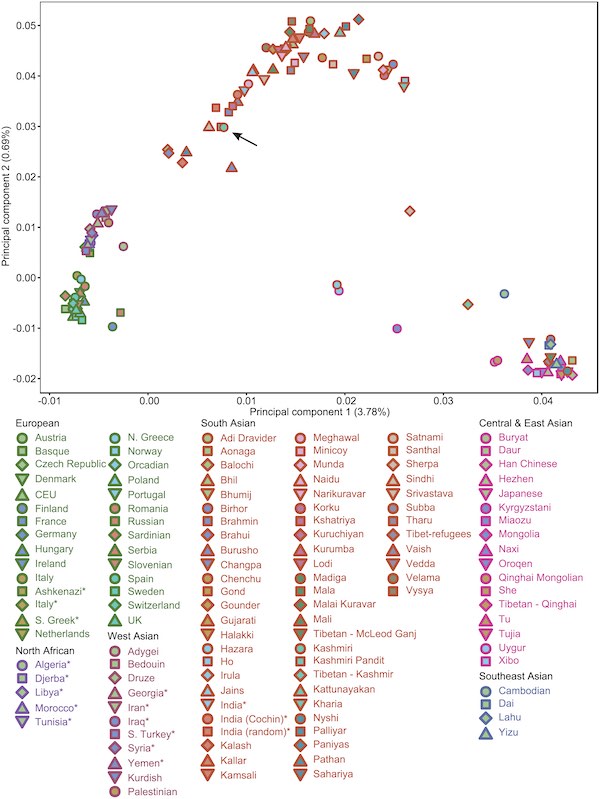
Kashmiris are just generic North Indians, and there is no difference between Pandits and Muslim Kashmiris


Since people ask me this I have to post this now and then. We have genetic data. So in short order

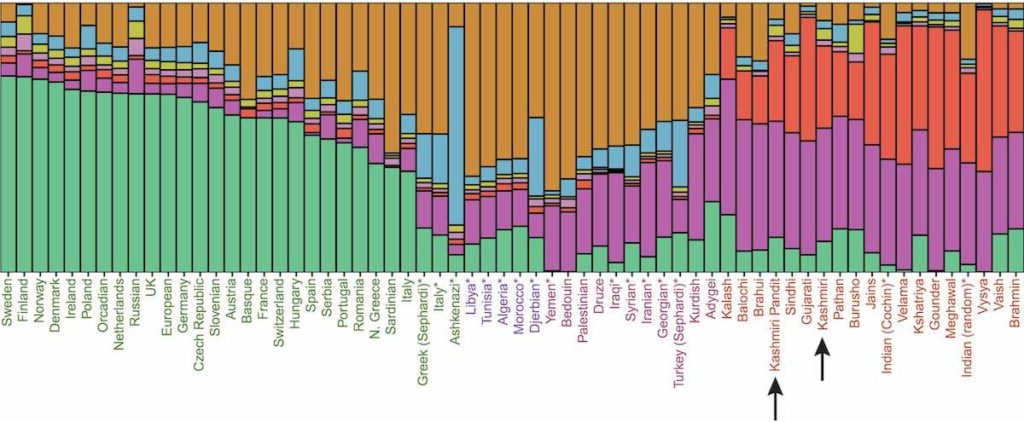
1) Kashmiris are like other people in the Northwest of India. They are not enriched in steppe ancestry, at least compared to many Punjabis or Brahmins from the Gangetic plain

2) There is no genetic difference I can see between Pandits and Kashmiri Muslims, indicating to me that one distinctive aspect of the Vale of Kashmir in comparison to the rest of the Indian subcontinent is that it does not exhibit the jati-varna structure common across the subcontinent

3) Some researchers and genetic genealogists have found some Tibetan admixture at low levels among Kashmiri Muslims and Pandits

4) It is probably correct that elite Muslims have low levels of Central Asian and Iranian ancestry, though that’s harder to detect than Tibetan background

Some notes on the accession of Junagadh vs. Kashmir

Whenever there is a debate on Kashmir, there is often a parallel drawn, particularly in Pakistan, between the accession of Junagadh to India, and the accession of Kashmir (also to India).

The narrative in Pakistan typically goes –

In the case of Kashmir, a predominantly Muslim state acceded to India, as its Maharaja was Hindu. While in Junagadh, India insisted on a plebiscite and eventual accession to India though its Muslim ruler had acceded to Pakistan. 

While this criticism may seem superficially sound, it is very specious and misleading as it ignores how different the case of Junagadh was from that of Kashmir. It is worthwhile to reflect on the circumstances surrounding the accession of the two states.

A few things –

1. Junagadh was not contiguous at all with Pakistan. In contrast J&K in its entirety was contiguous with India.  The Nawab’s accession to Pakistan was in violation of the contiguity principle. Here’s a map locating Junagadh in Southern Gujarat.

On the other hand, all of Jammu and Kashmir in its entirety was and is contiguous to the rest of India. So the “contiguity principle” was very much adhered to in the Maharaja’s accession to India
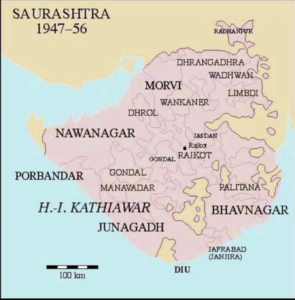
 

Image Source : wiki

2. Junagadh, with its population of 700K, was ~85% Hindu. The Nawab’s decision to accede to Pakistan was clearly in violation of the wishes of his subjects. In the plebiscite that succeeded the Nawab’s Pakistan accession, well over 95% of the voters chose to accede to India

In contrast, J&K was about 75% Muslim. Also unlike in Junagadh, where Hindus dominated the whole state, in J&K, the Muslim predominance was mainly in the Kashmir valley, while the Hindus were numerous in Jammu and Buddhists in Ladakh.

3. Junagadh’s Hindu population revolted strongly and vocally against the Muslim Nawab’s decision to accede to India. Close to 100K Hindus fled the state in the fall of 1947 as per VP Menon, leading to a near collapse of Kathiawar economy.

The plebiscite in Feb 1948 was prompted by this revolt against the Nawab’s decision. Which ofcourse settled the matter in favor of India. In contrast, in J&K, there was no major clamor among the Muslim population in favor of Pakistan. The major Muslim political body National Conference supported the Maharaja’s decision to accede to India notwithstanding its differences with the Hindu princely ruler. So it was a situation fundamentally different from that of Junagadh.

4. The Nawab of Junagadh unilaterally and hastily decided to join Pakistan, under the influence of his Dewan – Shahnawaz Bhutto (father of Pak PM Zulfikar Ali Bhutto) without even the common decency of letting the Indian govt know of the decision through proper channels.

In fact, Sardar Patel and VP Menon learnt about the decision through the media in late Aug 1947, and later got it confirmed by the Nawab. The Nawab had gone back on the word of his earlier Dewan Abdul Kadir, who had assured Gujarati press as late as April 1947, that the state won’t join Pakistan.

In sharp contrast to the indecent haste and reneging of promise by the Nawab, the Maharaja of Kashmir, Hari Singh, was deeply conscious of the fact that 70% of his subjects were Muslim. He did not accede to India in a hurry.
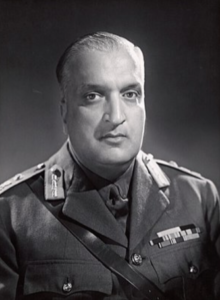
The accession happened only as late as 26 October 1947, following the invasion of Kashmir by “irregulars” and tribal militias sent from Pakistan. So Hari Singh’s sensitivity and judiciousness was tested to the limits and his hand was forced by Pakistan’s aggression.

5.  Next, let’s examine the attitude of India and Pakistan in either case – radically different approaches.

In Junagadh, Muslim league politicians tried to “force” the hand of the Nawab through Shahnawaz, though the Nawab ruled over a Hindu province with no borders with mainland Pakistan.

While in the case of Kashmir, Sardar Patel and VP Menon assured Hari Singh throughout 1947 that they would be okay if he chose to accede to Pakistan. So the Indian attitude was a cool-headed dispassionate one that acknowledged whatever decision Hari Singh would take.

Pakistan in contrast tried to force the issue militarily in Kashmir, not just using its Army and its “irregular” agents, but by cutting off supplies and transport to Jammu from Pakistan, in an attempt to intimidate the Maharaja into acceding to Pakistan.

So these are five major ways in which the case of Junagadh differed from that of Kashmir. Clearly there is no parallel.

There is no ideological contradiction in the way India handled both cases. The Indian reaction was pragmatic and philosophically consistent.

References for the thread :

  1. TCA Raghavan, The People Next Door: The Curious History of India’s Relations with Pakistan
  2.  On Kashmir Demographic history –http://cpsindia.org/dl/Blogs/Blog%2015%20J&K.pdf

Post-script : 

In the first draft of this piece, it was mentioned that Hindus were predominant in Jammu in 1947. I have corrected this to “Hindus were numerous in Jammu”, though maybe not in a majority. The census numbers of 1941 are unreliable on account of WW2, and also the Jammu specific numbers may have been impacted in the course of 1947 on account of both the riots against Muslims in Oct 1947 and against Hindus / Sikhs in Mirpur / Rajouri the following month.

Also the % share of Muslims in the state of J&K has been edited from ~70% to ~75%, as the latter number is a fairer estimate based on 1931 census, while the former number stems from the 1961 census

Run up to the Kashmir War of 1947-48, Pakistani POV

From Major Amin.

  • There was duplicity on Pakistan side in not agreeing to simple formula proposed by Lord Mountbatten that Muslim majority states join Pakistan and non-Muslim majority states join India-Thus Pakistan was unrealistically hoping to get Hyderabad Deccan , Jodhpur ,Bikaner and Junagadh–
  • Thus technically and legally Maharaja of Kashmir’s joining India was legitimate
  • Nehru’s agreement to plebiscite in Kashmir was the most stupid blunder of the whole
  • Ideally Kashmir should be demilitarized and made independent after a plebiscite but this is not acceptable to Pakistan, India or China.

Also for general interest an extract from my book HISTORY OF PAKISTAN ARMY VOLUME ONE

History is made by those who seize fleeting opportunities in the critical time span in any particular situation and relentlessly execute their plans without second thoughts, subduing inner fears, overcoming procrastination and vacillation, and above all by those who are propelled by the burning desire to defeat the enemy rather than any halfhearted judiciousness and timidity. Ninety years of loyalism and too much of constitutionalism had however made the Muslims of 1947 slow in taking the initiative and too much obsessed with consequences of every situation. This attitude was excellent as long as the British were the rulers, but not for a crisis situation, in which geography, time and space, alignment of communications and weather temporarily favored Pakistan, in case initiative and boldness was exercised and simple but audacious plans were executed in the shortest possible time! Today, it is fashionable to blame the Indians, Mountbatten, Gracey etc. as far as the 1947-48 War is concerned. A dispassionate study of the events of 1947-48 clearly proves that victory was closer in 1947 than ever again as far as the Pakistan Army was concerned. Opportunities were lost because very few people who mattered at any level apart from Mr. Jinnah, Brigadier Akbar Khan and some others were really interested in doing anything! Continue reading Run up to the Kashmir War of 1947-48, Pakistani POV

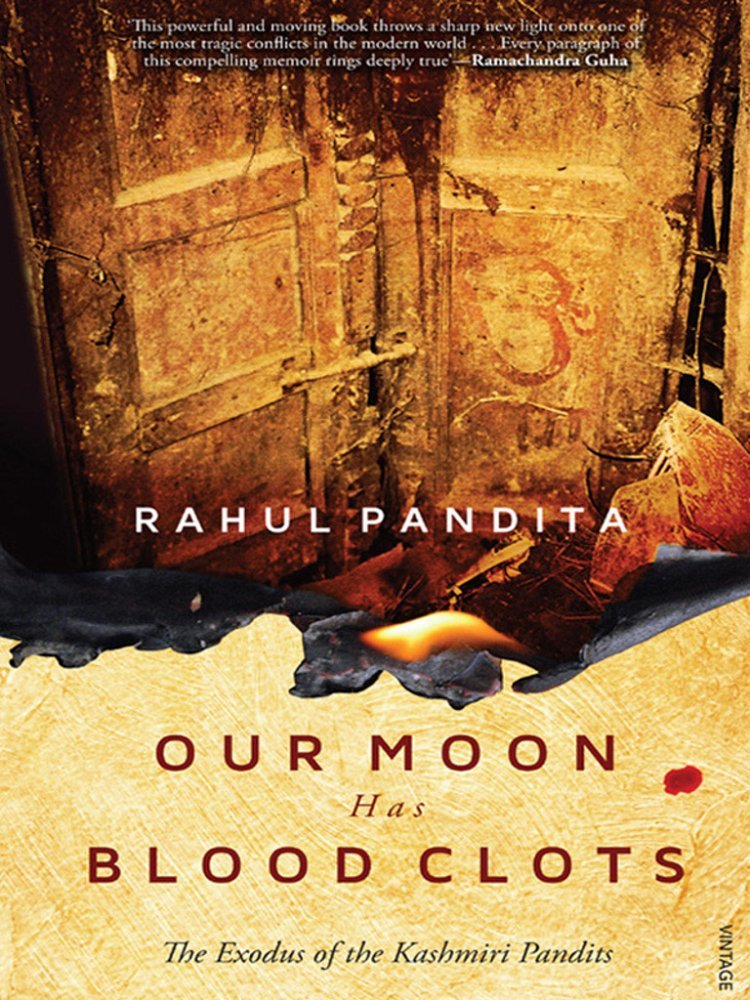
Book Review: Our moon has blood clots

Our moon has blood clots is a gripping biographical tale by journalist Rahul Pandita – which recounts the horrors faced post-1986 Kashmir by the Kashmiri Pandit community at hands of Pakistan aided Islamists. The subtle changes in some Kashmiri attitudes towards the Pandits since the 1980s are brilliantly conveyed through small incidences from the author’s childhood. The book tells the other side of the Kashmir story which has rarely received attention in the global political and even local social circles. The terror emanating nightly from the local mosques jumps out of the pages very effectively. All the killings are from 1989 onwards are told separately and serially which is very impactful in recreating the reign of terror- the pandits must have felt in their ancestral homeland. The Islamist nature of killings is also highlighted (how some pandits were killed with nails hammered to their foreheads). The book also highlights how the silent observers of the valley, who may have not approved the brutalization of Pandits, rarely put up a fight supporting their neighbors. The continuing tragedy of the Pandits at the hands of Jammu residents and negligent central and state government is also narrated from personal and observed experience. The ethnic cleansing of Kashmir in 1947 at hands of Pakistan supported tribesman is also connected to the book narrative through another POV.
The passage where the author narrated his personal journey back to his house leaves the reader in a sad and dazed state. The author’s Hindu culture and heritage are always present in the backstory and hence the pain at the potential loss of Kashmiri pandit culture in the refugees creates a particularly poignant moment in the book. The author’s sufferings, however, aren’t translated into bigotry against Muslims (Kashmiri or non-Kashmiri). The reference to Gujarat 2002 riots (author’s father’s recollections at the lynching of Ehsan Jafri) in the juxtaposition of Pandit anger at suffering is handled with consideration of human rights as the author explained once on television debate. (I have lost my home, not my humanity).

There are few things in the book which could have been handled slightly differently for a better effect IMO. The narrative structure of the book is not perfectly linear – which could’ve been handled differently – but that’s a personal preference and many might view it differently than me. The 1947 story could also be helped a bit by putting it into the larger Partition story of 1947, even though this occurred 2 months after the worst slaughter of 1947. However, these criticisms don’t blunt the impact this book will make on any reader. The book not only makes you feel the pain of the Pandits but also makes you want to work towards preserving the Kashmiri Pandit culture and heritage (especially in the valley). There really is no solution to the Kashmir valley question problem till the Pandits return to their ancestral homeland from where they were brutally driven out.

Post Script: 

The only personal connection I have had to the Pandits is because of the Kashmiri Pandit Quota present in Maharashtra Education enacted by the Shivsena BJP government of 1995 on Balasaheb Thackeray’s insistence. Slapstik or anyone else with Kashmiri connections – Could you please add your comments on Pandita’s telling of the story – both in Book and other media. For me, he serves as a Northstar to navigate polarized debates on twitter and social media in general – for example, his coverage of Delhi Riots & 2019 election. 

Kashmiri Brahmins are just like other Kashmiris

I think I’ve posted this before, but it was a while ago before we had so many readers. In this paper they took 15 random Kashmiris from the Valley, and compared them to various populations. The plot below, as well as admixture analysis in the paper, shows no daylight between the Pandit samples and generic Muslim Kashmiris.

This is not to say Pandits are not an endogamous community and were not before the Islamicization of Kashmir. But, it is to say that in their overall genome their origins are exactly the same as other Kashmiris. This is in contrast to many parts of India in regards to Brahmins, though the “stylized fact” seems to be the further north and west you go, the smaller the genome-wide difference between Brahmins and non-Brahmins will be. This seems to comport with the idea that Brahmins are intrusive to the south and east in a way they are not to the north and west.

Finally, the data from ancient DNA is strongly suggestive of “AASI-reflux” across north and west South Asia after 3000 BC. See my post The Aryan Integration Theory (AIT).

The Role of the Ahmediyya Movement in Kashmir

From Dr Hamid Hussain

20 December 2019

I wrote a piece about recent changes in Kashmir.  While working on the background, I stumbled on an interesting chapter of Kashmir & Pakistan history that I have never seen in any mainstream publication.  I decided to dig a more deeper to understand it better.  Following is the outcome of that exercise.  I thought it was important for those interested in the history of the region.  Enjoy.

Regards,

Hamid

Ahmadis and Kashmir

Hamid Hussain

“Independence of Kashmir can only be achieved by Kashmiris.  Outsiders can only help in two ways; with financial support and by advocating their cause.  Kashmiris should forget that outsiders will fight their war.  Such outside help will not be useful; in fact, it will have opposite effect on the struggle for independence. If control of the struggle is in the hands of outsiders, it is possible that they will sell Kashmiris for their own interests.  It is in the interest of Kashmiris that they should get advice as well as financial help from outsiders but never ask them to come and fight their war in Kashmir.  In this case they will lose control.  Long term sacrifice and not temporary emotional outburst will serve their cause and long term sacrifice can only be done by Kashmiris”.  Head of Jama’at Ahmadiyya, Mirza Bashir Uddin Mahmud, 27 September 1931

Jama’at Ahmadiyya is a sect founded by Mirza Ghulam Ahmad (1835-1908).  In early twentieth century, it was a small community with disciples mainly from Punjab; the birthplace of the founder.  There was much hostility against the group in view of doctrinal differences especially when Mirza claimed to be Messiah and prophet.  Agitation of orthodox clerics over decades finally culminated in an unprecedented act where Pakistan’s parliament declared the sect non-Muslim in 1974.  This started a wave of persecution forcing many Ahmadis to leave the country and find refuge all over the world.  General hostility including outright abuse against the group is at such an abnormal state that it is impossible to have any kind of meaningful discourse about the role of Ahmadis in Kashmir as well as independence movement of Pakistan.  This part of the history disappeared from almost all historical works in Pakistan.

Kashmir was a Muslim majority princely state ruled by a Hindu Dogra ruler.  Kashmiri Muslims were economically poor and politically powerless. Muslims of neighboring Punjab, many with Kashmiri heritage were concerned about the plight of Kashmiri Muslims.  In 1911, they established All India Kashmiri Muslim Conference (AIKMC) in Lahore.  This organization remained only on paper with no connection with Kashmiri Muslims and no program.  In the summer of 1931, simmering discontent in Kashmir resulted in riots.  On 25 July 1931, leading Muslims mainly from Punjab gathered at Simla and established All India Kashmir Committee (AIKC).  The list of attendees of this meeting included literary and intellectual powerhouse Sir Muhammad Iqbal, head of Ahmadiyya community Mirza Bashir Uddin Mahmud Ahmad, leading Punjabi politician Sir Mian Fazal Hussain, Nawab of Maler Kotla Sir Muhammad Zulfiqar Ali Khan, Nawab of Kanj Pura Ibrahim Ali Khan, leading cleric of Delhi’s Barelvi community Khawaja Hassan Nizami and a former teacher of the leading orthodox Sunni seminary Darul-Uloom Deoband Maulvi Mirak Shah.  Fazal Hussain wanted Iqbal to head the organization but on recommendation of Iqbal, Mirza Mahmud was unanimously chosen as president of AIKC.  Muslims of different walks of life were members of AIKC including politicians affiliated with different parties, lawyers, educationalists, landed aristocracy, clerics from different schools of thoughts, journalists and businessmen.  At no other time, such a consensus developed among diverse Muslim population of India. Continue reading The Role of the Ahmediyya Movement in Kashmir

The Shias of Kashmir

From our regular contributor, Dr Hamid Hussain. 

In my last piece about Kashmir, I briefly mentioned Shia factor in Kashmir in current context and Ahmadi factor in historical context.  Many otherwise well informed individuals admitted that they had little idea about these.  Others with more direct interaction with Kashmir issue asked questions and this is in response to these exchanges.  Enjoy if you are bored of black and white narratives on the subject and interested in ‘fifty shades of grey’.

Hamid

Shia of Kashmir

Hamid Hussain

Shia of Kashmir has a unique history.  There were two groups of Shias who migrated to Kashmir from present day Iran and Iraq in fifteenth and sixteenth centuries.  One group escaped persecution and other were missionaries.  Some artisan classes also joined these groups.   Local conversion due to efforts of missionaries increased Shia numbers.  In Gilgit-Baltistan area with geographic links to Badakhshan province of Afghanistan and Tajikistan, Ismaili missionaries were successful in small pockets while mainstream Ath’na Asha’ari (followers of twelve Imams) missionaries were successful in areas that are now part of Indian Controlled Kashmir (ICK).  Separation of Gilgit-Baltistan from Pakistan Controlled Kashmir (PCK) which is ethnically and linguistically different from Kashmiris left no significant Shia population in PCK.

In ICK, there are about one million Shia out of a total Muslim population of 8.5 million.  Shia are geographically and politically separated in ICK.  Sparsely populated Ladakh which is now separated from Jammu & Kashmir (J&K) as Union territory has equal numbers of Buddhists and Muslims.  In Kargil area, ninety percent of Muslim population is Shia numbering about 125’000.  There are small numbers of Sunnis in Drass area.  Remainder Shia population is concentrated in the Valley. Continue reading The Shias of Kashmir

Article 370 Revocation Through the Eyes of an Indian-American Immigrant – Part II

In the first part of this article Article 370 Revocation Through the Eyes of an Indian-American Immigrant – Part I I provided a historical, geographic and demographic context to the Kashmir conflict. In this part I provide contemporary political context and speculate on what the future might hold for J&K.

I was a teenager in North-Central India (Uttar Pradesh) when the Kashmir Valley exploded into the national consciousness as a full-blown armed insurgency and secessionist movement in 1989-90. India at that time had state-controlled TV media and most adverse news out of J&K was suppressed. However, we had all heard about Islamic terror groups targeting Hindus. Many of these Hindus trickled into refugee camps in and around New Delhi which was a city I often visited to see relatives, so people had begun to be familiar with the scale of the violence against Hindus despite the attempts of state-controlled media to conceal it.

India’s Rationale for Preventing Kashmir’s Secession

In general, the attitude of most Indians since the late 1980s and early 1990s when the conflict became radicalized has been to hold on to the Kashmir Valley by any means necessary. There is a simple rationale for that position. Around 20% of the population of India is not Hindu (with religious minorities being broken up roughly in 70%/10%/10%/10% proportions of Muslim/Christian/Sikh/Other) and there are close to 200 million Muslims in India in a country of 1,400 million people. Indians have always been proud of having a secular Constitution and State, uniquely so in South Asia. India is the most ethnically and religiously diverse nation in the world bar none. Each and every resident of J&K has always been a full-fledged citizen of India. So, it is a hard pill for any Indian to swallow that 7 million Muslims in the Kashmir Valley feel that they cannot be equal citizens of India and must secede to Pakistan. It would raise questions about the unity of India and its tradition of religious and ethnic diversity. It would also put a question mark against the nearly 200 million Muslims in the rest of India. Consequently, almost all Indians feel an emotional and visceral reaction against allowing even just the overwhelmingly Muslim majority Kashmir Valley region of J&K to secede. India has Muslims in positions of power and influence in every field, ranging from Government to Sports and Entertainment. Some of the biggest Indian movie stars are Muslim minorities. Every Muslim of J&K had more than equal citizenship in secular India. There was simply no reason for a secession movement other than religious fascism.

Most Indians are united on Kashmir policy, regardless of political affiliation. Even If Modi lost the next election in 2024 and even if a Communist government was in power, there is very little chance that their actual policy on J&K would differ very much other than in public rhetoric. That is because a religion-based secession would be disastrous to India’s identity. Continue reading Article 370 Revocation Through the Eyes of an Indian-American Immigrant – Part II

Article 370 Revocation Through the Eyes of an Indian-American Immigrant – Part I

On August 5, 2019 the Modi-led BJP government in India surprised most political observers by announcing its decision to revoke Article 370, a section of the Indian Constitution that had granted a special status to the state of Jammu & Kashmir (J&K) which allowed it significant autonomy from the federal government in India. This bold move sought to put an end to a lingering uncertainty and stalemate over the status of Indian-held J&K for nearly 72 years. Certain basic facts about the origins of this conflict are poorly understood by Western journalists and I dare say many Indians and Pakistanis themselves and bear repeating.

Laying My Cards On the Table

As an Indian-American who has now been living in the US for 25 years, I have gone through a cycle familiar to many a first-generation immigrant. I spent the first few years in America reacting to feelings of cultural disorientation in my new home by seeking to consciously renew my Indian identity and intensifying the emotional connection with the idealized homeland. Then in the middle act there was  a period of beginning to feel more and more at ease in America, being able to view events in India with a greater sense of objectivity and less defensiveness, and then finally in the third and final act, a legal and emotional break with India by applying for US citizenship, an act which culminates in surrender of one’s Indian passport and renunciation of Indian citizenship.

During the first act of the three Act play above, it was a period marked by hyper-sensitivity to US and Western media coverage of India. I found the coverage offensive and lacking in any nuance. Overwhelmingly the coverage was critical and unflattering and coming across such examples was guaranteed to quicken the pulse, set the temple throbbing and unleash feelings of anger and rage. As one entered the second act, these symptoms declined in their intensity and usually I would decide to skim or even ignore reporting on India, which would inevitably be lacking in insight and empathy. Now well into the third and final act of the cycle above, it saddens me that the reporting on India continues to be low quality and lacking in insight and rigor. A quarter century later, nothing has really changed, even as India is undoubtedly transformed as a nation in the 25 years since I left the Matrabhumi (motherland).

When discussing controversial topics, I believe an author must be honest about their intellectual beliefs, predispositions and biases. I intentionally used the evocative term “Matrabhumi” to indicate that although I now see myself as an American first, and am legally not an Indian citizen anymore, the country of my birth continues to have an emotional resonance for me. As I have lived in America, I have come to appreciate how unique India is. There is simply no country that can compare when it comes to the extraordinary ethnic, religious and linguistic diversity of India. The only comparable global peer is America. Both of these countries serve as an example to the world and indeed an inspiration of how to weave a national identity out of more than the raw soil of tangible markers such as ethnicity, but from the intangibles of shared values, feelings and aspirations.  I was born a Hindu and see myself as a Hindu today despite my complete lack of religious observance of any kind, and in fact my agnosticism. All of the above is to say in a somewhat long-winded fashion that I come to my views on the Kashmir conflict with a certain backdrop and world view, and readers are free to discount my views on that basis if they so wish. Continue reading Article 370 Revocation Through the Eyes of an Indian-American Immigrant – Part I

Kashmir, Analysis by Dr Hamid Husain

From our regular contributor and well respected Military historian Dr Hamid Husain

Following was outcome of exchanges with some informed individuals from both sides of the border about Kashmir.  I was educated & enlightened. It is just a glimpse on my part about possible scenarios.  It is first of a two part; second part deals with the legal aspect of the issue as Constitution bench of Indian Supreme Court has taken up the case.

“Borders are scratched across the hearts of men

By strangers with a calm, judicial pen

 And when the borders bleed we watch with dread

The lines of ink along the map turn red”

                                                               Marya Mannes

Regards,

Hamid

Paradise Lost – Kashmir at Crossroads

Hamid Hussain

“Any intelligent fool can make things bigger, more complex and more violent; but it takes a touch of genius and lots of courage to move something in the opposite direction.”    Albert Einstein

On 05 August 2019, newly elected government of India announced change in Kashmir status. President issued an order under Article 370 superseding a previous Presidential Order of 1954 thus removing restrictions on application of Constitution of India in the state of Jammu & Kashmir (J&K).  This also removed Article 35 A that gave special status to residents of J&K. In addition, J&K was divided into two Union territories with separation of Ladakh.

Currently, three countries control parts of the territory that was once princely state of Kashmir during the Raj.  Indian Controlled Kashmir (ICK) is fifty five percent of the territory, Pakistan Controlled Kashmir (PCK) is thirty five percent and Chinese Controlled Kashmir (CCK) is fifteen percent. There is no conflict at Indian-Chinese border in Kashmir called Line of Actual Control (LAC) and there has been no border incident in the last fifty years.  I recall the only incident of military history several years ago when tempers escalated at that border, the soldiers simply threw stones at each other. The story of Line of Control (LOC) between India and Pakistan is totally different.

Kashmir is more of an ideological element between two countries.  Both sides have a psychological entanglement where the raison d’etre of both countries is linked with it.  India views continued control of Kashmir as vindication of its stand that Hindus and Muslims are not two separate nations and that is why a Muslim majority state is part of Indian union.  Pakistan contests this narrative and see India’s control of Kashmir as challenging the very idea of Pakistan based on ‘two nation theory’.  Both sides are intelligent enough to recognize the old dictum that ‘possession is the nine-tenth of the law’. Rhetoric aside, in real politic, both countries are fully aware that LOC is now a de facto border, and no one can force a military solution of the problem.  When there is an interlude of peace between two countries, public opinion is in favor of compromise.  However, with every crisis, jingoism runs supreme on both sides of the border.

India

‘Nationhood is rooted in rites of violence we all prefer to forget’.  Quoted in Karl Meyer & Shareen B. Brysac’s King Makers

India’s recent efforts to remove special status of Kashmir is to fully integrate the state in Indian union with the hope that this will end separatism in ICK.  Unique circumstances of Kashmir at the time of partition in 1947 necessitated a compromise.  Article 270 of Indian constitution gave Kashmir a special status where Indian constitution was exempted from the state in governance of the state.  In the last seventy years, 94 of the 97 entries of the Union List and 260 of the 395 articles of the constitution were extended to Kashmir.  Ironically, it was all done through Article 370 as this was the only ‘tunnel’ through which center could act in Kashmir.  The result is that in practical terms Article 370 had ceased to provide any special concessions to Kashmiris.  More important is Article 35 A that was inserted by a Presidential Order in 1954 as a compromise between Indian Prime Minister Jawaharlal Nehru and Kashmiri leader Shaikh Abdullah.  This clause gave the authority to state government to define ‘permanent resident of the state’.  A Dogra rule era law of 1927 that prohibited acquisition of land in Kashmir by an outsider was incorporated in Constitution of J& K in 1956 that closed the door for acquisition of land by outsiders. Now only a permanent resident of the state was eligible for land acquisition, government jobs and scholarship in state educational institutions. Article 370 was a psychological and 35 A practical anchor of special status of Kashmir. Continue reading Kashmir, Analysis by Dr Hamid Husain

Brown Pundits