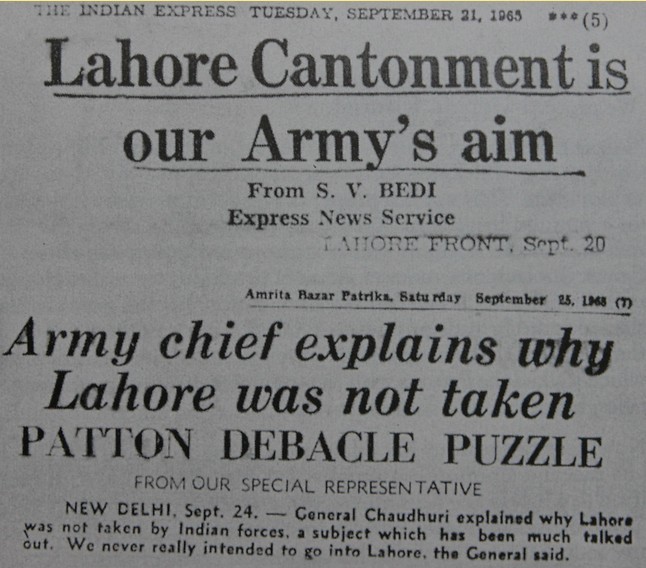
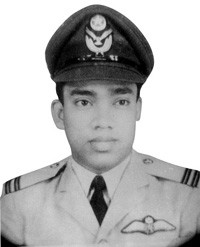
Major Amin is a Pakistani military historian who has written extensively about the Pakistan army (and other military history topics). Since both India and Pakistan have decided to try and outdo each other in claiming that the war was an emphatic victory for their side, I have copied and pasted one of his old articles that gives a more objective view of the war. A war whose memory should be an embarrassment for the higher officials and leaders of both countries, though lower level officers and men can still take pride in smaller-scale stories of courage, initiative and achievement.
Pakistan started hostilities in late July and early August with operation Gibraltar and then raised the ante with Operation Grand Slam in late August. But both operations were confined to Kashmir and for some unfathomable reason the geniuses running Pakistan at that time seriously did not expect India to respond at any point outside of Kashmir. But India did exactly that on 6th September by crossing the international border in Lahore and Sialkot (primarily to relieve pressure on Kashmir, though later claims that they never intended to actually capture Lahore are probably bunk. They at least intended to try). Caught off guard (the details are quite amazing) Pakistan was still able to stop those thrusts short of both major cities. Pakistan officially dates the war to the attack on Lahore and paints India as the “unprovoked aggressor”, which is of course, also bunk. They were sorely provoked.

Anyway, that date has since been celebrated as defense of Pakistan day. Claims of resounding victory are exaggerated with each passing year and by now the mythmaking has reached ridiculous proportions. That Pakistan failed to achieve its objectives in Kashmir (where we started hostilities with operation Gibraltar and far from liberating Kashmir, got into trouble in our own part of Kashmir; then attacked with Grand Slam and also got stopped short of the main objective Akhnur), then barely held off the Indian counter-offensive in Lahore and Sialkot in spite of a distinct edge in weapons and training (and near-parity in numbers in Northern Punjab) makes claims of a great victory somewhat hollow. (Pakistan’s weapons, organization and and training were distinctly superior because we had joined the American anti-communist front in 1954 and received an impressive and systematically implemented aid package as a result; this superiority was especially marked in tanks and artillery. Near parity in numbers was possible in Northern Punjab thanks to concentration of forces).
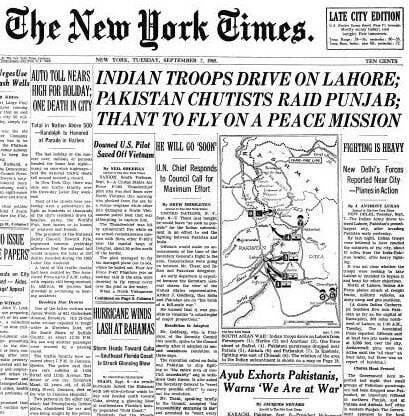
But while Pakistan failed in its objective, so did India once they had been provoked into full scale war. The Indian army failed to take Lahore in spite of achieving “near surprise”. Then their major armored offensive was blunted and stopped in Chawinda, and they almost suffered disaster in the battle of Assal Uttar (see below). Finally, they also failed to convert superior staying power and deeper reserves into decisive victory by agreeing to a ceasefire when Pakistan had only a few days of supplies left. So they can celebrate having survived whatever their smaller neighbor managed to try, but to describe it as a great victory is a bit much.

The attack by Pakistan’s 1st armored division in the battle of Assal Uttar deserves special mention. It was Pakistan’s most ambitious attempt to change the outcome of the war and indeed for a day or two a fourth battle of Panipat seemed within our grasp. The weak-kneed Indian commander in chief (General Choudhry) is on record as having panicked and suggested giving up most of East Punjab and withdrawing East of the Beas river! That would have been an absolutely stunning Pakistani victory even if it went no further than that. But GOC Western command General Harbaksh Singh held his nerve and tenacious defense by Indian troops, a successful tank ambush at Assal Uttar and an absolutely disastrous command performance from the superior Pakistani armored forces saved India.
India’s major opportunity came in the Sialkot sector and there it was the Indian commanders who proved over-cautious and made multiple blunders and missed several opportunities, while tenacious defense by the Pakistanis, a heroic action by one tank regiment (25 cavalry), and superior artillery and air force support saved the day. Details below.
Still by day 17 of the war Pakistan was running out of supplies and it is very likely that if India had kept going, they could have won a decisive victory . Luckily for Pakistan, the “great powers” did not want any change in the status quo in South Asia and were putting pressure for a cease-fire. Indian PM Shastri (a civilian, but one who seems to have had more resolution than his army chief) may have been willing to fight on, but again General Choudhry seems to have lost his nerve and advised his PM to accept the ceasefire.
The net result was therefore a draw. Nobody won anything new, though both sides had opportunities and near misses. India had the upper hand by the time of the ceasefire but that is about the best that can be said.
All this and more is summed up in Major Amin’s articles in greater detail, so I am posting them here.
Overall map:

From Defence Journal.
1965 War. Overall Analysis
Columnist A H AMIN analyses the 1965 war dispassionately.
1965 was a watershed in Indo-Pak history! The war instead of being dispassionately analysed became a ground to attack and condemn political opponents! Complete books were written out of sheer motivation based on pure and unadulterated venom! To date the trend continues at the cost of serious research and history writing! Most of these books were written by beneficiaries of the usurper Ayub or Bhutto haters! Men with a naive knowledge of military history made worse by a desire to settle personal scores! Jaundiced history of the worst kind!
This article is an overall analysis of the 1965 war based on military facts rather than any motivation to settle political scores based on matters of ego rather than any serious objective considerations! It is hoped that after 36 years readers would be more interested in hard facts rather than pure and unadulterated polemics by men who did not know the division of battle “more than a spinster”!
Timing of 1965 War
This has been the subject of many controversies and myths! In 1965 India was recovering from the effects of the China War. Indian Army was engaged in a process of massive expansion with units and divisions half trained half novice! Something like the Austrian Army of 1809! Outwardly expanding and larger but lacking the military virtue and military spirit identified by Carl Von Clausewitz as the key elements in an military machines effectiveness! There was no overwhelming Indian numerical superiority unlike 1971 and many parts of the
Indo-Pak border like the vast bulk of Shakargarh bulge were unmanned on the Indian side! Qualitatively Pakistan had a tangible superiority by virtue of possession of relatively superior tanks and artillery! The Centurion tank which was the backbone of Indian army was concentrated in the Indian Armoured division while the vast bulk of Indian infantry divisions were equipped with the obsolete Shermans! Even in quality of command there were serious drawbacks! The Indian 1 Corps had been just raised and the GOC of the Indian 1st Armoured Division was about to retire! Indian Mountain Divisions brought into the plains lacked sufficient antitank resources and were not in the ideal fighting condition. Some 38 plus Indian Infantry Battalions were absorbed by the blotting paper of Indian Army i.e a tract known as Kashmir! All these battalions were deployed north of Chenab River.
Indian Army was in the process of expansion and the Indian Army had no strategic reserves in the Ravi-Sutlej Corridor against the Pakistani 1st Armoured Division.
Setting aside the ethical dilemma whether war is the best instrument of policy to settle political disputes militarily 1965 was the ideal time for Pakistan to settle its political problems with India. This point was realized by some mid- ranking senior officers in the Pakistan Army which included the Pakistani DMO Gul Hassan, Major General Akhtar Hussain Malik and by some civilians like Foreign Minister Z.A Bhutto and Foreign Secretary Aziz Ahmad.
On the other hand Musa the Pakistani C-in-C was opposed to war! This was not because Musa was a pacifist but because Musa lacked military competence and was enjoying his second four-year-term as C-in-C of the Pakistan Army! Ayub the military ruler was initially against any military adventure but revised his ideas after Pakistani military successes in Rann of Katch.
In Clausewitzian terms 1965 was the ideal time for Pakistan to start a war. The following quotation illustrates the rationale; ‘Let us suppose a small state is involved in a contest with a very superior power, and foresees that with each year its position will become worse: should it not; if war is inevitable, make use of the time when its situation is furthest from worst? Then it must attack, not because the attack in itself ensures any advantages but it will rather increase the disparity of forces — but because this state is under the necessity of either bringing the matter completely to an issue before the worst time arrives or of gaining at least in the meantime some advantages which it may hereafter turn to account’.1
Comparative Level of Planning-Strategic
At the strategic level the Pakistani plan was superior. Its initial thrust launched with an infantry division-tank brigade size force against Akhnur was enough to cause a crisis of strategic level in the Indian Army. The situation with Akhnur in Pakistani hands would have been disastrous for India. All the Indian plans to launch the 1 Corps against the MRL would have been thrown to winds and Indians would have spent the entire war redressing the imbalance caused due to loss of Akhnur! On the other hand the Pakistani thrust in Khem Karan would have bottled up three Indian Infantry divisions in the Beas-Ravi corridor and three Indian divisions would have been forced to surrender. 1965 could have then been a Pakistani strategic success rather than a tactical draw as it turned out to be.
On the other hand the Pakistani 6 Armoured Division was well poised to deal with any Indian armoured thrust launched in the Ravi-Chenab corridor.
Pakistani failure lay in poor execution and understanding at the strategic level rather than planning
It was in implementation rather than planning that the Pakistani GHQ and Ayub failed miserably at the strategic level. The reason was simple. Both Ayub and Musa lacked strategic insight! They lacked the resolution and strategic coup d oeil to conduct decisive warfare. Both were extremely defensive in their approach and saw war as reacting to enemy countermoves rather than making the enemy react to their moves. Thus Musa as late as 1983 naively claimed in his book “My Version” that the aim of Grand Slam was not to capture Akhnur but to merely threaten it. In other words Musa saw a move which had the potential to cause a severe strategic imbalance in the Indian High Command as a tactical move to relieve pressure on Muzaffarabad! Allah be praised!
(details of grand slam lower down in this article)
Even a foreigner saw the immense importance of capturing Akhnur. Thus the remarks of Marshall Chen Yi the Foreign Minister of China who was visiting Pakistan at the time of Grand Slam. Chen Yi thus “made a sharp cutting movement at the little finger; ‘knock them out at Akhnoor’.That will help the freedom fighters and also guarantee the security of East and West Pakistan. With the little finger gone, the whole hand becomes useless”!2 So thought a veteran of a many decade long civil war! This was Greek for a man who was elevated to the rank of Army Chief because of political considerations! This was Greek for a man accused of tactical timidity in Burma!
Inability to develop a doctrine of decisive warfare
The principal reason of failure of both the armies was “failure or inability to develop a doctrine of decisive warfare”. This was a colonial legacy. The Indian Army of pre-1947 was an internal security machine designed for defence while the main forces of the empires allies came into action on other decisive fronts. The concentration on both sides was to have tactical concepts while no doctrine integrating tactics with operational strategy and national strategy existed to give coherence to the whole business of warfare.
Lack of Resolution in the Ayub-Musa duo to energetically conduct the war
1965 was a failure in resolution at the highest level. Both the president and his handpicked chief lacked the resolution to provide strategic direction to a well oiled machine which had the potential to inflict a severe strategic defeat on the enemy.
Failure of Pakistani GHQ to effectively supervise execution of plans or to create alternative organization or command arrangements to supervise the conduct of war
The job of an army HQ is not just to formulate plans but to effectively supervise the execution of plans. Ayub in words of a British contemporary was devoid of “operational experience” “organizational understanding” and “lacked tactical flair”.3 Thus Ayub and Musa saw no need to have intermediate corps headquarters to over insure the success of the army’s main attack involving a force of an infantry division and an armoured division. This was a case of extreme naivette rather than a minor error of judgement. Probably the supreme commander was too busy with Five Year Plans and big business and had lost sight of the business of soldiering! His handpicked proxy chief wanted a peaceful tenure in which he would not be forced to exercise any strategic judgement!
The 12 Divisional organizational failure, one of the main reasons of Grand Slam’s failure, was another glaring case of lack of organizational insight on part of Ayub and Musa. While the Indians had bifurcated their forces in Kashmir based on north and south of Pir Panjal range right from 1948 and early 1950s Pakistan’s military supremos naively thought that one divisional headquarter was sufficient to manage a front of 400 miles in a mountainous territory spanning the Himalayas, Karakorams and the Pir Panjal!
Indian and Pakistani armour failures compared
At the strategic level both India and Pakistan got an opportunity to knock out the other side. Pakistan got it twice, first at Akhnur and then at Khem Karan. India got it once at Gadgor on 8th September. Both the sides failed. On the Pakistani side the failure had more to do with lack of strategic insight at Akhnur, ordering a change of horses in the middle of a crucial operation. Then at Khem Karan the Pakistani failure was at divisional level i.e failure to pump in all five armoured regiments on the 8th or 9th September thus achieving a decisive breakthrough.The situation was made worse by absence of Corps Headquarter. The Indian failure at Gadgor had more to do with failure at brigade and divisional level in actual execution despite the fact that the Indians had the mains “available” as well as “physically available” to achieve a breakthrough. The failure was Brigadier K.K Singh Commander Indian 1st Armoured Division who saw a threat to his flanks which in reality was a tank squadron of 62 Cavalry which had lost its way and blundered into the Indian artillery echelons opposite Rangre. The Indians had the means to achieve a breakthrough but failed primarily because lack of coup d oeil and resolution at brigade level. This was a command and execution failure. In Khem Karan on the other hand Pakistan had the resources but failed to bring them into the battle area because of poor staff work and planning at divisional level. Thus on the decisive 8th September Pakistan did not have the means to achieve a breakthrough and this had more to do with poor initial planning and staff work at div and brigade level rather than at the command or execution level. Thus the Pakistani failure was a staff and planning failure in which all from brigade till GHQ were included while the Indian failure was a command failure in which the prime culprits were the armoured brigade and divisional commander.
On the Pakistani side the success at Gadgor had more to do with outstanding leadership at squadron and unit level rather than any operational brilliance at brigade or divisional level. In the Indian success at Khem Karan, however, an important role was played by Indian higher headquarters at divisional corps and army command level.
Triumph of Defence and Failure of Offence as a Form of War
1965 was a failure of offence and triumph of defence. Except in Grand Slam where initial overwhelming superiority enabled Pakistan to achieve a breakthrough, on both sides defence triumphed as a way of war. Both the armies were more used to defence because of British colonial military experience and comparative relative lack of difference in weaponry also ensured that defence triumphed over attack. Thus the attackers failed at Gadgor, Chawinda, Assal, Uttar and Valtoha regardless of religion of the defender! Both the armies lacked the dynamism to conduct attack a far more complicated form of war and totally outside the pre-1947 experience of fighting divisional and brigade level defensive battles till overwhelming superiority enabled the Britisher to resume the offensive as at Alalamein and that too with non-Indian formations like the purely British armoured divisions or in Burma where the British-Indians had overwhelming superiority against the Japanese in tanks and air.
Ignored aspects of the war
There are certain points which are conveniently forgotten or not understood at all. Although the paratroopers failed in Pathankot area their dropping delayed the move forward of 14 Indian Infantry Division to support Indian 1st Armoured Division operations opposite Chawinda. The latter fact was acknowledged by a man no less eminent than the Indian GOC Western Command Harbaksh Singh.4
Conclusion
While Indian GOC Western Command Harbaksh Singh admitted that the Pakistani attack opposite Khem Karan could have been decisive we in Pakistan have twisted 1965 war into a case of blaming the civilians for intriguing against the army and leading it into an aimless military adventure. Even today India’s top military thinker Ravi Rikhye admits that Khem Karan had the potential to be India’s Fourth Battle of Panipat.
Pakistan failed because its military leaders lacked the strategic insight which was necessary to transform its tangible qualitative superiority in equipment and manpower at the tactical level into a victory! 1965 was an undoubted strategic failure on part of Pakistani higher command. Pakistan paid the price six years later. Success would have meant unity. Defeat led to civil war and secession. The fault lay in lack of strategic insight at the military level.
End Notes
Pages-397 and 398-On War-Edited by Anatol Rapport-Reprinted National Book Foundation-1976.
Page-93-Memoirs of a Bystander-A Life in Diplomacy-Iqbal Akhund-Oxford University Press-Karachi-1997.
Pages 428 & 429-Pakistan-Memories of Earlier Years-Lieut Gen Sir James Wilson-Army Quarterly and Defence Journal-Volume-120-No Four-October 1990.
Pages-61,129,135 and 136-War Despatches-Harbaksh Singh-Lancer-1991.
Ravi Rikhye’s article on Assal Uttar-ORBAT-19 August 2001.
The Battle of Assal Uttar: Pakistan and India 1965
v.1.3 February 24, 2002
Agha Humanyun Amin (orbats)
Roland Davis (supplemental orbat information)
Ravi Rikhye (commentary)
Pakistan Orbat
Please note that President (General) Pervez Musharraf was a lieutenant of artillery in the 16 (SP) Field Regiment, 1st Armored Division Artillery.
Also please note that the Pakistan Army during this period normally assigned only seven infantry battalions to an infantry division (with the exception of the 12th Azad Kashmir Division). It was thought that Pakistan did not need a full complement of infantry. Great reliance was put on the excellance of Pakistan Artillery (justified, in the event), and in the numerical and quantitative superiority of the Pakistan Cavalry (only partially justified, in the event). After the 1965 War Pakistan recognized its error and increased infantry in its divisions to a more standard nine battalions.
11th Division was a new raising only some months old. For this reason, all its artillery came from other divisions and was either not replaced or replaced with new raisings. In the Pakistan Army new raisings relied heavily on recalled reservists who were not necessarily pleased to return to active duty, sometimes just weeks before the outbreak of war. The issue is not that some of the battalions failed to perform well, but that so many actually did a commendable job. In 1971, when India mobilized its reservists Territorial Army battalions, it remained unsatisfied with their performance even though the reservists had at least six months to retrain.
Pakistan raised four cavalry regiments as Tank Delivery Units (30, 31, 32, 33 TDU), intending to decieve the Indians as to their real strength. This gave Pakistan 17 regiments vs India’s 15. Four of India’s regiments were, however, equipped with the AMX-13 or PT-76, tanks which while excellent for reconnaissance, were near useless against Pakistan’s M47/48 and M4 Shermans, and quite inferior to Pakistan’s two M24 Chaffee regiments. This widend the disparity in Pakistan’s favor even further.
1st Armored Division [Maj. Gen. Naseer Ahmad Khan]
12th Cavalry (Division reconnaissance regiment, Chaffees)
Division Artillery [Brig. A.R. Shammi] (killed in an ambush)
3 (SP) Field Regiment [Lt. Col. Ghulam Hussain]
15 (SP) Field Regiment [Lt. Col. Ehsan Ul-Haq] (later Major General)
16 (SP) Field Regiment [Lt. Col. Akram Chaudhry]
21 Medium Regiment [Lt. Col. Maqbool]
19 (SP) Light Anti Aircraft Regiment [Lt. Col. Mohammad. Sarwar]
1 Engineer Battalion [Lt. Col. Altaf Hussain]
3rd Armored Brigade [Brig. Moeen] (in reserve, did not enter battle)
19th Lancers (Pattons) [Lt. Col. Bashir Ahmad] (Later replaced at Chawinda) – See Correspondence
7th Frontier Force (Armored Infantry) [Lt. Col. Abdul Rahman]
4th Armored Brigade [Brig. “Tony” Lumb]
4th Cavalry [Lt. Col. M. Nazir] Pattons
5th Horse [Lt. Col. M. Khan] Pattons (sole pre 1947 unit not to fight in any Indo-Pakistan action)
10th Frontier Force (Armored Infantry)[Lt. Col. Fazal Kareem]
5th Armored Brigade [Brig. Bashir]
6th Lancers [Lt. Col. Shahibzad Gul] Pattons
24th Cavalry [Lt. Col. Ali Imam] Pattons
1st Frontier Force (Armored Infantry) [Lt. Col. Syed Shabbir Ali]
11th Infantry Division [Maj. Gen. Abdul Hamid Khan]
15th Lancers [Lt. Col. Iskandar Al Karim] I Corps Reconnaissance Regiment
32nd Tank Delivery Unit [Lt. Col. Aftab Ahmad] Shermans after war 32 Cavalry
Division Artillery [Col. Shirin Dil Khan Niazi] (Major General in 1971)
26 Field Regiment [Lt. Col. Ata Malik] (ex 7th Division)
38 Field Regiment [Lt. Col. Hamid Tamton] (ex 8th Division)
12 Medium Regiment [Lt. Col. Bashir] (ex 8th Division)
9 Medium Regiment [Lt. Col. Gulzar] (ex 10th Division)
35 Heavy Regiment [Lt, Col. M. H. Ansari] (later Major General) (35 Regt ex I Corps Artillery)
Troop/88 Mortar Battery (ex 8th Division)
37 Corps Locating Regiment [Lt. Col. Khalil Ahmed Khan] (37 Regt ex I Corps Artillery)
3 Engineer Battalion [Lt. Col. Saleem Malik]
25 Signals Battalion [Lt. Col. Anwar Ahmad Qureshi]
21st Infantry Brigade [Brig. Sahib Dad] initially detached, returned Sept. 6 Div striking force/reserve
5th Frontier Force [Lt. Col. Mumtaz]
13th Baluch (now spelled Baloch) [Col. M. Hussain]
52nd Brigade [Brig. S.R.H. Rizvi] (deployed from Kasur-Khem Karan Road to Kasur-Ferozepur Road)
2nd Frontier Force [Lt. Col. Fateh Khan]
7th Punjab [Lt. Col. Shirazi]
12th Baluch [Lt. Col. Akhtar]
106th Infantry Brigade [Brig. Nawazish Ali] (deployed Bedian Sector, North of Kasur)
1st East Bengal [Lt. Col. A.T.K. Haque]
7th Baluch [Lt. Col. Rasul Bux]
Indian Orbat
Werstern Army (Kashmir theatre, Punjab theatre down to Bikaner in Rajasthan)
[Lt. Gen. Harbax Singh] Commanding XV, I, XI Corps, total 11 divisions
XI Corps [Lt. Gen. J.S. Dhillon] Commanding 4, 7, 15 Divisions
2nd Independent Armored Brigade [Brig. T.K. Theograj]
3rd Cavalry [Lt. Col. Salim Caleb] Centurions
8th Lancers [Lt. Cpl. P.C. Mehta] AMX-13
(Third regiment was away in another sector)
1st (SP) Field Regiment (Sextons)
4th Mountain Division [Maj. Gen. Gurbaksh Singh]
9th (Deccan) Horse [Lt. Col. A.S. Vaidya, later Army Chief] Sherman IV/V
A Squadron [Maj. J.M. Vohra, later Lt. Gen.]
B Squadron [Maj. G.S. Bal]
C Squadron [Maj. D.K. Mehta]
7th Mountain Brigade [Brig. Sidhu]
4th Grenadiers
7th Grenadiers
9th Jammu and Kashmir Regiment
62nd Mountain Brigade
1/9th Gorkha Rifles
13th Dogra
18th Rajputana Rifles
(33rd Mountain Brigade was away in another sector)
Caveat
Neither India nor Pakistan take their military history seriously. India, for example, has still to release its war histories for 1965 and 1971, though xeroxed copies were obtained by the Times of India. The histories are so bland as to be next to useless. The history of the 1962 War may not even have been written. Aside from the Ministry of Defense’s in-house historians, no one is allowed access to war documents. The same is true of Pakistan. Much of the conduct of Indian and Pakistani battles is by means of verbal orders, and there seems to be no scheme of keeping proper records and notes of conversations and signals. Unsurprisingly, Indian and Pakistani military history becomes an unbroken disaster of “I said – he said” Few of the histories published by retired soldiers would meet the requirement of rigor needed for real history. The more decent writers couch their language in ambigious terms, so as not to hurt anyone’s feelings. Those with an axe to grind go after their bete noir, who can do nothing right, while covering up their own errors, to indicate they did nothing wrong. Good research is expensive, and almost without exception no Indian or Pakistani writer, university, or publisher can afford to pay for it. So accounts are written in great part because you happen to run across an officer who was there, or a story told you by the batchmate of the general concerned, who heard it from a staff officer, who was told by someone from the general’s staff…and so on. Even the most concietntious writer has trouble getting a fair picture under these cirucmstances, and the best such writers can do is to acknowledge their limitations, and continue. Else we would have no history at all, good or bad.
When writing about Indo-Pakistan wars, a further complication arises. Both sides find it near impossible to give the other credit where credit is due, whereas criticism becomes rabid propaganda. So the pakdef.com account of the Battle of Assul Uttar makes the outcome a great victory for the Pakistanis, with cruel and demanding Indian generals heedlessly sacrificng thousands of their men to make unsuccessful inroads into the staunch Pakistani defense. Pakistanis, being from the smaller and more insecure country, are worse when it comes to objectivity, but we also have no shortage of Indians without a good word for the Pakistanis. It remains unclear how anyone is supposed to learn anything when neither side wants to be fair.
Into this morass come two Pakistani writers, Maj. Agha Humanyun Amin and Brig. Z.A. Khan, both retired and former cavalry officers. Both have a disspassionate commitment to getting as close to the truth as possible, and both completely reject any attempt by their Government to put a gloss on mistakes. Both are iconoclasts with a keen eye for the absurdity that war generates. Both have a sense of humor, prodigious memories, and many friends willing to talk freely off the record. Thanks to Mr. Ikram Seghal of Pakistan Defense Journal, both have a forum from which to speak candidly and courgageously, and we are the richer for it. It is hard to come up with any Indian writers who equal Amin and Khan in their attention to detail and frankness, though overall you will find Indians readier to blast their own side than is true for Pakistanis. India being the bigger is less insecure.
Because the Battle of Assul Uttar was a disaster for Pakistan cavalry, as an Indian I have chosen to use Amin and Khan’s accounts rather than the Indian accounts, such as the excellent treatise by Lt. Col (Dr) Bhupinder Singh (1965 War: Role of Tanks, BC Publishers, Patiala, India, 1982) . To me what happened on the Pakistan side is of more interest than what happened on the Indian side. Amin and Khan have the inside story, which was not available in such detail to the world till they spoke. I hope also that by using primarily Pakistani sourcess, I will deflect criticism from chauvinistic Pakistanis who might think I am bent on slandering Pakistan because I am an Indian. I have been in enough trouble with my government for exposing Indian lies and propaganda with regard to Pakistan. If I can slam my own government for its stuypidies and mistakes, I certainly have the right to examine the mistakes and stupidites on the Pakistan side. I have no interest in proving something at the expense of someone else. Scholarship and propaganda are two different things. Like Amin and Khan, I am interested in the truth, however imperfectly we may get to view it.
My main concern, in this first of two parts, is to try and understand why Pakistan’s 1st Armored Division, the pride of its army, blundered so badly at Assul Uttar despite an eneormous superiority in armor. In the second part, I will try and understand why the newly raised Pakistan 6th Armored Division, in contrast, put such a staunch defense in the Battle of Chaiwanda, against a much more closely match adversary.
Introduction
In 1965, Pakistan had two armored divisions, the 1st and the 6th. Both fought major battles. While the 6th Armored Division acquited itself well, the 1st Armored Division failed miserably and completely. Its division commander, two of its three brigade commanders, and most of its staff officers were transferred out as reprimands for their unacceptable performance. This division witnessed scenes that have never taken place in the history of the Pakistan cavalry, before or since. We have an armored regiment where, after the CO is killed, the 2nd in command refuses to take charge and none of the squadron commanders picks up when the 2 i/c refuses. We have armored infantry abandoning their APCs when they come under friendly fire, and then running from the field, all the way back home. We have a regimental commander who achieves his phase line, but does not bother to inform brigade, and then decides if brigade – who has no idea where he is – does not link up with him that night, he will surrender in the morning, Seventy officers and men from two squadrons decide they had best push off while they can, and leave for Pakistani-held territory. The next morning, as good as his word, the regimental commander surrenders as soon as someone can be arranged to accept the surrender, and hands over 11 running tanks in the process. We have a divisional engineer regiment that builds a bridge across an obstacle, only to find the banks are too high for passage, and then has to rectify the problem, halting the entire division in the process. We have regimental commanders arguing with brigade commanders, brigade commanders arguing with the division commander, instead of cooperating to get on with the battle.
We know all this and more because two Pakistani retired officers have written of these strange and perhaps unique events. Our sources for the Battle of Assul Uttar are primarily Pakistani, and we ask Pakistani readers who may get offended to keep that in mind.
Opening stages
On September 5/6, Indian XI Corps (4 Mountain, 7 and 15 Infantry Divisions, 2nd Independent Armored Brigade) launched its three divisions against Lahore. 4th Mountain Division was on the southern axis, alunching from Khem Karan towards Kasur, which lay perhaps 6-7 km from the international border. 7th Division was to the north of 4th Mountain Division, also aiming at Kasur from a different direction. The Indians deny Lahore was their objective, saying instead that their attacks were limited to keeping Pakistan from launching a major attack against the Punjab. Be that as it may, had India gained Kasur, it could have outflanked the Lahore defenses, which would have been under attack from two different direcxtions. The defenses of Kasur were immensely difficult to negotiate. The Pakistanis had done a superb job of building defenses that could hold superior Indian numbners failing that, inflict such heavy losses that the gain would be unworthwhile.
4th Mountain Division (two brigades, a third was in another sector) and a Sherman regiment attacked at seven points, expecting to be opposed by a single regular infantry battalion. Instead, it found a brigade reinforced with armor, and the entire Pakistan 1st Armored Division sitting behind. Pakistan 11 Infantry Division defended the Southern Lahore area with six battalions. Because of the large frontage, only its 21st and 52nd Brigades were defending Kasur, now subject to a two-pronged attack by India. 11th Division, though a completely new formation, was led by a geenral who repeatedly showed a capacity for rapid action aimed at keeping the initiave. Pakistani plans were to seize Khem Karan, opening the way for a rapid advance to the Beas River. The Beas had two bridges over it at this time Pakistan was to seize one bridge and then turn north. If successful, this manuver would have isolated eleven divisions of the Indian Army, more than half its effective strength at the time, in the Punjab, Pathankot, Jamm, Kashmir, and Ladakh. The way to Delhi would also have been open, a liesurely one-day drive. This was because India had no reserves, and no troops east of the Beas River. Had Pakistan succeeded, a Fourth Battle of Panipat could have taken place: the first three, fought from 1526 onward, changed the fate of India each time, and the Fourth would have been no different.
The Pakistani counterattack caught advanced Indian troops in a difficult position. They had pushed forward as far as possible under the impression they faced only one regular infantry battalion supported by paramilitary forces, and were without reserves to sustain their offensive. They also had only one tank regiment of Sherman IVs and Vs armed with 76mm guns in support, absolutely no match for the Pakistan M47/48 Patton. Pakistan artillery was, as usual, superbly handled, with the 140 guns available to the sector by pooling all units within range. The Indian division was completely outgunned in artillery: as a mountain division it had 120mm mortars and 105mm pack howitzers, though a single heavy regiment was deployed in support. Indian 106mm RCLs were deployed on a meagre scale of six per infantry battalion and were essentially ineffective against the Pakistani tanks except at close range. The PAF – again as always in contrast to the IAF – supported the ground troops with all means at its disposal. Last, and this is very important, the Indian infantry had insufficient training on facing armor, quite aside from the shortage of appropriate anti-tank weapons. RCL crews would hold their fire for fear of giving away their positions.
Considering the situation, GOC Indian 4th Mountain Division immediately ordered the division to fall back and assume a horseshoe shaped defensive position with Assul Uttar as its focal point. This village of 1500 persons had presumably been evacuated, but we do not know the situation here. As in most accounts of battles, the civilians who live on or near the battlefield are seldom mentioned. Both India and Pakistan, however, have a good record of clearing civilians off the field before fighting, and neither side bombs civilian targets. So the non-combatant loss on both sides is low. Now, of course, thanks to the United States, which has declared water purification plants, baby food factories, and electrical power plants as legitimate targets for attack, India and Pakistan may well change their mind. Assul Uttar was chosen because it was located at the focal point of two roads leading from Pakistan to Khem Karan, and thus the defenders could cover both likely axes of advance.
The Pakistanis have said that 4th Mountain Division was routed. From their viewpoint, it is understandable they thought so: some Indian infantry units, unable to take the pressure of Pakistani artillery and air attacks, unable to defend themselves against Pakistani armor, and quite aware of how seriously outgunned the Indian tanks were, retreated before being ordered to withdraw, or withdrew in a disorderly manner. Considering the speed with which the Indians set up their new defense line which was never breached – about 24 hours – it is, however, more reasonable to accept that the division withdrew in an overall organized manner.
Either on the 6th itself or on the 7th, Pakistan 11th Division etablished a bridgehead in Indian territory. On September 7, Pakistan 5 Armored Brigade of its 1st Armored Division began the first Pakistani attack that culminated in the battle of Assul Uttar. Also concentrating in the bridgehead were 4th Armored Brigade and 21st Infantry Brigades. It is difficult without better accounts to tell how many attacks the Pakistanis made: 4th and 5th Armored Brigades made at least five, perhaps seven or even eight attacks between them. At the very first, Pakistan 5th Brigade overran Khem Karan. Subsequently, however, every attack was defeated by the Indians though they did npot suceed till after the ceasefire in getting back lost ground. Even Khem Karan, however, was not fully under Pakistan control till September 10.
By now, HQ Indian 2nd Armored Brigade with two regiments (one Centurion, one AMX-13) had moved to reinforce Indian 4th Mountain Division. On the 8th and 9th Pakistan armor attacked repeatedly, to be beaten back with heavy losses, both to the Indians and the terrain, which was soft in many places. On September 10th, the day of the last attack, the advancing Pakistani tanks ran into 4th Division’s horseshoe ambush, and the attackers were annhilated. The ambush was placed in sugarcane fields – the crop was standing tall and ready to be harvested – and Indian Shermans had learned by now to hold their fire till Pakistani tanks came within 550-750 meters. At longer ranges Indian shot simply bounced off the Pattons.This ambush was only one part of the reason for the Pakistani defeat at Assul Uttar.
The other reason was that the Pakistan Chief of General Staff himself arrived to push the offensive forward. He took over the business of giving orders to the brigades – three command levels down. Odd as this may seem, GOC Indian XI Corps, otherwise an excellent commander, was at one point ordering the movement of tank troops and even single tanks on the battle field, five and six levels down! To ensure the CGS’s orders were executed, GOC 1 Armored Division ordered the Officer Commanding Pakistan 5th Armored Brigade to drive back some kilometers for a meeting. The conversations were intercepted, and the Indians ambushed the GOC’s convoy, an indication of how intersperesed the two armies were and how fluid the battlefield. The artillery brigadier was killed, and though the GOC escaped – contrary to Indian belief he also had been killed – it appears that Pakistan 1st Armored Division completely disintegrated.
If the twin setbacks of Assul Uttar and the ambush were inusfficient, on the same day Pakistan GHQ ordered the division’s third brigade to the Sialkot sector, where the fiercest tank battles since World War II were underway. The next day 1st Armored Division was reorganized. Its 4th and 5th Brigades were given one tank regiment and one armored infantry battalion each, and the division HQ plus 4th Armored Brigade was sent north against the possibility of an Indian breakthrough at Sialkot.
This did not end the battle of Khem Karan-Kasur. The Indians continued attacking until the ceasefire was announced – by September 19th Pakistan had started to run of ammunition, aircraft spares, and reserve equipment. The Chief of the Army General Staff and the Chief of Air Staff met with the President of Pakistan that day to request a ceasefire be negotiated. Twenty-three days into the war, Pakistan was done for – hardly surprising, as the Americans had kept Pakistan on a short leash, giving just 14-21 days of supplies. Enough time for the Americans to arrive should a communist power attack Pakistan insufficient to do India any serious harm. Meanwhile, India was just getting into its stride, learning from its mistakes, pulling fresh mountain troops from the east into the western theatre. Logically, India should have continued the war, but was talked into a ceasefire by Russia and America, both of whom wanted the status quo preserved. That is another story.
Before we go into the reasons the Pakistani offensive failed, I am compelled to make a general observation. Western military experts and observers have had a lot of fun taunting both India and Pakistan for the limited results in the 1965 War. I would like to ask, how many wars have Britain, France, and the United States won in 23-days, and if so, were both sides as evenly matched as India and Pakistan? I need say no more on the subject, and I hope future western historians writing about India and Pakistan show a little more humility.
Analysis
Now to some analysis. The Patton was a far superior tank to anything the Indians possessed, and the Pakistanis outnumbered the Indians 3-1 in tanks if we exclude Indian AMX-13s, and 3-0 in armored infantry. Are we justified in this exclusion? The had no more utility in battle than an armored car, perhaps less, because after it fired off its 12 round magazine, it was left defenseless till resupplied. It was acceptable as a reconnaissance vehicle completely unacceptable as a tank. The Pakistani M24 Chaffee may have been a light tank, but it was a proper tank, and a successful one. Quite incidentally, the US had agreed to replace the M24 with the more modern M41, but refused when the time came because it was wooing India.
The Patton had computers to handle firing solutions most important, it could fight at night, whereas none of the Indian tanks could. The Indians had perhaps half as many artillery pieces as the Pakistanis, and were outgunned to boot. If that wasn’t enough, Pakistani artillery command was absolutely first rate – a result of the excellent training imparted by the Americans. The Pakistanis had good air support, the IAF had its own problems and was usually absent. The pure infantry numbers were equal. Pakistani defenses were long-planned and thickly constructed Indian defenses were hastily thrown up in the field. The Pakistani commander had helicopters available to him, and could arrive anywhere on the battlefield in short order, and did. The Indian commander had no such advantage. So what went wrong?
Many of the following points are equally applicable to Indian armor forces, but since our attempt is to understand why Pakistan did not succeed when it should, we will discuss India only tangentially.
1. Command failures at all levels
According to Pakistani sources, GOC 1st Armored Division, two brigade commanders, three of the six tank regimental commanders, all three of the infantry battalion commanders, and the engineer battalion commander failed to command their troops as required. The division was the pride of the Pakistan Army, and four of the six many of cavalry regiments plus all three Frontier Force Regiment infantry battalions were seasoned units with at least one hundred years of service each. How such a situation came about in a highly professional army and in the leading division of the Pakistan Army is not something we as outsiders can answer. The mystery is compounded by the contrast with 6th Armored Division’s memorable stand in the Sialkot sector.
2. Dilution of cavalry regiments due to new raisings
Under the 1954 US plan, Pakistan was to have eight tank regiments of 75 tanks each, and the US supplied approximately 700 tanks toward this end. This left ample numbers of tanks for war wastage and training. In 1962, Pakistan decided to switch to an establishment of 44 tanks per regiment this enabled 4 new regiments to be raised. Pakistan wanted to raise four more regiments, but this would have breached the manpower celings set by the US. Instead, Pakistan created four Tank Delivery Units, which in reality were reserve tank regiments. Between 1960 and 1965 Pakistan more than doubled the number of its armored regiments, from 8 to 18, without increasing either its tank fleet or its training capabilities. In the subcontinental context of the day, a minimum of 2-3 years were required to train new crews from scratch, and a new regiment required at least two years to shake down even with seasoned cadres taken from other regiments. Though the Pakistanis for some reason do not emphasize this point, even with recalled reservists, the training standard in cavalry regiments must have been affected. India, by contrast, had yet to seriously undertake its armor expansion, so all its regiments were seasoned. We know many of the Pakistani crews at Assul Uttar were inadequate trained because many tanks had 50 miles or less on their odometers, indicating they had been pulled straight from war reserves. The Indians believe that the Patton was too complex a weapon system for a subcontinental army of the day, and this too created difficulties. Last, by raising so many extra regiments without any increase in tank strength, the Pakistan cavalry had very little left over for reserves.
Parenthetiucally, it is worth noting that had the US supplied Pakistan the agreed number of M36 tank destroyers, India, already inferirior in numbers of tank regiments, 14 to 18, would have been in serious trouble. The M36 mounted a high-velocity 90mm gun in a turret, and was a lethal anti-tank weapon. It was to provide anti-tank support for Pakistan’s infantry division. This would have freed Pakistan from using armored regiments to support its infantry, leaving all 18 regiments to be utilised for offensive operations. Only six Indian regiments were available for this role (4 in Indian 1st Armored Division and two excluding AMX in Indian 2nd (Indpendent) Armored Brigade. We can only speculate on what the outcome might have been had Pakistan deployed three full-strength armored divisions.
3. Role of infantry inadequately understood/7th Division shifted
Pakistan seemed to have little conception that tanks require the close support of infantry. Time and again tanks were sent out with little or no infantry support, and on that fateful day at Assul Uttar, the tanks riding into the ambush had no infantry support. Perhaps we should not be too harsh on Pakistan – Israel did not understand this till after 1973. It is not as if infantry was short – the division had four battalions of its own and another battalion (1 FF) from the 11th Division was under command. To add to the problems, the 1st Armoured Division’s running mate, 7th Infantry Division, had been broken up with its brigades going to reinforce other sectors. Had 1st Division been able to work with it usual partner, matters might have turned out differently.
4. No reconnaissance at Assul Uttar
Pakistan sent its tanks to Assul Uttar with infantry and without performing reconnaissance. The Indians hid their Shermans in tall sugarcane fields – the crop was ready for harvesting. The Shermans were spaced out every 500 meters. When the Pakistanis rolled into the U-shaped Indian defensive positions, they were hit from every side while unable to see where the Indian fire was coming from. Though the Patton was almost invulnerable at range, at 6-800 meters it could be destroyed by Indian Centurions and Shermans. Moreover, according to the Indians, the Patton tended to catch fire when hit, causing crews to bail out rapidly following a hit.
5. No logistics support
This point is not discussed in any detail in Pakistani accounts. Nonetheless, several times tanks were lost after they ran out of fuel or got bogged down in soft terrain.One wonders where 1st Divisions ARVs and fuel tankers were. Our purely impressionistic take is that (a) insufficient attention was paid to logistics to begin with (b) the division may have been short of B vehicles – Brig. Khan says when the division moved to its battle station several hundred vehicles broke down because of insufficient peacetime maintenance (c) the fluidity of the battlefield inhibited B echelon personnel from replensihing their advanced troops. No one can blame administrative troops in soft vehicles for their relcutance to charge up and down an insecure battlefield, with the danger of an ambush always present. Further, the Indians were also constantly on the attack, so if an area was under Pakistan control in the morning, it might not be in the afternoon, and the Pakistanis might regain the area at night. (d) Overall communications were poor.
6. Faulty concentration area/Too small a bridgehead/ Faulty tactics
Pakistan crammed an armored division and a substantial fraction of an infantry division into what appears to be an area less than 30-40 square kilometers and bounded by rivers, canals, and streams. This analyst has seen no good maps, and so this remains an impression, but he suspects there is something to this. In any event, creating a single small bridgehead for an entire armored division to pass through would seem to work only if the lead armored brigade attacks with utmost rapidity and violence. The lead brigade, 5th Armored, would repeatedly get pushed back on the bridgehead, or would return on its own. Each time a brigade left the bridgehead, it was told to attack two or three divergent targets so that its effort was split. The shifting of units from one HQ to another, or one sector to another, even as battles were underway was a notorious feature in both armies. Indian 2nd Independent Brigade, for example, had all its integral regiments taken away before the outbreak of war, and replaced by three other regiments. True that the armored corps on both sides was small, so every officer knew every other officer, but it cannot be helpful to chop and change just before and all through battles. Instead of using tanks against infantry, both sides insisted on colliding head on with each other’s tank regiments in the old cavalry tradition.
7. Tank units too quick to recoil
This is a criticism equally applicable to Indian tank units. First, because of a paucity of resources, both sides had little armor relative to the size of their armies. Because the infantry was unable to protect itself against tanks even for a short time, tanks had to be dispersed in penny packets all over the battlefielf for infantry support – even in armored brigades and divisions. Tanks were valuable, they were also – in the absence of proper tank-infantry cooperation – highly vulnerable. The lack of reconnaissance information in Indo-Pakistan Wars is absolutely remarkable: most of the time both sides were fighting almost blind over terrain with which they had little familiarity, and often with outdated, bad, or no maps at all. Given these circumstances, it is unsurprising that both sides tended to quickly recoil if they came upon each other unexpectedly. The unit that you came upon suddenly was just as happy when you bounced back and would very rarely come afater you – because it too was bouncing back, worried about the unknowns surrounding the situation. There was no conception of selecting an objective and sticking to it, taking the inevitable casualties as a necessary condition of success. Ironically, of course, the one time the Pakistanis did bash on regardless under pressure from the CGS and divisional commander, they drove into the Assul Uttar ambush. If the Pakistan armored infantry had been doing its job, this would not have happened. Incidentally, the integral reconnaissance troops of Pakistani armored regiments were mounted on jeeps, so one cannot really expect these men to go forth boldly into the unknown. Again ironically, in seeking to limit casualties by bouncing back, in the long run the casualties were greater than if the push had been maintained.
8. Returning to leauger at night
Incredibly, after Pakistani tanks had pushed forward, often at cost, the moment darkness fell, the concern was solely to get back to a secure position, just as happened in the Western Desert. After all, Indians and Pakistani both learned their craft from the British. So most of the gains of the day – sometimes all of the gains of the day – were surrendered. The rationale was that the tanks were exposed to enemy tank-hunting parties working at night. Well, that’s what the armored infantry and SP guns were for, weren’t they? And what about the excellent night-vision equipment on the Patton? And the moonlit nights? How is an army supposed to advance if it falls back everynight? Armored brigade commanders would invariably ask to return to secure territory once the light began to fail once a tank regimental commander, who had advanced with a single platoon of infantry, asked not to be ordered back at nightfall, and the brigade commander refused because he could not spare additional infantry. His infantry was still trying to clear out the Indians from the route of advance.
9. Faulty Command and Control
In the absence of a corps HQ, GOC 11th Division was given overall command of 1st Armored Division as well. He had his hands full protecting his extended sector and maintaining his bridgehead, particularly with two of his seven manuver units detached to the armored brigade. This double-responsibility could not have helped a situation already bedevilled by bad leadership.
Hvaings aid all this, we have to return to the issue of leadership. In 1st Armored Division, there was none. The contrast with 11th Infantry Division couldn’t have been greater. This division had been hastily raised a few months earlier, but its commander was a very tough, very steady soldier. He always kept his focus on obtaining and maintaining the bridgehead, no matter what the Indians were up to. He personally visisted all his rifle companies every day, and so was never in danger of the appaling ignorance that seemed to have befogged higher HQ for the armored division. India put in nine attacks in 12 days against his division. He held off every one of them. One wonders what if he had been commander of 1st Armored Division….
Letter to the Editor
From Hamayun Akhtar Malik
Lahore, January 27, 2002
Subject: The Battle of Assal Uttar: Pakistan and India 1965 (v.1.2 October 14,2001)
Sir:
It was by chance that I came across your above referenced article on theInternet.
I would like to bring your attention an incorrect statement in the article, which is to say the least a gross injustice. In your list of the Pakistan army’s formations, you have stated that Lt. Col.Bashir Ahmad, who commanded 19 Lancers, was “later sacked at Chawinda”.
This is not true. Lt. Col. Bashir Ahmad, who was CO 19 Lancers at the outbreak of the war, was in fact reassigned and he remained on active duty on the frontlineuntil the end of the war.
It is true that at the end of the engagements at Chawinda, an incident occurred between two Pakistani regiments that resulted in some losses due to a mix-up in communications . The officer at HQ, who was actually responsible for the incident, passed the blame onto the CO of 19 Lancers, in order to save himself.
Since there was no time to carry out a detailed investigation, the Divisional Commander reassigned Lt. Col. Bashir, but he remained on active front-line duty.
It is a matter of record that the allegations were subsequently found to be baseless and false. This is attested by the fact that Lt. Col. Bashir Ahmad was given the command of Guides Cavalry after the war. He later served in a Middle Eastern country as a member of a Pakistani military advisory group. As many would attest, Lt. Col. Bashir Ahmad was considered to be one of the most outstanding officers of the Pakistani armoured corps. During his career, he was selected to go to the USA and UK on postings that were reserved for the best officers only. To this day, both 19 Lancers and Guides Cavalry continue to honour him on their annual regimental functions. Would this be likely had he been ‘sacked’ or dishonoured the regiment in any way?
I have listened to the personal experiences of numerous junior and senior army officers , much of it in confidence, none of it published. Their accounts are supported by records kept in GHQ, but unfortunately not accessible to members of the public, historians or not. Since it is not my objective to taint the reputation of others, I shall not go into details.
After the 1965 war, Lt. Col. Bashir Ahmad was given the command of Guides Cavalry. During the course of the following year, Gen. Abrar Hussain, who had investigated the whole matter, later apologised to Lt.Col. Bashir Ahmad and promised to set the record straight at the next board meeting. Unfortunately, Gen. Abrar Hussain suffered a stroke a few days prior to the meeting of the promotion board, and was not able to attend. In his absence, the remaining members of the board were either not sufficiently briefed about the subject, or they took the cowardly way out and remained silent during the meeting chaired by Gen. Yahya Khan. Thus the career of one of the finest officers in the army came to an end. It is a matter of record that the promotion was denied by Gen. Yahya Khan without even discussing the fact s of the case.
But that is another story. Such is life, injustices happen, but would you not agree that it is our collective responsibility to ensure that we do not lose sight of the truth, no matter which side we are on?
[Mr. Malik provides names of three retired generals who he says would verify his statements.]
Your stated objective is to seek and report the truth. In the interest of fairplay, justice and common decency, I urge you to remove the offending statement from your article.
Sincerely etc.
We forwarded Mr. Malik’s letter to Major Amin, and a correspondence followed between them.
Major Amin’s final (edited) reply says:
“Hamayun Malik has himself acknowledged that Bashir was sacked in 1965, which is all that has been written on the orbat site.
No one has alleged on the subject site that Bashir was dismissed or retired or sacked for cowardice.”
Battle of Chawinda
Comedy of Higher Command Errors
Major Shamshad’s excellent and thought provoking articles published in the Defence Journal in 1997-98 on the Battle of Chawinda, inspired this scribe to redraft parts of his book “The Pakistan Army till 1965” and present them in form of an article devoted exclusively to the Chawinda Battles. The article is a humble attempt to integrate the picture incorporating viewpoints of both sides and to analyse the Battle of Chawinda in its larger perspective.
Maj (Retd) AGHA HUMAYUN AMIN examines this crucial battle objectively.
Introduction
The tank battles fought in the area between Charwa and Chawinda from 8th to 21 September 1965 were the most decisive battles of the 1965 War . Initially the Indians were very close to victory while in the last stages the Pakistan Army was in a relatively better position to launch a counterstroke which could have forced the Indians to abandon all gains made inside the Shakargarh Bulge from 7th September.
The Chawinda Battles also gave birth to many myths as far as the Pakistan Army was concerned. Many conflicting claims were made about ‘Military Effectiveness’ ‘Martial Fervour’ etc citing the ‘Battles of Chawinda’ as an example. The Indian commanders were also criticised for phenomenal incompetence, but somehow they rationalised their failures as a case of normal failure in face of technically superior tanks.
Pakistani Dispositions
Pakistani dispositions in Ravi-Chenab Corridor where the battle of Chawinda was fought were as following:– (ONE) 8 Division consisting of four infantry brigades (24,101,104 and 115 Brigades) four armoured regiments (20 Lancers,25 Cavalry, 31 & 33 TDU 1) defending Sialkot-Pasrur Sector and Jassar. The total frontage that this division had to defend was approximately 180,000 yards. 2 But this was only a theoretically awesome figure, because till 1965, keeping in view the force to space ratio in terms of divisions available, the Indians were not in a position to be effective as a threat all along this frontage. (TWO) 6 Armoured Division in Chenab Ravi Corridor3 to defend the area from any Indian incursion. The 6 Armoured Division was not a full strength division and consisted of a divisional headquarter, three armoured regiments (one of which was in Chamb for Grand Slam) two artillery regiments, two motorised infantry regiments and had no brigade headquarter. Initially it was placed at Gujranwala but later placed at Pasrur4. This Division according to Musa was placed at Pasrur with the express intention of dealing with enemy’s main attack which was expected on the Jassar-Sialkot approach.5
Indian War Plan
The Main Indian Attack was aimed at decisively disrupting the Pakistani defensive layout and resultantly forcing Pakistan to commit its main armoured reserves for defence was to be launched by the newly formed Indian 1 Corps comprising the 1st Armoured Division and three infantry divisions (6 Mountain Division 14 Division and 26 Division) in the Ravi-Chenab Corridor from Samba area on the general axis Samba-Chawinda-Phillora-MRL Link and eventually secure line Daska-Dhallewali-Mandhali6. In other words the Indian aim as stated by another Indian military writer was to ‘cut off Sialkot from Lahore’.7 As per the wording of the decisions taken at the planning conference of the Indian Chief of Army Staff held on 9th August the object of the 1 Corps attack aimed at Daska was ‘with a view to relieving Jammu’.8 This meant that the Indian Army Chief viewed a Pakistani attack on Jammu with a view to severe the Indian line of communication as most likely. This attack was rightly termed as ‘Riposte’ by some Indian authors.Riposte has been defined as ‘Striking a vulnerable point thus forcing the enemy to abandon his attack’.9
The Battle of Chawinda
The main Indian attack against Pakistan was launched by the Ist Indian Corps opposite Chawinda in Sialkot Sector. The Sialkot Sector was defended by the Pakistani 1 Corps comprising 15 Division and 6 Armoured Division. From 1956 onwards the 1 Corps was the only corps of the Pakistan Army. Till 1965 its area of operational responsibility extended from river Chenab till Sulaimanke in the north and it consisted of 1st Armoured Division, 6 Armoured Division,10,11 and 15 Divisions. The 1 Corps since soon after its creation in 1956 was commanded by Lieutenant General Bakhtiar Rana10 whose basic qualifications were described as extreme loyalty and limited intellect by many contemporaries! In early September the frontage of the corps was reduced to the area between Ravi and Chenab rivers or simply the Ravi-Chenab Corridor, and its under command formations were reduced to the 6 Armoured Division and 15 Division.
Pakistani Dispositions and Plans:- 15 Division (four infantry brigades, four tank regiments) was designated to defend the area of responsibility while the newly formed 6 Armoured Division (previously known as 100 Armoured Brigade) was the main strategic reserve in the area. The total frontage of 15 Division was 180,000 yards and the distribution of forces/dispositions/tasks were as following11:–
15 Division:- This division was commanded by Brigadier Sardar Mohammad Ismail Khan from the ASC. Its defences were organised as following:-
115 Brigade:– The main task of this brigade was to defend the area along the river Ravi with special emphasis on Jassar bridge over river Ravi. The brigade had two infantry battalions, one tank regiment (33 TDU), one R & S company and two artillery batteries (one field and one mortar).
24 Brigade:– Defend area Chobara-Phillaura and be prepared to attack an enemy force which seek to attack the Sialkot Sector (i.e. 15 Division area of responsibility). It was a sort of a reserve/counterattack force. The brigade had two infantry battalions, one tank regiment (25 Cavalry), one R & S company, and one field artillery regiment less a battery in direct support.
101 Brigade:– Defending Sialkot city against enemy attack along main Jammu-Sialkot road and also to be prepared to go on the offensive in case of an enemy concentration in Phillaura area. The brigade had two infantry battalions,one R & S company, one tank squadron (ex 31 TDU) and one field regiment and a mortar battery less troop in direct support.
104 Brigade:– This was a reserve brigade but had just one infantry battalion, one tank regiment (31 TDU) minus one squadron and a field regiment less battery in direct support.
One infantry battalion in an independent role to defend the crucial Marala Headworks.
Covering Troops/Advance Positions:–
One tank regiment (20 Lancers) less squadron deployed in front as covering troops from Chaprar till main Jammu-Sialkot road. 20 Lancers was the corps recce regiment.
One tank squadron (20 Lancers) with one infantry company, one R & S company deployed as advance position on main Sialkot Jammu road in area Raspur-Kundanpur.
One R & S company as screen on border to cover the front from Bajra Garghi to Charwa.
One R & S platoon with R & S Battalion Headquarter in Shakargarh area.
Rangers (border police) to keep the border between Chaprar and Marala Headworks under observation.
12 Mujahid Companies (Militia) and rangers all along the border subdivided into small posts for observation/local defence.
NOTE:– There were a total of 24 Rangers/Mujahid Companies in 15 Division area. These were of limited military value and could not face regular Indian Army.
6 Armoured Division:- 6 Armoured Division was not an armoured division in the full sense but did have a large number of the organisational ingredients of an armoured division. It was commanded by Major General Ibrar Hussain. It was the 1 Corps reserve and was the main Pakistani armoured reserve in the Ravi-Chenab Corridor with the primary role to take on an enemy strike force attacking 1 Corps area of responsibility. According to Musa the most expected line of Indian approach in 1 Corps defended area was the Sialkot Jassar Corridor12 and the 6th Armoured Division was to be used in a defensive role against an enemy offensive in 1 Corps area.According to Gul Hassan it was also visualised that the 6 Armoured Division could be used to attack the Jammu sector but later on this idea was dropped13. The 6 Armoured Division was a curious division for it had no brigade headquarters! On 6th September 1965 it was in dispersal in Gujranwala-Nandipur area. It had the following units14:-
Guides Cavalry (10th Cavalry)
22 Cavalry
11 Cavalry (On loan to 12 Division/7 Division for Operation Grand Slam since late August 1965 and in Chamb area on 6th September 1965.
Two infantry battalions one of which was in Kharian as defence battalion with the 1 Corps Headquarter.
One self-propelled field artillery regiment and one medium battery. Later on from 6th September onwards the formidable and extremely well organised 4 Corps Artillery Brigade consisting of one field, one medium, one heavy and one locating regiment was also affiliated with it.
One engineer and one signal battalion.
Indian Dispositions and Plans:- The Indian 1 Corps was deployed opposite the Pakistani 1 Corps. The 1 Corps consisted of one armoured division (1st Armoured Division) and three infantry divisions (6 Mountain Division,14 Infantry Division and 26 Infantry Division). The 1 Corps was the principal Indian strike force and was tasked to launch the main Indian attack inside Pakistan.The main task of this corps in words of K.C Praval was to ‘cut off Sialkot from Lahore’ and this was to be done by attacking from general area Samba east of Jammu and advancing in a southwesternly direction cutting the Sialkot-Jammu road around Daska15 as already discussed in the earlier part of this chapter. Gurcharan Singh described 1 Corps task as ‘secure a bridgehead extending to line Bhagowal-Phillora cross roads junction south of Tharoah with a view to advancing to the eastern bank of the MRL canal’ with the possibility of advancing further to line Dhalewali-Wahulai-Daska-Mandhali’16. The initial objectives of this attack were capturing Phillora Chawinda and Pagowal areas.Distribution of forces/dispositions and formation tasks were as following17:–
1st Armoured Division:– It was the spearhead of the Indian offensive. This formation was much weaker in numerical/organisational terms from the 1st Pakistani Armoured Division i.e. having only four tank regiments and lorried infantry battalions and two brigade headquarters. 62 Tank regiment was therefore taken from 26 Division and assigned to it as the fifth tank regiment.It was tasked to advance inside Pakistani territory on general axis Ramgarh-Phillora-Pagowal-Chawinda-MRL from first light 8th September after the 6 Mountain Division had secured the bridgehead in Maharajke-Charwa area.As per the Divisional plan this advance was to be conducted on two axis with 43 Lorried Brigade on the right and 1st Armoured Brigade on the left. The 1st Armoured Division was organised as following:–
1st Armoured Brigade:- It consisted of two tank regiments (17 Poona Horse, 16 Light Cavalry) one tank squadron (from 62 Cavalry), and one and a quarter infantry battalion (lorry borne) etc which was tasked to advance in the first phase on axis Ramgarh-Harbal-Sabzkot-Chobara-Phillora. Tasks/Groupings for operations till MRL canal after capture of Phillora were to be given later.
43 Lorried Brigade:- Grouped as one full tank regiment (2 Lancers), one tank regiment less squadron (62 Cavalry) and two lorried infantry battalions tasked to advance on axis Salehriyah-Saidanwali-Cross roads-Mastpur-Ahmad Pur-Pagowal.
Divisional Reserve:- One tank regiment (4 Hodson’s Horse) and one lorried infantry company.
6 Mountain Division:- This division was the principal infantry component of the 1 Corps offensive battle and was tasked to secure the bridgehead inside Pakistani territory from where the 1st Armoured Division was to be launched on the thrust towards MRL canal.Its initial task was to secure the bridgehead in area Maharajke-Charwa and exploit till line Ahmadpur-Nauni.It was tasked to commence the attack at 2300 hours on 7th September 1965.18 It had the following troops for the bridgehead operation:-
69 Mountain Brigade:- The right forward assaulting brigade in the 6 MountainDivision bridgehead operation. It had three battalions and a tank squadron from 62 Cavalry and was tasked to capture Maharajke area in the first phase of the 1 Corps operation.
99 Mountain Brigade:- The left forward assaulting brigade in the 6 Mountain Division bridgehead operation.It consisted of three infantry battalions and was tasked to capture Charwa in the Corps phase one.
35 Infantry Brigade:- Originally from 14 Division, this brigade consisted of three infantry battalions and was placed under command 6 Mountain Division specifically for the bridgehead operation. It was the reserve brigade of the 6 Mountain Division and was earmarked for unforeseen tasks.
14 Infantry Division:- In the initial Indian attack plan this formation was supposed to take full part in the I Indian Corps offensive in Sialkot sector. However the peculiar developments of events in September 1965 dictated otherwise and this formation played a limited role in the 1 Corps operation. These reasons are explained in detail in note 146.19 The Division played no role in the initial battles of 8 to 10 September 1965 as its 35 was under 6 Mountain and 1st Armoured Division but was assigned a limited role from 11/12th September to attack Zafarwal. Its 116 Brigade reached Samba area from Pathankot on 10th September and became the first brigade to function under command 14 Division opposite general area Zafarwal.20
26 Infantry Division:- This formation consisted of three infantry brigades (19,162 & 168) and one tank regiment (18th Cavalry).19 Brigade had two infantry battalions while 162 and 168 Brigades had three infantry battalions each. It was assigned the mission of containing Pakistani forces at Sialkot so that these could not create any problem on the northern flank of the 1st Armoured Division’s line of advance. To achieve this aim 162 and 168 Brigade with a tank squadron each,162 Brigade on the right and 168 Brigade on the left were to carry out a limited advance into astride Sialkot Jammu road in the direction of Unche Wains-Niwe Wains-Bajragrahi areas from 2330 Hours night of 7th September onwards. The third brigade i.e. 19 Brigade was to be the reserve brigade.21 It appears that this brigade was brought particularly against the Pakistani Marala Salient which was called ‘ Dagger Salient’ by the Indians. All the Pakistanis had in this dagger salient was one simple infantry battalion! The main malady with which the Indians suffered was having too much infantry and not knowing how to use it while the Pakistani problem seems to have been having too many tanks and not knowing how to use them!
Battle of Chawinda-6th to 22nd September 1965
Jassar Bridge Crisis:- At 0315 hours on the night of 6th/7th September Indian artillery shelled the Pakistani 115 Brigades positions on both sides of the Jassar Bridge.It was ironical that both the 115 Pakistani Brigade (two infantry battalions,one R & S Company and one TDU tank regiment) and the 29 Indian Brigade(three infantry battalions and one tank squadron) opposing each other in Jassar area were commanded by two extremely timid and highly nervous commanders. The task assigned to 29 Indian Brigade originally from 7 Division but now operating in an independent role directly under 11 Corps Headquarter was to capture the Pakistani enclave across river Ravi which was a potential Pakistani jump off point inside Indian territory. The Indians launched their attack at 0400 hours 6th September and by 0415 hours reached the southern end of the Jassar bridge which was a few hundred yards from the Indian border. 115 Brigade launched a counter attack using tanks and dislodged the Indians from the southern end of the bridge by 0800 hours. The Pakistani GHQ, influenced by nervousness at Headquarter 1 corps, took the situation opposite Jassar very seriously and ordered the 6 Armoured Division in dispersal in Gujranwala-Nandipur area to move to Pasrur on night 6/7 September.22 The Indian brigade commander sent exaggerated reports about Pakistani success to 11 Corps Headquarter and requested permission to withdraw. 11 Corps Headquarter instead sent their Chief Engineer Officer and another staff officer to revive the morale of 29 Infantry Brigade Commander. These two officers on arrival were able to put some spirit in the 29 Brigade and under their supervision the 29 Indian Brigade launched another attack on night 06/07 September 23. This attack was successful and the Indians recaptured the southern end of the bridge by 0800 hours 7th September 1965. In response to this development the 115 Brigade blew up a span of the Jassar bridge which was already prepared for demolition since 6th September at 0800 hours 07 September 1965. In reality the situation had stabilised now with river Ravi in between and both the brigades positioned north and south of the river. Brigadier Muzaffar was unfortunately for Pakistan Army of a different stuff. At 1130 hours on the same day i.e. 7th September without reconfirming he sent a report to Headquarter 15 Division that an enemy infantry battalion had crossed the ravi river and established a foothold on the northern side of the river 24. All this was happening at a time when Headquarter 11 Indian Corps had ordered the 29 Brigade on 8th September to leave a battalion and revert to its parent formation 7 Infantry Division’s command in area Bhikiwind on the night of 8/9th September25, in response to the developments in 4 Mountain Division sector as a result of the 1st Armoured division’s offensive in Khem Karan. 115 Brigades alarming report naturally caused grave apprehensions in the Pakistani High Command from 15 Division onwards till the GHQ. Headquarter 15 Division despatched 24 Brigade less one battalion opposite Chobara-Phillora alongwith one tank regiment (25 Cavalry) to 115 Brigade area (Jassar). 25 Cavalry spearheading the fire brigade sent to extinguish the exaggerated fire at Jassar reached Jassar at 2200 hours on 7th September and found out that the situation was not a fraction as serious as reported by 115 Brigade and at 0200 hours on night 7/8 September to return to his original location Pasrur which 25 Cavalry reached at first light 8th September26. Meanwhile the 6 Armoured Division which had started moving from Gujranwala to Pasrur on 6th September evening and whose leading elements had reached Pasrur by 2345 hours was ordered to return to Gujranwala by 0500 hours 7th September!27 Contrary to the porevalent thinking in Pakistan Jassar was no Indian deception but a sheer defensive action aimed at eliminating a dangerous enclave from which the Pakistanis could threaten Amritsar. It was the fog of war that made the Pakistani GHQ and 1 Corps imagine the shadow at Jassar as that of a giant ! Interestingly the Indian brigade commander at Jassar was as much afraid of the Pakistani troops opposite him as the Pakistani 1 Corps and GHQ were afraid of the Indian threat opposite Jassar. If Major Shamshad a direct participant who went to Narowal (Jassar) is to be believed then only one squadron of 25 Cavalry was sent to Jassar.28
The 26 Division Fixing Manoeuvre against Sialkot from 7th to 8th September:– The aim of 26 Division attack against Sialkot was not to capture Sialkot but to contain the Pakistani forces in Sialkot so that they could not pose a threat to the northern flank of the main Indian attack force consisting of the 1st Armoured and 6 Mountain Division.Keeping in view the Indian superiority in this sector this was an easy to achieve objective.The Pakistani 15 Division had relatively better mobile forces in the shape of one tank regiment, one TDU tank regiment and one R & S Company but just three infantry battalions (two from 101 Brigade and one being from the divisional reserve i.e. 104 brigade) against one Indian tank regiment and eight infantry battalions. The Indian attack commenced two brigade up against the border villages of Niwe Wains, Bajragarhi etc from 2330 hours night 7/8 September. Both the brigades captured their insignificant objectives.In any case the troops opposite Sialkot were too weak to interfere with the advance of the main Indian attack. The Indians however remained obsessed with defence of Jammu and later brought a fourth brigade i.e. the 52 Mountain Brigade(three battalions) on 11th September 1965.29
The Main Indian Attack and 25 Cavalry (24 Brigade) Counter actions 0n 8th September 1965:–We have already discussed that 25 Cavalry and 24 Brigade minus one unit in defence opposite Charwa was despatched to Jassar on 7th September and that 25 Cavalry returned to Pasrur at approximately 0500 hours on 8th September. While 25 Cavalry and 24 Brigade were moving to Jassar and moving back to Pasrur the third battalion of 24 Brigade i.e. 3 FF which was holding defences opposite Maharajke-Chrawa extended as a screen for over 10,000 yards30 was overrun by the concerted attack of the 69 and 99 Mountain Brigades on the night of 7th/8th September. This news about the overrunning of 3 FF was received at 0600 hours at Pasrur by the 24 Brigade headquarter which had just reached Pasrur from Jassar at 0500 hours on 8th September. The news was shocking! Brigadier Abdul Ali Malik the 24 Brigade Commander knew little about tank warfare and had no idea of the quantum of troops opposite him. However the Commanding Officer of 25 Cavalry Lieutenant Colonel Nisar, was a capable armour officer. In adition 25 Cavalry was,to Pakistan Army’s good luck, a newly raised but extremely fine tank regiment, having on its strength some very outstanding officers, not merely on paper but in terms of bravery in face of enemy and in extraordinary situations. Malik who like Nisar had no clue about the situation in his front and asked Nisar to do something.31 Thus Malik abdicated the conduct of battle to the commanding officer of a tank regiment which was under his command! The regiment was refuelling at this time having poofed up all the fuel going to Jassar (Major Shamshad, a direct participant and later referred to, states that only Charlie Squadron went to Pasrur) and coming back. Nisar immediately ordered tank squadron (B Squadron) commanded by Major Ahmad (originally from Guides Cavalry and an extremely brave leader of men) to advance in an extended order towards Charwa the reported point of enemy breakthrough!After tasking one of the squadrons to advance towards Charwa Nisar alerted the remaining part of the regiment to move towards Chawinda. At 0730 hours Nisar sent another squadron (A Squadron) towards Tharoah on receiving reports that Indian armour was seen opposite Tharoh area. At 1130 hours Nisar sent ‘A’ Squadron to area west of Gadgor.In short by 1200 hours the whole of 25 Cavalry was deployed three squadrons in line abreast opposite the Indian 1st Armoured Brigade leading the advance of the Indian 1st Armoured Division. ‘B’ squadron of 25 Cavalry came in contact with the advancing tanks of the Indian 1st Armoured Division near Gadgor.The Indian 1st Armoured Division which had commenced its advance from the bridgehead secured by the 6 Mountain Division in Charwa-Maharajke area after crossing the international border at 0600 hours on the morning of 8th September.It was advancing two regiments up;with an inter regiment gap of approximately 3500 to 4000 metres in between,each regiment one squadron up, 16 Light Cavalry supported by a Gurkha infantry battalion on the right,advancing towards Phillora 17 Poona Horse on the left advancing towards Tharoah cross roads.Both the tank regiments had a clean run during the first 15 kilometres of their advance inside Pakistan.According to the Indian armoured corps historian the Pakistan Airforce aircrafts attacked the leading Indian armour elements at about 8.40 Am. at Chobara but were unable to hit any tank. The Indian 16 Light Cavalry advancing two troops up came in contact with 25 Cavalry’s tanks advancing in extended order towards Chobara without a clue that the Indian 1st Armoured Division was just a few miles away. 25 Cavalry ‘s ‘Bravo Squadron’ commanded by Major Ahmad ,suddenly at approximately 50 to 200 metres ranges at about 0900 or 0945 hours came into contact with two leading tank troops of 16 Light Cavalry. Some of Ahmad’s tanks had taken firepositions while some were in the open .The Indians were on the move. A confused firefight followed in which both sides lost tanks, Pattons burning on being hit while Centurions getting shot through both sides! Both the Indian leading tank troop leaders were killed, thus leaving the leading squadron commander of 16 Light Cavalry clueless.32 Major Ahmad of 25 Cavalry carried the day by fighting from the front, thus inspiring his men to fight till death, rather than withdraw an inch. It was during this firefight that Major Ahmad, who had already changed his tank once was also severely burnt after having personally destroyed four tanks.33 There is no doubt that it was Major Ahmad who saved the Pakistani position at Gadgor by fighting from the front and injecting in his men real steel. He was the only squadron commander in 25 Cavalry who led from the front and was the only major who proved himself equal to the crisis in 25 Cavalry! Major Shamshad one of the direct participant in that battle gave the same verdict.34 16 Light Cavalry CO tried to bring up another squadron, commanded by an Indian Muslim officer Major M.A.R Shiekh to outflank the Pakistani position in front from the the east. The space for manoeuvre was however extremely limited Poona Horse the left forward Indian unit being just 4000 metres away from the right forward unit. In the process of manoeuvring this second squdron exposed its broadsides to 25 Cavalry tanks of ‘ Alpha Squadron’ losing many tanks including that of Major Shiekh who received a head injury35 and died on the spot. Finally this second squadron was held up having lost its squadron commander and unable to manoeuvre due to limited visibility and lack of space to manoeuvre. As per General Gurcharan Singh once the second squadron was held up CO 16 Light Cavalry passed ‘exaggerated’ reports to the 1 Armoured Brigade Commander who in turn ordered 16 Light Cavalry not to advance any further36. We will not go in the details of what 25 Cavalry or 16 Light Cavalry did since this in itself would require a whole book.In brief 16 Light Cavalry’s advance was checked at Gadgor by 1000 hours 8th September. 17 Poona Horse which was advancing on the left towards Tharoah commenced its advance two squadrons up but soon changed to one squadron up because of the limited fields of fire and observation that made command and control, extremely difficult.It came in contact with 25 Cavalry at 0945 hours in Tharoh area and was also checked like 16 Light Cavalry. According to Gurcharan Singh some firing took place in between the tanks of 16 Light Cavalry and 17 Poona Horse37. This happened because the inter regiment gap between both the regiments was too less. ‘C’ Squadron 62 Cavalry which was tasked to provide left flank protection to the 1st Armoured Division’s advance was delayed as its tanks got bogged down while inside Indian territory .When half of this squadron did finally got going and crossed the border at 1000 hours it went south towards Zafarwal by some misunderstanding after crossing the Degh Nala instead of advancing parallel and north of the Degh Nala as originally ordered!This squadron crossed the Degh Nala and reached Zafarwal in Pakistani territory absolutely unopposed and later recrossed the Degh Nala to go north once it probably realised that it was supposed to stay north of Degh Nala!Once this squadron was recrossing the Degh Nala it was engaged by an Indian artillery battery providing fire support to the 1st Armoured brigade,which naturally mistook it for Pakistani tanks seeing it approach from south of Degh Nala.In turn this squadron also opened fire on the Indian battery which they thought to be a Pakistani battery destroying several guns and vehicles!38 By 1300 hours Brigadier K.K Singh Commander 1st Armoured Brigade was a mentally defeated man.He reached the conclusion that ‘He was held up by at least two Patton regiments and that there was no possibility of advancing direct towards Phillora without suffering unacceptable losses’.He was further unnerved by reports of a ‘raid by enemy tanks on guns and soft vehicles’ (which in reality was the firing between 62 Cavalry’s tanks coming recrossing Degh Nadi!)39 Commander 1 Armoured Brigade concluded that ‘his line of communication was not secure’40 and ‘decided to adopt a defensive posture for the security of his command at 1400 hours issued orders withdrawing the brigade into a ‘box’ around Sabzpir cross roads! The 17 Poona Horse which had encountered opposition but was taking positive measures to deal with it was also withdrawn and deployed to cover the eastern flank in the area,and the 4 Hodson’s Horse was also detailed to defend the southern flank41. All this was happening at a time when there was just 25 Cavalry in front of the whole 1st Indian Armoured Division! The readers may note that the Indians were not lacking in valour as cheap propaganda conducted in Pakistan after 1965 claimed but phenomenally incompetent at unit and brigade level. Their right forward unit 17 Poona Horse could have easily outflanked 25 Cavalry’s ‘Alpha Squadron’. Major Shamshad a direct participant thus rightly observed in his article that ‘There is a big gap, about six miles wide, between Hasri Nala and Degh Nala which could have provided a safe passage to 17 Poona Horse up to Pasrur. No troops were deployed to defend this area. It appears that they did try to advance but the higher headquarters held them back. I say so because I saw trackmarks of Centurions in Seowal on 19th September.’ 42 It may be noted that the 43 Lorried Brigade advance on the other axis also went diasastorously, less due to enemy opposition and more due to poor as well as inefficient execution.The 43 Lorried Brigade which was supposed to commence advance at 0600 hours commenced advance five hours late at 1100 hours because its leading unit 8 Garhwal reached the start line much later than planned,and got delayed as soon as it commenced advance due to poor traffic control ! No men with landmines tied to their chests were needed in face of such phenomenally incmpetent staff and battle procedures! 43 Lorried Brigade led by 2 Lancers finally reached Sabzpir cross roads at 1530 hours where tanks of the Indian 1st Armoured Brigade opened fire on Indian Armoured Corps’s 2 Lancers mistaking them for Pakistani tanks and in the process destroyed two Indian tanks including CO 2 Lancers tank!43 Thus 43 Lorried brigade also harboured at Sabzpir cross roads.Gurcharan Singh’s verdict on the Indian 1st Armoured Division’s performance is worth quoting and is also a tribute to 25 Cavalry, the only unit of the Pakistan Army that did on 8th September 1965 what no other unit of Pakistan Army ever did and most probably would ever do again.44 Gurcharan thus wrote; ‘The first days battle could not have got off to a worse start. The Armoured Brigade had been blocked by two squadrons of Pattons and in the first encounter the brigade had lost more tanks than the enemy had….whole of 1 Corps had gained a few kilometres… The worst consequence of the days battle was its paralysing effect on the minds of the higher commanders. It took them another 48 hours to contemplate the next offensive move. This interval gave the Pakistanis time to move up and deploy their 6 Armoured Division with five additional armoured regiments.In fact the golden opportunity that fate had offered to the 1st Armoured division to make worthwhile gains had been irretrievably lost’.45 Harbaksh Singh also accurately summed up the Indian failure; ‘both 16 Cavalry and 17 Horse failed to determine the strength of the opposing armour and displayed little skill in outmanoeuvring it… the Brigade Commander made the unfortunate decision to withdraw 17 Horse from Tharoah for countering an alleged serious tank threat on the Left flank. This was a grave error of judgement as 4 Horse which by this time had been released to the Brigade by GOC 1 Armoured Division, could have been used to meet any flank threat posed by the enemy armour. The blunder cost us dearly.We made an advance of only four miles beyond the bridgehead when a much deeper penetration could have been achieved. The fleeting chance that could have been exploited to gain a striking success, was lost forever…. and while we were fumbling about ineffectively in a chaotic situation of our own creation, the enemy had that vital breathing space so essential for a quick rally round from the stunning impact of surprise. We courted a serious setback through faulty decision and immature handling of armour which the enemy was not slow to exploit. From now onwards,the thrust intended to keep the enemy off balance and reeling until the final blow by sheer speed of advance, turned into a slow slogging match—a series of battering-ram actions’.46 I have not come across any finer summing up of the Battle of Chawinda than the one done by Harbaksh Singh. I have specifically quoted it to show that 8th September was the most critical day of the otherwise long series of actions around Chawinda which dragged on till cease-fire on 22 September 1965. It was on 8th September or 0n 9th when the Indians could have easily outflanked the Pakistanis at Chawinda,had their higher armour commanders not been paralysed into a state of inertia indecision and inaction because of 25 Cavalry’s memorable extended line stand in Gadgor area. Major Shamshad states that ‘Instead of wasting two days in planning, If Poona Horse had advanced from Dugri to Shehzada and captured Pasroor on 9th we would have been in serious trouble.Alternatively, 2 Royal Lancers could have moved unopposed from Bhagowal to Badiana and cut Sialkot-Pasrur Road’.47 After 9th September when the Pakistani 6 Armoured Division and later the 1st Armoured Division beefed up Pakistani strength it was no longer a question of valour or superior generalship but simple,unimaginative frontal battle with both sides having equal number of tanks.Keeping this background in mind we will not waste much stationery on the battles around Chawinda after 9th September.48 These battles like Phillora etc are good motivational topics for indoctrinating the other ranks but little else. The real issue was decided on 8th September 1965 and not by Tikka Khan 49 etc but by Nisar and his officers and men around Gadgor!
Operational Situation on 9th and 10th September:– The Indians had not suffered a physical defeat on 8th September.It was their higher command that was afflicted by paralysis and in this state they ‘exaggerated’ dimensions of the force in front of them and imagined something much larger than one battered regiment in front of them! On 9th September they had two absolutely fresh regiments (4 Horse and 2 Lancers), one reasonably fresh regiment (62 Cavalry), and two regiments with relatively weaker tank strength against 25 Cavalry whose tank strength was down to two tank squadrons.50 In infantry they were vastly superior having twelve battalions against one. Had they possessed a resolute general nothing could have stopped them, not even Tikka Khan projected by Shaukat as ‘one ‘known for his firmness and endurance’.51 But their brigade divisional and corps headquarters was paralysed due to the trauma of Gadgor! In words of the Indian armoured corps historian on 9th and 10th September ‘The 1st Armoured Brigade with its three Centurion regiments and its motor battalion remained ‘boxed’ in its defensive position during these two days’.52 25 Cavalry found the Indian Operation Order regarding ‘Operation Nepal’ (the 1 Corps Offensive) in one of the abandoned/hit tank of 16 Light Cavalry and came to know that the formations opposite them were the Indian 1st Armoured Division, 6 Mountain Division and 14 Division and that these were functioning as part of 1 Indian Corps.53 This operation order enabled the Pakistani High Command to understand the entire Indian plan aimed at destruction of the 6 Armoured Division and the fact that Chawinda was on the axis of the main Indian line of advance. The 6 Armoured Division whose headquarters were located at Bhalowali east of MRL 54 was alerted in the evening of 8th September and assigned the mission ‘be prepared to destroy enemy penetration in area east of MRL canal, on further orders’.Shaukat Riza’s account of what followed on 8th and 9th September is not reliable and therefore extremely vague. No sane reader can make head or tail of what Shaukat assisted by his team of GHQ’s so called cream officer material was trying to say about 6 Armoured Divisions actions in the aftermath of the Indian attack. In all probability Shaukat was trying to put a smokescreen on the Pakistani High Command which was as unnerved as the Ist Indian Armoured Brigade and Division! Brigadier Amjad Chaudhry who did not become a general and therefore did not belong to the trade union of Pakistani generals had a better explanations per Brigadier Amjad Chaudhry ‘the presence of the Indian 1st Armoured Division was discovered from the copy of the operation order found in an Indian tank which had been knocked out in the first encounter. This information was immediately transmitted to GHQ. The GHQ took 48 hours to decide upon their next move. Our operational plans had perhaps not taken into consideration all the options open to the aggressor’.55 GOC 1st Armoured Division issued the following ‘ be prepared’ contingency orders at 2200 hours 8th September 1965:– (1) Guides Cavalry to move to Badiana extending northwest towards Sialkot. (2) 11 Cavalry to move to Pasrur to deal with any outflanking enemy move towards MRL from east of Degh Nala.(11 Cavalry at this stage was moving from Chhamb back to 6 Armoured Division’s command and reached Pasrur on night 9/10 September) .56 (3) 22 Cavalry to stay in concentration area and send its recce troop to screen area north of Badiana (4) 9 FF (Motorised Infantry) to deploy in area Phillaura-Degh Nala with at least one platoon at Zafarwal. 57 It may be noted that Shaukat did not describe what 6 Armoured Division actually do on 9th and 10th September!Nor did Shaukat state the precise location of 6 Armoured Division between 7th and 9th September. The period 9th and 10th September can be very exactly described by a Clausewitzian term ‘SUSPENSION OF ACTION’ which has been defined by Clausewitz as a situation when ‘Action in war temporarily stops for a variable duration due to a variety of reasons which may be broadly classified into four distinct categories; ie; firstly—want of resolution in the military commander; secondly—imperfect human perception;thirdly—inherent strength of defence and fourthly—imperfect knowledge of the situation.58
We have already seen that the Indians were immobilised due to primarily the first factor identified by Clausewitz.During this period the various units of 6 Armoured Division were slowly arriving in general area Chawinda-Badiana-Pasrur and various advisors were thrust upon GOC 6 Armoured Division like Brigadier Riaz ul Karim who was made deputy GOC 6 Armoured Division and Major General Sahibzada Yaqub Ali Khan who was appointed Deputy Corps Commander 1 Corps59 (probably keeping in view the fact that General Bakhtiar Rana however reliable and effective in the drill square type requirements of the Ayubian army, would not be able to understand the subtleties of armoured warfare!!!!). It appears that the GHQ realised the need to intellectually improve the performance of the eminent corps headquarter after seeing its deplorable performance during the Jassar Bridge panic when the corps headquarters was paralysed by inertia ! Brigadier Riazul Karim narrates an interesting incident about this advisor business. Oonce the war started Riaz volunteered for command of troops but was told by the VCO type Chief of General Staff Sher Bahadur ‘not to be unnecessarily excited as we had already got good commanders with the armoured formations’. Riaz narrates that ‘ as soon as news of failure of 1st Armoured Divison’s failure was confirmed, I was suddenly called up by General Musa who said that I should go immediately to join 6 Armoured Division and guide the GOC on armoured operations’. The role of the corps commander was nominal. Riaz states that ‘ Another senior armour officer was detailed by the GHQ to join corps headquarter….the general officer was reported to be discussing on telephone plans and events directly with C in C over the head of the corps commander and furthermore, also passing GHQ orders regarding even minor armour operations direct to GOC 6 Armoured Division ‘. There were too many cooks trying to prepare the Pakistani broth! Thus in words of Riaz ‘Whenever I advised the GOC on any matter,he told me that he had already received orders from C in C/CGS/DMO to do something else.My GOC was therefore usually in a flat spin.Fortunately however, there,was never any divisional battle as such’.60
During this period the Guides Cavalry was stationed in general area Bhureshah-Alhar while 11 Cavalry reached Pasrur on night 9/10 September. 22 Cavalry was in general area Badiana and 25 Cavalry alongwith 24 Brigade was holding general area Gadgor-Phillora and not in contact with the Indians who as we discussed earlier had gone temporarily on the defensive in box formation from the afternoon of 8th September. The 6th Armoured Division was not given any operational responsibility on 9th September and at this stage 24 Brigade and 25 Cavalry were still functioning under command 15 Division. Finally on the night of 9/10 September the much needed change in area of responsibility was made by Headquarter 1 Corps assigning the area expected to be soon threatened by the 1st Indian Armoured Division;ie area Charwa-Phillaurah-Chawinda-Chobara-Badiana-Pasrur; to the 6 Armoured Division;alongwith 24 Brigade and 25 Cavalry.61 At this stage GOC 6 Armoured Division made a plan to contain the Indian main attack which was based on the rationale that either the Indians would attack on axis Phillora-Chawinda-Pasrur-Daska or on axis Bhagowal-Badiana and west of Sialkot towards general area Ugoke-Umman with the aim of isolating Sialkot.Based on this assumption about enemy intentions Major General Abrar issued the following orders:– (1) Phillora-Gadgor to be continued to be held by 24 Brigade-25 Cavalry battlegroup (2) Chawinda to be prepared/earmarked as alternative position for 24 Brigade or as depth position for reinforcements (3) Badiana to be covered by one tank regiment (4) Zafarwal to be thinly masked by elements of the R & S Battalion (13 FF) (5) Pasrur to be held by 14 Para Brigade which was previously Corps Reserve (5) Artillery Brigade 4 Corps to support 6 Armoured Division Operation.62 At 0900 hours on 10th September Shaukat Riza claims that the Indians attacked 25 Cavalry opposite Gadgor and lost seven tanks 63, but the Indians did not mention any such attack! GOC 6 Armoured Division was called to 1 Corps Headquarter at 0900 hours on 10th September and asked to make the following amendments to his plan on the recommendations of Major General Yaqub in the capacity of Deputy Corps Commander:– (1) Zafarwal to be held by 14 Para Brigade with one TDU tank squadron from 33 TDU and one company R & S under command (2) 11 Cavalry and 9 FF to hold Phillauarah (3) Guides Cavalry and 14 FF to hold Badiana area (4) 22 Cavalry in area track junction (5) Pasrur to be held by 24 Brigade and 25 Cavalry.64 In the afternoon on the same day Yaqub arrived in 6 Armoured Division Headquarter to ensure implementation of his amendments in Abrar’s plan, with particular emphasis on 11 Cavalry relieving 24 Brigade and 25 Cavalry at Gadgor.This decision was criticised by both Shaukat Riza and General K.M Arif who was grade two operations staff officer in 6 Armoured Divisional Headquarter during the war.65
Battle of Phillora– 11th September 1965:- The Indian 1 Corps/1 Armoured Division finally gathered greater resolution and recommenced their advance on 11th September. It may be noted that by now two more infantry brigades i.e. 58 and 116 Brigades (Originally on the ORBAT of 14 Division) moving up from Pathankot had joined the Indian attack force.116 Brigade minus one battalion joined 14 Division for operations opposite general area Zafarwal while 35 Brigade and one battalion of 116 Brigade were placed under command 1st Armoured Division.58 Brigade was placed under command 6 Mountain Division.66 The Indian plan of attack was based on a preliminary deception plan to impress upon the Pakistanis that the main Indian attack was coming from the direction of Sabzpir, while the 1st Armoured Brigade was to mount an attack originating from Rurki Kalan67. Details of this plan were as following:– (1) 43 Lorried Brigade (two battalions) to capture area Rurki Kalan by first light 11 September .In the next phase it was assigned the be prepared task of assisting 1 Armoured Brigade in reducing Phillora (2) 1 Armoured Brigade (three tank regiments) to break out at first light 11 September with two regiments i.e. 4 Horse and 17 Poona Horse encircling Phillora from both flanks by a pincer movement (17 Poona Horse isolating Phillora from the west and 4 Horse from the east) while the third regiment 16 Light Cavalry was to advance towards road junction area near Khakan wali on Phillora-Sialkot road with the aim of intercepting any Pakistani armour from interfering with the main armour attack against Phillora.(3) 62 Cavalry and one infantry battalion functioning as a separate battlegroup directly under command 1st Armoured Division were to function as right flank protection force against any threat from Sialkot. The whole brunt of the Indian tank attack was directed against 11 Cavalry and 9 FF who had just relieved 25 Cavalry and 24 Brigade during the night of 10/11 September and had had no opportunity to orientate themselves with the terrain during day time. The assault on Rurki Kalan commenced at 0600 hours and Rurki Kalan was captured by 0640 hours. The main tank battles took place on line Libbe-Nathupur-Saboke and 11 Cavalry with two tank squadrons of Pattons and one of obsolete Tank destroyers and not knowing the area ,was no match to the overwhelming Indian superiority68 of six squadrons of Centurions with intimate infantry support of two battalions. 6 Armoured Division ordered Guides Cavalry and 14 FF to mount an attack from Bhagowal-Bhureshah area against the right flank of the Indians aimed at area Libbe-Chahr at 1130 hours on 11th September. The aim of this attack was to relieve pressure on 11 Cavalry. This Guides had a severe firefight with 16 Light Cavalry losing many tanks as well as destroying some enemy tanks but was unable to make any impression and the main Indian attack against 11 Cavalry holding Phillora proceeded smoothly .Phillora was captured by the Indians on 1530 hours on 11th September. I1 Cavalry fought well and lost so many tanks that from 11th September onwards it ceased to function as a complete tank regiment. The Indians fought well but in the overall strategic context capture of Phillora was of little consequence. Had the Indians shown similar resolution and a little more coup d oeil and modified their plans at the brigade and divisional level on the 8th of September, by 11th September they would have been leisurely holding the east bank of MRL. Gurcharan Singh accurately described the situation from 11 September onwards as one in which; ‘there was little hope of a battle of manoeuvre any longer’.69 The Pakistani position on the night of 11/12 September was serious but luckily Pakistan possessed an extremely resolute man in the person of Major General Abrar Hussain (an MBE of Second World War). Abrar remained calm and unperturbed and luckily the Indian higher commanders opposite him failed to understand that by remaining inactive on 11 th and 12th September they were losing their last opportunity to inflict a decisive defeat on Pakistan at a time when fresh tank regiments from the 1st Pakistani Armoured Division had not yet reinforced 6 Armoured Division.
Operational Situation 12th and 13 September:– Swiftness in decision making was certainly not the cardinal command attribute of personality of higher commanders in both Indian and Pakistan Armies!After capturing Phillora the Indian higher headquarters again wasted 48 hours in planning their next move.The Indian troops at this stage were motivated and they had some excellent commanders at regiment and squadron level like Colonel Tarapur who was as brave as any Pakistani. Subconsciously higher commanders on both sides were still behaving like platoon commanders and company commanders;the primary role of Indians in the British Indian Army; rather than brigade divisional or corps commanders.It never occurred to them that Phillora in itself was of little military value and every day that they were wasting was enabling the Pakistanis to reinforce their defence opposite Phillora.GOC 6 Armoured Division Major General Abrar Hussain now firmly resolved to make the final stand at Chawinda.Abrar made the following readjustments on 12th September:- (1) Remnants of 11 Cavalry to collect south of Chawinda (2) 25 Cavalry to move forward to Chawinda (3) 14 FF to move to Chawinda (4) 24 Brigade to move to Chawinda (5) 14 Para Brigade to move to Zafarwal from Pasrur.70 Luckily for Pakistan the Indians did nothing like advancing on 12th as well as 13th September! During this Godsend period of much needed rest and recuperation the 3rd Armoured Brigade (one tank regiment and one self propelled artillery regiment) arrived at Sambrial near Chawinda at 1500 hours on 12th September and was designated as 1 Corps reserve.71 Its tank regiment 19 Lancers was absolutely fresh as far as having participated in actual combat was concerned and was equipped with brand new Pattons.In afternoon 12 September as per Gurcharan Singh the Indians captured Zafarwal employing a tank squadron of 2 Lancers which was withdrawn back across Degh Nala by 116 Brigade the same day. Harbaksh Singh however states that this tank squadron ‘ made no attempt to push forward to Zafarwal and having idled away the rest of the day returned to Kangre’.72 Once the Indians tried to recapture Zafarwal on 13th September it was already strongly held by six tank troops,one R & S Platoon and five infantry companies.What had happened was that on 12th September after getting the correct report from army aviation’s air observer at 1500 hours (which Shaukat Riza has naively dismissed as questionable and doubtful ) 6 Armoured Division had directed 14 Para Brigade to send an infantry battalion and tank squadron (ex 22 Cavalry) to Zafarwal. Brigadier Niazi (of East Pakistan fame) commanding 14 Para Brigade sent a report later that day that Zafarwal was occupied by Indians and requested the GOCs permission to recapture it.We have already seen that Zafarwal was not in enemy occupation and this report of Commander 14 Para Brigade was not correct.In any case even if the Indians occupied it for a short duration as Gurcharan claims but Harbaksh Singh (a relatively more reliable authority denies) it was not occupied by the Indians when according to Shaukat Riza 14 Para Brigade (employing one infantry battalion less one company-4 FF) secured it by 0100 hours night 12/13 September.73 At 0600 hours 13 September i.e. five hours after 4 FF (14 Para Brigade) had occupied Zafarwal (without any enemy holding it) a squadron of 22 Cavalry (with one infantry company of 4 FF tank mounted) which had been ordered at 1335 hours on 12 September from Pasrur also reached Zafarwal. Shaukat Riza has repeated another false claim regarding capturing of Zafarwal which in reality was held by none other than ghosts by an R & S company and a tank troop of 32 TDU sent to Zafarwal by 115 Brigade entirely on its own initiative! According to Shaukat 115 Brigade commander came to know through unspecified sources (probably some angels helping 115 Brigade)Indians on 12th September had squandered their last opportunity to outflank the Pakistani 6 Armour that the Indians had captured Zafarwal at 0800 hours 12 September and sent the above mentioned force which recaptured Zafarwal at mid day 12 September. Later Shaukat claims that this force was ordered to withdraw to Dhamtal!74 Shaukat has repeated a claim which appears to be as false as the one advanced by Gurcharan Singh regarding the 2 Lancers squadron having occupied Zafarwal on 12th September and later withdrwaing from it on orders of the 116 Indian Brigade! The Indians squandered 12th September in inactivity and failed to exploit the last opportunity to outflank the Pakistani 6 Armoured Division from the open flank of Zafarwal and thereby again regain the initiative and employ their armour in a meaningful war of manoeuvre rather than the medieval methods of frontal ramming as they were employing at Phillora!Harbaksh Singh hit the nail on the head when he pointed out that ‘These piecemeal and disjointed attempts on Zafarwal in which the armour had shown no interest,were our undoing.For while we were making ineffective jabs at the objective the enemy had reinforced the town with armour and infantry’.75 Finally on 13th September the Indians did launch an attack on Zafarwal with an infantry brigade and a tank squadron (116 Brigade and squadron 2 Lancers) but in words of Harbaksh Singh ‘the squadron of 2 Lancers in keeping with its performance all along came to a halt in the Degh Nadi when opposed by some recoilless gun fire and hence failed to contact 5/5 Gurkha Rifles (the battalion attacking Zafarwal) and the attack fizzled out short of the objective’. Harbaksh Singh is by no means exaggerating when he said that; ‘What could have been a cheap victory,was thrown to the winds by dilatory tactics and a want of proper coordination’.76 Shaukat Riza in a bid to glorify the odds faced by 14 Para Brigade in beating the Indian attack on Zafarwal states that some Indian tanks came to within few yards of the forward defended localities. Harbaksh Singh’s findings prove otherwise and even Gurcharan Singh does not glorify Indian tanks so much as to have reached ‘within few yards’ from the Pakistani defences!77 Shaukat’s account is good as a motivational speech for other ranks or for school children or may be a good citation for getting gallantry awards but definitely not good military history! Another development on 13th September was the capture of Pagowal (Bhagowal) by the 69 Mountain Brigade assisted by a tank squadron. The last major development of this period was the arrival of the 4th Armoured Brigade comprising one tank regiment,one motorised infantry battalion and one self propelled artillery regiment (5 Horse,1 FF and 15 SP ) from Khem Karan adding yet another fresh tank regiment to assist 6 Armoured Division. This brigade had been pulled out from Khem Karan on 11/2 September and reached Sambrial a little west of Sialkot by train on the night of 12/13 September 1965. It was commanded by Brigadier Riaz ul Karim an MC from Burma who had taken over from Brigadier Lumbs on 11th September 1965 and was also deputy GOC 6 Armoured Division.78
Indian attack on Chawinda-14th & 15th September:– By early morning 14th September the 6 Armoured Division was deployed as following:– (1) Guides Cavalry, 22 Cavalry and 14 FF organised under a headquarter known as Combat Command-Colonel Wajahat from Gunna Kalan west of Pagowal till Jassoran in the south a frontage of 12,000 yards (2) 24 Brigade comprising three infantry battalions,one R & S Company and one tank regiment (2 Punjab,3 FF, 14 Baluch, B Company 13 FF and the indomitable 25 Cavalry) was holding the pivot of the whole battle i.e. Chawinda area (3) 14 Para Brigade with three and a quarter infantry battalions,one R & S Company and a tank squadron holding Pasrur and Zafarwal79. The Indians who thought in steps and at the tactical level now decided to capture Chwainda. Salient features of the Indian plan to capture Chawinda, which was to be put into execution at first light 14th September were as following:– (1) 4 Horse to advance from Chahr to Fatehpur and cut road Badiana-Pasrur in area Buttar and then swing Southeast towards Sarangpur with a view to destroying Pakistani armour which may try to escape from or attempt to reinforce Chawinda (2) 17 Poona Horse to thrust toward Kalewali-Chawinda and be prepared to support 43 Lorried Infantry Brigade’s assault on Kaliwal-Wazirwali and later Chawinda if ordered (3) 69 Mountain Brigade Group (including 16 Cavalry) to ensure that Pakistani armour was prevented from joining the main armour battle in area south of Phillora and Chawinda from direction of Sialkot (4) 43 Lorried Brigade with under command one infantry battalion from 35 Infantry Brigade to advance and attack Chawinda from firm base at Phillora. (5) 1 Artillery Brigade to concentrate in area Saboke in support of 1 Armoured Division 80. As it was obvious the Indian assault being frontal did not make much progress and by last light 14th September the Indians made nominal progress capturing the villages of Kalewali, Wazirwali and Alhar. The area captured was so limited that the tactical pre condition of an infantry assault was not satisfied due to limited space for manoeuvre and the planned infantry attack on Chawinda was not launched. Harbaksh Singh who unlike Shaukat Riza and some other Pakistani historians does not distort history to prove that the Indians were intrinsically superior to the Pakistanis by virtue of belonging to some superior religion or some martial race (particularly the north of Chenab races!) is honest enough to admit that in the attack of 14th September ‘Inspite of our superiority in forces,we had failed to capture Chawinda and with that 1 Armoured Division threw away a cheap success and added another failure to its spate of lost opportunities’81. It should be noted however that Harbaksh’s criticism though to some extent valid, does not take into account the fact that even three tanks against one in defence cannot succeed. This is so not because the defender is a Hindu or a Sikh or a Muslim but because of the devastating power of modern weapons. Tank as a weapon is not meant to be used as a ramming device because the lethality of modern munitions reduces this ramming device into chunks of scrap within few minutes. The second aspect dealing with comparative strength is also debatable. The Indians being attackers had naturally suffered more casualties than the defenders. The Pakistanis had three tank regiments in Chawinda and surrounding country against four Indian regiments involved in the attack on 14th September.In addition two fresh tank regiments had reached Sambrial close to the battle area by the morning of 14th September. In any case by 14th September the battle had degenerated into futile frontal bloody clashes of armour at close ranges and were an apology of real armoured warfare. In this regard Harbaksh’s criticism was to some extent influenced by an anti armour bias which was common to both the armies. A dispassionate analysis of all tank battles till 14th September clearly prove that it was not the Indian armour which failed at the troop squadron and regimental level, but the Indian commanders at Brigade and Divisional level.No evidence proves that there was any difference in Pakistani and Indian armour in terms of valour,tank gunnery or tactical proficiency at the regimental and squadron level. There was another aspect in the fighting of 14th and 15th September. More casualties were caused by artillery and air attack than in actual tank to tank battles!It is but natural that the tank corps men on both sides will never agree that any such thing happened.In this regard the Pakistani artillery being qualitatively superior to the Indian artillery by virtue of having the most modern US guns and by virtue of having the qualitatively superior 4 Corps Artillery Brigade 82 led by Brigadier Amjad Chaudhry, described by many contemporaries as one of the finest artillery officers that the sub continent produced played a crucial role.15th September did not bring much change in the situation and the Indian I Corps Commander reached the conclusion that unless more infantry was brought in the built up area terrain of Chawinda and surrounding villages tanks wont be able to make any headway.Thus the Indian I Corps Commander instead of dynamic modification of plans aimed at achieving a decisive decision remained obsessed with Chawinda which had become sort of a mini Verdun; and issued orders that Chawinda was to be captured by 6 Mountain Division assisted by 1 Armoured Division,Badiana by 1 Armoured Division and Zafarwal by 14 Division. During the afternoon of 15th September 19 Lancers also joined the battle.It was deployed in area west of Mundeke Berian.83
Indian bid to capture Chawinda-16 September 1965:– The Commander of 1st Indian Armoured Division had come to the conclusion that it was necessary to outflank Chawinda before attacking it with infantry and selected Jassoran-Buttar Dograndi area to the west of Chawinda for this purpose 84. The Indian plan for conduct of operations on 16th September was as following:– (1) Poona Horse with under command one infantry battalion to first capture Jassoran and then advance to Buttur Dograndi, (2) 4 Horse to cross the railway line and secure area Sodreke crossing covering roads Chawinda-Badiana and Badiana-Pasrur (3) The places captured by Poona Horse and 4 Horse were to serve as firm base from where 6 Mountain Division would mount a night attack on Chawinda on night 16/17 September85. The Indian attack commenced at 0600 hours 16th September and Buttur Dograndi was captured by 1030 hours. After this the Indians did not make much headway and at 1615 hours abandoned Buttur Dograndi since they did not have sufficient infantry to hold it. Later an attack was made to recapture Buttur and it was during this attack that Colonel Tarapur of 17 Horse died as a result of artillery fire. The Indians recaptured Buttur Dograndi again on the same day late in the evening but failed to make any more progress. The planned attack on Chawinda on the night of 16/17 September was not launched because the Indian 6 Mountain Division was not yet ready for the attack due to lack of recce and other reasons.86 Artillery fire played a major role in defeating the Indian armour whose failure was made 100 percent certain thanks to singularly unimaginative orders for headlong advance in area of extremely limited dimensions!Shaukat Riza describes the situation on 16th September in the following words; ‘Indian armour must have been particularly inept (it was the 1 Corps Commander who was inept) that with the support of six artillery brigades (there were three artillery brigades) they managed to advance only 3000 yards in 15 hours. And they must have been particularly thick skinned to continue advance while being hit by 90 artillery pieces including twelve 8 inch howitzers for 15 hours. In fact Indian artillery was scattered all along the front. There was hardly a place where it could provide the quality of concentrated fire necessary for blasting a hole in our defences. Indian armour scattered whenever hit by the concentrated fire of our 4 Corps Artillery’.87 The Indian failures in making any worthwhile progress on 15th and 16th September had a more intimate connection with poor higher leadership that pigheadedly insisted on a modern charge of heavy brigade of tanks, than with Pakistani artillery, which off course took advantage of the errors of enemy leadership at brigade and divisional level in the employment of armour, which was unnecessarily sacrificed in a suicidal manner, rather than being employed in a dynamic war of movement. Amjad Chaudhri the man who had trained the 4 Corps artillery brigade in peace and handled it in a most masterly and resolute manner at Chawinda noted that ‘most of the attacks mounted by the enemy were broken up by artillery fire…. On the east of Chawinda, the enemy was prevented from coming close to our positions by our artillery though he made repeated efforts to outflank Chawinda from this direction…. The nearest he came to this position was approximately 600 yards when he was forced to withdraw after his leading tanks had been destroyed and accompanying infantry badly mauled…. On two occasions the enemy succeeded in partially overrunning the western flank of our defences but these attacks too were repulsed with massed fire of all the guns… casualties inflicted on the attacking troops by our shelling were so heavy that in one of the actions even after he had left our main defensive position behind him,the enemy’s will to continue the attack was broken and he was forced to withdraw… Up to 16 September the Indians concentrated their tanks and infantry and attacked on a narrow front….’88 Despite unimaginative leadership the Indians did come close to a breakthrough on the 16th September. General K.M Arif who was a general staff officer in headquarter 6 Armoured Division at Chawinda in 1965 described the critical situation on 16th September in the following words ‘The battle raged with considerable intensity on September 16. After its failure to capture Chawinda the enemy attempted to envelop it by a two pronged attack. In the process the villages of Jassoran and Sodreke fell and Butur Dograndi came under attack. The severe fighting resulted in many casualties. The situation was confused and the outcome uncertain. So fluid became the battle situation that at 1630 hours 24 Brigade requested permission to take up a position in the rear. Abrar (the GOC) told the brigade commander on telephone, ‘You know what is there in the kitty. There is no question of falling back. We shall fight till the bitter end from our present positions’. His words provided a timely tonic. 24 Brigade fought gallantly. Soon the danger subsided.89 Major Shamshad who participated in the Buttur Dograndi action ascribed poor unit and brigade level command as the principal reason for the Indian failure. Shamshad states that he never saw a general officer in the entire war ! Shamshad states that the Indians could have carried the day by just pushing one tank troop supported by artillery fire to the railway line ahead of Buttur Dograndi or simply moving to Chawinda Railway Station which was undefended , thus winning the ‘Battle of Chawinda’.90 However Shamshad states that ‘the enemy was no good or in other words the enemy squadron commander felt contended after capturing Buttur Dograndi without any losses and destroying eight of our tanks in the process’.91 Shamshad states that the Indians remained inactive for one hour and this lull was fatal for the Indians.
The Operational Situation from 17th September till ceasefire:– The Indians withdrew from Buttar Dograndi at 0600 hours on 17th September because of heavy casualties caused as a result of artillery shelling.Gurcharan Singh states that it was decided that Jassoran would suffice as a firm base for launching an assault on Chawinda and it was decided to abandon Buttur Dograndi. At 1200 hours 17 September 4 Armoured Brigade’s 19 Lancer was ordered by 6 Armoured Division to clear line Buttar Dograndi-Purab-Mundeke Berian. This was done by 1600 hours since the Indians were demoralised due to heavy casualties suffered on 16th September. By the evening of 17th September the Indians withdrew their armour north of the railway line; and took up the same dispositions as on 15th September. There is considerable confusion about why the Indians withdrew their tanks north of the railway line while there was no significant reason to do so. Harbaksh Singh thinks that tanks were withdrawn north of the railway line, ‘Through an inexplicable misunderstanding from Jassoran’ on 18th September. It appears that the Indian Army was afflicted by an almost as serious inter arm bias as the Pakistan Army and this withdrawal was a clear proof of this bias.Infantry and armour commanders did not see eye to eye and the Indian armour was not interested in fighting the infantry’s battle. Indian general Menezes admitted the existence of this inter arm rivalry and lack of communication. Menezes thus said; ‘A regrettable lack of understanding between certain commanders often thwarted cohesive action so essential in achievement of a common goal. There were misunderstandings galore between the infantry and armour commanders in the Second Battle of Chawinda’.92 Harbaksh states that 1st Armoured Division was asked to recapture Jassoran as it was intended to be used as the firm base,from where Indian infantry was to mount the main infantry attack on Chawinda. At this stage it appears that the Indian 1 Armoured Brigade Commander who was ordered by the GOC 1st Armoured Division to recapture Jassoran had lost all the will to fight.Harbaksh states that the 1 Armoured Brigade Commander gave a plea that he could not recapture Jassoran at such a short notice but would be able to do so on first light 19th September (8 hours after the planned assault time of Indian infantry attack on Chawinda!) .This left the Indian 6 Mountain Division Headquarter which was tasked to command the infantry attack on Chawinda with no other option but to recapture Jassoran without Indian armour’s support…This was done by employing one infantry battalion of 35 Brigade and Jassoran was recaptured on the evening of 18th September.Finally the long planned and many times postponed infantry attack on Chawinda was launched on night 18/19 September employing 35 (two infantry battalions) and 58 Infantry Brigade (two infantry battalions) under command of the 6 Mountain Division.Both the brigades were to attack Chawinda from the west simultaneously with the railway line as interbrigade boundary.At this stage the Indian troops were demoralised more because of a perception that their higher commanders were employing them in senseless as well as futile frontal attacks.Any army in this state of mind ceases to function like a well oiled military machine and there comes a point when it becomes extremely difficult to prod the under command units into action. The same was the fate of the planned Indian attack on night 18/19 September. Harbaksh Singh praised the efficiency of Pakistani artillery in dislocating the Indian attack from the very beginning by effectively shelling both the assaulting Indian brigades in an extremely decisive and effective manner. Harbaksh Singh thus wrote praising Pakistan artillery’s performance in the following words; ‘Enemy shelling created such confusion that all control was lost. The leading troops lost direction and 14 Rajput barged into our own neighbouring position in Wazirwali held by a company of 5 Jat and a squadron of 2 Lancers of 43 Lorried Brigade. There was a brisk exchange of fire between our forces. 5 Jat taken completely by surprise, abandoned their positions!14 Rajput equally stunned by the unexpected opposition en route to their objective also dispersed in confusion…next morning 5 Jat reoccupied their positions-14 Rajput were still out in the blue. Two companies of 4 JAK Rifles (the second infantry battalion of 58 Brigade) which managed to reach Chawinda were thrown back by the enemy’s combined infantry and tank fire.By that stage all control at battalion and brigade level was lost and the formation (6 Mountain Division attacking Chawinda) ceased to be a cohesive force’.A similar fate befell the other assaulting brigade i.e. 35 Infantry Brigade. First its ‘ Forming Up Place’ was effectively shelled by the Pakistani artillery while the Indian troops were in the process of deploying in the formation of attack. This caused significant dislocation but one of its battalions reached Chawinda while the other was repulsed half way.After first light the battalion which had reached the outskirts of Chawinda was also forced to withdraw to Jassoran in face of heavy Pakistani pressure93. As per Shaukat Riza both Pakistani artillery and armour played a major role in defeating the Indian infantry attack on 19th September. According to Shaukat ‘C Squadron 25 Cavalry saw some men of 3 FF and 2 Punjab (in face of Indian infantry attack of 35 and 58 Brigade) moving towards the rear….at 0400 hours 19th September Lt Col Nisar (25 Cavalry) ordered his tanks to engage the area of railway line west of Chawinda….the combined fires of 25 Cavalry and artillery 4 Corps broke the enemy attack’94 Thus ended the last Indian major attack on Chawinda.This was followed by a counter attack by the 6 Armoured Division employing 19 Lancers and two infantry companies which forced the Indians to abandon Jassoran by 1800 hours 19th September. This counterattack was launched when some Indian tanks were observed advancing towards Jassoran. These were tanks of two squadrons of 4 Horse which had been already ordered by 1Armoured Brigade to position themselves in Jassoran and Sodreke area by first light 19 September to protect the western flank of 6 Mountain Division which it was thought would have occupied Chawinda by then. 6 Mountain Division had not informed 1st Armoured Division about failure of its infantry attack and the 1st Armoured Division sent 4 Horse to Jassoran as earlier planned to protect 6 Mountain Divisions flank against a Pakistani counter attack. The Pakistani 6 Armoured Division resultantly ordered 19 Lancers to attack Jassoran as it thought that the Indians were again launching a major attack involving tanks.95 After 19th September fighting in and around Chawinda was reduced to routine exchange of fire rather than any more futile frontal assaults. On 20th September the Indian High Command finally realised that it was impossible to achieve a decisive breakthrough in Chawinda area.Keeping this in mind they decided to hand over the defence of the area opposite Chawinda to the 6 Mountain Division (with two tank squadrons of 1st Armoured Division under command 6 Mountain Division) and to relieve 1st Armoured Division. 1st Armoured Brigade was to be in the rear of 6 Mountain Division at Rurki Kalan while 43 Lorried Brigade was to hand over its defended area to 99 Mountain Brigade and withdraw to area cross roads.Nothing significant happened till cease-fire at 1410 hours 22 September 1965 96
23 Mountain Division and Pakistan’s Operation Windup
In the last stages of the war the Indian GHQ had decided to employ 23 Mountain Division initially designated as ‘Army Reserve’ in the Western Command area.As per Harbaksh Singh initially the Indian GHQ had contemplated during the period 15-18 September, using this formation in Kasur area with the aim of ‘wearing down Pakistani military potential’ in the Ravi-Sutlej Corridor. Later it was decided to use 23 Division in Dera Nanak area for an offensive across the Ravi on axis Dera Nanak-Narowal-Pasrur and orders for this offensive were issued on 20th September 1965 directing 23 Division to concentrate for the proposed operation in area Dera Nanak by 26 September 1965 but the planned operation was abandoned in the end. It is doubtful whether the Indian High Command possessed any resolve to launch this formation whose success keeping in view the lack of sufficient armour and hesitation to attempt any operation involving an assault across a major water obstacle by both sides would have succeeded.As a matter of fact at this stage the Indian Army was as keen as cease-fire as Ayub Khan! This can be imagined from the following incident. As per General Menezes the Indian Army Chief had already portrayed a picture of ammunition shortage, a pet excuse of soldiers, once the Indian Prime Minister asked General Chaudhry whether ‘the Army would be able to achieve significant results on the ground’ whereas later as per Menezes it was discovered that only 14 to 20 percent of the Indian ammunition stocks had been used! 94
The Pakistani GHQ behaved in a remarkably similar way. General Musa thus vetoed the proposed Pakistani Counterstroke against the Indian penetration at Chawinda codenamed ‘Operation Windup’. According to the Pakistani C in C the operation was cancelled since ‘both sides had suffered heavy tank losses……would have been of no strategic importance….’ and above all ‘the decision…was politically motivated as by then the Government of Pakistan had made up their mind to accept cease fire and foreign sponsored proposals’.95 Musa was definitely in no mood to attempt any further manoeuvre that would test Pakistani generalship at strategic or operational level, just like General Chaudhri!
CONCLUSION
The real heroes of Chawinda were Colonel Nisar and his unit ∏ whatever their perception or misperception,not knowing what was in front of them , and thankfully so,for this may have reduced their resolution to make a resolute stand, saved Pakistan on 8th September by their most heroic resistance in Gadgor area. General Ibrar who entered the scene albeit after the really decisive engagement of Gadgor had been fought played a decisive role in keeping the Pakistani position intact after fiascos like Phillora and by prodding Brigadier Abdul Ali Malik not to panic on the fateful 16th of September. The Indians made the Pakistani task easier by pure and unadulterated military incompetence at unit and brigade level ! There is no doubt that nothing could have stopped them from reaching the MRL on 8th 9th 10th and 11th September, had they possessed, an armoured brigade or divisional commander of even a medium calibre! The Indian failure commenced from division and brigade and not from troop and squadron level. At tank, tank troop and tank squadron level, both sides fought equally level ! It was at brigade and divisiona level that the Indians failed on 8th 9th 10th and 11th September , and thank God there was no brigade headquarter (Abdul Ali Malik having nothing to do with Gadgor) controlling 25 Cavalry on the Pakistani side.I say this with conviction with what I saw of the Pakistan Army and this is true till 1993 when I left service ! From what I have assessed the Indians are equally illustrious to date at brigade and higher levels ! This mutual incompetence has saved both the countries in all three wars ! Abrar later played a decisive role in saving Pakistan by his most resolute leadership during the highly critical period from 11th to 19th September when the Indians came close to victory on at least three different occasions. During one of the most critical moments of the Battle of Chawinda , on 16th September , Abrar as we discussed earlier dismissed the request of 24 Brigade Commander to abandon Chawinda. This if done would have seriously jeopardised the Pakistani position ! And yet after the war Abrar was superseded and 24 Brigade Commander promoted to general rank finally retiring as a three star general! The third factor in the Pakistani success was 4 Corps Artillery Brigade under the indomitable as well as extremely able leadership of Brigadier Amjad Chaudhry. All three were sidelined. Abrar never went beyond Major General’s rank since Yahya Khan did not like his face, and Abrar was not from Ayub’s unit !Chaudhry also suffered on the same count and retired as a brigadier while the much more mediocre gunner Tikka rose to the highest rank!Nisar did become a brigadier but was sidelined even before the 1971 war broke out, since he was not from the infantry, and did not have the right push and pull or patrons in higher positions after 1971! It was an irony of Pakistani history that Abrar since he was on the wrong side of the army chief was placed on a much lower rung in the heroes of 1965 war than men like Tikka Khan (in whose area of responsibility no major fighting took place) etc.On the other hand many like Niazi (14 Para Brigade Commander) etc rose to the rank of Lieutenant General by virtue of push and pull based on parochial and personal relations with Ayub being from his unit, while the real heroes were sidelined.
END NOTES
1Shaukat Riza does not says anything about the TDUs or Tank Delivery Units. All evidence indicates that TDUs were full fledged tank regiments. Theoretically a TDU was organised at the scale of one TDU per armoured division. A TDU consisted of a Regiment Headquarter and two ‘Holding Squadrons’ with a Squadron Headquarter and two tank troops of six tanks each and a Signal Platoon and Maintenance Detatchment known as the LAD or the Light Aid Detatchment (Page-288 & 289-Armoured Regiment in Battle-1980). The theoretical aim of a TDU which was mistakenly called a Tank Destroyer Unit by the Indians was (a)-Receive manpower from reinforcements camps and tanks from the vehicle depots (b)- Impart limited refresher training to tank crews and to form them into a well knit team (c)- Deliver the tanks with crews to the divisional administrative area (d)- Maintain, Inspect and conduct limited field repairs to the tanks. These units were raised shortly before the war and in Musa’’ words (in case of TDUs Musa has been far more truthful and straightforward than Shaukat Riza) ‘Integral Armoured Regiments (Tank Delivery Units-TDUs—as they were called for deception purposes) allotted to the infantry divisions provided the divisional commanders concerned with a powerful armoured unit directly under their command. They did not have to request higher headquarters for for close armoured support. Nor did the need arise for us to fall back on our armoured divisions for this purpose, thereby dissipating their resources, and diverting them from their main tasks. All the units were used with very good results, in particular against the enemy tanks supporting their Infantry. In the Sialkot and Kasur sectors integral armoured regiments already deployed their effectively co-operated with 6 and 1 Armoured Divisions respectively when the latter went into action and thus we achieved an accretion of armoured strength in these areas.The presence of the regiments on the fronts held by infantry formations,and as they were available for immediate deployment there had a favourable effect not only tactically but also psychologically‘ (Pages-107 & 108- My Version -General Musa Khan-Wajid Alis -Lahore-1983).Compare this with Shaukat Riza who is practising deception more than two decades after 1965 war and hardly gives any importance to the TDUs in his book on the 1965 war. See The Pakistan Army-War 1965 -Major General Shaukat Riza (Retired)-Army Education Press-Rawalpindi-1984. This was Shauakat’s first book on the history of Pakistan Army and was, in fact it was more of an official version of the events of the 1965 war as the dictator and usurper Zia wanted to be written. Considerable part of the book was thus devoted to anti Bhutto diatribes, since Bhutto’s People’s Party was Zia’s main political rival!Despite being having official blessings and full support of the Pakistani GHQ the book was an extremely poor specimen of all that a book must be in order to be graded as a serious military historical work.The meticulousness or lack of meticulousness of the so called blue eyed GHQ Staff officers who assisted Shaukat Riza who was described as semi senile by one staff officer who assisted him, can be gauged from the fact that there is no map,depicting the on ground battle dispositions of the main 1965 War except one(which is highly inaccurate and a horror of a military map in terms of having no relevance at all to the ground that it sought to depict-there are some maps showing battle dispositions of battalion level of the Rann of Kutch which was an insignificant part of the pre war skirmishes).In addition this marathon effort of the GHQ does not have any figures about casualties suffered by the Pakistan Army in the 1965 War.Perhaps it was thought that they were too martial to suffer any casualties!
2 Page-21-Musa Khan and Pages-139 to 144-Shaukat Riza-1965-Op Cit.
3Page-175-Memoirs of General Gul Hassan Khan- Lieutenant General Gul Hassan Khan-Oxford University Press-Karachi-1993.
4 Page-21-Musa Khan-Op Cit.
5 Page21-Ibid.
6 Page-19-War Despatches- Lieutenant General Harbaksh Singh-Lancer Books-New Delhi-1990.
7Page-395-The Indian Army Since Independence-Major K.C Praval (Retired)-Lancer International-New Delhi-1990.
8Page-18-Paragraph no-33 (a)-War Despatches-Op Cit.
9Page-39- An Introduction to Strategy-General Andre Beaufre-Faber and Faber-London-1965…This attack was a ‘Classic Riposte’ in the sense that it forced the Pakistan Army to abandon both the attacks i.e. ‘Grand Slam’ as well as the ‘Counter Offensive’ in Khem Karan.In this respect the Indians achieved their strategic object but without having captured any significant objectives on ground!
10 Gul Hassan has thrown some light on this heavy weights possession or lack of decisiveness, intellect etc in considerable detail in his memoirs .(See pages-192 , 194-Gul Hassan Khan-Op Cit).
11Pages-139 to 145-Shaukat Riza-Op Cit.
12 Page-21-Musa Khan-Op Cit.Musa ‘s words cannot be taken on the face value since he stated these in a book written 18 years after the war.
13 Page-175-Gul Hassan-Op Cit.
14Pages-140,141 and 147-Shaukat Riza-Op Cit.
15 Page-395-K.C Praval-Op Cit.
16 Page-385- The Indian Armour-History of the Indian Armoured Corps-1941-1971-Major General Gurcharan Singh Sandhu-Vision Books-Delhi-1994.
17Pages-141,142,163,164,165-War Despatches-Op Cit.
18 Page-136-War Despatches-Op Cit.
19Pages-61,129,136 & 135-War Despatches-Op Cit.The Indian High Command was greatly unnerved by the swift Pakistani thrust towards Akhnur and on 3rd September 1965 was forced to rush the 28th Infantry Brigade which was originally responsible for defence of Pathankot/Madhopur Headworks to Akhnur.As a result the 14 Division was forced to leave its 58 Infantry Brigade for defence of Madhopur .As per the original Indian plan the 28 Brigade was to be 6th Mountain Division’s third brigade for the bridgehead operation.But 28 Brigade was forced to move to Akhnur due to the Grand Slam thrust scare.As a result the Indian high Command placed 14 Division’s 35 Infantry Brigade under 6 Mountain Division command in lieu of 28 Brigade for the bridgehead operation while 58 Infantry Brigade was temporarily left at Madhopur since the main Pakistani attack location was not known till 8th September and the Indians feared that Madhopur/Pathankot area was one of the likely areas of the expected Pakistani thrust.Thus for the offensive the 14 Division was left with just one brigade i.e. the 116 Infantry Brigade.In addition the rapid pace of events in first week of September forced the Indians to shorten the move period of concentration of the I Corp’s formations from the actual planned period of ten to four days.As a result it was not possible for 14 Division to concentrate in time for taking part in the offensive as far as the initial two days were concerned.
20Page-395-The Indian Armour-Op Cit and Page-144-War Despatches -Op Cit.
21Page-135,138 & 141-War Despatches-Op Cit.
22False Alarm at Jassar :–Page-147-Shaukat Riza-Op Cit.According to Gul Hassan Headquarter 1 Corps was the main culprits responsible for the exaggerated reports sent toGHQ.Gul thinks that it was not Brigadier Muzaffaruddin i.e. 115 Brigade Commander who was unnerved but GOC 15 Division (Brigadier Sardar Ismail and his Colonel Staff Colonel S.G Mahdi known with the nickname of Killer Mahdi) and Commander 1 Corps.Shaukat Riza who had a better access to war diaries/records however maintains that it was Brigadier Muzaffaruddin who was the main reason for the false alarm at Jassar.(Page-191-Gul Hassan Khan-Op Cit and Page-147-Shaukat Riza-1965-Op Cit). Musa placed the entire blame for the Jassar false alarm on the shoulders of GOC 15 Division and his Colonel Staff Colonel S.G Mahdi.According to Musa ‘During this period,the headquarters of this division (15 Division) appeared to be in a state of delirium.Its Colonel Staff (a Military Cross from Burma) was sending messages to GHQ and its lower formations that enemy commandos had infiltrated and were operating behind Sialkot town….it regained sanity only after the acting Divisional Commander and the Colonel Staff were relieved of their jobs’ (Pages-65 & 66-Musa Khan-Op Cit) . It may be noted that HQ I Corps was commanded by one who was not famous for any intellectual prowess but owed longevity in his post as Corps Commander to proven loyalty,yesmanship and extreme lack of imagination.This was the opinion of about fifteen different officers who had served with Lieutenant General Bakhtiar Rana in various capacities and who were interviewed by the author during the period 1985-99.In the opinion of Brigadier Amjad Chaudhry a relatively more reliable authority than both Gul and Shaukat, and one who was present on the spot as Commander 4 Corps Artillery Brigade Lieutenant General Bakhtiar Rana said ‘the Indians had established a bridgehead with one infantry battalion (a tribute to the level of thinking of Ayub’s handpicked and Pakistan Army’s only corps commander !!!!) and his assessment was that they would build it up to a brigade strength by next morning…he ordered me to get corps artillery into action to support the counterattack to be launched next morning to destroy the bridgehead…when I reached the brigade headquarter in Narowal I found Commander 15 Division (Brigadier Ismail) and Brigadier Abdul Ali commander 24 Brigade already there.We were all surprised to learn from the local brigade commander Brigadier Muzaffaruddin that the situation on his front was nothing like what it had been made out to be (Amjad does not explain who made it out,why and how on earth did GOC 15 Division was in 115 Brigade area if no alarming report was sent or why was General Bakhtiar convinced that the main Indian attack was coming from Jassar) and that after demolition of the bridge (only one span was demolished) only four or five Indian soldiers had managed to crawl up to the near end of the bridge and he was taking action to deal with them (!!!!)’ (Page-73- September 65 -Before and After -Brigadier Amjad Ali Khan Chaudhry-Ferozesons Lahore-1977). Amjad Chaudhri and Musa Khan as late as 1976 and 1983 respectively, mistakenly thought that the Indian effort opposite Jassar was the part of some grand deception plan ans that the Indians were trying to ‘make us look towards Jassar while they crossed the international border at Charwa from the direction of Samba (Pages-73 & 74-Ibid) or that the Indian move at Jassar was a ‘Feint’ or ‘Diversionary Effort’ (Pages-65 & 66-Musa Khan-Op Cit).According to Harbaksh Singh no such grand strategic deception was intended but all that happened at Jassar was a figment of the 115 Brigade Commander,15 Division Commander and 1 Corps Commander’s extremely disturbed and nervous imagination as on 6/7th September!Compare the comparative lethargy of Pakistani Commander 1 Corps with Harbaksh Singh. While Harbaksh personally went to revive the spirits of local commanders in face of perceived or real enemy threats Bakhtiar Rana preferred forwardly reports received from lower formations without moving out of his headquarter,to check the situation in person as Harbaksh Singh that indomitable Jat did!It must however be remembered that before the war the Pakistani GHQ had a preconceived notion that the Indians would go through the inconvenience of crossing the Ravi at Jassar and launch their main offensive from Jassar (Page-18-Ibid) . It is quite possible that both 15 Division acting GOC and Commander Pakistani 1 Corps were influenced by this preconceived notion in currency in the Pakistani GHQ and passed on this false report without rechecking.Later once the perceived threat petered out Brigadier Ismail was made a scapegoat while Rana escaped Scot free by virtue of having closer bonds with Ayub-Musa and his higher rank.Musa in his book (informed sources think that it was beyond Musa’s capability to write a single page without assisatnce!!!!) criticises GOC 15 Division for ‘demolishing the bridge (Jassar Bridge)’ on page- 65 of his book but also states on page-18 of the same book that before the war he as C in C had assessed that one of the two important aspects of the Indian invasion plan in case of war was to ‘Capture Jassar and the railway bridge intact’ (Page-18-Ibid). Musa nowhere explains the royal lethargy of his handpicked man i.e. 1 Corps Commander Lieutenant General Rana who as per Musa ‘Ably Commanded’ I Corps (Page-64-Ibid) in not personally checking the actual situation at Jassar or even sending a senior staff officer from Headquarter 1 Corps for doing so.
23Page-111-War Despatches-Op Cit.
24Page-146-Shaukat Riza-Op Cit.
25Page-111-War Despatches-Op Cit.
26Page-147-Shaukat Riza-Op Cit
27Page-147-Ibid.
28Page-28-Article- “A Subaltern in Action-1965 War”- Major Shamshad Ali Khan Qaimkhani (Retired)-Defence Journal-October 1997-Karachi-1997. Shaukat Riza claims in his official acount that the whole of 25 Cavalry was sent to Jassar and the unit was recalled when its head (i.e leading troops had reached Narowal).
29Page-147-War Despatches.
30Page-148 & 149-Shaukat Riza-Op Cit.Shaukat Riza has painted an exaggerated picture about the extreme length of 3 FF defences. The reader must note that in the initial pre war plan 3 FF was supported in depth by a whole tank regiment i.e 25 Cavalry .Firstly 15 Division did not have sufficient troops to man the entire area of responsibility.Secondly thanks to the extremely incompetent Pakistani intelligence agencies both military and civil of that time (as well as now) who were/are good only in petty reporting against their own officers and in making personal fortunes,no one in the Pakistani GHQ had the slightest idea that the Indian 1st Armoured division was in Kashmir
31Page-150-Shaukat Riza-Op Cit.
32 The description of the fight is based on Gurcharan Singh‘s account.Refers Page-392-Gurcharan Singh-Op Cit.
33Pages-150 to 154-Ibid.There are various conflicting accounts about who in 25 Cavalry did what.These are largely irrelevant in the broader context.There is one thing in this whole affair about which all historians whether Indian or Pakistani completely agree;ie it was ‘25 Cavalry alone which stopped the Indian 1st Armoured Division on 8th September from advancing towards MRL’.It was 25 Cavalry’s show alone and it is historically irrelevant whether some one says that it was Nisar or Ahmad or Shamshad who saved the day.
34Page -46-Article – ‘A Subaltern in Action’- Major Shamshad Ali Khan Qaimkhani (Retired) -Defence Journal— November 1997-Karachi. The level of interest in military history in Pakistan may be imagined from the following incident. A close friend of this scribe asked a senior Pakistan Armoured Corps officer whether he reads the ‘Defence Journal’ or not.The armoured corps officer replied, ‘ I don’t read magazines which publishes trash written by people like Major Shamshad’. This senior officer and many like him have never written anything to do with military history but have highly inflated egos,probably based on their peactime records,good ACRs ,good career appointments and course reports!
35 Page-392-The Indian Armour-Op Cit.
36Page-392-The Indian Armour-Op Cit.
37Page-393-Ibid.
38Ibid.
39Ibid.
40Ibid.This false and factually totally incorrect misconception about threat on the flank or that the Indians advanced too fast on 8th September was advanced by various authors like Verghese, Kar etc and repeated as late as 1999 by Cloughley.The 1 Armoured Brigade had not dashed forward rashly as mistakenly asserted by Verghese (Pages-120 & 121- A History of the Pakistan Army-Wars and Insurrections- Brian Cloughley- Oxford University Press-Karach-1999-). The 1 Armoured Brigade had advanced reasonably cautiously despite the fact that keeping in view the overwhelming Indian tank strength vis a vis Pakistani tank strength on 8th September the Indians could have taken the risk of advanced much more rapidly; and could have easily outflanked 25 Cavalry by simply pushing their third regiment from east of Degh Nala.In reality as we have seen the Indians did not even use their two complete regiments advancing in front and two others (62 Cavalry and 4 Horse) who were free did nothing at all.Cloughley has even modified history by asserting that the force which struck on 8th September (i.e. 25 Cavalry) was under direct command of Headquarter 1 Corps! (Page-120-Ibid). In reality 1 Corps, or even 15 Division Headquarter had nothing to do with what 25 Cavalry did on 8th September.The only two men who acted with considerable coup d oeil and saved the situation were Nisar and Abdul Ali Malik.Another Indian author Kar was under the false impression that the Indian 1st Armoured Division had exposed its flank on 8th September (Page-664-A Military History of India- Lt Col H.C Kar-Firma KLM-Calcutta-1993) . There was no Pakistani force on 1st Armoured Division’s flank on 8th September except some ‘Jinns’ which were the product of Indian 1st Armoured Brigade Commanders extremely graphic and fertile imagination!
41Pages-393 & 394-Ibid.
42Page-47-Major Shamshad Ali Khan Qaimkhani (November 1997 Issue) -Op Cit.
43Page-394-Indian Armoured Corps-Op Cit.
44People in Pakistan even today do not know how much Pakistan owes to 25 Cavalry.It is ironical that the myopic brains of Ayub and Musa in line with their anti armour bias ignored 25 Cavalry when gallantry awards were distributed. 25 Cavalry should have received at least one NH. But then 25 Cavalry was not the Punjab Regiment and had no Godfathers ! Nisar later retired as a brigadier while none of the squadron commanders and troop leaders (those who were in tanks on 8th September) went beyond brigadiers rank!Only one who was sitting many miles behind at the regimental headquarters did go beyond brigadier.During Zia’s time some officers from armoured corps were promoted because of family connections and sycophancy with Zia or for baby sitting Zia’s mentally retarded daughter.
45Page-394-The Indian Armour-Op Cit.
46Page-143-War Despatches-Op Cit.
47Page-47- Article- ‘A subaltern in action in 1965-Critique’- Major Shamshad Ali Khan Qaimkhani (Retired)-Defence Journal-February 1998 – Karachi.
48We will discuss more of this aspect in the next chapter.The battles around Chawinda were later portrayed in Pakistan as a propaganda theme to illustrate that the Indians were defeated despite their massive numerical superiority.While useful to a reasonable extent as a propaganda theme;this assertion is conceptually incorrect and a partial distortion of facts of history.This is good opium for the cheap popular imagination but trash in terms of real military instruction. The issue or the deciding factor at Chawinda was not Islam versus Hinduism,but an excellent unit consisting of a large number of excellent officers who by their resolute stand imposed a severe check on the imagination of an irresolute and intellectually myopic leadership. At unit level both the Indian units i.e. Poona Horse and 16 Light Cavalry fought as bravely and heroically as 25 Cavalry losing in the process more tanks than 25 Cavalry. But these units were handicapped by an incompetent and irresolute higher headquarter who became mentally paralysed.The rot in the Indian command structure started from brigade headquarters downwards and not from squadron or regiment upwards.At this time commander Indian 1st Armoured Brigade had the liberty to employ the third unit i.e. 4 Horse and two squadrons of Poona Horse and one squadron of 16 Light Cavalry.It was the 1st Armoured Brigade Commander who lost his nerve and stopped the advance.The conclusion is that at regimental and squadronlevel both the Indians and the Pakistanis fought equally well!Tarapur leading the Poona Horse was as good and as brave an officer as Nisar (and both had served before partition at the same station Aden), the difference being We must not forget that the same Hindus under British officers humbled many tough foes including the Afghans, the Sikhs ,the Turks,Japanese Germans.The factor which went against the Indians on 8th September was not that Hindus were less brave, or the Pakistani (or Punjabi Muslims braver) as is foolishly propagated in Pakistan, but the fact that their higher headquarter, the brigade level in particular and divisional in general failed to preserve their mental equilibrium in face of the stress of battle and the friction of war.Luckily for Pakistan there was no brigade headquarter,controlling 25 Cavalry, with a timid,equally cautious (like the Indians) brigadier more concerned with his personal safety in the immediate present and promotion in future than with taking any dynamic decisions in battle.Thus while on the Indian side higher command was poor, no such comparative armoured brigade headquarter existed, luckily I would say;keeping in view similarly mediocre performances on the Pakistani side as amply proved in 4 and 5 Armoured Brigades,and the whole show was that of Colonel Nisar and his squadron commanders and tank commanders.Brigadier Malik the 24 Brigade Commander only told Colonel Nisar to do something but after that it was Nisar alone who did everything.All the so called heroes later projected after the war like Tikka Khan had nothing to do with all that happened on 8th September.
49After the war much projection was given to Tikka Khan since he was the same drill square type ex serviceman breed like Musa and Ayub and both must have seen in him one who was unimaginative and intellectually mediocre enough to be groomed for higher command ranks in line with the Ayubian philosophy of ‘Goof Selection Syndrome’.Luckily for history Tikka took over 15 Division from afternoon of 8th September;when Gadgor was already being fought;otherwise all the glory for what 25 Cavalry did would also been laid at his feet!Tikka survived the 1971 war and the notoriety in the genocide of the Bengali Muslims in 1971, because he was viewed by Bhutto as a good pawn and a yes man!
50Page-154-Shaukat Riza-Op Cit.
51Page-153-Ibid.
52Page-395-The Indian Armoured Corps-Op Cit.
53Page-154 & 155-Shaukat Riza-Op Cit
54Page-4-Article-Abrar’s Battlefield Decisions-General K.M Arif (Retired) — The Pakistan Army Green Book-1992-The Year of the Senior Field Commanders-Pakistan Army General Headquarters-1993.
55Page-75-Amjad Chaudhry-Op Cit.
56Page-159-Shaukat Riza-Op Cit.11 Cavalry as we have already discussed in the section dealing with Grand Slam had received orders to move to 6 Armoured Division concentration area on 6th September.Between 6th and 9th September these orders were amended and Shaukat Riza has used the term ‘fragmentary’ for these orders amending 11 Cavalry’s final destination which is a polite way of saying that the GHQ and 1 Corps were quite confused and nervous.It may be noted that 11 Cavalry has been much criticised (and that too most unjustly) for not having done well later at Chawinda.11 Cavalry had already seen some very hard fighting in Chhamb and had already suffered more than 50 casualties by 6th September including 19 killed,one of which was 11 Cavalry’s finest officer Major Mian Raza Shah.In addition one squadron of 11 Cavalry consisted of M-36-B -2 tanks which were quite obsolete by 1965.
57Page-155 & 156-Shaukat Riza-Op Cit.
58Page-115,290,291,292-On War-Carl Von Clausewitz-Edited by Anatol Rapoport- Pelican Books London-1974.
59Page-155 & 158-Shaukat Riza-Op Cit.Both Yaqub Ali Khan and Riaz ul Karim were recipients of ‘Military Cross’ of Second World War and were Hindustani Muslims.Yaqub Ali Khan was one of the most intellectually gifted officers of the army and one who later created history by agreeing to military action against the Bengali Muslims in 1971 and resigned his commission when ordered to take military action.
60Page-12-Article- ‘Higher Conduct of 1965 Indo Pak War- Brigadier Riaz ul Karim Khan, LOM, MC-Defence Journal-Special Issue-Volume Ten-Numbers-1 & 2-1984- Karachi.
61Page-155-Ibid.
62Page-157 & 158-Ibid.
63Page-158-Ibid.
64 Page-158 & 159-Ibid.
65Page-159 -Ibid and Page-5-Pakistan Army Green Book-1992-Op Cit.Arif while criticising Yaqub, at one time his Commanding Officer in 11 Cavalry in the 1950s has just stated that the ‘plan had been jointly evolved with some experts’, meaning Yaqub.This relief of 25 Cavalry by 11 Cavalry was very unpleasant for 11 Cavalry since it had no idea about the area, while 25 Cavalry knew the area like the palm of their hand, but was not as serious an error of judgement as portrayed by both Shaukat and Arif.After all 25 Cavalry deserved some rest after all that it achieved on 8th September and in any case remained available as a valuable reserve with the 6 Armoured Division!
66Page-144 & 145-War Despatches-Op Cit.
67This illustrates the narrow vision of basically glorified JCO type armour commanders of the Indo Pak regardless of the fact whether they were from Indian or Pakistan Armies.This new Indian armour operation which was supposed to be a grand deception was being mounted from just four or five west of the old location of the Indian 1st Armoured Brigade; but it was thought that it was a major change of direction and would disorient and confuse the Pakistanis.On the Pakistani side already everyone in the 6 Armoured Division was clear that Phillora was the next major Indian objective.Even the Indian armoured corps historian was visibly amused by this few kilometres sideways shift of armour and drily noted; ‘The 1st Armoured Brigade moved from Sabzpir crossroads on the evening of 10 September in order to get to the southwest of Maharajke.The move took time because of heavy going due to rain and the enemy shelled the regiments throughout their move. The Pakistanis were apparently fully aware of the new location of the formation. They must have wondered what the purpose of a sideways shift of a few kilometres,which could have been covered in minutes by day, was’ (Page-395-The Indian Armour-Op Cit). Gurcharan Singh very correctly pointed out that ‘ there was little possibility of either side achieving surprise because shifting the point of thrust a few kilometres this side or that hardly matters where half a dozen armoured regiments were deployed in defence…it was a head on encounter….’ (Page-398-Ibid).
6811 Cavalry has been most unjustly criticised for not fighting well at Phillora-Gadgor on 11th September. The Indian attack on 11th September was a very deliberate and well planned affair with full artillery support and overwhelming concentration of force against Phillora.Unlike 8th September when the Indians and 25 Cavalry just unknowingly crashed into each other; on 11th September the Indians had a fair idea about the extent of Pakistani armour’s defensive dispositions and had made detailed artillery preparation.25 Cavalry had been in the area before the war since it was integral armoured regiment of 15 Division.11 Cavalry had never served in this area being a part of 6 Armoured Division based in Kharian and had reached Phillora-Gadgor after last light 10th September having fought for six days in Chhamb, where it had suffered more than 50 casualties including 19 killed; and having carried out a long journey on tracks and train all the 80 miles distance from Chhamb to Gadgor.The Indian armoured corps historian described the odds faced by 11 Cavalry at Gadgor-Phillora in the following words; ‘The weight of fire brought down by a whole regiment of Centurions was to much for the enemy who started to withdraw….the enemy left behind 23 tanks destroyed or burnt’ (Page-397-The Indian Armour-Op Cit).
69 Page-396-The Indian Armour-Op Cit.
70 Page-164-Shaukat Riza-Op Cit.
71Page-164 & 165-Ibid.
72Page-398 & 399-The Indian Armour-Op Cit and Pages-148 & 149-War Despatches-Op Cit.It appears that Harbaksh was right since Shaukat Riza also did quote an air observer who saw some Indian tanks moving towards Zafarwal on 12th September,but never reached Zafarwal (Page-165-Shaukat Riza-1965-Op Cit). Shaukat thought that the air observer made a false claim (Shaukat’s assertion being incorrect as is proved by Indian account), but it appears that 2 Lancers made some token movement towards Zafarwal on 12th September. Gurcharan and Harbaksh were both Sikhs but Gurcharan was defending armoured corps motivated by espirit de corps while Harbaksh Singh not being from armour was being more factual!Personally I would believe Harbaksh Singh since he had greater integrity as a historian than any other Indian or Pakistani participant including all Pakistani generals who wrote any books on 1965 war.
73 Page-165-Shaukat Riza-Op Cit.
74Pages-165 & 166-Ibid.
75Page-149-War Despatches-Op Cit.
76Ibid
77Page-166-Shaukat Riza-Pages 399 & 400-The Indian Armour and Page-149-War Despatches-Op Cit
78 Page-171 & 172-Shaukat Riza-Op Cit.
79Page-168-Ibid.
80Page-151-War Despatches-Op Cit.
81Page-152-Ibid.
82The Pakistani Chief of General Staff General Malik Sher Bahadur was a man of limited vision and had little understanding of the decisive role of artillery in modern warfare!The outcome of Battle of Chawinda may have been different had Sher Bahadur succeeded in disbanding 4 Corps artillery as he very much wanted! Gul Hassan has described in his memoirs in some detail Sher Bahadur’s myopic wish to disband Headquarter 4 Corps Artillery and distribute its units piecemeal to other formations, just before Grand Slam in which this headquarter played the most decisive role. Luckily two men Brigadier Reilly the Anglo Indian Director Artillery and Brigadier Amjad Choudhry convinced Gul to take a stand in his capacity as DMO. (Pages-171 & 172-Gul Hassan Khan-Op Cit). Amjad stated in his book without naming Sher Bahadur (since it was 1976) that it was the intention of GHQ to make headquarter artillery 4 Corps do the work of a ‘traffic control centre’.Amjad stated that ‘I argued with him (Gul Hassan) that our corps artillery should not be employed in penny packets. I suggested to him that if the Corps Artillery was used as a GHQ reserve of firepower, it would enable the GHQ to influence the course of battle in any sector which needed reinforcing. Brigadier Gul Hassan saw my point and agreed with me and and ordered us to concentrate between Wazirabad and Sialkot’ (Page-35-Brig Amjad Chaudhry-Op Cit) .
83Page-170-Shaukat Riza-Op Cit.
84Page-401-K.C Praval-Op Cit.
85Page-402 & 403-The Indian Armoured Corps-Op Cit and Page-152 & 153-War Despatches-Op Cit.
86 Page-404-The Indian Armour-Op Cit.
87Page-171-Shaukat Riza-Op Cit.
88Page-75 & 76-Amjad Chaudhry-Op Cit.Pakistani armour and infantry officers will never admit this fact.See how armour and infantry fared without artillery support at Bara Pind in 1971 in the same Sialkot area in a scenario where about one Indian tank regiment and three infantry battalions humbled three Pakistani tank regiments and two infantry battalions!
89Page-6-Pakistan Army Green Book-1992-Op Cit.Major General Mitha in his book/polemic against Gul also mentioned that the senior armoured corps attached to 6 Armoured Division Headquarter as advisor advised Abrar to withdraw from Chawinda.Mitha has however neither named the officer who gave this advice nor mentioned the date on which this incident occurred (Pages-38 & 39-Major General A.O Mitha-Op Cit). Brigadier Zaheer Alam Khan in an article stated that on 15 or 16 September Brigadier Hissam-el Effendi an otherwise colourful and flashy personality (reputed to have married his British commanding officers wife) ‘ ordered withdrawal of the divisional headquarter (of 6 Armoured Division) when the news about Indian tanks at Badiana was received.Z.A states that Abrar on hearing about this order countermanded it and removed Brigadier Sardar Hissam-el Effendi from 6 Armoured Division’s Headquarters (Page-59- The Way it was-Brigadier Z.A Khan – Defence Journal – Karachi-May-1998).
90Page-22- Article- “Battle of Buttur Dograndi-16/17 September 1965”- Major Shamshad Ali Khan Qaimkhani (Retired)- Defence Journal-April 1998- Karachi.
91Ibid.
92Page-404-The Indian Armour-Op Cit.Gurcharan does not state the ‘inexplicable misunderstanding’ as Harbaksh had stated why the tanks were withdrawn north of the railway line. (Page-155-War Despatches-Op Cit). See page-496- Fidelity and Honour-Lt Gen S.L Menezes-Viking-India-1993.
93Pages-154 & 155-War Despatches-Op Cit.
94Pages-173 & 174-Shaukat Riza-Op Cit.
95Page-174-Ibid and Page-405-The Indian Armour-Op Cit.
96Page-406-The Indian Armour-OpCit and Pages-158 & 159-War Despatches-Op Cit.
94Page-492 -S.L Menezes-Op Cit.
95Page-70-Musa Khan-Op Cit.
Operation Grand Slam
| DEFENCE NOTES |
|
Grand Slam—
|
|
A Battle of Lost Opportunities
|
Maj (Retd) AGHA HUMAYUN AMIN from WASHINGTON DC does a detailed analysis of Pakistan Army’s attempt to capture AKHNUR in 1965.
INTRODUCTION
The aim of this article is to discuss “Operation Grand Slam” in the overall context of the 1965 War, assessing its strategic significance, and the various controversies surrounding it.
The Kashmir problem shaped the future of Indo-Pak Sub-Continental politics from 1947 onwards and led to the militarisation of India and Pakistan. The Poonch Valley link road connecting Jammu with Poonch Valley, the second largest valley of Kashmir, was a hot favourite military objective of military planners in Pakistan, right from 1947-48. One of the major military objectives of the 1947-48 War was to harass Indian communications around Jammu in areas Akhnur and Kathua.1 Beri Pattan Bridge over River Tawi a few miles south-east of Nowshera on this road was the main objective of a planned Pakistani armoured brigade and infantry brigade attack code named “Operation Venus” in December 1948.2 As a matter of fact one of the reasons which motivated the Indian Government, in 1948, into requesting for a complete ceasefire may have been its anxiety to avoid a major battle, opposite its communications to the Poonch Valley.3 The Pakistani governments, calling off the projected “Operation Venus”, and acceptance of this ceasefire offer and final ceasefire with effect from night 31 December 1948 and 1st January 1949, was later much criticised in Pakistan. Claims were made that the Pakistani Government agreed to a ceasefire “to the army’s horror” at a time when military victory was within Pakistan’s grasp!4 A Pakistani officer who was then commanding the infantry brigade strike force tasked to execute “Operation Venus”, much later in 1976 claimed that, had the operation been launched, he could have been in Jammu within 24 hours and into Pathankot and Gurdaspur in the next 24 hours! 5
Thus when “Operation Grand Slam” was conceived and launched in 1965 history was repeating itself and as later events turned out, ironically history repeated itself, in terms of irresolution and indecisiveness on part of Pakistan’s highest military and political leadership. The bluff self-promoted Field Marshal from a so-called martial area proved himself as indecisive as the Hindustani Muslim Prime Minister of 1948 who was much criticised by many intellectuals in Pakistan6 for indecisiveness and timidity in the 1947-48 War. History repeated itself for the second time in 1999 when a smaller scale military operation was called off in Kargil. The man accused of timidity on this occasion was a Punjabi (Kashmiri) Prime Minister! The 35th anniversary of the 1965 War demands that we in the Indo-Pak Sub-Continent must re-assess the validity of the historical life scripts into which past experiences have programmed us! It is a vain hope since most human beings despite all advancement in civilisation are dominated by absurd urges!
OPERATION GRAND SLAM
Background
1965 was an eventful year in Indo-Pak history. The Pakistani military ruler Ayub emerged victorious in the Presidential elections held in January 1965 amidst allegations of rigging. This factor created a desire in Ayub to improve his political image by a limited gain in the realm of foreign relations. He got an opportunity to do so in April 1965 over a minor border dispute with India in the Rann of Kutch area. The Pakistan Army dominated the skirmishes in the Rann area as a result of which a climate of overconfidence was created in the Pakistani military and political establishment.7
In May 1965 following the jubilation in Pakistan because of the Rann affair Ayub became keen to launch the proposed “Operation Gibraltar”: a proposed plan to launch guerrillas into Indian held Kashmir with the objective of creating a popular uprising, finally forcing India to, abandon Kashmir. Ayub went to Murree on 13 May 1965 to attend a briefing on the conduct of Operation Gibraltar.8 We will not go into the controversy surrounding this plan, which is basically an exercise in futility, and mud slinging initiated by some self-styled experts, motivated largely by personal rivalry and ulterior biases, since the prime aim of this article is to discuss the military significance of Operation Grand Slam and its connection with “Operation Gibraltar”. In this briefing Ayub “examined” the “Operation Gibraltar” plan prepared by Major General Akhtar Malik, the General Officer Commanding (GOC) 12 Division. The 12 Division was responsible for the defence of the entire border of Pakistan occupied Kashmir from Ladakh in the north till Chamb near the internationally recognised border to the south. It was during this briefing that Ayub suggested that the 12 Division should also capture Akhnur.9 This attack was codenamed “Operation Grand Slam”. General Musa, the then C in C Army and Altaf Gauhar the then Information Secretary and Ayub’s close confidant, the two principal defenders of Ayub have not given any explanation about what exactly was the strategic rationale of “Grand Slam” and what was its proposed timing in relation to “Operation Gibraltar”. We will discuss this aspect in detail in the last portion of this article.
OPERATION “GIBRALTAR”
The confusion in history writing in Pakistan may be gauged from the fact that Shaukat Riza’s book on 1965 War, despite being Pakistan Army’s official account does not contain the two words “Operation Gibraltar”! It appears that the idea of launching a guerrilla war in Indian held Kashmir was in vogue since the 1950s. Major General Mitha confirms in his GHQ inspired book, written soon after publication of Gul Hassan Khan’s memoirs10 that had outraged the Pakistani GHQ that he heard ideas that such an operation should be launched since 1958.11 Mitha claims that from 1958 to 1961 he had advised that “such operations had no chance of success and each time F.M Ayub Khan had agreed with me and vetoed the suggestions”.12 General Gul Hassan states that the secret “Kashmir Cell” formed by the Foreign Office on Ayub’s orders consisting of various key officials including the DMO i.e Gul Hassan was informed by the Foreign Secretary Aziz Ahmad that the President had ordered GHQ to prepare two plans to encourage/provide all out support sabotage/guerrilla operations in Indian Held Kashmir. Gul states that the decision to mount guerrilla operations with active Pakistan Army involvement was taken after the Rann of Katch skirmish. Altaf Gauhar who was the Information Secretary at that time claims that the Foreign Secretary Aziz Ahmad had “convinced himself that Pakistan was in a position to dislodge the Indians from Kashmir” and that “Once trained Pakistani soldiers went inside Kashmir the people of the Valley would spontaneously rise in revolt” and that “fear of China would prevent the Indians from provoking an all out war that would give Pakistan army the opportunity to drive the Indians out of Kashmir just as it had done in the Rann of Kutch”. Gauhar further claimed that the Inter Services Intelligence (ISI) Directorate and the Foreign Office drew up the plan for Operation Gibraltar.13
Pakistani expectations, and this does not include Bhutto alone, as many self-styled experts based on personal rivalry would much later claim; were raised to unrealistic heights after the Rann affair and Ayub was convinced that Gibraltar would succeed! In a written communication before the war Ayub asserted that “As a general rule Hindu morale would not stand more than a couple of blows delivered at the right time and place. Such opportunities should, therefore, be sought and exploited”.14
Gauhar states that Mr Z.A Bhutto the Foreign Minister was so convincingly persuasive in his advocacy of Operation Gibraltar that he convinced many Pakistan Army officers serving in the GHQ, who in turn urged the Pakistani C in C Musa to “bite the bullet”.15 Further Musa, the C in C much later in 1983 claimed that Bhutto had “Brainwashed” his officers.16 These two assertions if true means that either Bhutto was a military genius or those army officers who he convinced had no grey matter and that the Pakistani C in C was a glorified headclerk whose function was that of a rubber stamp rather than anything to do with higher military strategy or operational planning.
This article is not about “Operation Gibraltar” but “Grand Slam”, however, no discussion or analysis of Grand Slam is possible if Gibraltar is not discussed, although in brief. Operation Gibraltar envisaged guerrilla operations inside Indian Occupied Kashmir by a number of guerrilla groups of roughly a battalion strength comprising of Kashmiri Volunteers trained by Pakistan Army, Pakistan Army Special Services Group (SSG) Commando personnel and some regular infantry troops.17 The total strength of the “Gibraltar Force” was not more than 5,000 to 7,000 men subdivided into five forces i.e (1) “Salahuddin Force” operating in Srinagar Valley, (2) “Ghaznavi Force “ in Mendhar-Rajauri area, (3) “Tariq Force” in Dras-Kargil area, (4) “Babar Force “in Nowshera-Sundarbani area, (5) “Qasim Force” in Bandipura-Sonarwain area, (6) “Khalid Force” in Qazinag-Naugam area, (7) “Nusrat Force” in Tithwal-Tangdhar area, (8) “Sikandar Force” in Gurais area and (9) “Khilji Force” in Kel-Minimarg area.18 The mission assigned to the various Gibraltar forces was warfare in the enemy’s rear including harassing enemy communications, destruction of bridges, logistic installations, headquarters with a view to create conditions of an “armed insurrection” in Kashmir finally leading to a national uprising against Indian rule leading to liberation of Kashmir or at least parts of it.19
The infiltration operation of the Gibraltar Force commenced from first week of August 1965.20 General Harbaksh Singh the C in C Indian Western Command described the infiltration operation as “brilliant in conception”.21 The Gibraltar Forces mission was too ambitious and its achievement was beyond its means, however, in words of Indian military writer Major K.C Praval “Although the Gibraltar Force failed to raise a revolt, they did succeed in creating a great deal of confusion and disorder by acts of sabotage, violence and murder”.22 Praval praised “Nusrat Force” which was operating in Tithwal area which in his words “caused a great deal of damage before it could be pushed back over the ceasefire line”.23 Indian General Harbaksh Singh in the typical Indo-Pak style of not being intellectually honest once dealing with assessment of enemy actions, inadvertently admitted the mental dislocation that the Gibraltar Force had caused in the headquarters of Indian 15 Corps. Harbaksh thus stated “General Officer Commanding 15 Corps gave the following assessment of the prevailing situation: — The maximum success gained by the infiltrators was in the Mandi area where they had secured local support”24 ………. “General Officer Commanding 15 Corps in a personal signal to me recommended the abandonment of the Hajipir offensive …..on account of the serious tactical situation in that sector”. 25 This happened on 15th August! On 17th August 1965 General Harbaksh Singh noted that the 15 Indian Corps Commander’s assessment of operational situation in Kashmir was “rather too grim and gloomy”.26 Even Joginder Singh who later wrote a book to refute most of Harbaksh’s assertions admitted in his book that “GOC XV Corps Lt Gen Katoch appeared to be overwhelmed by the scale of infiltration”.27 The reader may note that all this was happening despite an overwhelming Indian numerical superiority in troops. A small example being the 25 Indian Division area where the Indians had some 20 infantry battalions 28 at a time when the total strength of the 12 Pakistani Division responsible for all 400 miles of Kashmir was not more than 15 infantry battalions! 29
The local population of Indian Held Kashmir did not co-operate with the Gibraltar Force and by 18th August the operations of the Gibraltar Force were considerably reduced. The Indians brought in additional troops and the infiltration operation was checked by 20th August. As discussed earlier the Indian 15 Corps Commander was unnerved, however, the C in C Western Command Harbaksh Singh exhibited greater resolution and spurred the 15 Indian Corps into launching two major counter infiltration attacks inside Pakistan Held Kashmir to destroy the logistic bases in Hajipir Bulge and Neelam Valley areas. Both these attacks succeeded since the 12 Division was already over stretched with single infantry battalions holding frontages varying from 10 to 20 miles. 30 There is absolutely no doubt that Gibraltar was an undoubted failure! The loss of Hajipir Pass, the principal logistic base of the infiltrators on 28th August and Indian successes in the Neelam Valley and opposite Uri on 29-31st August 1965 unnerved the Pakistani GHQ who assumed that Muzaffarabad was about to be attacked!31 The supposed liberators of Indian Held Kashmir were more worried now about what they had held before commencement of hostilities! It was under these circumstances that the Pakistani GHQ ordered execution of Grand Slam with the aim of relieving Indian pressure against Muzaffarabad! Shaukat Riza the official historian of the 1965 War admitted that by 31 August the Indians had ruptured 12 Division’s defences and this was the main reason why the GHQ decided to attack Chamb “to ease pressure on 12 Division”. Shaukat also quoted Musa and the Chief of General Staff Sher Bahadur in stating that the main reason why Grand Slam was launched was that “there was danger of Indians capturing Muzaffarabad”.32 Musa in his roundabout way of saying things did not mention Muzaffarabad but merely stated that the main object of launching “Grand Slam” was “reducing pressure in the north by capturing Chamb and threatening Akhnur”.33
THE BATTLE OF CHAMB-JAURIAN-AKHNUR
Significance of Akhnur
Akhnur Class 18 bridge 34 on the fast flowing Chenab River was the key to Indian communications from Jammu and mainland India a group of valleys lying south south of the Pir Panjal Range and West of Chenab River, most prominent of which was the Poonch River Valley. The bridge was the sole all weather lifeline of one oversized Indian infantry division, with at least twenty infantry battalions, defending Poonch, Rajauri, Jhangar and Nauhshera and one Independent Infantry Brigade defending Chamb-Dewa Sector. Possession of Akhnur could enable an attacker to threaten Jammu the key to all Indian communications from Pathankot to Srinagar/lLadakh etc.
Orientation with the area
Chamb-Jaurian Sector is bounded by the ceasefire line from Dewa till Burjeal in the west, the international border from Burjeal till River Chenab in the south, various branches of River Chenab from Phulkean Salient till Akhnur in the south and Southwest, and a range of hills between the height of 1000 to 3000 feet running in a roughly east-west direction in the north. Some ridges run from this range of hills downwards in a north-south direction, most prominent of which are Phagla-Sakrana Ridge located about between a mile and two miles, eastwards from the border, followed by Tam Ka Tilla, east of Pallanwalla and the Fatwal Ridge four miles west of Akhnur. Average relative height of each ridge varied from 40 to 80 feet. These ridges on the face value were minor features, however, in terms of fields of fire and observation; their value was immense for a defender engaged in opposing tanks. The gradient rose from north to south as well as from west to east, and the area to the north restricted tank movement, while the area in the south with minor boggy patches afforded excellent manoeuvrability for tanks. Two small ridges known as Mandiala North and South dominated Chamb village itself. The Munawar Wali Tawi running from north to south into the Chenab River divided the sector into two halves, was located about 7 to 8 Kilometres from the border. The Nala had a wide bed varying from 100 yards in the north to 300 yards in the south and steep banks, which made it a partial tank obstacle. There were various crossing places on the Nala notably at Chamb, Mandiala, Darh and Channi from north to south respectively. The Nala had a lot of water in summers but maximum water depth in September was not more than four feet, thus making it negotiable for all types of tanks. Only one partially constructed bridge spanned the Nala near Chamb in 1965. Road Akhnur-Jaurian Chamb to the south and Road Akhnur-Kalit-Mandiala, both running in a east-west general alignment were two metalled roads running almost parallel to each other connected Chamb with Akhnur. The area of manoeuvre for tanks from the west was restricted to a 12 Kilometre gap between Burjeal and Dewa Hills and a 7 to 8 kilometre tract from Burjeal to the Chenab River which became relatively more boggy as one went closer to Chenab River. Both the roads leading from Chamb to Akhnur were intersected by Nalas running from north to south at a distance of two to four kilometres with small ridges in between, thus reducing tank speed, but were no obstacle for tanks. The ground all along was thus broken as well as interspersed with dry Nalas. These Nalas restricted the cross-country mobility of wheeled vehicles once off road. There were mango groves and wild orchards at places, which provided adequate cover. The area was well cultivated and in September 1965 the fields had four feet high standing crops of millet and maize. River Chenab running from north-east to south west in the south and the line of hills running in an east-west direction provided natural built-in flank protection against any tank threat, for any tank force advancing from west to east but also restricted the movement of a tank force. In terms of tank manoeuvrability and space for manoeuvre the area from the border in the west till Akhnur may be described as a cylinder which is about 12 kilometres wide on the extreme western side at its western entrance and gets progressively narrower as one advances from west of east by virtue of a line of hills in the north and Chenab River in the south both of which successively get progressively closer narrowing the north-south space reducing the north south open space gap from 12 kilometre in the west to about 3 to 4 kilometre at Akhnur. Thus in terms of tank warfare, the defenders task became easier, as the attacker advanced from west to east since space for manoeuvre was reduced by some one fourth.35
Indian and Pakistani Force Composition and Plans
Indian Force Composition and Plans. Till August 1965 the Indian force defending Chamb Jaurian consisted of the 191 Independent Infantry Brigade Group consisting of four infantry battalions and no armour.36 In addition the border posts were manned by two irregular battalions of Punjab Armed Police and Jammu and Kashmir Militia Battalion. These two battalions, however, had nominal military value like the Pakistani Rangers, by virtue of being poorly trained/equipped. In May 1965 as part of “Operation Ablaze” (Indian plan of mobilisation/shifting forward of forces in Punjab in May 1965) the Indians placed a tank squadron of AMX-13 Light tanks under command 191 Brigade.37 Activities of the Gibraltar Force Infiltrators in Chamb-Jaurian forced the Indians to bring in two additional infantry battalions by end of August 1965, 38 however, both infantry battalions reverted to their parent formations after successfully dealing with the Gibraltar Force infiltrators by end of August.39 In 1956, 80 Indian Infantry Brigade responsible for defence of area Naushahra-Rajauri-Jhangar had pointed out that 191 Brigade defending Chamb-Jaurian Sector to his left constituted a vulnerable left flank.40 The same officer as Brigadier General Staff 15 Indian Corps Kashmir had concluded that Pakistani troops attacking from opposite Chamb could capture Chamb and had recommended stationing of a tank regiment in the sector, upgrading 191 Infantry Brigade to a division and construction of an alternate bridge over the Chenab at Riasi.41 None of these recommendations except upgradation of Akhnur Bridge to carry AMX-13 tanks were accepted by the Indian higher headquarters! The Indian military planners till 1965 had firmly believed that Pakistan would not cross the international border between Chenab and Burjeal and thus regarded the southern half of Chamb Salient as “sacrosanct”.42 The Indian planners had hypothesised that the most likely area of Pakistani attack in South Kashmir was the Jhangar-Nowshera Sector.43 The Indian defences in Chamb-Jaurian were thus not as extensive as in other sectors of Kashmir. The Indian artillery consisted of just one field regiment and a troop of medium guns.44 In August 1965 in the wake of Operation Gibraltar the Indian High Command finally decided to upgrade Chamb-Jaurian Sector to a divisional command, however, till 1st September 196545 the area was defended by 191 Independent Infantry Brigade directly under command 15 Indian Corps. The 10 Division headquarters staff designated to take over the area was at this time being organised at Bangalore in the Indian south.46 The 10 Division headquarters was assigned a time frame of three weeks in August 1965 and ordered to take over the command of 80 Brigade and 191 Brigade by 15 September 1965 and had reached Akhnur by 28th August 1965. The headquarters had no communication equipment and nominal staff on 1st September 1965.47 The Indian armour consisting of a squadron of AMX-13 Light tanks which was assigned the responsibility of anti tank defence of the main tank approach west of Chamb. It was deployed in an extended form two troops on a ridge between Daur and Palla responsible for the defence of the area from Paur in the north till a little east of Burjeal in the south, one troop in the south in Munawar area and one troop in reserve at Barsala. On 1st September, however, three tanks were under repair in the rear. All Indian infantry battalion anti-tank recoilless guns were grouped under 15 Kumaon and tasked with the anti-tank defence of the Mandiala crossing. The border was manned by the border force irregular battalions and 3 Mahar and 6 Sikh Light Infantry as shown on the map with 15 Kumaon and 6/5 Gurkha in depth. 15 Kumaon was deployed on the pivotal Mandiala Heights and 6/5 Gurkha was deployed till 1st September on the Kalidhar Ridge east of River Tawi. This Ridge it may be noted was an important feature which dominated both the Chamb-Jaurian-Akhnur Road from the north and overlooked the Akhnur-Naushera-Rajauri-Poonch Road from the south.
Pakistani Force Composition and Plans. Pakistan’s 12 Division Headquarters which was also responsible for the defence of entire Kashmir and was facing three Indian divisions and two independent brigades was tasked to command the Grand Slam attack force. The division was commanded by Major General Akhtar Malik described by Shaukat Riza as a “largehearted man and a natural leader”. One whose “subordinates never felt crowded by him, or inhibited in speaking out their minds”.48 Another military historian described Akhtar Malik as “an avid bridge player”.49 Akhtar Malik was assigned two tank regiments (from 6 Armoured Division then deployed in Gujranwala area), an independent artillery brigade (Artillery 4 Corps) consisting of three medium regiments, one field regiment, two heavy batteries of 155 mm guns and 8 inch guns respectively, a Light Anti-Aircraft gun battery, a corps artillery locating regiment, another artillery brigade (Artillery 7 Division) consisting of two field regiments and one locating regiment. His infantry component consisted of three infantry brigades i.e Number 4 Sector (3 and a quarter infantry battalions of the semi-regular AKRF), 10 Brigade (Two regular battalions) detached from 7 Division and placed under command 12 Division for Grand Slam and his own divisions, 102 Brigade (three infantry battalions).50 Akhtar Malik moved to Kharian on 28th August with a small tactical headquarters. Arrangements were made to exercise command of the Grand Slam force through the communication system of the 4 Corps Artillery Brigade. The Pakistani plan was based on three phases i.e an initial breakthrough by two infantry brigades each supported by a tank regiment along two points capturing the Chamb salient east of Tawi Nala, followed by capture of Akhnur by 10 Brigade Group (including a tank regiment) and finally a northward advance by the 102 Brigade on axis Akhnur-Jhangar linking up with Pakistan’s 25 Brigade operating against Indian communications in Naushera-Jhangar area with the final objective of capturing Rajauri51 which Pakistan had lost earlier to an Indian tank squadron on 12 April 1948.52
Comparison of Strength. It is an unfortunate trait of Indo-Pak history to magnify enemy strength and to omit mentioning own strength. The operational situation in Chamb was thus later described in words like “the Indians held the Chamb Valley strongly”53, or “Chamb was very well guarded. Apart from its very strong fortifications, the Indians had by then increased their forces in Chamb to seven battalions”.54 The following table comparing Indian and Pakistani strengths is self explanatory:—
|
|
PAKISTAN |
INDIA |
RATIO |
REMARKS |
|
INFANTRY
(Battalions)
|
8.25 |
4 |
2 : 1 |
Two Battalions of border police have not been counted as these were like the Pakistani Rangers. One Indian infantry battalion included in the total i.e the 6/5 Gurkha was deployed at Kali Dhar in the rear and had nothing to do with the fighting on 1st September 1965. |
|
TANKS
(Squadrons)
|
6 |
1 |
6:1 |
Pakistani tanks were far superior to Indian tanks in terms of firepower, mobility as well as protection. |
|
ARTILLERY
(Batteries)
|
18 |
3.5 |
6:1 |
The Pakistani total does not include one anti aircraft battery that enhanced air defence and two regiments of locating artillery which severely reduced the Indian artillery’s capability to retaliate, by virtue of locating enemy guns and neutralising them by counter bombardment. Pakistani batteries included nine field batteries, seven medium batteries and two heavy batteries while Indians had three field and a troop of medium guns. |
|
COMMAND AND CONTROL
|
Ad hoc through artillery headquarters |
Same since 10 Div HQ was newly raised |
|
10 Div HQ was brought from Bangalore to Akhnur on 28th August 1965 and was in the raising/formation process. |
Execution of Operation Grand Slam.
We will not discuss each and every detail of Grand Slam operations but stick to the salient facts relevant to the overall context and scope of the operation. The Pakistani attack commenced at 0500 hours 1st September 1965 supported by a terrific pre-H-Hour artillery bombardment executed in the words of the Pakistani official historian by “nine field, seven medium and two heavy batteries” which had commenced belching fire 55 at 0330 hours. The artillery was deployed so boldly that medium and 8 inch howitzers were deployed ahead of field guns 56 thus increasing their range and ability to support operations for a longer duration without redeployment. Pakistani armour which was divided into squadrons did not do well on the 1st September and was effectively engaged by Indian anti-tank guns and AMX-13 tanks. 11 Cavalry was checked in the south by the two three tank troops of 20 Lancers while 13 Lancers attacking in the north was also checked by the brilliant anti-tank gun screen under 15 Kumaon and a single tank troop of 20 Lancers. The infantry brigade commanders took greater interest in the work of battalions and the first major tactical blunder of the day was committed once the southern attacking infantry brigade i.e the 102 Brigade Commander wasted the entire day by insisting that Burjeal a minor position must be captured despite clear instructions of General Akhtar Malik to bypass it.57 Thus half of 102 Brigade and a squadron of 13 Lancers was committed to clear the Rome that Burjeal was! Burjeal was finally captured at 1500 hours!58 Shaukat Riza states that it was defended by two infantry companies of 6 Sikh but also adds that only 14 Indian soldiers were captured once it (Burjeal) was finally cleared!59 Shaukat’s verdict on the operations of 1st September is accurate once he states that “The Indians had only covering troops on border outposts “but the Pakistanis failed to cross the Tawi on 1st September as their “artillery fire was distributed”.60 This is only a partial explanation since the artillery fire was distributed because armour was distributed and the 12 Division failed to cross the Tawi on the first day because of the delay of 102 Brigade at Burjeal. In any case by evening of 1st September the 191 Indian Infantry Brigade despite all the Pakistani blunders was at its last gasp! Its sole field artillery regiment i.e the 161 Field Artillery Regiment (14 Field Regiment as per K.C Praval) had abandoned its guns61 as a result of effective Pakistani artillery counterbombardment. Thus by afternoon the Indians were supported by just one troop of Medium guns! By 6.30 in the evening 13 Lancers finally reached the line of Tawi Nala but made no attempt to cross it.62
The Indian 10 Division which had assumed command by evening of 10th September ordered the 191 Indian Infantry Brigade to withdraw to Akhnur the same night. It also ordered 3 Mahar and 6/5 Gurkha to continue holding defences in the Kalidhar area in the north. 191 Brigade was now tasked with defence of Akhnur, while 41 Mountain Brigade which was concentrating at Akhnur was ordered to “occupy the Jaurian-Troti position as quickly as possible”.63 Chamb which had been captured by evening of 1st September 1965 was occupied by an infantry unit of the 102 Brigade at 0800 hours 2nd September 1965.64 On 2nd September 1965 while General Akhtar Malik was finalising arrangements for advance towards Jaurian the command of the C in C General Musa arrived in the area of operations in a helicopter and ordered change of command of Grand Slam, replacing General Akhtar by General Yahya the GOC of 7 Division which was also in the same area of operations since 28th August 1965. This happened around 1130 hours on the morning of 2nd September 1965. 65 Brigadier Gulzar who was provided access to official records of the GHQ66 and whose book was published in August 1968 i.e some 18 years before Shaukat Riza’s account, states that change of command took place at 1100 hours.67 The Indians were equally surprised and their military historian noted that because of this change of command the Pakistanis gave “24 hours to the Indians to strengthen their defences”!68 Brigadier Amjad Chaudhry well summed up the feelings of the Grand Slam Force as “Bitterly disappointed and completely at a loss to understand”!69 Yahya proceeded in a leisurely manner calling an orders group at 1430 hours and gave orders for crossing Tawi which was not held by any troops, the 191 Indian Brigade having withdrawn to Akhnur the previous night! The 10 Brigade supported by 13 Lancers crossed the Nala “without any trouble” in Shaukat Riza’s words by 2130 hours 2nd September. Thus the Indian defences continuity was not compromised despite the fact that their 191 Brigade had withdrawn in a near rout situation. In polite language the Indians were thus not routed but pushed back and given a grace period of 24 hours to prepare a brigade strong defensive position on line Troti-Jaurian over which more Pakistani blood was to be shed on 3rd September 1965. The critical time span was not seized by the forelock and what could have been accomplished with ease on 2nd September was postponed to 3rd September! The readers may note that the Indians were still outgunned in terms of armour and artillery by six to one and thus in no position to resist a determined onslaught. The Pakistanis had, however, lost the first major opportunity to impose strategic dislocation on the 10 Division by the 24 hour pause on 2nd September 1965. Thus when the Pakistanis resumed advance on 3rd September the 41 Mountain Brigade reported that it was in position at Troti-Jaurian “reasonably well prepared to oppose the enemy”!70 Another tank squadron of 20 Lancers was also in the same position. The Indians were not strong enough to stay in this position but it was a good bargain since they were trading space for time as their strategic reserves were swiftly moving into position to launch a “Riposte”. On 3rd September Yahya ordered 10 Brigade (three battalions) with a tank regiment under command to attack and secure Jaurian by last light of the same day.71
The Indian 10 Division assumed command of the 191 Brigade and 80 Brigade by the evening of 1st September.72 The Indian 15 Corps made frantic efforts to remedy the situation and ordered 41 Mountain Brigade (Corps reserve) to occupy an intermediate position at line Troti-Jaurian. It also ordered 20 Lancers (AMX-13) less two squadrons to move from Pathankot and occupy a defensive position under command 41 Mountain Brigade at Troti-Jaurian.73 10 Brigade was to attack from Pallanwala area on two axis i.e an infantry battalion and two tank squadrons on axis Chamb-Akhnur in the north and a battalion and a tank squadron on a southern axis heading towards Nawan Hamirpur and thereafter advancing along the northern bank of River Chenab with a view to outflank the Indians from the south.74 The 10 Brigade Commander issued his orders at 1130 hours and advance commenced at 1300 hours. The advance made very slow progress due to broken terrain interspersed by a growing number of north to south aligned watercourses (Nalas) and the Indian position at Troti-Jaurian was contacted by 13 Lancers by approximately 1700 hours in the evening. The right axis force reached Nawan Hamirpur by 1800 hours. The Indians now brought in their third brigade i.e the 28 Brigade (two battalions) deploying it in another position in the rear of 41 Brigade at Fatwal Ridge about 4 kilometres west of Akhnur.
On morning (0800 hours) 4th September Yahya ordered 6 Brigade of 7 Division to relieve 102 Brigade till then deployed at the line of Tawi Nala and 102 Brigade to move forward and concentrate at area Pahariwala. 10 Brigade commenced its attack on 41 Brigade position from 1130 hours. 13 Lancers attempted to outflank the Indian 41 Brigade’s defences between Kalit and Troti, and made some progress but was delayed by two Indian AMX-13 Tank troops till last light. The Indians realised that they could not hold the 41 Brigade position for long and ordered withdrawal of 41 Brigade to Akhnur during the night of 4/5 September 1965.75 The 102 Brigade also moved forward and two of its battalions attacked Sudhan Ki Dhok on the Tam Ka Tilla Ridge on 5th September 1965. By evening 5th September 1965 the leading elements of the 13 Lancers were in contact with the 28 Brigade position on the Fatwal Ridge just four miles west of Akhnur. It was at this stage that Musa sent the message about “teeth into the enemy and should bite deeper and deeper”, in all probability drafted by a staff officer who had read the exact text of Auchinleck’s message to the 8th Army during the Tobruk battle! But later events proved that the Pakistani GHQ, including the self- promoted field marshal of peace, only had Ritchies, Cunninghams and Mclellans, but no Auchinlecks! The whole situation changed on 6th September once India attacked all along the international border opposite Sialkot, Lahore and Kasur. The 7th Division was ordered to transfer 11 Cavalry, HQ 4 Corps Artillery Brigade and 39 Field Regiment to 1 Corps in Ravi-Chenab Corridor.76 Grand Slam was over!
ANALYSIS
The Origins of the Grand Slam and Gibraltar Controversy in Pakistani Military History
The Grand Slam and Gibraltar controversy instead of being handled like a military failure unfortunately degenerated into a highly personalised affair. As a result instead of dispassionate and constructive analysis, the real reasons for failure of the 1965 war were substituted for analysis of minor tactics and in settling personal scores. Mr Bhutto the principal leader of the pro-war party in the Pakistani leadership was dismissed by Ayub from the post of Foreign Minister and very soon became a major political opponent of Ayub. Ayub tasked his Information Secretary and right hand man Mr Altaf Gauhar to initiate a campaign of character assassination of Bhutto. Bhutto by no definition an angel, like any politician also indulged in personal attacks. The controversy was soon overtaken by the 1968-69 political agitation, which resulted in the exit of Ayub, and to a second military government in Pakistan. Since Yahya the military dictator who succeeded Ayub was one of the key figures in the Grand Slam drama the issue was tactfully avoided by all politicians. The emergence of Bhutto in 1970 elections as the principal leader of the West Pakistan Wing once again ignited the 1965 controversy, but again the issue became a low key affair once Bhutto became the Prime Minister from 1971 to 1977.
Grand Slam once again made headlines once Brigadier Amjad Ali Chaudhry’s book was published in 1977.77 Chaudhry raised doubts that Ayub may have been influenced by USA into not capturing Akhnur and that the change of command was merely a tactful way of slowing down the pace of operations. Amjad also quoted Yahya as saying that he did not capture Akhnur, which as per Amjad was within Yahya’s grasp, simply because he was ordered by the then army high command not to do so! 78 Amjad’s book infuriated the then government of the military usurper Zia who was engaged in a life and death political confrontation with Bhutto and like all military governments of Pakistan, including the present one, idolised the Ayub Government! Amjad had also accused the US government of pressurising Ayub into not capturing Akhnur and this was also regarded by the Zia regime as improper! The readers may note that the change of command on 2nd September was an outrageous decision that had shocked the participants of Grand Slam! As per a participant the change of command question was “debated with so much passion that GHQ had to issue instructions outlawing such talk”.79 There is substance in this assertion. Brigadier Riazul Karim a more credible authority states that soon after the ceasefire “a rumour went around that our senior officers were unnecessarily panicky and that the war had been fought by brigadiers and below….this caused a storm in the GHQ”.80
Later on Musa the most affected party, cooked up another story that the operations of 12 Division on 2nd September were delayed since artillery was not deployed well forward to support further advance. This false assertion was challenged by Brigadier Amjad Chaudhry who was a direct participant and was the man on the spot.81 Systematic efforts as part of a totally political plan of character assassination of Bhutto, without realising that Grand Slam was Pakistan Army’s failure, were undertaken during the 11-year old Zia government to re-write the history of Pakistan. General Musa was actively assisted in writing two books which were published some six years after Amjad’s book. Musa made up a story to cover up the change of command on 02 September, stating that it was a pre-arranged issue.82 The same story was repeated by Shaukat Riza in his GHQ dictated trilogy on the Pakistan Army.83 This was 1984-85. Finally in 1993 Gul Hassan the then Director Military Operations memoirs were published. Gul exposed the cover up and dismissed the idea that change of command had been pre-planned!84
Soon after publication of Gul’s book another defender of Ayub came on the scene ! He alleged that Grand Slam was a failure in any case! The learned author is an intelligent man! But so was Bhutto, Aziz and many others! The trouble starts when one intelligent man is at loggerheads with another! Thus the resultant subjectiveness of this book, since much of it is about another intelligent man, and defence of a benefactor who was injured by this intelligent foe of the learned author! Above all one who was the author in questions enemy, without doubt a terrible enemy!85 One about whom a close friend once said that “with friends like him one does not need enemies”!86 The reasons for failure of Grand Slam given by this author, thus, were emotional but not substantial! 10 Division, which came from Bangalore consisted of just three or four officers who organised a headquarters at a garbage dump in Akhnur and was a still born baby on 1st September 1965. One whose GOC was sacked for incompetence in 1965 war! 87 It was again a case of mixing Bhutto with Akhtar Malik and the intricacies of the art of war! The net result was thus a good biography of a benefactor while simultaneously exposing the machinations of a Machiavellian evil genius! It may have been a best seller but was certainly not good military history! The worst part about writing of history in Pakistan is the fact that those who took part in the actual conduct of operations either did not have the ability to express themselves in writing, were too disgusted or disillusioned to do so, or did not have the funds to get their accounts published! Military history has thus to date been distorted!
A case of failure at the highest level
Lack of resolution as well as military talent in Ayub was the most serious drawback as far as Pakistan Army’s conduct in 1965 War in general and Grand Slam in particular was concerned. Subconsciously Ayub was the last man who wanted war despite all the propaganda of Kashmir dispute. It is possible that this hesitation had some link with Ayub’s poor or insignificant war record in WW Two. On various occasions Ayub avoided military action. In the 1947-48 period when many officers in Pakistan were volunteering for participating in the Kashmir war Ayub did not show any inclination to participate in the Kashmir war. Ayub exhibited extreme timidity88 when the Chinese asked Pakistan to take advantage of the India-China War and settle the Kashmir dispute by exercising the military option. Seven years in power, however, somewhat emboldened Ayub’s spirits and by 1965 he felt confident enough that the Hindu who Ayub mistakenly thought as more timid than the Pakistani would not dare to start a conventional war even if Pakistan pinched the Hindu damsel at will, sometimes in the Rann and sometimes in Kashmir! Even in 1965 Ayub was not interested in a war which he wanted to avoid at all cost. This was a case of the desire to gain the glory of martyrdom in battle without actually getting killed in action! It was Ayub’s misfortune that he was surrounded by more resolute, ruthlessly ambitious, albeit militarily relatively naive, advisors like Bhutto and Aziz Ahmad who did not have any of Ayub’s timidity. Musa, Ayub’s handpicked Chief was the weakest link in the whole chain of command. The last person to wish for a war in which he would be forced to exercise his intellect in the actual conduct of modern war involving tanks divisions and corps etc, about whose employment Musa had very rudimentary ideas. A limited war i.e. a war in which fighting remained confined to Kashmir was seen by Ayub as a political opportunity to enhance his prestige which had suffered because of allegations of rigging in the 1965 elections. Thus Operation Gibraltar which visualised a Guerrilla War leading to Kashmir was seen by Ayub as a golden means of winning Kashmir without war and getting all the glory reserved for the victor of a war without ever starting an all out war! Ayub did not have the resolution to start an all out war in 1965! He also did not have the long-term vision to understand that India would retaliate militarily against the infiltrators sent into Kashmir by Pakistan. Ayub thus unwittingly set fire to the fuse which triggered a series of actions and counteractions which ultimately led to an all out war. Later critics blamed Bhutto for doing the right things for the wrong reasons! As a matter of fact all major actors were doing the right things for the wrong reason! But that is what the game of power is all about! Ayub was militarily naive enough to think that India would not start an all out war if Pakistan went for what Ayub himself called “India’s jugular vein”89 i.e. Akhnur. Critics think that Ayub lost his nerves later and made an attempt to halt the Pakistani advance by ordering change of command of the force, since he suddenly realised that an all out war was likely if Pakistan captured Akhnur. If this was Ayub’s motive then once again it was too late and Ayub’s half measures and half hearted conduct of military operations in Grand Slam harmed the Pakistani military cause in two ways. Firstly, it provoked India to launch an all out war which Ayub did not have the resolution to fight and which Musa did not have the military genius to conduct! Secondly, as a result of this indecision Pakistan failed to capture Akhnur whose loss would have led to a serious operational imbalance in the Indian dispositions in Kashmir and would have weakened India’s resolve to attack Lahore and opposite Chawinda without first redressing the serious imbalance opposite Kashmir. Thus Pakistani military/political leadership failed in both aims; ie to sever the jugular and to prevent an all out war; and primarily because of irresolution on part of their own higher leadership rather than enemy resistance. Thus Ayub and his team were not propelled by a burning desire to defeat the enemy by decisive conduct of operations but by an essentially defensive attitude. Thus even after 6th September they viewed Pakistani thrusts inside India not as actions taken to strike a decisive blow on the enemy but merely as measures to reduce Indian pressure on Lahore. The GHQ simply did not have a forward command and control set up designed to vigorously prosecute the war but essentially a distant headquarter modelled on colonial principles from where orders were issued for defence of India. The war on the Pakistani side was thus conducted disinterestedly because the higher leadership was simply irresolute and was not prepared or interested in fighting the war which came as a rude shock to them once the Indians attacked Lahore. Pakistani military writers like Shaukat Riza’s claim that the Pakistan Army never wanted a war in 1965 but war broke out in 1965 largely because of those accursed Machiavellian schemers i.e. Bhutto and Aziz Ahmad; does not speak very highly about the standard of resolution of Ayub or Musa.What is the aim of an army if it never wanted to fight a war to settle a just cause or to recover a territory which was at least as official propaganda went some sort of a Pakistani Alsace or Lorraine. It is an open secret that till this day the Pakistan Army claims that it was the Foreign Office who got them involved in 1965. So what did the army’s leadership want; to rule their own people, in uninterrupted peace,creating large business empires which made many far more prosperous than they were in 1958! Perhaps the only positive impact of the 1965 war was the realisation in the otherwise politically naive and docile Pakistani masses that their leaders were essentially making a fool out of them and Kashmir was just a cheap slogan to galvanise the masses! Unfortunately, that is what history is about! The masses have always been mobilised by great actors who were great leaders! Kashmir was never regarded as an issue by Ayub but was forced upon him by the hawks like Bhutto and Aziz, off course again for the wrong reasons, more subjective than objective, aided by military advice of Akhtar Malik. It is an irony of Pakistani military history that these civilian hawks possessed much greater resolution than the two soldiers leading the country’s government and the army! Once a man lacks resolution his conduct is vacillating and indecisive and all decisions that he makes are compromises and half measures. But even worse is the case when a man in total power lacks military talent or that animal instinct or talent that enabled civilians like Cromwell, Hitler, Stalin or Mao to do great things in the military sphere! It was a case of military incompetence at the highest level combined with lack of resolution! This essentially was the tragedy of the Pakistan Army in 1965. A time when it was still possible to settle the so-called Kashmir dispute by exercising the military option. It is best to quote Clausewitz who gave guidelines about the philosophy of war at least seventy five to ninety years before Ayub and Musa were born, but whose ideas perhaps were not digested by both of them. Clausewitz said; “No war is commenced, or, at least no war should be commenced, if people acted wisely, without first seeking a reply to the question, what is to be attained? The first is the final object; the other is the immediate aim. By this chief consideration the whole course of the war is prescribed, the extent of the means and the measure of energy are determined; its influence manifests itself down to the smallest organ of action”.90 The Pakistani leadership and the sycophants who courted them later laid the entire blame for starting the war on one who had nothing to do with soldiering and one who was not in any case the right authority for asking the question whether the Indians would start an all out war even if their jugular was severed !It was an irony that a soldier and not a naive civilian was leading the country at this stage. One who was far more naive than even Shaastri the civilian who knew much less about soldiering but understood grand strategy in a crystal clear manner. The Indians however dumb their execution of war at least started it with clear cut and definite rationale and did achieve their aim of putting an end to military adventurism in Kashmir. The Pakistani leadership, and this included the army chief turned president, was confused and as a result conducted the war with most inexplicably.
Responsibility for Operation Gibraltar and possible motivation of various principal characters
Operation Gibraltar conceived by the ISI91 as Gauhar has stated and perhaps by Akhtar Hussain Malik and/or other people and were in vogue since 1958 was approved by President Ayub in July 1965 and executed from 1st August 196592. This means that the operation was not a conspiracy by the Pakistani Foreign Minister Bhutto alone or a pet of General Akhtar but had the blessings of Ayub. Since 1977 many Pakistani intellectuals have been wasting a lot of stationery in proving that Ayub was an innocent bystander who was duped by his Machiavellian Foreign Minister! This is an exercise in futility and it is high time that it is stopped. Above all it proves that the intellectual calibre of the Pakistani GHQ was so low that responsibility for conceiving military operations had been abdicated to the Foreign Office! The idea was too idealistic and naive but before it was launched its advocates included almost everybody who mattered in the Pakistani military and political hierarchy! Off course later with the benefit of hindsight almost all participants tried to lay the entire blame on the Pakistani Foreign Office and Mr Z.A Bhutto.
After 1965 War an exercise was initiated to prove that Ayub Khan was duped by his Foreign Minister into war with India! One opponent of Bhutto propelled by a body chemistry of pure and unadulterated venom alleged that it was a conspiracy on part of Bhutto, so that Pakistan may lose the 1965 War as a result of which Bhutto would succeed Ayub as Pakistan’s next ruler!93
In the final analysis it was Ayub who bears the ultimate responsibility for ordering Gibraltar! Failure is no crime! Churchill one of the greatest names in modern history has been accused of ordering the Gallipoli landing, which turned out to be a blunder in terms of fallacious execution! But the idea was brilliant, and this mind you is Liddell Hart’s verdict! It was in execution that it failed! Continuing on this line of thinking Ayub or Bhutto cannot be accused of blundering! War as Clausewitz says is directed on assumptions and “All action in war is directed on probable, not on certain results. Whatever is wanting in certainty must be left to fate or chance, call it, which you will. We may demand that what is so left should be as little as possible, but only in relation to the particular case…”. To thus rephrase Clausewitz with special reference to Gibraltar or Grand Slam, initiating both operations was not a crime as many including the Pakistani official historian Shaukat Riza were trying to prove! It was failure to achieve success which was possible to achieve due to various military organisational strategic and operational lapses, which was a crime!
The aim of Gibraltar and Grand Slam was after all to internationalise or defreeze the Kashmir issue . The positive aspect about Grand Slam was the fact that unlike the most recent operation Kargil of 1999 Pakistan’s means were more balanced in relation to its objectives.
A word about the motivation of various principal characters in launching Gibraltar and Grand Slam. Ayub viewed Gibraltar and Grand Slam as acts of limited aggression like the Rann of Kutch skirmish which would force India into negotiating on Kashmir at best and redeem his political position at worst. Bhutto and Aziz also had similar ambitions on a smaller scale! Akhtar Malik may have been motivated by the lust for glory, a perfectly honourable aspiration as per Clausewitz . His minority status and humble origins , having risen from the ranks may have made this urge stronger!
Intelligence Failure on both sides
There were intelligence failures on both sides. The Indians failing to discover the move of 7 Division and heavy concentration of armour and artillery opposite Chamb and the 6 Armoured Division’s existence. The Pakistanis failing to discover the true extent of Indian preparations and its firm intention to launch an all out war.
The breakdown of command issue
The breakdown of command issue has not been understood by many civilian and military writers who have discussed Grand Slam. Confusion, uncertainty and breakdown of information are the norms rather than the exception in war. Breakdown of command was rationalised later by apologists of Ayub to justify the change of command. Wireless failures, communication breakdowns and loss of key commanders are a normal occurrence in military history! In 1971 war an infantry unit in the same sector went missing just before the attack despite having all the wireless sets. In the, same sector in 1971 a brigades units were missing and a brigade attack had to be postponed for twenty four hours. In the same sector in 1971 despite having all the communication and divisional command arrangements two infantry brigades kept feeding their divisional headquarters. Anyone who has a doubt may read the 23 Divisions second principal staff officer Lieutenant Colonel Saeed Ahmad’s book “Battle of Chamb-1971”.94 Clausewitz throughout his work “On War” states that “Breakdown of command” is the most normal condition in war. It appears that a breakdown of communication did take place on 1/2 Sept 1965.
However, some direct participants hold the view that even then, the delay of 24 hours was avoidable in case change of command had not taken place. To conclude, it was a choice of four to six hours breakdown of command and control and 24 to 36 hours change of command between Akhtar Malik’s continuing as commander or Yahya’s take over as the commander. The only serious point that can be brought against Akhtar Malik is delay in resuming operations on 2nd September 1965. The Indians had commenced their withdrawal from Chamb at 2050 hours on 1st September 1965. 12 Division had nothing in print after 2400 hours 1st September, 1965 and should have commenced its advance towards Jaurian by 0700 hours involving 2nd Sept 1965. At 1100 hours when change of command was ordered 12 Division was still on the west bank of Tawi.
Concentration of Resources and All Arms Cooperation
The advantage of overwhelming superiority in armour was, however, not utilised in the initial plan by distributing armour over two axes under infantry brigades who in turn dished out squadrons to their infantry battalions for the dirty work of close support! This meant that artillery fire could not be concentrated and the artillery general Shaukat’s caustic but accurate observation that artillery fire on 1st September 1965, although initially concentrated, was naturally distributed into targets spread over a 30,000 yards front 98 after the Pre-H-Hour bombardment. There is a discrepancy in accounts of Shaukat Riza and Amjad Chaudhry about utilisation of artillery .Shaukat claims that artillery fire after the H-Hour was distributed and thus relatively ineffective, however, Chaudhry states that even after H-Hour some Indian strongpoints were “attacked with as many as 13 batteries of all calibre” 99. It is true that armour was not properly employed on 1st September 1965 but the superiority in tanks when combined with overwhelming artillery support even then was so immense that the 191 Brigade was no longer a fighting force by the night of 1st September 1965.
Smaller Controversies in conduct of operations.
Some participants were of the view that Yahya assessed that the Indian 41 Brigade position required a deliberate and planned attack and this delayed the attack on 41 Brigade position at Troti by few hours. This, however, is a matter of assessment and no general in war is a prophet who knows the DS solution.
Failure to create strategic dislocation
The important factor which salvaged their position was the fact that “dislocation” was not imposed on them. This factor can only be understood in the classic Clausewitzian scenario of diminishing force of attack. The Pakistanis were attackers and their capability of offensive action was fast being reduced due to casualties and successive narrowing down of space for manoeuvre. On the other hand the Indian defensive capability was improving. Their 191 Brigade was dislocated but the Pakistanis had failed to “dislocate the equilibrium” of the 10 Division; something which was well within their grasp, had no change of command taken place on the 2nd of September.
Chances of Pakistani success in Grand Slam
The Pakistani chances of success in Grand Slam were very high, had the change of command not occurred on 2nd September 1965. The Indians described Grand Slam as “bold and masterly” in conception.100 The Indians found the 24 hour delay on from morning of 2nd to 3rd September inexplicable at a time when in words of their highest operational commander “the sudden collapse of 191 Brigade had created a critical situation”.101 The Indians thus were confounded and one of their leading historians remarks i.e “ There was a pause in operations (referring to Pakistan’s 12 Division) because, for some accountable reasons, the Pakistanis relieved 12 Infantry Division and handed over conduct of further operations to Major General Yahya Khan”.102 Another Indian direct participant and chief of staff of Western Command, no relative of Bhutto or Akhtar Malik noted “At 1100 hours on 2nd September an event of great significance took place. The enemy came to our rescue. There was a change in the command of Pakistan’s operational force in Chamb. HQ 7 Infantry Division replaced HQ 12 Infantry Division. With the inevitable procedural delay that such changes involves, we got a breather of 36 hours. Our forces reeling under the impact of relentless onslaught so far regained a measure of balance. It was a providential reprieve. Major General Mohammad Yahya Khan took over the command of operations as he thought it was a sure success and wanted all the glory for himself. GOC 12 Div Major General Akhtar Hussain Malik was sent back to look after the Hill Sector.”103 The Indians were in a bad shape on the morning of 2nd September. Contrary to Pakistani writers writing with ulterior motives of settling personal scores assertion that “the Indians had been building up their strength for defence of Munawar gap through which Pakistan could attack Akhnur”.104 The reader may gauge this so-called build up from direct quotes from Indian military historians:— “C squadron 20 Lancers (the only Indian tank force between Tawi and Akhnur on 2nd September) had only three tanks left”.105 The only reinforcements were at Pathankot some 80 miles from Akhnur and these consisted of another light tank squadron of 20 Lancers which had no ability to withstand Pakistan’s two tank regiments of five Patton Squadrons. The 191 Brigade was marching to Akhnur since 2050 hours night 01 September and the 41 Brigade which later established a position at Jaurian by morning of 3rd September was at Akhnur. The Indian armoured corps historian described the change of command of 12 Division as a “Godsend for 41 Mountain Brigade which improved and consolidated its defences”.106
Employment of Armour
Armour was not correctly employed on 1st September 1965. Regardless of all rhetoric about Grand Slam’s brilliance, armour was under-utilised and poorly employed. The vast numerical advantage of six to one in armour, was partially nullified by dividing the two tank regiments between two brigades who in turn dished out each tank squadron to one infantry battalion. Thus instead of using the armour as a punch it was used like a thin net, as a result of which its hitting power was vastly reduced while the Indians were able to engage tank squadrons made to charge them in a piecemeal manner! Thus while the Pakistani victory, thanks to tank numerical and qualitative superiority was a foregone conclusion, the cost in terms of equipment and loss of manpower was too high as the following figures prove. 11 Cavalry lost 19 killed alone in Grand Slam and all 19 of these brave men were killed on 1st September 1965!107 The readers may note that this figure exceeds killed casualties of all regular infantry units which fought the Grand Slam battle from 1st September till ceasefire except 9 Punjab which lost 24 killed. But then the total effective strength of an armoured regiment is around 400 while that of infantry battalion is around 800. The reader, however, is cautioned not to jump to false conclusions about Grand Slam from this single example. Some units like 14 Punjab lost as few as 3 killed while the total killed of all regular infantry and tank regiments did not exceed the figure of 104 killed.108 The reader may note that the casualties of the 10 Indian Division were 246 killed and 240 missing most of whom were killed.109 On the other hand the fighting on 1st September was in prepared defences and far more difficult than later. Armour’s mishandling was affordable on 1st September 1965 and was improper but not lethal as was the case with change of command on 2nd September.
Organisational Failures
It appears that in mid-May 1965 when Ayub attending the Murree briefing earlier discussed the idea that 12 Division’s task was too big to defend Kashmir as well as conduct Grand Slam did not occur to Ayub! This man commanded the corps without ever having thought how his corps with five divisions with one river dividing his command and with divergent and different roles fight their battles in war.Kashmir with 400 miles of difficult terrain was left to be commanded by one divisional headquarters though we have seen that as early as 1948 the Indians keeping in view the terrain requirements had subdivided the area into two divisional commands. Raising another divisional headquarters’ was not that much of an expensive issue so as to require US aid! Similarly it was taken for granted that one corps headquarter with a not very intellectually gifted commander was enough to control four divisions; two in defence in two different areas with a major river in between and two divisions which were supposed to carry the war into enemy territory, one of which was an armoured division! To say that by 1965 it was already too late, to raise another divisional headquarters, after the plan to launch Gibraltar was made, does not hold any substance. The Indians as late as 1st September 1965 brought in a new divisional headquarters to command and control the operations in Chamb-Akhnur area. Pakistan had the 8 Division Headquarters which had been stripped of all its brigades and was doing nothing at Kharian.This headquarter could have been tasked to take care of Grand Slam.It required imagination and common sense and it is not just enough to blame Mr Shoaib the Finance Minister for not having another divisional headquarter!110 Ayub Khan did not change the command arrangement in Kashmir after he became the C in C in 1951 and the same situation i.e. Kashmir being entrusted to one divisional headquarter continued till 1958. Ayub’s understanding of basic principles of command and organisation can be gauged from the fact that he thought that one divisional headquarter was enough to control 25 battalions of infantry organised under five sector (brigade) headquarters spread over 400 miles of the most difficult mountainous terrain in the world! Shaukat Riza does not find anything wrong in this arrangement. This command arrangement contained the seeds of disaster of many failures of 1965 war as far as Operation Grand Slam was concerned. The problem was not that of lack of US dollars but essentially lack of perception on part of the hero of Burma fame! Creating two or three divisional headquarters did not require US aid but operational vision, a quality which Ayub lacked. In 1990 a British General who knew Ayub well, having served in Indian Army in WW Two; hit the nail in the head once he wrote without off course mentioning the “12 Divisional Headquarters Command Organisational Fiasco” that “as C in C Ayub was an adequate administrator but without operational experience….and devoid of tactical flair and organisational understanding”.111 This statement cannot be taken lightly. Shaukat Hayat and Sher Ali as Ayub’s opponents may be accused of being subjective in their criticism. Lieutenant General Sir James Wilson cannot be put in this category. Wilson also observed Ayub from close quarters while serving as General Gracey’s Private Secretary in 1949. If Akhtar Hussain Malik broke down soon after change of command and wept, while blaming no one it was not because he had failed but because he was too much of a gentleman to blame anyone! God Bless his soul! While the senior Indian generals have admitted that change of command was crucial in saving Akhnur, we have been downgrading the achievements of very few great generals in our history! This self-defeating exercise was conducted by all, the military establishment and the civilians, and for various reasons, all of which had nothing to do with military history! These few great men who we have been unjustly criticising, left footprints, not business empires on the sands of time! That’s why their sons are not ministers or members of national assembly! Mediocrity knows nothing higher than itself!
Assessment of 12 Division’s Role in 1965 . War at the strategic level and Influence of Operation Gibraltar and Grand Slam on Indian Military Operations in Kashmir
It is a tragedy of Pakistani military history that the futile mudslinging matches between various mandarins and political opponents of Bhutto, in the process of pursuance and as part of a war of egos has clouded the true contribution of 12 Division at the strategic level in the 1965 War. Grand Slam was a military operation approved by all who mattered at the highest level in the Pakistani decision making circles. The exercise of downplaying 12 Division’s role in 1965 is a classic case of misinformation through verbal sophistry but without concrete knowledge. One in which self-styled experts well described in the English verse “Never set a squadron in the field, Nor the division of battle knew, More than a spinster”, indulged in a battle of words, assigning to their opponent, more Machiavellian qualities than he could have humanly possessed! The vastness of Akhtar’s task may be gauged from the fact that his command was spread over a 400 mile area containing mountains between 3,000 to 28,000 feet and his 25 battalions were facing more than 38 Indian infantry battalions. The reader may note that the total Indian battalions in Ravi-Sutlej corridor opposite Lahore, Barki, Bedian and Kasur never exceeded 30 while the entire Indian 1 Corps and 26 Division’s total strength between Chenab and Ravi never exceeded 29 infantry battalions. On the other hand Kashmir, north of Chenab observed around 38 and perhaps more infantry battalions. The following table is self-explanatory:—111a
|
SUMMARY OF RELATIVE STRENGTH IN 1965
|
|
|
PAKISTAN
|
INDIA
|
|
|
TANKREGIMENTS |
INFANTRYBATTALIONS |
TANKREGIMENTS |
INFANTRYBATTALIONS |
|
NORTH OF CHENAB
|
1 |
15 (Incl 11 AK Battalions) |
2/3 Regt |
38 |
|
CHENAB-RAVI CORRIDOR
|
7 (Including 2 TDU) |
12 |
6 1/3 |
29 |
|
RAVI-SUTLEJ CORRIDOR
|
10 (Including 2 TDU) |
17 |
7 |
30 |
|
SOUTH OF SUTLEJ
|
NIL |
5 |
1/3 |
6 |
|
TOTAL
|
18 |
49 |
1401/3 |
103 |
The Foreign Involvement Dimension and the Change of Command Controversy
Brigadier Amjad Chaudhry raised some doubts that the change of command took place because of US pressure. This is the realm of speculation. It is highly improbable that this was the reason for change of command. Of all the people Ayub had the maximum to gain from success of Grand Slam. It appears that change of command had more to do with Ayub’s lack of military insight than with superpower interference! Yahya as later events proved was his hot favourite and was being groomed to take over as the next chief as Musa’s book “From Jawan to General” proves. Musa writes in his memoirs that Yahya was not his first choice as Army C in C but was selected by Ayub overruling Musa’s reservations about Yahya’s character.112 Musa’s book prove that he did not like Akhtar Malik. So, here there was a convergence of objectives. Musa not liking Akhtar since he was close to Bhutto and Ayub liking Yahya having made up his mind to groom him for higher ranks. The situation on night 1st September 1965 was excellent. So why not let Yahya have the credit. It was ignorance and naivety of the worse kind on part of both Ayub and Musa to decide on the change of command!
Grand Slam-Some other viewpoints:-
This scribe interviewed certain direct participants, who for reasons in comprehensible are still terribly afraid of being quoted. One direct participant stated that even after 6 Brigade had replaced 10 Brigade on 6/7 September 1965 Eftikhar Khan (6 Bde Comd) told General Yahya that he could capture Akhnur since his forward troops are at “Mahwali Khad”. Yahya, however, told Eftikhar to stay put and to forget about Akhnur.
Some participants from 7 Division alleged that Gen Malik was not tracable on 1st & 2nd Sept 1965 and reasons for this absence according to the participants were ones which cannot be written. This school of thought holds the view that Amjad Chaudhry was covering Akhtar’s absence since they were from the same community ! This scribe met a retired colonel many years ago and discussed this question with him. The colonel who again did not wish to be quoted stated that General Akhtar retained the same alertness and clarity of mind even after chemical factors had produced significant changes in the body chemistry, thus dismissing doubts that the general was not sober on night 1/2 September 1965! The colonel was the generals district mate and from the same battalion! Allegations of such type have been levelled against General Grant, Mustafa Kemal etc and are beyond the scope of this brief article.
The Rationale of Grand Slam and its timing
The million dollar question that no one including Ayub’s latest biographer has answered is about the timing and strategic rationale of Grand Slam! Shaukat Riza the official historian of the Pakistan Army has nothing to say except that the aim of Grand Slam was to “force the Indian Army to throw up its gains in 12 Division area”. If this was the aim then Grand Slam was a miserable failure since the Indians did not evacuate an inch of territory in Kashmir because of Grand Slam! It did so only after Tashkent but so did Pakistan! So at the strategic level Grand Slam, in the manner it was launched had no strategic aim but merely a mid- level operational aim and one that provoked India into launching an all out war! This fact proves Ayub’s lack of strategic insight! Shaukat Riza also states in his very disjointed history that the “aim of Grand Slam was limited (again a compliment to Ayub’s strategic acumen!) i.e to relieve pressure against 12 Division.”113 Shaukat also notes that the army was a part of the wishful thinking when he states that “General Sher Bahadur admitted that it was wishful on our part to believe that Indian reaction to Grand Slam would be restricted to Kashmir”.114 Musa does not give any strategic rationale for Grand Slam in his book. But then Musa was not expected to have anything to do with strategy! Gauhar admits the ambiguity about the plans strategic rationale and timing when he writes “the purpose of Grand Slam was never clearly defined”.115
All this lack of strategic acumen is no compliment to Ayub! Altaf then praises Ayub at this point for selecting Akhnur as an objective in his book but fails to note that Ayub despite being a soldier never appreciated that there is a military term known as “Riposte” which means “Strike a vulnerable point thus forcing the enemy to abandon his attack”.116 War is not an isolated attack and the higher the level, the broader is the requirement to examine a matter from all angles. Akhtar Hussain Malik the GOC of 12 Division had to think only about his division but Ayub as Supreme Commander had to think about the whole country. The fact that Ayub as a soldier at least by length of service if not by virtue of having seen much of combat, failed to realise that if one adversary goes for another’s jugular vein as Ayub called Akhnur, speaks volumes for Ayub’s comprehension of a strategic issue, also keeping in mind the fact that the enemy in question had already redeployed his striking force and reserve divisions within 10 to 50 miles of the main Indo-Pak border since mid-1965!
Ayub approved both “Operation Gibraltar” as the infiltration campaign was called and “Operation Grand Slam” as the thrust against Akhnur was later to be called.117 The Army and men like Altaf Gauhar and Shaukat Riza were to later blame the Foreign Office for provoking India to attack Pakistan!
Who conceived the Grand Slam plan:—
Altaf Gauhar insists that it was Ayub who made the brilliant choice of Akhnur as an objective and that everyone praised him for doing so!118 Amjad Chaudhry and many in the army state that Akhnur was Akhtar Malik’s choice. Here Musa has come to our help although somewhat unwittingly! Musa first states that “The push towards Akhnur was not part of it (The original Gibraltar plan). However it was considered as one of the likely operations that we might have to undertake, as we felt that our activities would have an escalating effect”.119 This proves that the attack on Akhnur was already forwarded by 12 Division as one of the contingencies in the initial planning. Musa did not want to say it but inadvertently admitted this reality! Musa later in the same book also states that Ayub did say in the same meeting “Why don’t you go for Akhnur”, but the first part of the paragraph in Musa ‘s book proves that the Grand Slam idea i.e choice of Akhnur as an objective had originated from the 12 Division.
Grand Slam compared with Battle of Chamb-1965
It is an ironic fact of history that Grand Slam has attracted far more attention than the Battle of Chamb of 1971. Chamb was a far more difficult to enter in 1971 than in 1965! Four Indian brigades were deployed on ground to defend it unlike 1965 when the only Indian troops in 1965 holding the area consisted of one overstretched brigade. In 1971 two Indian tank units of technically better tanks than the two attacking Pakistani units were defending it! The Pakistani artillery was inferior to Indian artillery in 1971 both in technical as well as numerical terms. The Pakistani commander Eftikhar Khan was far more dynamic than anything that Pakistani army has seen from 1947 till to date! In 1971, keeping in view the near parity of all types of forces/equipment even capturing Chamb was an achievement! In 1965 not capturing Akhnur, keeping in view the overwhelming Pakistani superiority in tanks and artillery was the worst operational and strategic crime in Pakistani military history!
Ultimate Responsibility for failure to take Akhnur
The ultimate responsibility for failure in not taking Akhnur rests on Ayub. Yahya in case he obeyed Ayub’s orders for not taking Akhnur was merely obeying orders. Amjad Chaudhry, however, blamed Yahya alone since some critics hold that Yahya had not considered him fit to be promoted to general rank. The principal responsibility for not taking Akhnur lies with Ayub.
CONCLUSION
Ambition, lust for glory etc are perfectly reasonable aspirations where they are matched with military talent pertaining to operational strategy, low intensity operations, strategic insight or statesmanship! All these were sadly lacking at all levels, except unit level bravery and enthusiasm! Gibraltar failed because of pure and unadulterated military incompetence and Akhtar Malik bears the principle responsibility for Gibraltar! The Grand Slam story was different! It was not a case of balanced distribution of lack of talent at all levels that resulted in the failure of Grand Slam! The principle reason why Grand Slam failed was delay in initial launching and change of command!
Pakistani victory in Grand Slam keeping in view the immense superiority in armour and artillery was a foregone conclusion, just like the Indian victory in East Pakistan! Any divisional commander with a medium calibre could have captured Akhnur! The fatal error was change in command! Victory despite all the imperial blunders committed by 12 Division on 1st September was within Pakistan’s grasp, had not Ayub and Musa ordered change of command! The issue was not that Akhtar was brilliant or Yahya incompetent but simply that the very act of change of command was against all sound military axioms even if Yahya was Akhtar and Akhtar Yahya!
There is nothing that can describe “Operation Grand Slam” more accurately and briefly than Schiller’s quotation i.e “What is lost in a moment, is lost for eternity”! The dilemma that destroyed the Pakistani chances of victory or at least strategic dominance were also summed up long ago by another great philosopher Sun Tzu who described the most essential condition for victory as a general who has the military capacity and is not interfered with by his sovereign!
This article is not the defence of any individual but a humble attempt to see military facts as they were! It was written because a person who I hold in very high esteem asked me to do so. The only point that pinches a dispassionate student of the art of war is the fact that Grand Slam was launched some three to four days late and the change of command on 2nd September gave the Indians 24 valuable hours to dig a position at line Jaurian-Troti! The seeds of its failure were planted many years before when soldiers strayed into politics and became more interested in creating business of power, devolution of power and basic democracies, rather than in military theory, strategy, operational strategy, doctrine and military reorganisation! Grand Slam was Pakistan’s failure, Pakistan Army’s failure! It was not Ayub’s failure alone, nor Bhutto’s failure, nor Akhtar Malik’s failure! Operation Gibraltar was an altogether different affair but this article is about Grand Slam! All the reasons for Pakistan’s foreign policy of appeasing USA were rendered null and void on 6th September 1965! War is a continuation of policy but only so when those who conduct it have military talent! This was sadly lacking in the Pakistan Army and the Pakistani supreme commander at the strategic level! Pity the army that blames its foreign minister for military failures! Foreign policy whatever its quality or failures gave the Pakistan Army Pattons, locators and 8 inch howitzers to blast a hole in the bloody valley of Munawar Tawi! The true failure was Ayub’s and Musa’s in failure to function as army chiefs and national leader, so as to ensure that political questions could be settled with military effectiveness! Ayub had the maximum to gain from Grand Slam! Ayub erred in this case not because of irresolution alone but more because of lack of strategic, operational and organisational insight! The change of command, as we have discussed, and delay in launching the operation, was the main reason, if not the only reason, why Grand Slam failed! n
REFERENCES AND ENDNOTES
1 Page-21-Raiders in Kashmir- Ex Major General Akbar Khan, D.S.O-First Printed 1970-Karachi-Reprinted by Jang Publishers-Lahore-1992.Page-214-‘The Nation that Lost its Soul’-Sardar Shaukat Hayat Khan-Jang Publishers-Lahore-April 1995. Shaukat Hayat states that Akhnur was an objective assigned to the 1947 irregulars tasked to invade Kashmir from Pakistan in 1947, while Akbar Khan who is relatively more credible states that the objective was Kathua-Jammu Road.
2 Page – 266-‘The Kashmir Campaign’-1947-48-Historical Section-General Staff Branch-General Headquarters-Rawalpindi-1970.
3 Page-295 & 296-The Pakistan Army-1947-1949- Major General Shaukat Riza -Printed by Wajid Ali’s (Private) Limited-Lahore and distributed by Services Book Club-General Headquarters-Rawalpindi-1989. The signal initiated on orders of General Bucher the Indian C in C to General Gracey the Pakistani C in C and signed by Brigadier General Staff Manekshaw was thus worded; “In view of political development my government thinks continuation of moves and countermoves too often due to misunderstanding accompanied by firesupport seems senseless and wasteful in human life besides only tending to embitter feelings. My Government authorises me to state I will have their full support if I order Indian troops to remain in present positions and to ceasefire. Naturally I cannot issue any such order until I have assurance from you that you are in a position to take immediate reciprocal and effective action.Please reply, most immediate.If you agree I shall send you by signal verbatim copies of any orders issued by me and I will expect you to do the same”.This signal was dated 30th December and the Pakistani artillery had just bombarded the Beri Pattan Bridge.
4 Page-115- ‘The Story of the Pakistan Army’- Major General Fazal Muqeem Khan-Oxford University -Karachi- 1963. Page-120-‘The Story of Soldiering and Politics in India and Pakistan’-Major General Nawabzada Sher Ali Pataudi-First Published Lahore-1976-Reprinted by Syed Mobin Mahmud and Company-Lahore-1988. Page-117-Akbar Khan-Op Cit. Page-15, 16 & 17-September ‘65-’Before and After’-Brigadier Amjad Ali Khan Chaudhry-Ferozsons Limited -Lahore-1976. The reader may note that Fazal Muqeems’ book was written in 1963 with the direct blessing of the ruling military clique in Pakistan. Muqeem who was later to criticise Ayub Khan the then Pakistani President, in this book hailed Ayub as Pakistan’s saviour!
5 Page-120-Sher Ali-Op Cit.
6 Page-343- ‘Modern Muslim India and the Birth of Pakistan’-S.M Ikram-Shiekh Mohammad Ashraf-Kashmiri Bazar Lahore-Second Edition-July 1965. S.M Ikram was a Punjabi Muslim civil servant whose book is a landmark study of Indian Muslim politics and highlights the Punjabi Muslim point of view about modern Muslim history. His book again had the blessing of Ayub and was reprinted in a revised form at a time when Ayub was involved in a political confrontation with his opponents led by Mr Jinnah’s sister. As a result Ayub enlisted the services of many paid intellectuals in order to reduce Jinnah’s role in the Pakistani history and projection of Iqbal in his place as a greater leader. (Refers-Page-140-‘The Military in Pakistan-Image and Reality’-Brigadier A.R Siddiqi-Vanguard Books Pvt Limited-Lahore-1996).
7Pages-84 to 92-Brigadier A.R Siddiqi-Op Cit. General Gul Hassan Khan who was the Pakistani Director of Military Operations in 1965 and later rose to the post of Pakistan Army’s C in C also thought that in May 1965 the Indian Army’s morale was at its lowest ebb following the Rann Skirmish (Refers-Page-179-‘Memoirs of General Gul Hassan Khan’-Oxford University Press-Karachi-1993). This was also the opinion of Aziz Ahmad the then Foreign Secretary who according to Gauhar was convinced that India could be dislodged from Kashmir by a guerrilla war in which Pakistan Army actively participated (Refers-Page-319-’Ayub Khan-Pakistan’s First Military Ruler’-Altaf Gauhar-Sang-E-Meel Publications-Lahore-1993).
8 Page-321-Altaf Gauhar-Op Cit.
9 Page-36-‘My Version -Indo Pakistan War-1965’-General Musa Khan-Wajid Alis Limited-Lahore-1983-Page-322-Altaf Gauhar-Op Cit-Page-183-Gul Hassan-Op Cit.
10 The book enjoyed official patronage and was distributed to military libraries and units by the Army Education Directorate Edn-4 (Lib). See Note on first page bearing no number-‘Fallacies and Realities’-Major General Aboobaker Osman Mitha-Maktaba Fikr-O-Danish (which has no future in Indo Pak!)-Lahore-1994.
11 Page-43-Ibid. This disproves the theory that the idea about Operation Gibraltar originated from outside the army!
12 Ibid. Mitha does not explain why that angel of a man Ayub later agreed to launch Operation Gibraltar!
13 For Gul’s statement regarding the time when the decision to launch Gibraltar was taken, see Page-116,167 & 168-Gul Hassan Khan-Op Cit. For Gauhar’s statement regarding Aziz Ahmad’s assessment of the Kashmir situation see Page-319-Altaf Gauhar-Op Cit.
14Annexure-G to GHQ Letter Number 4050/5/MO-1 Dated 29 August 1965.Directive from President Ayub Khan to General Mohammad Musa, Commander in Chief Pakistan Army. Quoted by Stanley Wolpert -Page-91 of main text and page-338 of Bibliographical Notes-‘Zulfi Bhutto of Pakistan-His Life and Times’-Stanley Wolpert-Oxford University Press-Karachi-1993.
15 Page-323-Ibid.
16 Page-10-Musa Khan -Op Cit.
17Page-65-‘Pakistan -Bharat Jang-September 1965’- Lieutenant Colonel Mukhtar Ahmad Gillani-142 Harley Street- Rawalpindi-July 1998.
18 Pages-65 & 66-Ibid.
19 Ibid.
20Page-67-Ibid. Colonel Gilani claims that it commenced from 15th August 1965. Musa states that the operation was put into effect from 7th August 1965 (Refers-Page-35-Musa Khan-Op Cit. Gauhar whose authenticity of facts is less reliable since he was a civilian states that all the forces commenced movement from 24 July and reached their destinations (in Indian Held Kashmir) by 28 July 1965 (Refers-Page-323-Altaf Gauhar-Op Cit). Brigadier Z.A Khan claims that movement commenced in late July and the ceasefire line was crossed from 1st August 1965, while 7th August 1965 was the date set for commencement of operations (Refers- Page -155-‘The Way it Was’-Brigadier Z.A Khan-Dynavis Private Limited-Pathfinder Fountain -Karachi-1998. The Indian account dates the beginning of infiltration from 5th August (Refers-Page-26- ‘War Despatches’- Lieutenant General Harbaksh Singh-Lancer International-New Delhi-1991.) and larger moves from 8/9 August 1965 (refers-pages-30 & 31-Ibid).
21 Page-26-Harbaksh Singh-Op Cit.
22Page-251-‘The Indian Army after Independence’-Major K.C Praval-First Published in 1987-Lancer International-New Delhi-Paperback Edition Reprinted in 1993.
23 Ibid.
24 Page-41- Harbaksh Singh-Op Cit.
25 Page-36-Ibid
26 Page-38-Ibid.
27 Page-127-‘Behind the Scenes-An Analysis of India’s Military Operations’-1947-71-Major General Joginder Singh-Lancer International-New Delhi-1993.
28 Page-43-Ibid.
29 Pages-105 to 110-‘The Pakistan Army’-War 1965- Major General Shaukat Riza -Printed for Army Education Press by M/S Wajid Alis Limited-Lahore-1984.
30 Pages-104 to 109-Shaukat Riza-1965-Op Cit.
31 Page-39-Musa Khan -Op Cit and Page-110-Shaukat Riza-1965-Op Cit.
32Page-111-Shaukat Riza-1965-Op Cit. For Shaukat’s quoting Musa and Sher Bahadur about danger of loss of Muzaffarabad see Page-113-Ibid.
33 Page-39-Musa Khan-Op Cit.
34Page-344- ‘The Indian Armour-History of the Indian Armoured Corps’-1941-1971- Major General Gurcharan Singh Sandhu-Vision Books-New Delhi-1993.
35 The description of terrain is based on narratives of K.C Praval and Gurcharan Singh Sandhu op cit, Article-Battle Lore-Breakthrough in Chamb- in Soldier Speaks-Selected Articles from Pakistan Army Journal-1956-1981-Army Education Press-General Headquarters-First Edition-1981.The Battle of Chamb-Lt Col Saeed-Army Education Press-GHQ-1979.
36Page-345-Gurcharan Singh Sandhu-Op Cit.
37Page-334 and 345-Ibid. For explanation of Code name “Operation Ablaze” see Page-89-Joginder Singh-Op Cit.
38 Page-345-Ibid and Page-36-Harbaksh Singh-Op Cit.
39 Page-345-Gurcharan Singh-Op Cit.
40 Page-26-Joginder Singh-Op Cit.
41 Pages-36 & 37-Ibid
42 Pages-343 & 334-Gurcharan Singh-Op Cit.
43 Page-344-Ibid.
44 Page-345-Ibid and Page-257-Major K.C Praval-Op Cit.
45 Page-255-Major K.C Praval-Op Cit.
46 Page-257-Ibid
47 Ibid.
48 Page-104-Shaukat Riza-1965-Op Cit.
49 Footnote Number One-Page-46-Amjad Ali Khan Chaudhry-Op Cit.
50 Pages114 & 115-Shaukat Riza-1965-Op Cit.
51 Page-117 & 118-Ibid.
52 Page -297-Gurcharan Singh -Op Cit.
53 Page-39-Musa Khan-Op Cit.
54 Page-48-Amjad Chaudhry -Op Cit..
55 Page-116-Shaukat Riza-Op Cit.
56 Ibid. This was achievement of the indomitable gunner Amjad Chaudhry who was later not promoted for doing well in war ! Amjad was assisted by another extremely able artillery officer Aleem Afridi who was later famous in removing Yahya by threatening him with a march of 6 Armoured Division to Rawalpindi immediately after the surrender at Dacca and later in the Attock Conspiracy case to overthrow Mr Bhutto in 1972.
57 Page-49-Amjad Chaudhry-Op Cit.Shaukat Riza , who was more interested in the artillery aspect of all operations , does not state anything about the delay that was caused due to Burjeal , and its overall negative effect on the overall conduct of operations on the 1st September 1965 , but merely states that “Burjeal had been bypassed by 13 Punjab” and “Brigadier Zafar ordered 8 Baluch to clear the position forthwith” . (Refers-Page-120-Shaukat Riza-1965-Op Cit).
58 Page-121-Shaukat Riza-Op Cit.
59 Ibid.
60 Page-123-Ibid.
61 Page-62-Harbaksh Singh-Op Cit . Harbaksh states that this was a “blemish on the fair name of 161 Field Regiment as well as 10 Division” .Also seePage-50-Amjad Chaudhry-Op Cit. It was here that Pakistani locating regiments proved their worth by locating Indian guns through modern US sound ranging devices .Chaudhry states that many 25 Pounders of this Indian unit received direct Pakistani artillery shell hits .K.C Praval says it was 14 Field Regiment ( Pages-260 & 261-Major K.C Praval-Op Cit).
62 Page-348-Gurcaharan Singh-Op Cit.
63 Page-60 & 61-Harbaksh Singh-Op Cit.
64 Page-121-Shaukat Riza-Op Cit.
65 Ibid.
66 See page-11 of Preface-Brig Gulzar Ahmad-Op Cit.
67 Page-151-Ibid.
68 Page-261-Major K.C Praval-Op Cit.
69 Page-55-Amjad Chaudhry-Op Cit.
70 Page-61-Harbaksh Singh-Op Cit.
71 Page-124-Shaukat Riza-Op Cit.
72 Page-348-Gurcharan Singh-Op Cit
73 Page-60-Harbaksh Singh-Op Cit.
74 Page-124-Shaukat Riza-Op Cit.
75 Page-62-Harbaksh Singh-Op Cit.
76 Page-131-Shaukat Riza-Op Cit. Auchinlek had passed a message saying “During three days at your advance headquarter, I have seen and heard enough to convince me, though I did not need convincing, that the determination to beat the enemy of your commanders and troops could not be greater, and I have no doubt whatever that he will be beaten . His position is desperate , and he is trying by lashing out in all directions to distract us from our object which is to destroy him utterly.we will not be distracted. And he will be destroyed.You have got your teeth into him.hang on and bite deeper and deeper and hang on till he is finished . give him no rest .The general situation in North Africa is EXCELLENT.There is only one order ATTACK AND PURSUE.ALL OUT EVERYONE. C. AUCHINLECK GENERAL C IN C. (Refers-Pages-312 & 313-The Sidi Rezegh Battles-1941-J.A.I Agar Hamilton and L.C.F Turner-Oxford University Press-Cape Town-1957.
77 Page-64-Amjad Chaudhry-Op Cit.
78 Page-63-Ibid.
79Page-46-Letter from a major from Lawrencepur dated 1st September 1975 to Editor Defence Journal Karachi- Defence Journal-No 11-Decemeber 1975-Volume Number-One-Karachi-1975.
80Pages-13 & 14-Article-Higher Conduct of 1965 War-Brigadier Riazul Karim Khan-Defence Journal-Special Issue-Volume Ten-Numbers-1-2-1984- Karachi.
81 Page-55-Brigadier Chaudhry-Op Cit.
82 Pages-39 & 40-Musa Khan -Op Cit.
83 Page-121-Shaukat Riza-1965-Op Cit.
84 Explained in detail by Gul-Page-201-Gul Hassan Khan-Op Cit.
85 Bhutto later implicated Gauhar in a trumped up case on ridiculous grounds i.e possession of a bottle containing about 12 ounces of Scotch Whiskey and an old “Playboy” issue.
86 Remarks of a friend of Mr Bhutto who had served in Burma Shell quoted by Akhund (Memoirs of a Bystander) or Rafi Raza (Zulfikar Ali Bhutto and Pakistan) published by Oxford University Press Karachi in 1997. The inability to provide an exact reference is regretted since I lost both the books which I had bought in 1997 and was unable to find a copy to locate the exact page number.
87 Pages-257 & 305-Major K.C Praval-Op Cit.
88Page-918 to 920-‘Shahab Nama’-Qudratullah Shahab-Sang-E-Meel Publications-Lahore-1994.Shahab who was with Ayub at that time as a civilian staff officer has given a detailed account of this incident. Shahab who later became very religious (as many men in their old age !!!!) was a sycophant par excellence who competed with,but was finally surpassed by another in playing the sycophant courtier with Ayub. Qudrat was notorious in sycophancy with Ayub and also wrote the notorious “The New Leaf” that appeared in the Pakistan Times issue of 19th April 1959. (Page-102-Pakistan-Military Rule or Peoples Power-Tariq Ali-Jonathan Cape-London-1970 ). Shahab was also notorious in initiating a campaign against Justice M.R Kayani (Page-4-Preface to M.R Kayani’s collected works by Iftikhar Ahmad Khan-‘The Whole Truth’-M.R Kayani-Pakistan Writers co-operative Society-Lahore-1988). A case of two typical lower middle class civil servants employing sycophancy as a tool for advancement! Herein lies the secret of success of many Pakistani successful civil servant families who later amassed great wealth despite being from basically humble or middle class background!
89Page-322-Altaf Gauhar-Op Cit.
90Page-367-On War-Edited by Anatol Rapoport-Pelican Books-London-1974.
91Page-321-Altaf Gauhar-Op Cit.
92Page-155-Brig Z.A Khan-Op Cit.
93Page-112-‘The First Round-Indo Pakistan War’-1965-M. Asghar Khan-Islamic Information Services Limited-London 1979.
94“Battle of Chamb”-Lieutenant Colonel Ahmad Saeed-Army Education Press-GHQ Rawalpindi-1979.
95Page-45-Letter to the Editor Defence Journal from Major Khursheed Ahmad (Retired) , Hyderabad-Dated 26 Otober 1975 -Defence Journal-No 11-Decemeber 1975-Volume Number-One-Karachi-1975.
96Page-47-Letter to Editor Defence Journal from Lieutenant Colonel M.R Hassan (Retired) dated 06 October 1975.
97 Page-53 & 54-Amjad Chaudhry -Op Cit.
98 Page-123-Shaukat Riza-1965-Op Cit
99 Page-48-Amjad Chaudhry-Op Cit.
100 Page-255-Major K.C Praval-Op Cit.
101 Page-61-Harbaksh Singh-Op Cit.
102 Page-349-Gurcharan Singh-Op Cit.
103 Page-118-Major General Joginder Singh-Op Cit.
104 Page-331-Altaf Gauhar-Op Cit.
105 Page-349-Gurcharan Singh Sandhu-Op Cit.
106 Page-349-Gurcharan Singh-Op Cit.
107 Page-45-History of 11 Cavalry (FF)-Lieutenant Colonel Khalid Gujjar-Quetta Cantt-1999.
108Calculated from total regular infantry casualties given by Lieutenant Colonel Mukhtar Gilani (Page-109-Colonel Mukhtar Gillani -Op Cit), total casualties of 11 Cavalry (Refers- page-45 of 11 Cavalry History-Op Cit) and total casualties of 13 Lancers i.e 16 killed (Refers-Page-160-Brig Z.A Khan -Op Cit).
109 Pages-404, 405 and 409-Major K.C Praval-Op Cit.
110 Page-182-Shaukat Riza-1965-Op Cit. Till 18th September this Headquarters was doing nothing sitting in Kharian and in words of Shaukat Riza “engaged in line of communication pursuits”.
111Page-428-Article-Pakistan- ‘Memories of the Early Years’- Lieutenant General Sir James Wilson-in-Army Quarterly and Defence Journal -Volume-120-Issue Number Four-Tavistock Street-London-October-1990.
111aPage-230-Footnote 68-The Pakistan Army Till 1965-Major A.H Amin-P.O Box 13146-Arlington-VA-22219-USA-17 August 1999.
112 Page-187- Jawan to General-General Mohammad Musa- East and West Publishing Company-Karachi-1984.
113 Page-113-Shauakat Riza-1965-Op Cit.
114 Page-114-Ibid.
115 Page-327-Altaf Gauhar-Op Cit.
116 Page-39-‘An Introduction to Strategy’-General Andre Beaufre-Faber and Faber-London-1965. Altaf praised Ayub in the following words; “everyone admired Ayub for giving the operation a real edge and a new dimension” (Page-322-Altaf Gauhar-Op Cit).In the Army and Civil Service as in the Corporate Sector the sycophants are always admiring their bosses.Psychologists have concluded that , “Flattery” pays and it does gets you into better places”. See Pages-321 to 328- of the Research Essay-“Flattery Will Get You Somewhere:Styles and Uses of Ingratiation”-Edward.E.Jones-in Readings About the Social Animal-Edited by Ariel Aronson-W.H Freeman and Company-San Francisco-1973.It is one thing to make a plan on the map and another to execute it.Ayub did not have the “Resolution” to capture Akhnur as we shall discuss in greater detail later.
117 Page-322-Altaf Guahar-Ibid.
118 Page-322-Altaf Gauhar-Op Cit.
119 Page-35 and 36-Musa Khan-Op Cit.
|