Changing Pakistan after Peshawar: The Role of the State

Three long, agonizing days have passed since the unspeakable
events in Peshawar on December 16. As people everywhere grapple with a tragedy
that is beyond comprehension, the one thing that unites all Pakistanis –
indeed, all those who care for humanity – is the desire to do whatever it takes
to fight back against the forces that unleashed this horror. Knowledgeable
Pakistanis and others have written insightful
analyses
, offered moving
pleas
, expressed new
hope
, and made important
suggestions
. There has been a gratifying upsurge
of revulsion
against extremists that is already producing some concrete
results
. But this is now, while the tragedy is still fresh in our hearts.
What of the longer term?
As human beings, we all know that the solidarity that we see
now will fade over time; the old differences will resurface; the grief will
dissipate, except for the families that actually suffered the loss of loved
ones. In this age of distraction, unity of purpose is ephemeral, and unity of
action even more so. Thus, it is critical that this passing period of common
rage and determination be used to set up concrete plans and policies that will
outlive our rage and achieve our purposes.
The immediate response to the tragedy will come from the
military, the intelligence services, the police, and the political leadership
of the country. The military response will be swift and brutal, as it should
be. And even the politicians may be able to overcome their petty differences
sufficiently to put better policies in place. But the problems epitomized by
the Peshawar attack were not created in a few months or years, and will not be
solved quickly. The question is whether the state of Pakistan will make
long-term changes that begin moving us towards a solution.
The cynic in me is skeptical, and this skepticism is shared
by others
who have followed the history of Pakistan. However, it is also true that great
calamities sometimes produce permanent changes that had appeared impossible
before. Perhaps this massacre of innocents will be such a “hinge event” for
Pakistan, but to make it so will require answering some hard questions and
making some difficult decisions. So, first the questions:
Question 1: Who is to be considered a “terrorist”?
Will this term be applied narrowly to those who directly challenge
state institutions such as the Army, or broadly to all those who attack
innocent people in the name of any
ideology or political purpose. This is not an issue peculiar to Pakistan – the
post-9/11 West has faced and failed to solve this problem. But clarity on this
issue is especially important in the context of Pakistan. This is because,
unlike the situation in, say, Sri Lanka with the Tamil Tigers, terrorism in
Pakistan is not rooted in a single concrete cause
but in a state of mind. This state of mind can, and does, promote diverse
causes: Enforcing strict religious laws; combating India; suppressing sectarian
rivals; creating a new caliphate; and even hastening the Day of Judgment. With
such a breadth of incommensurate and sometimes irrational purposes, one must
define terrorism not by its goals or its targets, but by its underlying
ideology. The thing that unites all those who kill innocents en masse in Pakistan (and indeed, all
over the world) is their deviant view of the value of human lives – they love
their cause more than they love their fellow humans. The term “human” is
critical here – not “Muslim” lives, or “military” lives, or “Pakistani” lives,
but “human” lives. Unless we use this greatest common denominator as our
definition, we will continue to
distinguish between “good” terrorists and “bad” terrorists
– and perhaps
also some “neutral” terrorists who kill people we just don’t care much about. Even
the term “Taliban” is insufficient, since many terrorist groups don’t use that
name. But once we recognize the primacy of protecting all human lives, it is easy to determine who is a terrorist,
regardless of whether they fight for religious, sectarian, nationalist or
metaphysical causes. It is abundantly clear that groups (such as the
Tehrik-e-Taliban Pakistan (TTP)) that target military personnel are closely
linked with groups that target their sectarian rivals and specific communities
such as Shi’as, Ahmadis and Christians. Unless both types of groups are included in the definition of
“terrorists”, pools of infection will survive in Pakistan and will continue to
infect the population in the future.
Question 2:  Where do
the terrorists get their ideology?
The painful answer here is that, in the case of Pakistan,
they get their ideology from an exceptionally literalist, inhumane and
narrow-minded interpretation of Islam. Like all great religions with a
substantial history, Islam has had many forms and interpretations in different
times and places. This plurality has largely been accepted by Muslim societies,
with some notably bloody exceptions. The form of Islam that has dominated in
the areas of Pakistan for many centuries is a relatively open-minded, even
syncretic, version of the sufi tradition. However, much more austere and
puritanical interpretations have sporadically infiltrated the region from both
the east and the northwest. This infiltration became more sustained during the
colonial and post-colonial periods – through the emergence of pan-Islamist ideas,
the ideologically rooted movement for the creation of Pakistan, the rise of
political Islam in the form of Jamaat-e-Islami, the influence of ultra-orthodox
seminaries, the influx of more orthodox Muslims, and, most importantly, the
importation of the Wahhabi ideology from Saudi Arabia during the years of Gen.
Zia-ul-Haq and the Afghan jihad against the Soviets. Today, violence in the
name of Islam is perpetrated by groups aligned with different Muslim sects,
with targets varying accordingly, but all these groups ultimately derive their
zeal from the same attitude: Regarding those with differing beliefs as inferior
and worthy of elimination (waajib-ul qatl).
Question 3: Why does religious extremism lead to
terrorism?
Traditionally, extreme religiosity has manifested itself in asceticism
and piety, not violence. What is it about Muslim extremism in the 21st
century that leads inevitably to violence? The answer lies in the way Muslims –
not just extremists – have come to relate to their faith in recent times.
Following its early expansion, Islam quickly shed any puritanical tendencies it
had, becoming an instrument of politics at the collective level and a vehicle
for piety at the personal level. Kings – even if they were called Caliphs –
could not countenance a supra-royal orthodoxy and, contrary to popular belief,
the history of Muslim societies is one of religious flux rather than rigid orthodoxy
– punctuated occasionally by orthodox-minded kings such as Aurangzeb Alamgir. Extremists
of the kind we see today have always existed, but they have been treated as rebellious
outsiders (khawaarij) and suppressed strongly by the state. The celebration of
such groups as heroic is a phenomenon rooted in more recent history – particularly
in the revivalist vision with which many Muslim societies responded to colonial
subjugation. This vision saw deviation from the “true” faith as the main cause
of Muslim decline, and sought to purify Islam by returning it to its founding
principles. This attitude of originalism (which is much broader than just the Salafism
of Wahhabis) is a major source of violent fervor among Muslims today, enabled
particularly by three core aspects: 1) Belief in a mythologized history; 2) A
strongly bipolar view of the world in terms of believers and unbelievers; and
3) A literalist view of Islam and its practice. All three strains have acquired
special power in modern Pakistan through the revivalist ideological narrative
underlying the creation of the country. The vision of Pakistan was sold to many
– both before Partition and after – as that of an ideal “fortress of Islam”
that would revive the polity of the original “State of Madina” under the
Prophet Muhammad. Politicians
still use this trope to move their supporters
. Of course, if Pakistan is to
be the fortress of Islam, it must have ferocious enemies, which are
conveniently available in the form of Christians, Jews, Hindus, etc. And
finally, if Pakistan is truly to revive the State of Madina, its people must
follow the original laws and texts of that state, not just in spirit but in
letter. From there, it is a short step to believing in the virtue of fighting
unbelievers, oppressing minorities and accepting laws such as the blasphemy
law, which prescribes irrevocable capital punishment for any disrespect of
Islam. Unfortunately, these attitudes are not confined to a few fringe
extremists, but are widely accepted by the Pakistani populace. They have been
woven into the distorted curricula taught in schools, reinforced by the
rhetoric of a religiously-defined nationalism, and promoted by the media
through the amplification of bigoted voices. The government of Pakistan has
systematically created an institutional framework to support this ideology
through laws and courts. The extremists have not needed to create intolerant
attitudes; government and society have already done that. The extremists just
take the ideas to the extreme – some might say, to their logical conclusion – identifying
suicide bombing with martyrdom, narrowing the circle of believers to only their
sect, and enforcing the blasphemy laws through vigilante action. These extreme
positions are possible only because less extreme versions of them are
considered mainstream, making it almost impossible to denounce the extremism
without risking a charge of blasphemy. This has to change if Pakistani society
is to make any real progress against terrorism.
Question 4: Why does the state allow these attitudes to
persist in Pakistani Society?
The single biggest factor that allows the attitudes
described above to persist is the fractured state of the Pakistani state:  Every political party and religious group has
its own exclusive center of power; the military is a state unto itself, with
its own policies and purposes; and the intelligence services are widely
believed to comprise an even “deeper” state that links up with extremist
groups. Even the traditionally weak Pakistani judiciary has shown signs of
“going rogue” in recent years, not always to the benefit of society at large.
All these centers of power sponsor specific narratives to exploit patriotism,
ideology and religion for their own purposes. In the prehistoric days of
exclusive state control over the media, this made little impact on the public,
but in today’s laudably open and cacophonous media environment, every narrative
can find a voice, leaving people confused and seeking certainty. Too often,
this certainty is provided – by the same agents through the same media – in the
form of bizarre conspiracy theories that rapidly become part of the national
psyche, going from rumor to fact to belief, and often connecting up with
pre-existing ideological and religious dogma. Dwelling in this forest of
whispers, it is hardly surprising that many people lose touch with the reality
of the rest of the world and slip into a state of mind where a mythology of
millennial wars, dark forces and the Hand of God guiding history begins to make
sense. The romance of crusaders, fortresses, black banners and caliphates
emerges from this, and is nurtured by the fictional history taught to the populace.
Again, this is not a peculiarly Pakistani or Muslim
phenomenon – most countries have their national mythologies, in some cases
connecting with actual ancient mythologies (as with India and Israel) or seeing
the Hand of God or Destiny in their affairs (as with the British Empire and the
United States). The difference with Pakistan (and to some degree in Israel) is
that the myths have become central to national identity and even policy-making.
So how can all this be changed?
It is tempting to embrace an ultra-authoritarian model like
that of Ataturk in Turkey and now Sisi in Egypt, secularizing the country by
force and squashing dissent. History suggests that this is unlikely to work and
can be exceptionally dangerous. First, it is impossible to guarantee that
dictators in an authoritarian state will always be enlightened – in fact, that
is very unlikely (see Mugabe,
Robert G.
) Second, deep beliefs do not disappear in a few generations
because they have been suppressed by force. The case of Muslim Central Asia is
instructive: A population indoctrinated into strict communist ideology for
decades has now become a fertile source of jihadists for extremist groups
everywhere. And Turkey, which was the most successful example of top-down
secularization in the Muslim world, is rapidly moving back to the old ways
before our eyes. The Chinese experiment goes on, but there are too many
differences for it to apply directly to Pakistan.
It is also important to realize that, in today’s complex
world, the state can only make a limited impact in trying to change society.
Any change towards a moderate, enlightened Pakistan must come from the people.
I believe that this is very possible, because most of the people who live in
the country come from an open-minded tradition, and still celebrate it in many
aspects of their culture. The role of the state should be to reconnect people
to that tradition, and to remove, as far as possible, the factors that impede
this reconnection. It is also futile to propose radical ideas such as declaring
Pakistan a secular state or immediately normalizing all relations with India. Sensible
as these ideas may be, they will take root only if they develop organically
within the society rather than being imposed in Kemalist fashion. The key is
that the trajectory of Pakistan must be changed – both by its people and by the
state. What the people must do is a complex topic that I will leave for another
time, but here is
a (necessarily incomplete) to-do list:
Implement
fundamental reforms in the educational system
Educational curricula at all levels should be changed to
emphasize a modern, rational, inclusive world-view rather than the obscurantist,
hyper-nationalist, mythologized and exclusivist narrative that exists today.
This will require: a) Teaching real history rather than a fictional one; b) Focusing
 broadly on world history rather than
just on the history of Pakistan; c) Exposing students to the history of ideas,
not just the history of events and personalities; d) Encouraging the habits of
critical thinking and skeptical inquiry rather than a mindset of received
certainties; and e) Emphasizing engagement with the world of human endeavor
through the sciences, arts and humanities rather than immersing students in
abstractions of religious dogma. Let young minds learn that what we make of
this world depends on natural forces
and human actions, and that morality
comes from social responsibility rather than religious edicts.
Highlight the
diversity of interpretations within Islam rather than supporting a single
orthodoxy
Contrary to popular myth, puritanical beliefs are not the
only standard ones held by Muslims through the centuries. They often come from
more recent interpretations by the clerical class to whom the public has ceded
all religious interpretation. If there’s one thing that the state must do to
combat extremism, it would be to change this religious narrative. At the
present time, the amount of pure hate preached from pulpits and taught in
seminaries all over the Muslim world is mind-boggling. Ordinary people who live
immersed in this miasma are easily conditioned to accept such beliefs as part
of their faith. The state must provide alternatives to this – not by creating
some new “official version” of Islam, but simply by highlighting the many
interpretations of Islam that have been held in Muslim societies throughout
history. Extremism does not come naturally to human beings, and exposure to the
truth will always bring moderation.
Combat the cult of
death by respect for life
The terrorists thrive on the idea of embracing death in the
hope of rewards in the hereafter. This allows them to devalue the lives of
everyone who disagrees with them. The best way to combat this is to oppose it
with a system that values all human
lives- not just Muslim lives. There is vast justification for this within the
Islamic tradition, but it needs to be codified into the law of the land. The
political rhetoric must also change accordingly from exclusivist to inclusive –emphasizing
equal respect for all communities within society. Most importantly, the state
must not allow the use of hate speech to stoke violence against any group. A
bright line must be drawn between personal free speech, which should be
protected, and incitement, which must be curtailed. People should be free to
express hateful views as individuals, but not from pulpits or in public forums.
And under no circumstances must the institutions of the state be perceived as
supporting or condoning such speech. Let the purveyors of hate live, but as
social and official pariahs.
Unify the
structures of government around service to society
No state can survive if it is at war with itself. The
current situation where power groups within the government act to advance their
own narrow agendas has to change, and all these groups have to align themselves
towards a single purpose. In a modern state, this purpose can only be service
to society at large. Each institution will play a different part in this, but all
must agree on the same principles. Ideally, these must come from the elected civilian
leadership, but if they must be negotiated with greater participation from the
military and other institutions, so be it. The core element that must not be
sacrificed is a system of mutual checks and balance between the institutions of
power.
Stop using
militants as “strategic assets”
There is a long and instructive history of societies using mercenary
militant groups as weapons against their opponents. In almost all such cases,
the militants turned against their patrons at catastrophic cost to the latter.
The classic example of this in Muslim history is the invitation of the fundamentalist
Berber group Al-Muraabitoon (Almoravids) by Muslim rulers in Spain to fight
against their Christian foes. The group did fight Christians effectively, but also
found their own Muslim sponsors insufficiently Islamic and proceeded to destroy
them. A similar process has unfolded in Pakistan, where extremist groups have
been nurtured as “strategic assets” by hyper-nationalist forces within the
power structure, mainly for use against arch-foe India, to (unsuccessfully)
create a zone of influence in Afghanistan and possibly to combat the influence of
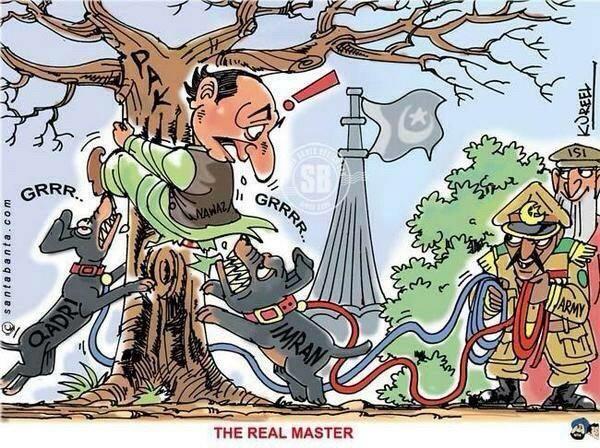
Shi’a Iran. Like wild beasts kept as pets, these groups are now devouring their
keepers.  It should be easy to decide
that this strategy has failed, and to stop feeding the beasts, but this will
require giving up dreams of an Indian
reconquista
and a new caliphate. Recent
reports
(pre-Peshawar) suggest that this has not yet happened.
Stop promoting
conspiracy theories and blaming others
It is tempting for any individual or group to ascribe their
problems to circumstances beyond their control, but enough already with
conspiracy theories! Even today, after the TTP have loudly accepted
responsibility for Peshawar, “responsible”
people are out in the media blaming the massacre on India
.
Pakistan does have real enemies, but most of what ails it
has come from its own misguided policies. The Crusader-Zionist-Brahmin axis,
the CIA-Mossad-RAW alliance, the Protocols of the Elders of Zion, the
ubiquitous “foreign hand”, the impending arrival of “Dajjal” (the Antichrist), secret
atmospheric weapons (HAARP) causing floods and earthquakes, 9/11 trutherism –
these and many other outlandish conspiracy theories rife in Pakistan serve only
to distract people from the real authors of their woes. Ultimately, these can
only be combated by a better educational system, but to the extent that these
theories are promoted by specific power groups for their own narrow agendas,
they can be controlled at the source. The institutions themselves should develop
cultures where propagating such conspiracy theories is cause for ridicule. In
particular, the nexus between religious fantasies and conspiracy theories must
be broken.
Engage with the
world
The wonderful world we live in is the best teacher and moderator
of humans. A big factor behind the profusion of outlandish ideas in Pakistani society
is disengagement from the world. While the Internet and social media have
brought people closer across traditional barriers, this is a distorted
connection at best. More Pakistanis – especially young people – need to
experience the diversity of the world first-hand. The best way to do that is
for the government to support international travel and exchange programs for youth, which
would allow students of high school and college age to spend significant time
in other countries – notably those which are seen with the greatest suspicion,
i.e., India and Western countries. Such exposure at an impressionable age will
give Pakistani youth a real sense of the world and its pluralism, making it
more difficult for obscuranist forces to infect their minds with thoughts of
jihad and martyrdom.
As I write this, the outrage is still pouring in, but it is
too early to know if any of the changes suggested above will actually occur, or
if the questions raised here will be answered honestly. The establishment has
built the current structure with great effort, and there will be many who are
still reluctant to let go. To these, the people of Pakistan must speak loud and
clear: The time for vacillation is over. The cause is clear and the enemy
obvious. Those who still obfuscate these issues must be consigned to the garbage-can
of history. 
The urgency of the hour notwithstanding, real change will take time
– decades and generations, not months and years, and most of it will come from
the people, not the state. Much will change during this time in ways that we
cannot imagine today, and not always for the better. The war that is underway
now is unlikely to be short, and though its details may still remain in flux, it
is critical to acknowledge the nature of
this war. It is not a war between believers and unbelievers, Shi’as and Sunnis,
or the West and the Muslim world. It is a war between two visions of life and
death;  not a clash of civilizations, but
a war for civilization. On one side are nihilists who value their beliefs more
than the lives of their fellow humans, see this world as ephemeral, and seek
their rewards in the hereafter. On the other are those who do care for other
human beings and, however imperfectly, want to understand and improve this world.
No society interested in thriving can possibly choose the nihilist side over
the long term, even if it is dressed up in the garb of faith. Therefore, I will
go out on a limb and predict that the day will come when Pakistan, India, Afghanistan,
Iran, Syria, Saudi Arabia, Turkey, Israel, China, Russia, the United States and
many others will all fight as allies against an amorphous jihadist threat
stretching from Morocco to Indonesia. It may take ten years, or twenty, to get there, but that’s where things are going whether we like it or
not, and we will all need to decide which side we stand on.
Burnt Offering: The Martyrdom of Shama and Shahzad Masih

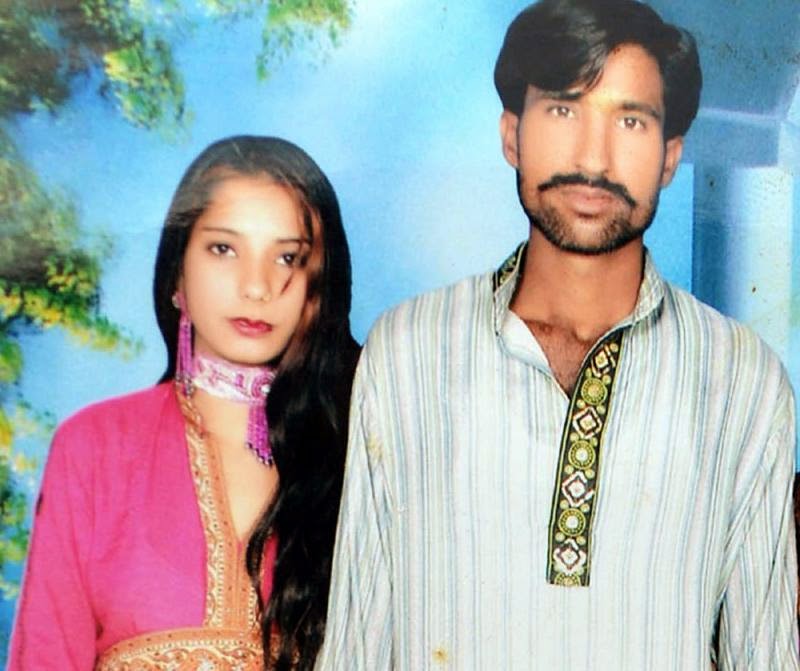
Shama and Shahzad Masih were poor Christians who lived in the small village of Chak 59 in the Tehsil (subdivision) of Kot Radha Kishan near Lahore. It is not a remote area (though some orientalist in the BBC has managed to describe it as such), being a well developed center of the leather industry lcoated only 60 kilometers from the provincial capital of Lahore on a major national highway (and is the home of 2 former prime ministers of Pakistan!). Like many other poor people in their village, they worked as modern-day slaves in the local brick kiln. This, by the way, is not an exaggerated or poetic description of their employment status; bonded labor in brick kilns in India and Pakistan is internationally recognized as a type of modern slavery and involves many of the abuses known to us from books and movies about slaves in the days of yore.

The young couple had 4 children: Solomon (8) and Zeeshan (5) had been given to an uncle for adoption, probably due to the parent’s poverty. Sonia (4) and Poonam (18mths) lived with them and Shama was pregnant again with her fifth child. Her father-in-law had died recently and a few days later Shama cleaned out his room and disposed of his old papers by burning them. He had been an “amil” (a folk healer) who used various religious texts in his amulets and suchlike, and the burnt papers apparently included some with arabic writing on them. Shama, who was illiterate and so could not read them in any case, burnt the lot and threw the remains on a nearby garbage heap.What happened next is best described in this report from World Watch Monitor (corroborated to me by a friend in the police as the best description of the event):

“On Sunday, Shama burned them all and threw the ashes on a garbage heap outside their quarters. Shama never meant any disrespect to Islam as she was totally illiterate and had no idea what the amulets contained,” she said. “A few people recognized partially burned pages in the ash and raised a cry that Shama had burned the Qur’an.”
Shahzad Masih and his five brothers worked for many years at the brick kiln, owned by Yousuf Gujjar. Parveen said Shahzad and his brothers went to Gujjar to resolve the matter after the situation got tense in the village. “Gujjar on the one hand assured us that nothing would happen, and on the other hand asked his accountant not to let Shahzad and Shama flee the village without paying back their bond money”, (taken from them as an ‘advance’ against their employment and wages).
By Monday night, some Muslim neighbors had informed the police of the alleged desecration and warned of a possible attack on the Christian couple, Parveen said. “That night I had Shahzad and Shama sleep in my home so that if the police arrested them, at least we would know.”At about 6 a.m. when Shahzad and Shama went back to their own home in order to prepare for work, an angry mob began pouring into their quarters. Sensing the danger all the Christians fled except Shama’s sister Yasmeen (married to Shahzad’s brother Fiaz Masih).Yasmeen said they were still preparing breakfast when a few more people knocked at their door and enquired about Shama. 
“They entered the house and one of the men dragged Shama out. Shama had their youngest daughter Poonam in her arms. That man snatched Poonam and threw her on the floor…So brick kiln guard Muhammad Akram rescued Shama and took her to the kiln office (only a few yards away from their house) and locked her in there, to save her from the attackers.”
“By then, the number of mobsters was very small, but we could hear announcements being made from mosque loudspeakers in nearby villages – that a Christian woman had desecrated the Qur’an”.Yasmeen said people from five surrounding villages – Chak 60, Rosey, Pailan, Nawan Pindi and Hatnian – were gathered together by the residents of Chak 59 and their brick kiln coworkers.
Soon thousands of men armed with clubs, hatchets and axes loaded onto tractors and trolleys began pouring in.(The guard) Akram had locked the main kiln office door from the outside, but the angry protestors broke in anyway. But they failed to break the iron door of the office inside, and Shama and Shahzad must have locked it from inside.”The angry protestors then climbed on to the roof, and broke it in, “as if it was made of wood, straw and mud” said Yasmeen.She says these men then opened the door from inside and brought the couple into the open, where the highly-charged protestors were ready to attack.
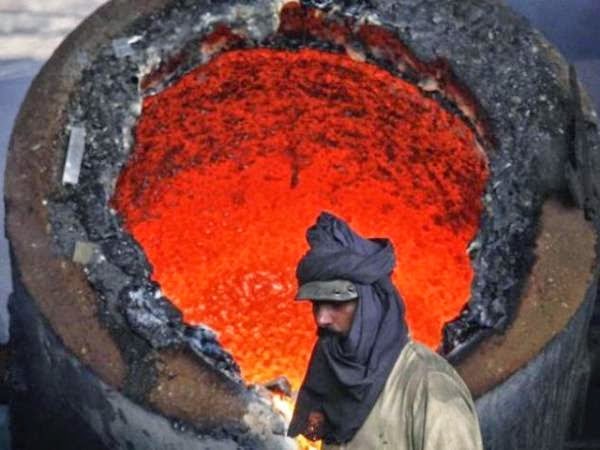
“They beat them with wooden clubs on their heads, and hatchets, before they were both tied to a tractor and pulled out onto a road which was under construction, covered with crushed stones.”“I think they were unconscious, but still breathing, but the mob was still not willing to leave them alone,” said Yasmeen. “They took some petrol from a tractor and doused their bodies and threw them in the kiln. Then I lost hope and fled with my children from there.”
Another relative, Parvaiz Shehzad, who also lives in Clarkabad, said that Muslims of neighboring villages “were very much jealous of Christians”. The village is named after Robert Clark (1825–1900), the first Anglican missionary to Pakistan. Parvaiz Shehzad said it was the first village in the district that had electricity, a bank, a post office and a high school.“Most educated people of surrounding villages had studied in in Clarkabad…Strife between the Christian villagers and Muslim villagers has been a common feature in recent years”.As Shehzad and Shama were of Clarkabad, he claims jealousy came into play.
The dead woman’s sister Yasmeen says that during the entire violent attack, a police van was present, but because they were so few, the police did not take charge. “Some men asked them to fire into the air to quell the protestors, because the mob had no weapons to fire back…Shama and her husband might have survived if the police had taken timely action.”
Heavy contingents of police did arrive at the scene after the crowd had killed the couple. A local media reports that the police have arrested at least 42 people in connection with the case.The police themselves filed the case and lodged the First Information Report (FIR), [no. 475/14], registered in Kot Radha Kishan Police Station. The FIR states that 500 to 600 men tortured the Christian couple. The FIR identifies 60 men by name and says that:“the incident took place after the above-nominated persons gathered a crowd of people and roused their passion though false announcements from the mosque (loudspeakers) of desecration of the Qur’an.”...


Another eyewitness reports that when the young couple, beaten to near death, were put into the fire, a large heavy iron sheet was put on top of them to hold them down; as if the crowd wanted to make sure that they would burn. As if there was ever any doubt. As if there could be a different ending after a mob had arrived to defend the honor of Allah and his prophet. As if this was not 2014 in Kot Radha Kishan (“stronghold of Radha and Krishna“). As if this was not Kalyug…

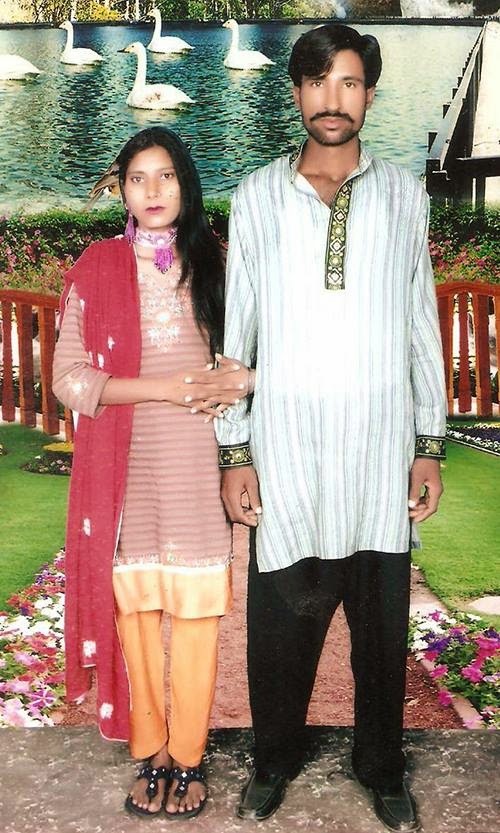
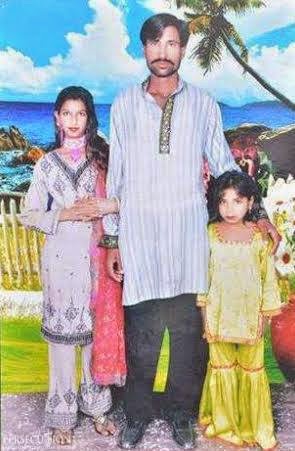
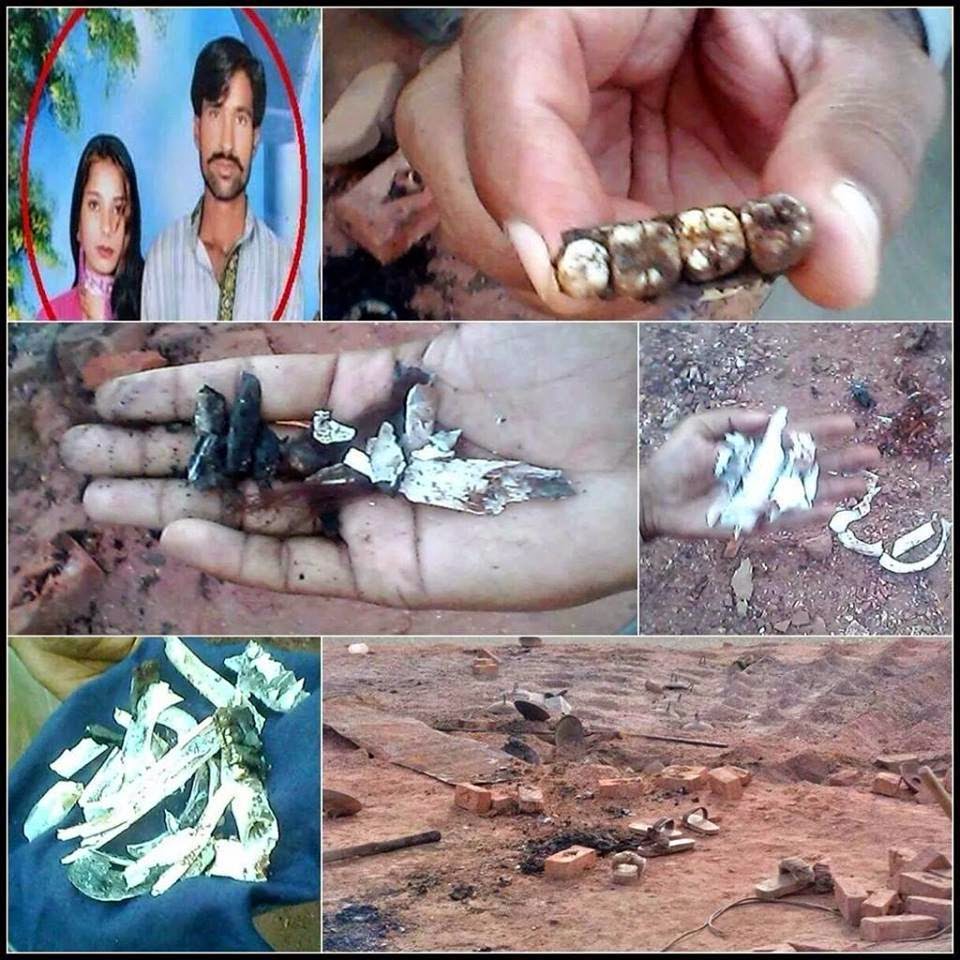
Several pictures of the couple have surfaced. We do not know if it was Shahzad or Shama who chose the backgrounds. (Note: I hv been told (and agree after looking again at the pictures) that it is not the same girl in all the pictures, some are with a cousin or niece of Shahzad, not with his wife Salma; this will no doubt become clearer with time; In any case, there seems to be no doubt about the picture of their last remains)

Yes, many thousands were killed in equally gruesome ways in 1947, in 1971, in 1984, in 2002; India, as Naipaul said, is a wounded civilization. But just look at these pictures…the contrast between the idyllic scenes depicted in the photographer’s backgrounds and the actual life of the poor couple was already harsh when they took went to the photographer in Clarkabad; the contrast between these beautiful, hopeful faces and their terrified, screaming last hour on earth is unbearable and unimaginable. Too painful for words. After such knowledge, what forgiveness?

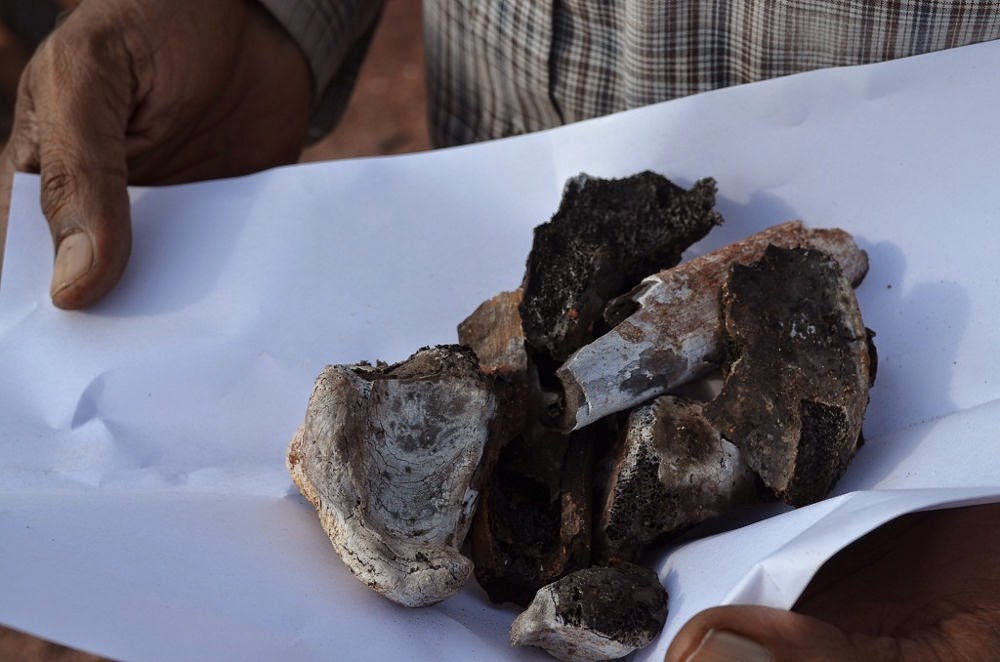
Someone took a picture of the remains after the good people of Kot Radha Kishan had finished with the couple.

Burnt offering
What more can one say?

The government of chief minister Shahbaz Sharif has acted with some speed and 40 or so people have been arrested for this atrocity. The Prime Minister has expressed shock, condemned the incident, and promised to bring the guilty to book. Multiple organizations within Pakistan have condemned this murder and I have no doubt that millions of Pakistanis are shocked to the core. I also believe that both the chief minister and the prime minister are entirely sincere in their concern. They are not inhuman bastards and they are not dumb. They see this is a terrible atrocity and they know how ugly it looks to the rest of the world. But their best intentions will not prevent the next incident and the fact that the blasphemy law itself has been openly questioned in Pakistan after this incident will not lead to any change in the law.

Why not? Because the law runs deep and has real support among the people and, perhaps more to the point, serves real purposes for sections of the ruling elite. (the follow is modified from an earlier article I wrote about the blasphemy law)

A blasphemy law was part of the 19th century Indian Penal code as section 295 (this fact has allowed many a postmarxist to begin any discussion of blasphemy laws with the phrase “colonial era law”, God be praised).
Here is section 295 of the Indian Penal Code of 1860:  Injuring or defiling place of worship with intent to insult the religion of any class.—Whoever destroys, damages or defiles any place of worship, or any object held sacred by any class of persons with the intention of thereby insulting the religion of any class of persons or with the knowledge that any class of persons is likely to consider such destruction, damage or defile­ment as an insult to their religion, shall be punishable with imprisonment of either description for a term which may extend to two years, or with fine, or with both.

This seems like an eminently sensible law and cannot really be blamed for all the evils that came later. But in the 1920s there was a famous case in Lahore where a Hindu publisher was arrested by the colonial authorities after Muslims agitated against him for having published a book called Rangila Rasul (“merry prophet”). But the court in Lahore (quite properly) found him innocent because there was no law on the books against just publishing a book, no matter how offensive it may be to some religious group. Fearing future communal discord from such provocations, the British then had the legislative assembly add section 295A to the law in order to criminalize deliberate attempts to “outrage the religious feelings of any community”). This section states:

Whoever, with deliberate and malicious intention of outraging the religious feelings of any class of citizens of India, by words, either spoken or written, or by signs or by visible representations or otherwise], insults or attempts to insult the religion or the religious beliefs of that class, shall be punished with imprisonment of either description for a term which may extend to 4[three years], or with fine, or with both. 

But even with this new and expanded article 295A in place, prosecutions for blasphemy were few and far between until, in the 1980s, General Zia added two new sections to the law in Pakistan and really set the ball rolling.  These infamous sections are labelled 295B and 295C.

295-B:  Defiling the copy of Holy Qur’an. Whoever wilfully defiles, damages or desecrates a copy of the Holy Qur’an or of an extract there from or uses it in any derogatory manner for any unlawful purpose shall be punishable with imprisonment for life.


295-C: use of derogatory remarks etc., in respect of the Holy Prophet: – who ever by words, either spoken or written, or by visible representation, or by any imputation innuendo, or insinuation, directly, defiles the sacred name of the Holy Prophet Muhammad (PBUH) shall be punished with death, or imprisonment for life and shall also be liable for fine.

Note that the law no longer requires that the offense be malicious in intent. Intent is no longer an issue. Insulting the Quran or the prophet, even unintentionally, is now punishable by death. To seal the deal, in 1991 the Federal Shariat Court of Pakistan struck down the option of life imprisonment and made the death penalty obligatory. Between 1984 to 2004, 5,000 cases of blasphemy were registered in Pakistan and 964 people were charged and accused of blasphemy; 479 Muslims, 340 Ahmadis, 119 Christians, 14 Hindus and 10 others. Thirty-two people charged with blasphemy were killed extra-judicially during that time. More have died since. Eighty-six percent of all the cases were reported in Punjab.

In the wake of this latest horrendous outrage, many liberal people are hoping that this blasphemy law can be changed to finally stop or slow down this torrent of prosecutions and killings. Others have noted that the law is not the problem, free lance enforcement of a broader blasphemy meme in the Muslim community is the problem and will likely persist even if the law is repealed. In my view the law is not the only problem, but it IS a very potent symbol of the surrender of state and society in front of the blasphemy meme. Repeal of the law will not kill that meme, but repeal of the law will be an equally powerful signal that things have changed and that state and society no longer approve of the killing of blasphemers. It will not end the problem, but it will be the beginning of the end. Repeal of the law is not a sufficient condition for this nightmare to end, but it is a very important necessary condition.

Unfortunately, I don’t think such repeal or amendment is actually likely in the foreseeable future. My predictions:

1. The law will not be repealed. Some minor amendments may be made someday (and even these will excite significant Islamist resistance and are not likely) but their effectiveness will be limited. Blasphemy accusations will continue, as will the spineless convictions issuing from the courts. In fact, new blasphemy accusations will almost certainly be made with the express intention of testing any new amendment or procedural change (thus, ironically, any amendment is likely to lead to at least one more innocent Christian or Ahmedi victim as Islamists hunt around for a test case).
2. Aasia bibi, the law’s most prominent current victim, will not get a reprieve from anyone but she will not be hanged. Instead, she will be held in prison till she dies or is killed by a vigilante in prison.  Her immediate family will have to leave the country at some point. The local Christian community will have to clearly show their humble submission in order to be allowed to get on with their lives.
 3. Blasphemy will continue to be a potent weapon in the hands of the deep state, the Islamists and sundry local gangsters and land grabbers.
These predictions may appear pessimistic and discouraging, but I would submit that they are not meant to be discouraging; they are meant to be realistic. The law will not be repealed because the law is not just an invention imposed by General Zia on an unwilling populace. Rather, this law is the updated expression of a pre-existing social and religious order. Blasphemy and apostasy laws were meant to protect the orthodox Islamic theological consensus of the 12th century AD and they have done so with remarkable effectiveness. Unlike their Christian counterparts (and prosecutions for heresy and blasphemy were seen throughout the middle ages in Europe) these laws retain their societal sanction and have been enforced by free lancers and volunteers where the state has hesitated. The most famous, and in many ways, the most telling example of the wide societal sanction for killing blasphemers is the case of the carpenters apprentice Ghazi Ilm Deen Shaheed, who executed the Hindu publisher of Rangila Rasul after legal prosecution had failed. The demand to kill Rajpal was being made openly in public meetings and two other Muslims had already attempted to kill Rajpal prior to Ilm Deen’s successful attempt. In fact Ilm Deen’s best friend had wanted to do the act and only stepped aside because they drew lots and Ilm Deen won thrice in a row.
And when he did do the deed the Muslim community mobilized to defend him and in the high court his appeal was handled by two lawyers, one of whom was none other than Quaid E Azam Mohammed Ali Jinnah, who was asked to take up the case by that illustrious modernist and “moderate Muslim hope”, Allama Mohammed Iqbal. After he was hanged by the British, Allama Iqbal was one of the leaders of a campaign to have his body brought to Lahore for reburial (he had been quietly buried in a remote prison by the British authorities). When this demand was conceded in the face of massive public protests, his funeral drew thousands and was attended with pride by Allama Iqbal, who supposedly said that “this carpenter has left us, educated people, far behind”. In an ironic twist the charpoy (rope bed) on which Ilm Deen was borne to his grave was said to have been donated by another literary luminary, Mr MD Taseer, whose own son would later become governor of Punjab and would be killed for “blasphemy” by a new Ilm Deen. Ilm Deen’s grave is now a popular shrine and a movie has been made about his exploit, complete with a dance sequence featuring the blasphemer enjoying himself before he meets his fate.

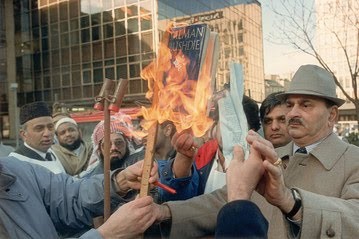
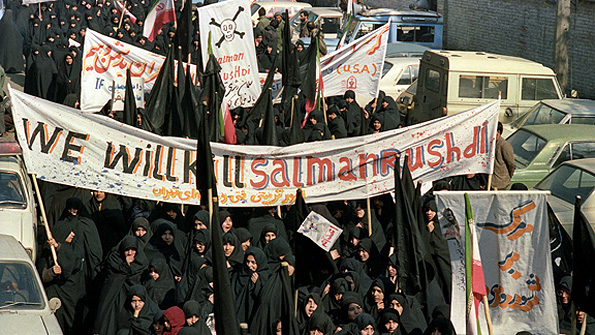
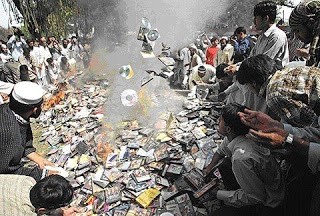
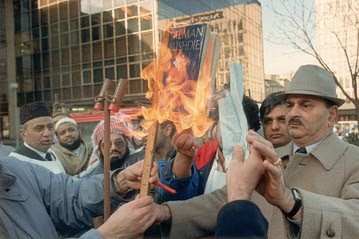
When Salman Rushdie’s book was declared blasphemous and rallies demanding his head were held all over the world and books were burned, General Zia was not the agent of those protests.

Rushdie went underground and has managed to survive, though some of his translators were not so lucky. But Theo Van Gogh was killed in broad daylight in Amsterdam and Ayan Hirsi Ali was driven underground for producing a supposedly blasphemous movie in liberal Holland. Another blasphemy execution was attempted by textile engineering student Aamir Cheema in Germany. And as expected, Aamir Cheema too has achieved sainthood in Pakistan after he took his own life in a German prison, with his funeral attracting thousands and his grave becoming a popular shrine. A minister in Musharraf’s enlightened cabinet wrote more than one op-ed commending such acts and fantasizing about the day Salman Rushdie’s skin will be torn from his body with sharp hooks. A fantastically surreal movie has even been made about the execution of Rushdie by Muslim Guerillas who penetrate his secret Zionist hideout and attack him with flying Korans.
I am not kidding.

In 2002 a convicted murderer named Tariq decided to atone for his sins by killing a man accused of blasphemy who happened to be in the same prison in Lahore. Director Syed Noor (known for countless song and dance Lollywood films) produced and directed a movie called aik aur ghazi (one more holy warrior) about this young man and his glorious exploit. It is worth noting that Syed Noor is a “moderate Muslim”, but this has not prevented him from glorifying the actions of a vigilante who killed another prisoner because he believed him guilty of blasphemy.

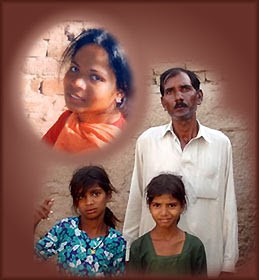
When a poor christian boy was accused of blasphemy in Lahore, the entire colony he lived in was burned to the ground. When a poor Christian woman named Aasia bibi acted “uppity” in front of some Muslim ladies (see details in the video below), she was charged with blasphemy and sentenced to death. These episodes highlights another important aspect of the blasphemy meme: it functions to bully and oppress minorities by threatening them with legalized lynching in exactly the same way as the “uppity nigger” meme was used to bully and oppress black people in the pre-civil-rights South in the United States. The fear of being accused of blasphemy, enforced by periodic horrific lynchings, ensures that Christians, Hindus and Ahmedis never forget their place and act uppity in front of good Muslims, since any indiscretion could lead to a blasphemy accusation and once accused, your goose is cooked.


Aasia Bibi’s death sentence was so flagrantly unjust that Salman Taseer (whose own father had provided a funeral bier for Ilm Deen), the then governor of Punjab, was moved to say she should be let go and the blasphemy law should be amended to prevent such misuse. He was killed by his own guard for saying so. His guard was garlanded and showered with rose petals by Pakistani lawyers when he appeared in court and now has at least one mosque named in his honor.

HE has not been hanged. In fact, he is a hero to many and has been handing out new death sentences of his own while in prison; he convinced one of his guards to go and shoot a 70 year old mentally unstable British man who has been sentenced to death on blasphemy charges but not yet exectuted (probably not yet executed because he is British). MNA Sherry Rahman introduced a “private member bill” to amend the law and was herself charged with blasphemy for her pains (though being a member of the ruling elite, she has not yet been brought to trial). Rashed Rahman, a well known human rights lawyer was shot dead because he dared to take up the case of a young university lecturer who is being tried for blasphemy on insanely ridiculous grounds in Multan. Javed Ahmed Ghamdi, a liberal cleric who has tried to present religious arguments against this law (a law that clearly goes well beyond anything written even in most of the medieval compilations of shariah law) has had his assistant killed and is now living in exile in Malaysia. “Respected” Pakistani religious scholars have declared him to be an apostate and an agent of the enemies of Islam. The law is no closer to repeal or even modification.

And just a few weeks ago, the spineless Lahore High Court upheld the death sentence on Aasia Bibi. She may be hanged before the Governor’s killer.

In fact. the law is now moving on to fresh pastures. There is a sustained push by anti-Shia groups to use the law against Shias just as it is being used against Ahmedis, Christians and other minorities. The law does not specifically mention the issue of blasphemy against the companions of the prophet (the sahaba), but why not? if you insult any of the companions of the prophet, do you not insult the prophet? Never mind that the companions themselves were frequently at each other’s throats, but today the issue is the wedge that will open the way to legal persecution of Shias and help push them into the same position now occupied in daily fear by Christians, Hindus and Ahmedis. Several Shias have already been charged under the law and there is more to come. In fact, on the same day when Shahzad and Shama met their gruesome fate in Kot Radha Kishan, a Shia Zakir was killed in custody in Gujrat. He may have been mentally unstable and had been arrested for brawling in the bazar. In custody, he continues to harangue the police about the calumnies suffered by the Banu Hashim (the family of the prophet) at the hands of some of the companions (the sahaba). This so upset one of the police officers present that he got an axe and decapitated the prisoner inside the police station. The police officer concerned has been arrested and desperate attempts are being made to play down the sectarian dimension of this killing, but all will become clear once the policeman is put on trial. The ASWJ (the main umbrella anti-Shia organization) will protest that he was only defending the honor of the prophet. Punishment will not be easy. “Sweep under the rug” is likely to be the compromise.

In short, while it is indeed true that misuse of the law has become common after General Zia’s time (an intended consequence, as one aim of such laws is to harass and browbeat all potential opposition), the law has deeper roots and liberals who believe that it is possible to make a distinction between true blasphemy and misuse of the law, may find that this line is not easy to draw. The second, and perhaps more potent reason the law will not be repealed is because the law was consciously meant to promote the Islamist project that the deep state (or a powerful section of the deep state) continues to desire in Pakistan. The blasphemy law is a ready-made weapon against all secular opposition to the military-mullah alliance (though some sections of the military now seem to have abandoned that alliance, hence the qualification “section of the deep state”). Secular parties are suspected of being soft on India and are considered a danger to the Kashmir Jihad and other projects dear to the heart of the deep state. At the same time, Islamist parties provide ideological support and manpower for those beloved causes. In this way, the officers of the deep state, even when they are not personally religious, recognize the need for an alliance with religious parties and against secular political forces (Musharraf was a good example). They may have been forced into an uneasy (temporary?) compromise with secular parties by circumstances beyond their control (aka America) but with American withdrawal coming soon, the deep state does not wish to alienate its mullah constituency too much. They will be needed again once the Yankees are gone. Hence too, no repeal at this time.

Of course blasphemy accusations and their use to suppress speech are not limited to Muslim countries; e.g. Sikhs have resorted to violence to protest blasphemy and Hindu mobs have rioted to enforce the sanctity of Shivaji’s memory in Mumbai. But Islamist consensus on blasphemy is wider and deeper and has an edge that other fanatics can only envy. In the long run (decades, not centuries) Islamists will be forced to compromise with modernity one way or the other (with one way being less painful than the other). But that time is not yet here…For many years, perhaps decades, we are going to see terrible violence in the Islamicate core and some of it is going to be about blasphemy. That is just where we happen to be..

Post Script: It is likely that in the coming days some of the details of the murder will be revised (though the beating and burning are not in doubt and will not be wished away). About such revisions, it is important to keep in mind that a number of new stories are going to be circulated by interested parties to muddy the waters, spoil the prosecution, confuse the issue and so on. And the “best supported” new stories may not be the most authentic. As Goldhizer noted about hadith authentication, in many cases the best authenticated are the ones most likely to be untrue (the authentication chains being so good precisely because they were invented to look authentic).

Local MPA’s will be activated to defend the kiln owners. Local villagers will find ways to play down their own barbarity and play up the “desecration”. Clerics will find NGO’s behind a new conspiracy to defame Islam.
It has all happened before….

PPS: The All Pakistan Private Schools Association (which may or may not represent too many schools) has observed an “anti-malala day” to condemn her membership in the “Rushdie club”. Mashallah.

High Court Upholds Death Sentence on Aasia Bibi

Setting new records of shamelessness and spinelessness, the Lahore High Court has upheld the death sentence awarded to Aasia bibi for “blasphemy”.


For years now, the lower courts in Pakistan have taken the route of automatic award of death sentence in blasphemy cases. Lower court judges feel that they have no security and why should they put their life on the line for a Christian or an Ahmedi (and of course, for apostates they themelves almost certainly feel a death sentence is justified, so no conscience issues there)? They expect that the case will go to the High court and high court judges will either keep it in limbo forever or hear it and throw out the death penalty (helped, no doubt, by the transparent lack of due process at the lower court level..so in a way the lower court judge is doing the accused a service by giving zero time to their defence and pronouncing sentence on the flimsiest of grounds).
Well, no more.
Christians and Ahmedis in Pakistan now face a legal situation whose closest parallel may be in the Jim Crow South, where Black defendants were frequently found guilty on the flimsiest of grounds and if acquited, faced mob justice and public lynching. But while the Jim Crow South has moved on (a lot, though not all the way), the situation in Pakistan is headed in the opposite direction.
A poor woman has been in prison for 4 years and now faces the very real prospect of execution for what is basically the crime of being “uppity”. 
Sad.
Very sad.
Btw, this does shed light on what is clearly the weakest part of Ben Affleck’s ignorant but well-meaning liberal account of the Muslim world: the fact that the core Islamic world (really, everyone except Muslim countries that have been hit hard by communism, as in the Soviet Stans and in Xinjiang) is COMPLETELY illiberal when it comes to apostasy and blasphemy. Illiberal views on these issues are not fringe views in the Muslim world. Blasphemers are to be punished, usually by death. This is a MAJORITY view, supported by ALL major Islamic sects and their theologians. The notion that apostates are to be killed has a little less support, but is still the majority view in many countries and is again the clear consensus among orthodox Sunni theologians (I have little detailed knowledge of Shia theology, so I am leaving them out of it…they may believe exactly this as well). Based on these two memes, criticism of Islamists becomes a problem in all these countries and “reform from above”, enforced by Westernized rulers (like Ataturk) is always in danger because the religious establishment has never accepted it and the population continues to honor classical beliefs in principle (without knowing them too well, thanks to secularized education) and so is always available to be “reformed” back to those classical beliefs when circumstances change (as they have been changing in Turkey).
And so on.
Its not as hunky dory as Affleck and his fans may wish to believe.
For more, see this article about blasphemy laws. http://www.3quarksdaily.com/3quarksdaily/2010/11/blasphemy-law-the-shape-of-things-to-come.html

Also note that while Aasia bibi cannot get out of jail no matter what, this guy apparently had no problem joining the Mujahideen after being imprisoned in Croatia and deported to Pakistan for being a Jihadist

http://www.mediafire.com/view/75piv2l2qtc6s6w/Ahlul%20Azayim%204.mp4


Shoot rushdie


Playing the loony tunes (non-stop)

….I still remember his analysis….how
thoughtful and well-researched it was…..whenever he was on air, I used to tell my
parents proudly…that’s my professor on TV….I can’t believe that a scholar like him has been shot dead…..It’s like losing a father….


We are assuming (perhaps wrongly) that since Prof Auj was guest of honour at the Iranian Embassy, he must be a Shia. Ceratinly he can be accused of being a non-conformist.
…….

Mr. Auj, a recipient of a presidential medal of
distinction, was known for his unorthodox views and was fighting a legal
case against the originator of a widely circulated text message that
called him an apostate.….The
professor had issued controversial fatwas (religious decrees) —
pronouncing for example that a Muslim woman could marry a non-Muslim
man, and that women need not remove lipstick or nail polish before
saying their prayers.
Such views can cause serious offence to some
conservative Muslims in Pakistan….

……


This much is true, as Omar has pointed out repeatedly, weapons like the blasphemy law which are shiny and useful will not be put away so easily. It will require a mass movement and a big-hearted man (who can rise above all partisanship).
…. 
A
Muslim scholar named Muhammad Shakil Auj who had received death threats
over “blasphemy” allegations was shot to death Thursday
in Karachi, Pakistan. Auj was the dean of Islamic studies at the
University of Karachi, and some of the blasphemy allegations against him
reportedly originated with his colleagues. 

….
From the New York Times:

Unidentified gunmen on a motorbike attacked the vehicle he
was riding in on his way to a reception at his honor at the Iranian
Consulate. Dr. Auj was shot in the head and neck and died immediately,
officials said. A female student in the back of the car was shot in the
arm and was treated at a hospital.
A week earlier, a visiting religious scholar at the same
Islamic studies department, Maulana Masood Baig, was also shot dead by
unknown attackers.

Auj
had told police that four colleagues at the University of Karachi
had accused him of blasphemy—including one colleague who’d previously
held Auj’s position as dean.
The four were arrested but are free on
bail, and they are “being questioned” about Auj’s murder, the Times
reports. A seminary in Karachi had also called for Auj’s death.

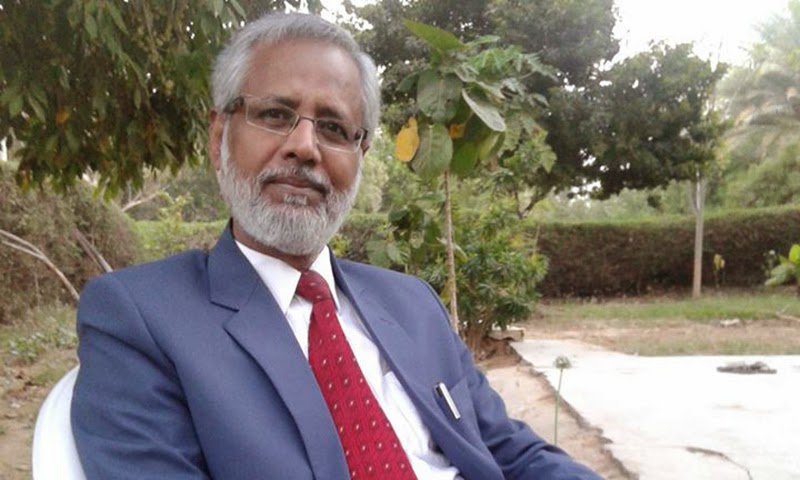
Thursday morning started with very tragic news. One of my beloved teachers who had taught us in university was shot dead for some unknown reason.  

Dr
Shakeel Auj was Dean, Faculty of Islamic Studies, University of Karachi
since 2012. He completed his PhD in Islamic Studies from University of
Karachi in 2000 with a PhD dissertation of “Comparative Study of Eight
Selected Urdu Translations of Holy Quran.”

Apart from PhD in Islamic Studies, he also possessed an LL.B and a
Master Degree in Journalism. With all his books, research papers,
articles and an unending list of prizes and honors, he was an institution of his own.

Dr
Shakeel was my lecturer for Islamic Studies during my Bachelors back in
2006. After I graduated, I hardly got a chance to meet him again, and I
still regret it. Dr Auj was an unconventional Islamic scholar
who used to believe that Islam was an easy religion to practice, and it
was the people who had made it difficult.

We used to have
detailed, open discussions on various topics in the class, and he was
always very inviting to his student’s opinions despite having tons more
knowledge and understanding.

I still remember his analysis on the
meaning of “Al Rehmaan” and “Al Raheem”, the two names for Allah; how
thoughtful and well-researched it was! Doctor sahab also had a
strong media appearance and whenever he was on air, I used to tell my
parents proudly that that’s my professor on TV.

I can’t believe that a scholar like him has been shot dead in such a
horrendous way. It’s like losing a father; someone who spent his whole
life serving others without a complaint and played a pivotal role in
teaching, grooming, mentoring, guiding and making us into better
individuals today.

……….

Link (1): slate.com/karachi_islamic_studies_scholar_killed_for_blasphemy

Link (2): dawn.com/of-guilt-and-goodbye-too-late-to-thank-my-professor

Link (3): thehindu.com/pak-liberal-academic-shot-dead
….

regards

Pakistan: Weimar Republic of Asia?

More than 3 years ago I wrote a piece asking whether Pakistan is a failed state or the Weimar Republic? At that time, i was still an optimist and thought it was probably neither. But I did say at the end:  (the original article is at the end of this post, to see it with hyperlinks go to http://www.3quarksdaily.com/3quarksdaily/2011/03/pakistan-failed-state-or-weimar-republic-omar-ali.html#sthash.0aDDDW0f.dpuf  ).

So much for the optimistic version. Since this is a post about Pakistan, it cannot end without some pessimism. The most dangerous element in Pakistan today is not the Islamist fanatics. It is the rise of China. Not because the rise of China threatens Pakistan or because Chinese hyper-capitalism or cheap Chinese products threaten our industry or our social peace or any such thing, but because it may inflate the egos of the military high command to the point that they lose contact with reality and try a high jump for which we are not yet ready (and may never be ready). It’s not that the high jump will get anywhere, but that the attempt may lead us into more trouble than we can handle. Jf 17 thunder


 I say this because GHQ, for all its pragmatic pretensions, has been known to overestimate their skill and underestimate their opponents.  If China was not truly a rising power, and if Pakistan did not have some real assets and advantages, we might have been safer in the long run. But since there is an element of truth in the paknationalists notions about China and the changing global balance of power, they may lose their balance.  All I am saying is GHQ is prone to flying off on a self-generated hot air pocket even when the situation does not encourage such optimism. When the situation actually has some positive aspects, there may be no restraining them. But, I remain an optimist. I think our own weaknesses may protect us from the fate of a much stronger and more capable country (Germany in 1940).

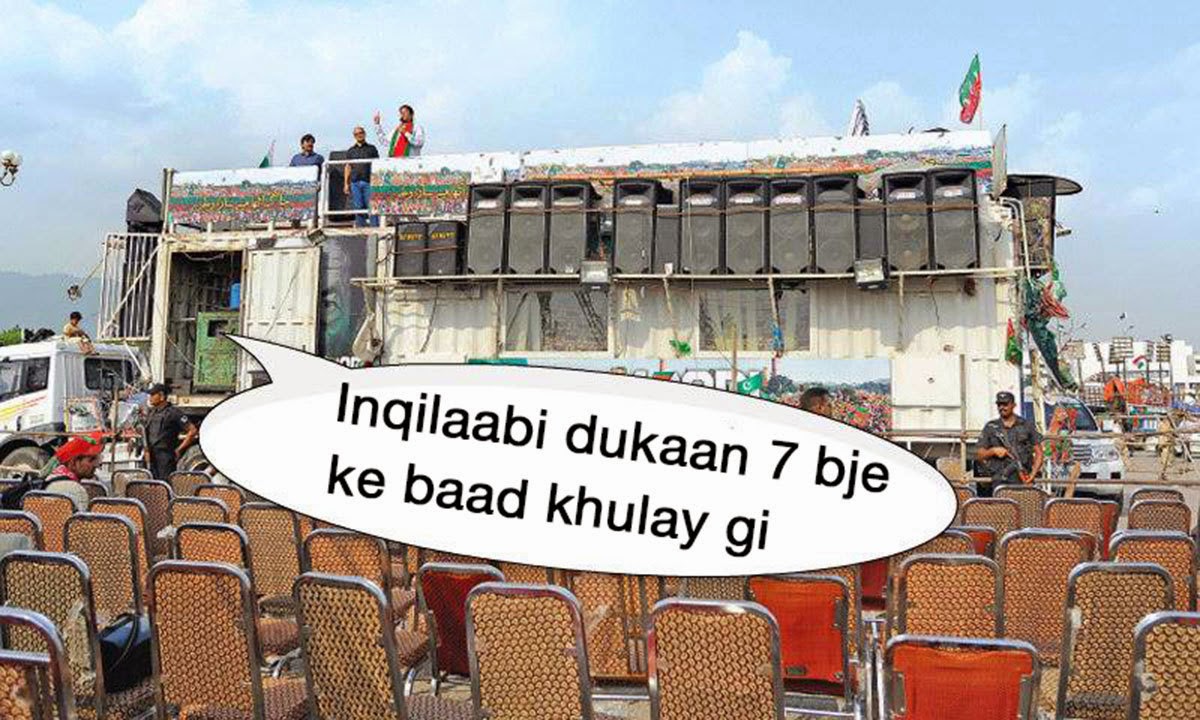
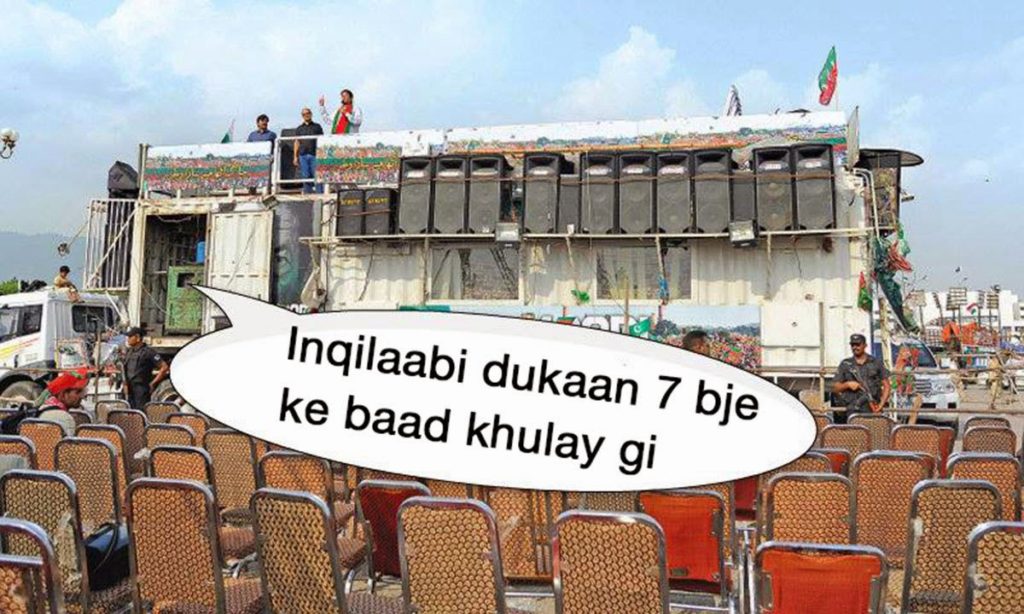
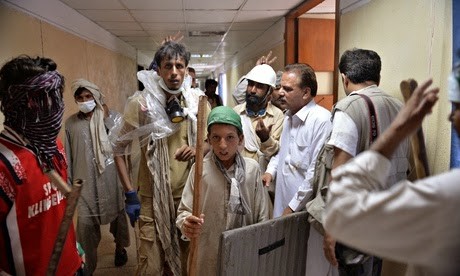
This year, things have taken a turn for the worse. According to a report (written months ago, so not cooked up after the event), a plan was hatched in London to depose Nawaz Sharif and bring in a new government under the supervision of the army. Who knows what the real details of the plot are (it may be that the army chief, for example, was not involved, but only some generals and retired adventurers put the script together) but it hit a snag on 14th August when Imran Khan failed to deliver his promised 100,000 motorcyclists to the “Azadi March”. But not to be deterred by poor crowds, he has kept up the show and the civilian institutions of the state have failed to establish their writ in spite of court orders and blatant violations of the law by Imran Khan and Qadri (including a raid on a police station by Imran Khan himself, to free PTI workers being held there). Whether this failure is due to incompetence, collusion or fear of the army (likely all three), the insistent drumbeat of speeches (and their 24-7 amplification by most news channels) in Islamabad continues and the central government looks weak and ineffectual in spite of the support of most established political parties. This is not necessarily considered a negative in Pakistan, where the government, the police, the courts and the political parties are all corrupt to varying degrees and all have their hand in robbing and insulting the citizenry on a daily basis. In fact, some leftists (and not just leftists) who are not necessarily fans of Imran Khan or Qadri cannot help but be delighted by the scenes of policemen getting beaten up and “high authorities” looking like fools.

But unfortunately (or fortunately, if you happen to think that the demise of Pakistan is in fact a desirable outcome and the sooner the better) this humiliation is not being meted out to bring about more democracy or a Bolshevik revolution (itself a most undesirable event as far as I am concerned, but i am sure many friends disagree with that) but to bring in a new cycle of military rule (this time using the “Bangladesh model” of technocrat govt to mask the “military” part) and Paknationalist cleansing. This is an old dream. Since Pakistan does not seem to conform to the dreams of “true Pakistani nationalists” (too much “disorder”, too many dirty politicians, too much “provincialism”, too little discipline and too few white rings on trees) there is a recurring desire to try and clean the place up (the “Chakwal solution”). Shoot the corrupt politicians. Bring in “clean people”. Break up existing provinces with their linguistic and cultural identities and replace them with “more efficient smaller provinces” and “pure Pakistani culture”. Get rid of “Indian culture”.  etc etc….of course there isnt just ONE dream. In actual practice, the dreamers have many different dreams. Some want an end to “fake democracy”. Others want an end to democracy, period (“no political parties in Islam”). Some want Swedish Social Democracy but with more Islam and fewer naked women. Some want organic farming (with “extra people” being exported elsewhere perhaps, so that some sort of Vandana Shiva paradise can be re-established with a pre-1960 population level) while others want modern progressive agriculture (Jahangir Tareen). Some want to cut off the hands of thieves (with future troublemakers, but not the current lot, having their hands and feet cut off on opposite sides, as per Quranic recommendations) while others just want more handouts. But the dreams converge on the desire to destroy the current “system” and replace it with a better one. Oh well, I guess the phrase I am looking for is “useful idiots” and lets leave it at that..

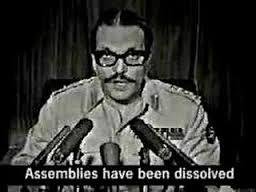
But thats not what triggered this post. What triggered this post is the notion that all this is itself a symptom of that good old social phenomenon “things fall apart”.  It used to be the case that a general would just poke the president in the ribs and send him on his way (Sikander Mirza, literally poked in the ribs to encourage him to leave) and the political class and civil service would (overwhelmingly) fall in line and take orders. That was in “old Pakistan”. That fell apart in 1971, but new Pakistan retained the institutional characteristics and ideological peculiarities of old Pakistan (in fact, they became more concentrated once the inconvenient Bengalis exited Jinnah’s dream palace). General Zia conducted his coup without any fuss. Sure, he then had to hang Bhutto and flog tens of thousands to keep the show on the road, but at least the civil service remained fully loyal (Roedad Khan rising to become secretary general of the interior before retiring and writing about dreams going sour and now joining Imran Khan!). Generals Aslam Beg and Waheed KakaR did their thing via President GIK but by 1999 things were messier. At least one general went along with an attempted pre-emptive strike on the army by the prime minister before the old ways prevailed. But even that was smooth sailing compared to this farce. Now the army chief may not even be the main conspirator! Retired generals and (perhaps, if even half the rumors are true) some soon to be retired ones are trying one thing, the chief is trying another. The good old bureaucracy has long since splintered into various camps. The police is looking shaky. Old reliables of the deep state are present on all sides of the “revolution” and cannot seem to agree on one deep state script. The corrupt politicians are proving surprisingly resistant to “positive change”. Journalists are in opposing camps. Media houses are openly fighitng each other. Even the main actors (Imran Khan and Qadri) dont seem to be on the same page. And to top it all, Punjab has one set of priorities and all the other provinces seem to have very different ones, not just amongst the people (where it was always thus perhaps) but even among the leaders of those provinces. Even the Taliban are not united any more. Is this a good sign or a bad sign?

In the short term, it must count as a bad sign. Whatever your politics (and if you are reading this in English on the internet, your politics are likely to be either paknationalist or leftist…or both; cognitive dissonance is not just a river in Egypt) the country as a functioning state needs certain institutions to function at bare minimum levels. Last year there was even hope that in Pakistan those institutions may be strengthening and may now include a superior judiciary, an election commission and a parliament, but thanks to Imran Khan and his “youthful” supporters, all that has been delegitimized very thoroughly. Still, that is India-level dreaming, forget about that. What about having a police force and a civil adminstration? what if you no longer have those either? that has not happened yet, but both are being battered as we speak. No big deal you say. They are corrupt, incompetent and useless anyway…mostly true, but then, they are all we have. What happens when they are gone? Some army officers and their cousins (which covers most of the Punjabi middle class) are probably going “you forget the army”, but no, I didnt forget them. The army is the pride of Pakistan. Still disciplined, united, well armed, etc etc. But there has NEVER been a martial law in which they actually ran things at the local level. The country has always run (and never run too well, but it is what it is) using the civilian instittutions of the British Raj. Ideally, the aim would have been to remodel them over time into improved versions suitable for an independent democratic country, but what with ideological confusion and martial laws, that never really happened. So OK, they are pretty bad by now, even compared to British Raj standards. But they are all there is. Lose them and its over, Even if root and branch replacement is someone’s aim, no replacement actually exists, so the question is academic.
Are we heading for that point? Please give your opinion in the comments.
My own feeling: we are headed that way and if this goes on, it could become irreversible. I am an incorrigible optimist, so I dont think its too late yet. If MNS survives AND actually learns some lessons and rules a little better (less reliance on police and gangsters, more inclusive and responsive government) AND his victory pushes intelligence agencies a little on the back foot, then institutions may come out a little stronger and more secure. But that seems increasingly unlikely (perhaps it always was, I dont know). If he does not survive this and we are to host the Bangladesh model, then things will look better for a few months (at most), then decay much faster than before as the emperor is seen to have no clothes. That will then lead to Paknationalists “doubling down”, with the possibility that the full Chakwal solution may finally be attempted. Provinces will be broken up, political parties will be decapitated. “Bad journalists” and intellectuals will be arrested or exiled. The ideological vacuum will be filled with Paknatinalism, which is just too shallow and confused a construct on which to base a successful state. Chaos and/or war with India will follow as the cart follows the horse.
Too pessimistic? What do you think?

The old article from 2012 follows.

PAKISTAN: FAILED STATE OR WEIMAR REPUBLIC?

by Omar Ali

I recently wrote an article with this title that was triggered by a comment from a friend in Pakistan. He wrote that Pakistan felt to him like the Weimar Republic: An anarchic and poorly managed democracy with some real freedoms and an explosion of artistic creativity, but also with a dangerous fascist ideology attracting more and more adherents as people tire of economic hardship and social disorder and yearn for a savior. While the Weimar comparison was new to me, the “failed state” tag is now commonplace and many commentators have described Pakistan as either a failed state or a failing state. So which is it? Is Pakistan the Weimar republic of the day or is it a failed state?  For my initial answer, you can read the article in the News, but when that article was circulated among friends, it triggered some feedback that the blog format allows me to use as a hook for some further discussion and clarification.

Some friends disagreed with my contention that Weimar Germany was too different to be a useful comparison. Germany and Pakistan may indeed be apples and (very underdeveloped) oranges, but the point of the analogy was that the current artistic and creative ferment in Pakistan is not sustainable and just as the Weimar Republic fell to fascism (not to state collapse), Pakistan’s current anarchic spring is a prelude to fascism.

It’s a fair point, but I think the crucial difference between Pakistan and Weimar Germany that I should have highlighted is the decentralized and broken up nature of the polity, with so many competing power centers that it is very hard to imagine a relatively modern fascist takeover (which, I assume, is the danger we are being warned against).

To make this point clearer, let’s look at the power that is supposed to be the agency of incipient fascism in Pakistan; Liberals who fear a fascist takeover almost universally regard the military high command as the center of this fascist network. They may regard the Jamat e Islami, with its long history of organizing thuggish student and labor wings, its close alliance with the jihadist faction of the army, and its systematic (islamicized) fascist ideology, as the ideological center of such a takeover. But they expect the army and its intelligence agencies to be the actual executors of Pakistani fascism.  Thus, they point towards army apologists like Ahmed Qureshi and Zaid Hamid as propagandists who are preparing the ground for this supposed takeover.

But a closer look reveals a vast gulf between anarchic and incompetent reality and slickly presented “paknationalist” propaganda. The army’s “Islamist-fascist” wing has been pushed back by 10 years of American vetting of the high command that makes it hard to imagine a successful Islamist version of fascism. Of course, some leftists accept that, but believe that the threat was never from “Islamo-fascism”, but from good old fashioned fascism in the German and Italian mode, led by army officers in Western uniforms, not by the beards and their gangs. But that leads to two other problems; one is ideological, i.e. what will be the ideology of this fascist takeover? In Germany and Italy it was German and Italian nationalism, but Pakistani nationalism minus Islam is still too incoherent to be useful for this purpose (which is why the small sliver of educated westernized paknationalists who flock around army websites are so ineffectual and confused). But the critical missing component is not ideology (which can be created from very thin gruel if needed), the critical missing component is capacity; the army cannot even control its own agents in the tribal areas and South Punjab. It could not fix the electrical grid after running the system unchallenged by civilians for almost ten years. Its ministers and trouble-shooters ran a semi-functional Pakistan Railways into the ground during a similar period of direct military control. Even during martial law, they are forced to make deals with corrupt and useless politicians to keep other corrupt and useless politicians at bay. This, in short, is the gang that cannot shoot straight. They may be more capable in some areas than their detractors imagine (witness the efficient handling of the Raymond Davis families by the ISI or their ability to make nuclear bombs or advanced aircraft) but they really cannot make the trains run on time even if they do take over again. Their strong points are limited to a few areas (very good at milking their foreign patrons, for example) but their weak points are far too many and are getting worse. The threat is less serious than imagined.

 A lot of feedback comes from the opposite extreme: the people who are convinced that Pakistan is on an unstoppable slide to disaster. To these people, the army is less capable than I indicated. Since they believe that all other institutions have already become junk, the army is the last wall standing between the current disorder and total state collapse, and the army is not immune to decay. Since the army has been ruling the country in one form or the other for decades, it has become politicized and discipline, morale and professional competence are deteriorating. Add to that the fact that the army is now fighting a civil war against the very elements it created and lionized for years and is doing so without any ideological framework beyond conspiracy theories about Hinjews and CIA agents. This situation is not sustainable and the army itself will crash and burn at some point, with horrific consequences. Meanwhile, the country is splitting further on ethnic and sectarian lines and is always one step away from economic chaos. No one, not the army, not the mainstream political parties, not the intelligentsia, has a coherent framework in which they can disengage from Islamist millenarian dreams and rebuild the country as a more normal country “developing” country.

Again, some of the points are fair points, but I think the doom and gloom may be exaggerated. First of all, it is very hard to break up a modern post-colonial state. It’s been done, but it is not easy and it is not the default setting. The modern world system is heavily invested in the integrity of nation states and while some states do fail in spite of that, this international consensus makes it difficult to get agreement on any rearrangement of borders. In most cases, distant powers as well as surrounding neighbors find it more convenient to find ways to compromise within existing borders. Even a spectacular failure, like the collapse of the Soviet empire, actually ends up validating already existing borders rather than creating entirely new ones. The supranational structure of the Soviet Union collapsed, but its component nations remained almost entirely within their existing borders. In this sense, Pakistan does not have 4 separate ethnically and culturally distinct units joined by weak supra-national bonds. Even an extremely unhappy component like Baluchistan is not uniformly Baloch. In fact, Balochis are probably no more than half the population of that province. Sindh contains large and very powerful Mohajir enclaves that do not easily make common cause with rural Sindh. More Pakhtoons live in Karachi than in the Pakhtoonkhwa capital of Peshawar. Economic and cultural links (especially the electronic media) unite more than they divide. If nothing else, cricket unites the nation. In addition, the reach of modern schooling and brainwashing is not to be underestimated. Even in far flung areas, many young people have grown up in a world where Pakistani nationalism is the default setting.

Economically, the country is always in dire straits, but agribusiness and textiles are powerful sectors with real potential. More advanced sectors can easily take off if law and order improves a little and irrational barriers with India are lowered a little bit.  The nation state is not as weak as it sometimes appears to be.

 So much for the optimistic version. Since this is a post about Pakistan, it cannot end without some pessimism. The most dangerous element in Pakistan today is not the Islamist fanatics. It is the rise of China. Not because the rise of China threatens Pakistan or because Chinese hyper-capitalism or cheap Chinese products threaten our industry or our social peace or any such thing, but because it may inflate the egos of the military high command to the point that they lose contact with reality and try a high jump for which we are not yet ready (and may never be ready). It’s not that the high jump will get anywhere, but that the attempt may lead us into more trouble than we can handle.

 I say this because GHQ, for all its pragmatic pretensions, has been known to overestimate their skill and underestimate their opponents.  If China was not truly a rising power, and if Pakistan did not have some real assets and advantages, we might have been safer in the long run. But since there is an element of truth in the paknationalists notions about China and the changing global balance of power, they may lose their balance.  All I am saying is GHQ is prone to flying off on a self-generated hot air pocket even when the situation does not encourage such optimism. When the situation actually has some positive aspects, there may be no restraining them. But, I remain an optimist. I think our own weaknesses may protect us from the fate of a much stronger and more capable country (Germany in 1940).

– See more at: http://www.3quarksdaily.com/3quarksdaily/2011/03/pakistan-failed-state-or-weimar-republic-omar-ali.html#sthash.0aDDDW0f.dpuf

“They have stormed the PTV office”

…..200 supporters of Qadri seized the PTV building……”They
have stormed the PTV office”…news anchor said just before the screen
went blank…..”PTV staff performing their journalistic duties are being
beaten up”…….Khan, who
like Qadri has since 15 August been living on the streets…..frequently
alluded to a “third umpire”….send Sharif home…veiled
reference to the army…..

….

….
This is looking like the beginning of the end. How long is it before Nawaz Sharif departs for Saudi Arabia. This guy is likely to be de-throned for the third time…this has to be a record of some sorts. The closest analogy we can think of is from the fictional depictions of Latin America a few decades back when there would be a musical chair full of supreme rulers which ever way you look.

One thing is for sure, we would not like to tangle with that youngster – the one in the fore-ground with an intense look and a thick stick – down a dark alleyway.

Here is our revenge in a teacup proposal. After the PTI-PAT combo comes to power, can the Sharif brothers return the favor by invading the inner sanctum with their supporters? The country will by then have moved to a permanent chaotic state. The new mind-set is as follows: why bother to co-operate in the national interest, when you can be in opposition and have fun all the time.
…….
Anti-government protesters pushed further into sensitive areas
of the Pakistani capital on Monday, briefly taking over the state
broadcaster and forcing it off air.

……
The police force, under orders
from the beleaguered civilian government, did little to prevent
thousands of supporters of former cricket star Imran Khan
and populist cleric Tahir-ul-Qadri from entering a compound containing
many government ministries in Islamabad and the offices of the Pakistan Television Corporation (PTV).

The
all-powerful army had decreed on Sunday night that the government
should not use force against protesters following clashes on Saturday in
which three people died and hundreds were injured.

The weekend
violence had been triggered when Qadri and Khan ordered their followers,
who had been camped on a road in a high security area of the capital
where government buildings are located, to storm the prime minister’s
residence although ultimately they only succeeded in flooding on to the
lawns of parliament.

On Monday more than 200 supporters of Qadri seized the PTV building, reportedly seizing weapons from security guards. “They
have stormed the PTV office,” a news anchor said just before the screen
went blank. “PTV staff performing their journalistic duties are being
beaten up.”

Army troops also refused to use force and protesters were free to simply mill amid the large troop deployment in the capital. Instead army soldiers asked the crowds to leave restricted areas and not enter government ministry buildings. Eventually, protesters were also persuaded to leave PTV, which then began broadcasting again.


All
sides of the dispute are treating the military with extreme caution and
respect. On Sunday it published a statement saying it was “committed to
playing its part in ensuring security of the state” but wanted the
situation to be “resolved politically without wasting any time and
without recourse to violent means”.

Many protesters say they hope
the army will step in to support their cause by either seizing power or
at least ordering prime minister Nawaz Sharif to step down, just 15
months after he was elected in a huge landslide victory.

Khan, who
like Qadri has since 15 August been living on the streets in a
specially modified sea container, has in his many speeches frequently
alluded to a “third umpire” who will send Sharif home – a thinly veiled
reference to the army.

Although the military has directly ruled
Pakistan for half of its history, and wielded enormous power behind the
scenes even when civilians have nominally been in control, many analysts
doubt the army wants to oust the government.


While senior
generals have repeatedly clashed with Sharif over the past year, an
unconstitutional removal of the government would jeopardise billions of
dollars of much needed US aid.

It is widely suspected however that
the army will attempt to use the crisis to clip the wings of Sharif,
who has defied the top brass by ordering a high treason trial for former
military ruler Pervez Musharraf and by pushing for better diplomatic
and trade relations with India.

But even though the military
appeared to be trying to remain as an independent arbitrator between the
two sides the extraordinary television pictures of troops flooding on
to the streets highlighted the government’s growing vulnerability.

Many
of the soldiers were members of the 111 Brigade, which has been
responsible during past coups for grabbing government buildings – in
particular the offices of PTV. On Monday morning large numbers of troops were seen pouring into the office block in central Islamabad.

The
mornings have generally been quiet during the two-week long crisis that
has gripped Pakistan’s capital with political speeches and rallies
largely being held in the evening. But just before 9am the crowds
began to once again try to remove sea containers placed on roads leading
to the prime minister’s house. Despite the use of teargas and shooting
into the air above the protesters the police were unable to stop the
crowds moving to various areas around Islamabad’s Red Zone.

Khan
said attempts to negotiate had collapsed because the government had
refused to meet his main demand that the prime minister should step
down, even just temporarily whilst a commission of inquiry investigates
last year’s election that Khan claims was rigged to deprive him of
victory. 

While the May 2013 election was not without
irregularities, no independent election monitoring group has supported
Khan’s claims of massive rigging that would have changed the overall
result.

On Monday Khan said he would not call off the protests. “I
call upon my workers to remain peaceful,” Khan said from atop a
shipping container at the main rally site. “Do not carry out any acts of
violence. God has given us victory.”

……

Link: guardian.com/pakistan-protesters-prime-minister-nawaz-sharif-islamabad

…..

regards

Saving the Incompetent Sharif Brothers and this Rapacious Unfair System

Embedded image permalink

We know from history that the skill, wisdom and effort (and oodles of luck) needed to build and sustain a working democratic system (whatever you may think of the pros and cons of such a system is a separate and interesting discussion) in one of the ex-colonial countries is orders of magnitude greater than the skill needed to just run a functional government for a few years. Saddam, Gaddafi, Ayub Khan, they all ran functional regimes and even made their Universities conduct their examinations on time. But none had a system with adequate checks and balances or the mechanism to transfer power smoothly from one elite clique to another without having to shoot the other clique first.
It may be possible to repair the effects of poor governance by this or that democratic regime in a few years, but if the system as a whole is undermined and devalued, then it may never get working again, or may take decades to repair. Political authority (like money) is a shared (useful) illusion. Puncture the illusion and what is left is naked force (or, if enough of asabiya exists, a monarchy; whether called a monarchy or under some other name).

Given our history, it is a significant achievement that all parties participated in a reasonably (by our standards) fair election under reasonably (by our standards) neutral caretaker administrations and an actual transfer of power took place peacefully. All that progress can be (and is) being undermined by this sustained campaign against democracy and civilian politics (with TUQ playing a conscious and Imran Khan a characteristically semi-conscious role in the undermining). That the Sharifs are not the best rulers is hardly debatable, but that the system should be wound up on that account is a disastrous step beyond the punishment of the Sharifs for any specific crime or misdemeanor. They must be removed from within the system or else they must be tolerated for their term. There is no third choice.
We know very well from our history that the next step in the paknationalist (aka PMA) framework is a “technocratic government of all talents” and we also know that in short order that will prove worse than the poor Sharifs and will lack even the rickety checks and balances that limit the damage done by the Sharifs or any other democratically elected crook. Beyond that, we also know that the institutional biases of the Pakistani army in particular are utterly opposed to the rights of smaller nationalities and are determined to pursue suicidal and extremely disruptive policies with respect to relations with our neighbors and with the wider world. The Sharif brothers dalliances with ASWJ notwithstanding, it is the army that is most responsible for creating and sustaining various sectarian and islamofascist tendencies in the body politic. For all these (and other) reasons, this latest farcical soft coup is very bad news.
Finally, it is good to keep in mind that it is not all fun and games…there really IS a bottom. One fine day the whole shithouse could go up in flames (as East Pakistan did in 1971); and what follows could then cause significant discomfort even to those whose low opinion of the Sharifs or of bourgeois politics or of the current politicians, makes them look kindly upon any disruption to the system…
I would add that I have come around to agreeing with those who think that NONE of the major VISIBLE players really had a detailed plan or a script that has been faithfully followed during this farce. But that does not mean that there is no one with a coherent agenda. There are people with coherent agendas and they make hay while the sun shines on Imran Khan’s empty chairs. Just as the ASWJ terrorists are pursuing their agenda, the “Paknationalists” in the intelligence agencies are pursuing theirs. Sharifs (including Raheel Shareef) may have no plan and may be blundering in the dark, but some people have plans and most of them are dangerous…

Embedded image permalink

Bangla ferry goes down (again)

So….about 100-150 dead in Munshiganj district (30 km south of Dhaka) off Mawa Ferry Ghat on the Padma river. 
…………..

….
This is two months since the last disaster. One year after disaster struck at (near) the same spot. Three quick thoughts that we deem to be fit for sharing.
……..

……
1) In Bangladesh, waterways are basically roadways. Thus one can rationalize the ferry deaths as just the same as horrific road accident deaths in other countries (including India). But the sinking reports always look very similar: boat was overcrowded, river was rough..etc.

Bangla should be heavily investing in “water traffic control”- sensor networks, for example, which provide early warning to boats to pull over if travel conditions are poor. Sensor networks have been used extensively on Indian railways (for landslide monitoring for example in the Western Ghats- Konkan Railway) and we can point to the many advantages of such installations (low cost, reliable).

As far as overcrowding goes this must be regulated. All it requires (we imagine) are surprise inspections by traffic inspectors and immediate impounding of the vehicle (and fixed jail terms) if there is evidence of overcrowding.
…..
2) Where is the outrage? Every few months go by and one more ferry sinks, are human beings counted so cheaply? Bangla politics is really screwed up because of the bitter, battling Begums  but surely some disasters should lead  to a national unity moment? There would be some one, one would imagine, in a nation brimming with 160 million proud people (and millions in diaspora), who would put their hands up and say “never again.”

3) We often wonder what is the motivation for (religious minded) terrorists to kill us? As it is in South Asia countless people die enough un-planned deaths through acts of God, is there really any room for additional planned deaths delivered by HIS agents?

Such a state of affairs should evoke deep compassion (and self-reflection). Focus (if you must) on why God chooses to punish us with these terrible thunder-bolts.  

But it seems people would rather prefer violence as the path to un-settle “settled facts.” The numerous partitions stand testimony to our resolve to solve problems to which there are no permanent solutions excepting mass genocide or ethnic cleansing.

We really should learn to say “never again”….if we were smart enough that is…or if our leadership had any foresight. Too bad, WE are not smart enough, and THEY are as blind, willfully so.
……
A ferry with
about 200 passengers aboard capsized on Monday in the river Padma
southwest of Dhaka and rescue teams took about half of them to safety,
the chief of the district administration said.


Mohammad Saiful Hasan
Badal, Deputy Commissioner of Munshiganj district, said about 100
passengers had been rescued from the vessel, identified as the MV
Pinak-6. No deaths had yet been reported.

Teams
from the Bangladesh Inland Water Transport Authority, fire brigade and
the army were engaged in the rescue operation about 30 km (18 miles)
southwest of Dhaka.

“Most
of the passengers were coming back to the city from home after
celebrating Eid-al Fitr,” Saiful told Reuters, referring to the festival
marking the end of the Ramadan fasting month.

A
similar capsize occurred in May, when 54 bodies were recovered from a
vessel that went down with around 200 people on board. Low-lying
Bangladesh, with extensive inland waterways and slack safety standards,
has an appalling record of ferry accidents, with casualties sometimes
running into the hundreds.

Overcrowding is a common factor in many of the accidents and each time the government vows to toughen regulations.

In March 2012, a ferry sank near the same spot, killing at least 145 people.
…..

Link: http://www.theguardian.com/world/2014/aug/04/bangladesh-ferry-capsizes-250-passengers

……

regards

“Crossing the river by feeling the stones”

…..what Zia claimed to base his economic policies was ‘social
justice’….
involve economic growth…..stable prices and macroeconomic stability…..safety nets such as
food vouchers for the needy….programmes for human development….development of the marginalised sections.
….Social justice, I would contend, is what Sen says Bangladesh is better at than India……
……………

……
Blogger-badshah and king of economists Jyoti Rahman makes the (convincing) case that Ziaur Rahman is the true father of modern-day Bangladesh, whose efforts have directly contributed to the (relatively) advanced social parameters as well a number of foreign policy achievements.  

Indeed JR goes so far as to state that Bangladesh can be an inspiration to all the struggling Arab countries/people.
……….

….
Paraphrasing JR, while ZA Bhutto promised Islamic socialism in Pakistan, Ziaur Rahman actually implemented the same in Bangladesh; Sheikh Hasina (current PM) is now promising Islamic secularism. Perhaps Imran Khan will be better inspired by looking east instead of west.
……

The problem we have with Zia (and the other Zia as well) is that he rejected the concept of a secular republic. [ref. Wiki] The secularism principle was removed from the constitution in 1977 by Ziaur Rahman and declared Islam as the state religion. In 2010, Bangladesh Supreme Court restored secularism as one of the basic tenets of the Constitution but also kept Islam as the state religion.  

While such a step may have been considered to be pragmatic (80% muslim pop) the practical impact has oscillated between bad and (mostly) worse.

While Islamic socialism/secularism has been good for Bangladesh it has not been so good for its Hindu minority which has pretty much one viable option: surrender your property and move to India. It has not really mattered which regime was ruling, military or civilian, Begum (1) or Begum (2). At least when the Bangladesh National Party (BNP) is in power, the atrocities against Hindus are highlighted (by Awami League aligned liberals). In contrast when the communal fires burnt recently in Jessore and in Chittagong there was not much ink spilled (analog or digital).

Also this. The only people in India who care to talk about ethnic cleansing of Hindus in Bangladesh are the Hindutva brigades. The fall-out from this (in the states/districts bordering Bangladesh) has been fairly predictable. As the (mostly) secular left fades away, the communal right is taking its place. Today, migrants from Bangladesh are under the gun everywhere (often literally, as in Bodoland).

Unless people find a way to reconcile thousand year old hostilities and neutralize poisonous ideologies, things will go from bad to worse, everywhere.
………………….

Had he not been killed in 1981, Ziaur Rahman would have been 76
today.  Despite the twists and turns of politics, over three decades
from his death, when things actually work in Bangladesh, they work along
the path set by this military strongman turned a very popular
politician.  And they work because the politics of synthesis crafted by
Zia had continued from the work of his predecessors, and his successors
saw the merit in keeping them.


….
Amartya Sen has noted how Bangladesh has better social indicators than
India despite having only half the per capita income.  This theme has
been picked up by a number of 40th anniversary pieces that note that
Bangladesh has done pretty well when it comes to human development,
despite unfriendly nature and dysfunctional politics.   

As it happens,
the beginning of pretty much all the examples of ‘good results’ recorded
by Bangladesh can be traced to the Zia era.


Take
population control for example.  In the 1970s, population was growing
by 3% a year, and was expected to double to 150 million by the
mid-1990s.  That has been delayed by well over a decade, and population
growth rate is now between 1-1.5%.  At the time of
independence, Bangladeshi women on average had 7 children.  By 2008,
according to the World Bank, fertility rate had fallen to 2.3 — close to
replacement level that stabilises population.  


….
And unlike in China or India, the decline in fertility rate hasn’t
been accompanied by grotesque discrimination against female infants
(effectively female infanticide in places). 
In fact, on metrics related
to living standards of poor women, Bangladesh tend to pretty well
compared with its peers.


….
The reason for this includes concerted government efforts — something
again initiated by the Zia regime, and continued by everyone since. 
But activities of the NGOs and the emergence of the ready made garment
sector have also played their part.   

Of course, both the first Aarong
shop and Desh Garments (first RMG factory) started when Zia was the
president.


What about self sufficiency in food?  The green revolution came to Bangladesh under Zia.


What about the remittance boom that has kept Bangladesh afloat for the past decade?  The Gulf labour market opened under Zia.


….
I would contend that Zia succeeded not because his task was easier,
but because he was a pragmatic technocrat who eschewed ideology and
grandiosity, and adopted ‘whatever works’.  Thus, for example, he
facilitated the NGOs to expand not because there was an ideological
dispensation for it, but because he recognised that these agencies were
providing a service that the state machinery was incapable of
delivering.


….
From all accounts, Zia’s pragmatism seems to be
heavily influenced by Deng Xiaoping’s philosophy of ‘crossing the river
by feeling the stones’.


Instead, what Zia claimed to base his economic policies was ‘social
justice’
– সামাজিক ন্যায়বিচার in Bangla.  Now, social justice has never
actually been defined formally.  But we can guess what he would have
meant by this from the policies and developments adopted and initiated
under his watch.


….
I would contend that social justice would involve economic growth,
which translated into jobs and income from the rural and urban poor and
less affluent classes.  I would contend that social justice would mean
stable prices and macroeconomic stability.  I would contend that social
justice would mean government programmes that ensure safety nets such as
food vouchers for the needy. 

…..
Social justice, I would suggest, would
involve active government programmes for human development, and
particularly development of the marginalised sections of the society.


….
Social justice, I would contend, is what Sen says Bangladesh is better at than India.


….
Interestingly, across the Muslim world, parties that are coming to
power with popular mandate seems to contain ‘social justice’ or related
terms such as welfare or development in their names.  It seems that
Ziaur Rahman pioneered a synthesis that is still all too relevant not
just in Bangladesh, but in other similar countries too.

…….

Link: http://jrahman.wordpress.com/2012/01/19/the-politics-of-synthesis-2-society-and-economy/

……

regards

Leaving the Left Behind

Professor Jamal Naqvi, one of the stalwarts of the Pakistani Left, recently wrote a book about leaving the Left behind. it has caused a stir..

Story of a Pakistani communist

In defense of Jamal Naqvi

Extracts: The fact is that Leaving the Left behind is the first book in Pakistan that confronts fundamentalism and defies the dogma of the left. Naqvi, who dominated the policymaking body of the left for the most part of the 1970s and 80s, has spared no one with his characteristic crisp and sharp wit….


The left now cannot insist on shallow economic ideals. Pursuing a social, cultural renaissance and working to promote liberal democracy in the country might redeem some of its lost pride. Capital is neither an ideology nor a system of faith. Confronting it with an ideology by assuming rigid sets of economic archetypes coupled with an absolute path of development is not a great idea to follow…

Story of a Pakistani communist
http://tns.thenews.com.pk/story-of-jamal-naqvi-pakistani-communist/#.U8VgIJRdV8E

Extracts from this review:
His autobiographical account has been published recently under the title Leaving the Left Behind, which is self-explanatory. If someone wants to know more, he can read the subtitle “An autobiographical tale of political disillusionment that took the life’s momentum away from the myopic politics of the Right and the Left to the enlightened concept of Right and Wrong”…..


With nine chapters and two appendices in this 264 page volume, the 81 year old Jamal Naqvi has shared all that he had to with his comrades. You may not agree with him but it is important to acknowledge this wise effort. We hope our elders in the movement would follow his example and give us a chance to read more about our common past.

Elegy for a comrade who lost his way

I come now to what is the central issue in the book (and provides its title, Leaving the Left Behind). A subsidiary issue is the standpoint he adopted after leaving the Left behind. I do not wish to say much about his new standpoint, but for the benefit of those who will not read the book I will make a brief mention. On the new standpoint that he now adopted, Naqvi writes: ‘I was always a democrat [but] my actions were not in conformity with my  beliefs, and standing between the two was an ideology [Communism, Marxism] that put blinkers on my eyes…’ (p.180). The new vision that he now saw on his road to Damascus was that of abandoning ‘the myopic politics of Left and Right’ for ‘the enlightened concept of Right and Wrong’ [front cover blurb]. Note that Naqvi’s ‘democracy’ without Left and Right is in fact nothing but democracy without politics; and he treats Right and Wrong as universal concepts so that that what is ‘right’ (or ‘wrong’) for the oppressor is also ‘right’ (or ‘wrong’) for the oppressed. Sadly, Naqvi has retreated into a world of abstractions. …


…To return to the question, is capitalism a fair and just system?  Marx never talked about fairness and justice of a political and economic system. What he thought of capitalism was stated plainly in the Communist Manifesto. Capitalism is a highly productive system. ‘The bourgeoisie cannot exist without constantly revolutionising the instruments of production.’ At the same time, for the capitalist labour is and will always remain a cost of production which it must try to minimise in order to maximise his profit. Class conflict is inherent in the system. 

IA Rahman’s review of the book

Professor Naqvi does himself much wrong when he declares his life “an utter waste.” One hopes he is not referring to any failure to realise a personal ambition — that would be contrary to the creed he followed for decades. He should be happy with what the Left in Pakistan achieved despite being a target of tyrannical rulers, the contributions it made in reinforcing the peoples’ commitment to democracy, federalism, civil liberties, rights of women, labour and religious minorities. On a personal level, he should be happy to have fulfilled his duties as “a hard core family man,” something Nazeer Abbasi, Hasan Nasir and scores of other party workers and sympathisers could not even dream of.


In the next edition, the professor may explain what is meant by taking “life’s momentum away from the myopic politics of Right and Left to the enlightened concept of Right and Wrong,” because those practicing the politics of the Left believe that they uphold the concept of “right” (an end to inequities) and reject “wrong” (the exploitation of the underprivileged).

I wrote an off-the-cuff comment of my own on this discussion on facebook and apologize in advance for the lack of intellectual depth and rigor (That would take more time and effort than I am capable of right now, but I look forward to enlightening comments from more qualified people)…
in liberal democracies (and even in relatively liberal dictatorships), leftists are the personality type that is anti-authoritarian, pro-humanist, progressive and pro-reason. That does not mean they are always humane, progressive or reasonable, but those are their instinctive sympathies. Marxism (especially as developed by Leninist parties…and that was the default position for a century, even among those who thought they repudiated Leninism) channeled these worthy instincts into disastrous and atrocious byways for a century. In an another hundred years, it will be seen as one of the great disasters of human history…its appeal to certain emotions (mostly negative emotions, like envy, jealousy, fake self-esteem, lazy dogmatism, etc) ensured its popularity and it provided generations of intellectuals with the illusion that they (in many, not all, cases; lazy, incompetent, personally vindictive and small-minded people) were the lonely heroes of history, struggling to overthrow the tyranny of evil men. That was another of the poisonous gifts of this ideological current. The worst, of course, was the fate of those societies where this current (usually in combination with an unusually incompetent and venal ruling elite) reached critical mass and managed an actual revolution. In EVERY case (except maybe Cuba, where the corrupt elite collapsed with such little bloodshed that the worst excesses did not play out) it led to horrendous suffering and disastrous dictatorships and cultural setbacks from which many countries have yet to recover…..


which is not to say that “Leftists” did not do anything good. far from it, all positive movements of the last 100 years (anti-colonialism, anti-racism, feminism, prisoner’s rights, gay rights, human rights, etc etc) had leftist support. But that support worked best when it was in countries where the “left’ was in no position to actually cause a revolution….

My friend Ajit immediately wrote: Omar, as an ex-Communist myself, I would have to differ with you on your characterization of the left as “anti-authoritarian” (hah. try joining an actual left organization), “humane” (really ? You must be talking about the coffeehouse intellectuals – even those become decidedly non-humane when some inconvenient truths are brought up) and pro-reason. (Actually being truly pro-reason is a quality vanishinhly few humans possess, so this cant be held against the left alone.)

To which i responded: I was indeed talking about coffee-house intellectuals and about a lot of ordinary people who gravitate leftwards..not so much about actual party workers. 
In defence of Jamal Naqvi

Brown Pundits