
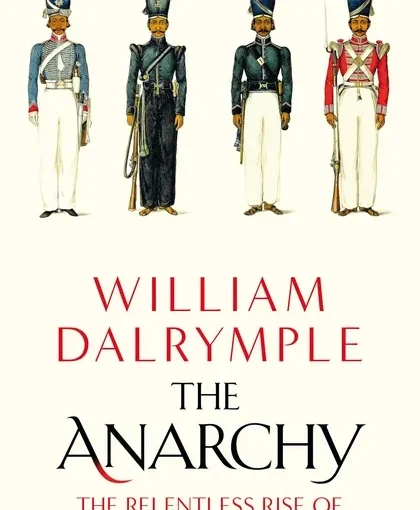
Since there has been some discussion of the Dalrymples recently, I am sharing this book review.
William Dalrymple is one of the foremost historians of colonial India, known for works such as White Mughals, The Last Mughal, and Return of a King. His latest work—The Anarchy: The Relentless Rise of The East India Company (Bloomsbury 2019)—continues in the tradition of popular history, telling the story of the East India Company’s conquest of India following Lord Clive’s 1757 victory over Siraj ud-Daula, the Nawab of Bengal, at the Battle of Plassey. The book ends with the Company’s conquest of Delhi in 1803 and the defeat of the Marathas—the last Indian power capable of resisting the British. The Company would rule India until the aftermath of the Sepoy Mutiny of 1857, when governance was transferred directly to the British Crown.
While we commonly speak of the “British conquest of India”, Dalrymple notes that it was not the British government that colonized India, but a private corporation, solely interested in maximizing its shareholders’ profit. In the Epilogue, he succinctly explains his book’s thesis, writing:
The East India Company remains today history’s most ominous warning about the potential for the abuse of corporate power–and the insidious means by which the interests of shareholders can seemingly become those of the state. For as recent American adventures in Iraq have shown, our world is far from post-imperial, and quite probably never will be. Instead Empire is transforming itself into forms of global power that use campaign contributions and commercial lobbying, multinational finance systems and global markets, corporate influence and the predictive data harvesting of the new surveillance-capitalism rather than–or sometimes alongside–overt military conquest, occupation or direct economic domination to effect its ends (397).
Continue reading Review: The Anarchy: The Relentless Rise of the East India Company