……by the 1990s, genocide had a “super stigma,”
….as the international court
for Rwanda put it, it was the “crime of crimes” …..
When it came to the Khmer Rouge, this development was only
complicated by the peculiar political usage of “genocide” in Cambodia…..In 1999, the UN Group of Experts announced…not take a position on“whether the Khmer Rouge committed
genocide with respect to part of the Khmer national group.” ……
….
…..
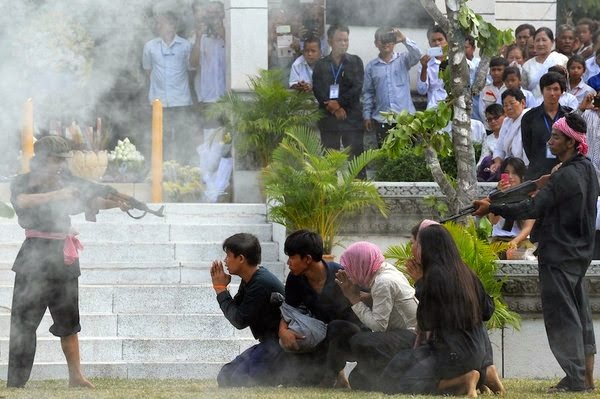
Cambodians are enthusiastic about play-acting to honor the memory of the victims of Pol-pot and company. We can sympathize as we sense that there will be a fuller sense of closure that way.
As far as justice is concerned…unfortunately all we have (again) is a lot of play-acting and word-playing and a bit of fore-playing (but much more expensive to enact at $220 mil…all those lawyer fees….).
We love international law. Majority community killing their own is not considered genocide. However, majority community killing minorities is appropriate for the g-tag.
Thus Chicoms killing 45 mil Hans is not considered suitable for the worst of the worst tag. Neither is the 30mil killed by Stalin and company. Not even the 3 mil Khmers killed by Pol Pot qualifies as genocide.
As a saving grace the 20k Vietnamese and 90k Cambodian muslims (Cham) killed by the Khmer Rougue may finally see some justice. Regardless of definitions, evil men need to be taken down by other (righteous) men on earth, not any supernatural agency.
Incidentally something which aroused our curiosity is the Cambodian word for genocide: prolai pouch-sas. We are no linguists but “prolai” in Sanskrit (used in Bengali as well) denotes a state of crisis (at the end of times level). Perhaps a person who knows will step forward and clarify?
………………
August 7 was supposed to be judgment day for the last two leaders of
the Khmer Rouge regime.
Thirty-five years after the end of Pol Pot’s
calamitous agrarian revolution, a United Nations-backed court in Phnom
Penh found the movement’s chief ideologue Nuon Chea and the former
president Khieu Samphan guilty of crimes against humanity and sentenced
them to life in prison.
On the lawn in front of the courtroom on the outskirts of Phnom Penh,
the mood was self-congratulatory. Deputy Prime Minister Sok An called
the judgment “a milestone” for the court and for Cambodia, which rebuilt
itself “from scratch after liberation from the genocidal regime, the
regime of horror.” David Scheffer, the UN Secretary-General’s special
expert to the court, said,
“Today, the winds of international justice
swept through the rice fields of Cambodia, through its cities, its
villages, its forests.”
Finally, some were saying, the Khmer Rouge’s top echelon was being
held accountable for a utopian folly that killed as many as two million
people. For what the US Congress once described as “one of the clearest
examples of genocide in recent history.” For what various American
officials — Hillary Clinton, Steven Rapp, Samantha Power — have also
called a genocide.
Except that neither Nuon Chea nor Khieu Samphan was convicted of
genocide on August 7. And the tribunal will never even consider that
charge in connection with the vast majority of the Khmer Rouge’s
victims, the Khmer people, who make up 90 percent of the Cambodian
population today.
When the Extraordinary Chambers in the Courts of
Cambodia, as this tribunal is formally called, does address genocide in a
second phase of the leaders’ trial, it will do so only in relation to
two Cambodian minorities: the Vietnamese and the Cham, a Muslim group.
This is an awkward development. Some 20,000 Vietnamese and 90,000
Cham are believed to have died under Pol Pot — compared to well over 1.3
million Khmer, according to the most conservative estimates.
One Khmer
woman, who lives in exile and travelled to Phnom Penh for the August 7
verdict, said that the court’s decision not to consider a genocide
charge on behalf of the Khmer left her feeling like victims were being
denied their “right to the precise term for what was done to us” — it
was as though “history had not been understood.” For Ung Billon, another
Khmer who is the president of a victims’ association in France called
Les Victimes du Génocide des Khmers Rouges and who also came for the
verdict, it was “an insult.”
And so even Cambodians who were relieved by the guilty verdicts and
especially the life sentences, like these two women, were left feeling
baffled, even betrayed, by the court’s handling of the genocide charge.
This is only natural. “Genocide” has been the term of choice in Cambodia
to describe Pol Pot’s regime for nearly four decades. It is the
characterization favored in schoolbooks and the local news, by
bureaucrats and lawyers.
In this respect at least, the ECCC is frustrating the very people to
whom it was supposed to bring resolution, recognition, and
reconciliation. Not only does the court’s narrow, technical definition
of genocide clash with the widespread popular understanding of the
crime, it also risks pitting different Cambodian communities against one
another.
There is, in fact, a simple explanation for why most of the Khmer
Rouge’s crimes, though widely thought to be a paradigmatic example of
genocide, both inside and outside Cambodia, are not actually that: the
1948 Genocide Convention, which codified the concept into international
law, deliberately ruled out its application to political pogroms and
class war — the signal crimes of Stalin, Mao, and Pol Pot.
That treaty defines genocide as killings, among other acts, committed
with the “intent to destroy, in whole or in part, a national, ethnical,
racial or religious group, as such.” This idea built on the word
“genocide” itself, a neologism combining genos (Greek for race or tribe) and cide
(Latin for killing), which the Polish lawyer Raphael Lemkin proposed in
1944, well into the Holocaust, to denote the deliberate “destruction of
a nation or of an ethnic group.”
But the language adopted in the
convention was also a compromise reflecting the power dynamics of the
day. The Soviet Union, for example, opposed including “political” in the
list of protected groups in the definition, presumably because it was
wary of getting into trouble for purging its opponents back home.
The Khmer expression for genocide, prolai pouch-sas, seems
to have first appeared when Cambodia ratified the Genocide Convention in
1950. But then it hardly was used, even within the learned elite; it
appears neither in the 1956 Cambodian penal code nor in the 1966
reference dictionary of Khmer compiled by the scholarly monk Chuon Nath.
And when the term became common in Cambodia, at least in official and
formal written language, soon after the Vietnamese toppled the Khmer
Rouge, it took on a meaning different from Lemkin’s original.
The Vietnamese communists, previously the Khmer Rouge’s patrons,
marched into Cambodia in late 1978, after vicious incursions by Pol
Pot’s forces into Vietnam and amid mounting evidence that his regime was
self-destructing. The Khmer Rouge went underground, and in short order
the Vietnamese tried some of the movement’s leaders in absentia, holding
what they called “the trial of the genocide crime of the Pol Pot-Ieng
Sary clique.” (Ieng Sary was the Khmer Rouge’s foreign minister then –-
and a defendant at the ECCC until he died last year.)
They turned the S-21 detention and torture center in Phnom Penh into a
showroom of horrors, with advice from curators in Eastern Europe. A
large sign calling the former prison the “Genocide Museum” was placed at
its entrance and inmates’ clothes were displayed in mounds, an
iconographic touch inspired by Nazi concentration camps.
All this made good political sense. The Vietnamese needed to justify
their occupation of Cambodia, and they needed to do so while
distinguishing the virtues of their communist ideology from the
perversions of Pol Pot’s vision. What better way than to cast the Khmer
Rouge regime as an aberrant form of communism and accuse it of genocide,
the Nazis’ defining crime?
Propaganda became even more necessary as the Vietnamese’s lightning
liberation turned into a lengthy occupation; their continued presence
risked rekindling many Cambodians’ ancestral anxiety about Vietnamese
expansionism — an anxiety so deeply engrained it had long been the
fodder of terrifying children’s fairytales. Schools were supplied with
new textbooks short on pedagogy and long on hyperbole. “The Pol Pot-Ieng
Sary clique killed more than 3 million people and completely destroyed
everything in Cambodia,” read one book intended for the second grade.
“We are absolutely furious and strongly struggle against these
atrocities.” January 7, the day in 1979 that Vietnamese troops seized
Phnom Penh from the Khmer Rouge, became celebrated as Victory over
Genocide Day.
However heavy-handed, the effort caught on. Prolai pouch-sas
roughly means to eliminate the lineage of a people or a nation, and
that definition echoed many Cambodians’ personal experiences under the
Khmer Rouge, according to Muny Sothara, a psychiatrist at the
Transcultural Psychosocial Organization, an NGO in Phnom Penh that
provides mental-health services, who has worked since 2007 with Khmer
Rouge victims involved in the trials. Pol Pot’s minions had seemed
intent on weeding out their enemies by “pulling them out roots and all,”
as one creepy Khmer Rouge saying went. The movement often targeted a
suspect’s entire family, group of colleagues, or community.
And so it was that almost as soon as the Khmer phrase for “genocide”
came to mean anything to Cambodians, it meant something both broader and
more precise than the destruction of a nation, ethnicity, race, or
religion “as such”: it meant the Khmer Rouge’s attempt to exterminate
Cambodians, mostly Khmer — their own group. (Kong Sothanarith, a
forty-something news editor at Voice of America, told me recently, “It’s
when I went into journalism that I realized the word meant almost
exactly the opposite of what I had been taught.”) And the term took. The
horror of the Khmer Rouge “genocide” was a rare matter on which
Vietnamese occupiers and Cambodian occupied could agree.
On April 30, 1994 -– while a bona fide genocide was raging
in Rwanda — the US Congress passed the Cambodian Genocide Justice Act,
which created the Office of Cambodian Genocide Investigations in the US
State Department, which in turn created the Cambodian Genocide Program
at Yale.
The idea was to document the Khmer Rouge’s crimes and at some
point prosecute them.
Very soon after that, the UN Security Council set up two tribunals to
judge abuses committed when Yugoslavia and Rwanda imploded — the first
international criminal courts since Nuremberg and the Tokyo trials.
The
notion of genocide finally had its day in court. (It had not be properly
adjudicated before, not even at the “genocide” tribunal that had tried
Pol Pot and Ieng Sary in 1979, which had used a legal standard of its
own making.) Meanwhile, in France, Germany, Spain, and Ethiopia,
legislators and judges were expanding the concept, sometimes
specifically to cover the destruction of political groups. Some legal
scholars were also trying to apply it to Cambodia: Pol Pot’s regime had
committed a genocide against the so-called “new people,” those urbanites
who were the prime enemies in its class war; its general onslaught
against Cambodians, a national group, could be called an
“auto-genocide.”
That the concept of genocide was stretched this way is a measure of
the cachet and clout it had acquired by then. After all, there was no
legal gap that needed filling: the Khmer Rouge’s crimes readily fell
under other categories, like crimes against humanity (a widespread and
systematic attack against civilians) or war crimes (severe mistreatment
of certain combatants and civilians during a conflict). And most jurists
would agree that international law establishes no formal hierarchy
among mass crimes.
But by the 1990s, genocide had a “super stigma,”
according to Patricia Wald, a US Court of Appeals judge who served at
the Yugoslavia tribunal. Or, as one chamber at the international court
for Rwanda put it, it was the “crime of crimes.”
When it came to the Khmer Rouge, this development was only
complicated by the peculiar political usage of “genocide” in Cambodia.
In 1999, the UN Group of Experts that had been asked to figure out how
best to try Pol Pot’s lieutenants — Pol Pot himself had died the year
before — announced that it would not take a position on the “complex
interpretive issues” surrounding “whether the Khmer Rouge committed
genocide with respect to part of the Khmer national group.”
And so when
the ECCC came into being in 2006, genocide was included in its mandate
(along with crimes against humanity, war crimes, and violations of the
Cambodian penal code). And under the court’s civil law procedure, it
would be up to two investigating judges to lead a factual inquiry and
determine how to characterize any crimes they uncovered — a
technical-seeming task fraught with high-stakes symbolism.
The Khmer Rouge leaders were arrested in 2007, and at first were
charged only with crimes against humanity and war crimes. (There were
four leaders at the time, but since then Ieng Sary has died and his
wife, the Khmer Rouge minister for social affairs Ieng Thirith, has been
declared unfit to stand trial because of dementia.) Genocide charges
were brought two years later, and only in reference to the Vietnamese
and the Cham.
Marcel Lemonde, who was the international investigating
judge back then, recently explained to me his office’s thinking on the
issue. He said that “troubling facts” unearthed during the investigation
suggested that the Khmer Rouge “may have intended to destroy the Cham
as Cham rather than as political opponents, and to destroy the
Vietnamese as Vietnamese rather than because the regime was at war with
Vietnam.” Not so with the Khmer population. “To establish that a
genocide occurred, a group needs to have been identified,” he explained,
“and that group cannot be the quasi entirety of the population –
otherwise the notion no longer makes sense.”
Still, it had been a difficult call. Lemonde and his Cambodian
counterpart, You Bunleng, feared that pursuing a genocide charge
exclusively on behalf of two small minorities would offend many
survivors and victims’ families. But Lemonde said that he and You
Bunleng, who was especially uncomfortable, decided they could not avoid
the issue by dismissing the genocide charge altogether at that stage.
Better to give it a full airing at trial and let the prosecution,
victims’ representatives, and the defense debate its merits and its
limits. Genocide, the ECCC’s marquee crime, had become a liability.
When the trial judges decided to segment the gigantic indictment into
smaller parts and stagger them, they postponed the genocide issue to a
later stage. (The recent verdict concerns only abuses pertaining to
various forced population transfers and the execution of officials from
the military government that the Khmer Rouge deposed in April 1975; the
next phase of the trial, which is expected to start later this year,
will include genocide, as well as crimes at certain work cooperatives
and security centers, internal purges, and forced marriage.)
Nuon Chea’s
lawyers challenged that decision. In an appeal last year citing “the
sheer gravity” of the genocide charge and its “special and privileged
role” as “an encapsulation of the Khmer Rouge period in the public
mind,” they asked that it be included in the first part of the trial.
Whether they really saw an opportunity to win an acquittal or simply
wanted to kick up some dirt, you know something is amiss when a
defendant is clamoring to be prosecuted, and ASAP, for genocide.
The trial judges certainly face an awkward predicament, one more
awkward still than the investigating judges did. They are damned if they
rule there was no genocide against the Cham or the Vietnamese (meaning,
there was no genocide at all). And they are damned if they rule there
was a genocide (meaning, against some group other than the Khmer
majority). Whatever they do, this internationally sanctioned court —
which has cost some $220 million so far — will frustrate most Cambodian
victims’ sense of what happened to them.
Nor is it clear that the two minorities stand to gain much from the
special treatment. An eighty-four-year-old imam I met in 2011 in a small
Cham village in Kompong Chhnang, a few hours north of Phnom Penh,
complained that the Khmer Rouge had prohibited him from praying and
forced him to eat pork. Yet he also said, “When it came to the beatings
and the killings, no one suffered more than anyone else.”
This view is
common, says So Farina, a researcher at the Documentation Center of
Cambodia, or DC-CAM, who has interviewed several thousand Cham over the
past decade. Most Vietnamese, for their part, have no desire to stand
out, especially against Khmer Cambodians, according to Long Danny,
another DC-CAM researcher. Many are poor, some are stateless, and most
would rather keep a low profile: anti-Vietnamese sentiment still runs
very deep in Cambodia.
The perils of these paradoxes haven’t surfaced yet because the ECCC
operates at a remove from daily life, and outside the court the same old
talk of that other, generic kind of genocide still prevails.
Educational and outreach efforts to parse the term’s legal and casual
uses have been modest and mixed. DC-CAM, which was originally set up by
Yale’s Cambodian Genocide Program to collect evidence of Khmer Rouge
crimes, is credited with putting together in 2007 the first history book
to describe the regime in any detail.
The book largely forgoes the use
of “genocide,” preferring to focus on facts, but the accompanying
teacher’s manual uses the word liberally. And through its “Genocide
Education” program, DC-CAM has been distributing posters with
anti-“genocide” slogans to schools throughout the country. Even Muny
Sothara, the counselor from TPO, and some victims’ lawyers have favored
maintaining their clients in a state of constructive confusion.
How much longer can such obfuscating work? Thouch Féniés Phandarasar,
a Khmer refugee living in France who testified at the trial last year
and flew back to Phnom Penh for the judgment earlier this month, told me
she hadn’t realized how the court was handling the genocide charges
until the week before the verdict, when she was briefed on the second
phase of the trial. And then she was “outraged,” she said.
For her,
“genocide” connotes extermination in a way that “crimes against
humanity” cannot, and so “if the tribunal refrains from using the term,
it must do so for everyone, rather than use it just for the Vietnamese
and the Cham.” Ung Billon, the head of the victims’ association in
France, told me, “This was a genocide between two political ethnicities:
The communists killed us because we weren’t communists. So to be told
that Khmer victims aren’t included in the genocide is unacceptable for
me.”
One could argue that the long-awaited trial of the “Khmer Rouge
genocide,” that oxymoron, will help clarify both the nature of communism
and the notion of genocide by confronting the essentially political
character of most of the Khmer Rouge’s crimes with the politically
expedient origins of the legal definition of genocide. But it is a
lesson that comes at a cost for the people the court was supposed to
help, the victims, especially those who are most involved in its work.
Many Cambodians, like other people who survive mass crimes, seem
haunted by that question with no answer: “Why?” But a moment after first
asking it they often repeat it with this characteristic twist: “Why did
the Khmer Rouge try to exterminate Cambodians?” If only the Khmer Rouge
had tried to exterminate an ethnic or national group other than their
own — if only their central purpose had been to commit a genocide –- then it might all make a bit more sense.
…..
Link: http://www.nybooks.com/blogs/nyrblog/2014/aug/25/khmer-rouge-genocide-wasnt/
….
regards