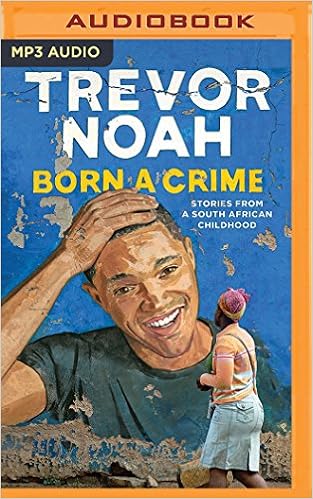
I listened to Daily Show host Trevor Noah’s memoir as an audiobook. I was expecting some sort of standard “third world middle class memoir with woke characteristics”, but it turned out to be something far more interesting; Trevor was born to a Black South African mother and a White father during apartheid, when such relationships were illegal. He grew up in poverty with a single mom who sounds like an amazingly strong and independent woman and the story of those early years is the best part of the book. You will learn more than you may expect about daily life in Black South Africa and the story is told with great verve and wit. There is the expected craziness and cruelty of apartheid, but he is also refreshingly blunt about the social evils prevalent in the ghetto and the various divisions (generally violent, sometimes outright vicious) within Black society. South Africa becomes a real (and far more colorful) place for the reader, well beyond the somewhat simple and superficial “black and white” story we all know from (distant) headline news reports. Trevor and his family attend 3 churches every Sunday, escape a possible rape/killing by jumping from a moving minibus, deal with poverty, crime and prejudice (mostly from other Blacks and “Colored” people, since interaction with White society is very limited in any case) and through it all, his mother manages to somehow hold things together and give him a reasonably good education. A violent stepfather (who eventually shot his mother, she survived) and a life of adolescent and early adult crime round out the picture. As a window into South Africa, it was much more colorful (and more interesting) than I expected.
Many of the quirks of Black life that he describes (always with empathy and sympathy) are not too unexpected or shocking to anyone with some knowledge of the world. When his teenage dance troupe goes to a Jewish school and they all start shouting “Go Hitler” (the name of their lead dancer) it is very funny, and Trevor’s explanation of why they did not see this as some sort of faux pas is sensible and reasonable. But one other episode was personally harder to process for me and that is: cruelty to cats. 2 of the author’s cats were lynched, skinned and hung from their gate because Black South Africans have a thing about cats and witches. And while talking about this, Trevor casually throws in the fact that a Black security guard beat a cat to death on live TV when she ran out onto a sports event in a stadium and Trevor seems to think this is just a cultural quirk and we all have them. He lost me at that point I am afraid. Yes, Spaniards publicly torture bulls, some Chinese do horrible things to various animals and modern people all eat meat from cruel factory farms, but I find it very hard to see this kind of cruelty as somehow “normal”, and Trevor lost a few points in my estimation with his attempt at cultural sensitivity on this topic.
Trevor is, as expected, ready with modern liberal tropes for most of the historical and political references in the book. That is OK, but one does get the feeling that he thinks his experience as a rather unique mixed-race South African, and the lessons he draws from this life, can be smoothly transposed into the experiences, attitudes and priorities of any generic “third world” person. In actual fact, South Africa is a rather extreme case, and his life is unique and unusual even within that case; the lessons he learned may not apply to every country as much as he thinks.
At the end he jumps from his life of petty crime (basically pirating and selling music and fencing stolen goods) to a successful career as a comedian, but this part lacks the detail we get of his early life. He does not in fact tell us anything about how he came to be a successful comedian. Maybe that will be in some future book. Or maybe he is just a smart guy and does not want to get too far into a phase of life whose characters he still deals with professionally.
Overall, a fascinating and very interesting book. More interesting and insightful than I expected it to be. Worth a read.