
On the states that were never drawn, and the language of Lord Krishna’s own country
- Why was the linguistic principle applied everywhere except the Hindi belt?
- What would a Braj Pradesh look like, and which is its capital, Agra or Mathura?
- Can the languages be scheduled without unseating Hindi?
- What did Ambedkar see in 1955?
Good for the South but not the North?
The States Reorganisation Commission redrew the South along language lines and left the North alone. Andhra for Telugu, Kerala for Malayalam, Karnataka for Kannada, and one enormous Uttar Pradesh for a “Hindi” that contains multitudes. Ambedkar read the report and wrote a pamphlet, Thoughts on Linguistic States, published in December 1955. His verdict: the Commission had produced “a consolidation of the North and balkanisation of the South“, and intentionally or not, the fact was there.
His remedy was specific. Divide UP into three states of roughly two crore each, capitals at Meerut, Cawnpore and Allahabad. Divide Bihar in two, capitals at Patna and Ranchi. “The idea of having bigger linguistic states is not a democratic idea at all,” he wrote, and he added the detail that pre-empts the obvious objection: each of the resulting states would still have Hindi as its language. Division did not threaten Hindi. Forty-five years later, southern Bihar became Jharkhand with its capital at Ranchi, exactly as drawn.
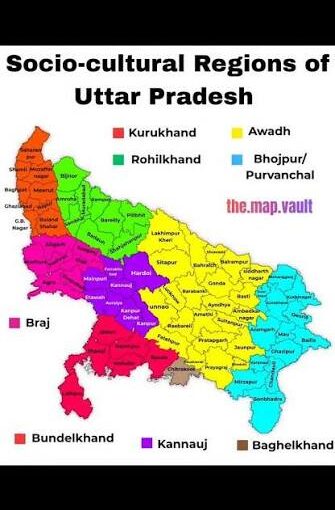
In November 2011 Mayawati’s assembly passed a resolution splitting UP into four, Purvanchal, Bundelkhand, Awadh Pradesh and Paschim Pradesh, and sent it to Delhi. The UPA let it die. Uttar Pradesh today holds over 240 million people, which would rank it around the fifth largest country on earth, under one Vidhan Sabha.
The Hindi umbrella
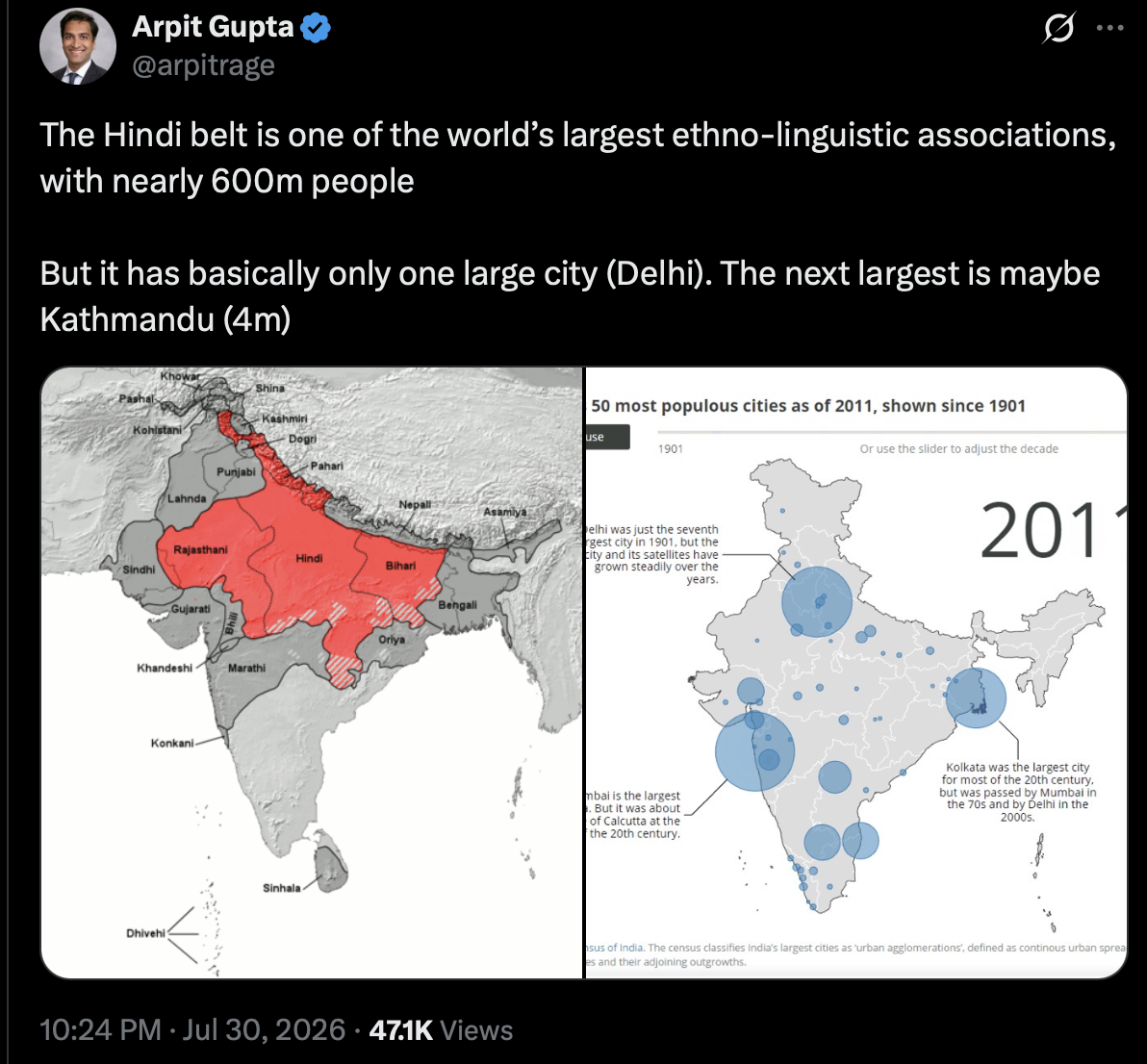
The census explains what the map will not.
In 1961, ten mother tongues were grouped under Hindi, Braj Bhasha and Awadhi among them. In 1971 the grouping widened to forty-eight, absorbing the languages previously counted as Bihari, Bhojpuri, Magahi and Maithili included, along with the Rajasthani and Pahari clusters. Hindi’s share of India rose from 30.4 per cent to 37 per cent in a single decade. Nobody learned Hindi in those ten years.
By 2011 the umbrella recorded 528 million speakers, 43.6 per cent of India, of whom roughly 320 million reported Hindi proper as their mother tongue. Inside the rest: Bhojpuri at 50.6 million, Rajasthani at 25.8 million, Chhattisgarhi at 16.2 million, Magahi at 12.7 million. Two languages have escaped, Nepali on scheduling in 1992 and Maithili in 2003, and each promptly left the Hindi count. The Bhojpuri demand has been pending since before 2009, on which the Union’s position is that no time frame can be set.
This is the quantity the undivided map protects. Schedule the four pending claimants alone, Bhojpuri, Rajasthani, Chhattisgarhi and Magahi, and roughly 105 million are reassigned on the Maithili precedent, taking the umbrella from 528 million to something near 423, from 43.6 per cent of India to about 35. The base is Hindi proper itself, just over a quarter of the country. The giant states of the North and the extra-wide Hindi column of the census are the mirrors.
Braj
Braj is the western crescent, Mathura, Agra, Aligarh, Hathras, with Bharatpur across the Rajasthan line belonging to it culturally if not administratively. It is Krishna’s country, the land of the pilgrimage circuit, and its language was not a dialect that failed to rise. It was the language that had already risen. Surdas composed the Sursagar in it. The Ashtachhap poets of the Pushtimarg wrote in it. For roughly four centuries Braj Bhasha was the premier literary vehicle of what we now call Hindi, until Khari Boli displaced it in the late nineteenth century and the court poetry of one era became the “dialect” of the next.
The 2011 census records 1.56 million people declaring Braj Bhasha as their mother tongue, 0.36 per cent of Uttar Pradesh (in Krishna’s own country, the enumerator hears “Hindi”).
A Braj Pradesh would face a problem no other proposed state has: its administrative and devotional capitals cannot be the same city. Agra has the size, the infrastructure and the economy. Mathura has everything else. Ambedkar’s western capital was Meerut, but his western state ran far larger than Braj proper. The secretariat in Agra but otherwise expect the state to be governed, in every sense that matters, from Mathura?
The communal balancing
A claim circulates that the big states were built to manufacture Hindu majorities.
Braj fails the premise outright. Mathura and Agra districts run under ten per cent Muslim; a Braj Pradesh would be among the most religiously homogeneous states in India, and it has still never been drawn.
Rohilkhand, Moradabad, Rampur, Bijnor, carries districts above forty per cent, and a Paschim or Harit Pradesh built there would have India’s largest Muslim share outside Kashmir.
So the communal reading does explain one resisted state. It cannot explain the resistance to all of them, Bundelkhand and Purvanchal and Braj included, where the arithmetic of faith changes nothing but of course dilutes the Hindu % in the rest of the State.
The case against Linguistic Reorganisation
The serious objection is not administrative. It is that the belt is a dialect continuum, that Braj shades into Kannauji and Kannauji into Awadhi with no line a surveyor could defend, that every division manufactures new minorities at new peripheries, and that unseating Hindi from its plurality hands a loaded weapon to every anti-Hindi politics in the South at the precise moment the language question is combustible again.
Ambedkar answered most of this in the pamphlet. His three states were all to be Hindi states; the official language loses nothing when its territory is administered in thirds. The continuum objection proves too much, since Telugu shades into Kannada at the border and nobody proposes remerging them. And Telangana settled the remaining question in 2014: one language now has two states, the linguistic principle survived, and Ambedkar’s formula, one state one language rather than one language one state, acquired its proof.
What has actually been divided tells its own story. UP and Bihar have both been cut, in 2000, but on hill and tribal lines, Uttarakhand and Jharkhand, never on language. The one principle that organised the entire map of the South has intermittently been permitted to touch the North.
The freeze on Lok Sabha apportionment lapses after the next census, the North’s huge numbers become the South’s open grievance, and every settlement on the table will involve redrawing of some kind. When that argument arrives, the pamphlet from December 1955 may well be the most current document in the room (Meerut, Cawnpore and Allahabad are still waiting)?
https://jacobin.com/2026/07/kashmir-pakistan-protests-democracy-economy
We removed 60 comments en masse. There will be no Flame Threads on BP.
20 comment indiscriminate fine to any offender. And we will simply increase it next time.
The ceasefires were working very well and avoiding this whole situation.
Personally, deletion of my comments is not existential for me.
then you are admitting to trolling BP?
Not at all.
I have said many times I have no interest in interacting with RNJ. He’s the one who keeps replying to my comments. I have zero interest in interacting with OM either.
When people get personal with me or cast aspersions on the Islamic Republic of Pakistan, of course I will respond. I don’t make comments against people’s relatives.
I don’t think deleting comments is really something that keeps people up at night. That’s all I’m saying. Otherwise, people would have learned by now not to get personal.
I know you don’t particularly like hearing this but it is true that some people’s main interest in this blog is to fight Pakistanis.
I am advocating a return to the ceasefire. Unless you want to deal with periodic flame wars.
That is a mythology you keep perpetuating.
The CJP plainly demonstrate this otherwise.
And I don’t care even if it means the blog gets zero traffic. I didn’t restart the blog 2 years ago simply to get popular but to revive something I love.
I think you should read the Ruchira threads.
It’s not a “mythology”. The evidence shows that certain people (you know who I’m referring to) take inordinate pleasure in being nasty to me and to Q.
When they don’t have a Pakistani to fight with, they fight with leftist Indians.
Don’t tell me my lived experience is “mythology”.
You can return to the ceasefires and see what happens.
If you stop mentioning the Islamic Republic of Pakistan, I have zero interest in commenting on India’s internal matters. But if people are given the opportunity to bash Pakistan, then you can expect Pakistani pushback.
My two cents. I don’t think Indians here actively counter you specifically because you’re Pakistani or Calvin because he’s not Centre-right.
It’s more due to the difference in outlook or divergence of views. This as we have seen in the CJP thread doesn’t have to descend into taking offense personally by anyone.
In fact imo we learn more due to a divergence of viewpoints rather than boring agreement on all. Not to mention challenging one’s own priors.
Divergence of viewpoints is fine.
But there is an animus shown towards me and Q that is not shown to others. It’s partly because we are Pakistani Muslims. We are the external enemy.
We simply will not be going back to a Saffron-Crescent dynamic.
agree 100%.
I’m…..unhesitatingly abrasive at times in making my point, but I focus on the debate and the discussion, not the man. If folks can’t handle vigorous debate, don’t insert yourself into it.
This is a word to any offenders – the next time you go into a flame war. It’ll be 40 comments.
And also do temporary bans, so that it’s also punitive going forward.
Also it’s about Red List, Amber List & Green List. Green Listers get more latitude then Amber or Red Lists.
I’d like everyone in this space to be in the Green List so work constructively with one another.
As you all know I don’t mind the idea of an interrogated debate; that’s how we learn from one another and makes BP special.
But the lesson I learnt from Ruchira; is I want to build a community, where we can centre one another, emotionally and intellectually.
And we all have our biases and blindspots, that’s inevitable and that’s life; the hope is to ameliorate one another.
Pakistan has not even been a footnote on this blog for at least a month now. We Indians have been busy debating our own issues. Your stereotypical thinking of Indians is very tiring not to mention shows you up as an ignoramus.
Why don’t you make a real contribution and post something original for once on BP?
There is no more a Cresceniate – Saffroniate faction but rather left versus right.
That is a much healthier evolution .
Yes absolutely. The canvas for healthier conversations has expanded and in my view the traction in the comments sections is organic – not instigator dependent.
Yes exact
100% agreement; thank you Archer
“Pakistan has not even been a footnote on this blog”– Look at three of the last five posts. They are either about Pakistan or about Azad Kashmir.
I keep saying this. Don’t mention the Islamic Republic of Pakistan at all and I will disappear very quickly.
As for “stereotypical” thinking, the Indian right-wing commenters here have their own stereotypes about Pakistan which we are all familiar with.
I have posted many things to BP. No one cares about literature or music. The “masala” is in yelling at Pakistanis.
If you really care to read my writings, you can follow my Substack.
P.A.K protests are interesting and the Princely States could easily apply to India but after the Braj Pradesh post; I thought I’d mix it up.
//I keep saying this. Don’t mention the Islamic Republic of Pakistan at all and I will disappear very quickly.//
Pakistan is an important part of the Indian subcontinent. For various reasons we occupy each others headspace quite a bit and above all, we are both heirs of the Indus Valley civilization. Our destination are tied to one another.
We will be discussing about Pakistan, and given the political climate a lot of it will be raucous. Whether it is uncharitable or not is a different matter entirely.
I think unless it is accepted that nothing can be done from this blog, and keep our honor separate from our country the discussions here will continue to be both raucous and uncharitable.
you should really consider Authorship, Calvin. I’m now keeping a very tight list of Authors but you are making strong points.
Kabir you should not take people here too seriously or get emotional.
None of them can do anything to Pakistan and honestly in many cases, engaging seriously and answering on a fact basis is enough to end most unserious discussion.
The point is, many seem to take disagreements as an attack on their honor and are more interested in doing firefighting for their favorite party/leader. In these cases, it is better to call this out and move on.
//My point is that the easiest way to get me to stop commenting here is for certain people not to cast aspersions on the Islamic Republic of Pakistan. I am sick of “kleptocracy”, “slavery of the awaam” and other such anti Pakistan Army discourse. The people who indulge in it know exactly why they are indulging in it.//
I dont think anyone wants you to stop commenting, but have you never considered that people here may be purposely trying to get a reaction out of you?
Not that they may not mean what they say, but it does look to me that some people are trying to rile you up, and by telling them what makes you mad you are giving them what they want?
Food for thought, becuase many people here have linked their honor with their views, an attack on their viewpoint to many is like an attack on themselves, keep that in mind the next time they get personal. It should help see things more clearly.
Admin boundaries do create their own realities. FWIW, UP, Bihar and MP do vote as a state and usually winner takes it all. That explains the resistance to division as well why this topic is being brought up now in certain sections.
All I’ve heard regarding this topic is that altering UP’s admin boundaries won’t really fix the state or magically increase its per capita GDP. It’ll just sever Western UP from the Eastern portions further create a larger wealth gap. There are advantages to having such a large province as well.
So it is once again rice eaters Vs wheat eaters.
Wrote a post on the Princely States of Pakistan..
India & Pakistan are two heavy post-Imperial entities that need to disburse power (and money) to the “natural units” of the Indian Subcontinent.
They both draw on the Raj like all post colonial political entities.
I wish that Braj became the standard dialect of Hindi it sounds much more beautiful than Khariboli which is more stilted in comparison to its cousin Urdu.
As for why we have linguistic states in the south( and west and east) and not in the north. The answer is kind of simple. None of the people in present day UP and Bihar wanted a linguistic state( we can add MP also to the list)
You dont get a state if you dont fight for it, every new states made either on linguistic or tribal lines or on lines of development being cornered followed state long agitations.
If UP and Bihar is to be split aprt and combined to reflect linguistic realities it has to be done by the people living in these areas themselves which seems unlikely as they have accepted the hindi is our national language narrative and for some reason think division of states is a precursor to division of country, anyways as long as the language are spoken the division into more manageable divisions is always a possibility.