https://www.instagram.com/reel/DNSOUMMIXEZ/?utm_source=ig_web_copy_link
X.T.M
·
November 2, 2025
·
Comments Off on
https://www.instagram.com/reel/DNSOUMMIXEZ/?utm_source=ig_web_copy_link
Kabir:
WordPress dashboard data noted roughly 20,000 monthly readers circa mid-2020 .
Updated trends confirm continued modest growth, with India-based IPs making up a rising share .Monthly Unique Users
Comment Engagement
Recent posts regularly attract 100+ comments, indicating strong reader engagement and active discourse.
An average reading time on site is 4+ minutes, suggesting high dwell and thoughtful consumption .
Reader Geography (2018 Data)
Estimated by mid-2018:
United States: ~35%
India: ~29%
Followed by UK, Canada, Pakistan, and others .
Likely similar or more skewed toward India today, given recent commentary.
|
Metric |
Estimate / Insight |
|---|---|
|
Monthly Readers |
~20,000 (unique visitors) |
|
Engagement per Post |
~100+ comments; high dwell time (~4 min+) |
|
Geographic Spread |
USA ~35%, India ~29%, UK ~6%, Pakistan ~5% |
|
Engagement Quality |
Active discussions, reflections, back-and-forth |
|
Growth Trend |
Steady rise; India traffic accelerating |
Readership is modest in scale (~20K/month), but engagement is high, with active comments and deep platform dwell.
Most traction likely comes from Indian-origin and South Asia-adjacent readers, especially online communities aligned with diaspora and intellectual South Asian discourse.
This audience profile aligns with Brown Pundits’ ethos — curated intellectual conversation, not mass media reach.
Kabir:
I’m not “inventing victimization”. I’m calling out the anti-Pakistan and anti-Muslim biases of the commentariat.
Do think about why no Indian Muslim comments here. We don’t even know if Indian Muslims read this blog.
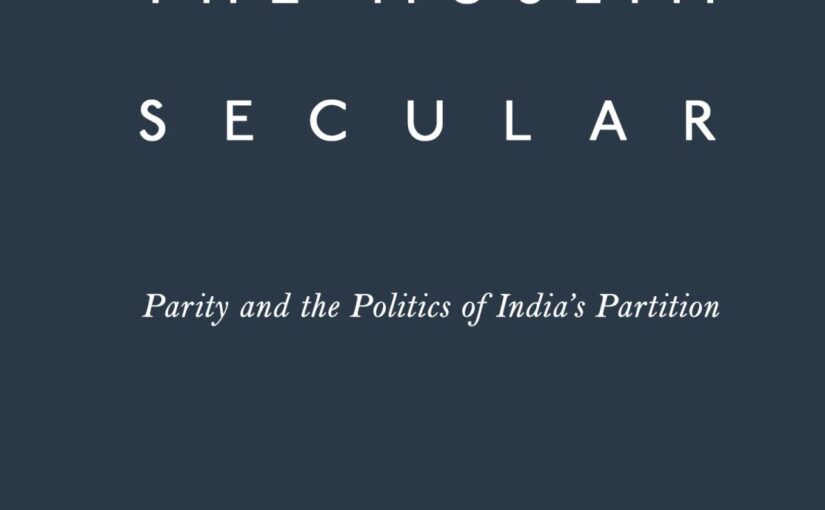
Since Partition is a popular topic here on BP, I am posting this review from my Substack. Amar Sohal’s book is important because it focuses on three Muslim politicians who did not support the Muslim League’s vision: Maulana Azad, Sheikh Abdullah and Abdul Ghaffar Khan. Thus, the book foregrounds a vision that is an alternative from those of Indian and Pakistani nationalisms.
Historians of the politics leading up to the Partition of British India usually focus on the Indian National Congress and the Muslim League. To an extent, this is understandable–along with the colonial power, the Congress and League were largely responsible for the decision to partition British India into the sovereign nation-states of India and Pakistan. This historiography is largely focused on judging which of these two parties was most responsible for the lack of compromise that led to the ethnic cleansing of August 1947 and to decades of antagonism between (the now nuclear armed) states of India and Pakistan. Ayesha Jalal’s The Sole Spokesman: Jinnah, the Muslim League and the Demand for Pakistan can be considered a representative work of this school of historiography.
Amar Sohal’s book The Muslim Secular: Parity and the Politics of India’s Partition attempts a very different task. Based on his DPhil thesis at Oxford, the book examines three comparatively lesser-known thinker-politicians of late colonial British India: Maulana Azad, Sheikh Abdullah, and Abdul Ghaffar Khan. While unequivocally Muslim, all three of these figures aligned their politics with the Indian National Congress’s vision of a united India. As Sohal writes in his “Introduction”:
My endeavour, then, is to escape, as far as possible, from the long shadow cast on modern Indian history writing by Britain’s dramatic withdrawal and the minutiae of the Partition negotiations. Rather than rehash that familiar tale, I want to contribute instead to the burgeoning field of Indian and global political thought by unearthing a forgotten argument for integrationist nationalism and shared sovereignty. And this is significant because ideas (and not only transitory interests) mould the narrative of history, and ultimately survive it to speak to the epochs that follow. The subjects of my investigation were some of India’s foremost politicians…. So like other intellectual historians of India and the Global South that have engaged with this anti-colonial moment, here my task is ‘to reconstruct these “politicians” as thinkers and their words as concepts that were central to the making of political thought’. (Sohal 2-3)
since Sbarrkum writes on Dravidians, Dalits & Aryans; I wanted to leave a short comment (for now)
What is
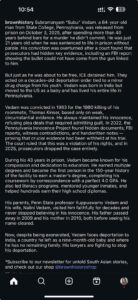
A fellow TamBram writes about it; https://nereview.com/article/the-trials-of-subu-vedam.
The word Brahmin is mentioned 4 times in the non-paywall foreword.
Subu’s father was an academic, a physics professor and materials scientist at Penn State, who would have blended seamlessly with my parents’ friends in North Carolina, who were all vegetarian and spoke Brahminical Tamil with its idiosyncratic conjugations and vocabulary.
Dr. V