
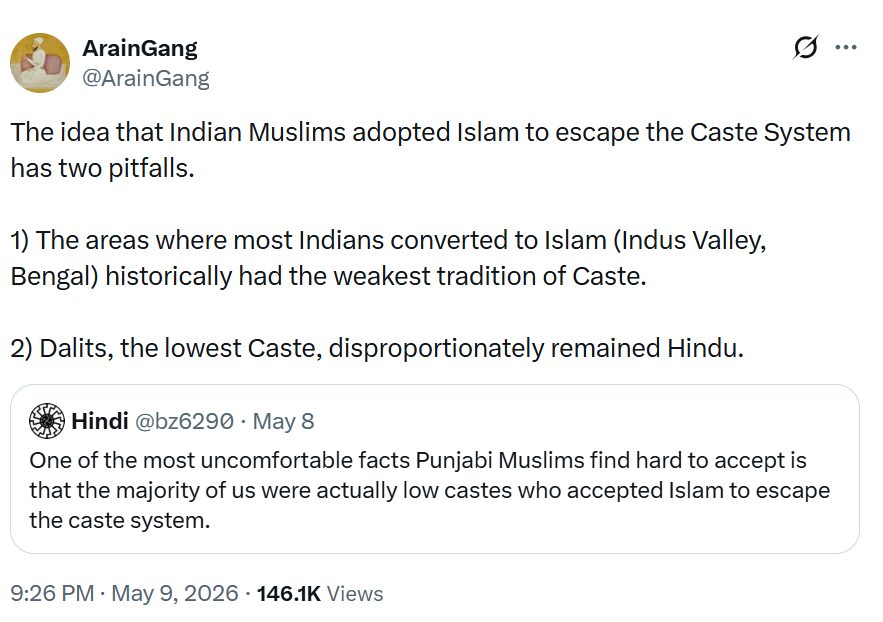
The idea that jAti-varNa – Caste system is the reason why ancient Indians converted to Islam and Christianity in olden times is often presented as a obvious wisdom. Why wouldn’t the oppressed seek new religion the instance it was offered ? But this simplistic notion is often goes against historic evidence.
As BP commentator and genetics nerd ArainGang states here – Areas of subcontinent which today form Pakistan and Bangladesh – were the least conservative regions of the subcontinent – ie – least rigid caste system. These regions also had significantly higher Buddhists than the heartland.
Christian conversions in Goa and Kerala were often but not always elite lead. Even in Maharashtra which is the birth place of Ambekarite Navayana Buddhism, significant % of Dalits remain Hindu (30-40%). Outside Maharashtra even less % of Dalits have embraced Navayana – though most regard Ambedkar as a quasi divinity. Mayawati, the longest serving Dalit CM of India hadn’t officially converted to Navayana as she assumed she would lose the non Jatav Dalit votes if she did.
Simplistic theories about history – which seem obvious to our understand often don’t stand the test of evidence. It means the simplistic models which explained the reality of Caste and mechanisms of conversion can be rejected and even their premise need to be scrutinised.

The main thing in these kind of conversations is to see what communities one is talking about.
Many christian communities in Tamil Nadu and Andhra Pradesh, who converted in the last 200 years did do so, quite explicitly for betterment of their lives and in many of their own histories make this a focal point, in Goa, mangalore, and kerala this aspect is not emphasized, in favour of upper caste origins and other unique aspects( portuguese colonialism, migration and antiquity, respectively.). I believe it is the same for Muslims.
Muslims in Punjab, sindh and bengal have a different histories from a muslim in Bihar, Uttar Pradesh and other places, some may have converted due to caste discrimination, others converted for personal advancements, and others converted because some pir may have been locally dominant. Moving away from these kind of essentialization would be better for histiography and Indian society in general.
May seems plausible – but there is hardly any corroborative historical accounts which state that. Most noted historic conversions come under broadly 3 categories
This doesnt mean the other kind dont exist – but the arent documented nearly as much as other cases are.
Over a thousand year period, it is possible at least one had occured due to caste discrimination.
But yes, most conversion would be from the above situations, with my view being that it was number 2 and number 3 that led to most Indian muslims, given the long period it took even places like modern day Bangladesh and Western punjab to become majority muslim.
Probably much more than 1 but that would remain insubstantial to the larger story.
There were also high number of forcible conversions – just we don’t know how many of those who were forcibly converted survived – esp.
And conversion to escape Jizya would also fall in category 1 – coercion.
Islamic chroniclers themselves claims 1000s of conversions – how many they really did we cant be sure.
Viz Kashmir it certainly was more forcible conversion than say Bengal or Kerala.
OP is – Caste oppression doesnt come even in top 5 reasons
Many christian communities in Tamil Nadu and Andhra Pradesh, who converted in the last 200 years did do so, quite explicitly for betterment of their lives and in many of their own histories make this a focal point…
Genuine question – how does conversion lead to betterment of lives?
Most of the conversions pointing to betterment of life, are from the Britsh period, where many of the depressed class communities were out of formal education entirely, including native run schools, and the support that christian missionary schools would provide for prospective converts would be very helpful, malas in andhra pradesh for instance had to see an attempt from the madiga in andhra pradesh to remove them from the SC community due to the relative advancement this early access to education had.
Today charity is less of a factor, in comparison to faith healing and disillusionment with their native religion from time to time. Some dalit communitiy christians also revert to their former religion for various ideological and economic reasons as well.
The ultimate counter against the propaganda that Muslims in South Asia were mostly low caste converts is the history of Kashmiri Muslims. Our heritage deconstructs their entire narrative. The existence of Kashmiri Muslims is what enrages and frustrates a lot of Indian nationalists/Hindutvas – many even resort to calling Kashmiris “foreigners” or invaders” despite historical and genetic evidence of being native to the valley and mostly descending from upper caste converts.
Even in the valley the ‘foreign ‘ Muslims like geelani, andrabi, and their likes dominate the religious elite.
Brahmin converts lead political zone, like Abdullahs (kaul), salahauddin (dar), etc.
Ghulam Nani azadi is not a Muslim from the valley.
On my mom’s side, we are Kashmiri-Punjabi. My great-grandfather is buried in Srinagar. We probably are descended from Pandits and I don’t think anyone really has an issue with it.
My mom’s side is “Khawaja” and my dad’s side is “Mir”.
K, I thought you were fully Kashmiri?
My dad’s ancestors came from Iran. They went to Kashmir and then to British India. My paternal grandfather was from Peshawar. My paternal grandmother was from Agra.
My mom’s side is Kashmiri-Punjabi.
but are they ethnically Kashmiri?
or were they Shi’ite Muhajirs?
Presumably when the people who came from Iran migrated to Kashmir, they intermarried with Kashmiris.
I’m really not sure of the details. I don’t really care about ancestry that much.
My dad had made a family tree of his mother’s ancestors who I guess came from Afghanistan. All I remember is that their last name was “Yar Khan”. Presumably they married Indians once they got to (British) India.
All of the iranian and khorasani origin families in Kashmir were Kashmirized and assimilated into a Kashmiri identity and intermarried with other ethnic Kashmiris.
It’s not that any Kashmiri or Pakistani has an issue with it – it’s mostly an issue for Indian nationalists cause it debunks a lot of the propaganda they’re fed or the narratives they try to push Many try to deny and erase indigeneity of Kashmiri Muslims as it doesn’t suit their narratives.
well presumably not just UC converts but broad cross-sections?
Yeah of course not just upper castes but a broad cross section of Kashmiri society but it still dispels the Indian nationalist myth of south asian Muslims being mostly Dalit converts.
There is a very clear reason why Islam spread more in Pakistan and Bangladesh than in North India.
The Pakistani and Bangladeshi populations were mostly converted due to the efforts of the Sufis who preached a very syncretic version of Islam which was often indistinguishable from local Hindu customs and only grew seperate over the centuries (infact it still hasn’t in many places)
The North Indian and Deccan core was the centre of Indo Islamicate civilization, the Muslims here were mostly desecendants of foriegn conquerors (patrilineally) who did not need to promote Islamic converts as those will naturally compete with them for administrative positions. They also had deep alliances with local Hindus rulers and did not want to stir the pot being seen promoting conversion to Islam. There is a reason why all major Islamic revivalist movements started in UP (because this was where the most ‘bookish’ Muslims were who took Islam seriously)
Caste system’s role seems to be very minimal in these two trajectories.
Also agricultural practises and topography.
Bangladesh was settled during Islamicate times.
Pakistan was tribal until irrigation spread during British times..
I mean, there are two very specific things about both Pakistan and Bangladesh that people often don’t discuss. These regions were basically centred on Buddhism for a long time. Pakistan was a major centre of Mahayana Buddhism, while Bangladesh, during the reign of the Pala empire, was the centre of Vajrayana Buddhism. A similar thing can be seen in Indonesia as well, since it was a major center of Buddhism for the longest time, even though it is associated with Hinduism during the Majapahit empire. It seems that Hinduism was more elite-oriented, while the population seemed to have followed a Buddhist adjacent folk religion.
In all of these cases, Islam succeeded in its spread since it displaced Buddhism (from my perspective). This kinda explains muslim distribution in South Asia; out of Pakistan and Bangladesh, most muslims are urban, mercantile, and live in historical areas that were associated with Buddhism (Bihar and Uttar Pradesh were a centre of Buddhism). Another aspect worth mentioning here would be the fact that historical Buddhism was more reliant on state and merchantile support, unlike their Hindu counterparts, who had control of rural land holdings to support them even if they lost patronage and merchantile support. So Islam was more successful in displacing these religious groups as a result, since patronage shifted from Buddhist institutions to Islamic ones, taking their followers with them.
Another worth mentioning was the fact that both Pakistan and Bangladesh weren’t fully in line with the mainstream even during the pre-Islamic period. Pakistan was heavily influenced by foreign dynasties like Indo-Greek, Saka, Kushan, Huns, and Turks due to its position as the first region sitting between the Gangetic Valley and the broader Persianate (both pre- and post-Islamic) world. Bangladesh, on the other hand, was more inland and tribal, making it less accessible to most major empires. An example would be to compare West Bengal and Bangladesh throughout history. A sizeable portion of historical regional empires in Bengal placed their capitals in West Bengal: Nadia, Gaud, Karnasurvarna, etc., which served as centres of commerce and trade with the broader regions outside of Bengal. Nonetheless, there were many centres of activity within Bangladesh, but the West Bengal region seemed to have served as a bridge between the more inland Bengal regions and the outer non-Bengali regions. This goes into other things like how West Bengal was a centre of Brahmanical learning in places like Nadia that produced important figures like Raghunatha Siromani and the broader school of Navya Nyaya.
So, there is a lot more to these divisions than religion alone, but a complex history of contact and connectivity that shaped regional differences in these lands in spite of ethnic (and sometimes religious) overlaps.
Very fine comment.
I wanted to say all this and more but was just tired to write this but you have written it a lot better than i thought in my head.
Fantastic comment ^ worth reposting.