
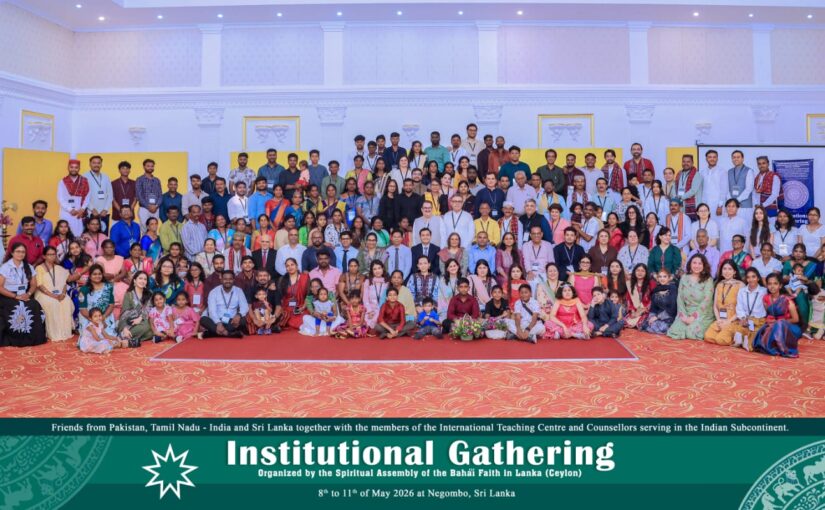
The photograph above was taken on the 11th of May in Negombo, on the western coast of Sri Lanka. The caption records the occasion plainly: friends from Pakistan, from Tamil Nadu, and from Sri Lanka, gathered with members of the International Teaching Centre and the Counsellors serving in the Indian subcontinent, at an Institutional Gathering convened by the Spiritual Assembly of the Bahá’ís of Lanka.
We want to say something about what this image makes possible, and where.
Indians & Pakistanis cannot meet any longer
The hard fact first. There is no longer any practical way for an ordinary Indian and an ordinary Pakistani to sit in the same room inside either of their own countries. Visa regimes have hardened to the point of farce. The land border is sealed in spirit if not in law. What remains are the smaller states of the subcontinent and the wider diaspora. Of the smaller states, Sri Lanka is the one that handles the meeting most gracefully: visa-on-arrival to both passports, no overland complication, no political theatre, and a civic culture that does not ask either side to perform a position.
Which brings us to the older question, whether Sri Lanka belongs to our civilisational space at all. Some friends north of the Palk Strait still treat the island as adjacent rather than constitutive. We think this is wrong, and the reasons are not sentimental.
Sri Lanka is Dharmic?
Sri Lanka is Dharmic in the strict sense. Theravāda Buddhism is its public religion and its constitutional cornerstone, and Buddhism is one of the four Dharmic traditions, alongside Hinduism, Jainism, and Sikhism. The Mahāvaṃsa narrates the island’s history inside a cosmology that any reader of the Purāṇas will recognise on first contact. The northern and eastern provinces carry an unbroken Tamil Saiva inheritance, with temples invoked in the Tevaram hymns of the seventh to ninth centuries. Sri Pada, the peak in the central highlands, is climbed by Buddhists for the Buddha’s footprint, by Hindus for Shiva’s, by Muslims for Adam’s, and by Christians for the same. Anurādhapura and Polonnaruwa are not adjacent to the Indic civilisational core. They are inside it. And the island sits at the heart of the Rāmāyaṇa itself, whatever one makes of that text’s geography.
Theravāda
We anticipate the strongest objection, since we have heard it again this week in our own comment thread. Theravāda Sri Lanka, the argument runs, is defined precisely by what it rejected of Indic-Hindu tradition: the Brahminical priesthood, the Manusmṛti, the institutionalisation of caste. To call the island Dharmic, on this view, is to drag it back into a fold it left at the foot of the Bodhi tree. We understand the force of this and do not think it succeeds. Dharmic is a family, not a unanimity, and reform inside the family is not exit from it. Buddhism’s repudiation of caste, Jainism’s radicalisation of ahiṃsā, and Sikhism’s rejection of idol worship are constitutive moves within the Dharmic tradition, not departures from it. The Triple Refuge that every Theravāda Buddhist recites is itself the proof. Buddhaṃ saraṇaṃ gacchāmi, Dhammaṃ saraṇaṃ gacchāmi, Saṅghaṃ saraṇaṃ gacchāmi.
One does not take refuge in the Dhamma having walked out of the Dharmic tree. Dhamma is the Pali cognate of Dharma, and the cognate is not an accident of translation. It is the family resemblance speaking.
Kandyan Customary Law
The Manusmṛti objection in fact runs in our favour. Kandyan customary law in the upcountry permitted married women to hold and inherit property in their own right, the binna form of marriage preserving this most clearly, and the British codifying regime progressively narrowed those entitlements over the nineteenth century. That is a Dharmic achievement, not an exit from Dharma. It shows what the family produces when its reformist streams are ascendant. The Manusmṛti is one ancient text among many in a tradition that also contains the egalitarian Buddha, the property-rights Theravāda of Sinhala custom, the radical Sikh gurus, and the Jain refusal of hierarchy. The tradition is plural and self-critical. That plurality is its strength, not its disqualification.
So when we speak of the subcontinent as the Crown Jewel of the planet, from the Hindu Kush to the Indian Ocean, from the great rivers to the Burmese Highlands, we mean Sri Lanka emphatically. It is not the periphery. On the present visa map it is the centre, the one room in the house where the family can still gather.
Oneness of Humanity
That brings us back to the photograph. The Bahá’í Faith teaches the oneness of humankind not as a slogan but as a structural principle. Bahá’u’lláh wrote that the earth is but one country, and mankind its citizens. An Institutional Gathering, in which appointed Counsellors and elected Spiritual Assemblies consult together, is one of the most concrete expressions of that principle the community has. To hold one that brings Pakistani, Indian, and Sri Lankan friends into the same consultation, on Sri Lankan soil, in May 2026, is not a small thing. It is a working enactment of what the subcontinent’s politicians have not yet found a way to perform.
Is Dharmic an actual term or was it made in reaction to the word Abrahamic, to help categorize the various non-Abrahamic belief systems in south Asia? If that’s the case I can see why Sri Lankans take offense to being called dharmic or being labelled under other colonial terms like “subcontinent” and “desi”
At what point does ignorance, turn from the genuinely unknowing, to the intentional wilful refusal to acknowledge facts even when presented?
After a pattern of repeated snide remarks – ‘Dharmic’ is a made up word, Hinduism is a made up religion and not ‘real’ – at some point, the agenda and attitude is nakedly dishonest.
Dharm/dharma literally means religion in Hindi and the Indian media commonly refers to Islam and Christianity as “dharms” therefore dharmic is anything related to any dharm/religion. The modern coinage of the term dharma to define only non-Abarahmic faiths in south Asia seems like the academic version of forming a coalition in an election to unseat the incumbent – an unnatural alliance of vastly different belief systems.
You are a bigoted propaganda troll. Toodles.
As they say, every accusation is a confession.
Running away from someone challenging your opinions instead of having a civil and respectful discourse is just straight up cowardly.
As a parting message, I’ll just say that Sikhs and Buddhists don’t identify as dharmic or really include their beliefs under that big tent category which makes many question the usefulness of that term.
“Every accusation is a confession”– RNJ is a right-wing Indian. He only comes on BP to denigrate Pakistan.
He is an author. He’s perfectly capable of making his own threads. But he chooses not to.
At this point, I would just ignore him. His agenda is so obvious.
On your point about Sikhs: There is literally a book written in the 19th century called “Hum Hindu Nahin” (We are Not Hindus”).
Sikhism is a monotheistic religion.
https://en.wikipedia.org/wiki/Ham_Hindu_Nahin
well presumably at Partition they kind of chose a side?
Sikhs may not be pro-Muslim. During the lead up to Partition, they were among some of the worst proponents of anti-Muslim violence.
But they don’t take kindly to being referred to as “Hindu” either.
Also, Sikhs remember Operation Blue Star and the pogroms that followed Mrs. Gandhi’s assassination.
So there are lots of issues between Hindus and Sikhs that really are no concern of Pakistanis.
No issues for the ordinary Sikhs and Hindus. It’s the jats who have captured the Sikh holy places make ambiguous statements.
All the founding gurus of Sikhs were khetris and not jats.
Increasingly there are reactions to this behavior of jat sikhs by others.
If this continues we may well see a formal division in the Sikh practices.
that does happen; Khatri Sikhs are not into Khalistan at all
Yeah I figured he was a troll or some far right jingoist.
Yes, that corroborates with what what my Sikh friends have told me about their beliefs. I’ve only ever heard this broad “dharmic” categorization used in Indian publications or by Indian talking heads.
You forget the new word “sanatani” which comes from ‘sanatana dharm’ or ‘eternal religion’.
At least there is a recognition that the persian word Hindu may not be appropriate for the more shuddi minded bhakts.
Why are they against Persian? Saffron is also from Iran.
Persian was brought to India by foriegn invaders so it is unacceptable..
Unlike the local native langauge Sanskrit, which was .. er also brought to India by foriegn invaders.
Using bhakts is unacceptable as it is used by so called liberal Hindu haters.
LMAO, we’ve got Pak trolls talking to each other spouting fictional nonsense about how Indians conduct themselves.
If this sort of toxic BS is not policed, its only going to drive rational folks away.
“Talking to each other” and you conveniently use the same phrases as BB but apparently you’re not his alt..
If an honest discussion between some curious minded people is driving away “rational folks” and by rational you mean far right indian nationalists then that should be welcomed. Policing free speech and valid criticism is all hindutvas know.
He’s not BB’s alt. They are two different members of the Saffroniate.
It is very ironic that he wants to police the discourse of the Pakistani commenters since he also is very pro “free speech” and very upset that I’ve banned him from my threads.
If he can police our discourse, I can certainly police his.
I am not a troll.
Your only agenda on BP is to denigrate Pakistan.
You have the ability to write your own posts about topics of interest to you but you choose not to do so.
I continue to be amazed that you are so concerned about “rational folks” and policing Pakistani discourse but when someone gives me an actual threat of violence, you can’t be bothered to even call that out.
That is what is actually “toxic”.
Initially, I thought the same, that it was a term that gained usage via online hindutva polemicists, but it seems to have some pedigree going back to 19th century philologists and orientalists. The great Sri Lankan philosopher Ananda Coomaraswamy was probably using the term before it got wide currency within mainland India in fact. The idea is that the different religious traditions like Jainism/Shaivism/Buddhism/Shaktism/Sikhism all emerged from *relatively* common ecosystem of thought. They share a grammar about how they frame problems of human existence or the nature of consciousness. They share the broader indic philosophical traditions of formal logic and debate. They invoke the same vocabulary and poetic grammar. This is not to say they are the same religion, if anything , Jainism and Vaishnavism couldn’t be more profoundly contradictory, (and yet they are seemlessly integrated socially). Which is why I think we are in a cultural war not a religious war. At any rate, I sort of agree with Q, and I don’t know why others would get defensive about the assertion that Hinduism isn’t a religion at all. And yes, “dharmic” is politically convenient as it allows for sufficient religious sovereignty and reduces friction for cooperation. Where I may disagree is if someone were to assert that its a *completely* arbitrary collection of folkways with a veneer of formal theology. The geography of the subcontinent acted as a container and there are fairly unbroken cultural continuums, and through many ages shared a high culture, whether prakritic and sanskritic
>d I don’t know why others would get defensive about the assertion that Hinduism isn’t a religion at all.
There’s nothing to be defensive about – but the intent and context in which such statements are hurled, do matter. EK’s malicious intent drips quite consistently from his comments. I’m trying to be patient and forgiving with his silliness – clearly he’s quite immature and likely to be a youngling still figuring what his actual perspective is, and has blindly embraced a harsh, tribal-patriotic worldview.
we’ve learnt comment threads become dark places anyway; it’s the threads that emerge from it that are redemptive.
The great Sri Lankan philosopher Ananda Coomaraswamy
Early Buddhism, as we have seen, is strictly rationalistic, and could no more have inspired a metaphysical art than the debates of a modern ethical society could become poetry. The early Sutras, indeed, expressly condemn the arts, inasmuch as ‘ ‘form, sound, taste, smell, touch, intoxicate beings.” It is thus fairly evident that before Buddhism developed into a popular State religion (under Asoka) there can hardly have existed any “Buddhist art,”
Reservoirs: but it was only notably in Ceylon that there existed conditions favourable to the construction of very large works at a much earlier date. The largest of the embankments of these Ceylon reservoirs measures nine miles in length, and the area of the greatest exceeds 6000 acres (24 sq km). The earliest large tank dates from the 4th century B.C. What is even more remarkable than the amount of labour devoted to these works, is the evidence they afford of early skill in engineering, particularly in the building of sluices: those of the 2nd or 3rd century B.C. forming the type of all later examples in Ceylon,
https://www.brownpundits.com/2018/07/06/ananda-coomaraswamy-the-arts-and-crafts-of-india-and-ceylon-1913/
Sri Lanka is Dharmic in the strict sense
It is not, the Buddha rejected Caste, Brahmanism from the Get Go
XTM if you want accept Caste and Barahminism as Dharmic go ahead. Incidentally the Buddhist/Pali ward in the Dhamma
upcountry permitted married women to hold and inherit property in their own right, the binna form of marriage preserving
XTM You know a little but not the whole story. There is also diga marriage where the wife goes to the Husbands (Typically a couple of Brothers, i.e.Polyandry). The woman can at anytime walk away and when she goes back to her home, her share of the property is given back to her. Now she can enter into a new liaison an bring a man to her share of the house property
The children belong to the house where they were born.
XTM Sri Lanka is so different from India, you are just scratching the surface, the keywords being Gender Equality and Tolerance
Dhamma is the Pali cognate of Dharma, and the cognate is not an accident of translation. It is the family resemblance speaking.
Pali sounds like Sanskrit but is a different language and a different SCRIPT
Thats why There were no Indians who could read Asokas Edicts which are in Pali
The was deciphered by two English, one in India and one in Ceylon
The story of how Lankan chronicles helped British orientalists discover India’s lost emperor Ashoka (second part of post)
https://www.brownpundits.com/2018/06/01/lanka-and-kalinga/
the Abrahamic tradition wildly disagree on the nature of God, Prophethood and pretty much everything else but they are considered to be the same family tradition.
but they are considered to be the same family tradition.
Christians specially Protestants reject Muslim as being of the same same tradition
Being a Zionist you should know many Jews reject Christianity and Islam being of the same tradition
On this point: Dante’s Inferno depicts the Prophet Muhammad in one of the circles of Hell. I think it’s the circle for heretics.
Christians didn’t see Islam as a new religion but as a heresy.
There are still way more similarities and cultural diffusion between buddhism and Hinduism than there is differences
diffusion between buddhism and Hinduism than there is differences
We differ in the most important aspects, rejection of caste and brahminism and equality including gender equality being central
Many tradition reject caste, lingayat dharma for instance, and many dont endorse superiority of one group over the other, many forms of vaishnavism.
Sinhalese is an indo Aryan language, their ancestors are bengali migrants who intermarried with local tribes of Sri Lanka, the gender equality part is steadily narrowing.
And buddhism shares concepts of karma, reincarnation and ahimsa, like literally the majority religion one follows comes from India.
Also I dont think the average Sri Lankan holds this kind of distinction between themselves and Indians generally
Calvin, caste I. E Jati is from birth , literally and otherwise. Lingayets have Jati. Hope girmit or bhumiputra can comment on this.
That is the consequence of historical forces. It’s intent and origin is one of the most radical anti caste philosophies.
No, it never was. Non discrimination was preached, never practiced.
The Lingayats were attacked and forced to retreat into the western ghats afyer marrying basavas sister with a dalit (I think hr was a leather worker) male.
The casteism was later embraced as they reintegrated into society
Please read the issues properly..basava’s sister was not involved.
Jati most certainly persists, but the hundreds have collapsed into effectively very few groupings in this last 2 generations. Just about everyone in the extended family, including myself, is mixed in that regard.
Like everything, there were probably ebbs and flows historically. (Moreover, my opinion is that most Lingayats are converts from intervening centuries, not from the original Kalyan Kranti). At any rate, I would not say that radical egalitarianism is completely absent, for example, several mathas make a point of grooming monks and thereby future pontiffs from backward non-lingayat backgrounds. That said, as most Lingayats are culturally vegetarian, they are susceptible to the same prejudices and purity-pollution complexes as brahmins.
+1 to Girmit said. Only addition I would make is that I think vegetarianism is declining among younger crowd.
Indeed, I think its declined considerably, in a familiar pattern, first among males and then among females.
Further, the movement for a separate dharma of lingayats appears to be petering off. It had become an academic excercice for a few.
The masses seems to prefer the broader Hindu envelope.
As shankar Badari said once, that in North karnataka if one is not a veerashaiva lingayat he is a Muslim. I am keeping the Brahmins out of the equation.
on the political side, the powers that be are at it with differing levels of success/failure. Ultimately if Indic/Dharmic people don’t grasp that True Swarajya runs deeper than political independence. It’s self-rule in the fullest sense—mastery over one’s mind, institutions, knowledge systems, and civilizational direction.
+1
Well if political independence from alien rule is achieved, then swarajya looks deeper, as is the case in India now.
Without political independence as was under British rule swarajya on its own had no legs to stand.
Then political independence and swarajya meant one and the same.
we don’t even know what a Lingayat is for our sins
As I define lingayats are a protestant movement against the practices of Hinduism then.
There existed an earlier stream of Shiva worship called veera Shivas.
In my opinion lingayats are inside this fold.
The philosophy followed is a variety of advaita.
These days basava the sect’s founder is clubbed with Buddha and ambedkar.
I think it had more mass appeal than what was reported on. Interesting that the national media didn’t see it as an opportunity. It was a tall order with so many community leaders still in the BJP camp.
Many would emphasize the distinction between Lingayatism and Veerashaivism. These are two rather different things that become conflated centuries later for often political reasons. The ishtalinga mode of worship perhaps has roots in the agro-pastoral folk religion of the deccan, which concurrently became formalized by Veerashaivas but separately made central to the spiritual praxis of the movement led by Basavanna ,Allama Prabhu and contemporaries at Anubhava Mantapa. It was a few centuries later, at the Vijayanagar court, when Lingayatism emerges from the underground and begins theological formalism in resistance to Veerashaiva orthodoxy but also aggressive cooption.
But, the contention of the proponents of lingayats as an independent religion , that all vachanas are expressions of lived experience and devoiding any influence of vedic knowledge is bit far fetched.
This has been proved to be false by sections of lingayats themselves.
Cutting the “cult” from ancient roots are making its practices extremely abstract, spartan and puritan almost akin to making it abrahamical.
Aspects like bhakti, meditation, puja seems to have gone out of the discourse.
The sovereignty of Basava dharma/Lingayatism isn’t dependent on it being “devoid” of any vedic influence. How could it, insofar as it was refuting its authority? Its no different than Buddhism and Sikhism in this regard. As Dharmic faiths they all share significant “morphology” and terminology with Vedic and post-Vedic commentary. The question of whether Lingayats are Hindu is muddled because it can be two-fold; on one hand, it is sovereign and does not submit to any brahminic authority, veerashaivite or otherwise, but if Hindu is an ethnographic term for non-abrahamic Indic peoples, then yes, without doubt they are in that category. The movement is not to separate from hindu society but to have sovereign tradtions. Lingayats are free to create new denominations that hybridize with the mainline brahminic traditions, but the Virakta mathas and the subcommunities that support them insist on their own direction.
Sinhalese is an indo Aryan language,
Grammatical High Sinhalese is Derived from Pali and therefore Indo Aryan
Spoken Sinhalese is diglossic and mixture tamil, veddha words erc
ancestors are bengali migrants who intermarried
Calvin you better read the Mahavamsa (translation available online). The longest continuous 2500 year history in South Asia
Also I dont think the average Sri Lankan holds this kind of distinction between themselves and Indians generally
Sri Lankans love Indians because India sponsored and Trained the LTTE and we had 30 years of Civil War. The Tamils so loved the Indians the assassinated Rajiv Gandhi
What are you smoling Calvin
Sinhalese share genetic markers with bengalis.
There is no disgust seen towards Indians amongst Sri Lankan online like we see in pakistan and bangladesh, nor would most Sri Lankan ignore the very ethnostate they were creating, which started the domino effect that led to LTTE and Rajiv Gandhis assassination.
+1 to Sri Lankans not having a personal animosity towards Indians. I’ve had the pleasure of working with a few and found them to be very friendly and warm and also more in tune with subcontinental values than for e.g., East Asians.
friendly and warm and also more in tune with subcontinental values than for e.g., East Asians.
For a start Sri Lankans dont shit on the streets like Indian Values
Plus much more civic sense and hence cleaner cities. Still lot more to be desired.
Both of the above is because SL dont have caste.. Average middle class have no problem in joining in street clean ups
Sri Lankan are courteous much like the Thais.
Unless there is an issue they will keep smiling
Does not mean they like you.
Does not mean they hate us either
By the looks of below, many Lankans like India more than Indians. We really need to up our game.
Even if this is 2 years old nothing major has happened, like in bangladesh that would change these results.
That is an academic term that is used by those who belong to traditions outside of them for terminology.
Muslims seem the most enthusiastic users of this term with christians preferring the term judeo-christian instead, which i dont know the popularity of in orthodox or secular Jewish circles
Muslims don’t really care as much about the term and I’ve seen scholars criticize its political usage, we use the positive term “people of the book”/”ahle kitab” to refer to Jews, Mandaens and Christians while “yehudo-nasar” (Judeo-Christian) is the preferred word when criticizing political wings of those religious groups.
Traitors and collaborators with the Enemy should be Executed
Iran has executed 29-year-old aerospace engineer Erfan Shakourzadeh on Monday on espionage charges despite his protestations that authorities tortured him into giving a false confession, according to a prison note published before his execution, as recounted in Western press reports.
Iranian judiciary’s Mizan Online website announced and confirmed the execution, describing that he was hanged after being convicted for allegedly collaborating with the CIA and Israel’s Mossad intelligence service.
https://www.zerohedge.com/geopolitical/iran-executes-top-young-aerospace-scientist-alleging-cia-mossad-ties