
Dharms are Natural Democrats

On what Britain bequeathed, and what Delhi chose

  1. What did Britain actually leave in 1947, institutions or a franchise?
  2. Whose precedent was universal suffrage in 1950?
  3. Why did the wardrobe never decolonise?
  4. Are all South Asians natural democrats?

The Colonial Bequest

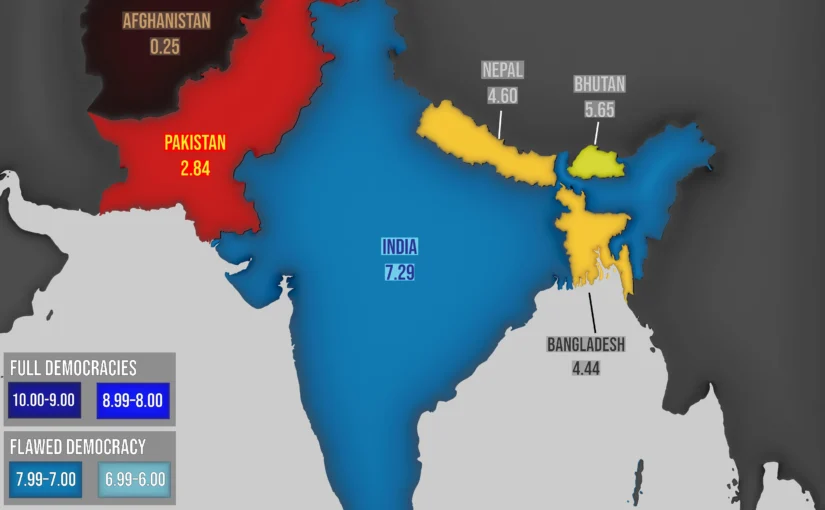
The parliamentary system across India, Pakistan and Bangladesh is Westminster’s. The founders, Gandhi, Nehru, Jinnah, were British-trained lawyers. Liberal democracy arrived in the West through revolutions and arrived in South Asia from the top down. Before the British, the subcontinent was ruled by monarchies, and the political parties are still run by royal houses in all but name, the Bhuttos, the Sharifs, the Gandhis. South Asians, on this account, are not natural democrats.

The chamber, the party system, the common law, the drafting language, the Inns of Court on the founders’ CVs are Albion’s gift. The Indian precedents, Chandragupta and Akbar are kings at scale, and pointing at them concedes the monarchy claim rather than rebutting it. The answer sits in the smaller polities.

The Dharmic republics
Continue reading Dharms are Natural Democrats

The Hindification of East India

The Saffron Block

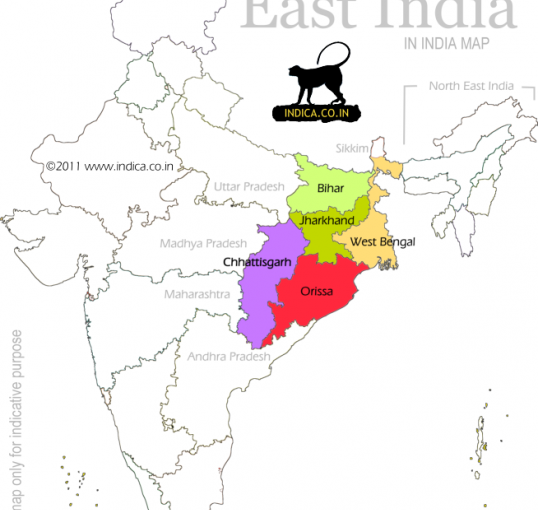
The map of East India has changed colour. Bihar fell to the NDA in November 2025 with 202 of 243 seats, and Samrat Choudhary now sits as the first BJP Chief Minister Bihar has ever had. Odisha went saffron in 2024 under Mohan Charan Majhi. On 4 May 2026 Mamata Banerjee lost Bengal after fifteen years; the BJP took 206 seats and will form its first government in Kolkata. Himanta Biswa Sarma returned in Assam with 82 seats, a two-thirds majority and a third consecutive term. The old Bengal Presidency, once the largest province of British India, is now a single saffron block.

This is the completion, by ballot, of a partition the British attempted by map.

1905

In 1905 Curzon split Bengal. The eastern half was to be Muslim and centred on Dhaka; the western half was to be joined to Bihar and Orissa, which made the Bengalis a linguistic minority in their own province. The Bengali Hindu elite, the bhadralok who ran Bengal’s commerce and letters, fought it bitterly. They did not want to be drowned by Bihari and Oriya numbers. In 1911 the British relented and reunited Bengal.

The Biharis, for their part, had spent two decades campaigning to escape Bengali domination. The 1912 reorganisation that gave them their own province, jointly with Orissa, was their reward.

Linguistic identity then was the prime axis. Hindu and Muslim mattered, but not as much as Bengali, Bihari, Oriya.

The Historical Axis Flipped

A century on, that axis has flipped. The Bengali, the Bihari, the Oriya and the Assamese are voting as Hindus, and they are voting for the same party. The two-nation theory, which Bengal once threw off, is doing its work the long way round.

Hindi,, Hindu, Hindustan

Continue reading The Hindification of East India

Brown Pundits