
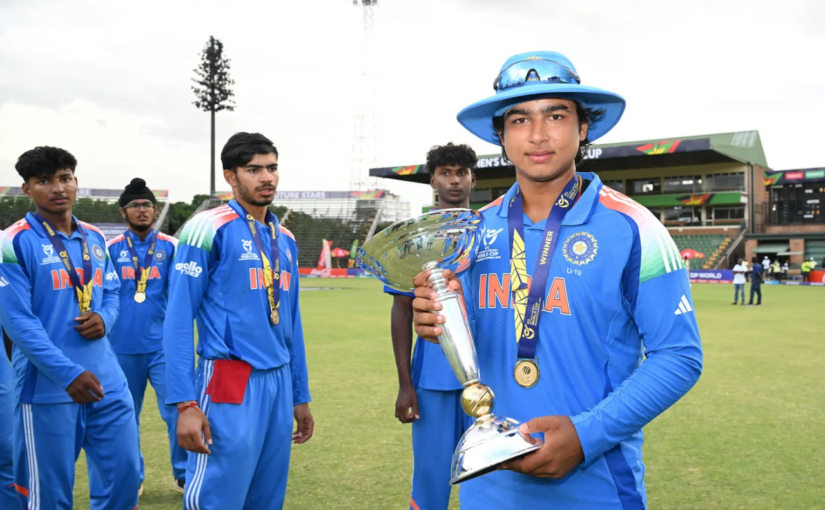
After the twin pleasures of the Indian cricket team’s campaign in the T20 World Cup in February and early March and Dhurandhar: the Revenge in late March, the thing that has given me a lot of joy throughout the months of April and May is watching Vaibhav Sooryavanshi’s batting in the IPL.
As I write this, he has been selected for the Ireland and England tours in late June-July, becoming the youngest Indian to get an international callup ever, surpassing the great Sachin Tendulkar. He also won the IPL MVP award along with the Emerging Player Award (usually people win them years apart, not in the same year) along with a variety of other awards. This follows the U-19 World Cup in February where he was Man of the Match in the final as well as Man of the Tournament.
And it is not just me, but the entire cricketing world which has been set aflutter by his exploits. His extremely fast pace of play (even compared to some of the fastest players in the world) plus his insane shot making and bat swing have made him a fan favourite already.
U-19 Exploits
Vaibhav came into the limelight when he debuted for Bihar U-19 as a 12 year.
He had multiple exploits at the U-19 level which is where his hype built up.
There was a 104 (62) in a Youth Test vs Australia U-19 in Chennai and then a 113 (86) in the return tour in Brisbane. In his first tour to England he hit a 143 (78) and then in South Africa he had 127 (74).
But he saved the best for his last ever U-19 knock. In the 2026 U-19 WC Vaibhav had been doing well in India’s unbeaten run to the final with scores of 72, 40, 52, 30, 68 but none of them were big innings. Fast starts in the powerplay which the rest of the batting could consolidate upon but not the kind of knock people knew he could play where he single-handedly ends the game.
He saved the best for the last and played the greatest knock in U-19 history. His 175 (80) led India to a record score of 411 and India ended up winning by 100 runs. He started out slow but at a point switched on and turned on “video game” mode and started hitting sixes all over for fun. And this was against a pretty strong England side who themselves had come through unbeaten. As someone who watched it live, I was amazed at some of the shots he played – the best of which was a tennis swat for six (attached below).
Because India has a policy of one U-19 WC per player even if they are eligible for more, that is the end of his U-19 career (Also he is too good for this level). And what a way to sign off.
IPL Glory
Vaibhav is the youngest player to get an IPL contract at 13 when he was signed by Rajasthan Royals. It was the period when his hype was building up so most people thought it to be an interesting curiosity. Most people thought he would show some potential but seem extremely out of sorts at a higher level (normal for that age).
What happened when he did play was something different. He had a decent debut hitting 34 (20) (with a six off the first ball) and this was what was in line with most people’s expectations. In his third match he hit the 2nd fastest IPL century ever of 35 balls helping Rajasthan Royals chase down 210 in 15.5 overs. Now the opposition were Gujarat Titans who were champions in 2022 and finalists in 2023 (and again finalists this year) so they are a pretty strong side and their bowling attack had the likes of Siraj who was a WC winner from 2024 as well as Rashid Khan who is seen as the greatest T20 spinner. To flay this attack in this matter was when the world realized what they were watching.
And while his initial IPL season was good, it was this year’s IPL which really cemented the craze for him in the Indian public. Fresh off his U-19 WC exploits, Vaibhav set the IPL on fire – scoring 776 runs in 16 innings at a strike rate of 237.30 and winning the MVP, Orange Cup (for most runs) and Best Emerging Player in the process.
Now the thing about this Indian T20 team is that it is one of the greatest teams in sport. Since 2024, India has a 52-7 record (49 outright wins, 3 super over wins). They have won everything they have played in that period including two World Cups, one of which was unbeaten, an Asia Cup unbeaten as well as every bilateral series, home or away.
This team includes batsmen like Sanju Samson, Man of the Tournament of the World Cup who had the greatest run of three matches in the history of the format and Abhishek Sharma, the no 1 ranked T20 batter in the world, scorer of the fastest fifty in a T20 WC final and the Man of the Tournament in the recent Asia Cup. Plus there are other great batsmen like Ishan Kishan, no 2 ranked T20 batsman in the world who had a great World Cup in his own right.
All of these guys had great IPL seasons befitting their quality but Vaibhav surpassed even them.
In Cricinfo’s Impact metrics Vaibhav is 350 points away from the second best batsman.
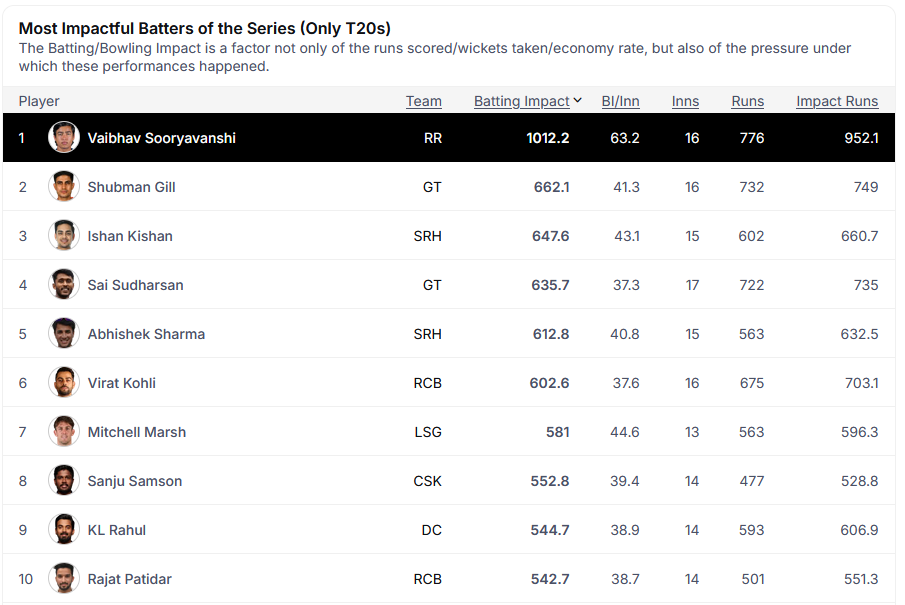
Also another feature of his batting was how he went after the best bowlers in the world – many of them current or former World Cup winners. He made a habit of hitting the first ball he faced from these bowlers for a boundary – Cummins, Hazlewood and of course the T20 GOAT Bumrah.
Bumrah was recently crowned the greatest T20 bowler of the century by Cricinfo. He was the Man of the Tournament in the 2024 World Cup when he won India an unwinnable game in the final and then repeated his exploits in 2026 when he delivered a masterclass in a run fest of a semifinal which India won by 7 runs by bowling very economically (as well as taking out England’s captain and best batsman) before following it up with a Man of the Match performance in the final with figures of 4/15 off four overs.
Vaibhav didn’t even spare him, hitting a six off the first ball he ever faced by Bumrah.
In the KOs, Vaibhav was again his team’s best batsman hitting 97 (29) vs Hyderabad in the Eliminator and then a 96 (47) vs Gujarat in the Qualifier 2 which they lost.
Even in that final match, Sooryavanshi brought out his tennis shot.
The Future
Vaibhav has been selected for the T20 series vs Ireland and England in late June-July becoming the youngest player to get an India callup, breaking Sachin’s record.
His hype is at an all time high, with everyone cashing in on it. He has already made ads for Google Pay for minors as an example.
Currently he is touring Sri Lanka as part of an A side (the next match is in half an hour as I type this) and even SL Cricket is promoting the series using Vaibhav. In fact, this series is getting a live broadcast plus commentary simply because of Vaibhav’s hype and not relegated to a Youtube stream as most matches at this level are.
The only similar analogy to this craze would be when Sachin came up in the late 80s-early 90s. It is very interesting to see the contrast in Indian cricket’s fortunes during both eras.
When Sachin came of age, Indian cricket was not doing well on or off the field. Cricket was controlled by the English and the Australians and Indians were relegated to occasional tours of those countries. Even on field India were a mid level team at best. Now, India sits at the high chair of cricket, with Jay Shah as ICC chairman, getting the largest pie of the ICC revenue, dedicated two and half month window for the IPL, frequent five match test series, frequent ICC trophies hosting etc. Even on field, the Indian cricket team’s fortunes have changed a lot with India currently holding two ICC trophies and generally being a top team for most of the 21st century.
In a way, Sachin was responsible for India being where it is now in cricket. If we look at the bigger picture, India was not really doing well as a country when Sachin came into the frame. Poverty stricken country, communal/caste tensions, raging insurgencies in Kashmir and Punjab etc. For all of the doom-mongering some Indians do regarding India in the present day, India has come a long way from the dark days of the early 90s.
As India liberalized and Indians got access to televisions, watching Sachin on TV became a rite of passage. If there was a match on and India was playing, people would watch Sachin’s batting before turning it off once he got out. And in this way, India’s cricket broadcast rights started making money which led to the snowball effect of where India is now, both on and off the field.
Cricket now is at another precipice as it is on the verge of global expansion. T20 is the most marketable form of cricket due to its short duration and even the Olympics have included it for the first time in Los Angeles 2028. More and more new teams/leagues are mushrooming around the world with some like Afghanistan and USA gaining certain degrees of success.
Just like Sachin led to the rise of Indian cricket, will Vaibhav become a poster boy of cricket in general and like Michael Jordan in the 90s lead to greater global popularity of cricket, compounded by the Olympics? The IPL of course will keep expanding as India keeps growing. 10 teams for a country like India is too small.
Also because Sachin’s career was so long it coincided with India transforming from a impoverished third world country to a “middle power” on the verge of “second world” status (If you take the UN’s 0.7 “high” HDI threshold. India in 2023 is at 0.685 so a few years off at max).
If Vaibhav’s career and India’s economic growth both maintain momentum as hoped for, then by the late 2040s when he is ready to hang his boots (with plenty of silverware won on the way) India will have become a member of the “Global North” and one of the three superpowers of the world (with a greater population than the other two combined and younger too).
The future is here. And it’s beautiful.
His ability on swinging pitches is probably suspect. But he needs to be kept in the team.
Let’s see. Lots of time to learn.
He has been great in England, SA and Australia in U-19 level.
Anyways he is only in the T20 team for now. ODI and test for later after proving himself in lower levels.
Excellent post btw.. We were reflecting on his impending stardom; we wanted to run a historical analysis of the IPL & Premier League..
As in?
A point I often ponder is the expansion of the IPL. All of the major leagues started with a way lesser number of teams before expanding in time. Most of the global leagues are at least 80-90 years old, if not over a 100.
The IPL won’t stay a 10 team league for long.
Of course this will mean the international calendar shrinks which will be a big paradigm change in the sport but it will get in line with other global sports then – league being played most of the time, international cups/trophies every 2/4 years, Olympics presence.
but then there would have to be some sort of global synchronisation..
they wanted to a create an European SuperLeague but that got pulled.
Yes there will have to be some synchronization. IPL franchises buying up teams in all the leagues help I guess.
Let’s see, interesting years ahead.
This is already happening but in the shadows. Most of the ‘league’ teams have common ownership – Indian conglomerates dominate ownership of the Caribbean League, North American ones, the South African one, and now the England one. Even the second tier one in the Gulf and the newly minted European leagues are largely financed by Indian money.
The International calendar has already started shrinking drastically over the last few years. The only defence the ICC has against it, is scheduling the T20 WC every 2 years, and that’s about it.
Australia is opening up BBL to private ownership soon.
few years back, I wrote something up proposing an IPL international expansion – by adding an IPL franchise in Dubai and Colombo. Indian cricket Babus however, have decided to go a different route, by going after international league ownership instead, while keeping the primacy of the IPL as a top-tier league disconnected. In a way, its arguably a smarter approach. I’ll paste my earlier ‘article’ here..
Can the IPL help save Sri Lankan Cricket?
The one-sided beat-down handed to SL by India and the passionate words of Andrew Fernando here, here, and here, shed some light on the current state of SL cricket. Question is, where do they go from here? How do they get more competitive? Do they? Given the unprecedented level of churn and chaos that cricket is undergoing right now, Franchise T20 cricket is forcing a re-drawing of international calendars, as well as forcing cricket boards to drastically change how their domestic cricket is structured, played, coached and governed. Sri Lankan Cricket will not have a popularity problem with the sport, unlike say England, Aus, NZ, SA. But they are almost destined to have a funding and talent issue, given their population base. It is no surprise that they have firmly allied themselves to the BCCI – its given them a funding lifeline without which things would have been even worse. Based on Fernando’s reporting, it appears that the lifeline may have been wasted to some extent by profligate and corrupt administrators. A situation that’s as sad as it is predictable. The question is, what can SL cricket do to stay competitive at the international level?
Cricket as we know it is changing. And changing rapidly. All countries and boards need to keep up with the modernization that has entered the game in this post-T20 world. Top teams need top dollars in order to compete with the best in the world, and they need to create and/or strengthen their domestic cricket structures to ensure that they have a steady pipeline of skilled players coming through. Boards need to work to provide their younger and developing players with platforms where they get to train and compete with and against the best possible circumstances – whether that’s first-class cricket or Franchise T20 cricket. Opportunities to ‘develop’ prospects apprenticing in international cricket over bilateral series will continue to shrink.
I believe the answer is to double-down on its alliance with the BCCI. The time has come for a Columbo Franchise to join an expanded IPL. SLC already tried their hand at getting their own little franchise tournament going. It died as soon as the Indian money stopped flowing through the “Champions League” tap. They don’t have the population numbers that the Bangladesh or Pakistan have to sustain their own league. Nor do they have deep pocketed fans who can make up the paucity in numbers that Australia or England do. Their best bet at acquiring and maintaining access for their unfinished talent to top-level franchise cricket is to partner with the BCCI, and a deep-pocketed Indian investor – let them get a piece of the profits, while extending the IPL’s 7 domestic player rule to Sri Lankans for the Colombo Franchise. This will create a self-funded pipeline and finishing school for Sri Lanka’s younger cricketers. 7 Sri Lankans starting for an IPL team, means a dozen or so Sri Lankans are guaranteed roster spots in the top T20 league in the world. Apart from the established stars that win contracts for the other teams. If they don’t do this, the only Sri Lankans who will get a chance to participate in these overseas leagues will be the ones that are already on their way to international star status.
There are 2 immediate obstacles that stand in the way of this hypothetical scenario. First, This requires a bold and visionary attitude from SL cricket administrators, one that will set aside short-sighted provincial and nationalistic attitudes to recognize the long-term benefits to SL cricket. And second, it requires equally visionary and pro-active leadership on the Indian side – both within the “non-profit” quasi-governmental BCCI, as well as the private IPL Council.
From a BCCI perspective, adding the Colombo Islanders and the Dubai Stallions to the IPL makes complete financial and strategic sense. You enhance and extend the IPL’s pole position as the planet’s leading cricket T20 league, expand your playing calendar, increase your fan-base, your profits, and gain/strengthen long-term allies at the ICC voting table in the process. Geographic proximity and existing cricket infrastructure means the logistical challenges are minimal. There is ample precedent for this – Look at the most successful sports leagues in the world, and you’ll see that the best ones already span national borders – whether its the NBA or MLB in America, for example. The NFL – widely considered to be the most profitable sports league in the US, is working hard to expand beyond its American footprint, and is investing heavily in building a platform that will ultimately lead to creating a Franchise in London. The NBA has been quietly doing the spade work to lay the foundation for spreading its reach into emerging markets like China and India. Unlike the NFL, The IPL doesn’t even need to do the hard yards. All it needs to do, is say yes.
More than international, domestic expansion is required.
If places like Oklahoma City and Indianapolis can have teams, so can dozens of Indian cities.
As more money flows in there should be more expansion.
Pune, Surat, Indore, Patna, Kanpur, Nagpur, Thane/Navi Mumbai, Gurgaon/Noida, Baroda, Vizag, Guwahati, Kochi, Ranchi, Raipur, Bhopal, Bhubaneshwar etc are all candidate cities.
Again won’t be immediate – but over next 30-40-50 years.
India could probably do an East-West conference considering the scale and size but that requires much more money involved.
Come to think of it the “Big Four” model in the US .. it’s pretty fascinating but that requires a rather large vision and much deeper consumer base (as u say that’s a decadal approach but roots have to be put into it now)..
that would probably turn Cricket somehow into an extended version of one of the Big Four (For an American context).
it also create the virtuous cycle that India become it’s sporting hegemon.
the irony is that Cricket is the oldest professional team sport in the world as well..
Again, long term project as India grows. I expect 20 teams by the 2050s.
North/East India is severely underrepresented considering its population (again due to lower purchasing power compared to the South/West).
Expect majority of the new teams coming from the Hindi belt in the long term.
we can see the need for Colombo.
Dubai would probably open up the entire Persian Gulf..
An interesting thing is happening in US and UAE cricket.
Both have got IPL backed leagues which compensate as well as any non IPL league.
This leads to a point where associate nations like the US/UAE have “better” leagues than many of the full member nations.
Because these leagues have mandatory spots for domestic players, a lot of US/UAE based cricketers are actually honing their skills at a high level with better cricketers.
Also another interesting thing is while most of their players are journeyman transplants from the bigger nations, they have started getting “native” players as well.
In the recent World Cup, the USA’s youngest two players were 21 year old Saiteja Mukkamalla from New Jersey and 23 year old Sanjay Krishnamurthi from Oregon. UAE also had 21 year old Aryansh Sharma and 23 year old Alishan Sharafu who were raised in the UAE.
Considering that the UAE/USA are first world countries with a high quality of life, I see many “goodish” players from the established nations who can’t make it into their national sides make the move.
That combined with the new native talent pool might mean these two countries become “decentish”, at least in T20 – somewhat similar to what Afghanistan has become.
It’s fascinating to see India indigenise cricket; such a meaty topic.
Cricket as an Indian sport that the world plays .. we’re loving this angle
What is your timeline for India dominating Cricket as the US dominating the Big Four..
Yeah, in the USA cricket is seen as an Indian sport. It is being spurred on there by Indian origin tech billionaires.
Dallas already has a permanent stadium. San Francisco the baseball stadium of the MLB team got repurposed. Los Angeles is building a new cricket stadium where they also plan to host the matches in the Olympics.
Timeline wise I’d say by the 2040s. Of course it will keep growing beyond that but I’d say 20 teams by mid century is a good estimate.
The big 4 have expanded till the early 2000s. NHL has been expanding well into the 2020s.
Name an aggressive batter from any era whose ‘ability on swinging pitches’ is not suspect.
I was among the skeptics who thought his ability was a bit hyped and he was being rushed. But his sheer consistency and production, coupled with trailblazing strike-rates, against undeniably world class bowling, is …beyond reproach.
Of course at the end of the day, he’s still a young cricketer, relatively early in his development curve. But as much as I do not want to make SrT comparisons, just like Tendy when he was in his early international years – still not quite the finished product, but yet, stood out like the prodigy he was, demonstrating a level of quality all of his own.
Vaibhav is a kid, he will stumble, he will have his slumps and failures – and given the ‘setup’ of his technique and bat-swing, his slumps when they come are likely to be quite challenging for him to get out of.
None of this can take away from how special his achievement already has been this year.
But will gavaskar and Ravi Shastry agree?
not sure I get your point..
Gavaskar and Shastri being the unquestioned oracles of Indian cricket will be very critical of any short comings.
As someone had written elsewhere, India is a republic of watsapp uncles.
It’s sporting season now; World Cup fever has taken over the UK..
Thing is like Sachin, he is on such an accelerated timeline.
Gill/Jaiswal are following the pathway of “regular” great players – does well in junior cricket, makes debut in early 20s – promise but inconsistent, becomes more consistent/world class by mid-late 20s before declining in mid 30s. Similar to the likes of Kohli, Dravid, Rohit etc.
Sachin was so good that by the time his contemporaries like Dravid, Ganguly, Laxman started making it to the team in the late 90s he already had a 6-7 year body of work.
The “regular” great player in Suryavanshi’s case is his U-19 captain, Mhatre. Again, solid at U-19 level, doing well in IPL etc.
Vaibhav has already made the team when a lot of the previous generation themselves are quite young and not even entered their late 20s-early 30s peaks.
Valid.