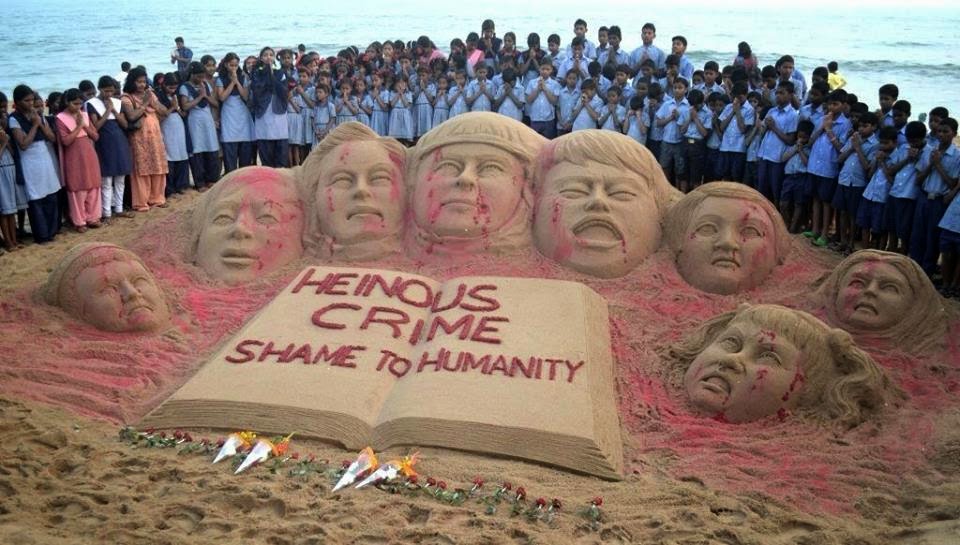
This is a rape culture

I’m not a big fan of the latest and newest terminologies that are bandied about by “social justice warrior” types. The issue is not the terminology taken literally, but its context. In the United States a focus on college campuses strikes me as fixating on a population less at risk, but class privileged. Rather, the more economically and socially marginal women, not women as a whole, is probably where the cultural focus should be. But these people are generally not in the limelight, and are not able to fluently deploy the verbal tools which the more educated are familiar with and understand and unlock keys of media attention (this goes to the issue that when a sex or race are viewed as a class as a whole without distinction resources and attention often go to its more elite segments).*

These terms become even more freighted when viewed in a cross-cultural context. Consider what is occurring in India, as one of the Delhi rapists has now spoken in a film. Man Convicted of Rape in Delhi Blames Victim:

You can’t clap with one hand,” said Mr. Singh, who was convicted of rape and murder, though he denied taking part in the assault. “It takes two hands. A decent girl won’t roam around at 9 o’clock at night. A girl is far more responsible for rape than a boy. Boy and girl are not equal. Housework and housekeeping is for girls, not roaming in discos and bars at night doing wrong things, wearing wrong clothes. About 20 percent of girls are good.”

As abhorrent as the views are, we can’t look away. They reflect real sentiments which must be abolished.

* Can you imagine that the UVA rape story could be transferred into a public housing project, and still be published in a high profile journal such as Rolling Stone?

Islam, ISIS and the Dream of the Blue Flower

First published on 3quarksdaily.com

A few days ago, Graeme Wood wrote a piece in the Atlantic that has generated a lot of buzz (and controversy). In this article he noted that:
“The reality is that the Islamic State is Islamic. Very Islamic. Yes, it has attracted psychopaths and adventure seekers, drawn largely from the disaffected populations of the Middle East and Europe. But the religion preached by its most ardent followers derives from coherent and even learned interpretations of Islam”
The article is well worth reading and it certainly does not label all Muslims as closet (or open) ISIS supporters, but it does emphasize that many of the actions of ISIS have support in classical Islamic texts (and not just in fringe Kharijite opinion). This has led to accusations of Islamophobia and critics have been quick to respond. A widely cited response in “Think Progress” quotes Graeme Wood’s own primary source (Princeton scholar Bernard Hakykel) as saying:
“I think that ISIS is a product of very contingent, contextual, historical factors. There is nothing predetermined in Islam that would lead to ISIS.”
Indeed. Who could possibly disagree with that? I dont think Graeme Wood disagrees. In fact, he explicitly says he does not. But that statement is a beginning, not a conclusion. What contingent factors and what historical events are important and which ones are a complete distraction from the issue at hand? 
Every commentator has his or her (implicit, occasionally explicit) “priors” that determine what gets attention and from what angle;  and a lot of confusion clearly comes from a failure to explain (or to grasp) the background assumptions of each analyst. I thought I would put together a post that outlines some of my own background assumptions and arguments in as simple a form as possible and see where it leads. So here, in no particular order, are some random comments about Islam, terrorism and ISIS that I hope will, at a minimum, help me put my own thoughts in order. Without further ado:
1. The early history of Islam is, among other things, the history of a remarkably successful imperium. Like any empire, it was created by conquest. The immediate successors of the prophet launched a war of conquest whose extent and rapidity matched that of the Mongols and the Alexandrian Greeks, and whose successful consolidation, long historical life, and development of an Arabized culture, far outshone the achievements of the Mongols or the Manchus (both of whom adopted the existing deeper rooted religions and cultures of their conquered people rather than impose or develop their own).
2. Islam, the religion we know today (the classical Islam of the four Sunni schools, as well as the various Shia sects) developed in the womb of the Arab empire. It provided a unifying ideology and a theological justification for that empire (and in the case of various Shia sects, varying degrees of resistance or revolt against that empire) but, at the very least, Islam and the nascent Arab empire grew and developed togetherone was not the later product of the fully formed other. Being, in it’s classical form, the religion of a (very successful and impressive) imperialist project, it is not surprising that its”official” Sunni version has a military and supremacist feel to it. Classical Islam is not intolerant of all other religions (though it is in principle almost completely intolerant of pagans) but the rules and regulations of the four classical schools all agree on the superior status of Muslims and impose certain restrictions, disabilities and taxes on the followers of the “religions of the book” that they do tolerate. By the standards of contemporary European “Christendom”, many of these rules appear tolerant and broad-minded; and since Western intellectuals (leftists as much, or even more than rightists) are completely focused on European history and culture (and therefore,on the achievements and deficiencies of that culture), this relative tolerance is frequently remarked upon as a stellar feature of Islamicate civilization. But it should be noted that this degree of tolerance is quite intolerant compared to contemporary Chinese or Indian norms and is horrendously intolerant compared to post-enlightenment ideals and fashions. The imposition of Ottoman rules today would be most unwelcome even to post-Marxist intellectuals if they had to live under those rules. Of course, this does not mean they cannot speak highly of these norms as long as they themselves are a safe distance away from them, but such long-distance  approval is of academic interest (literally, academic) and not our concern for the purposes of this post.


3. Modern states and modern politics (not just all the complex debates about how power should be exercised, who exercises it, who decides who exercises it etc., but also the institutions and mechanisms that evolved to manage modern states and modern politics) mostly reached their current form in Europe. They did not arise from nothing. Many ancient strands grew and intersected to create these states and their political institutions. And there are surely things about this evolution that are contingent and would have been different if they had happened elsewhere. But there are also many features of modern life that are based on new and universally applicable discoveries about human psychology, human biology and human sociology. They have made possible new levels of organization and productivity and in a globalized world (and the Eurasian landmass has had some sort of exchange of ideas for millennia, but this process has accelerated now by orders of magnitude) it is impossible for any large population to ignore these advances and suvive unmolested by those willing to take advantage of these advances.
The modern world that has been created is not just one random “civilization” among many. It is the cutting edge of human knowledge and the human ability to apply that knowledge to good and evil ends. Whatever else it may be (and there is no shortage of people who feel it is too oppressive, too unfair, too fast, too anxiety-provoking, too inhuman, etc etc.) it is an extremely powerful and progressive culture. You can reject it, and countless people (including, it seems, many of the most privileged intellectuals of this very civilization) do reject many aspects of it. But it should also be noted that there are degrees of rejection. Most of the critics (but not all of them) are either critics-from-within, who only reject certain aspects of it, or non-serious critics whose wholesale contempt for the project is not matched by any equivalent personal commitment or serious consideration of alternatives. Most of them also seem unable to do without critical aspects of modernity. Aspects you cannot have without having far more of the rest than they seem to care for. To give two random examples, I have never met a multiculturalist liberal or leftist in the West (including those of Desi origin) who is willing to himself or herself live under the restrictive sexual morality and the community-centric balance of community vs individual rights characteristic of “traditional cultures’. And I have NEVER met an Islamist who did not want an air-force (you can work out for yourself all the other innovations and institutional mechanisms that would be needed in order to have a competitive indigenous air-force). 
In fact, forget traditional cultures, just look at Maoist China and the Khmer Rouge, both of whom explicitly rejected modern individualism and mere meritocracy and insisted they wanted to be “Red rather than Expert“. One ended up honoring the legacy of Liu Bocheng and Deng Xiaoping over Mao, the other ended up on the proverbial “dust heap of history”. There is a lesson (or several lessons) in those choices and their spectacular failure.
In short, the only people who can realistically stay outside of “our universal civilization” are either museum communities permitted to survive as quaint exemplars of bygone days (like the Amish) or VERY tiny communities that are so isolated and remote that they have escaped the maw of the Eurasian beast until now.  Our universal civilization does not have to be seen as positively as Naipaul famously saw it, but it still has to be seen for what it is, a gigantic human achievement and a work in progress; all criticism and resistance being included within it (dialectics anyone?) 
And it is important to note that this universal civilization is no longer exclusively European (and never was exclusively European for that matter). Soon, this universal civilization may be dominated by non-European people, a fact that Eurocentric PostMarxist intellectuals seem to have very great difficulty assimilating into their worldview. The institutions and ideas that developed in Europe (from earlier sources that came from all over Eurasia) in the last 400 years have been adopted and adapted already by several Asian nations (Japan, South Korea, Taiwan), with China not far behind and India set to follow. Muslims are not special enough to escape that fate. The only thing truly remarkable about the Muslim core region is the widespread desire to integrate huge elements of modern civilization while remaining medieval in terms of theology, law and politics. Of course we are not unique in this desire; there are Indians and Chinese and Japanese who “reject  modernity” as being too European, and who insist they have an alternative path. Whether they do or do not is to some extent a matter of semantics, but Muslims are not unique in claiming that “we are a fundamentally different civilization”. Where we are unique (for now) is only in our inability to generate a genuinely open debate on this topic; the tendency in the Islamicate core is for almost everyone in the public sphere to pay lip-service to delusional or formulaic and practically meaningless Islamist ideals and to avoid direct criticism of medieval laws and theology. This is unlike how it is routine for Indians to criticize Indian “fundamentalists” or Christians to criticize Christian ones. And for that we have to thank the blasphemy and apostasy memes more than any intrinsic unchangeability of Islamicate laws and theology.
4. But while Islamicate empires (the dominant form of political organization in the middle east and South Asia from the advent of Islam to the colonial era) insisted they were “Islamic” and used Islam (especially in the first 500 years) as the central justification for their expansionist ambitions, there was another sense in which these same empires had a near-total separation of mosque and state. All these empires operated as typical Eurasian empires and they were, in most administrative details, a straightforward evolution of previous imperial patterns in that region. Religion was part and parcel of the empires, but religious doctrine provided practically no guidance to the political process. The rulers used religion to justify their rule, but the battle-axe determined who got to rule and how. Some rulers attempted to conduct an inquisition and impose their favorite theology on their subjects, but most were content to get post-facto approval for their rule from the ulama (and the ulama were happy to oblige). Islamic theologians accepted practically ANY ruler as long the ruler said he was Muslim and continued to work for the expansion of the Islamic empire. ALL four schools of classical Sunni Islam insisted that the ruler should be obeyed and rebellion was unislamic. This did not stop people from rebelling, but once a rebellion succeeded, the ulama advised submission to whatever ambitious and capable prince had managed to kill his way to the top. An imaginary idealized Islamic state was discussed at times but had little to no connection with actual power politics.
5. It must also be kept in mind that Empires governed loosely and interfered little with the everyday religious rituals of the ruled, especially outside the urban core. The rulers were interested in collecting taxes and continuing to rule. Most of the ruled gave as little as possible in taxes and had as little as possible to do with their rulers. This is not a specifically Islamic pattern, but it was practically a universal feature of Islamicate empires. Muslim religious literature developed no serious political thought. Power politics was guided more by “Mirrors of princes” type literature and pre-Muslim (or not-specifically Muslim) traditions and not some detailed notion of “Islamic state”. There is really NO detailed “Islamic” blueprint for running a state. The so-called Islamic system of government is a modern myth. Every Islamicate empire down to the late Ottomans ruled in the name of Islam, but they did so using institutions and methods that were typically West-Asian/Central-Asian in origin, or were invented to solve a particular Islamicate problem, but had no direct or necessary connection with fundamental Islamic texts and traditions.  
6. After defeat at the hands of more capable imperialists and during the (relatively brief) colonial interlude, some people dug up the old stories of the rightly guided caliphs; It seems to me that early Islamicate fantasists (like Allama Iqbal in India) took it for granted that the everyday institutional reality of any “Islamic” state would, for the foreseeable future, be much closer to England than it was to Medina (witness for example his approval of the Grand Turkish assembly). Most Muslim leaders, like their Chinese or Japanese counterparts, were first and foremost interested in getting out from under the imperialist thumb. If they gave some thought to the form their states would take, their imagination ranged from Marxist Russian models to very poorly imagined Islamist utopias.  But over time, stories frequently repeated can take on a life of their own. Islamist parties want to create powerful, modern Islamic states. But the stories they were using were more Islamic than modern. The result is that every Islamist party is forever in danger of being hijacked by those espousing simple-minded and unrealistic notions of Shariah law. It turns out that pretending to have “our own unique genius” is much easier than actually having any genius that can get the job done. Modern ideas (fascism, the grand theatre of modern media manipulation, modern methods of guerilla war) are used to promote legal codes and theology whose relationship with these new institutions has not been worked out yet (and I see no problem with sticking my neck out and saying “will NOT be worked out satisfactorily by ANY contemporary Islamist movement). 
7. The MODE of failure may vary, but the failure of the Islamist political project in the next 20 years is inevitable. This is not because there can be no such project in principle, but because the project as it has actually developed in the 20th century is based on the twin illusions of  an “ideal Islamic state” and an existing alternative “Islamic political science”…neither of which actually existed in history. AFTER this failure, there can certainly be new ways of creating modern, workable institutions that have enough of an Islamic coloring to deserve the label “Islamist” while incorporating all (or most) of the new discoveries in the hard sciences as well as in economics, human psychology, politics, social organization, administrative institutions, mass communication and so on.

8. I do want to emphasize that I do not believe Islamic theology per se is some sort of insoluble problem.  It may be a difficult problem, but both liberals who are trying to discover modern fashions in that theology and “Islamophobes” who insist that the theology is a permanently illiberal fascist program are wrong in their emphasis on the centrality of this theology. As Razib put it in an interesting post on this topic on his blog, “Islam is not a religion of the book”. NO religion is a religion of the book. People make religions and people remake them as the times demands. Messily and unpredictably in many cases, but still, there is movement. And in this sense, Islam is no more fixed in stone by what is written or not written in its text (or texts) than any other religion.
Someone commented on Razib’s blog (and I urge you to read the post and the comments, and the hyperlinks, they are all relevant and make this post clearer) as follows:
“Well, if you take the Old Testament and Koran at face value, the OT is more violent. The interesting question is then why Islam ends up being more violent than Judaism or Christianity, and for that I agree you have to thank subsequent tradition and reinterpretation of the violence in the text. It appears that for whatever reason Islam has carried out less of this kind of reinterpretation, so what was originally a less violent founding text ends up causing more violence because it is being interpreted much more literally.”
I replied that there is an easier explanation: Whether the text canonized as “foundational document” does, or does not, explain the imperialism and supremacism of the various Islamicate empires is a red herring. The Quran is a fairly long book, but to an outsider it should be immediately obvious that you can create many different Islams around that book and if you did it all over again, NONE of them have to look like classical Sunni Islam. The details of Sunni Islam (who gets to rule, what daily life is supposed to look like, how non-Muslims should be treated, etc) are not some sort of direct and unambiguous reading of the Quran. While the schools of classical Sunni Islam claim to be based on the Quran and hadith, the Quran and the hadiths are clearly cherry picked and manipulated (and in the case of the hadiths, frequently just invented) based on the perceived needs of the empire, the ulama, the individual commentators, human nature, economics, whatever (insert your favorite element here).
So in principle, we should be able to make new Islams as needed (and some of us have indeed done so over the centuries, the Ismailis being one extreme example; some Sufis being another) and I am others will do just that in the days to come. The Reza Aslan types are right about this much (though i seriously doubt that he can invent anything new or lasting; that does not even seem to be his primary aim). In fact, in terms of practice, millions of Muslims have already “invented new Islams”. Just as a random example, most contemporary Muslims do not have sex with multiple concubines that they captured in the most recent Jihad expedition to the Balkans (or bought from African slave-traders for that matter). Not only do they not buy and sell slaves, they find the thought of doing so somewhat shocking. Also see how countless Muslims lived very obediently under British laws in the British empire and in fact provided a good part of the armies of that empire.  Or see the countless Muslims who take oaths of loyalty to all sorts of “un-Islamic” states and for the most part, turn out to be as loyal and law-abiding as any of their Hindu or Sikh or Christian fellow citizens in the various hedonistic modern states. Their “Islam” has already adapted itself to new realities. 
What sets Muslms apart is really their inability (until now) to publicly and comfortably articulate a philosophical rejection of medieval (aka no longer fashionable) elements of classical Sunni Islam. And for all practical purposes, this is a serious problem only in Muslim majority countries. In other countries that have a strong sense of their own identity and of the necessity of their own laws, Muslims mostly get on with life while following those laws. In the Muslim majority countires, it is the apostasy and blasphemy laws (and the broader memes that uphold those laws) that play a central role in preventing public rejection of unfashionable or unworkable aspects of classical Islam.  A King Hussein or a Benazir Bhutto or even a Rouhani may have private thoughts rejecting X or Y inconvenient parts or medieval Islamicate laws and theology, but to speak up would be to invite accusations of blasphemy and apostasy. So they fudge, they hem and how, and they do one thing while paying lip service to another. Unfortunately, this means the upholders of classical Islam have the edge in debates in the public sphere. And ISIS and the Wahabis are not far enough from mainstream classical Sunni Islam; for example, classical Islamic theology recommends cutting the hands of thieves, stoning adulterers, going on jihad (not just some inner jihad of the Karen Armstrong type, but the real deal), capturing slaves, buying and selling concubines, killing apostates and so on; ISIS of course goes much further in their willingness to kill other Muslims, to rebel against existing rulers and to bypass common humanity and commonly cited restrictions and regulations about prisoners, hostages, punishments and so on, but when they say classical Islam permits the first set of things noted above, they are not lying, the apologists are lying. 
By the way, while this inability to frontally confront aspects of classical Islam that are out of sync with the current age is a serious problem in Muslim communities, it is not insoluble. The internet has made it very hard to keep inconvenient thoughts out of view. So even in Muslim majority countries, there will be much churning and eventually, much change. It’s just that some countries will emerge out of it better than others.
ISIS itself will not get anywhere. Of course, in principle, an evolved ISIS living on in the core Sunni region is possible. But we make predictions based on whatever models we have in our head. Like most predictions in social science and history, these will not be mathematical and precise and our confidence in them (or our ability to convince others, even when others accept most of our premises) will not be akin to the predictions of mathematics or physics. But for whatever it’s worth, I don’t think ISIS will settle into some semi-comfortable equilibrium (irrespective of whether more capable powers like Israel or Turkey or even the CIA are supporting them or not). They will only destroy and create chaos. And eventually they will be destroyed. It is possible that in the process parts of Syria, Iraq and North Africa could become like Somalia; too messy, too violent and too poor to be worth the effort of pacification, even by intact nearby states. But even if a Somalia-like situation continues for years, it will not go on forever. The real estate involved is too valuable, the communities involved were too integrated in the modern world, to be left alone. Eventually someone will bring order to to those parts. Though it is likely that this “someone” will be local and will use more force and cruder methods than liberal modern intellectuals are comfortable with. The first stage of pacification is more likely to be handled by local agents of distant imperialists, not directly by the imperialists themselves. That is just the way it is likely to work best. 
Of course, success and failure are always relative to something. If the zeitgeist (whatever that means) is no longer in favor of something then a “successful” policy would be one that achieves a soft landing. Since the zeitgeist is (almost by definition) unknowable in full in real time, even the soft landing is not going to land where the first planners of soft landing imagined it as being headed. Being able to land softly, wherever that may be is the best outcome we can hope for in many cases. With that cheery note, here are some other useful links (many extracted from an extremely learned discussion on smallwarsjournal)  that shed light on some aspects of the above, raise opposing ideas, or help to understand where I am coming from. 

 Our religion problem by Babar Sattar in DAWN Pakistan. 
 Reforming the blasphemy laws, in many ways, an enlightened “Islam-based” initiative.  
 Razib Khan on “The Islamic State is right about some things”
 From Zenpundit Charles Cameron on Misquoting Mohammed 
“Brown is a Muslim, a professor at Georgetown, and author of Hadith: Muhammad’s Legacy in the Medieval and Modern World. His book Misquoting Muhammad — not his choice of title, btw — lays open the varieties of interpretive possibility in dealing with the Qur’an and ahadith with comprehensive scholarship and clarity. In light of the upsurge in interest in Islamic and Islamist religious teachings occasioned by Graeme Wood‘s recentAtlantic article, I asked Prof. Brown’s permission to reproduce here the section of his book dealing with abrogation and the rules of war.
Here then, with his permission, is an extract from Misquoting Muhammad. I hope it will prove of use both here and to others beyond the circle of Zenpundit readers. Spread the word!”
http://zenpundit.com/wp-content/uploads/2015/02/Extract-from-Misquoting-Muhammad.pdf
An ISIS reading list. 
MUST read: Enough about Islam: Why religion is not the most useful way to understand ISIS
From a conservative Western perspective: The fantasy of an Islamic reformation. 

“Q 2:256, “There is no compulsion in religion . . .” (lā ikrāha fī l-dīni) has become the locus classicus for discussions of religious tolerance in Islam. Surprisingly enough, according to the “circumstances of revelation” (asbāb al-nuzūl) literature (see occasions of revelation), it was revealed in connection with the expulsion of the Jewish tribe of Banū l-Nadīr from Medina in 4⁄625 In the earliest works of exegesis (see exegesis of the Quran: classical and medieval), the verse is understood as an injunction (amr) to refrain from the forcible imposition of Islam, though there is no unanimity of opinion regarding the precise group of infidels to which the injunction had initially applied. Commentators who maintain that the verse was originally meant as applicable to all people consider it as abrogated (mansūkh) by q 9:5, q 9:29, or q 9:73 (see abrogation). Viewing it in this way is necessary in order to avoid the glaring contradiction between the idea of tolerance and the policies of early Islam which did not allow the existence of polytheism — or any other religion — in a major part of the Arabian peninsula. Those who think that the verse was intended, from the very beginning, only for the People of the Book, need not consider it as abrogated: though Islam did not allow the existence of any religion other than Islam in most of the peninsula, the purpose of the jihād (q.v.)against the People of the Book, according to q 9:29, is their submission and humiliation rather than their forcible conversion to Islam.[…]
From Tolerance and Coercion in Islam 
“Both verses that are said to have abrogated Quran 2:256 speak about jihad. It can be inferred from this that the commentators who consider Quran 2:256 as abrogated perceive jihad as contradicting the idea of religious freedom. While it is true that religious differences are mentioned in both Quran 9:29 and 9:73 as the reason because of which the Muslims were commanded to wage war, none of them envisages the forcible conversion of the vanquished enemy. Quran 9:29 defines the purpose of the war as the imposition of the jizya on the People of the Book and their humiliation, while Quran 9:73 speaks only about the punishment awaiting the infidels and the hypocrites in the hereafter, and leaves the earthly purpose of the war undefined. Jihad and religious freedom are not mutually exclusive by necessity; religious freedom could be granted to the non-Muslims after their defeat, and commentators who maintain that Quran 2:256 was not abrogated freely avail themselves of this exegetical possibility with regard to theJews, the Christians and the Zoroastrians. However, the commentators who belong to the other exegetical trend do not find it advisable to think along these lines, and find it necessary to insist on the abrogation of Quran 2:256 in order to resolve the seeming contradiction between this verse and the numerous verses enjoining jihad. p. 102-3t al-_arab). Despite the apparent meaning of q 2:256, Islamic law allowed coercion of certain groups into Islam. Numerous traditionists and jurisprudents ( fuqahā_) allow coercing female polytheists and Zoroastrians (see magians) who fall into captivity to become Muslims — otherwise sexual relations with them would not be permissible (cf. q 2:221; see sex and sexuality; marriage and divorce). Similarly, forcible conversion of non-Muslim children was also allowed by numerous jurists in certain circumstances, especially if the children were taken captive (see captives) or found without their parents or if one of their parents embraced Islam. It was also the common practice to insist on the conversion of the Manichaeans, who were never awarded the status of ahl al-dhimma. Another group against whom religious coercion may be practiced are apostates from Islam (see apostasy). As a rule, classical Muslim law demands that apostatesbe asked to repent and be put to death if they refuse.”
The pact of Umar 
“In the name of Allah, the merciful Benefactor! This is the assurance granted to the inhabitants of Aelia by the servant of God, ‘Umar, the commander of the Believers. He grants them safety for their persons, their goods, churches, crosses – be they in good or bad condition – and their worship in general. Their churches shall neither be turned over to dwellings nor pulled down; they and their dependents shall not be put to any prejudice and thus shall it fare with their crosses and goods. No constraint shall be imposed upon them in matters of religion and no one among them shall be harmed. No Jew shall be authorised to live in Aelia with them. The inhabitants of Aelia must pay the gizya in the same way as the inhabitants of other towns. It is for them to expel from their cities Roums (Byzantians) and outlaws. Those of the latter who leave shall be granted safe conduct… Those who would stay shall be authorised to, on condition that they pay the same gizya as the inhabitants of Aelia. Those of the inhabitants of Aelia who wish to leave with the Roums, to carry away their goods, abandon their churches and Crosses, shall likewise have their own safe conduct, for themselves and for their Crosses. Rural dwellers (ahl ‘I-ard) who were already in the town before the murder of such a one, may stay and pay the gizya by the same title as the people of Aelia, or if they prefer they may leave with the Roums or return to their families. Nothing shall be exacted of them.
Witnesses: Khaledb.A1-Walid, ‘Amrb.A1-Alp, ‘Abdar-Rahmanb. ‘Awf Muawiya b. Abi Sufyan, who wrote these words, here, In the year 15 (33).
Winston King states in the Encyclopaedia of Religion, 2nd Ed., Vol. 11
Many practical and conceptual difficulties arise when one attempts to apply such a dichotomous pattern [ sacred / profane ] across the board to all cultures. In primitive societies, for instance, what the West calls religious is such an integral part of the total ongoing way of life that it is never experienced or thought of as something separable or narrowly distinguishable from the rest of the pattern. Or if the dichotomy is applied to that multifaceted entity called Hinduism, it seems that almost everything can be and is given a religious significance by some sect. Indeed, in a real sense everything that is is divine; existence per se appears to be sacred. It is only that the ultimately real manifests itself in a multitude of ways—in the set-apart and the ordinary, in god and so-called devil, in saint and sinner. The real is apprehended at many levels in accordance with the individual’s capacity.” p.7692, 
Paul Radin, Primitive Religion: Its Nature and Origin in connexion with early societies”Where there is little trace of a centralized authority, there we encounter no true priests, and religious phenomena remain essentially unanalysed and unorganized. Magic and simple coercive rites rule supreme”.p.21
Carl Schmitt in Political Theology,
All significant concepts of the modern theory of the state are secularised theological concepts‟ (p. 36)
or again in The Concept of the Political that
“The juridic [sic] formulas of the omnipotence of the state are, in fact, only superficial secularisations of theological formulas of the omnipotence of God‟ (p. 42).


Sometimes the Bible just gets it right

I can’t claim to have read the Bible, the only books I read are book club prescribed ones and Holy Books haven’t yet come onto the selection.
But I always turn back to my favorite chapter

To every thing there is a season—Whatever God does, it will be forever—God will judge the righteous and the wicked.
 1 To every thing there is a season, and a time to every purpose under the heaven:
 2 A time to be born, and a time to die; a time to plant, and a time to pluck up that which is planted;
 3 A time to kill, and a time to heal; a time to break down, and a time to build up;
 4 A time to weep, and a time to laugh; a time to mourn, and a time to dance;
 5 A time to cast away stones, and a time to gather stones together; a time to embrace, and a time to refrain from embracing;
 6 A time to get, and a time to lose; a time to keep, and a time to cast away;
 7 A time to rend, and a time to sew; a time to keep silence, and a time to speak;
 8 A time to love, and a time to hate; a time of war, and a time of peace.

Another Angry Voice on Podemos

Why the EU is damned to doom

On facebook I follow the extreme left page, Another Angry Voice, and they have a small piece on Podemos, the new left-wing party that’s virulently growing in Spain (even more worryingly the party wants to call a referendum on the Spanish monarchy).

Podemos and the appeal of Pablo Iglesias

Pablo Iglesias is the 36 year old leader of a new left-wing party in Spain called Podemos (We Can) that was born out of the 15-M street protest movement.

The Origins of Podemos

Podemos arose out of the 15-M “indignados” protests, which were a little bit like the Spanish version of the Occupy Wall Street Movement, but crucially the Spanish protesters managed keep the movement going and convert it into a powerful political force, whilst the Occupy Wall Street movement has faded away into near irrelevance in the grand scheme of US politics.

When the right-wing Spanish government led by Mariano Rajoy brought forward plans to introduce €600,000 fines for people participating in “unauthorised” public protests, they gave the 15-M movement a huge incentive to legitimise themselves as an official political party.

The rise of Podemos

Since Podemos was formed in March 2014, the party has experienced an unprecedented rise in popularity. In May 2014, just two months after it was formed, Podemos took 8% of the vote in the European elections to bag 5 MEPs (that’s two more than the Green Party managed in the UK, despite the UK having 73 European Parliament seats to Spain’s 54).

One area in which Podemos is utterly dominating Spanish politics is in the online sphere. The Podemos Facebook pagehas picked up over 950,000 followers, which is more than the pages of all of the other political parties in Spain combined!

At any rate it’s a chicken and an egg scenario; the Eurozone is a doomed project banking on economic synchronizing between the heavyweight Germanic economies and the more haphazard Romantic Europe.
A telling example is the rift between Germanic Europe and the rest (via Inside Europe):

Ayub Khan, Yahya Khan and Sam Manekshaw (and a comment from Major Agha Amin)

A post from Dr Hamid Hussain. A (typically earthy) comment from military historian Major Agha Amin follows below Dr Hamid Hussain’s post.

Dear Sir;

A while ago, many officers asked about the controversies about Ayub Khan’s selection and I wrote a piece that may interest those raising these questions.

Mr. Ardeshir’s comment about Sam Manekshaw and Ayub Khan is incorrect.  It is related to Sam and Yahya Khan.  The real story is as follows;

In early 1947, Sam and Yahya were serving together at Military Operations directorate in New Delhi.  Sam owned a red James motorcycle that looked like the picture below;

Yahya fell in love with it and Sam agreed to sell it for 1000 Rupees.  In the chaos of partition, Yahya left for Pakistan promising to send the money from Pakistan but later forgot about the money.  After 1971 war, Sam once joked about the incident stating that ‘”Yahya never paid me the Rs1,000 for my motorbike, but now he has paid with half his country.” In 2001, Pakistani columnist Aredshir Cowasjee went to India and met Sam.  Cowasjee remembered Sam’s quip and offered to pay the money Yahya owed along with the interest.  Sam replied that ‘Yahya was a good man and a good soldier.  We served together and he didn’t have a mean or corrupt bone in his body’.


An additional corollary to the above story is another story.  In 1946, Lt. Colonel Sam Manekshaw was GSO-1 (Operations), Major Yahya Khan was GSO-2 (Frontier Defence) and Captain S. K. Sinha was GSO-3 (Internal Security) at Military Operations Directorate in New Delhi.  In 1971, General Sam Manekshaw was Indian army chief, Yahya was Pakistan army chief and Lieutenant General S. K. Sinha was head of pay and pension department at army headquarters in Delhi.  When war started, Sinha sent a letter to Sam requesting for chance to participate in the war.  Sinha wrote, “old G-1 is going to war with old G-2 and G-3 is being left out’.

Regards,
Hamid

Selection of First Native C-in-C in Pakistan

Hamid Hussain

In 1947, India and Pakistan emerged as new independent states and Indian army was divided.  There were no senior native officers and both countries decided to keep British officers at senior posts while native officers were given accelerated promotions to prepare them for senior positions.  In India, General Robert Lockhart (commissioned in 51st Sikh; now 3 Frontier Force Regiment of Pakistan army) was appointed first C-in-C.  He relinquished charge in January 1948 and was succeeded by Lieutenant General Francis Robert Roy Bucher (commissioned in 55th Coke’s Rifles; now 7 Frontier Force Regiment of Pakistan army.  He later changed to 32nd Lancers that was amalgamated with 31st Lancers in 1922 to form 13thLancers; now an elite cavalry regiment of Pakistan army).  Near the end of 1948, it was decided to appoint an Indian C-in-C to complete the nationalization process and in January 1949, General Cariappa took charge as first Indian C-in-C.  In case of Pakistan, General Frank Messervy (he was commissioned in Hodson Horse) was appointed first C-in-C on August 15, 1947.  He retired on February 1948 and succeeded by his Chief of Staff (COS) General Douglas Gracey (commissioned in Ist King George’s Own Gurkha Rifles and later commanded 2/3rd Gurkha Rifles).  Interestingly, the last two British C-in-Cs of India belonged to regiments that were allotted to Pakistan and the two British C-in-Cs of Pakistan belonged to regiments that went to India.

On the eve of independence, Pakistan inherited only two native Brigadiers; Muhammad Akbar Khan and Nawabzada Agha Muhammad Raza.  Several officers were given accelerated promotions and senior positions were filled with Pakistani officers.  In 1949, it was decided that Major General Iftikhar Ali Khan will be the first native C-in-C.  He was commissioned from Sandhurst in August 1929.  His parent regiment was 7 Light Cavalry.  Later, he was transferred to 3 Cavalry when later regiment was Indianized and he served as regiment’s Adjutant.  During war, he served with newly raised 45 Cavalry.  He was junior to several Pakistani officers and the list includes with commission dates in brackets; Muhammad Akbar Khan ‘Rangroot’ was Daly College Indore graduate and not Sandhurst commissioned (December 1919), Faiz Mohammed Khan (July 1921), Mohammad Ishfakul Majid (August 1924), Khairuddin Mohammad Idris (September 1925), Malik Fazal-ur-Rahman Kallue (January 1927), Nawabzada Agha Muhammad Raza (January 1927), Raja Mohammad Afzal Janjua (January 1927), Muhammad Ayub Khan (February 1928), Nasir Ali Khan (February 1928) and Mohammad Yusuf (January 1929).  It is important to clarify seniority issue.  At every rank, several officers are superseded and seniority alone is never a criterion for senior positions.  Some officers when superseded ask for retirement while others continue to serve.  Two examples will clarify this position.  Mir Haider was commissioned in December 1919 and in 1949, he was Major. Jamaldar Orakzai was commissioned in August 1928 and in 1948 he was Colonel serving at Quarter Master General (QMG) branch.  Haider and Orakzai were senior to Iftikhar but in view of their service track and rank, they were not relevant to the selection of army chief.  It was decided to send Iftikhar for Imperial Defence Course (IDC) in London to prepare him for his job.  In December 1949, his plane crashed near Jangshahi in Karachi killing all on board that included his wife and son and Director Military Operations (DMO) Brigadier Mohammad Sher Khan.  Sher was a Sandhurst graduate commissioned in September 1932 and joined 6th Battalion of 13th Frontier Force Rifles (now 1 Frontier Force Regiment).

There are many confusing stories about selection of first native C-in-C of Pakistan but they relate to selection of Ayub and not Iftikhar with the exception that Ayub contended that Iftikhar’s name was floated as possible first native C-in-C but no final decision was made.  This may be due to the fact that decision was made but Iftikhar died before any official notification was issued.  Very few officers of that time period wrote memoirs therefore written record is very limited.  Political leadership of newly independent Pakistan under Prime Minister Liaqat Ali Khan selected Iftikhar on the advice of British senior brass.  British considered Iftikhar professionally sound and apolitical. His thoroughly westernized life style was probably a plus.  Some suggest that he was tough disciplinarian and may have temper problem.  According to Major General A. O. Mitha, he had ‘the reputation of eating a Brigadier or Lt. Colonel for breakfast everyday’.  Ayub considered Iftikhar a good officer but ‘a difficult man’ and ‘short-tempered’.  Two most credible sources about the subject matter are Major General Sher Ali Khan Pataudi and Major General Syed Shahid Hamid.  Pataudi knew Iftikhar for a long period of time starting from the days when two were at Royal Indian Military College (RIMC) at Dehra Dun where Iftikhar was senior to him.  In early 1948, Pataudi served as 14 Para Brigade commander under Iftikhar when later was commanding 10 Division.  Pataudi was bachelor and stayed at Iftikhar’s house and knew Iftikhar intimately.  When Pataudi came to Pakistan in October 1947, he was posted to Gardai Brigade in Waziristan commanded by Ayub. The two were together for three months and developed friendship.  When Ayub was C-in-C, he superseded Pataudi therefore he was resentful.  Hamid served with Iftikhar in the same 3 Cavalry Regiment.  Hamid’s time in 3 Cavalry was not pleasant and he soon left the regiment.  He didn’t have good memories as some Indian officers including Iftikhar preferred to interact with British officers rather than fellow Indian officers.  Hamid also had friendly relations with Ayub and Ayub used to stay with him.  He served as Master General Ordnance (MGO) and Adjutant General (AG) under Ayub.

These two contemporaries of Iftikhar and Ayub give different accounts and these perspectives are based on their own personal relations with the two.  It is important to note that during a professional life spanning over two to three decades an officer interacts with several hundred officers in different capacities therefore one can expect quite diverse opinions.   Major General Sher Ali Khan Pataudi considered Iftikhar professionally sound, well read and highly intelligent.  In contrast, he considered Ayub as a typical battalion officer good at basic soldiering but not cut for higher direction of war.  He defended Iftikhar’s aloofness by suggesting that ‘he was a very shy person which gave the impression of his being conceited, which he wasn’t’.  Pataudi claims that Iftikhar was concerned about politicization of officers and distrusted politicians.  He once commented that ‘it would be better for both of us if we both got out before our hands were stained and garments polluted’.  Pataudi is of the view that if Iftikhar had been C-in-C, ‘he would not have allowed the Army to be used for political purposes and ‘would have never used his position as C-in-C, to come into power through the Army’.  In contrast, Major General Shahid Hamid is of the view that Iftikhar was a thoroughly westernized officer (he was married to a charming Parsee girl who was number one woman rider in India.), ruthless and hated politicians.  Hamid is of the view that Iftikhar would have adopted the same course later adopted by Ayub.

Iftikhar’s choice as first native C-in-C is an established fact and Pataudi states that Prime Minister contacted Iftikhar and informed him about the decision which Iftikhar shared with him.  In addition, Pataudi also states that on that day Ayub was also in Lahore and contacted him and asked to arrange for a meeting with Iftikhar to get to know the incoming C-in-C.  Ayub was leaving the next day therefore meeting didn’t materialize.  Hamid also alludes to the fact that Ayub was always curious about Iftikhar as it was an open secret that Iftikhar would be next C-in-C.  An incident narrated by Ayub also gives credence that Prime Minister had considered Iftikhar for C-in-C position.  There was a division commander’s conference and Prime Minister Liaqat Ali Khan invited some senior officers to circuit house.  He brought up the subject of selection of C-in-C and told the audience that ‘it was possible that the appointment would not go to the most senior officer’.  He then elicited opinion of several officers regarding selecting a junior officer as C-in-C.

Among the list of officers senior to Iftikhar, Akbar was commissioned in 1 Brahmans but spent most of his career with Royal Indian Army Service Corps (RIASC) with no command, staff or instructional experience (the only exception was command of Meerut sub area in 1947).  In April 1946, British recommended several Indian officers for senior appointments to prepare them for command when British left.  Akbar was recommended by the selection board to be Army Commander but it was probably to have a Muslim and not for professional excellence.  Akbar was the only senior Muslim officer at Brigadier rank while the remaining six recommend for promotions and coveted postings were Hindus (Cariappa, Rajindra Singhji, Srinagesh, Nathu Singh, A.J. Rudra and B.S. Chimni).  In Pakistan, by 1949, several officers have attained accelerated promotions and were considered professionally superior therefore Akbar was not considered for post.  He retired at Major General rank in 1950.    One other qualified candidate Raza was not liked by British.  Brigadier Francis Ingall in the process of establishment of Pakistan a military academy dealt with Raza who was then serving as Adjutant General (AG) and didn’t have high opinion of him.  Ingall considered him ‘extremely pompous’, ‘difficult to deal with’, vague’ and ‘hesitant to make decisions’.   A junior councilor at British High Commission A. H. Reed remarked that Raza ‘a born intriguer, had been lobbying hard for the Commander-in-Chief position’.  He also remarked that Raza was feared by juniors and universally disliked by both British and Pakistani officers.  Major General A. O. Mitha who served under Raza summed up the general opinion that Raza was professionally average and ‘had the reputation of being strict and a bit of bully’.  However, after a personal encounter he developed great respect for Raza for his ‘large-heartedness’ and ‘broad-mindedness’.  Many other officers senior to Iftikhar later retried at Colonel and Brigadier ranks.

In early 1948, Ayub was superseded at the rank of Brigadier and two sources confirm this.  Shuja Nawaz was given access to Ayub’s file for his encyclopedic work on Pakistan army and his information removes doubts about seniority.  Ayub Khan was sent to command East Pakistan sub area (later designated 14th Division) with the local rank of Major General.  This could have caused confusion in terms of seniority and General Gracey sent a note to Military Secretary stating that when Ayub is promoted to Major General rank, this will be antedated to the date of his local Major General rank starting January 08, 1948.  Gracey went ahead to clarify the seniority list putting Ayub ‘NEXT below Maj. General Iftikhar Khan, and next above Major General Nasir Ali Khan’.  This clearly shows that while Iftikhar was junior as far commission date is concerned but when he was promoted Major General, Ayub was Brigadier with only local Major General rank thus making him junior to Iftikhar.  Pataudi was a friend of C-in-C General Frank Messervy and both played polo together.  Pataudi states that in early 1948, when he was serving under Iftikhar at Lahore, Ayub on his way to East Pakistan passed a note to him ‘been superseded.  Can you do something’?  Pataudi went to Rawalpindi and met Frank Messervy and gently raised the subject.  Messervy replied that selection of right officers at this stage was crucial as they will lead the army when British officers are gone.

After the death of Iftikhar, selection of C-in-C came up again.  The decision was finalized sometime in September 1950 when General Douglas Gracey was C-in-C.  Syed Wajahat Hussain (later Major General) served as ADC to General Gracey in 1947-48 at the rank of Lieutenant.  In 1956, he visited England and stayed with General Gracey.  Wajahat states that Gracey told him that after the death of Iftikhar in plane crash, the choice of C-in-C was narrowed down to Ayub, Raza and Nasir Ali Khan.  According to Gracey, Ayub was picked because of his command experience compared to Raza and Nasir although Gracey was worried about Ayub’s political ambitions.  Raza was commissioned in 1/7 Rajput Regiment and later commanded 6/7 Rajput and 18/7 Rajput battalions.  Raza was the first Pakistani Adjutant General (AG).  Nasir was also commissioned in 7th Rajput Regiment and commanded 9/7 Rajput.  He was the first Pakistani Military Secretary (MS), Quarter Master General (QMG) and Chief of Staff (COS) of Pakistan army.  Nasir spent all post independence time at staff positions and didn’t command a Brigade or Division.  Nasir was not particular about military decorum and this may have also gone against him.  In summer, sometimes he was seen wearing sandals without socks with his military uniform.  In a British trained army, I’m sure this attitude would have horrified not only British but many Pakistani officers.

Gracey’s remark about Raza’s lack of command experience is curious as he commanded 12 Division.  12 Division was raised in Peshawar in November 1948 by Major General Mohammad Yusuf who commanded it until December 1949 (Division was later moved to Batrasi and finally to Murree).  Yusuf was succeeded in command by Raza.  Major General A. O. Mitha confirms that in his memoirs.  He served under Raza when he was Commanding Officer (CO) of 9/8 Punjab Regiment and his battalion was defense battalion of the division at Batrasi.  When decision about C-in-C was made in summer of 1950, Raza was in command of the division for about six months and this may have not been thought as adequate.  One possibility is that Gracey was referring to mid 1949 time period during consideration for C-in-C position when Iftikhar was chosen as at that time Raza had not yet commanded a division.  Prime Minister Liaqat Ali Khan had a favorable view of Raza as Raza’s father was Liaqat’s friend but probably recommendation of General Gracey and favorable input by Secretary of Defence Sikandar Mirza tilted the balance in Ayub’s favor.  Sikandar Mirza was Secretary Defence and he weighed in Ayub’s favor.  Mirza had spent his long career in Indian Political Service (IPS) on North West Frontier and familiar with the byzantine intrigues.  He contacted the head of nascent Inter Services Intelligence (ISI) Colonel (later Major General) Shahid Hamid and asked him to generate an adverse intelligence report about Raza with the intention of getting him out of the race for C-in-C.  Shahid refused to oblige.

The command of 14th Division needs some elaboration.  At the time of partition, the command in East Pakistan was designated East Pakistan Army.  Ironically, this grand title was given to a formation that consisted of a single infantry battalion; 8/12 Frontier Force Regiment.  When Ayub assumed command in January 1948, it was called East Pakistan Sub Area and consisted of only two infantry battalions (8/12 Frontier Force Regiment and 2/8 Punjab Regiment).  In December 1948, sub area was designated 14th Division and although its command played a major role in the decision of  Ayub’s appointment as first C-in-C, technically Ayub’s command consisted of only two infantry battalions.

In September 1950, it was decided that Ayub would be next C-in-C.  He was appointed Deputy C-in-C under Gracey to groom him for the top job.  He visited military installations in England and Germany.  He took charge on January 17, 1951.  Lieutenant General Ross McKay was appointed his advisor.  Ayub’s appointment as first C-in-C has been criticized by many with the hindsight.  This criticism is invariably in the context of Ayub’s coup and long tenure as President with the assumption that another army chief was not likely to launch the coup.

The issue of seniority and a bad report in Second World War is cited against Ayub.  As far as seniority is concerned regarding three contenders; Raza, Ayub and Nasir, Raza was senior and Nasir and Ayub from the same course although Nasir was put junior to Ayub in army list.  In the argument against Ayub’s professionalism a bad report is cited which is probably ‘tactical timidity’ during Second World War in 1945 by his commander Major General Thomas Wynford ‘Pete’ Rees (Served with 1/3 Madras during First World War, long stint with 5/6 Rajputana Rifles and commanded 3/6 Rajputana Rifles).  Rees was commanding 19th Division in Burma.  Ayub was serving with First Assam Regiment as second in command (2IC) at the rank of Major.  First Assam was a divisional support unit under direct command of Rees.  On January 10, 1945, Commanding Officer (CO) of First Assam Lieutenant Colonel W. F. Brown was killed and Ayub Khan assumed command.  Ayub was removed from the command by Rees when Ayub suggested that battalion was not fit for the assigned task.  Rees considered this as tactical timidity and removed Ayub from command.  On March 07 (some accounts give the date of March 15) 1945 Lieutenant Colonel Hugh Parsons took command from Ayub.  Parsons was originally from 5/6thGurkha Rifles and had served with First Assam in the past.  Ayub stayed in the tent of Risaldar/Honorary Captain Ashraf Khan of Hazara until his departure to India on April 18.

All evidence suggests that Ayub got a bad report during his command of First Assam Regiment although exact nature is not clear.  Pataudi states that Ayub discussed this with him when he was working with him in Waziristan.  Pataudi also claims that he had seen this report when he was in Delhi.  Pataudi opted for Pakistan and came to Pakistan in October 1947.  While in Delhi, he was given access to files of Muslim officers opting for Pakistan as he was designated Deputy Military Secretary of Pakistan army.   In October 1958, British High Commissioner Sir Gilbert Laithwaite pointed to this in his report about Ayub.  Laithwaite wrote, ‘he was according to our records, a failure as a Commanding Officer (Lieutenant Colonel) on active service and had to be relieved’.  Ayub survived the bad report of Rees and later re-raised and commanded his parent battalion 1/14 Punjab Regiment (now 5 Punjab of Pakistan Army).  Later, he served as President of Army Selection Board tasked with recommending permanent commission to Emergency Commissioned Officers (ECOs).  Some suggest that Ayub had this negative report removed from his file when he became C-in-C.  Shuja Nawaz who was given access to Ayub’s file communicated to me that he does not recall seeing Rees’s report in the file.  Pete Rees and Ayub’s paths crossed again when Rees was commanding Punjab Boundary Force (PBF) and Ayub served under him.  Ayub Khan was one of the advisors to Reese at Colonel rank.  It is not clear whether two had any problems in view of their previous unpleasant encounter.  PBF was severely criticized by Punjab politicians for failure to control law and order.  PBF story is another neglected chapter of subcontinent history and very little has been written about it.   I have done some work on the subject and in my view it is quite unfair to criticize PBF or Ayub for the tragedy that was a chapter from Dante’s inferno.  I think this left a deep mark on Ayub and his extreme distrust of politicians.

Some suggest that country’s founder Jinnah was not in favor of Ayub which is probably not correct.  In October 1947, Ayub was Brigadier and commanding Gardai Brigade Group in Waziristan area command.  If the assertion that Mr. Jinnah was not happy with Ayub is true then it does not make sense that Ayub is promoted Brigadier against Mr. Jinnah’s wishes and given the task of execution of Operation Curzon; withdrawal of troops from tribal areas.   Similarly, Ayub was promoted Major General in January 1948 and posted to East Pakistan when Mr. Jinnah was very well in full control of all affairs.  In Pakistan, there is a wrong perception that Operation Curzon was the brainchild of Jinnah.  By 1946, it was clear that British were leaving and British high command had put in place a plan for removal of regular troops from tribal areas.  This decision was reached before the Cabinet Mission plan when even partition of India was not envisaged.  On April 24, 1946, a conference was held at Peshawar.  It was attended by Governor North West Frontier Province George Cunningham, Agent to Governor General Baluchistan, Air Officer Commander-in-Chief (AOC-in-C), British minister at Kabul, C-in-C General Claude Aukinleck and senior military and civil officers.  It was realized that the status of tribes will be uncertain until the outcome of Cabinet Mission plan.  The decision was made that regular troops will be replaced by civil armed forces although the process was to be gradual.  It was in this context that decisions such as Indianization of officer Corps of Scouts, raising of Central Waziristan Scouts, Malakand battalion and re-raising of Khyber Rifles was discussed.  Gardai brigade was the first to be withdrawn and replaced by local tribal levies; Khassadars. Once Civil Armed Forces were properly organized and equipped then Wana and Razmak brigades withdrawn.  Events of sub-continent moved much faster with impending independence of India, emergence of Pakistan and massive migration and slaughter put this issue on the back burner. It is to Jinnah’s credit that he made the decision quickly and swiftly implemented the plan.  The caveat is that by that time tribesmen had been directed by Pakistan to greener pastures of Jammu & Kashmir during 1947-48 conflict.

Ayub Khan was an average officer not different from many of his contemporaries.  He was trained as a regimental officer and he was neither trained nor did he strive to learn the higher direction of war.  His reading was limited to Readers Digest type of publications and Philip Mason’s Men Who Ruled India.  He was not known for reading classic or modern military works on history or art of war.  This was the reason that Lieutenant General Ross McKay was appointed his advisor.  Ayub was mild mannered and humble.  He was handsome with an impressive personality and very pleasant.  This endeared him to many international leaders.

Ninety percent of officers of Indian army both British and Indian were groomed for regimental service.  Selection and training of Indian officers during Indianization of officer corps was focused on basic regimental training.  It was envisioned that probably the highest rank an Indian could achieve was command of a battalion.  Second World War opened the door wide open and large numbers of Indians were commissioned.  War also resulted in accelerated promotions and several Indians commanded battalions.  After the war, when it was clear that British Raj would come to an end, then the question of promoting Indians to senior ranks was seriously discussed.  In 1947, only a handful of Indians were at colonel and brigadier ranks. Indian subcontinent went through cataclysmic changes with emergence of new states.  It had an impact on all institutions including army.  In these extraordinary circumstances, officers were given accelerated promotions and first Pakistani C-in-C was selected in these exceptional circumstances.  What else describes the anomalies of that time period than the fact that first Indian C-in-C jumped six ranks from Major to four stars General in six years while first Pakistani C-in-C accomplished this feat in five short years?

Notes:

–        Major General ® Shaukat Raza.  The Pakistan Army 1947-49 (Lahore: Services Book Club, 1989)

–        Shuja Nawaz.   Crossed Swords: Pakistan, Its Army, and the Wars Within (Karachi: Oxford University Press, 2008)

–        Major General Sher Ali Khan Pataudi.  The Story of Soldering and Politics in India and Pakistan (Lahore: Wajidalis, 1978)

–        Field Marshal Mohammad Ayub Khan.  Friends Not Masters (London: Oxford University Press, 1967)

–        Interview of Major General ® Syed Wajahat Hussain by Major ® Agha H. Amin, Defence Journal, August 2002

–        Lieutenant Colonel Mustasad Ahmad.  Living Up To Heritage: The Rajputs 1947-1970 (New Delhi: Lancer Publishers, 1997)

–        Major General Shahid Hamid.  Disastrous Twilight (London: Leo Cooper, 1986)

–        Lt. Colonel ® Gautam Sharma.  Nationalization of The Indian Army 1885-1947 (New Delhi: Allied Pubslishers, 1996)

–        Brigadier Francis Ingall.  The Last of the Bengal Lancers (California: Presidio, 1988)

–        Pradeep P. Barua.  Gentlemen of the Raj: Indian Army Officer Corps 1817-1949 (New Delhi: Pentagon Press, 2008 Indian Edition)

–        Major General S. Shahid Hamid.  Early Years of Pakistan (Lahore: Ferozsons, 1993)

–        Major General A. O. Mitha.  Unlikely Beginnings: A Soldier’s Life (Karachi: Oxford University Press, 2003)

Hamid Hussain

February 13, 2014

The following comment is from Major Agha Amin, (from his website here)
Dear Dr Hamid Hussain

you have simply left out joginder singh who stated that ayub khan was in chamar regiment ? joginder was his unit officer and mentioned this incident in his book behind the scenes

Shuja Nawaz had a vested interest as his brother Asif Nawaz was from Ayub Khans unit.

Also note that Shuja Nawaz in his work referred by you as encycolpedic distorted history and elevated his fatherin laws brother abdul ali malik as main hero of Chawinda while Shaukat Rizas official account maintains that Abdul Ali Malik was indecisive and just implored commanding officer 25 Cavalry “Nisar do something”

Problem is that in biased pakistan army hero had to be from between rivers indus and chenab ! Thus all Nishan i Haidars were awarded to people from this region as most generals were from this area.

I interviewed Major General Tajammul Hussain Malik in 2001 and he stated that Major Aziz Bhattis Nishan i Haidar award was not based on merit.

Even in Battle of Sulaimanke 6 FF Pashtun officer Farooq Afzal or Saeed Afzal was ignored.

I dont think that Nishan i Haidar could have been awarded to Karnal Sher and Lalak both non Punjabis if Pakistan Army had a non Punjabi Chief.

Even General Musharraf acknowledged General Kakars extreme parochialism in his book.

General Khwaja Ziauddin told me that on Asif Nawazs death Kakar requested General Ali Kuli to fly to Pindi to convince his relative President Ghulam Ishaq to appoint Kakar Chief.So Kakar was trying to reward his benefactor Ali Kuli.

It is same General Kakar who as per General Ameer Hamza was thrashed by Major Rasheed Warraich at Sulaimanke.

I remember Kakar was so unpopular for illegally stopping armys election allowance of 1993 elections that he was literally hooted by troops in Darbar held at Fortress stadium .I was on leave and went to this darbar to give company to a friend.

Brigadier Nisar main hero of 1965 war was just ignored by promotion boards as he was from Patiala (Pashtun descent) and not from main Punjabi belt.

It is same Nisar who was praised by Indians for his outstanding performance as commander of Changez Force in 1971.

You see Psc and afwc business came only in 1976 when MG Abdullah Saeed (6 FF) GOC 33 Division asked my father to write a paper and in that analysis it was discovered that most serving generals were non Psc or non afwc.Nisar was bypassed long before that time when Psc or afwc became compulsory.

Frankly much of what is going on in Pakistan is a farce.Pakistan seems to exist only between Indian border and Indus river !

In retrospect one may state that partition of 1947 was a failure .Punjabi Hindus regarded as exploiters were replaced by Lahore Gujranwala Faisalabad Sargodha and Pindi Divisions with some Pashtun low caste Khattak Kammis and Hindko Kakar clowns.LTC Feroz , 33 FF my squash partner in Okara in 1993 recounted that kakar counted cherries of his garden as corps commander and suspected that 33 FF guard was pinching the official residences gardens cherries ?

A Trip to Pakistan

A heartfelt post consisting only of pictures and Urdu verses from Dr Hamid Hussain (about his latest trip to Pakistan). 
My recent trip to Pakistan was in the aftermath of the December tragedy in Peshawar.  More painful at personal level as it is my hometown but I and many had no illusions and though hoping against all hopes that this may be the last whole sale slaughter but we knew in our hearts that this is not yet the drop scene of the horror movie.  Surely, the ever enterprising militants showed up again and mowed down several Shia praying in a mosque in Hayatabad where brother and cousins of a very dear friend narrowly escaped death.   During my trip, many in different cities in Pakistan were kind enough to share their fears, anger and hopes with me and I’m thankful.  Sometimes few short verses give more meaning to feelings than lengthy explanations but off course it is only for Urdu readers. 
Regards,
Hamid
November 2009. Over ninety People killed in bombing of a crowded bazaar in Peshawar.
http://i.dawn.com/archives/2010/Website%20Metropolitan/81blast-608.jpg
زمیں سے آیے ھیں یا آسماں سے آیے ھیں
عزاب شھر پہ جانے کھاں سے آیے ھیں

Fazlullah: Leader of Pakistani Taliban.
http://i1.tribune.com.pk/wp-content/uploads/2014/11/796877-MullahFazlullah-1416915303-971-640x480.JPG
حکم دے رکھا ھے شھروں کی تباھی کے لیے
کوی قانون نھیں ضل الھی کے لیے
Taliban Leaders
http://i.ytimg.com/vi/HTFT5KxExN0/hqdefault.jpg
لوگ ٹوٹ جاتے ھیں ایک گھر بنانے میں
تم ترس نھیں کھاتے بستیاں جلٓانے میں
December 2014.  Pictures of some of the children killed in an attack on a school in Peshawar. 133 children and 16 members of school staff were killed.
http://www.independent.co.uk/incoming/article9931279.ece/alternates/w460/peshawar-victims.jpg
کب اٹھاے گا خدا حشر خدا ھی جانے
آدمی روز یھاں حشر اٹھا دیتا ھے
December 2014.  Family members mourning one of the victims of the school attack in Peshawar.
http://si.wsj.net/public/resources/images/BN-GA879_1216pa_M_20141216140555.jpg
اک صف ماتم بچھی ھے کوچہ و بٓازار میں
نوحہ خوانی ھو رھی ھے قصہ خوانی کی جگہ
December 2014.  Pakistani political leaders at a meeting after the tragedy of Peshawar.
http://i1.tribune.com.pk/wp-content/uploads/2014/12/808763-NawazPID-1418854179-848-640x480.jpg
وہ سبھی لوگ معاون تھے میرے قاتل کے
جن کو منصف نے بلایا ھے گواھی کے لیے
Leaders of religious parties of Pakistan.
http://cache2.asset-cache.net/gc/459933396-leaders-of-pakistani-religious-parties-raise-gettyimages.jpg?v=1&c=IWSAsset&k=2&d=GkZZ8bf5zL1ZiijUmxa7QZnVjXHr%2FeENur9RN7N5%2BDHhkmwZQK8LzxlT3CzvJ3FX
بشر مجبور اھل  مصلحت پر رحم آتا ھے
کے يے بیمار ذھنوں کو بھی چارہ گر بتاتے ھیں
November 2014.  Civilians killed in a suicide attack in Paktika Province in Afghanistan and laments by Afghans as well as many pakistanis questioning pakistan’s support for some Afghan militants.  For a decade they had been warning, pleading and begging Pakistan.
http://gdb.voanews.com/62BF73D1-7584-4B73-938D-5FF779E99B6F_cx0_cy5_cw0_mw1024_s_n_r1.jpg
وہ دھشتوں کو ھوا دے رھا ھے بستی میں
اسے بتٓاو یے تمھید ھے اجڑنے کی
March 2013.  A mob destroys 150 houses of Christian minority in Lahore
http://www.thenewstribe.com/wp-content/uploads/2013/03/Badami-Bagh-tragedy.jpg
رحمت سید لولاک پہ کامل ایماں
امت سید لولاک سے خوف آتا ھے
May 2010. Ninety four Ahmadis killed in attack on their mosque in Lahore.  Members of the community standing over freshly dug graves with names of the deceased in their hands.
<p>Members of the Ahmadi Muslim community hold the names of victims as they stand over their graves in Chenab Nagar, in Punjab's Chiniot District, on May 29, 2010.</p>
دل ھي تھے ھم دکھے ھوے تم نے  دکھا لیٓا تو کٰیا
خود بھی تو  بے اماں ھوے ھم کو ستا لیا   تو کٰیا
February 2013. Preparation of graves of Hazara Shia killed in Quetta.
http://www.hrw.org/sites/default/files/media/images/photographs/2013_pakistan_balochistan_PRESSER.jpg
ھمی کو قاتل کھے گی دنیا ھمارا ھی قتل عام ھو گا
ھمیں کنویئں کھودتے پھریں گے ھمیں پے پانی حرام ھو گا
 September 2008.  Marriott Hotel bombing in Islamabad, killing over 60 people.
http://express.com.pk/images/NP_LHE/20080922/Sub_Images/1100487791-1.jpg
کتنے خوش طبع ھیں إس شھردل آذار کے لوگ
موج خوں سر سے گزر جاتی ھے تب پوچھتے ھیں
Karachi: A city held hostage by political, ethnic, sectarian & criminal mafias.
http://amarguriro.com/wp-content/uploads/2012/04/protest.jpg
ھجرت کے چراغوں سے سجا رکھا تا جس کو
اس شھر کراچی میں تماشا بھی ھمیں ھیں
Baluch Rebels
http://s1.reutersmedia.net/resources/r/?m=02&d=20120905&t=2&i=649503315&w=&fh=&fw=&ll=700&pl=378&r=CBRE8840EWS00
ھم کسی اور کے ھو جائییں تو حیرت کیسی
تم نے جو زخم دئے ھیں انھیں بھرنا بھی تو ھے
Leaders of religious parties of Pakistan.
http://i.dawn.com/2012/02/difaa-i-pakistan-543.jpg
کسے سجدہ کرو آخر کسے أپنا خدا ماںو
کے ھر پتھر یھی کھتا ھے مجھ کو دیوتا ماںو
February 2013.  Pakistan Army Chief General Raheel Sharif chairing Corps Commander’s conference.
http://i1.tribune.com.pk/wp-content/uploads/2015/02/832055-CorpsCommandermeetingINP-1422972825-691-640x480.jpg
جو اندھیرا میری تقدیر نے پھیلایا ھے
إس میں شامل تیری زلفوں کی گٹھا بھی کچھ ھے
PTI Leadership standing with Mr. Munawar Hassan and Mr. Shaikh Rashid
https://encrypted-tbn3.gstatic.com/images?q=tbn:ANd9GcQ3Z2m2m3xSzb2fyR9DRxgcPGvFd16qAvjqVmzk3vitj7bQM5tq
دائروں
میں چلںے سے
 دائرے
تو بڑھتے ھیں
فاصلے نھیں  گٹھتے
آرزوئیں جلتی ھیں
منزلیں تمنا کی ساتھ
  ساتھ چلتی ھیں
صبح دم ستاروں کی تیز جھلملاھٹ کو
روشںی کی آمد کا پیش باب کھتے ھیں
إک کرن جو ملتی ھے آفتاب  کھتے ھیں
دائرہ بدلنے کو
انقلاب کھتے ھیں
Family member holding picture of one of the victims of Peshawar school attack.
https://news-images.vice.com/images/2015/02/08/families-of-peshawar-massacre-victims-demand-justice-during-emotional-protest-body-image-1423415453.jpg?resize=1000:*
ھزار دکھ مجھے دینا مگر خیال رھے
مرے خدایا مرا حوصلہ بحال رھے
August 2013.  Coffins of police officers killed in attack when they were attending the funeral of a fellow officer in Quetta.
Image result for attack on the funeral prayer of police officers quetta
ھوا کے ظلم سے بجھنا قبول ھے لیکن
ھوا کے حکم سے جلنا ھمیں قبول نھیں
Pakistan:
http://www.propertiesinpakistan.pk/wp-content/uploads/2011/08/pakistan-flag.jpg
یار مقتل سے بہر حال گزرنا ہو گا
بچ گۓ ہم تو کسی اور کو مرنا ہو گا
ٹال دینے سے کہاں مسئلہ حل ہوتا ہے
اک نہ اک دن تو کوئ فیصلۂ کرنا ہو گا
اگلی نسلوں کو تباہی سے بچانے کے لۂے
جو بھی کرنا ھے اسی نسل کو کرنا ہو گا
Indian school children holding candles in memory of school children killed in attack in Pesahwar.
http://gallery.oneindia.com/ph-big/2014/12/school-children-pray-during-a-candle-light-vigil-for-victims-of-a-taliban-attack-on-a-school_141880681170.jpg
محبت ایسا دریا ھے
کے بارش روٹھ بھی جائے
تو پانی کم نھیں ھو تا

End of the Muslim Brotherhood

This is an old post and I would probably change some things now (and in fact, will change some things soon once I do a new post) But this was lost when the old Brownpundits crashed and I wanted to recover it. So here it is
Posted on October 7, 2013 by omar

Hussein Ibish has written an article on the decline and (impending?) fall of the Muslim Brotherhood.

Reports of their death may be exaggerated, but surely the “Islamist political party” project is not doing well in most places. Turkey will be cited as an immediate counter-example, but I think AKP just hasn’t had the chance to really become too “Islamic” yet. If and when they do (and pressure to do so is bound to come from within, unless the project falls apart so badly in the middle east that Turkey gets away without trying it), they will find themselves in trouble as well.

The problem (in over-simplified form):

Modern states and modern politics (not just all the complex debates about how power should be exercised, who exercises it, who decides who exercises it, the theories around it; but also the actual institutions and mechanisms that evolved) arose first and foremost in Europe. There are surely things about that evolution that are contingent and could have been different elsewhere, but there are also many very fundamental features of modern life (modern levels of knowledge, modern industry and organization, modern understanding of human biology, psychology, sociology etc) that will still hold no matter where they develop on this planet. This is an extremely dense and imposing edifice. You cannot reject it and be modern in ways most people do seem to want to be modern (I have NEVER met an Islamist who did not want an air-force). Some non-western countries have already managed that knowledge transfer (e.g. Japan, South Korea), others are getting there (China), others hope to get there someday (India?) but Muslims are notable for wanting to get there while remaining medieval in terms of theology, law and politics. And not just at the fringes. Fringes are fringes everywhere. But in the Islamicate world, this dream is mainstream.

Why? maybe because while no serious theory of politics developed in Islamicate religious thought (Ibn Khaldun is not religious literature), some dreams/fantasies of an idealized “Islamic state” were allowed to percolate. The deal was that the ulama would throw this dream around at each other and leave actual ruling to the rulers (who in practice were always and everywhere guided by existing Byzantine, Persian and Central Asian models and by “mirrors for princes” kind of literature, not by the dreamworld of the “rightly guided caliphs”). Every Islamicate empire down to the late Ottomans ruled in the name of Islam, but they did so using institutions and methods that were typically West-Asian/Central-Asian in origin. And then the Europeans took off (literally by 1903 but earlier metaphorically) and that whole world crashed and burned.

And out of this wreckage, somebody dug up the old stories of the rightly guided caliphs; It seems to me that early fantasists (like Allama Iqbal) took it for granted that a lot of this is just propaganda and we all need propaganda, so “ek hi suf mein khaRey ho gaey Mahmood o Ayaz” (a famous verse of Iqbal, describing how Sultan Mahmood and his “slave” Ayaz could pray in one row; the wonders of Islam, that sort of thing) but they fully expected reality to be much closer to London than it was to Medina (witness his approval of the Grand Turkish assembly). To them, it was more like Chinese or Japanese reformers creating their own version of what worked and getting out from under the imperialist thumb. I am sure Iqbal did not expect to be the leading poet of the Pakistani Taliban! But over time, stories frequently repeated can come to be seen as the truth. Islamist parties want to create powerful, modern Islamic states. But the stories they are using are more Islamic than modern. Far more so than the early reformers perhaps realized. The result is that every party is all the time in danger of becoming hostage to those espousing primitive notions of Shariah law and medieval political ideas. It turns out that pretending to have “our own unique genius” was much easier than actually having any genius that could get the job done. Human nature being what it is, the easy path was taken.

A small role was also played by well-meaning Western supporters, who wished to help the “lesser races” out of their misery and raise their “self-esteem”, and piled it on thick. With validation coming from Westerners, some in the Westoxicated Muslim elites had little difficulty believing “our indigenous tradition, our glorious heritage” and so on.

And last but not the least, some of the brightest minds of our generation chose to be ruined by postcolonialism instead of opting for more wholesome pursuits like sex, drugs and rock and roll. Today, the Leftist intelligentsia (otherwise the natural opponents of the Islamist parties) in Muslim countries is so heavily contaminated with Western academic claptrap that some can be found cheering on the Islamists as signs of welcome “resistance to the dominant narrative”. OK, maybe this is not true of Arab countries, I dont know. It seems to be prevalent in a certain Western educated, upper-class Pakistani and Indian context though.

The results do not look pleasant.

PS: On Islamicate empires, my background view:

Islamicate empires (the dominant form of political organization in the middle east and South Asia since the advent of Islam) had a near-total separation religion and state. The empires were run as West Asian empires, mostly (almost totally) an evolution of previous imperial patterns in that region. The religion evolved within these empires, but had practically nothing to say about politics. Religion was part and parcel OF the empires, but religious doctrine provided practically NO guidance to the political process. The political process used religion but was neither derived from it, nor bound by it .

Islamic theology accepted practically ANY ruler as long the rulers were Muslims. An imaginary idealized Islamic state was discussed at times but had little to no connection with actual power politics, contemporary OR past.

Empires governed loosely and interfered little with the everyday religious rituals of the ruled, especially outside the urban core. The rulers were interested in collecting taxes and continuing to rule. Most of the ruled gave as little as possible in taxes and had as little as possible to do with their rulers. This is not a specifically Islamic pattern, but it was almost universal in Islamicate empires.

As a result, Muslim religious literature developed no serious political thought. “mirrors of princes” and pre-Muslim (or not-specifically Muslim) traditions guided actual politics, not some notion of “Islamic state”.

PPS: some misconceptions are coming up repeatedly:

1. That I am referring to ALL muslims. Not so. I am talking about Islamist parties, which are NOT a majority in most Muslim countries, but are mainstream in most. There is also the matter of the Islamist parties getting a certain authenticity cachet in the eyes of Western observers looking for “Muslim representatives” in the multiculturalist universe.

2. That this is about whether the Egyptian military or the Morroccan king are making X or Y correct choice. No, its not about them. Its a broader generalization; the MODE of failure may vary. But failure of the Islamist political project is inevitable…not because there can be no such project in principle, but because the project as it has actually developed in the 20th century is based on the twin illusions of “the ideal Islamic state” and “Islamic political science”…neither of which actually existed in history.

The signs when you become white

(1.) you actually start becoming punctual

(2.) your schedule runs months into advance
(3.) you stop socialising nearly as much
(4.) you start saying Christ inadvertently
(5.) when you and your other half are the only dark-haired (let alone dark-skinned) people in the room
(6.) your friends are based on shared hobbies
(7.) your social calendar revolves around societies
(8.) you would never dream to drop into other people’s homes as you used to
(9.) seeing people once a year is more than enough to sustain a friendship
(10.) Christmas becomes a BIG thing and you start thinking about bona fide Easter Eggs lol.
Bonus 11:
(11.) your ethnic identity becomes a very valuable tool to differentiate yourself from the white bread upper middle class, who are very homogenous & metropolitan at times.

Is Islam a Religion of the Book?

Razib put up an interesting post on this topic on his blog . I think his point is that no religion is a “religion of the book”. People make the religion and they remake it as time demands. Messily and unpredictably in many cases, but still, it moves. And in this sense, Islam is no more fixed in stone by what is written or not written in it’s text (or texts) than any other religion.

Someone then commented (and I urge you to read the post and the comments, and the hyperlinks, they are all relevant and make this post clearer) as follows:

“Well, if you take the Old Testament and Koran at face value, the OT is more violent. The interesting question is then why Islam ends up being more violent than Judaism or Christianity, and for that I agree you have to thank subsequent tradition and reinterpretation of the violence in the text. It appears that for whatever reason Islam has carried out less of this kind of reinterpretation, so what was originally a less violent founding text ends up causing more violence because it is being interpreted much more literally.”

I replied there, and then thought I would put that reply up as a new post here because I want to see what people think of this quick and off-the-cuff comment. THEN, I can maybe improve it in a final new post this weekend. So, without further ado, my comment:

There is an easier explanation. Islam the religion we know today (classical Islam of the four Sunni schools and it’s Shia counterparts) developed in the womb of the Arab empire. It is evident that it provided a unifying ideology and a theological justification for that empire (and in the case of various Shia sects, varying degrees of resistance or revolt against that empire), but at the very least, they grew and formed together; one was not the later product of the fully formed other. Being the religion of a (very successful and impressive) imperialist project, it’s “official” mature Sunni version obviously has a military-supremacist feel to it.

Whether the text canonized as “foundational document” does or does not fully explain the imperialism and supremacism is a red herring. The Quran is a fairly long book, but to an outsider it should be immediately obvious that you can create MANY different Islams around that book and if you did it all over again, NONE of them have to look like classical Sunni Islam. The details of Sunni Islam (who gets to rule, what daily life is supposed to look like, how non-Muslims should be treated, etc) are not some sort of direct and unambiguous reading of the Quran. Even the 5 daily prayers are not specified in the Quran. The schools of classical Sunni Islam are supposedly based on the Quran and hadith, but the Quran and the hadiths are clearly cherry picked and manipulated (and in the case of the hadiths, frequently just invented) based on the perceived needs of the empire, the ulama, the individual commentators, human nature, economics, whatever (insert favorite element here).
So in principle, we should be able to make new Islams as needed (and some of us have indeed done so over the centuries…the Ismailis being one extreme example) and I am sure many of us will do that in the days to come as well. The Reza Aslan types are right about that (though i seriously doubt that HE can make anything lasting). In fact, in terms of practice, millions of Muslims have already “invented new Islams”. Just as a random example, most contemporary Muslims do not have concubines and do not buy and sell slaves (and find the thought of doing so shocking). They take oaths of loyalty to all sorts of “un-Islamic” states and most of them turn out to be loyal at least to the same degree as their other fellow citizens of various hedonistic modern states. And so on and so forth.
What sets them apart is their inability (until now) to publicly and comfortably articulate a theological framework that rejects medieval (aka no longer fashionable) elements of classical Sunni Islam. And this is especially a problem in Muslim majority countries. What stops them? I think apostasy and blasphemy laws (and the broader memes that uphold those laws) play a big role. King Hussein or Benazir Bhutto or even Rouhani may have private thoughts about changing X or Y inconvenient parts, but to speak up would be to invite accusations of blasphemy and apostasy. So they fudge and do one thing while paying lip service to another. Unfortunately, this means the upholders of classical Islam (and ISIS and the Wahabis are not as far from the mainstream Sunni Ulama in theory as is sometimes portrayed, though clearly they are pretty far in practice) have the edge in debates in the public sphere. This IS a serious problem. But the internet has made it very hard to keep inconvenient thoughts out of view. So there will be much churning. Eventually, some countries will emerge out of it better than others.
ISIS itself will not. Of course, in principle, anything is possible. But we can still make predictions based on whatever model we have in our head. Like most predictions in social science and history, they will not be mathematical and precise and our confidence in them (or our ability to convince others, even when others accept most of our premises) will not be akin to the predictions of mathematics or physics. But for whatever it’s worth, I don’t think ISIS will settle into some semi-comfortable equilibrium. They will only destory and create chaos. And eventually they will be destroyed, though it is possible (maybe even likely) that large parts of Syria, Iraq and North Africa could become like Somalia. Too messy, too violent and too poor to be worth the effort of colonizing even by intact nearby states. But probably not forever. The real estate is too valuable and eventually someone will bring order to it. Probably using more force and cruder methods than liberal modern intellectuals are comfortable with.

Indian Troops in East Africa

As usual, a post from Hamid Hussein, this time about the British Indian army in East Africa, with some comments about “all Muslim regiments’ and neo-orientalist claptrap about the Pakhtoons and the British. Enjoy. 
Omar 
Major ® Agha H. Amin; an authority on history of subcontinent armies sent a reminder about 129th Baluchistan Infantry in E. Africa.  Few questions about Indian soldiers in E. Africa in Great War as well as some ancillary long forgotten aspects of military archeology came my way and following was the outcome.  Only for those interested in military history of the region.
Indian Soldiers in East Africa in Great War
“We are too much inclined to think of war as a matter of combats, demanding above all things physical courage.  It is really a matter of fasting and thirsting; of toiling and waking; of lacking and enduring; which demands above all things moral courage”.   Sir John Fortescue
East Africa is a forgotten chapter of Great War.  Several Indian battalions served in East Africa.  British East Africa is now Kenya and German East Africa is now Tanzania, Rawanda and Burundi.  German army in East Africa was calledSchutztruppe.  Indian Expeditionary Force (IEF) – C commanded by Brigadier ‘Jimmie’ Stewart arrived in September 1914.  This force was predominantly from state forces with about half battalion strength each from Rampur, Kapurthala, Bharatpur and Jind state forces.  Only one regular Indian battalion 29th Punjabis was part of the force.  Indian Expeditionary Force (IEF) – B under the command of Major General Aitken consisted of 27th Bangalore Brigade (2ndLancashire, 101st Grenadiers, 98th Infantry and 63rd Palamcottah Light Infantry – four companies of Madrassi Muslims, two Tamils and two Christian Madrassi companies) and Imperial Service Brigade (Gwalior Rifles, 2nd and 3rd Kashmir Rifles).  This was followed by battalions re-deployed from European and Egyptian theatres as well as.  As usual unsung heroes of the theatre are pioneers, railway volunteers and sappers and miners who were superb in the most trying conditions.

 In general, troops deployed from European theatres had performed well but suffered horrendous casualties and turnover of recruits and officers was very rapid.  The role of state forces was essentially ceremonial and they were neither armed nor trained for war.  Each state contingent was different from other and they had never even paraded together let alone trained for any significant military maneuver.  Most of the area was unmapped but Indian units didn’t get maps where they were available.  During the whole campaign, troops were on half ration.  Harsh weather, terrain, mosquitoes, flies, fleas, fever, malaria, dysentery and man eaters and alligators took more toll on all soldiers than enemy’s bullets.  Despite all these difficulties, Indian soldiers performed very well and discipline of Indian troops was exemplary.  Discipline of Indian troops was much superior to others especially South African soldiers when a number of times they were busy looting the towns. 
Most of white troops went out of action due to disease.  British political officers proved to be superior in linking up with local communities and raising African infantry.  New battalions of King’s African Rifles (KAR), Hausa Regiments and a Nigerian Brigade were now effective British force commanded by Brigadier F. H. Cunliffe in addition to Indian troops.  Germans lost about one third of their force to sickness but still had about 14,000 natives and 2000 European soldiers.  Local African soldiers called Askaris trained and led by German officers also performed very well.   
Disproportionately, large number of Pathans in different units served in E. Africa.  Having said all this, it should be remembered that Indians made only a very small part of the force operating in E. Africa and majority of troops of all arms were South African (infantry, cavalry and artillery).  South Africans had initially a very low opinion of Indian troops referring to them as ‘coolies’ but after seeing them in action had great respect for them.  Union Jack flying over Kibata belonged to 1/2 KAR and was a frequent target of German soldiers and gunners. After the battle 1/2 KAR presented this flag to 129th Baluchistan Infantry. 
129th Duke of Connaught’s Own (DCO) Baluchistan Infantry (now 11 Baloch of Pakistan army): This battalion came to East Africa from the killing fields of France.  This battalion has the distinction of being first in two aspects; first British officer casualty of Great War (Captain Vincent) and first Indian winner of Victoria Cross Sepoy Khudadad Khan). It narrowly missed being first Indian battalion to lock horns with Germans when their comrade of 57th Wilde’s Rifles became first Indians to fire at Germans. 
On the eve of Great War, infantry battalions were organized as four double companies (total 8 companies).  It was an all Muslim battalion and had six Pathan companies – all trans-frontier (three Mahsud, one Mohmand and two Afridis; Adam Khel Jowaki) and two Punjabi Muslim companies.  One double company of 127th Queen Mary’s Own Baluchistan Infantry was attached to bring up the battalion to war establishment (desertion of trans-frontier Pathans from some regiments resulted in discontinuation of their recruitment.  This is a whole separate subject and I have been working on it for some time so I may dwell on it sometime in future). Battalion suffered heavy casualties in France with repeated replenishments from sister as well as other battalions (Mahsud and Wazir Pathans from 124th Duchess of Connaught’s Own Baluchistan Infantry, Orakzai Pathans and Baluchis of 127th Baluchistan Infantry).  Only 4 British and 5 Indian officers and less than two dozen sepoys of original contingent were unhurt after a year of service in France.  It left for E. Africa under the command of Lt. Colonel H. Hulseberg DSO of 127th Baluchistan Infantry and spent one year in E. Africa (January 1916 – January 1917). 
Indian component of Ist East African Division consisted of 129th Baluchistan Infantry and 29th Punjabis (they were part of 2nd East African Brigade.  Later 40th Pathans joined the brigade).  Later, in a battle when CO of 29th Punjabis Lt. Colonel H. A. Vallings was killed and Adjutant wounded, soldiers were lost.  Later 30 soldiers of 29th Punjabis were court martialled for leaving battle with self inflicting hand wounds. 
From 1914 to 1918, four and a half thousand men of honor served the battalion’s colors with over three thousand and five hundred casualties.  Many lie buried in hallowed grounds all over the globe.  Many indomitable men of the battalion belonging to different ethnicities like Subedar Kambir Khan; a Baluch, Subedar Sarbiland; a Pathan and Jamadar Fateh Haider; a Punjabi Muslim and long list of Indian Order of Merit (IOM) winners are now just names on the forgotten pages of history.  Naik Alim Khan (127th attached) during a scouting patrol spotted a five men German picket and this superb marksman killed four of them and the fifth survived only by fleeing.  The ultimate compliment a regiment can get is what its adversary thinks about the soldiers.  German Commander Lettow-Vorbeck said about the regiment that “… the 129th Baluchis …..  Were without a doubt very good”.  A memorial in memory of contributions of all Baluchistan Infantry regiments in first world war at Frere Hall in Karachi is a tribute to sacrifices of many such men of honor.
130th King George’s Own Baluchistan Infantry (now 12 Baloch of Pakistan army): The deployment of 130thBaluchistan Infantry in E. Africa is interesting.  At the start of war, when battalion was in Calcutta getting ready to be deployed overseas, a Mahsud sepoy attacked battalion’s second-in-command Major Norman Ruthven Anderson who later died of his wounds.  Battalion was sent to Burma where two Pathan companies mutinied.  200 soldiers were court martialled and two soldiers executed.  British commander in East Africa Major General Richard Wapshare specifically requested deployment of 130th to East Africa.  I’m puzzled by why he specifically asked for the battalion. Battalion received double company of 46th Punjabis and it arrived under the command of Lt. Colonel P. H. Dyke (later Lt. Colonel C. U. Price) in February 1915 to become part of Ist East African Brigade (130th Baluchistan Infantry, 3rd Kings African Rifles, 2nd Loyal Lancashire and 2nd Rhodesia Regiment) commanded by Brigadier Wilfred Malleson of 2ndEast African Division commanded by General Michael Tighe.  Battalion participated in the battle of Latema. 
40th Pathan (now 16 Punjab of Pakistan army):  On the eve of Great War, battalion was in China and arrived in France in April 1915 and fought under Jullundur Brigade.  Battalion was decimated in the killing fields of France in the Second Battle of Ypres losing most of its officers.  It arrived in E. Africa in January 1916 under the command of Lt. Colonel Henry Tendyll.  40th Pathan was originally an all Pathan Muslim battalion (in 1901 the composition was changed with one company Orakzai, half company each of Afridis and Yusufzais, one company of Punjabi Muslims and one company of Dogras). That diluted to some extent the flavor of the original élan as well other naughtiness.  Battalion was nick named ‘Forty Thieves’ as whenever stationed at a cantonment things will mysteriously disappear and CO earned the nick name of ‘Ali Baba’.  Battalion’s marching tune was Pushtu song ‘Zakhmi Dil’ played on dhol andsurnai with strong homosexual connotations.  This song was later adopted by pipe bands of Ist and 2nd Battalions of Seaforth Highlanders.  Any officer commanding 700 young men living together in close quarters has to deal with many naughty souls but Commanding Officer of a battalion with significant number of Pathans had his hands full with many intricate issues such as how to deal with two young sepoys insisting to be put together at night for sentry duty, a young recruit putting a bullet through a randy old Subedar for undue advances or keeping a close tab on home furloughs to make sure that two soldiers with blood feud in their village are not sent home at the same time else one will not return.  
57th Wilde’s Rifles (Now 9 Frontier Force of Pakistan army): This battalion went to France in 1914 with four companies instead of eight.  Class composition was one company each of Sikh, Dogra, Pathan (Afridis) and Punjabi Muslims.  After a year in the killing fields of France, battalion went to Egypt for six months before landing in East Africa in July 1916.  Commanding officer was Lt. Colonel Thomas Willans DSO.  Battalion was part of 2nd East African Brigade.  Pathan Subedar Arsala Khan Afridi winner of MC and IOM in France (already IOM winner in 1908 Mohmand expedition) also served in E. Africa where he was wounded.  He earned an OBI for service in E. Africa and became Subedar Major of the battalion. 
57th landed in E. Africa with 11 British officers, 21 Indian officers and around 850 men.  Merely two months later, only 3 British officers and 180 men were fit for service.  An amazing incident happened here.  No: 2 Pathan company commander was Major James Buller.  During an attack on entrenched German position, he shot at German company commander Lieutenant von Ruckteschel but bullet went through the hat.  Ruckteschel fired back severely wounding Buller.  Buller was captured and sent to German hospital in Dar ul Salam where he was nursed back to health by a kind nurse who was wife of Ruckteschel.  Later, Ruckteschel’s leg was shattered by a shell.  Battalion returned to India in October 1917 leaving behind about 35 comrades buried in E. Africa but were proud owners of the German Imperial flag that flew on Governor’s House of German East Africa.  Another irony of the times is the story of Havaldar Salim Khan.  He survived the killing fields of France, German bullets and shells, malaria, snakes, alligators and man eaters in East Africa, won an IOM for a daring attack on a German machine gun position capturing it but killed by fellow Zakha Khel tribesmen when he was going on his well earned pension in 1921.
One squadron of 17th Cavalry:  This squadron reached E. Africa in February 1915.  17th Cavalry (later in 1922 amalgamated with another all Muslim cavalry regiment 37th Horse to form 15th Lancers) was another all Muslim regiment consisting of two squadrons of trans-frontier Pathans and two squadrons of Punjabi Muslims.  The squadron sent to E. Africa was a composite 120 men Pathan squadron (60 from A and 60 from B Pathan Squadrons) commanded by Major R. C. Barry-Smith.  Indian officers were Risaldar Usman Khan and Risaldar Sajid Gul.  Squadron became orphan when two of the three British officers of the contingent were killed in an ambush until replacements came from India.  Many horses were lost due to harsh climate and horse illness.  After two years, squadron returned to India leaving twenty comrades buried in E. Africa.
Colonel Paul Emil von Lettow-Vorbeck: He was commander of German forces in E. Africa.  There is no doubt that he was head and shoulders above all his British rivals in the theatre.  He was master of planning, logistic details, tactics and almost always one step ahead of his British foes.  For four years, he fought, feigned, disappeared, re-appeared and engaged his rivals in a lengthy retreat and in the process kept a large number of troops under British command entangled.  However, inter-war German writings raised him to a mythical level which is not accurate.  His success was partly due to inept British military leadership in the theatre but then he who takes advantage of foe’s mistakes is the man who wins.  First German victory at Tanga using conventional strategy clouded Lettow-Vorbeck’s judgment and he didn’t change his strategy despite changing circumstances.  He assumed that another victory like Tanga would end the campaign in his favor despite two alternatives offered by his subordinates (Captain Max Wintgens and Captain Heinrich Naumann advised for guerrilla warfare campaign by deep raids which they had successfully applied and Captain Max Looff’s suggestion about positional strategy to take advantage of the terrain and concentrate dwindling German forces in selected areas).  Lettow-Vorbeck continued on his own path that ultimately destroyed his forces and when finally he realized it was too late.  All this however doesn’t diminish his achievements. 
He was student of Chief of German General Staff Graf Alfred von Schlieffen; master of maneuver warfare.  He was banished to remote E. Africa because he was not much liked by General Staff due to his personality as well as his dogmatic adherence to conventional warfare.  The last act of maverick Lettow-Vorbeck during his retreat was another brilliant maneuver surprising the 900 strong Portuguese contingent under Major Pinto on his heels.  He re-crossed the river, made a swift encircling march and after a brief sharp encounter, 700 Portuguese surrendered and provided Lettow-Vorbeck much needed supplies especially ammunition. Clothing his men in Portuguese uniforms and armed with foe’s arms, he captured Fort Naguri.  Lettow-Vorbeck was uncompromising to the extent of ruthlessness and expected one hundred percent effort from his subordinates.  After an encounter, he sat on judgment of one of his subordinates Major Fischer and after announcing that Fischer has not tried hard enough to block enemy’s advance handed him revolver.  Fischer dutifully took revolver from his commander went away and shot himself.  South African commander General Jan Smuts acknowledged his foe by stating that “The enemy’s stubborn defense of his last colony is a tribute to the military qualities of Von Lettow”.  (John Nesselhuf’s master’s thesis on the subject is a very good analysis looking at the alternative view of Lettow-Vorbeck).
I found Edmund Dane’s British Campaigns in Africa and the Pacific 1914-18 and Ross Anderson’s Forgotten Front: The East African Campaign 1914-1918 good comprehensive review of the E. African campaign. 
·       Above narrative clearly demolishes at least one myth prevalent in Pakistan especially among army officers that there were no all Muslim regiments in Indian army.  At different time periods there have been several all Muslim regiments and I think Major ® Agha H. Amin has given a detailed account a while ago.  A similar myth is about Pathan being anti-British where hostility of a segment of trans-frontier Pathans is generalized.  They ignore the simple fact that trans-frontier Pathans generally didn’t accept central authority whether Mughal or even their own kin i.e. Pathan rulers of Afghanistan.  They flocked in droves to serve East India Company and later British Crown all over the globe as well as acted as game keepers in their own hinterlands joining scouts.  Pathans were way over represented in Indian army compared to their population.  Numbers of Afridis and Mahsuds is simply astounding. I’m currently working on Pushtun recruitment in British Indian army during Great War.  There were whole companies of Yusfuzais, Khattaks, Mohmands, Orakzais, Mahsuds and Afridis who bravely fought under Union Jack for the pig eating Queen (later King).  Pondering over the Khyber Agency political agent’s files at Peshawar archives of that era I found long lists of many who gave up the ghost in the killing fields of Europe, Mesopotemia, Middle East and Africa.  What is the lesson from this page of history? When properly trained and led by first rate officers even alien who shared nothing with their soldiers and look at the results.  Zakha Khel Afridis of Khyber Rifles with only four years of service were steady as a rock even against their own kin in a battle.  In 1897, when whole frontier was aflame and sole British officer of Khyber Rifles was not allowed to go back to Landi Kotal to join his soldiers, one indomitable Subedar Mursil fought to his last breath in a situation where one son was with him while two sons were with the tribesmen attacking his post.  Compare it to what happened recently.  Poorly trained and horribly led scouts would not fight even for their own homes and hearths. Even in the darkest days of the Empire, a scout would risk his life despite severe wounds to bring back his rifle with his head held high let alone think about surrender.  And here you have dozens including regular troops surrendering without firing a shot or deserting.  Officers who should have been court martialled for their acts of omission and commission were promoted and given prized appointment ensuring that rot went all the way up the chain of command.  Things have improved a lot but still there is lot of room for improvement.  At Moschi in E. Africa, a Mahsud sepoy hardly out of his boyhood was hit with two bullets in his left arm.  When Company Commander ordered the company to rise and reinforce the firing line, he saw the bleeding Mahsud and telling him to report to hospital.  Cocky Mahsud refused telling his Company Commander that ‘you have two arms, you take my rifle and I have one arm, I’ll take your revolver.  We will both go to the perimeter’.  In 1930, only three resolute British and three Indian Scout officers (one Swati, one Afridi and one Khattak) lead their men to defend the Sararogha fort against a large lashkar.  Everyone knew that government was here to stay and not going to run away no matter what is the challenge and the result was that a strange combination of an outlaw, a Khassadar Subedar, a local Mahsud Malik and a retired Subedar Major Mir Badshah Khan stood as a rock against heavy odds and prevailed. (this incident is described in detail by Charles Chenevix Trench in his great work The Frontier Scouts).  In 2008, the same fort was lost to militants due to strategic myopia, pathetic indifference at all levels and due to the fact that men with lot of brass on their shoulders but with feet of clay were at the helm of affairs.  In 1888, the death of only two British officers and four soldiers of 5th Gurkha Rifles moved the whole government machinery and Black Mountain expedition was launched.  Resoluteness of government was for everyone to see and the result was that 300 Afridi volunteers of Khyber Rifles joined the fray.  Over a century later, dozens of soldiers were abducted and beheaded, two and three star officers were killed in major cities and nobody seem to be in any hurry.  No surprise that chair lift operators (Mullah Fazlullah) and bus conductors (Mangal Bagh) made a mockery of state authority.  The wages of such incompetence are the tragedies that militants are slaughtering children in schools and blowing dozens in attacks on mosques. Now Pakistan will need a lot of blood and treasure to reverse the rot. 
·       Indomitable Baluch fought for the alien sovereign with pride hundred years ago and hundred years later his alienation from the state of Pakistan is almost complete.  Wisdom of Solomon and patience of Job will be needed to bring him back into the national fold but some in high temples thought that dumping Baluch bodies will keep the nation together.  They forgot that we have seen this movie before and it ends very badly.
Hamid Hussain
February 2, 2015
Brown Pundits