Mission 5000

Everything in life needs a mission (and a vision) statement, even a humble blog like BP.

When the old brownpundits “crashed and burned” we were very sad that such a wonderful meeting place of ideas is lost forever. We must thank the proprietors for bringing BP back into our lives.

At that time the thought occurred that something must be done – an initial spark – that leads to a solid foundation from which further progress (incremental) is possible.

This is how Mission 1000 came into being. The question was: can we ramp up fast enough, can we put up stuff which is interesting to a broad spectrum of readers? The focus would (naturally) be on browns and their (global) affairs.

So here we are, 200+ days young, 1000 posts on the score-board and 200,000+ page views. Mission 1000 is well done (if we say so ourselves).


However things can always be improved and that will depend on the bloggers that will (hopefully) take BP forward (perhaps in new directions). We need more readers who are open-minded and who have some time to spare to come forward and contribute. We cant speak for the bosses but they have been at least very kind to us and allowed us to have our say. That is greatly appreciated.

Many of our readers have come forward with helpful suggestions (which will be taken up as much as possible) and more are welcome. We would like to get to 5000 posts and 1,000,000 page views in 3-5 years. It will take some effort and a lot of sacrifice, but we think this is a fair target to dream about. And at some point all you can do is to dream sweet dreams.

warm regards

Saving the Incompetent Sharif Brothers and this Rapacious Unfair System

Embedded image permalink

We know from history that the skill, wisdom and effort (and oodles of luck) needed to build and sustain a working democratic system (whatever you may think of the pros and cons of such a system is a separate and interesting discussion) in one of the ex-colonial countries is orders of magnitude greater than the skill needed to just run a functional government for a few years. Saddam, Gaddafi, Ayub Khan, they all ran functional regimes and even made their Universities conduct their examinations on time. But none had a system with adequate checks and balances or the mechanism to transfer power smoothly from one elite clique to another without having to shoot the other clique first.
It may be possible to repair the effects of poor governance by this or that democratic regime in a few years, but if the system as a whole is undermined and devalued, then it may never get working again, or may take decades to repair. Political authority (like money) is a shared (useful) illusion. Puncture the illusion and what is left is naked force (or, if enough of asabiya exists, a monarchy; whether called a monarchy or under some other name).

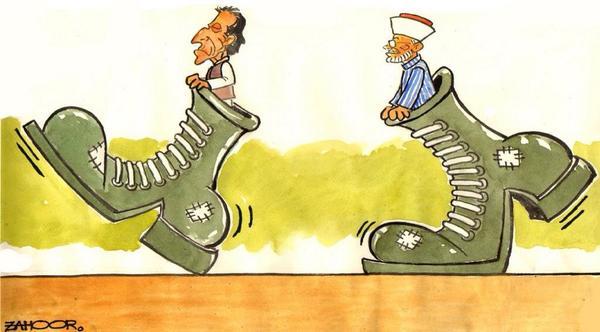
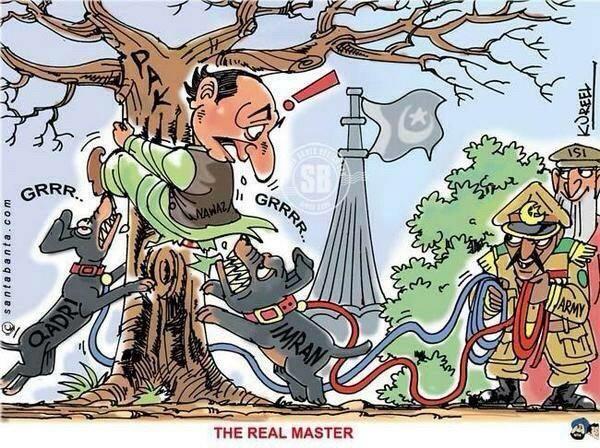
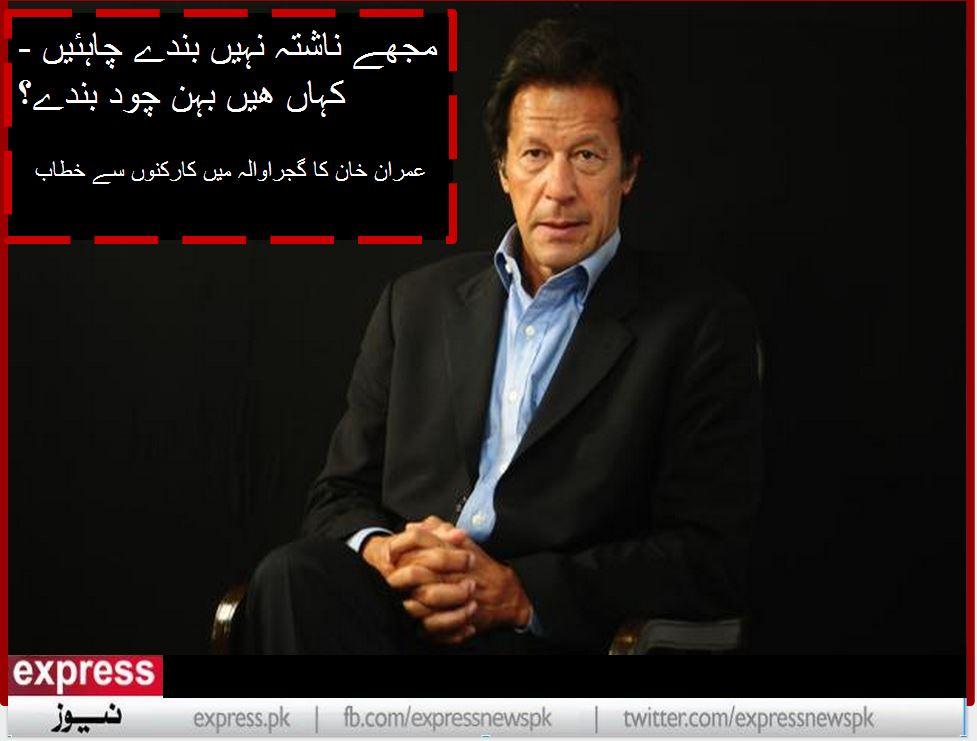
Given our history, it is a significant achievement that all parties participated in a reasonably (by our standards) fair election under reasonably (by our standards) neutral caretaker administrations and an actual transfer of power took place peacefully. All that progress can be (and is) being undermined by this sustained campaign against democracy and civilian politics (with TUQ playing a conscious and Imran Khan a characteristically semi-conscious role in the undermining). That the Sharifs are not the best rulers is hardly debatable, but that the system should be wound up on that account is a disastrous step beyond the punishment of the Sharifs for any specific crime or misdemeanor. They must be removed from within the system or else they must be tolerated for their term. There is no third choice.
We know very well from our history that the next step in the paknationalist (aka PMA) framework is a “technocratic government of all talents” and we also know that in short order that will prove worse than the poor Sharifs and will lack even the rickety checks and balances that limit the damage done by the Sharifs or any other democratically elected crook. Beyond that, we also know that the institutional biases of the Pakistani army in particular are utterly opposed to the rights of smaller nationalities and are determined to pursue suicidal and extremely disruptive policies with respect to relations with our neighbors and with the wider world. The Sharif brothers dalliances with ASWJ notwithstanding, it is the army that is most responsible for creating and sustaining various sectarian and islamofascist tendencies in the body politic. For all these (and other) reasons, this latest farcical soft coup is very bad news.
Finally, it is good to keep in mind that it is not all fun and games…there really IS a bottom. One fine day the whole shithouse could go up in flames (as East Pakistan did in 1971); and what follows could then cause significant discomfort even to those whose low opinion of the Sharifs or of bourgeois politics or of the current politicians, makes them look kindly upon any disruption to the system…
I would add that I have come around to agreeing with those who think that NONE of the major VISIBLE players really had a detailed plan or a script that has been faithfully followed during this farce. But that does not mean that there is no one with a coherent agenda. There are people with coherent agendas and they make hay while the sun shines on Imran Khan’s empty chairs. Just as the ASWJ terrorists are pursuing their agenda, the “Paknationalists” in the intelligence agencies are pursuing theirs. Sharifs (including Raheel Shareef) may have no plan and may be blundering in the dark, but some people have plans and most of them are dangerous…

Embedded image permalink

Old age homes (not just for politicians)

….Dwivedi’s statement
reflected that Congress wants to follow BJP…creating “old age
home” for senior leaders…..a taunt directed at the ruling party by Congress when it dropped Advani, Joshi and Vajpayee
from parliamentary board…..

….. 
When the revolution comes it can take off in so many uncertain ways.

We did not quite imagine that a Hindutva flavored govt that is in love with the concept of a 5000 year old civilization and making policy based on (age-old) scriptures would launch a movement (admittedly for self-serving reasons) for pushing youngsters to power (well OK 50+ aged youngsters, but then we are talking about India).
……………….

….
Continuing on this theme, we should not be limit the action to politicians only. Scientists, entertainers, technocrats,… all those who continue to feather their nests and do not let young talent come forward should be asked to retire post 70. One outstanding example that comes to mind: long after her nightingale as a girl days were behind her, Bollywood would stick stubbornly with Lata Mangeshkar (we mention this with all humility and as an ardent admirer).
………..
Now the cremation fires have touched the Congress as well and it will spread beyond it for sure. As we see it, the party who can best capture the imagination of the youth will win the next elections. 

The only issue with an iron-clad Stop at 70 rule is that the Leader is 63 years young (Madam is 67). Are people not too concerned that they are making a nice rod for their own backs? We will believe the good news when we see the proof in action.
…………..
Congress today distanced itself from party leader Janardan Dwivedi’s
remarks that people in politics should not continue in active posts
beyond 70 years of age even as another party leader Digvijaya Singh
backed him.

 ……

“Let me make it clear. This is his view and he is certainly entitled to
it…. This is not the party view. This is not the party stand. This is
his personal opinion,” party spokesperson Abhishek Singhvi told
reporters in reply to a volley of questions on the issue.

His refrain was the same when asked whether Dwivedi’s statement
reflected that Congress wants to follow BJP’s model of creating “old age
home” for senior leaders, a taunt directed at the ruling party by
Congress when it dropped LK Advani, MM Joshi and Atal Bihari Vajpayee
from parliamentary board.

A senior party leader speaking on condition of anonymity said that the
sentiment expressed by Dwivedi were not improper but it is not feasible
to have any specific cut offs in a large party like Congress.

Party general secretary Digvijaya Singh, speaking separately, backed Dwivedi saying that “change is the law of nature”. Singh, who has generally been at odds with Dwivedi, recalled that in the
Burari AICC sesssion 2010, he had pitched for a generational change in
the party under the leadership of Rahul Gandhi.

“I had said the same thing in Burari session. Congress party always
gives opportunity to the youth. Change is the law of the nature. In the
modern management lexicon, it is called succession management. “It should happen at every level from top to bottom. I am in favour it.
It is high time for major changes in the organisational structure,”
Singh said.

The conflicting views in Congress have been aired at a time when there
is a likelihood of a generational shift in the party to take on a
resurgent BJP.

Singh said, “We will do whatever we are asked to do. Antony Committee
has given its report and the restructure should happen accordingly.”

Citing examples of various other fields where elders handover the
responsibility to a young team, Dwivedi had said “similarly generational
change is also necessary in politics. “After certain age, people should not live on active posts in a political organisation.”

Dwivedi has at the same time said that he did not mean to say that
people above 65 or 70 should retire from politics and that they can take
other responsibilities that do not require hectic activities.

To a question on whether he wants his 65 or 70 formulae also to be
applicable to 67-year-old Congress president Sonia Gandhi, Dwivedi said
that the post of Congress president and some others could be exceptions
to it.

The remarks of Dwivedi, who is the general secretary in charge of the
Organisation, had come yesterday a few days after BJP dropped veterans
Vajpayee, Advani and from the parliamentary board and named them in
Margdarshak Mandal, mentor’s group.

They also came at a time when there is intense speculation about
imminent changes in the AICC setup with the younger generation likely to
call the shots and leaders of Dwivedi’s generation may be replaced.

Dwivedi’s remarks were being seen as indication of things to come.

“The writing on the wall is clear. After such a debacle, a party can
come back only after fighting on the street for which youngsters are
needed. It is the young, who have to fight the electoral battle,”
another senior party functionary said on the condition of anonymity.

The average age of AICC secretaries appointed by Rahul Gandhi last year
was 40 to 45 years. Besides a number of PCC chiefs like Ashok Tanwar in
Haryana and Sachin Pilot in Rajasthan, who were appointed in last one
year are among the youth brigade.

………

Link: www.firstpost.com

…….

regards

The “Disney” God and Blasphemy

….“The guy who couldn’t save his own head from being cut, how
he will save others heads is my question?….Happy Ganpathi day to morons!”….
“Can someone tell me if
today is the day Ganesha was originally born or is it the day his dad cut his
head off?”
…..“love to know from devotees a list of what obstacles he removed” ……”All tweets I put on Ganesha….unintended to hurt anyone’s sentiments…but if they did I sincerely apologize”….


….

….
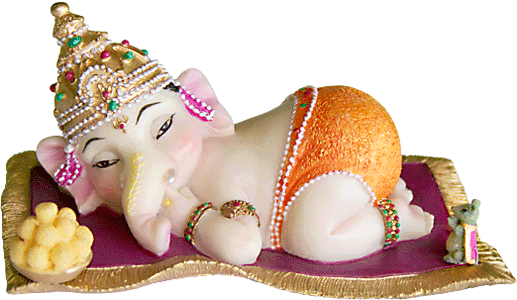
Best wishes on Ganesha Chaturthi to all believers and fans. We have to admit, we do think of Ganesha as a cutie pie. Also he is mama’s golden boy and you know that no one crosses his mom and lives to tell about it (ask the demon Mahisha-Asura).
……

…..
Incidentally this reminds us of the Tamizh commandment: kakaikku than konju pon konju….literally my crow is a golden crow.…figuratively, the love a mother feels for her child who is not blessed with the best of appearances…
…….


BTW if you are curious to know how left-liberals think about Ganesha just follow Ram Gopal Varma on Twitter. RGV is originally from Vijayawada, Andhra Pradesh and he is a super-hit director in both the Hindi and Telugu film world. His top movie is Satya (we also rate Rangeela), which Danny Boyle has claimed as an inspiration for Slumdog Millionaire (that must be a first…a western director…for real or for show….claims to being inspired by Bollywood).

In an ideal world, we would be most happy if the liberals established a hegemony in which we could crack jokes (even mean jokes) about religion and the religious…all of them. The sheer number of ridiculous religious leaders in India (and in the wider world) presents endless opportunities for (black) comedy. But we would propose to do it in a fair-minded and even-handed manner, or we are in danger of looking ridiculous ourselves. RGV we are sure, thinks twice about breaching some boundaries than others. Why is that?

Now, we should be clear that RGV is entitled to his views and opinions, but we fail to see what good comes out of this tamasha. From a political standpoint he is acting like a recruiting agent for the BJP.

Poking the crocodile is a lot of fun…sure, but then why crawl back with the apologies? Be a big boy and dish it out and be prepared to accept the consequences…in the extreme case be prepared to go to jail and start a new life-edition as a free speech martyr (we fully support him in that battle).

RGV considers himself as a man on a mission…to remove the cobwebs of superstition from the minds of deluded people. This is a fine and honest goal. Thomas Jefferson was also a man on a mission and he said that the tree of liberty must be refreshed from time to time with the blood of patriots and tyrants. RGV should have boldly stood up for (all) free speech and the free-flowing blood would have helped the tiny sapling to grow into a massive banyan tree.

We did like some of the non-inflamed responses, especially the one by “Subodh” who made a sporting attempt to respond to Shri RGV (questions marked below in bold and in red).
…………

It is painful to see that those who take pride in Hindu religion
couldn’t answer any of his questions and instead childishly chided him
for insulting Hindu gods. If you can’t answer legitimate questions about
the gods that you worship, you should stop being so religious.

His
questions were hardly that difficult to answer..With a little bit of
wit and wisdom, anyone could have answered them, but sadly the IQ levels
of ‘bhakts’ and also their knowledge about their religion is very low.

Here’s how you need to respond to silly questions..

Q-
What did Ganesha do that his brother Kumara dint do so that only
Ganesha became god? Is it becos Kumara dint get head cut off like
Ganesha?

A – He was cuter, wiser, wittier and hence gathered more
followers. Like in movie industry where more the fans you have, the
bigger screen god you become, in heavens too children of gods who gather
more followers become bigger gods.

Q – Can someone tell me if today is the day Ganesha was originally born or is it the day his dad cut his head off?
A
– Today’s the day we don’t ask silly questions about gods we worship
and use our brains to understand the symbolism behind mythological tales
of gods.

Q – Does Lord Ganesha eat with his hands or his trunk?
A – He eats with his mouth

Q – I have an innocent question…can someone please tell me how a Lord who couldn’t save his own head will save others heads?
A
– A local wrestler might not be able to win against a national or
Olympic level wrestler but he can save you from a local goon. Same way,
Ganesha couldn’t save his head from a more powerful god – his father,
but is capable of saving heads of mere mortals.

Q – Does Lord Ganesha eat much more than other Gods? My doubt is becos all the other Gods are either trim or muscular
A
– Not really. Buddha is trim when he is meditating, but when he starts
laughing and becomes ‘Laughing Buddha’ he develops a big paunch

Q – Did Lord Ganesha have a paunch in his childhood too or did it develop in the recovery time of the elephant head operation?
A – His mother, Parvati, sculpted him..and since all moms like cute and cuddly children, she sculpted him with a paunch

Q – Can someone explain how someone can cut off a child’s head who was just trying to protect his mother’s modesty?
A
– Can you explain how you can eat meat of chicken, goats, pigs and
other innocent animals knowing that the poor creatures are just trying
to enjoy life with their family

…..
No religion has a god as child-friendly as Lord Ganesha. Animal heads on
divine beings is not quite unknown in other religions. The Egyptians
had several but let’s face it when it comes to terms of endearment,
jackals and falcons just cannot compare to an elephant.

It was a particular elephant’s bad luck but Hinduism’s good fortune,
that when Lord Shiva went looking for a head to replace the human one he
had lopped off, he came across an elephant, some say Indra’s mount
Airavata and not an annoying crow or a fearsome tiger. That would have
given our Ganesha a very different temperament.

But with his elephant head, Ganesha becomes the most genial of all gods
especially for a young child. The broken tusk makes him vulnerable. The
plump belly makes him comforting. He is virtuous as gods are supposed to
be but exudes a more approachable friendliness. 

….
Though Hindu children
routinely and religiously pray to Saraswati for a little help during
examinations, no one would make a children’s film called My Friend
Saraswati. But it makes perfect sense for a lonely boy neglected by his
parents to find a buddy and fairy godfather rolled into one in the
elephant-headed god in My Friend Ganesha.

Ganesha isn’t just friendly. He also has a certain kind of smart that a kid can instantly relate to.

….

Take that story of Ganesha and Kartikeya and their great race to
circumnavigate the world. While Kartikeya huffed and puffed and set off
at great speed to go around the world, Ganesha just sat his parents down
and went around them. It was so incredible to read it on the colorful
pages of Amar Chitra Katha and know that the handsome, super-athletic
school jock didn’t always have to win the race.


….

Without being in the least bit preachy, it also told us not to
underestimate the kid who looked a little odd, the class misfit, the one
the other children might laugh at. We could instantly relate to it
because it was a story about sibling rivalry but one that thankfully did
not end in the bloody trauma of Cain and Abel. But most reassuringly,
it reiterated splendidly what as children we intuitively grasped – our
parents are the centre of our worlds. (Of course perhaps that’s also why
parents never tire of telling that story to their children.)


….

As a child there were things that mystified me about Ganesh. How did
someone of his girth ride a mouse? Why did an elephant’s head make the
rest of him so roly-poly? In the Bengali iconography during Durga Puja
he came with a kola-bou, a banana tree draped in a white sari with a red
border. Though scholars have argued whether the kola-bou was his bride
or a representation of the Mother Goddess herself, as a child I was
always worried the elephant-headed god might snack on his banana-plant
bride in an incautious moment.


…..

Amar Chitra Katha had no answers to these conundrums and Devdutt
Pattanaik had not yet written his 99 Thoughts on Ganesha. The story of
his creation itself, I discovered later, had been sanitized and
tempered. 

….
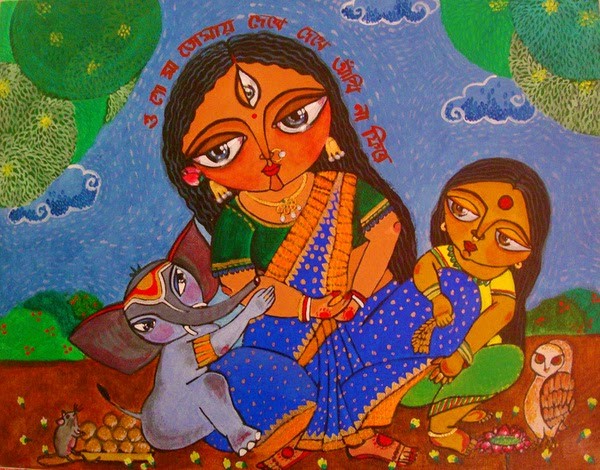
Parvati creates Ganesha as her little gatekeeper out of the
rubbings of turmeric paste she has anointed herself with. He is
Vinayaka, the son born without the help of a husband.
When Shiva lops
his head off for the effrontery of denying him entrance, Parvati is
inconsolable. Firstpost’s
Lakshmi Chaudhry recalled her daughter coming back from school and
telling her a more “family-friendly” version of that story.
 

“Parvati felt so sad when Shiva killed her little boy, she
started crying,” she said, explaining how Shiva replaced his head to
soothe his distraught wife. This was definitely not my grandmother’s
Ganesha story. 

….
My daughter’s very progressive pre-school had sanitised
the myth to fit the portrait of a happy modern nuclear family. Don’t
worry, good daddies comfort sad mommies, and make it all okay.
“No,
baby, Parvati was so angry that she vowed to destroy the entire
universe,” I corrected her,
“The gods were so terrified that they ran to
Shiva and begged him to bring the boy back to life.” The Parvati I grew
up with was not a heart-broken waif, but powerful and feared goddess
whose wrath had to be appeased in order to save all creation.

………
That says more about our discomfort with powerful females than anything
about Ganesha. But the sweetness of the teary Parvati also makes it a
better bedtime story and gives Ganesha an extra dose of cuddliness.
Ironically the very qualities that have made him both beloved and
lovable have also been his greatest handicap.

In Hinduism he might be the Remover of Obstacles but outside the faith
he has become more cute and less god. In a world of animated films where
animals routinely talk in human voices, Ganesha, to much of the world,
belongs to a different pantheon – more Disney than God. 

…..
But unlike a
Disney character he is in the public domain – free to be emblazoned on
t-shirts, keychains, lunchboxes. And unfortunately he also ends up on
things he should never be. American Eagle put him on slippers. Sittin’
Pretty put him on toilet seats. Café Press put Ganesha and other gods on
thongs and $79 yoga mats.

….
Bollywood-themed parties in the West put up
statues of Ganesha and Buddha for that exotic touch while belly-dancers
gyrate and the bartender mixes cocktails. A party organizer in San
Francisco once said she would try and educate her clients about the
significance of religious symbols and put up signage explaining them but
she was not sure that anyone cared after the “third shot of tequila”.

Were the companies intending to disrespect Hinduism? Probably not.
Ganesh to them was just a cool iconic image. But the danger of cool is
then even a God becomes a commodity to be bought and sold. The god who
removes obstacles seems helpless when the juggernaut of popular culture
turns him into a potbellied party prop.

Pattanaik says
reassuringly that though he’s been turned into celluloid cartoons and
plastic China-made dashboard displays, “Ganesha does not mind, so long
as we appreciate the realm of his mother, and aspire for the realm of
his father.” Perhaps that’s true. But still one should think long and
hard before annoying any god especially one with the memory of an
elephant.

……

Link (1): ram-gopal-varma-trolls-lord-ganesha

Link (2): the-challenges-of-being-ganesha
…..

regards

India is a “sinful country”

…..families came forward after the cops approached them with the information provided by
Arif’s father…..his idea of Islam
and how the religion should be followed…..admonish
those who listen to music and watch television…..frowns upon
women who don’t wear a veil and work with men……

…..
Not just Arif Fayaaz Majeed who is reportedly killed in action in Mosul, but as many as 19 youths from Mumbra and Bhiwandi have joined the army of the Caliphate. Mumbra and Bhiwandi are satellite townships north-east of Mumbai, and are noted for being hot-beds for Islamists.

Thus it is likely that many more families will be devastated as more and more boys become cannon fodder. It is hard to judge them harshly….after all they are barely adults…and they have been brainwashed by people whom they trusted implicitly (the culprit must be given exemplary punishment, see below). 

But stepping away from the human tragedies for the moment, this question seems to be of great interest and significance: why is India sinful?

Now we can think of several legitimate answers to that and they may even have a specific resonance with Indian muslims…mostly pertaining to human rights of young muslim males and the entire civilian population of Kashmir (valley).

But please note why Majeed (supposedly) considers his country to be a sinful place: The
note does admonish those who listen to music and watch television. He
also frowns upon women who don’t wear a veil and work with men.


GUYS LISTEN UP:  WOMEN WILL NOT BE DENIED THEIR RIGHTS because of strictures from scriptures composed by men and enforced by men (all of them).

If the men decide to fight for a pure state BECAUSE they dislike the fact that women are gaining freedom..well all we can say in response is goodbye (we still wish you well). Also we hope that you are not coming back (but your mother still cries for you and would love to have you back).

……
An Indian engineering student who suddenly left for Iraq with three
friends this spring, and who was believed to have joined the Islamic
State in Iraq and Syria, has been reported dead, a man whose nephew was
part of the group said Thursday.

The
student, Arif Majeed, 22, left his home in Kalyan, outside Mumbai, in
May, telling his family he was going to study, and next contacted them
from Iraq, where he and his friends slipped away from a religious tour
group and traveled to Mosul, a city now dominated by Sunni militants.
The case has drawn the attention
of the authorities because it is one of the first documented instances
of young Indians being recruited online by an international jihadist
group.


Iftekhar
Khan, whose nephew Fahad Tanvir Sheikh was one of the three men who
left with Mr. Majeed, said the news of Mr. Majeed’s death was conveyed
in a phone call by another of the group who made the journey to Iraq,
Shaheen Farooqui Tanki. “Arif’s father requested Shaheen’s family to ask
about their son Arif. A few days later, Shaheen called again and said
Arif had died. He didn’t know how but he was crying,” Mr. Khan said.
Several
Indian newspapers reported that Mr. Majeed had been killed in an
explosion, possibly as a result of an airstrike. Mr. Tanki’s family gave
Mr. Majeed’s father the news after evening prayers on Tuesday. “Imagine
the state of a father who does not even get to see his son’s body,” Mr.
Khan said.
In
a letter left behind for his family, Mr. Majeed, who was Muslim, asked
for forgiveness and said that he would next see them in heaven. He said
he was glad to leave India, which he described as “a sinful country.”
An announcement, in Urdu, Arabic, English and Hindi, on a website often used by ISIS,
said Mr. Majeed, shown holding a weapon, had been martyred in Iraq. It
said that Mr. Majeed, who went by the name Abu Ali Al Hindi, had
participated in the fight for the Mosul Dam and married a Palestinian
woman from Gaza. The information could not be independently confirmed.

“This website is false. Anyone can make a website and send a wrong message,” Mr. Khan said. “Our boys were peaceful.”
…..

The Mumbai police have zeroed in on a small-time
businessman suspected to be the brain behind the radicalization of the four
Mumbai men who are believed to have joined jihad in Iraq and Syria.

Adil Dolare, 35, who works with the Islamic Guidance Centre in Kalyan and had
organized the tour to Baghdad from where the four never returned, used to meet
them every evening at Kalyan’s Don Chowk.

The investigators, meanwhile, have expanded their probe and identified 15 more
men from Mumbra and Bhiwandi who may have joined the four from Kalyan in
Baghdad and enlisted with the Sunni insurgent group Islamic State of Iraq and
Syria (ISIS).

Dorale and the four reported missing from Kalyan — Arif Fayyaz Majeed, Fahad
Tanvir Sheikh, Aman Naim Tandel and Saheen Farooqi Tanki — are all residents of
Bazar Peth and spent considerable time together.

Dolare, who also runs a business in Navi Mumbai, often delivered talks on Islam
in religious institutions.

Islamic Guidance Centre through Rahat Tours and Travels had booked Arif, Fahad,
Aman and Shaheen with 37 others on a seven-day tour of Baghdad. The group’s air
tickets were bought by Akbar Tours and Travels.

….
The group left Mumbai on May 25 and returned on June
1. Arif, Fahad, Aman, and Saheen, however, stayed back. On May 26, Arif’s
father filed a missing complaint with the Kalyan police and produced a note
written by his son expressing his desire to join jihad. Arif’s father was
followed by the families of Fahad, Aman and Saheen, who filed their complaints
on May 29 and 30.

Investigators have so far not come across any links between Dorale and the 15
men from Mumbra and Bhiwandi, who too, just like the four from Kalyan, left
Mumbai on a pilgrimage to Baghdad on May 25, but did not return.

Cops now know that around 250 people left for Baghdad on May 25 from Mumbai and
19 of them did not return. They all flew from Mumbai to Dubai and then to
Istanbul and Iraq.

…..

Link (1): nytimes.com/indian-muslim-said-to-have-joined-isis-is-reported-dead.html

Link (2):  Thane-businessman-radicalized-Kalyan-youth-who-joined-ISIS-funded-their-Iraq-trip
……

regards   

False Dawn?

…..Suzuki Motor has shifted the technology
transfer paradigm into reverse, importing transmission technology
developed in India and installing it in the new Carry commercial vehicle in Japan……Auto Gear Shift…automated
manual transmission with an electro-hydraulic actuator…..Unlike computer-assisted automatic
transmissions, Suzuki’s relatively low-cost technology is structurally
simpler and improves fuel efficiency by around 5%……

….
The Indian economy is finally showing signs of life. After such a long time in coma, it will take a considerable amount of nursing to build things back up. We are not close to any industrialists but we see mostly relief at the end of …uncertainty. In that sense what Narendra Modi is to India, Pakistani Army is to Pakistan.  

The problem with dictatorships however is that …..in the words of one famous person….it creates a nation of cowards. The global system run by the elites would love to have countries filled with political cowards and economic consumers. The freedom to eat..but not to talk. Ask no questions and …Jiyo Life. What is not to like?
………..
As another renowned person has commented…the peasants are rising everywhere (however the number of good jobs is small in comparison). The caste system (India’s gift to the world) will be entrenched firmer than ever. Right now the WASP Brahmins and Oxbridge Brahmins are in charge. Down the road there will be newer Brahmins from Beijing, Delhi, Jakarta, Ankara…..

We are optimistic that the axis from East Asia to South Asia will form durable alliances and grow together. India (and Indians) should look east and be learning Mandarin and other languages (as a suggestion why not try Vietnamese?). These are old ties between old cultures. A bit of chest thumping is OK but (we hope for the sake of global prosperity) there will be no hot wars in the China sea.

As far as the pernicious effects of religion goes…we are sick and tired of it. Stop killing people…in  the name of religion. Live and let live. Killing off the minorities will lead to a corruption of the majority….forever. We hope that all communities realize this soon (not soon enough for the millions of victims world-wide).
………
India’s economy grew
by a faster-than-expected 5.7 per cent in the three months through
June, its fastest pace in two-and-a-half years, helped by a rebound in
manufacturing and mining sectors,
government data showed on Friday. Analysts polled by Reuters had forecast annual growth of 5.3 percent in the quarter.

Manufacturing expanded at an annual rate of 3.5 percent during the
April-June quarter compared with a contraction of 1.2 percent a year
ago. Mining sector grew 2.1 percent compared with a 3.9 percent annual
fall a year earlier, the data showed.

….

In a rare move, Suzuki Motor has shifted the technology
transfer paradigm into reverse, importing transmission technology
developed in India and installing it in the new Carry commercial vehicle
set to roll out in Japan later this month.

Japan’s
second-largest minicar manufacturer has a strong presence on the Indian
subcontinent, where it recently developed Auto Gear Shift, an automated
manual transmission with an electrohydraulic actuator that automatically
operates clutch and gearshift. Unlike computer-assisted automatic
transmissions, Suzuki’s relatively low-cost technology is structurally
simpler and improves fuel efficiency by around 5%.

However, shifting gears causes a slight vibration, an issue that still needs to be addressed.

The new Auto Gear-equipped Carry will be priced just under 900,000 yen
($8,574), the same as the current automatic transmission version. Suzuki
aims to install the transmission in other models and reduce its
production cost 10,000 yen to 20,000 yen below that of regular automatic
transmissions.

Suzuki released the Celerio
subcompact featuring the automated manual transmission technology in
India in February. Automatic cars account for a sliver of India’s
automobile market, representing less than 1% of all cars on the road
there. 

But nearly half of Celerio buyers, according to the automaker,
choose the affordable automatic model, pushing Suzuki’s management
toward a decision to apply the technology to domestic models.

The carmaker eventually plans to release subcompact models equipped
with automated manual transmissions in Europe as well. They will be also
showcased in Southeast Asia and other emerging markets.

….

Link (1): Economic-growth-hits-two-and-a-half-years-high-in-June-quarter

Link (2): asia.nikkei.com/Business/Suzuki-taps-India-developed-transmission-technology

….

regards

Egypt shows the way

….Khan is unpredictable….proudly
calls his supporters junoonis — or “crazies”….The military might enjoy
the troubles Khan gives the prime minister, but
it is unlikely to tie its institutional fortunes to Khan..
..Pakistani democracy continue to muddle
along as it has in the past. Pakistan optimists will be disappointed….But things could
be
worse…..

…..
The American establishment and its paid interlocutors (not meant in a derogatory sense) have now responded to the soft coup in Pakistan. Short answer: after observing what happened in Egypt and elsewhere in the Arab world, the focus is back to stability over anarchy. Shorter answer: “but things could be worse.”

We are not sure why the veil of modesty is required though. The whole world and his uncle knows now that Nawaz Sharif is finished. In Pakistan (just like in Egypt and in Thailand) it is clear that Army rule (as the most trusted institution) is preferred over mob rule (politicians are hated for cronyism, inefficiency,…).

One of the primary reasons for Army putting down Sharif is that he desired better relations with India (and acted on it by not meeting with Kashmiri separatists/nationalists). In this way Kashmir is shown up as the third rail of Pakistani politics, you touch it, you die. 
…….
We are not sure what lessons India will need to learn from this, but the reality is there is no constituency (apart from the poor in both countries) that will benefit from a peace dividend. For now the best solution is status quo on the border and cold peace across South Asia. While “but things could be worse” may be true…..things could have been much better.

A silver lining amongst this mess: Indonesia. It is a pure miracle when poor countries also choose to be democratic. Indonesia has followed Thailand (ten years ago) in electing a populist to the top chair. We sincerely hope that it does not follow Thailand by deposing the government when things become too uncomfortable for the elites.

…………..

In
1960, president and field marshal Muhammad Ayub Khan, Pakistan’s first military dictator,
built the city of Islamabad almost from scratch. Pakistan’s original capital, Karachi,
was roughly 800 miles away from his headquarters in Rawalpindi, and Ayub Khan — as
the story goes — wanted to reduce his commute in order to more easily serve the
requirements of both his military office and the presidency of Pakistan. In relatively
short order, Rawalpindi had a new twin city and Pakistan had a new capital. Instead
of flying from one office to the next, Ayub Khan could now walk, jog, or drive.

That little slice
of Pakistania illustrates the most important rule of the decades-long contest between
Pakistan’s unruly civilian democrats and its unconstitutional military rulers: When
the Army wants something, it gets it.


Since Aug. 14, Islamabad
has been in a state of constant uncertainty and insecurity. Politicians opposed
to Prime Minister Nawaz Sharif have been leading a sit-in of thousands of
protesters demanding nothing less than the resignation of Sharif — who has
been prime minister twice before and deposed in coups both times.


….
Today in Pakistan,
there are two big questions: Is the military attempting to stage-manage Sharif’s
third exit? And is his political tormentor, the temperamental former cricket
star Imran Khan (unrelated to Ayub Khan), the Army’s choice as his replacement?


….
Two separate camps
are conducting the Islamabad protests against Sharif: Khan leads one,
and Muhammad Tahir-ul-Qadri, an anti-Taliban cleric formerly based in
Canada, leads the other. The
two leaders are a study in contrasts, but they share one explicit
objective — to
oust Sharif. 

Pakistani fatigue with the saga has been growing, and on
the night
of Aug. 28, the Army became explicitly
involved
as a guarantor of
talks between the opposition camps and the government. The announcement of the Army’s
role as the adult in the room is nothing new for Pakistan, and though
expectations are that the crisis is petering out, protests could continue as
long as Sharif stays in power.


….
Where did this
mess begin? The 2013 elections brought Sharif back to power for a third term and
saw Khan’s party, the Pakistan Tehreek-e-Insaf (Pakistan Movement for Justice),
emerge as a major force in politics. Khan’s complaints that Sharif stole the
election received little attention until Qadri entered the picture. A colorful
cleric with a superb network of philanthropic activities and a politically
insignificant but deeply committed corps of disciples, Qadri has a history of
agitating against democratically elected governments. 

When Qadri announced his decision to return in June from his adopted home in Canada to Lahore
to launch yet another agitation, alarm bells went off for Sharif.


….
On June 17, things
took a tragic turn. Already exercised by the 100 degree-plus Fahrenheit heat and
smarting at the way senior leaders within Sharif’s government had spoken of
Qadri, supporters of the cleric clashed with police in Lahore’s tony Model
Town neighborhood. Fourteen people died, including a teenager and at least two
women, with much of the blame for the violence placed
squarely
on police
brutality. The Model Town tragedy galvanized Qadri’s supporters and stripped
Sharif of whatever moral high ground he had. The shifting national mood after the
affair buoyed the opposition’s spirits, and Khan could smell blood.


….
In July, Khan announced his decision to march on Islamabad — with the
objective of ousting Sharif — on Aug. 14, Pakistan’s Independence Day. On Aug.
10, Qadri announced that he would march on Islamabad as well. The
processions to Islamabad received wall-to-wall coverage from Pakistani media,
with some questioning whether the size and diversity of the protesters deserved
such lavish 24-hour exposure. As it has dragged on across two weeks,
the crisis has developed a momentum of its own. Khan has planted himself and
several thousand protesters in front of the Pakistani parliament building, insisting that he
will leave only when Sharif resigns.


…..
Few, if any
Pakistanis, would argue against the substance of Khan’s complaints — that the
electoral process needs major reforms and that corruption throttles the
economy. Instead, most debate focuses on just why Khan is so confident that he
will succeed in dethroning Sharif — despite the prime minister’s nationwide support and Khan’s falling stock.


…..
Khan’s bravado is,
on the surface, perplexing. His level of popular support has dropped significantly since the May 2013 election, and his
performance since then has been pedestrian, at best. His speeches at these
protests have been cavalier, even vulgar: He threatened to send his enemies to the Taliban so that the group could
“deal with them,” according to the New
York Times. He denigrates parliament and the prime minister; in one speech,
he proudly proclaimed that the fear of protesters has caused
Sharif to “wet his pants.” This is hardly the kind of leader whom soldiers from any
country would want to call boss — much less the ultraconservative ranks of
the Pakistan Army.


For some, this
kind of confidence only comes from the knowledge of having the support of
Pakistan’s military brass. Could it really be betting the house on Khan?


….
Probably not. Pakistan’s
military faces a hostile India on its eastern border and a dysfunctional peace
process in Afghanistan on its northwestern one. In between, it is trying to
stamp out the remarkably resilient and potent Tehrik-i-Taliban Pakistan, also
known as the Pakistani Taliban, against which it recently launched a massive operation
in the remote Pakistani region of Waziristan. Now is not a good time for the Army to manage a chaotic political
transition.


….
And removing
Sharif would probably complicate the country’s fiscal situation. Pakistan is a
poor country with an even poorer record of fiscal management. Outside aid is
vital to the country — be it from the IMF and World
Bank or from friendly nations like the United States, China, and Saudi Arabia.
International lenders hate instability and coups, and they have a long-standing
man-crush on Sharif and his team because they are the big-business,
Barbarians-at-the-Gate-type capitalists who love to privatize things while
disproportionately taxing the poor instead of the rich. Khan, on the other hand,
is a wild man when it comes to economic policy. Just this week, he instructed Pakistanis living abroad to stop using
legal means of sending home remittances and once again start using the hundi
system — the preferred cash-mobility solution for
terrorists everywhere.


….
Finance Minister
Ishaq Dar, who unsurprisingly is a close relative of Sharif, is surprisingly
good at what he does: managing exchange rates, borrowing cheaply, and stamping
out dissenting views on the economy. While growth is still sluggish, Dar has convinced
lenders that Pakistan is becoming a less risky investment. Bureaucrats
from the World Bank and IMF love him because he is an old-school chartered
accountant. Sharif loves him because he is family. And though the Army may not
love him, they probably like Dar a lot more than they like the prospect of
dealing with Khan’s cuckoo ideas about how to get remittances to Pakistani
shores.


….
Many in the armed
forces think Sharif is being needlessly vindictive in pursuing legal cases
against Gen. Pervez Musharraf, the former chief of army staff who seized power from
Sharif in October 1999, imprisoning Sharif and later exiling him to Saudi Arabia. Now Sharif is
pursuing a case against Musharraf, who is stuck
in Pakistan
, unable to leave
because of a court injunction related to a treason case against him — though Sharif’s
people insist the motivation is rule of law and not revenge.


….
Additionally, Sharif’s
overtures to India, especially to its newly elected Hindu nationalist
prime minister, Narendra Modi, may make some of the generals deeply
nervous. Sharif accepted Modi’s invitation to his inauguration,
and in a break from Pakistani tradition, Sharif did not meet with separatist leaders
from Kashmir whom Pakistan supports. If Pakistan and India become normal
neighbors, the military’s influence in Pakistan automatically decreases. The
hawks clearly won’t go easily.


….
But the fears of
Sharif improving relations with New Delhi too quickly have likely been assuaged by
the rank incompetence with which he implements decisions. Even if he wanted to, Sharif cannot move
any faster than a bored glacier on a cold day. He is hamstrung by an obsession with
surrounding himself with loyal but inept advisors and bureaucrats.


….
Sharif has
severely undermined his own rule. His shambolic treatment of his own party
members, to say nothing of the opposition, is legendary — often ministers
can’t get meetings for weeks on end. The presence of his family members in
government grates all segments of Pakistani society: Dar’s son is married to Sharif’s
daughter, Asma Nawaz. Chief Minister of Punjab Shahbaz Sharif is his younger
brother; Water and Power Minister Chaudhry Abid Sher Ali is his nephew, as is prominent
parliamentarian Muhammad
Hamza Shahbaz Sharif. If only his strategic vision for the country were as
consistent as his nepotism.


…..
On the other hand,
the best thing Sharif has going for him is the quality of his competition.
Pakistan with Khan at the helm would be a disaster of epic proportions — and
that’s even with the country’s extremely high tolerance for shambolic
leadership.


….
Khan may be the
world’s oldest teenager, with a captive national audience. He thumbs his nose
at political niceties and employs an invective that dumbs down the discourse.
Like Justin Bieber, Khan focuses on electrifying the urban youth who genuinely
believe him to be a messianic solution to the disenchantment they feel about
their country. And Khan’s understanding of Pakistan’s problems is probably only
slightly more sophisticated than Bieber’s. Khan does not have the policy chops
to fix what ails Pakistan: The crux of his efforts during these few weeks has
been that he, not Sharif, should be prime minister.


….
Sharif is a known
entity and one easy to tame. Khan is wild and unpredictable. He proudly calls his supporters junoonis — or “crazies.” The military might enjoy the troubles Khan gives the prime minister, but
it is unlikely to tie its institutional fortunes to unstable and irresponsible
political actors like Khan. Pakistani democracy under Sharif will continue to muddle
along as it has in the past. Pakistan optimists will be disappointed, because
this crisis is unquestionably a setback for democrats. But things could be
worse. For now, the most Khan is likely to achieve in challenging Sharif is
further strengthening the military’s already strong hold on key decisions
guiding the country’s future.


….
As Americans watch
in horror as Syria, Libya, and Iraq come apart, perhaps they will warm to the idea
of a Pakistan managed by its highly disciplined and professional armed forces. That
would be exactly the wrong conclusion to draw from the political chaos in
Pakistan. Now more than ever, Pakistan needs the rest of the world to reiterate
its strong support for democracy.

…….

Link: foreignpolicy.com/the_pretender_to_pakistans_throne_imran_khan_nawaz_sharif

……

regards

Soft coup-

I think the Army has emerged as the comprehensive and legitimate winner of this Pakistani imbroglio.

Democracy has been defanged until the next election but at the same time the fiction of it’s legitimacy has been maintained.
Compared to the results of the Arab spring (Egypt, Libya, Syria); a stable military is very good for unsteady democracies. Kudos to GHQ for steering an optimal outcome for all parties concerned.

Zone One

In addition to a fairly exhausting travel schedule I’ve been consuming a fair few iBooks.

I’m currently trying to finish my trilogy of Zombie Apocalyptic novels (Zombie survival guide, World War Z & Zone One). Now of course the first two are written by the same author (Mel Brooks’s son, Max Brooks) and thankfully I saw the film before I read the book because that way I didn’t have to complain.
Nonetheless I came across Xone One in some tendentious article complaining about the lack of colored people in Sci-fi (right now the main divide being address is the gender one, my book club just had an interview with Ms. Leckie of Ancillary Justice) but while I simply zoomed through WWZ & even ZSG, Zone One tends to be less easier as a read. It’s simply more elaborate, less plot driven and doesn’t have the pace that Apocalyptic novels demand.
The age of Multi-culti is fast waning to an end, the hidden rise of Indo-China is soon shaking West out of its stupor and complacency as the World’s greatest hegemon (LA-LON is a good axis but it’s not insuperable) and so we pass an age where somehow the colour of ones skin someone incurs automatic advantages. Race will have a novelty factor but the counter-stereotyping of Hollywood (which is still stuck in a black-white dynamic as the only real operating one) sooner or later will have to align to reality..

Soft genocide?

……by the 1990s, genocide had a “super stigma,”
….as the international court
for Rwanda put it, it was the “crime of crimes”
…..When it came to the Khmer Rouge, this development was only
complicated by the peculiar political usage of “genocide” in Cambodia…..In 1999, the UN Group of Experts announced…not take a position on“whether the Khmer Rouge committed
genocide with respect to part of the Khmer national group.” ……

….

…..
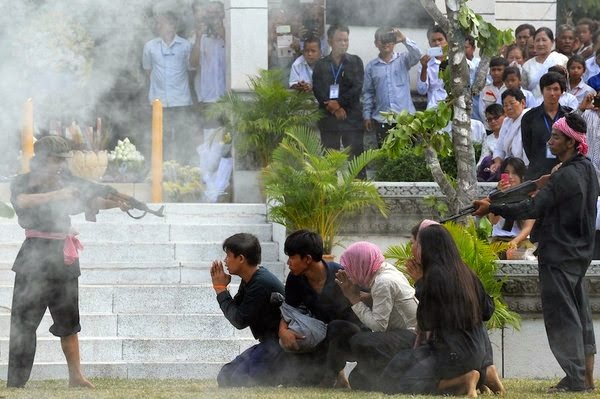
Cambodians are enthusiastic about play-acting to honor the memory of the victims of Pol-pot and company. We can sympathize as we sense that there will be a fuller sense of closure that way.  

As far as justice is concerned…unfortunately all we have (again) is a lot of play-acting and word-playing and a bit of fore-playing (but much more expensive to enact at $220 mil…all those lawyer fees….).

We love international law. Majority community killing their own is not considered genocide. However, majority community killing minorities is appropriate for the g-tag.

Thus Chicoms killing 45 mil Hans is not considered suitable for the worst of the worst tag. Neither is the 30mil killed by Stalin and company. Not even the 3 mil Khmers killed by Pol Pot qualifies as genocide.

As a saving grace the 20k Vietnamese and 90k Cambodian muslims (Cham) killed by the Khmer Rougue may finally see some justice. Regardless of definitions, evil men need to be taken down by other (righteous) men on earth, not any supernatural agency.

Incidentally something which aroused our curiosity is the Cambodian word for genocide: prolai pouch-sas. We are no linguists but “prolai” in Sanskrit (used in Bengali as well) denotes a state of crisis (at the end of times level). Perhaps a person who knows will step forward and clarify?
………………
August 7 was supposed to be judgment day for the last two leaders of
the Khmer Rouge regime.

Thirty-five years after the end of Pol Pot’s
calamitous agrarian revolution, a United Nations-backed court in Phnom
Penh found the movement’s chief ideologue Nuon Chea and the former
president Khieu Samphan guilty of crimes against humanity and sentenced
them to life in prison.


On the lawn in front of the courtroom on the outskirts of Phnom Penh,
the mood was self-congratulatory. Deputy Prime Minister Sok An called
the judgment “a milestone” for the court and for Cambodia, which rebuilt
itself “from scratch after liberation from the genocidal regime, the
regime of horror.” David Scheffer, the UN Secretary-General’s special
expert to the court, said, 

“Today, the winds of international justice
swept through the rice fields of Cambodia, through its cities, its
villages, its forests.”


 Finally, some were saying, the Khmer Rouge’s top echelon was being
held accountable for a utopian folly that killed as many as two million
people. For what the US Congress once described as “one of the clearest
examples of genocide in recent history.” For what various American
officials — Hillary Clinton, Steven Rapp, Samantha Power — have also
called a genocide.


Except that neither Nuon Chea nor Khieu Samphan was convicted of
genocide on August 7. And the tribunal will never even consider that
charge in connection with the vast majority of the Khmer Rouge’s
victims, the Khmer people, who make up 90 percent of the Cambodian
population today.
 

When the Extraordinary Chambers in the Courts of
Cambodia, as this tribunal is formally called, does address genocide in a
second phase of the leaders’ trial, it will do so only in relation to
two Cambodian minorities: the Vietnamese and the Cham, a Muslim group.


This is an awkward development. Some 20,000 Vietnamese and 90,000
Cham are believed to have died under Pol Pot — compared to well over 1.3
million Khmer, according to the most conservative estimates. 

One Khmer
woman, who lives in exile and travelled to Phnom Penh for the August 7
verdict, said that the court’s decision not to consider a genocide
charge on behalf of the Khmer left her feeling like victims were being
denied their “right to the precise term for what was done to us” — it
was as though “history had not been understood.” For Ung Billon, another
Khmer who is the president of a victims’ association in France called
Les Victimes du Génocide des Khmers Rouges and who also came for the
verdict, it was “an insult.”


And so even Cambodians who were relieved by the guilty verdicts and
especially the life sentences, like these two women, were left feeling
baffled, even betrayed, by the court’s handling of the genocide charge.
This is only natural. “Genocide” has been the term of choice in Cambodia
to describe Pol Pot’s regime for nearly four decades. It is the
characterization favored in schoolbooks and the local news, by
bureaucrats and lawyers.


In this respect at least, the ECCC is frustrating the very people to
whom it was supposed to bring resolution, recognition, and
reconciliation. Not only does the court’s narrow, technical definition
of genocide clash with the widespread popular understanding of the
crime, it also risks pitting different Cambodian communities against one
another.


There is, in fact, a simple explanation for why most of the Khmer
Rouge’s crimes, though widely thought to be a paradigmatic example of
genocide, both inside and outside Cambodia, are not actually that: the
1948 Genocide Convention, which codified the concept into international
law, deliberately ruled out its application to political pogroms and
class war — the signal crimes of Stalin, Mao, and Pol Pot.


That treaty defines genocide as killings, among other acts, committed
with the “intent to destroy, in whole or in part, a national, ethnical,
racial or religious group, as such.” This idea built on the word
“genocide” itself, a neologism combining genos (Greek for race or tribe) and cide
(Latin for killing), which the Polish lawyer Raphael Lemkin proposed in
1944, well into the Holocaust, to denote the deliberate “destruction of
a nation or of an ethnic group.” 

But the language adopted in the
convention was also a compromise reflecting the power dynamics of the
day. The Soviet Union, for example, opposed including “political” in the
list of protected groups in the definition, presumably because it was
wary of getting into trouble for purging its opponents back home.


The Khmer expression for genocide, prolai pouch-sas, seems
to have first appeared when Cambodia ratified the Genocide Convention in
1950. But then it hardly was used, even within the learned elite; it
appears neither in the 1956 Cambodian penal code nor in the 1966
reference dictionary of Khmer compiled by the scholarly monk Chuon Nath.
And when the term became common in Cambodia, at least in official and
formal written language, soon after the Vietnamese toppled the Khmer
Rouge, it took on a meaning different from Lemkin’s original.

The Vietnamese communists, previously the Khmer Rouge’s patrons,
marched into Cambodia in late 1978, after vicious incursions by Pol
Pot’s forces into Vietnam and amid mounting evidence that his regime was
self-destructing. The Khmer Rouge went underground, and in short order
the Vietnamese tried some of the movement’s leaders in absentia, holding
what they called “the trial of the genocide crime of the Pol Pot-Ieng
Sary clique.” (Ieng Sary was the Khmer Rouge’s foreign minister then –-
and a defendant at the ECCC until he died last year.)


They turned the S-21 detention and torture center in Phnom Penh into a
showroom of horrors, with advice from curators in Eastern Europe. A
large sign calling the former prison the “Genocide Museum” was placed at
its entrance and inmates’ clothes were displayed in mounds, an
iconographic touch inspired by Nazi concentration camps.


All this made good political sense. The Vietnamese needed to justify
their occupation of Cambodia, and they needed to do so while
distinguishing the virtues of their communist ideology from the
perversions of Pol Pot’s vision. What better way than to cast the Khmer
Rouge regime as an aberrant form of communism and accuse it of genocide,
the Nazis’ defining crime?


Propaganda became even more necessary as the Vietnamese’s lightning
liberation turned into a lengthy occupation; their continued presence
risked rekindling many Cambodians’ ancestral anxiety about Vietnamese
expansionism — an anxiety so deeply engrained it had long been the
fodder of terrifying children’s fairytales. Schools were supplied with
new textbooks short on pedagogy and long on hyperbole. “The Pol Pot-Ieng
Sary clique killed more than 3 million people and completely destroyed
everything in Cambodia,” read one book intended for the second grade.
“We are absolutely furious and strongly struggle against these
atrocities.” January 7, the day in 1979 that Vietnamese troops seized
Phnom Penh from the Khmer Rouge, became celebrated as Victory over
Genocide Day.


However heavy-handed, the effort caught on. Prolai pouch-sas
roughly means to eliminate the lineage of a people or a nation, and
that definition echoed many Cambodians’ personal experiences under the
Khmer Rouge, according to Muny Sothara, a psychiatrist at the
Transcultural Psychosocial Organization, an NGO in Phnom Penh that
provides mental-health services, who has worked since 2007 with Khmer
Rouge victims involved in the trials. Pol Pot’s minions had seemed
intent on weeding out their enemies by “pulling them out roots and all,”
as one creepy Khmer Rouge saying went. The movement often targeted a
suspect’s entire family, group of colleagues, or community.


And so it was that almost as soon as the Khmer phrase for “genocide”
came to mean anything to Cambodians, it meant something both broader and
more precise than the destruction of a nation, ethnicity, race, or
religion “as such”: it meant the Khmer Rouge’s attempt to exterminate
Cambodians, mostly Khmer — their own group. (Kong Sothanarith, a
forty-something news editor at Voice of America, told me recently, “It’s
when I went into journalism that I realized the word meant almost
exactly the opposite of what I had been taught.”) And the term took. The
horror of the Khmer Rouge “genocide” was a rare matter on which
Vietnamese occupiers and Cambodian occupied could agree.

On April 30, 1994 -– while a bona fide genocide was raging
in Rwanda — the US Congress passed the Cambodian Genocide Justice Act,
which created the Office of Cambodian Genocide Investigations in the US
State Department, which in turn created the Cambodian Genocide Program
at Yale. 

The idea was to document the Khmer Rouge’s crimes and at some
point prosecute them.


Very soon after that, the UN Security Council set up two tribunals to
judge abuses committed when Yugoslavia and Rwanda imploded — the first
international criminal courts since Nuremberg and the Tokyo trials. 

The
notion of genocide finally had its day in court. (It had not be properly
adjudicated before, not even at the “genocide” tribunal that had tried
Pol Pot and Ieng Sary in 1979, which had used a legal standard of its
own making.) Meanwhile, in France, Germany, Spain, and Ethiopia,
legislators and judges were expanding the concept, sometimes
specifically to cover the destruction of political groups. Some legal
scholars were also trying to apply it to Cambodia: Pol Pot’s regime had
committed a genocide against the so-called “new people,” those urbanites
who were the prime enemies in its class war; its general onslaught
against Cambodians, a national group, could be called an
“auto-genocide.”


That the concept of genocide was stretched this way is a measure of
the cachet and clout it had acquired by then. After all, there was no
legal gap that needed filling: the Khmer Rouge’s crimes readily fell
under other categories, like crimes against humanity (a widespread and
systematic attack against civilians) or war crimes (severe mistreatment
of certain combatants and civilians during a conflict). And most jurists
would agree that international law establishes no formal hierarchy
among mass crimes. 

But by the 1990s, genocide had a “super stigma,”
according to Patricia Wald, a US Court of Appeals judge who served at
the Yugoslavia tribunal. Or, as one chamber at the international court
for Rwanda put it, it was the “crime of crimes.”


When it came to the Khmer Rouge, this development was only
complicated by the peculiar political usage of “genocide” in Cambodia.
In 1999, the UN Group of Experts that had been asked to figure out how
best to try Pol Pot’s lieutenants — Pol Pot himself had died the year
before — announced that it would not take a position on the “complex
interpretive issues” surrounding “whether the Khmer Rouge committed
genocide with respect to part of the Khmer national group.” 

And so when
the ECCC came into being in 2006, genocide was included in its mandate
(along with crimes against humanity, war crimes, and violations of the
Cambodian penal code). And under the court’s civil law procedure, it
would be up to two investigating judges to lead a factual inquiry and
determine how to characterize any crimes they uncovered — a
technical-seeming task fraught with high-stakes symbolism.


The Khmer Rouge leaders were arrested in 2007, and at first were
charged only with crimes against humanity and war crimes. (There were
four leaders at the time, but since then Ieng Sary has died and his
wife, the Khmer Rouge minister for social affairs Ieng Thirith, has been
declared unfit to stand trial because of dementia.) Genocide charges
were brought two years later, and only in reference to the Vietnamese
and the Cham. 

Marcel Lemonde, who was the international investigating
judge back then, recently explained to me his office’s thinking on the
issue. He said that “troubling facts” unearthed during the investigation
suggested that the Khmer Rouge “may have intended to destroy the Cham
as Cham rather than as political opponents, and to destroy the
Vietnamese as Vietnamese rather than because the regime was at war with
Vietnam.” Not so with the Khmer population. “To establish that a
genocide occurred, a group needs to have been identified,” he explained,
“and that group cannot be the quasi entirety of the population –
otherwise the notion no longer makes sense.”


Still, it had been a difficult call. Lemonde and his Cambodian
counterpart, You Bunleng, feared that pursuing a genocide charge
exclusively on behalf of two small minorities would offend many
survivors and victims’ families. But Lemonde said that he and You
Bunleng, who was especially uncomfortable, decided they could not avoid
the issue by dismissing the genocide charge altogether at that stage.
Better to give it a full airing at trial and let the prosecution,
victims’ representatives, and the defense debate its merits and its
limits. Genocide, the ECCC’s marquee crime, had become a liability.


When the trial judges decided to segment the gigantic indictment into
smaller parts and stagger them, they postponed the genocide issue to a
later stage. (The recent verdict concerns only abuses pertaining to
various forced population transfers and the execution of officials from
the military government that the Khmer Rouge deposed in April 1975; the
next phase of the trial, which is expected to start later this year,
will include genocide, as well as crimes at certain work cooperatives
and security centers, internal purges, and forced marriage.) 

Nuon Chea’s
lawyers challenged that decision. In an appeal last year citing “the
sheer gravity” of the genocide charge and its “special and privileged
role” as “an encapsulation of the Khmer Rouge period in the public
mind,” they asked that it be included in the first part of the trial.
Whether they really saw an opportunity to win an acquittal or simply
wanted to kick up some dirt, you know something is amiss when a
defendant is clamoring to be prosecuted, and ASAP, for genocide.


The trial judges certainly face an awkward predicament, one more
awkward still than the investigating judges did. They are damned if they
rule there was no genocide against the Cham or the Vietnamese (meaning,
there was no genocide at all). And they are damned if they rule there
was a genocide (meaning, against some group other than the Khmer
majority). Whatever they do, this internationally sanctioned court —
which has cost some $220 million so far — will frustrate most Cambodian
victims’ sense of what happened to them.


Nor is it clear that the two minorities stand to gain much from the
special treatment. An eighty-four-year-old imam I met in 2011 in a small
Cham village in Kompong Chhnang, a few hours north of Phnom Penh,
complained that the Khmer Rouge had prohibited him from praying and
forced him to eat pork. Yet he also said, “When it came to the beatings
and the killings, no one suffered more than anyone else.” 

This view is
common, says So Farina, a researcher at the Documentation Center of
Cambodia, or DC-CAM, who has interviewed several thousand Cham over the
past decade. Most Vietnamese, for their part, have no desire to stand
out, especially against Khmer Cambodians, according to Long Danny,
another DC-CAM researcher. Many are poor, some are stateless, and most
would rather keep a low profile: anti-Vietnamese sentiment still runs
very deep in Cambodia.


The perils of these paradoxes haven’t surfaced yet because the ECCC
operates at a remove from daily life, and outside the court the same old
talk of that other, generic kind of genocide still prevails.
Educational and outreach efforts to parse the term’s legal and casual
uses have been modest and mixed. DC-CAM, which was originally set up by
Yale’s Cambodian Genocide Program to collect evidence of Khmer Rouge
crimes, is credited with putting together in 2007 the first history book
to describe the regime in any detail. 

The book largely forgoes the use
of “genocide,” preferring to focus on facts, but the accompanying
teacher’s manual uses the word liberally. And through its “Genocide
Education” program, DC-CAM has been distributing posters with
anti-“genocide” slogans to schools throughout the country. Even Muny
Sothara, the counselor from TPO, and some victims’ lawyers have favored
maintaining their clients in a state of constructive confusion.


How much longer can such obfuscating work? Thouch Féniés Phandarasar,
a Khmer refugee living in France who testified at the trial last year
and flew back to Phnom Penh for the judgment earlier this month, told me
she hadn’t realized how the court was handling the genocide charges
until the week before the verdict, when she was briefed on the second
phase of the trial. And then she was “outraged,” she said. 

For her,
“genocide” connotes extermination in a way that “crimes against
humanity” cannot, and so “if the tribunal refrains from using the term,
it must do so for everyone, rather than use it just for the Vietnamese
and the Cham.” Ung Billon, the head of the victims’ association in
France, told me, “This was a genocide between two political ethnicities:
The communists killed us because we weren’t communists. So to be told
that Khmer victims aren’t included in the genocide is unacceptable for
me.”


One could argue that the long-awaited trial of the “Khmer Rouge
genocide,” that oxymoron, will help clarify both the nature of communism
and the notion of genocide by confronting the essentially political
character of most of the Khmer Rouge’s crimes with the politically
expedient origins of the legal definition of genocide. But it is a
lesson that comes at a cost for the people the court was supposed to
help, the victims, especially those who are most involved in its work.


Many Cambodians, like other people who survive mass crimes, seem
haunted by that question with no answer: “Why?” But a moment after first
asking it they often repeat it with this characteristic twist: “Why did
the Khmer Rouge try to exterminate Cambodians?” If only the Khmer Rouge
had tried to exterminate an ethnic or national group other than their
own — if only their central purpose had been to commit a genocide –- then it might all make a bit more sense.

…..

Link: http://www.nybooks.com/blogs/nyrblog/2014/aug/25/khmer-rouge-genocide-wasnt/

….

regards

Brown Pundits