Chandrayaan 2; if at first you don’t succeed..

… try, try again

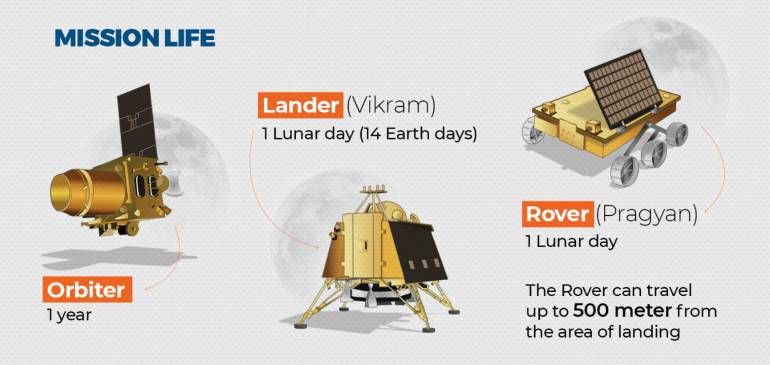
The Indian Space Research Organization (ISRO) is the crown jewel of India’s applied science and engineering institutions, having developed reliable satellite launching capabilities as well the ability to pull off “first world” space missions of great complexity and ingenuity. After a string of recent successes, including the innovative Mangalyaan mission to Mars, the agency planned to land on the South polar region of the moon and use a locally developed rover (Pragyan) to explore the lunar surface and carry out various experiments. This mission (Chandrayaan 2) was initially conceived as a joint mission with Russia and was approved by the UPA govt led by Dr Manmohan Singh in 2008. The Russians later dropped out of the project (they were mainly responsible for developing the landing vehicle that would travel from the orbiter in lunar orbit down to the lunar surface), so ISRO decided to go ahead with the mission on their own. Given ISRO’s recent successes and the rising tide of Indian Nationalism (and the generally science-illiterate level of Indian media) the mission generated intense hype within India, but with very little communication to the general public of the extremely difficult technical challenges that have to be overcome to successfully land a vehicle on the moon (and the significant risk of failure, even in the best run missions).

Image result for chandrayaan 2

Unfortunately, the Vikram Lander did run into trouble and appears to have crashed onto the moon after something went wrong in the last stages of its descent to the lunar surface. Given the complexity of the technological challenges (first and foremost, the fact that it is too far from the earth to be controlled by ground engineers on earth, it has to do the job autonomously) this is not a totally unexpected outcome (per my technology-literate fellow blogger @kaeshour the probability of success was 40%). As the saying goes, “space is hard” , failures unfortunately happen with some regularity and have happened in every space program. Still, it was heartbreaking to see the disappointment on the face of the ISRO scientists as the lander lost contact with the earth and a nation of over a billion people faced deep disappointment after tremendous hype had been built up around the mission. (as an aside, the mission is far from a complete failure. The lunar orbiter is in orbit around the moon, conducting experiments as intended and will continue to do so for many years. It remains to be seen if anything is still functional on the lander)

ISRO itself is a very professional organization and will no doubt continue its stellar work, but even the hype around the mission does not have to end in disappointment and disillusionment. Instead it is likely that the last minute loss will itself become a vehicle for “soft power” phenomena including everything from a greater interest in science and engineering to a paradoxical renewal of national pride and unity (e.g. someone on my twitter feed described the video of PM Modi hugging a weeping ISRO chairman as a boost to Indian asabiya; I can see why that may be so). The loss was followed by messages of support and appreciation for the fact that India could conceive, create and almost successfully carry out a mission of such complexity and difficulty (the exception being the science minister of Pakistan, who managed to set new records of boorishness and idiocy in his twitter feed)

Be that as it may, the topic of the Indian space program always brings up a few recurrent critical memes, and this setback may see a few of those resurface as well. One is the question of whether a poor country such as India should be spending money on a space program. The other is a relatively new one: that the “Hindu Nationalist” government of Narendra Modi uses space achievements as a means to boost “toxic nationalism”. As is usually the case, the two memes have merged in some cases to create what one may call the “New York Times style guide to writing about the Indian space program” (though to be fair in its latest article the NYT has managed to soften the “poor Indians wasting money on space” theme and devoted only one sentence to Mr Modi’s “muscular nationalism”). How valid are these criticisms?

The first one can be broken down into questions: 1. What good is a space program? and 2. How much should country X spend on a space program?

Q1 is easy to answer. A space program is not some sort of purely symbolic act of “conspicuous consumption”. Space is now an industry worth 100s of billions of dollars, with vast applications in communications, mapping, scientific research, military use, entertainment, etc. It is not like a statue or a monument whose only worth comes from its symbolism (and even that is something all human societies do, as an essential component of “soft power” and the building of group identity, etc). There is no question about the fact that earth orbit applications are now a routine part of our economic and scientific life, so there can be no question about the fact that someone needs to have a space program, though everyone may not be in a position to participate. Further out (the moon, mars, the sun, and beyond) the question becomes a little trickier, but quite apart from spinoff engineering applications (not trivial in itself), the purely scientific merit of these efforts is considerable. There is a very real (but very hard to quantify and analyze) human urge to know, to explore, to do what has never been done. It is this urge that has led humans from the African savannah  to the moon and beyond and whatever some naysayers may say about it, it is a part of human nature, and it not a trivial part. Nerds across the world will not need convincing on this account, but it extends beyond the nerdsphere and is really a part of all of us and I see no reason to deny it.

Q2 is trickier, but the first thing to keep in mind is that nation states are aggregate entities and a large country with many poor people still possesses far more resources at govt level than a small country with rich people. Pakistan has a space program, but Lichtenstein does not, even though on a per capita basis Lichtendstein is orders of magnitude richer than Pakistan. Costa Rica is better off than Brazil, but Brazil has a space program and Costa Rica does not. This is natural and perfectly expected. India is a country with far too many poor people, but it is also a HUGE country, with a 2.5 trillion dollar economy. It can afford a space program. How much it should spend on that program is open to debate, but it is hard to say that it spends too much at this time. People will go further and say the most ridiculous things about this; i remember reading an article somewhere many years ago where the writer asked if 10,000 (or whatever) engineers and scientists at ISRO would not be better employed building toilets in a country with so much open defecation. This is so silly it does not need to be discussed much further (anyone who seriously thinks the engineers of ISRO could be sent to build toilets in Indian villages, and that this would be a good use of their talents, is not someone you want to waste time debating; leaving aside the fact that building these toilets is already a huge project in India and does not need help form ISRO), but we can agree that how much gets spend on ISRO is a valid debate. My own view is that it is, if anything, not enough, but others can have different opinions. Whatever opinion they have, it would be useful to look at this not in isolation as “ISRO vs Toilets” but as just one component in a huge Indian national budget, in which huge chunks are wasted on items much less useful (practically and symbolically) than ISRO.

The criticism that space projects are a way to promote “jingoistic nationalism” may have some merit to it, but not much. We can (I hope) agree on the everyday usefulness of the broader space program, but high risk moonshots and trips to Mars have less immediate practical returns; so it can be argued that the scientific research projects (which are sometimes of no immediate economic benefit) should be left to richer nations to pursue. But there is a huge “soft power” aspect of this and the most important returns may not be the jingoistic nationalism ones (though these obviously exist as well). In a country like India, these events play a huge (but hard to quantify?) role in promoting scientific literacy, the image of working women,  a culture of engineering excellence, innovation and creativity. That alone would be worth the price of such a mission (in this case, under 200 million dollars, i.e. 2-3 Rafale aircraft?). But coming to the nationalism issue, what is really being said here is that the writer does not approve of this particular nationalism. I doubt if even one Marxist-Leninist in the world failed to feel pride and joy at the launch of Sputnik. I am confident that none of them wrote op-eds asking why Russia is investing billions in space when so many of their own citizens cannot even afford their own one room apartment. The question is really about whether the writer likes the Modi govt (or India as a whole) or not. Now there are good reasons to be critical of the BJP govt in India, but my point is that 1. this is about India, Indian science and Indian pride and does not have to be about the Modi govt. 2. The “soft power” benefits of this particular project (science awareness and ambitions in India, higher standards for Indian engineering, science, organization and institutions) are more than just “muscular nationalism”. 3. “Muscular nationalism” itself is a feature of this world of nation states. Russia, America, China, Pakistan, everyone does it. The hippie in me is wary of all of them, but no more wary of the Indian variety than any other. What is sauce for the goose is sauce for the gander. People who do not criticize Russian, Chinese, American or XYZ space programs being used as nationalist symbols should apply the same standards to India, nothing more, nothing less. That means those who are critical of ALL these programs (and such people exist and are frequently sincere and well meaning people) should carry on, everyone else can shut up.

Personally, I think it was a great effort and much of it succeeded (that orbiter is still going around the moon, and will be for years to come); unfortunately the lander failed, but such things happen. Better luck next time..

Image result for chandrayaan 2

One and the same be your resolve, and be your minds of one accord.
United be the thoughts of all, that all may happily agree. (Rig Veda, last mantra)

An Extension for General Bajwa

Commentary by Dr Hamid Hussain

30 August 2019
I fully understand limitations of retired senior officers.  We used to have some eccentric ones who would not care about consequences when advocating for the professionalism of their own institution.  Now, the silence is deafening.   Bless the British who instilled a sense of professionalism in officer corps that has taken a big hit in successor Indian and Pakistani armies. The most scathing criticism came from Lieutenant General Nathu Singh of Indian army who said, “I have not known a British officer who placed his own interests before his country’s, and I have hardly known any Indian officer who did not”.
It is left to some of us to bring mirror into the room; indeed, a heavy burden.  When I heard the announcement of General Bajwa’s extension, I recalled two couplets of Urdu poet Ahmad Faraz (for those who understand Urdu);
Ghurur-e-ja’an ko merey ya’ar baich detey hein​ (My friends sell the honor of their beloved)​
Qaba ki hirs mein dastar baich detey hein​ (​Just the way to get themselves a fancy dress, they wold sell their honor too)
Ye loog kiya hein, jo do cha’ar kwahishoon key liye​ 
Tama’am umar ka pindar baich detey hein
(After all who are these people​, who sell their life’s pride for a few crumbs)
Hamid

Extension Business

By Hamid Hussain

‘Power lies in the hands of those who control the means of violence.  It lies in the barrel of a gun, fired or silent’. 

Pakistani Prime Minister Imran Khan announced three years extension of Chief of Army Staff (COAS) General Qamar Javed Bajwa.  This has nothing to do with national security.  Army Chief using the power of his institution to favor one political group to come to power and Imran Khan paying back the favor.  My view about extension has been very clear that it is very bad for the army as well as the country.  Maneuvers about extension usually start quite early and few months ago many interested in Pakistan army asked me this question.  I gave my view in the following paragraph written about two months ago:

“2019 looks more like 2007.  General Pervez Mussharraf had come under criticism from different quarters of society and in the process army’s reputation was sullied.  Change of command provided an exit.  General Ashfaq Pervez Kayani slowly consolidated his command by sidelining old guard and then convincing all players that army has turned a page.  The possible exit for army is change of command in November 2019.  However, personal interests of three key players; Prime Minister Imran Khan, army chief General Bajwa and DGISI Faiz Hamid now converge where extension of General Bajwa is being seriously considered.  1-3 year extension will serve all three parties. Bajwa to enjoy few more years of private jet and being the master gamekeeper at the national park.  Imran Khan will be seriously thinking about giving him an extension to make sure that an unknown factor does not come into equation.  Imran is faced with enormous challenges.  However, he has not been able to put his house in order.  Rising economic woes and diverse opposition groups coming closer can cause many headaches.  Having army brass in his corner is important to weather any storm.  He would prefer to continue with known entity than venture into unchartered territory.  In case of three years extension, Faiz will be among top contenders in 2022.  After 18-24 months as DGISI, Bajwa can appoint him Corps Commander to make him eligible for the top slot.  I’m not in favor of any extension but especially in case of Bajwa, negative fallout for army is manifold.  Army is seen no more as a neutral body and extreme polarization of Pakistani polity is now directly affecting army as institution.” 

General Bajwa did not just walk into Prime Minister’s office to demand an extension of his tenure.  This is done in a way where circumstances are created and messages from briefings and body language are conveyed.  It is not a secret that army brass has made a strategic decision to give two terms to Imran Khan and General Bajwa is a fan of Imran Khan.  It was not in Imran Khan’s interest to inject an unknown factor in the game by appointing a new army chief.  General Bajwa had put his own ducks in a row for this outcome by using promotions and postings of senior officers.  In his interactions with British and American interlocuters, Bajwa conveyed the point that he is the man for the hour.  The buzz word was ‘continuity’.  The promise to British was continued quite along the Line of Control (LOC) and to Americans full support to Doha process for the snake pit of Afghanistan.  These are policies of the institution and the right course in current circumstances, but a Chief can present it in a way where he can carve out something for himself (General Kayani in his more than a dozen bonhomie meetings with American Chairman Joint Chiefs of Staff Committee and General Raheel actively working on his own post-retirement lucrative package are two recent examples).  There was possibility that former army chief General (R) Raheel Sharif would complete his three years of assignment in Saudi Arabia and General Bajwa could follow him with a very lucrative post-retirement contract.  This door was closed when Prince Muhammad Bin Salman gave Raheel a three years extension as we are in extension season.  Now the only option for ‘indispensible’ officer was extension. Continue reading An Extension for General Bajwa

Book Review: The 1965 War by Shaukat Riza

From Major Amin

  1. THE PAKISTAN ARMY –WAR 1965 MAJOR GENERAL SHAUKAT RIZA (RETD) –ARMY EDUCATION PRESS 1984-309 PAGES , MAPS AND PHOTOGRAPHS Reviewed by Major Agha H Amin (Retired)
  2. This book was the first official effort to record military history of 1965 war. Major General Shaukat Riza an artillery officer dabbled in military writing and had penned many articles and military papers etc. He was described as a soft spoken gentle man who did not take kindly to being ordered to carry out ruthless action against civilians thus his removal from 9 Divisions command in 1971 in East Pakistan. On the other hand Brigadier Amjad Chaudhry when I met him in 1977-78 described him as not getting along well with major general abrar in the staff college in 1967-68 while serving as chief instructor. In addition he had a long record of having served as an instructor at various army schools of instruction including the prestigious command and staff college. The first major attempt at writing the 1965 war history was made by Brigadier Amjad Ali Khan Chaudhry whose book on 1965 war was published in 1977. Shaukat Rizas book was officially sponsored and he was provided access to all records.
  3. However as all official publications are , the book was doctored and sanitized and the author did not enjoy the right to critical analysis. The book nevertheless has great value. First it contains almost all major orders of battles of all major formations . Second it gives a clear picture of major events of the war. Third it manages to give insights about some most decisive battles of the 1965 war. Most interesting battle of Gadgor where Shaukat Riza described how clueless the 24 Brigade commander was when the Indian 1st Armoured Division broke in and all he could say was “ Nisar, Do Something”.
  4. Brigadier Shaukat Riza’s analysis of Operation Grand Slam is also reasonably critical.  where he faults 12 Division with bad handling of artillery and dispersing artillery fire. He totally misses out how armour was divided by 12 Division on first day of the war thus leading to failure although B Squadron 11 Cavalry had reached Chhamb at Tawi River at 0830 Hours in the morning. However with regard to change of command it appears that major general shaukat riza was forced to give legitimacy to the post 1965 pakistan army whitewash, i.e that change of command of operation grand slam was pre planned and not a surprise as was mostly believed. His treatment of Pakistan Armys First Armoured Division attack is critical and incisive.He admits that whole 4 cavalry. was captured by the Indians .Further he admits that there was much exaggeration of enemy strength in the reporting of armoured division commanders at various levels. When he describes how various brigades of Pakistans 1st armoured division were ordered left and right away from the scene of attack he hints at a Pakistan Army general headquarters deeply afflicted and paralysed by supreme indecision, vacillation and irresolution.
  5. The maps of the book are weak in details of what actually happened merely showing topgraphic details while what formations actually did is left to the readers imagination. However when we received this book via the army book club in 1985-86 this was a revolutionary development as till that time censorship had deeply plagued the cause of military history in Pakistan. Much blame of the failure was passed to ZA Bhutto while Generals Ayub and Musa were presented as innocent bystander pure maidens !
  6. One must admit that the general was handicapped by too many cooks doctoring his book and practicing sycophancy with the usurper and dictator zia , at the height of his power. Even General Mc Chrystal confessed that his book was subjected to some kind of official censorship and sanitization. This is the cost of becoming generals in any army where a man has to compromise over many things . As Sir Francis Bacon brilliantly summed it up , men gain dignities through indignities.
  7.  Major General Saeeduz Zaman Janjua many times recounted how even General Asif Nawaz , although his close relative , had to be obsequious and flexible with his seniors , as a brigadier and major general , failing which he would not have been promoted. Particularly he recounted a situation where a very senior officers son was caught cheating in the Pakistan Military Academy and General Asif Nawaz had to stop at relegation while the minimum punishment was withdrawal from the academy. This is how the world moves and only those who compromise and submit climb high in the so called systems or hierarchies. A man with no war record but one who was all in all in Pakistan of 1984.A sad year like George Orwells book 1984.
  8.  The book ignores how badly Pakistan Army was organized with formations like 12 Division holding an area of responsibility occupied by some five Indian divisions. What stopped Ayub Khan from raising 5 more divisional headquarters in 12 Division area of responsibility. At least this book gave us some idea about what had happened and a skeleton structure to construct a more detailed picture. His two later books Pakistan Army 1947- 59 and Pakistan Army 1966-71 were also similarly handicapped by censorship and sanitization by the Pakistan Army GHQ but more of this in subsequent book reviews.

Continue reading Book Review: The 1965 War by Shaukat Riza

Obituary: Brigadier Nisar Ahmed SJ

From Dr Hamid Hussain. Perhaps not of general interest on this site, but worth preserving in any case. See details of Col Nisar’s critical (and courageous) action in 1965 are added below this obituary.

Obituary – Brigadier ® Nisar Ahmad Khan (28 March 1920 – 30 July 2019)

Hamid Hussain

Brigadier ® Nisar Ahmad Khan passed away on 30 July 2019 in Michigan; United States.  He was nick named ‘Kaka Nisar’.  A fine officer and gentleman who was instrumental in a very important holding action of armor in 1965 Indo-Pakistan War faded away into the fog of history.  He was born on 28 March 1920 at Bassi Pathana near Sirhind in Patiala state.  This Muslim Pathan colony was established during Mughal era.  This small Muslim enclave in a Sikh state provided soldiers to the Maharaja of Patiala.  Several generations of Nisar’s ancestors proudly served Patiala state. According to Maharaja Patiala Captain ® Amarindar Singh, Kaka Nisar was sixth generation of the family to serve Patiala state.  He followed the family tradition, joined Ist Patiala (Rajindra) Lancers and commissioned on 21 March 1943. Continue reading Obituary: Brigadier Nisar Ahmed SJ

Browncast Episode 64. We Talk with Meru Media about India, Pakistan, Hinduism, TNT, Aryans..

Another BP Podcast is up. You can listen on LibsyniTunesSpotify,  and Stitcher. Probably the easiest way to keep up the podcast since we don’t have a regular schedule is to subscribe at one of the links above.

You can also support the podcast as a patron. The primary benefit now is that you get the podcasts considerably earlier than everyone else. I am toying with the idea of doing a patron Youtube Livestream chat, if people are interested, in the next few weeks.

Would appreciate more positive reviews!

In this episode we talk to Mukunda Raghavan, who runs Meru Media (“your home for all things Indic”). We talk about Hindu drinking culture, India, Pakistan, Tambrams, Aryan Invasion, all the fun stuff. Do check it out and leave comments.


Letter of General Akhtar Malik (Re Grand Slam)

There is endless controversy in Pakistan about the way Gen Akhtar Malik, who led the opening phase of Pakistan’s invasion of Kashmir in 1965 (operation Grand Slam) was removed from command the day after the attack started. The Pakistan army had decisive superiority in tanks and artillery and on the first day captured Chamb and were threatening to break through towards Akhnur, but on the 2nd day of operations there was an abrupt change in command as Gen Malik was replaced by Gen Yahya Khan. This led to some delay and gave the Indians the chance to reinforce their defenses. Many in Pakistan blame this command change for the failure of Grand Slam. You can read more about the operation in another post. The controversy will no doubt continue. Here is a letter from Gen Malik to his brother, written 2 years after the war, which gives his version of events (I received this via Major Amin).
Gen Akhter Hussain Malik’s Letter to His Brother Gen Abdul Ali Malik
My Dear brother,
I hope you and the family are very well. Thank you for your letter of 14 Oct. 67. The answers to your questions are as follows:
a. The de facto command changed the very first day of the ops [operations] after the fall of Chamb when Azmat Hayat broke off wireless communications with me. I personally tried to find his HQ [headquarters] by chopper and failed. In late afternoon I sent Gulzar and Vahid, my MP [military police] officers, to try and locate him, but they too failed. The next day I tore into him and he sheepishly and nervously informed me that he was ‘Yahya’s brigadier’. I had no doubt left that Yahya had reached him the previous day and instructed him not to take further orders from me, while the formal change in command had yet to take place. This was a betrayal of many dimensions.
b. I reasoned and then pleaded with Yahya that if it was credit he was looking for, he should take the overall command but let me go up to Akhnur as his subordinate, but he refused. He went a step further and even changed the plan. He kept banging his head against Troti, letting the Indian fall back to Akhnur. We lost the initiative on the very first day of the war and never recovered it. Eventually it was the desperate stand at Chawinda that prevented the Indians from cutting through.
c. At no time was I assigned any reason for being removed from command by Ayub, Musa or Yahya. They were all sheepish at best. I think the reasons will be given when I am no more.
d. Not informing pro-Pak Kashmiri elements before launching Gibraltar was a command decision and it was mine. The aim of the op was to de freeze the Kashmir issue, raise it from its moribund state, and bring it to the notice of the world. To achieve this aim the first phase of the op was vital, that is, to effect undetected infiltration of thousands across the CFL [cease-fire line]. I was not willing to compromise this in any event. And the whole op could be made stillborn by just one double agent.
e. Haji Pir [Pass] did not cause me much anxiety. Because [the] impending Grand Slam Indian concentration in Haji Pir could only help us after Akhnur, and they would have to pull out troops from there to counter the new threats and surrender their gains, and maybe more, in the process. Actually it was only after the fall of Akhnur that we would have encashed the full value of Gibraltar, but that was not to be!
f. Bhutto kept insisting that his sources had assured him that India would not attack if we did not violate the international border. I however was certain that Gibraltar would lead to war and told GHQ so. I needed no op intelligence to come to this conclusion. It was simple common sense. If I got you by the throat, it would be silly for me to expect that you will kiss me for it. Because I was certain that war would follow, my first choice as objective for Grand Slam was Jammu. From there we could have exploited our success either toward Samba or Kashmir proper as the situation demanded. In any case whether it was Jammu or Akhnur, if we had taken the objective, I do not see how the Indians could have attacked Sialkot before clearing out either of these towns.
g. I have given serious consideration to writing a book, but given up the idea. The book would be the truth. And truth and the popular reaction to it would be good for my ego. But in the long run it would be an unpatriotic act. It will destroy the morale of the army, lower its prestige among the people, be banned in Pakistan, and become a textbook for the Indians. I have little doubt that the Indians will never forgive us the slight of 65 and will avenge it at the first opportunity. I am certain they will hit us in E. Pak [East Pakistan] and we will need all we have to save the situation. The first day of Grand Slam will be fateful in many ways. The worst has still to come and we have to prepare for it. The book is therefore out.
I hope this gives you the gist of what you needed to know. And yes, Ayub was fully involved in the enterprise. As a matter of fact it was his idea. And it was he who ordered me to by-pass Musa while Gibraltar etc. was being planned. I was dealing more with him and Sher Bahadur than with the C-in-C. It is tragic that despite having a good military mind, the FM’s [Foreign Minister Z.A. Bhutto’s] heart was prone to give way. The biggest tragedy is that in this instance it gave way before the eruption of a crisis. Or were they already celebrating a final victory!!
In case you need a more exact description of events, I will need war diaries and maps, which you could send me through the diplomatic bag.
Please remember me to all the family.
Yours,
Akhtar Hussain Malik

U.S.-Pakistan Re-Engagement; Hamid Hussain

From Dr Hamid Hussain

U.S.-Pakistan Re-Engagement

Hamid Hussain

 ‘Being a friend of the United States was like living on the banks of a great river.  The soil is wonderfully fertile, but every four or eight years the river changes course, and you may find yourself alone in a desert’.  General Muhammad Zia ul Haq to William Casey 1983 quoted in John E. Persico’s Casey: The Lives and Secrets of William J. Casey: From the OSS to the CIA.

 In July 2019, Prime Minister of Pakistan Imran Khan and President Donald Trump met at White House that generated some headlines and as expected from every Trump encounter some controversy.  As expected, this news lasted less than twelve hours in United States and 4-5 days in Pakistan.  Life has gone back to normal.  Positive signs should be acknowledged but Pakistan should not be carried away by euphoria.  The good part is that civilian and army leadership does not have trust deficit and not undermining each other.  This alone is a breath of fresh air for Pakistan. Continue reading U.S.-Pakistan Re-Engagement; Hamid Hussain

Beltway Bandits (Lobbyists and Middle East Policy), Dr Hamid Hussain

From Dr Hamid Hussain.

Last few years I have been working on horizontal and vertical spread of conflict in the Middle East.  This is first of the series looking at each player.  This one was the outcome of my own trips to Washington every few months to get some feel of beltway currents. I have no specific insight but want to provide some glimpses of the issues facing the region.

Hamid

Beltway Battles 

Hamid Hussain

“I have had lobbyists, and I have had some very good ones.  They could do anything.”  Donald Trump

In United States, domestic and foreign entities engage in lobbying at federal and state levels to promote their interests.  In the last few years, many Arab countries have increased their lobbying efforts in Washington to promote their interests.  In 2017, open conflict between Qatar on one side and Saudi Arabia, United Arab Emirates (UAE), Egypt and Bahrain on the other has spilled over into international arenas. In Washington, these efforts are multi-faceted including marshalling support of large businesses, think tanks, universities, legislators and public policy influencers.  

The meteoric rise of a 30-year-old previously unknown royal family member to the dizzying height and sidelining of the old hands of Royal family in Saudi Arabia changed power dynamics inside the kingdom. This resulted in some competition even in Washington.  Crown Prince and interior minister Prince Muhammad Bin Nayef hired a lobbying firm run by a Trump campaign advisor Robert Stryk.  The firm was paid $5.4 million to make inroads into new administration.  However, in June 2017 when Muhammad Bin Nayef was removed from his positions and Muhammad bin Salman (MBS) elevated as Crown Prince, the deal ended.  MBS alienated many royal family members but for international image, he used others.  Old hand and once a long-time ambassador to Washington Prince Bandar Bin Sultan quickly changed his direction and lined up behind MBS.  During MBS visit to United States, Bandar was at hand to bring in his old contacts.  Bandar’s daughter Princess Reema provided the soft and feminine face for the new regime on international circuit defending royal family in Washington and Davos.  Full brother and close confidant of MBS Prince Khalid Bin Salman was appointed ambassador to Washington.  Saudi embassy chose an American raised and educated Saudi-American Fatima Baeshen as its spokeswoman.  She had previously worked at a pro Saudi think tank Arabia Foundation run by a former banker Ali Shihabi.  (Bloomberg Businessweek, 26 April 2018, https://www.bloomberg.com/news/articles/2018-04-26/saudi-arabia-reboots-its-washington-lobbying-blitz) Continue reading Beltway Bandits (Lobbyists and Middle East Policy), Dr Hamid Hussain

Does Trump Have a Strategy in Afghanistan? What is it?

This is an old post from Major Amin (from 2017) The article is by Dr D Souza (originally in “Eurasian Review”) and Major Amin’s own comments are in bolded black font.. Now that the Afghanistan exit strategy is in full flow, how does this stand up?

Trump’s ‘New’ Afghanistan Strategy And India-US Strategic Partnership – Analysis

Donald Trump’s strategy for Afghanistan and South Asia announced on 21 August, was intended to highlight the novelty and surprise elements of a roadmap that purportedly sought little short of the decimation of terrorism. For all that, the ‘new’ strategy, its overheated semantics and studious ambiguity notwithstanding, in reality is but a continuation of the American trial and error method that has kept insurgent aspirations of a victory alive these 16 years since the US intervened in Afghanistan.
THIS IS A VERY MISCONCEIVED ASSERTION BY MS D SOUZA. THE NEW TRUMP STRATEGY IS TANGIBLE , PRECISE , WELL ARTICULATED , WELL SPELT OUT AND NOT SEMANTICS.
FIRST TRUMP STRATEGY HAS FOR THE FIRST TIME SPELT OUT THAT USA IN AFGHANISTAN IS DEALING NOT WITH NON STATE ACTORS BUT WITH A STATE PROXY I.E AFGHAN TALIBAN PROXIES OF THE PAKISTANI STATE.
 
THIS IS A RADICAL DEPARTURE FROM ABSOLUTE LACK OF MORAL COURAGE OR STRATEGIC RESOLUTION AS EXHIBITED BY BOTH PRESIDENTS BUSH AND OBAMA. 
 
THIS CHANGES THE US OBJECTIVES FROM PUNY THIRD RATE SNUFF SELLERS LIKE BAITULLAH MEHSUD BEING KILLED BY US DRONES TO STRATEGIC TARGETS WHICH ARE STATES AND NOT NON STATE ACTORS.
THE TRUMP STRATEGY AS PUBLICLY RELEASED DID NOT PRECISELY STATE THAT PAKISTAN WAS THE “MAIN ENEMY” BUT ITS CLASSIFIED PORTIONS AS PER HIGHLY PLACED SOURCES STATE THAT PAKISTANI STATE WAS CLEARLY SPECIFIED AS WHAT CARLOTTA GALL COINED ” THE MAIN ENEMY”.
After spending much blood and treasure, has the US learnt from its mistakes? Is the present strategy a break with the past? Or is it a mere continuation of a policy with no defined objectives and outcomes? India must consider carefully its desired terms of engagement for any serious partnership with the US in Afghanistan. Ahead of US Defense Secretary James Mattis’ visit to New Delhi on 25 September, New Delhi needs to use the opportunity to tell Washington of the shortcomings of the present Afghan policy.
THE ASSERTION BY MS D SOUZA THAT THE USA HAS SPENT MUCH BLOOD IS ALSO SEMANTICS AND NOT BASED ON HARD FACTS. AFGHANISTAN WAS OCCUPIED WITH ONLY ONE CIA CIVILIAN KILLED BECAUSE OF HIS OWN RASHNESS AND US CASUALTIES IN 7 YEARS OF PRESIDENT BUSH DID NOT EXCEED 394 . 1400 US SOLDIERS WERE LOST BECAUSE OF SHEER AMATEUR BEHAVIOUR OF PRESIDENT OBAMA WITH ARM CHAIR STRATEGISTS LIKE REIDEL AND OTHERS DURING THE SURGE WHICH WAS APOLOGY OF ANYTHING THAT CAN BE CALLED STRATEGY.

Ambiguities and Novelty

President Donald J. Trump addresses the nation on the South Asia strategy during a press conference at Conmy Hall on Fort Myer, Virginia, Aug. 21, 2017. (Photo Credit: DOD photo by Sgt. Amber Smith)
After all the opposition for the war in Afghanistan he unleashed over the years via social media, especially in his election campaign, when push came to shove, Donald Trump’s strategy for Afghanistan and South Asia, elaborated on 21 August 2017 chose the least bad option, the one which would have the least resistance and would provide room for maneuver to match the domestic needs and geopolitical interests. Despite tall claims of having studied Afghanistan in great detail and from every conceivable angle, Trump strategy’s on Afghanistan is neither new nor comprehensive.
New Delhi needs to remain cautious before embracing this ambiguous strategy. Among its many ambiguities, three are especially worth considering:

Kinetic vs Non-kinetic

First, the strategy, apparently scripted by the US military, is not about nation building but kinetic operations, search and destroy by another name. Getting a free hand on the ground with no micro-management from Washington is a victory of sorts for the US generals in Afghanistan.  Still, much confusion abounds as to whether the strategy is counter-insurgency, counter-terrorism plus, or an overt reliance on the use of military force. Moving away from the earlier time-based approach to one based on conditions is certainly appropriate. In this, Trump has addressed the error of his predecessor, Barack Obama, who in December 2009 had announced troop surge and exit at the same time. This only worked to insurgent advantage, allowing an approach of ‘waiting out the enemy’.
KINETIC IS THE ONLY THING IN A LAND OF COLD BLOODED ASSASINS WHO WERE PACIFIED BY MONGOLS , MUGHALS AND PERSIANS WITH MASSIVE MASSACRES.THIS IS A SCENARIO WHERE VULGARLY PUT NO ONE ACKNOWLEDGES YOU AS THEIR FATHER TILL YOU LAY THEIR MOTHER. KINETIC IS THE ONLY SOLUTION AND DID WORK UNDER GENGHIS KHAN , TAMERLANE AND BABAR.THE HINDU RAJPUT MUGHAL GOVERNOR OF KABUL CARRIED ONLY A WALKING STICK ! BECAUSE THE MUGHALS UNDER BABAR HAD SORTED OUT AFGHANISTAN.
Yet there is no indication whether the intent is to convert Afghanistan into a new South Korea, where US troops are indefinitely based, or something else. A conditions-based approach is preferable to the mistaken announcement of a time schedule, but there is nothing to indicate what will be done to address those conditions that are fueling extremism and violence. Further, the apparent decoupling of kinetic and non-kinetic elements of the strategy, the military and civilian components, will limit the gains achieved through kinetic operations. Claiming that all of this will be something more than smoke and mirrors is guaranteed, Trump proclaimed, by the application of will.  Unlike Obama, he implied, this time the US will fight to win. To point out the sheer profligacy of such a pronouncement seems almost a waste of effort.
MAKING SWEEPING JUDGEMENTS AND DISMISSING A PRESIDENT WHO HAS A STRATEGY WHICH HAS BEEN SPELT OUT IS NOT GOOD JOURNALISM AND THAT TOO FROM AN AUTHOR WHO HAS NOT REALLY VISITED THE ACTUAL BATTLE FIELDS OF AFGHAN WAR.

Role of Regional powers

Second, Trump has not identified any benchmarks and targets for actions. This keeps the expectation bar low but also does not address the basic component of metrics.  Neither has he expressed in any clear terms expected steps to be taken by Afghanistan, Pakistan, India, or even the US itself. Most importantly, the role of other major regional powers such as Russia, China, Iran, UAE, and Saudi Arabia remains undefined. Afghanistan’s tragedy lies in the fact that its internal contradictions have been exploited by external powers. Without a regional strategy, the external powers will continue along this path, notably neighbouring Pakistan.
PRESIDENT TRUMPS STRATEGY CLEARLY IDENTIFIES PAKISTAN AS THE CULPRIT AND THE WHOLE STRATEGY IS BASED ON THIS DEMISE. THIS HAS CREATED JITTERS IN PAKISTAN AND THE PAKISTANI ARMY CHIEF AND HIS ISI HAVE BEEN DOING A LOT OF RUNNING AROUND.

Safe haven

Third, every US president is aware of Pakistan’s role and interests in supporting the terrorist groups in Afghanistan. It is perhaps the first time that a US president has stated this publicly, but it is not as though the reality has not hitherto figured into planning. Nevertheless, there it was: ‘Pakistan often gives safe haven to agents of chaos, violence, and terror,’ Trump stated unambiguously. Unspecified was just what coercive instruments could be brought to play to change Pakistan’s behaviour.
Trump’s critique of Pakistan is in line with New Delhi and Kabul’s position on the external support and sanctuary provided to the insurgent and terrorist groups that are the source of Afghanistan’s instability. That Pakistan has been a mendacious ally in the US-led war on terror, sheltering terror groups like the Taliban and the Haqqani network, and using them as strategic assets in Afghanistan, despite the aid of more than US $33 billion being given to Pakistan in the last decade and half for the counter-terrorism cooperation.
HAQQANI NETWORK IS A MINOR PLAYER IN TERMS OF NUMBERS OF US SOLDIERS KILLED. THE MAIN ACTOR IN NUMBER OF US SOLDIERS KILLED IS THE QUETTA SHURA OR THE MULLA OMAR GROUP BASED IN PAKISTANI BALOCHISTAN.

Strategic Partnership in Afghanistan

The sudden recognition by Trump of New Delhi’s concerns needs to be received with caution in view of the role he wishes to assign New Delhi as a strategic ally andfurther develop thestrategic partnership with India. The proof lies in the pudding. Even as Pakistan considers cozying up to China as its safety-valve, the strategy has been welcomed in Kabul and New Delhi.  In spite of Trump’s awkward mentioning first of India’s substantial trade benefits from good relations with the US – before  elaborating on his expectations from New Delhi ‘to do more’ – New Delhi has welcomed the strategy. It is seen as a nod to the importance of India’s economic and development assistance thus far and an acknowledgement that without India’s soft power, things could be much worse.

Counter terrorism cooperation

Though mentioning the fact that at least 20 US-designated foreign terrorist organisations are active in Afghanistan and Pakistan — the highest concentration in any region anywhere in the world, Trump’s strategy appears geared towards targeting al-Qaeda and the ISIS. If the US is still looking for apolitical settlement with the Taliban, New Delhi will have to make sure that this is done by the Afghan government through an open, inclusive, and accountable process.
Moreover, New Delhi needs to tell Washington that the targeting of terrorists groups cannot be selective and must include groups that are detrimental to India’s security interests, as well.  Any robust counter-terrorism cooperation with the US will need to address issues of funding, training, and support provided to these groups.

Non-kinetic Approach

India has pledged more than US$3 billion for various civilian capacity building, infrastructure and development projects in Afghanistan.  This has brought it significant good will among the Afghans. By avoiding a narrow security dominated approach, India is seen as a neutral partner and not a party to the conflict. It is prudent, then, for New Delhi to stay clear of involvement in the kinetic side of the equation, while simultaneously urging the US to play a more meaningful non-kinetic role in institution building and reform.
This goes against the Trump administration’s stated goal of avoiding nation-building, yet any military strategy divorced from building strong institutions of governance and service delivery is unlikely to translate kinetic gains into tangible political outcomes. A mere addition of over 3,000 troops to Afghanistan, where they will bolster the approximately 11,000 American forces already there will not make much impact unless there is a clarity of the mission, rules of engagement and outcome, in addition to building effective and responsive governance institutions.
There is serious possibility that the US is looking to India to perform the non-kinetic component while the US engages in what certain figures feel it does best, kinetics.  This would be a thankless position for New Delhi to be in which could entail burden-sharing and risk strategic distortion as concerns its interests.
ALL INDIAN AID WILL GO INTO DUST IF THEIR IS NO KINETIC ENERGY IN THE AFGHAN SCENARIO.

Long drawn out war

Likewise, the role of private contractors in the push to outsource the war; the continued dependence upon warlords, power-brokers and militias for support of counter-insurgency operations; the use of air power as a surrogate for actual engagement, together with inadequate human intelligence (HUMINT) resulting in collateral damage and increase in civilian casualties, all need to be clarified. The potential for New Delhi to be caught in the blowback from Washington’s ill-considered approaches must be considered.
Skeptics are already highlighting that by lumping its Afghan with its South Asia (India and Pakistan) strategy, the Trump administration runs the danger of not only intensifying the India-Pakistan competition but also intensifying regional competition as Pakistan seeks succour from the likes of China, Russia, and Iran. The dangers of such competition, notwithstanding, Pakistan will need to compete with India on the development and reconstruction of Afghanistan which will accrue good will from the Afghans. At the moment, the popular sentiment for Pakistan remains very low.
A weak and unstable Afghanistan has been a primary objective of its predatory neighbours.  Leaving to the side the reality that countries like Pakistan are not simply going to give up this quest, regardless of US positions or threats, there is the fundamental necessity for any American strategy that has any hope of success to work towards building a strong and stable Afghan state that will make the subversive campaigns of these neighbours and their proxies difficult.

Institution building and reform

This can be achieved by institution building and reforms in the security, political, economic, and governance sectors. The Trump administration has refrained from making clear long term commitments. The time to do so is now.
In the security sector, there remains a need for better training, equipment, vetting, and policing capabilities, as well as an increase in Afghan airpower capability. The latter element alone, if inadequate, seems all but to guarantee that the gains achieved through kinetic operations will be simply lost.
In the political sector, in addition to revamping the indigenous institutions for peace and reconciliation such as the High Peace Council, reconciled and reintegrated fighters will need opportunities for employment and acceptability as they transition back into society. More importantly, as Afghanistan heads to another round of presidential and much delayed parliamentary elections in 2019 and 2018, respectively, systems, procedures, and logistics need to be put in place to avoid the messy elections outcomes of previous years. These have seriously impacted the credibility and functioning of the Afghan government. Greater decentralisation will help popular participation on the margins. The limits of an overly centralised form of governance of last decade and half are evident.
A legitimate government that delivers to the people the basic services is essential to any hope of victory, however defined. A clean, responsive and accountable governance system under the rule of law is essential to build the trust of the populace and deprive the insurgents of their support. If this seems so much pie-in-the-sky, then there hardly seems any point in being involved. Just what the announced US strategy is to contribute to such an end-state is puzzling.

Prospects for India-U.S. partnership in Afghanistan

If India and U.S. intend to work together in denying these groups and their sponsors any space in Afghanistan, the first step will be to chalk out a comprehensive and long term plan along with the Afghan government to build a strong and stable Afghanistan that will be an antidote to these forces at play and predatory neighbours. The Strategic Partnership Agreement signed by New Delhi with Kabul in October 2011, provides a good template. As US adopts a kinetic approach towards Afghanistan, New Delhi will have to spell the conditions for any cooperation to take this strategic partnership ahead.
For New Delhi to partner with US development and aid agencies, such as USAID, there is a need for integrated planning to provide market access for the products produced, accompanied by skill-based training for small and medium enterprises for income generation and boosting domestic production. Continuing instability has enabled neighbouring countries to pour in cheap goods, thus, stunting Afghanistan’s indigenous economic revival and growth.
New Delhi will have to tread carefully in the shifting sands inside Afghanistan and the region. Rather than rushing into the American embrace, New Delhi’s primary objective must be to fulfill its obligations as Kabul’s strategic partner. Trump has sought an honourable and enduring outcome, the contours of which remain unknown. Ahead of US Defense Secretary James Mattis’ visit to New Delhi on 25 September, which will be followed by secretary of state Rex Tillerson’s visit, New Delhi needs to use the opportunity to tell Washington of the shortcomings of the present Afghan policy. The Afghans have long looked to a friendly India to play this role of a serious interlocutor. India should step up to the plate commensurate with its rising power status and aspirations.
NEW DELHI WILL REMAIN A MINOR PLAYER IN THE AFGHAN WAR. IT DOES NOT HAVE THE GEOPOLITICAL MUSCLE TO RESTRUCTURE AFGHANISTAN. WHERE NEW DELHI CAN MATTER IS IN CAPACITY BUILDING OF AFGHAN STATE BOTH POLITICAL MILITARY AND ECONOMIC AND IN PRESSURISING PAKISTAN.THE GEOPOLITICAL PART OF RESTRUCTURING IS WHITE MANS BURDEN AND THE USA HAS TO ACCEPT THIS FACT.
AFGHANISTAN IS A US STRATEGIC OPPORTUNITY TO DESTABILISE CHINA AND RUSSIA AND KEEP AN EYE ON PAKISTAN AND IRAN AND NOT A CALAMITY AS PESSIMISTS VIEW IT.

Continue reading Does Trump Have a Strategy in Afghanistan? What is it?

Direct Participants Remember the 1977 Zia Coup

From Major Amin. These are snippets of conversation that he has sent. The participants include several retired officers who were direct participants or observers of Zia’s coup in 1977. Their memories are worth a look, even if the post is disjointed and some words probably need context not known to an outsider..

Major Amin: my father was CC Engrs 4 Corps and on 4 July 1977 iqbal khan gathered all officers and congratulated them that an agreement had been reached

I interviewed brig imtiaz warraich —-

You were Commander 111 Brigade in 1977. Please describe in detail all that you saw, and all the actions connected with Zia’s military takeover on 5th July 1977?

Brig Warraich: 111 Brigade is located in West Ridge Rawalpindi and was under command Headquarter 10 Corps. Lieutenant General F.A Chishti was the Corps Commander. This operation took place on the night of July 5, 1977 resulting into the imposition of martial law.General Mohammad Zia ul Haq the then COAS became the Chief Martial Law Administrator. Normally a question is asked as to how early were you as Commander 111 Brigade taken into confidence. My answer is only a few hours prior to the commencement of the operation on night July 5, 1977.

I recall that about fifteen days earlier I had requested for one month leave to prepare for my war course. Initially the leave was sanctioned but after three to four days I was recalled. In retrospect, gives an impression that at higher level this contingency might have been considered much earlier. I also recall that two three days prior to this operation Zia remarked that negotiations between the government and PNA are reaching a dead end and the situation is likely to worsen .I spontaneously remarked “Sir, if they are given some more time Sihala Parleys might see some tangible results”.On my uncalled for remarks the Chief of Army Staff (COAS) was startled and uneasy. Later I learnt that due to an element of uncertainty a major general was called and the impending operation was not changed. It appeared that the new incumbent was either not considered exuberant enough for the task in hand or due to shortage of time status quo was accepted.

On the fateful night at about 11:30 P.M, Chief of Staff 10 Corps personally came and conveyed the orders to me. There was a danger of civil war situation emerging, therefore, army had decided to intervene and take the higher political leadership both of Pakistan Peoples Party (PPP) and the Pakistan National Alliance (PNA) into custody. Names of eleven leaders from PPP mostly Federal Ministers and nine senior leaders from PNA were identified who were to be brought to Officers Mess, Headquarters 10 Corps Chaklala.

Within half an hour on receipt of the orders I held my orders group (O Group).On night July 5, 1977 I had six infantry battalions under command, four of my own and two ex 23 Division Jhelum, which were already there on Internal Security Duties in Rawalpindi. The principal task that we were required to perform was to constitute about twenty parties each headed by an officer with six other ranks, each to escort one VIP/Leaders from their residences to Chaklala. Guard Battalion 6 Baluch at PM House was to remain in location without any task. There were many other duties for which units were earmarked but these were not of great consequence.

We discovered that most of the ministers were living in Islamabad. Officers and men who had gone to escort them found it very difficult to locate their residences. Luckily within the stipulated time we were able to bring all the leaders of both parties to Chaklala.I may point out that all junior officers and men were given explicit orders to remain very respectful and courteous to the senior politicians and ministers, hence, no untoward incident took place.

When the task was accomplished by 0330 hours and all leaders had assembled in Headquarters 10 Corps, the army chief General Zia spoke to the ex Prime Minister on telephone that he had imposed Martial Law in the country therefore,Prime Minister would be escorted to Murree at seven O’clock in the morning. I may point out that during the whole operation no officer or troops entered the PM House and no disturbance was caused.

When I recall the events I find that when the morning came bigger people took over the charge and we once again were absorbed in our humble daily routine. During the subsequent years as we observed that a grand political manipulation commenced. Self- aggrandisement efforts to acquire most powerful jobs became the order of the day on part of most senior generals, some eminent politicians and technocrats. National interest as usual took the rear seat and was of secondary importance.

Zahid Zaman Brig: I am following the very interesting discussion about the imposition of martial law. I was acting gso1 16 div since Jan 1977 and involved in Balochistan operations. On April 26 we were ordered to move to Karachi where a local ML had been imposed. I moved with a small party from Temple Dera now Dera Murad Jamali reaching Karachi early morning 28 April.  Through a court order,these MLs were lifted in May 77. The GOC Late Lt Gen SM Abassi was called to GHQ we moved to Quetta in early June. On morning 5th July I was told that a Top Secret document has arrived to be collected by an officer from the signal centre and it was done. The document was the agreement likely between the govt and PNA. While still studying and reading the agreement,I was told to personally go and receive a flash signal. I got it, and it was the order imposing martial law. The rest, as they say, is history. 

Major Shahid Rahman: Zahid Zaman, Sir,  it was decided much earlier by the then COAS, Gen Zia, that he wanted to remove Bhutto. The Late Maj Gen Abdullah Malik, who had been our Bde Comd in East Pakistan, and was CGS in 1977, used to live close to my place in Islamabad after retirement. I had also joined the company he had raised with  Brig Mian Mahmud in the 1980s. 

He used to tell us, that from April, 1977 onwards in every meeting the Chief would be ridiculing  PM Bhutto, and making gestures to see how many of his generals are of the same mindset as himself. 

If I remember correctly, he told me, a meeting in April, 1977 in GHQ was the defining moment, when the Chief indicated, ‘we should be ready ‘..

We still don’t know,  what really happened which made Gen Zia  make a Uturn on Bhutto…

[11:24, 7/18/2019] Zahid Zaman Brig: I agree with. In May77, there was a naval cadets passing out parade in their academy. Gen Tikka Khan,who was the defence minister was to be the chief guest. The GOC asked me if I had been invited and gave an affirmative to that. He told me to accompany him along with my wife. I had been allowed to bring my wife to Karachi. We were to leave early as the GOC said the bridge connecting the mainland will be removed after 0800 hrs. In the evening while discussing the days happenings,Gen Abassi said let us skip the passing out and let Gen Tikka take his last salute. This was a clear indication to me of things to come. Any way once ML in Karachi was lifted, the GOC asked me to make list of all files and hand them over to HQ 5 Corps. . the GOC asked me to make list of all files and hand them over to HQ 5 Corps. He said after that I could leave for Quetta while he will go to GHQ Pindi. He said the chief has tasked him to prepare plan for holding elections under army supervision. Later after imposition of Martial Law throughout the country,Gen Abassi told me ,told me it was not for election but ML that he was called to plan.

Brown Pundits