Forbidden Fruit: Military and Politics in Pakistan (and beyond)

From Dr Hamid Hussain

While browsing through some old material, found an old piece written in 2003 when General Pervez Mussharraf had just completed the political engineering project. It is lengthy and indulges in some theories but gives some context to what is happening now. While pondering over it, I found words of Amjad Islam Amjad as best description;

Hum loog;

dairoon mein chalte hein

dairoon mein chalnen se

daire to barhtey hein

fasley nahin ghatey

aarzoen chalti hein

jis taraf ko jate hein

manzilein tammana ki

saath saath chalti hein

gard urhti rehti hey

dard barhta rehta hey

rastey nahin ghatey

subhe dam sitaroon ki

tez jhilmilahat ko

roshni ki amad ka

pesh baab kehtey hein

ik kiran jo milti hey

aftab kehte hein

daira badalne ko

inqilab kehtey hein

Enjoy if you have some extra time on hand.

Hamid

Forbidden Fruit – Military & Politics

Hamid Hussain

2003

Introduction

Politics and profession of soldiering has nothing in common. They are totally different but essential elements of any society. Politicians and soldiers have an interesting relationship in all societies. In societies where civilians are in control, military officers act in accepted boundaries though ready to defend their turf against civilian encroachment. In societies where political institutions are weak and there is lack of consensus on legitimate course of succession, soldiers gradually expand their area of influence. They gradually restrict the role of civilians in various areas and sometimes directly take over the state replacing the civilians. This generally accepted model does not mean that military as an institution has no relevance to the important policy decisions. Even in countries where the tradition of civilian supremacy is well established, military has a political role relating to national security, albeit a different one. One commentator has correctly pointed that “the military’s political role is a question not of whether but of how much and what kind”. [1]

This article will evaluate soldier’s attitude towards political activity and how it develops. This will be followed by the details of Pakistani experience of politicization of officer’s corps and how repeated and prolonged military rules have militarized the politics. In the end, the complex relationship between soldiers and politicians will be summarized. Continue reading Forbidden Fruit: Military and Politics in Pakistan (and beyond)

Indian Religious Landscape Survey

This is a very simple poll. I posted a couple of these questions on Twitter (@omarali50) and want to do the same here. The idea is to test a hypothesis (not about what will happen to the Indian religious landscape, but what do readers of this blog THINK will happen to it, and why) which will be part of a later blog post I plan. For now, please take this very simple 3 question survey by scrolling down within the survey below.. and comment on the post as you see fit.. We may learn something, or at least have some interesting discussions..

Create your own user feedback survey

Political Engineering in Pakistan Part II

From Dr Hamid Hussain.

June 12, 2018

Following piece is mainly the result of questions form non-Pakistanis to explain the context.  It may not be very interesting for Pakistanis as they are already well informed and it seems lengthy and a bit boring.  The noise is at a very high pitch making reasonable discourse very hard.  Reminds me tenth century Arab poet Mutanabbi’s words, “With so much noise, you need ten fingers to plug your ears”.   

 Summary could be single sentence quotes;

Political Leaders: Reminds me Liddelhart’s words “The prophets must be stoned; That is their lot, and the test of their fulfillment.  But a leader who is stoned may merely prove that he has failed in his function through a deficiency of wisdom, or through confusing his function with that of a prophet”.

Generals: The Times, April 6, 1961 issue statement that “it is difficult to envisage some thirty or forty generals and a smaller number of admirals and air force commanders appointed solely by Providence to be the sole judges of what the nation needs”.

Judiciary: Jorge Ubico of Guatemala’s words that “My justice is God’s”.

Enjoy.

Hamid

Political Engineering – Modus Operandi

Hamid Hussain

“The establishments in the US, Pakistan and India are usually working for their own good rather than for the good of their public.  Shaking them might not be a bad idea”.  Former Director General of Inter Service Intelligence (ISI) Lieutenant General (R) Asad Durrani quoted in Spy Chronicles

Pakistanis will be voting for general elections on 25 July 2018.  Events of the last one year have raised many questions about the process. The gulf between important institutions is widening by the day.  Attitudes have hardened and everyone is rallying behind their respective wagons.  Pakistan’s power stool is three-legged and at one time known as ‘troika’.  In the past, President, Prime Minister and Chief of Army of Staff were the three legs of this stool.  Change of President to a ceremonial role by taking most of his powers removed this leg. In due course, this leg was replaced by Judiciary. The three legs are uneven with executive as shortest, followed in size by Judiciary and then army.  There is an inherent element of instability in this arrangement.   Continue reading Political Engineering in Pakistan Part II

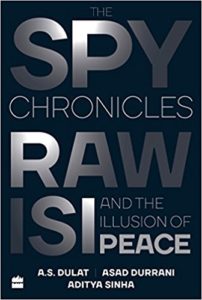
Review: The Spy Chronicles

This is a review of “The Spy Chronicles” (not by me, but by our regular contributor Dr Hamid Hussain), a recent book co-authored by two former chiefs of ISI (the Pakistani intelligence agency) and RAW (the Indian intelligence agency). The book has generated some controversy (a lot of it far-fetched and irrational) and the Pakistani author (Retired General Asad Durrani) has been called to GHQ to provide an explanation and has been barred from leaving the country until an enquiry (conducted by a 3 star general) has been conducted.

The review is by Dr Hamid Hussain.

The full title is: Spy Chronicles: RAW, ISI and the Illusion of Peace. A. S. Dulat, Assad Durrani and Aditya Sinha (Delhi: Harper Collins), 2018.

This book is neither a memoir nor an organized attempt to explain a theory. It is essentially a transcript of conversations. It covers India Pakistan relations, Kashmir, Afghanistan and other general regional and international topics. Two informed individuals from rival countries engaged in a candid conversation and some of their views are not fully in line with the official stance of their respective countries.
In view of unresolved issues between India and Pakistan, there have been several international attempts to bring high former officials of both countries together for dialogue. One effort was to bring former intelligence officials of both countries together. This effort called ‘Intel Dialogue’ was organized by the University of Ottawa. Dulat and Durrani met each other during these ‘Track II’ efforts and developed a kind of friendship. Continue reading Review: The Spy Chronicles

Drinking (alcohol) During Ramadan

The Washington Post has an article by Khalid Diab about the complications that arise around the issue of obtaining alcohol during Ramadan. Excerpts are posted later. As Shahab Ahmed points out in his magnum opus (What is Islam), drinking alcohol is prohibited in Islam, but it is also an established feature of Islamicate culture; i.e. not only is it regularly used (by a minority), it is celebrated in poems and songs, there are rituals associated with its use, everyone knows someone who drinks and drinkers have their own (albeit not always comfortable) place in society. In some countries (Saudi Arabia, Iran) it is strictly prohibited and users can expect serious penalties if caught, but even in those countries a great deal of regular communal drinking does go on. A few more countries (like Pakistan) have prohibition, but with more exceptions than exist in Iran and Saudi Arabia (non-Muslims and foreigners can buy alcohol, some high end hotels have bars, and so on). In several other countries (Egypt, Tunisia, Indonesia, etc) alcohol is widely available and can be purchased in supermarkets and even in small roadside kiosks (what would be called a Khoka in Pakistan). But in all these countries, there is a visible change during Ramadan: many regular drinkers voluntarily give up alcohol for the month and those who continue to drink may go deeper underground than usual. I have friends who cannot go to sleep without one (or several) nightcaps, but who will not touch  drop during Ramadan. They invariably get drunk on Eid.

Some excerpts from Khalid Diab’s article follow:

Although alcohol is considered haram (prohibited or sinful) by the majority of Muslims, a significant minority drinks, and those who do often outdrink their Western counterparts. Among drinkers, Chad and a number of other Muslim-majority countries top the global ranking for alcohol consumption.

Have a Murree with your curry.. Beer from Pakistan

Continue reading Drinking (alcohol) During Ramadan

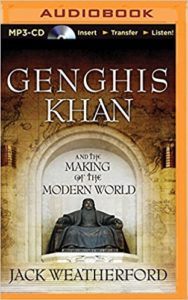
Book Review: Genghis Khan and the Making of the Modern World

Jack Weatherford is an anthropologist who has spent many years researching the Mongols in general and Genghis Khan in particular. The book is a very sympathetic portrayal of Genghis Khan and his descendants and their impact on world history. It is a very easy read and is an excellent summary of the rise of this amazing man and his (relatively few; a total population of less than a million) people to greatness. And there can be no doubt that Temujin is one of the most remarkable characters in world history; one of those (few) heroes about whom you can confidently say that without them, the history of his people would have been VERY different indeed. He is a one-man refutation of the idea that individuals, no matter how prominent, do not really matter and all we need to study are the aggregate/impersonal/stochastic processes that drive history. Continue reading Book Review: Genghis Khan and the Making of the Modern World

Political Engineering in Pakistan. The Military View

From our regular contributor, Dr Hamid Hussain

Following piece about recent clouds on Pakistan’s scene was mainly for non-Pakistani audience as many questions/confusions came my way. 

 This is an attempt to understand the view from barracks although I strongly oppose such moves from military.  This is first of two part. Second part will deal with modus operandi.

 Hamid

Political Engineering – View from the Barracks

Hamid Hussain

In July 2017, disqualification of Pakistan’s Prime Minister Mian Nawaz Sharif by Supreme Court again opened the debate about the role of country’s powerful army.  This was one of the most politicized decision of country’s Supreme Court.  In April 2017, Supreme Court not only ordered formation of a Joint Investigation Team (JIT) but went ahead and nominated its members.  It included a serving Brigadier Kamran Khurshid of Military Intelligence (MI) and a retired Brigadier Nauman Saeed of Inter-Services Intelligence (ISI). Supreme Court disqualified Sharif based on JIT investigation.  In the aftermath of Sharif disqualification, many political changes including change of provincial government in Baluchistan achieved by defection of several members, defeat of government’s nominee for Senate chairman position and defection of many politicians from ruling political party Pakistan Muslim League (Nawaz) (PML-N) to rival Pakistan Terek-e-Insaaf (PTI) were alleged to be orchestrated by the army brass.

Continue reading Political Engineering in Pakistan. The Military View

Kargil War

This topic comes up every once in a while on twitter, so I am reposting an old post with a few new links and videos added at the end.. The main point is simple: Musharraf and a few of his cronies (Javed Hasan, General Aziz, General Mahmood), without having thought it through, conducted a foolish operation in Kargil that cost hundreds of lives on both sides and set back (perhaps destroyed forever) the chances of peace between India and Pakistan (set in motion by Vajpayee’s historic bus journey to Lahore). The operation was not only a strategic disaster, it was a tactical disaster..

First, some links with details about the operations: Continue reading Kargil War

For “Strategic Reasons”, Did Britain Want Pakistan in 1947?

I got these via an email from an author who apparently wishes to remain anonymous. Since any post about partition gets a lively debate going, I though I would put these up (again, I did not write these points, I am just the messenger 🙂 ):

Continue reading For “Strategic Reasons”, Did Britain Want Pakistan in 1947?

Review: 12 Rules for Life (Jordan Peterson)

This is not the sort of book that usually interests me, but what with the controversy surrounding this man, I decided to look it up. To my surprise, when I requested it at my local library I discovered that I was 67th on the hold list! The man has clearly struck a chord; I have never seen a hold list that long in our (rather small) library. Luckily the system seems to have bought more copies, so I only had to wait a couple of months to get my copy. The book lists 12 rules that are an “antidote to chaos”. Somewhat to my surprise, they are generally good rules, though some of them are rather obvious, and even a bit hokey. Since many of you are not going to read the book, I will list them here:

  1. Stand up straight with your shoulders back
  2. Treat yourself like someone you are responsible for helping
  3. Make friends with people who want the best for you
  4. Compare yourself to who you were yesterday, not to who someone else is today
  5. Do not let your children do anything that makes you dislike them
  6. Set your house in perfect order before you criticize the world
  7. Pursue what is meaningful (not what is expedient)
  8. Tell the truth – or, at least, don’t lie
  9. Assume that the person you are listening to might know something you don’t
  10. Be precise in your speech
  11. Do not bother children when they are skateboarding
  12. Pet a cat when you encounter one on the street

Continue reading Review: 12 Rules for Life (Jordan Peterson)

Brown Pundits