Indians as Officers in the British Indian Army

From Dr Hamid Hussain. Some random notes about the first generation of Indians to become officers in the British Indian army, this note includes interesting tidbits about the handling of religion, class and caste issues in the Indian army in those times.

Pakistani general perception that somehow British favored non-Muslims as far as army was concerned is incorrect:   In view of anti-British attitude of Hindu dominated Congress, British had more sympathetic view of Muslims.  Congress had refused to endorse war effort while Muslim League wholeheartedly supported war effort.

British support applied to all classes of Muslims; including politicians (many Muslim League leaders would meet regularly with Deputy Commissioners to get directions), British senior civil servants giving instructions directly to Muslim junior Indian Civil Service (ICS) officers regarding law and order bypassing senior Hindu ICS officers fearing that later may pass on information to Congress (Police especially CID files of that time period are a very interesting read in this regard).   Same was true for army officers.  Many senior officers especially Auk helped to push many Muslim officers.  Ayub Khan (1 Assam Reg.), Sher Ali Khan Pataudi (1/1 Punjab) and Habibullah Khan Khattak (I Bihar Reg.) were given battalion commands during the war by direct intervention of Auk.

The issue of DSO has another angle.  It is usually given to the rank of Lt. Colonel and above.  A lucky major may bag it if really good.  Very few Indian officers were at Lt. Colonel rank during the war and those commanding battalions in combat theatres were very few.  Non-Muslim officers being senior got appointments and hence got the opportunity to get awards.  Many pioneer Muslim officers had left the army early for more prestigious Indian Political Service (IPS) and the list include Sahabzada Khurshid, Sikandar Mirza, ABS Shah, MAO Beg etc.  If they had stayed in the army, they would have been senior enough to get battalion commands and hence a shot at gallantry awards in combat.

Most Muslim officers were Captains. I don’t have the whole list but I think disproportionately more Muslim officers got Military Cross (MC); an award for which they were eligible.

I agree with you that maintaining loyalty of Indian officers was crucial during the war especially in view of nationalist campaign by Congress with large scale protests as well as emergence of Indian National Army (INA) from Indian POWs in Japanese POW camps.  Many benefits such as equal pay, important postings and possibly more liberal gallantry awards were part of this effort.

We need not to forget the attitude of Indian officers; both Muslim & non-Muslim.  Almost all Indian officers had deep antipathy towards politicians and saw them as rabble rousers. Overwhelming majority considered INA as cowards who broke their oath while in captivity and accused them of taking an easy way out of a harsh imprisonment.  This attitude was maintained right up to the eve of independence in August 1947.  All officers were against the division of Indian army.  To understand this phenomenon, we need to look beyond the post-independence revisionist statements of some officers i.e. LG B.M. Kaul, General Ayub Khan, MG Sher Ali Khan Pataudi, MG Tajjammul Hussain.  We need to look at the files of that time period and actual statements of officers that are very well preserved in archives.

A small number of ambitious officers tried to hob nob with politicians at the very near end when they saw that British were going.  I’ll put B Kaul and JN Chaudhuri of India in this category.  MG Akbar Khan of 1951 conspiracy fame of Pakistan army was also ambitious but made the mistake of opening his mouth in front of Jinnah.  He complained that they hoped to get rapid promotions but in view of Jinnah’s decision to keep senior British officers, this process will be delayed.  Jinnah promptly rebuked him.

Racial & Class Bias: In general, British conquered India and naturally like any dominant group had no high regard for anything Indian.  They saw their own culture, religion and society superior.  In Victorian era, British army officers were exclusively from aristocracy.  Purchase of commission meant that only affluent could afford an officer commission.  Commoners were only to serve in the ranks and hope to become Sergeant as the ultimate professional ceiling.  If a British aristocrat officer was not allowing even a British commoner to enter the elite officer club, how he could allow an Indian?  After First World War, changes in English and Indian societies opened new avenues.  British encouraged traditional Indian elites including landlords, members of civil service, police and army to educate their children so that they could qualify for commission.  These classes were in service of the government for a long time and in return prospered under Imperial patronage.  Members of these classes joining army as officers ensured continued loyalty of the Indian officer corps.  This also diminished chances of subversion by newly emerging nationalist politics.

The bias was not simply a one way street between English and Indians.  Both English and Indian societies were riddled with social and class distinctions and outright bigotry. An English aristocrat had nothing in common with a peasant from highlands.  Similarly, Hindu Rajput would not allow a low caste Hindu to touch his food.  A Pathan Muslim had no affinity nor respect for a Bengali Muslim.  The problem went all the way down even in small and distinct communities.  Two examples will suffice;  High caste Jat Sikhs would not serve in a regiment with non-Jat Sikhs (Lobanas) let alone low caste Mazhabi & Ramdasia Sikhs. Hence these different groups of Sikhs were recruited in different regiments.  Dogras were Hindus but Rajput and Brahman Dogras would not eat together.  5th Probyn Horse traditionally had Dogra Rajput squadron.In Second World war, due to increased manpower needs that could not be met from traditional classes, Dogra Brahmans were recruited. This added to administrative headache as in Probyn’s Horse instead of squadron mess for a single class, troop messing had to be implemented as Brahman Dogra would not eat with Rajput Dogra. It is no mean achievement that a first class army was created despite these administrative nightmares.

In 1932, it was decided to start an Indian Military Academy to train officers in India and in December 1932, first batch of 40 cadets started their training. The first batches of Indian Commissioned Officers (ICOs) faced discrimination even from fellow Indian officers who attended Sandhurst and known as King Commissioned Indian Officers (KCIOs).  In 1934, when two Sikh ICOs joined 3rd Cavalry there was a debate whether they should be allowed to eat in the mess.  3rd Cavalry was Indianized in 1932 and several KCIOs (Iftikhar Khan, Shahid Hamid, K. P. Dhargalkar, P. C. Banerjee, P. S. Nair, K. K. Varma and Nawabzada Agha Raza) were already serving in the regiment.

On the other end of the spectrum, the world of officer corps was opened to the least educated and very conservative class of India.  One example will show the enormous adjustment problem for both the Indian officers and their spouses of this class.  Gurbaksh Singh Dhillon enlisted as soldier and spent three years in an infantry battalion (4/14 Punjab Regiment).  Light machine gun section of infantry battalions had mules for transport and every soldier was rotated to take care of the mules.  Gurbaksh on his turn also performed this duty while his wife Basant helped him in polishing the mule saddle.  Gurbaksh qualified for Dehra Dun and after successfully completing his training was commissioned as an officer in 1/14 Punjab Regiment.  One can easily imagine the psychological barrier that Gurbaksh and his wife had to cross as the worlds of sepoy and officer were poles apart.  Even an Indian officer of aristocratic background (LG Sahabzada Yaqub Khan, MG Sher Ali Khan Pataudi) or highly educated (General JN Chaudhri and LG Atiq ur Rahman were educated in England) would have found it very difficult to see Gurbaksh as brother officer. There is plenty of evidence that many Indian KCIOs from Sandhurst didn’t consider fellow Indian officers from Dehra Dun as equal.  They called them ‘Dun Pansies’.  Some Indian officers completely identified with British ethos and were called ‘Brindians’.  General JN Chaudhri when instructor at Staff College Quetta deliberately kept away from Indian officers and only interacted with British officers.  This attitude reached to a point where all other Indian officers at staff college rebuked him with social boycott. MG Iftikhar Khan ‘Ifti’ was also a ‘Brindian’.

This lingered on even after independence in India and Pakistan.  In early 1950s, ‘martial class’ senior Indian officers (Rajput & Sikh) used to whisper that Indian army would not accept a ‘dhoti parshad’ to be appointed army chief using a derogatory term for Hindu non-martial races.   In Pakistan army, contempt was shown for Bengalis and General Ayub Khan refused to expand Bengali recruitment stating that he could not take risk with classes who have not been tried in combat.

There was another problem with second generation of officers.  Officers whose fathers were commissioned officers vs those whose fathers were VCOs belonged to two different social classes.  Former were educated in missionary schools in line with English public school system, had good command of English, brought up in cities and their female family members educated and outgoing. Later, mainly from rural and conservative backgrounds, educated at village schools or special schools set up for sons of VCOs (King George Military Colleges), less command of English language and females mainly in ‘purdah’ and generally not educated.

Surprisingly, combat experience of Second World War where young British and Indian officers fought together broke many barriers. Professional conduct and acts of bravery of young Indian officers showed to British colleagues that Indians were no inferior in the profession of arms.  On the other hand, urban educated British youth raised in more liberal environment were not of the same old ‘Imperial mold’.  The color bar of clubs in India was broken by some of these British officers.  They refused membership of clubs that would not allow Indian officers and some cavalry regiments refused to lend their horses to such clubs for equestarian activities.  This comradeship is born by the fact that decades after independence, these officers kept in touch with each other attending regimental re-unions.

Subedar Major Prabhat Chand Katoch:  He won his MC in 1914 in France.  When all British officers of the battalion became casualty, he took over the command of the battalion.

6/13 FFR suffered heavy casualties in Great War in western theatre and probably highest number of casualty rate as far as British officers are concerned.  Battalion landed in France with 13 British officers, 18 Indian officers and 810 other ranks.  A year later, no British officers, 4 Indian officers and 75 ORs remained of the original contingent. Ten British officers were killed including their CO Lt. Colonel P. C. Elliott-Lockhart; originally from Guides and 19 wounded.  The only officer not wounded was Captain Inskip who was shell shocked and not present. Subedar Major Prabhat Chand of 6/13th FFR was the first Indian who was awarded Military Cross (MC) for his conduct and battalion command when all British officers became casualty.  Battalion used to have a tradition where Subedar Major would parade off the battalion on ceremonial occasions remembering Prabhat Chand’s bravery.


Three brothers had illustrious career (see picture below).  Prabhat’s valor already known.  Col Bakshi Chand Katoch was awarded an IDSM in Mesopotamia when he was the Subedar Major of the 56th FFR. He was subsequently commissioned with the first batch of KCIOs from the Cadet College, Indore in Dec 1919. Honorary Captain Bidhi Chand was Subedar Major of 38thDogra; a post I think he held for 18 years.
 

A few random notes on gallantry awards (British Indian Army)

From an email from Dr Hamid Hussain. Also sheds some light on the cultural knowledge expected of British-Indian army officers..

Gallantry Awards:  Gallantry awards are always controversial depending on the perch from where you are looking at.  Many gallant deeds go unnoticed as there was no witness or Commanding Officer (CO) didn’t initiate his report in time.  Elite battalions and regiments have many godfathers in senior positions, hence these battalions have an edge when it comes to awards.  Those regiments known as ‘no body’s own’ usually fall behind in this race.  On the other hand, an enthusiastic CO can be too liberal in his recommendations for gallantry awards and military bureaucracy kicks in to downgrade or altogether reject his recommendations.  Bias against Indian officers may have been a factor in early stages of war but in later stages especially when Auk became C-in-C, he was instrumental in getting Indian officers battalion commands and liberal award of gallantry awards.

6/13 FFR (now 1 FF of Pakistan army):  6/13 FFR nick named ‘gaRbaR unnath’ for its naughtiness and old number of 59th Scind Rifles had one company each of Sikh, Dogra, Pathan & Punjabi Muslims.  VD Jayal was first Indian officer posted to this elite battalion.  It is to the credit of British Indian army that Indians came to know fellow Indians of different race and religion.  Officer assigned to a company had to pass language test and know about his men.  Jayal learned Pushtu and probably knew about Pathan culture and customs better than a Muslim from Hyderabad or Lucknow.  In the same paltan, a Muslim officer ‘ganga’ Hayauddin (later MG) was posted to Sikh company. He was a Pathan but a fluent speaker and writer of Gurmukhi and knew about Sikh religion more than many Sikhs.  6/13 FFR was commanded by Dudley Russell ‘Pasha’; a fine officer and gentleman.  Paltan won many gallantry awards in this theatre.  Jayal won DSO.  Battalion adjutant Sher Khan (later approved MG but died in air crash in 1949) was recommended for DSO but awarded MC.  Battalion intelligence officer Anant Singh Pathania (later 1/5 Gorkha Rifles and MG) also won MC.  The uncle of Pathania’s wife was the legendry Subedar Major of 6/13 FFR Prabhat Chand who won MC in First World War (the first Indian to win MC).  Lieutenant Sadiqullah Khan (later Brigadier, one of the first Indian officers posted to scouts, commanded South Waziristan Scouts and Tochi Scouts and retired as Inspector General of Frontier Corps) also won MC.  Later, in Italy, Sher Khan’s younger brother Bahadur Sher (later LG) who had joined battalion after emergency commission also won MC.  At the battle of Mont Cassino, Kashmir Singh Katoch (later LG) won his MC. In the battle of Gothic Line, Sepoy Ali Haider won his VC.

Distinguished Service Order (DSO):  Several Indian officers won DSO in Second world war. Rajendrasinhji ‘Reggie’ of 2nd Lancers (later General) was the first Indian officer to win DSO.  In addition to Jayal, another 6/13 FFR officer Akbar Khan (later Major General) won DSO in Burma while serving with 14/13 FFR.  The only Indian officer who won DSO and Bar was Lt. Colonel S. S. Kalha of 2/1 Punjab Regt.  He was killed in action during occupation duty in Dutch East Indies.  Family of Captain Taj Muhammad Khanzada (5/11 Sikh Regt) claims that he had won DSO in Burma but I could not confirm it.  He later joined INA and after the war, removed from the army.  The most famous case is of 51 Indian Infantry Brigade with unique distinction of Brigade commander Brigadier R. A. Hutton and three commanding officers of the battalions winning DSOs. Normally, infantry brigades had two Indian battalions and one either British or Gorkha battalion.  51 Brigade had all three Indian battalions and all three were commanded by Indian officers. Lt. Colonel S. P.P. Thorat (later LG) commanding 2/2 Punjab Regt, K. S. ‘Timmy’ Thimayya (later General) commanding 8/19 Hyderabad and Lt. Colonel L. P. ‘Bogey’ Sen (later LG) commanding 16/10 Baloch Regt. All these three Indian officers won DSO.

Additional award to a winner of DSO is addition of Bar.  There are many officers who won bar to DSO.  There are few officers who have the rare distinction of winning four DSOs (DSO with three bars).  The most decorated officer that comes to my mind is Brigadier Frederick Lumsden of the famous Lumsden clan that raised legendry Guides.  Frederick won VC and four DSOs before dying at the age of 45.  VC and three DSOs were won within six month time period during First World War.

RIP Fahmida Riaz

The poet and scholar Fahmida Riaz passed away today. She was known for her fearlessness and her willingness to call a spade a spade and she suffered for it (including an Indian exile during the Zia regime).

Here is Hasan Mujtaba’s poetic tribute to her:

سربکف سارے ستارے مشعلیں
اس کی آنکھوں میں جلوسوں کی طرح چل رہے تھے
جل رہے تھے جام سورج کی طرح سارے اسکے نام پر
اجرکوں کے رنگ سارے اسکی آنکھوں سے چراکر
تتلیاں لیکر اڑیں
دیس دیس دور دور
بچے اپنے ہاتھ مائوں سے چھپاتے پھر رہے تھے
رتجگوں میں بھکشوئوں کی ریت تھی
جیت تھی اسکے ماتھے پر لکھی
تاریخ کی خونی گلی میں
رات وہ مجھ کو ملی۔

Translation:

Severed head in hand

All the stars were like lamps marching in procession in her eyes

In her name, the wine-cups were circulating like the sun

Taking all the colors of the (Sindhi) Ajrak from her eyes

The butterflies took wing

From land to land and country to country

Children are hiding their hands from their mothers

All-nighters and the rites of bhikshus

Victory was written on her forehead

as in the blood soaked alleys of history

She met me..

Her poem Aqlima was translated by Ruchira Paul

Aklima
jo Habil aur Kabil ki maa jaani hai
maa jaani,
magar muqtalif
muqtalif beech raano ke
aur pistanon ki ubhaar mein
aur apne pait ke andar
aur kokh mein
is sab ki kismet kyun hai
ek farba bher ke bachche ki qurbani
woh apne badan ki qaidi
taptee hui dhoop mein jalte
teele par khadi hui hai
patthar par naksh banee hai
us naksh ko ghaur se dekho
lambee raano se upar
ubharte pistanon se upar
paicheeda kokh se upar
Aklima ka sar bhi hai
Allah kabhi Aklima se qalam karain
aur kuchh puchhain.

(Translation)
Aqlima..
Born of the same mother as Abel and Cain
Born of the same mother but different
Different between her thighs
Different in the swell of her breasts
Different inside her stomach
And her womb too
Why is the fate of her body
Like that of a well fed sacrificial lamb
She, a prisoner of that body
See her standing in the scorching sun on a smoldering hill
Casting a shadow that burns itself into the stones
Look at that shadow closely
Above the long thighs
Above the swelling breasts
Above the coils in her womb
Aklima also has a head
Let Allah have a conversation with Aklima
And ask her a few questions.
(Aklima was the lesser known offspring of Adam and Eve, the sister or Cain and Abel)

RIP.


Book Review: The Stan

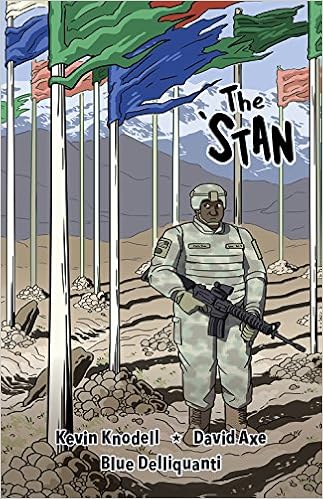
Dead Reckoning is a (fairly new) imprint of the Naval Institute Press that publishes military-themed graphic novels and books (e.g. they have published “All Quiet on the Western Front” as a graphic novel).   The Stan is a comic book based on stories collected by two American journalists (autors Kevin Knodell and David Axe) who have spent a long time covering the war in Afghanistan. The only story not based on their work is the opening chapter, which is a comic based on the life and words of former Taliban ambassador to Pakistan, Abdus Salam Zaeef. They use this first comic as a capsule history of the background to this war as well as a prediction of its futility and eventual failure.  This is the only comic that gives a nod, albeit a minimalistic and relatively simple one, to the “big picture” of the Afghan war and it is a strictly anti-war and anti-interventionist one. The other comics are all about the “little people”, ordinary soldiers, an Afghan interpreter, an Afghan soldier and an Afghan policeman. The last comic is about one of the authors (Kevin Knodell), who may have some PTSD, and his parting words are that “America’s longest war was going to stretch on longer”. Continue reading Book Review: The Stan

Dynamics of the Saudi Royal Family

From Dr Hamid Hussain

This piece written in summer of 2017 is a backgrounder for Kingdom at a crossroad.  This will help in understanding the background to my upcoming piece about challenges faced by the Kingdom in the aftermath of Jamal Khashoggi murder. Stay tuned.

Hamid

Royal Rumble – Dynamics of Saudi Royal Family

Hamid Hussain

 ‘In a western democracy, you lose touch with your people, you lose elections; in a monarchy, you lose your head’.  Prince Bandar Bin Sultan, Former Saudi ambassador to Washington.


 In the last two years, Saudi Arabia has gone through many changes.  Absolute monarchies are not easy to decipher.  There are many opacities and it is very difficult for any outside observer to have a real sense of events.  Two main factors are very limited expression by Saudis in their own country and opaque decision making process in the form of decrees with flavor of palace intrigue.  A Saudi will not express his honest view in the presence of another Saudi due to fear factor.  In view of these limitations, the perspective of an outsider has severe limitations.

Current system of governance of the country is based on accession to throne of one of the sons of the founder of the country Abdul Aziz bin Abdur Rahman al-Saud (d. 1953).  He works with other family members especially senior princes, Council of Ministers (most of whom are also royal family members) and Council of Senior Clerics in running day to day affairs of the country.  There is a fair amount of competition among all these groups about various issues and King carefully balances his act to avoid open conflict.

In January 2015, Salman bin Abdul Aziz ascended to Saudi throne after the death of his brother Abdullah bin Abdul Aziz.  He came quite late into the complex inner power circle of the al Saudi royal family.  He was appointed Governor of Riyadh province in 1962; a post he held until 2011 when he was appointed Defence Minister.  For five decades, his main influence was in business and media through his sons and a half-brother (Sattam bin Abdul Aziz).  His sons controlled different business and media interests.  Abdul Aziz was Assistant & Deputy Minister of Oil and now Minister of State for Energy Affairs, Faisal owned Sharq-al-Awst newspaper and appointed Governor of Medina in 2013.  Sultan is a pilot and worked at Saudi Ministry of Information.  He now heads tourism commission with the rank of a minister.  Khalid is also a fighter pilot and in April 2017 appointed ambassador to Washington.  Turki, Saud, Rakan and Nayef are little known and involved in various business ventures.  Fahad; a business tycoon and Ahmad with media interests died in their 40s from heart disease.  Continue reading Dynamics of the Saudi Royal Family

Pakistan’s Hybrid Government and the Aasia Bibi Fiasco..

Aasia bibi is a poor Christian woman from a village in Punjab who was arrested for blasphemy in 2009. She got into an argument with some other women from the village while working in the fields (purportedly over her drinking from a cup of water and hence “polluting” it) and in the course of the argument she allegedly said something  “blasphemous” about the holy prophet of Islam. The details of the case are murky and no one seems to know for sure what blasphemous statement she actually made that day (the most commonly reported one is that she said something along the lines of “Jesus died for the sins of the world, what has your prophet done for humanity”; other versions exist; the investigating police officer claims that she said much more, but even quoting it wud be blasphemy, so look it up on wikipedia) but whatever the details, a case was registered under Pakistan’s uniquely harsh blasphemy law (a death sentence is mandatory in case guilt is proven) and she has been in prison ever since.

Related image

As usually happens in blasphemy cases, she was sentenced to death by the local court (local judges usually feel it safest to convict any and all accused blasphemers, expecting that the most egregiously wrong verdicts will be reversed by higher courts that have better security). Meanwhile her case had come to national attention and the governor of Punjab, Salman Taseer, visited her in prison and spoke of her getting a presidential pardon. He was attacked in the media as a supporter of blasphemers and one of his own body guards shot him dead. The body guard was arrested and eventually hanged, but his grave has become a religious shrine and several ministers (including some in the current Imran Khan government as well as the opposition PMLN) have visited the grave to pay respects to this “hero”. Continue reading Pakistan’s Hybrid Government and the Aasia Bibi Fiasco..

Review: Raiders of the China Coast

Raiders of the China Coast is the account of a little known CIA operation that trained and managed anti-communist guerrillas and agents on the various islands that were retained by the Taiwanese regime (the “Republic of China”) after the Chinese mainland was captured by the Chinese communists. The author, Frank Holober, spent his life in the CIA and later in several academic institutions teaching about China. The book is one of the few memoirs written by people who personally took part in various CIA covert operations on the “hot” fringes of the cold war and has been vetted by the agency to ensure that no secrets are spilled (the author thanks some in the agency for approving it, and criticizes others for needless bureaucratic obstruction and “security theater”, but he got a foreword from General Robert Barrow, USMC, who had served with Frank (and the CIA) in the 1950s, so it is all good).

The book is mostly a fond look back at the author’s male-bonding days, not a detailed history of CIA covert operations during the Korean war (which is the somewhat misleading subtitle of the book). As the author relates in the first chapter (“Old Haunts Beckon”), the idea of the book came to him after he retired and revisited Taiwan after a gap of 40 years and was reminded of the days of youthful adventure and excitement he had spent there with his CIA comrades in “Western Enterprises Inc”; that nostalgia is clearly the main driver of the book. Which is fine, because while his family and friends (and those of the other adventurers he mentions in the book) will no doubt get an extra-special thrill from reading the book, other readers can also learn about an interesting aspect of the early cold war, about CIA covert operations in general, about the colorful characters who took part in these events, about China and it’s fascinating recent history, and of course, about male-bonding, buddy movies and all that jazz.  Continue reading Review: Raiders of the China Coast

Why Kill Jamal Khashoggi? (A personal view from Dr Hussain)

From Dr Hamid Hussain

Someone asked my two cent worth opinion on ongoing saga of Saudi journalist Jamal Khashoggi. More informed people have commented on the subject and many details are still murky. Based on my own work on the Kingdom’s power dynamics in the past, following is may take;

Thanks. With time, we change and our thoughts also evolve. This may be the case with Mr. Jamal Khashoggi and he may have been genuinely convinced that some kind of people’s participation in government is the way forward. However, we need to keep in mind the broader context as this incident is related to struggle inside the royal family. Khashoggi held some progressive views by Saudi Arabian standards related to extreme austere code of Wahabbism. However, he never questioned the legitimacy of the rule of al Saud family. He advocated increased consultation with population on important issues. He was employed by many government newspapers and any significant alternative view no matter how mild is simply a career ending move. He was not a dissident but mild critic of some policies of Prince Muhammad Bin Salman such as blockade of Qatar, Yemen war etc.

There are many Saudis in exile who are much harsher critics of royal family but why Khashoggi? More important to remember is his links with members of royal family who have been sidelined by the meteoric rise of the mercurial Prince Muhmmad Bin Salman (MBS) in 2015. Government’s view is published by a number of influential newspapers (Arab News, Sharq-ul-Awst etc) run by Saudi Research and Marketing Group. Owner of this group is Prince Turki Bin Salman. Khashoggi worked for some of these newspapers in the past. He also worked with former intelligence chief Prince Turki al Faisal and billionaire Waleed Bin Talal. He served in some advisor capacity to Turki projecting his softer image to the outside world. In 2015, Waleed opened a satellite channel Al Arab in Bahrain and in this venture partnered with Bloomberg News. Khashoggi was to be the star kid of Al Arab. This channel lasted mere eleven hours on air before it was shut down by Bahrain; a close Saudi ally and dependent on Saudi forces on its soil to protect its royal family from the restless Shia majority population.

MSB started grand purge on two fronts. One front was to sideline powerful brokers in royal family such as Crown Prince designate Prince Muhammad Bin Nayef; former interior minister, Prince Mitib Bin Abdullah; former head of Saudi National Guard (SNG). Head of SNG is a powerful position as SNG is royal family’s insurance policy against army coup. SNG recruits on tribal basis and head inserts his loyalists at various levels of positions. The second front was to weaken the financial muscle of some princes. This resulted in famous/notorious Ritz Carlton saga of billionaire princes hauled up there until they coughed up billions to get their limited freedom. Waleed was the prized prisoner of Ritz Carlton; the world’s only five star jail. Members of both groups cannot leave the country. On the other hand, other family members who have kept their heads down in the tent like Prince Turki are allowed to travel. With this in background, alleged rumor of an assassination attempt on MBS by his guards raised the fear factor by several degrees. Some reports suggest that most of his inner circle of security is now manned by foreigners.

Where Khashoggi fits into this picture? He was the window of these disgruntled royal family members to the outside world. Everybody in Washington who wanted to know what was happening in the Kingdom would knock at Khashoggi’s door. This was the main threat that MBS feared that angry royal family members may attempt to make some kind of deal with Washington to pull the royal rug from under his feet. A close study of MBS personality suggests that he acts rashly without thinking through and no one around him would even suggest an alternative thought. Hence, a very sloppy operation which is not even an intelligence operation. A rag tag team of guards, special forces people and a forensic doctor was to emulate a Mossad style overseas hit a la 2010 Dubai saga of assassination of a Palestinian operative.

Looking at the fall out of the operation, Khashoggi’s own words seem prophetic that ‘Saudi brand has been severely damaged’. What will be MBS likely response? The old Arab bedouine tradition is that when a big dust storm come down furiously (haboob), the Arab ducks down in his tent covering his head and wait until it passes away. For the next few weeks, MBS will be spending more time in his $500 million yatch parked in red sea than in his palaces. The only suggestion one can give to MBS is the words of one his own elders late King Abdullah bin Abdul Aziz; “a friend is someone who tells you the truth; not someone who believes in you’.

“Man’s history is waiting in patience for the triumph of the insulted man.” Rabindranath Tagore

Regards,
Hamid

Postscript:

Follow up intelligent questions from well informed people were inevitable thus a follow up. I wandered a little bit further as my personal quest of learning about military and conflict is to paint the horrible picture of the killing fields so that we can all avoid filling more graves.

Thanks Sir. You are correct. Trump will give him cover in view of personal/business relationship. However, there is a little bit shift in other power centers. In senate, recent vote to approve munitions to KSA was 53-47; a significant shift against KSA. If in mid-term, democrats take house of representatives, then there will be little more heat. In the long run, KSA is important and MBS cannot be pushed aside without arrangement with alternative leadership from royal family. This usually takes time. However in short term, single point agenda of getting Iran is making things complicated and they don’t want to quarantine MBS/KSA at this stage.

Anti-Iran camp of current administration coupled with almost messianic change in Bibi Netanyahu personality where he thinks his historic role is to strike nuclear assets of Iran is the possible ‘escape hatch’ for MBS. If Bibi wins in elections called early then watch for who he picks for IDF chief; who is retiring by the end of the year. In 2009-15, IDF COS, heads of all three intelligence agencies (Mossad, MI & Shin Bet) pushed Bibi back on military strike against Iran. This was complemented by Obama administration warning to Israelis that they will be alone in the mission with no military or diplomatic cover. Bibi wants a security team that will not second guess his mission. Bibi has covered a lot of ground by appointing his former national security advisor Yossi Cohen as head of Mossad, a more mellow head for Shin Bet and a new director of MI. The only chip left is COS. Two top contenders (Yair Golan & Aviv Kochavi) are their own men especially Kochavi is considered a ‘prince’; very well respected and highly professional man who cannot be bullied. Bibi may go for one of the two juniors ones for the post. If two conditions are met; first Bibi wins elections and still PM and then he picks one of the juniors as IDF COS, then I’ll put chance of Israeli strike on Iran around 50%. To hold the Arab bag, they will need MBS with General Sisi playing the second fiddle. Water is too muddy in the middle east to read tea leaves.

MBS is following the footsteps of all autocrats; thinking that they are invincible and normal rules don’t apply to them even if they see things like Saddam caught like a rat and Qaddafi dragged on the streets. This they watched with their own eyes and not something read in history books of decades or centuries old events. Power has its own logic not comprehended by commoners like us.

I can only think about words of Voltaire when I closely review personalities of three main actors on the stage for coming production; Trump, MBS & Bibi Netanyahu. “If you are desirous of obtaining a great name, of becoming the founder of a sect or establishment, be completely mad; but be sure that your madness corresponds with the turn and temper of your age. Have in your madness reason enough to guide your extravagances, and to not forget to be excessively opinionated and obstinate. It is certainly possible that you may get hanged; but if you escape hanging, you will have altars erected to you”.

As far as bankrupt leadership is concerned, Arab poet and philosopher Nizar Qabani has summed up nicely;

Every twenty years

Comes to us a gambling man

To stake our country and culture

And resources and rivers

And trees and fruits

And men and women

And the waves and the sea

At the gambling table

We die; broken, hated

Cursed like dogs

While our philosopher in his shelter cogitates destruction into victory

In the post-world war II period, in mad search for security, humanity has invented modern and more lethal killing machines to find itself less secure and living in fear. A whole new model of peaceful co-existence emerging from the wretched of the earth is needed. War mongers are busy 24/7 while those who wish peace are sleeping. They need to wake up, shake dust of their clothes and reach to the ‘other’ over the head of their leaders. The question for present generation is whether they will continue to fight the wars of their grandfathers and fathers on the altars of religion, nation etc. or choose a new path.

“Ishmael, my brother hear my plea

It was the angel who tied thee to me

Time is running out, put hatred to sleep

Shoulder to shoulder, let’s gather our sheep”

Shin Shalom, an Israeli Jewish poet

Regards,

Hamid

Pakistan and the Great War

From Dr Hamid Hussain

2018 is centenary of the end of the Great War. This piece was written for a magazine published in England about Indian military history. I tried to highlight participation of areas and units of future Pakistan army in that epic struggle to honor countless who served all over the globe.

Hamid

Pakistan and the Great War

Hamid Hussain

“We know that it was not strategy nor tactics nor leadership that really gained us the victory, but the spirit of sacrifice”. General Sir William Birdwood’s address on unveiling of the Punjab Frontier Force (PIFFER) Memorial at Kohat October 23, 1924.

It is impossible to narrate the story of the Indian Army in the Great War on ethnic or religious lines as some modern observers are tempted to do. It is equally futile to attempt a “revisionist” narrative through the nationalist lens of modern India and Pakistan. What were then Indian soldiers of many different religious and ethnic backgrounds fought in the Great War under their regimental standards as imperial British subjects of the Indian Empire on a global battlefield.

In 1947, British India and its armed forces were divided between the two new nations of India and Pakistan. Punjab Province, which had provided the bulk of the old regular Indian Army, was carved up with a few strokes of the cartographer’s pen. Ambala and Jullundur divisions and Amritsar and Gurdaspur of the Lahore division became part of India. Punjabi Muslims, Muslim Rajputs and Pathans of the North West Frontier Province (NWFP) became Pakistani citizens while Sikhs, Jats, Dogra and Rajput Hindus became Indian citizens. All of this cut across the traditional structures and allegiances of the old Indian Army, and the Great War experiences of men such as Subedar Major Parbhat Chand, a Hindu Dogra, who won a Military Cross fighting under the colours of the 59th Scinde Rifles, which would later become the 1st Frontier Force Regt. of the Pakistani Army, the many Punjabi Muslim sepoys who served under the colours of the 125th Napier’s Rifles and 101st Grenadiers which were allotted to India in 1947, and medical officers Capt. Indrajit Singh of the 57th Rifles and Major Atal of the 129th Baluchistan Infantry who died alongside their Punjabi Muslim and Pathan comrades. While these and other factors discourage any attempt to interpret the conflict in light of the later partition of the subcontinent, there is no reason why the war-time experience of what is now Pakistan, especially the Punjab, should not be studied in the same way that, for example, the impact of the war on the north of England and regiments raised there are examined for insights. Continue reading Pakistan and the Great War

Book Review: Pakistan Adrift by Asad Durrani

Book review by Dr Hamid Hussain

Former Director General Inter-Services Intelligence (DGISI) Lieutenant General ® Asad Durrani’ s memoirs Pakistan Adrift will be released in Pakistan in the second week of October 2018. It is a memoir of a former DGISI and ambassador and his perspective about events of the last two decades.

Durrani is considered a cerebral officer by his peers and had a good career profile. Like most officers in the business of intelligence, the most controversial part of his career was his stint as head of Military Intelligence (MI) and ISI. This book is his perspective about the events but provides the reader an insight into the dynamics of power at the higher echelons. He is candid in accepting his own mistakes especially role in distributing money to politicians. Supreme Court of Pakistan is hearing this case.

Two segments about his stint as ambassador to Germany and Saudi Arabia are his views about these two societies. The most interesting segment is the chapter on terrorism when he seriously discusses the subject, its various shades and the use of this term by various states to pursue their own interests. He also elaborates on the consequences of recent destructive policy of United States of dismantling fragile states that has unleashed new demons. Very little academic and policy discussion has been devoted to this crucial subject that has made world more dangerous, violent and unstable.

Durrani devoted a significant segment towards the issue of Afghanistan. His own personal experience as DGISI and observations on later events where he had some contact in the form of ‘track two’ parleys accurately reflects thought process of majority of Pakistani officers. This view is based on a genuine national security interest of Pakistan about its western neighbor as country bears the fallout directly. As these officers interact with Afghans in official capacities therefore they sometimes get blindsided. Pakistan has influence over some Afghan clients, but Afghans are very good at playing one against the other. They survived as an independent nation based on mastering this art. Amir Dost Muhammad Khan’s letters to Czar of Russia, Shah of Persia and British Viceroy of India in nineteenth century sums up the foreign policy of the country. A good friend of former Afghan President Hamid Karzai told me in 2002 what Afghans thought about the new phase? Many key Afghan players were of the view that ‘in the previous round, neighbors played their game and we ran away from the country. This time around, we are staying put and if neighbors don’t behave, we have sworn that we will make sure that the winds of chaos will not stay in Afghanistan but blow in the other direction’. Afghan and Pakistan liaisons with Americans in Kabul share a space. At prayer time, Afghans always insist that Pakistani counterpart lead the prayer. A Pakistani can be seriously mistaken by this gesture. When with Americans, Afghans are unanimous in their view that real problem is not Afghanistan but Pakistan. Like any other intelligence agency, ISI is a large bureaucratic organization and not monolithic. Mid-level officers of the organization may have a unique perspective about an event and in some cases not in agreement with policies adopted by the high command. My own work on the subject to get opinion of the boss and his subordinate about a given event or policy provided some limited insight about many shades of grey.

In this work, Durrani is confident in claiming that ‘since leaving service, I have spilled a few beans, so to speak, but not once have I been cautioned or charged with indiscretion’. This claim was severely tested recently. Three months ago, his informal conversations with former Indian intelligence chief about diverse topics were published in a book ‘The Spy Chronicles’ that caused an uproar in Pakistan. He was severely criticized and, in some cases, abused by his uniformed colleagues. Pakistan army headquarters summoned him for explanation and an inquiry was initiated. Hopefully this work will help in understanding his views and not add more indiscretions to his charge sheet.

Durrani’ s book provides a useful insight into the thought process of senior brass. Shaky civil-military relations with deep mistrust on both sides is explained by Durrani with many anecdotes. Recent events have shown that this Achilles heel of Pakistan has not shown any sign of improvement. In view of the recent events of Pakistan and in the neighborhood, it looks that Pakistan’s policy has been consistent about what it views as its core interests. This book should be on the reading list of those interested in Pakistan.

Asad Durrani. Pakistan Adrift: Navigating Troubled Waters (London: Hurst & Company), 2018, pp. 273

Brown Pundits