This has happened to me 5 times. Makes me uneasy that people think it’d be normal & ok to dislike people of another nationality so much I’d be offended to be mistaken for one.
I happen to have Saloni’s genotype and she is certainly closer genetically to Sindhis than to most other South Asians. That being said, my own response to her tweet is this: my personal experience is that many liberal Pakistani & Indian Americans are highly nationalistic.
To be honest, it’s mostly Indian Americans. I don’t know too many hyper-nationalistic Pakistani Americans. I think that has to do with the fact that despite India’s social-political problems, its democratic and pluralist history, along with the international appeal of Mahatma Gandhi, makes it easier to be an Indian nationalist than a Pakistani nationalist if you are an American.
Also, there is a cultural “code-switching” that is common among Indian Americans, where they are fluent in, and totally embedded within, a Left-of-centre cultural zeitgeist in the American landscape. But, they also are comfortable switching into their parents’ more Indian nationalist views in different contexts. Rather than synthesizing the two worldviews (which may not be possible), Indian Americans just switch facultatively between the two, because the two social milieus never really engage each other.
Because I am Bangladeshi American it is hard for me to relate. Bangladesh is a very young nation. Both my parents have spent more than 3.5 times of their life living in the United States than an independent Bangladesh. In fact, both lived as Pakistanis for far longer than they lived as Bangladeshis! Additionally, it is not a major geopolitical player, and there are ambiguities with the relationship to both India and Pakistan enough that socially my family has felt comfortable with both Indians and Pakistanis in the USA.
P.S. I do get annoyed when I’m identified as Pakistani American by people just because of my last name. Since I am not vocal about being a “Bangladeshi American” I only find out later people had assumed I was Pakistani. Apparently, in some Indian circles, I am known as a “Pakistani American geneticist”, albeit not a particularly nationalistic Pakistani (told to me by an Indian journalist friend).
To be honest to compare the political cultures of Pakistan and India is insulting to the latter.
For instance the condemnable lynching of the Muslim cowherd has been loudly and clearly condemned by the Indian political and media establishment whereas Aasia Bibi is still in jail.
It is furthermore arguable that the more right wing parties in India are still more liberal than the left wing parties in Pakistan since the Indian Right, by and large, accepts the Nehruvian settlement whereas the Pakistani left accepts the Islamic Republic.
Notwithstanding these caveats (after commentators complained of the anti-Indian bias on BP I want to make sure I check myself); if we are to map the Indian and Pakistan political scenes I do see some symmetry between IK & Modi.
One striking one is that they both have rather weird sex lives and haven’t been able to make marriage work for them individually.
Tough times ahead for Pakistan if Imran Khan does get to power. However I will say this that like Modi he does seem rather incorruptible perhaps because he doesn’t have a dynasty.
I would never accept Jemima’s sons in a dynastic setting; Pakistan has a hard enough time dealing with Benazir’s brood. The advantage the Sharifs have with their children is that their children (Maryam et al) exude a Pakistaniness that only comes from being immersed in the environment. Bilawal suffers from the Rahul syndrome (to make another Indo-Pak comparison).
I’ve noticed that our caste thread has once again exploded. My new policy is to simply skip over comment threads once they become negative.
I thought I would add 2 points. I’m very suspicious when white liberals “ally” in the war again caste since there is little doubt that caste was tremendously strengthened during the colonial era. I’m not arguing that it was created during the time of the Brits, the genetic data shows otherwise, but for the purposes of administrations & control, rigid lines were always drawn over the population. The Brits were not benevolent masters as so many on this blog like to believe.
I will share a little anecdote since I love stories. A senior female academic of Indian origins who was asked to speak at a conference wrote in asking as to why she was the only woman featured and why weren’t there more women. The white lady academic/administrator replied, very defensively, that “Genderism isn’t the only discrimination there’s racism, class and caste discrimination.”
As soon as I heard that snippet I realised what the white lady was trying to do; a dog-whistle. She was using caste as a way to attack the Indian academic. This is not the only story where this has happened. Another Indian female academic stopped going into a prominent college because everything she went in she was stopped by the porters (Oxbridge college have porters). This didn’t happen to the other white students.
As soon as this story made public there was a reactionary pushback by many white liberals that an “upper caste” Indian was trying to defame the white working class porters. This is bs because caste distinctions isn’t picked on by Westerners.
So I am very suspicious when white people try to get involved in the caste system since frankly it’s none of their business but I applaud that Ms. Girls had the chance to tell her story on her terms.
Finally what about Pakistanis; are we allowed to talk about caste? I’ve reflected on this a fair bit, ultimately I straddle the divide (to some extent) but it’s important to talk about Pakistan’s social system.
I do not think caste is at all operative above the middle classes who are Urducised and Muslimicised. It’s absurd to think caste has any real salience in a culture that takes its cue from Islamic values.
However there is a very strong clique in Pakistan that operate almost as a caste (but much more fluid – think Boston Brahmins) and are the sub-elite. They aren’t the most powerful or the richest or even celebrities but they are on the periphery of all 3 circles and in fact gel them together. I tweeted about them in a thread (I’ll link to it later) but they are the 1,000 families:
(1.) they live in Defense, Karachi; Clifton maybe. You could even go into particular phases
(2.) they school in KGS then go abroad for undergrad. Some stay in the West most (?) return
(3.) “Muhajir” families but most of them are the descendants of the administrators/ministers/leaders of post-independence Pakistan, when Karachi was the capital and migrants from UP provided the initial leadership cadre.
(4.) very well-spoken English and of course some Urdu for effect (Ghalib etc).
(5.) they love their drawing room politics and are entertaining to a fault. Virtually all of them drink.
(6.) they conform to a particular look since Punjabis and Pathans (other foreigners) have also married into this class but overt “ethnic” markers preclude entry into this class. If a family speak Punjabi or Pushto or even Urdu predominantly they simply are not a member of the 1,000 families. All have ultimately foreign origins (Persian, Arab, Morocco but like all recent Indian Muslim elite mostly Afghanistan) with Shijrahs and can usually pass for other parts of the Ummah.
(7.) they love to talk about how Partition was/may have been a mistake (virtually all are liberals) but deep down are the “germ of Pakistan”. They embody and pulsate the Pakistan ideal.
(8.) the other cities in Pakistan are not their territory. Karachi is their only base. Kashmir is another world (that is a Punjab-Isb-Pindi issue) since they all still have residual links into India proper.
(9.) Benazir Bhutto was an honorary member of this class; Sharifs are definitely not. Imran Khan, in his playboy heydays, was but now is not. It’s an ephemeral feeling but when “you know you know.” A lot of their fathers and grandfathers were celebrated Pakistanis either in the diplomatic corp. It’s why Pakistanis were known for being particularly suave in foreign affairs in the 60’s-80’s. This class probably lost power with Liaquat and with the rise of the first military govt; never regained it.
(10.) this class has also fallen on hard times. They became decadent in the 80’s and rely on good marriages and salaried employment to get them through. Not good at business (Memons etc) but rely on political connections.
This wouldn’t be a caste exactly because the boundaries are so slippery and ill-defined. However I would call them a “clique” that verges on a caste since it combines some Islamic and Hindu elements with a very strong colonial overlay.
Beyond the Military, Pakistan raison d’etre is really this highly successful sub-elite. They form that all-important ideological core since they set a national standard that Pakistanis/Pakistaniyat conform too.
The best name for the 1,000 Families are the Neo-Mughals since they embody (much like the Mughals) highly contradictory elements. In one go they are valiant defenders of Islam & Pakistan but on the other hand they are hedonistic and partial to all the “European” vices (alcohol, gambling, adultery, promiscuity). Straddling contradictions is what makes this clique-caste so compelling and a glue to Pakistan.
If India wants to eradicate Pakistan it needs to level Defense and KGS since the ideological core of the nation would be wiped out. The Muhajir psychosis, which is now the Pakistani psychosis, bubbles with them. Without them and their integration of all elite sectors of Pakistani society into a hedonistic socialising partying set; Pakistan would be more like Yugoslavia, which it’s avoided.
Of course the greatest failure of the neo-Mughal class was 1971 since Dhaka seemed to have a great number of these people.
This is an important video to see- we have of course discussed caste endlessly in BP however it is powerful to see an Untouchable speak about it first-hand.
In some ways Dalit is an euphemism so I’m referring to Ms. Gidla’s use of lingo.
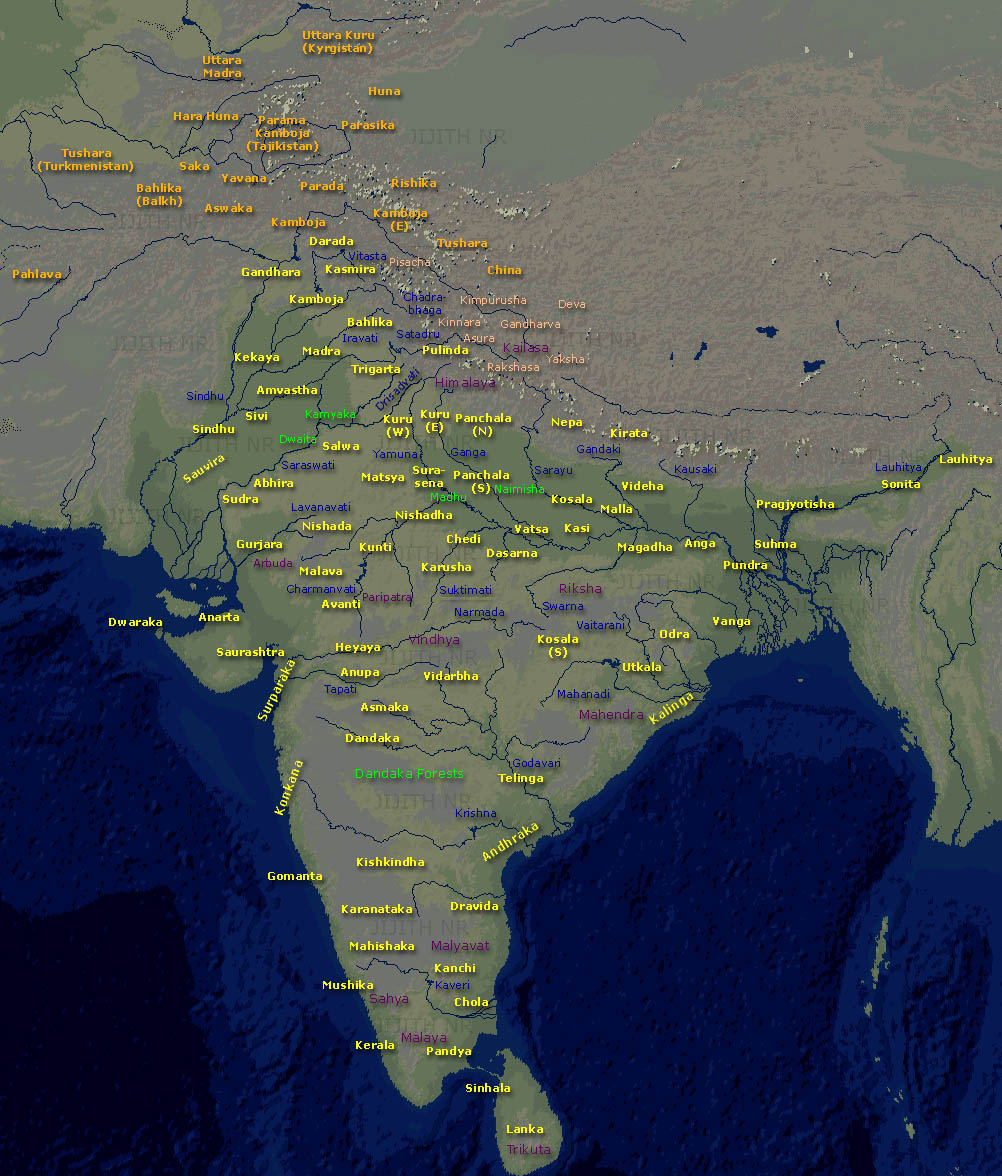
There are several perspectives on Afghanistan’s name. Afghanistan’s name might come from “Upa-Gana-stan”:
“Upa” with a choti “a” at the end or “उप” means near
“Gana” or “गण” I believe might be a reference to Shiva’s Ganas (gouls, ghosts, unusual looking beings . . . possibly a reference to non homo sapiens of some kind, some say aliens)
“Stan”, I don’t know. Is this “Sthaana” or “स्थान”? If so this might mean position or venue or station or field or throne
An extremely wise fellow contributor from Brown Pundit reminded me of two other ancient names used for Afghanistan:
Panini’s Aṣṭādhyāyīrefers to Afghanistan as ash-va-kaa-na (अश्वकान).
Please note that the Aṣṭādhyāyī is much older than Patanjali who is considered millennia older than Krishna. Traditional scholarship of Aṣṭādhyāyī places it more than 7 thousand BC, which is not to say that the Aṣṭādhyāyī has not in any way been modified since then.
Pakrit name “a-va-gaa-nna” (अवगान्ना).
The oldest part of the Rig Veda samhita refers to:
“The Pakthoons are descendants of the Paktha tribe mentioned in Vedic literature.”
“Archaeological excavations in this region conducted by Sir Estine (an East India Company official) led to the recovery of uncountable shrines and inscriptions. He has authored four books on that topic featuring photos of icons, icons and inscriptions discovered. The photos show a sun temple and a Ganesha statue too. An Islamabad University professor Abdul Rehman has authored two books on those finds recalling the glory and prosperity of those times.”
“Regimes of two Hindu rulers “Kusham” and “Kidara” lasted for fairly long periods. During their rule a number of Shiva temples were not only in Afghanistan but in other West Asian regions too. Uzbekistan and Takzikistan formed part of the Afghan kingdom in those times. Tashkent has one of those ancient Shiva temples standing even today.”
“Professor Abdul Rehman states that Bukhara region Was known as “Shah Vihar” in ancient times. It was ruled by an Hindu king. When Arabs invaded that kingdom its queen traveled to Kashmir to seek military help. Arab chronicles mention her as ‘Khatoon’, meaning ’Woman’.”
“An Ayurvedic practitioner of Varansi (alias Benares) had treated the Khalifa for some ailment afflicting the latter. In those days it was Hindu Ayurvedic practitioners who were eagerly sought by Arab patients. A number of Arabs had translated Sanskrit Ayurvedic texts into Arabic. A list of those translated Sanskrit texts appears in a Volume known as al “Frisht“.”
“Baku (capital of the Azerbaijan region) known for its underground petroleum yields has still an ancient Hindu temple of the Divine Flame generated by the subterranean petrol and gas). During the Czar regimes in Russia a Punjabi priest officiated at that temple. The walls display some religious stanzas written in Punjabi Gurumakhi script. The market there also had Hindu merchants. Nearby was a locality too of Hindu inhabitants. Baku in Azerbaijani language actually signifies a Goddess. Therefore obviously Baku derives its name from a very ancient Vedic Goddess temple there.”
Afghanistan is also central to the ancient Sharada civilization:
The Sharada civilization [Afghanistan, Northern Pakistan, Kashmir] represents many things. One is the convergence of the six major Shaivite schools (not just Trika) within Uttara Mīmāmsā (Vedanta) and the four major Tibetan schools via the shared 84 Siddhas. Later large streams within Sufism joined this convergence [which might be the topic of a future researched article].
In the opinion of Wilson the renowned Vedic translator Kandahar is similar to the Rig Vedic word Gandhara. Wilson further observes,:
Ibn Haukil mentions that in his time there were remains of a considerable city more to the west, by the people of which, Zaranj was built. He calls this places Ramshhristan, a curious compound of Indian and Persian appellations.
There were ruins ‘at astonishing number’ in Herat, at Farrah, and Peshawarun–all sites near the province of Dranjiana connected with the Vedic dynasty of the Srinjayas [who were prominent during the 18 day Mahabharata war]. It therefore becomes all the more curious to hear the name of the place called Ramshehristan.
Panini, the eminent grammarian of Sanskrit, lived here in about 350 BC. [for the record I think Panini lived far earlier and before Patanjali] In his composition of the a sutra (4.3.93) on the Sindh and Takshasila class (gana-patha), he includes Sindhu, Varnu, Madhumat, Kamboja, Salwa, Kashmir, Gandhara, Kishkindhya, Urasa, Darada and Gandika. These are geographical names and lie in the trans-Indus regions. The place mentioned by Panini as Kishkindhya is today known as Kalat in Baluchistan. A great linguistic puzzle is that the local people call Brahuis speak in a Dravidian dialect.
Afghanistan was not the name of a country before 1747 AD. The lands lying to the est of the River Indus were called by different times as Kamboja, Bahlika, Madra, Aratta etc. in the north; as Sarayu (Horayu) in the north-west; as Sarasvati (Harahvati) in the south-east; as Gandhara in the center; as Zranjiana in the south-west and as Kishkindhya in the south.
. . .
They were of five streams or Pancajanas. Their leader was Visvamitra, who lived in Satudri-Vipasa valley (RV III.22.1). They fought against the Srinjayas under Vasistha in the famous battle of the ten kings.
Several waves of the new people, the Aryan races–Druhyus, Turvasus and Anus went westwards from these places. These groups are variously known in traditional literature as the Persians (Parsu), Medians (Madras), Parthians (Prithus), Hyksos (Yaksus), Mittanians and Helenes (Alinas) etc. They originally settled at a places known as Shortugai in Badakhshan in North Afghanistan. Old Sumerian texts as also the descriptions in the Baudhayana say that Aratta was Badakhshan, Balkh, or Bactria in Central Asia. From here, they exported lapis lazuli to the Sumer. The Sumerian epic, Enmerker and the Lord of Aratta describes this in detail. The epic, found in the clay tablets of Boghaz Keui is dated c. 1700 BC. In the Mahabharata, Karna derides the Madras and Arattans as being lowly people! [in conversation with Salya during the 17th day of the Kurukshetra war]
. . .
The name Srinjaya is similar to Zaranj and Sarangaei of the Iranians, old Persians and the Greeks. These were the names of the Iranian tribes who lived according to Herodotus in Zranjiana or Dranjiana, an area on the River Sarasvati or Horahvaiti in the Arochosia-Helmand region. Divodasa, greatest among the Rig Vedic kings, was a Srinjaya. He was born here. . . .
Horahvaiti region i.e. the Helmand-Arachosia region of what is today western Afghanistan . . .
Heldebrandt, one of the earliest scholars on the Ramayana in the West, was of the view that Sarasvati was the river Arghandab (Horahvaiti of the Zend Avestaiver, ) in Arachosia of modern Afghanistan (then Iran). Brunhofer, another scholar of the epic, adopted the Iranian link. Zimmer was in favour of placing the Rig Vedic Sarasvati in this area. Recently, Burrow has held that the early Rig Vedic Sarasvati was the River Horaxvaiti of Iran, and the River Sarayu was the Afghan, Horayu. Among the Indian scholars, Jaichandra Vidyalankar, after a detailed rumination, identifies Sarasvati as the Iranian Haraqvati . . .
The Ishvaku, the family Ram belonged to, and the Vasistha family were linked to a very early time of the Rig Veda, originally from the north and north-west region called Harirud of modern Afghanistan, on the bank of the River Horayu, mentioned in the Avesta. Only in the Rig Veda there is the name Sarayu. In the same way, still earlier, the family of Atris hailed from the banks of the River Rasa in the region of South Russia and North Afghanistan today. In a very early hymn in the Rig Veda (53.9), Sage Syavasva Atreya extols in glory a fleeting dolumn of the Maruts moving southward–the horse-borne storm troopers. In the course of their journey, they cross the rivers Rasa (Ranha or Oxus, in modern South Russia), Krumu (Kurran), Sindhu (Indus-between Pakistan and India today) and Sarayu (Horayu or Harirud)
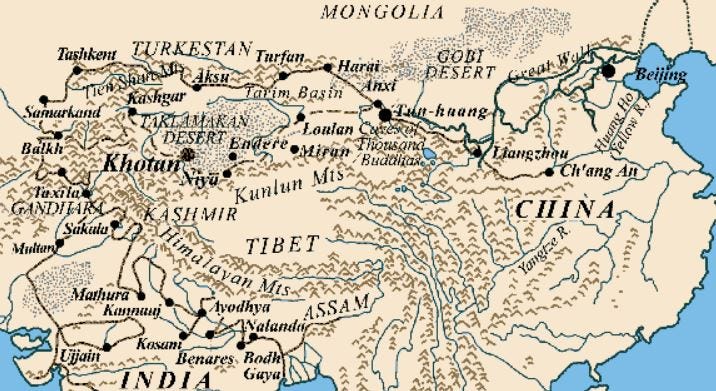
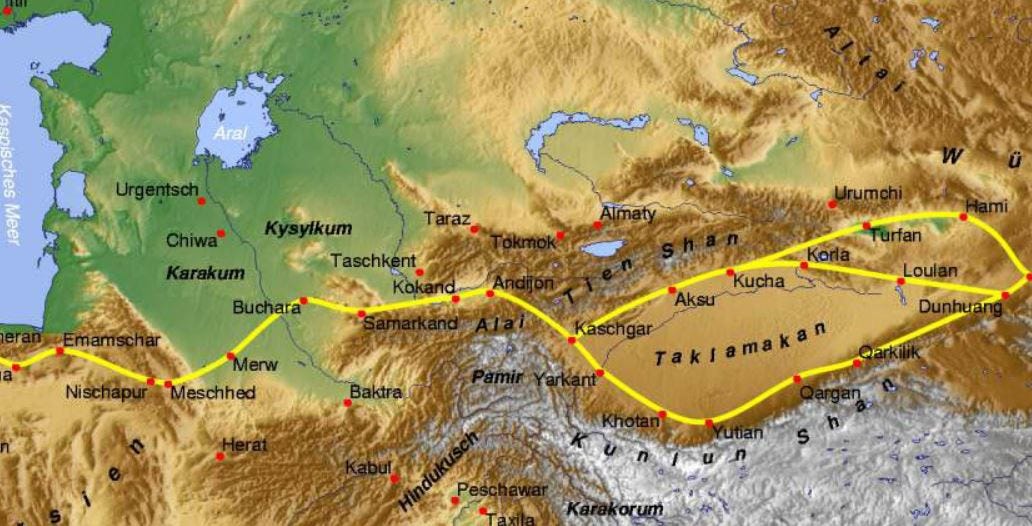
Most people do not know that until about a thousand years ago, the Tarim Basin (northwest of Tibet, which is the part of Xinjiang below the Tian Shin Mountains) was Indic in culture and it was a thriving part of the Sanskritic world; its people spoke the Gāndhārī language which many see as descended from Vedic Sanskrit, and Khotanese Saka, which is also closely related to Sanskrit. Perhaps the region to compare it most is Kashmir, to whose north it lay. There was also much interaction between the two regions with many scholars traveling from Kashmir to Khotan, and silk culture is believed to have passed from Khotan to Kashmir and then into India.
Gāndhārī inscriptions have been found as far east as Luoyang and Anyang in Henan province in Eastern China which attests to the vastness of the influence of Sanskrit. Europeans in recent centuries called the whole region Serindia, indicating the meeting place of China and India.
The traditional date for the of Khotan, on the southern and the more ancient branch of the Silk Road, is the reign of Aśoka Maurya (3rd century BCE). It was ruled by Buddhist kings until it was conquered by the Muslims in 1006. Some of the kings mentioned in the “Prophecy of the Li Country”, composed in 746 CE, dealing with events of the recent past are Vijaya Kīrti, Vijaya Saṅgrāma, Vijaya Dharma, Vijaya Saṃbhava, and Vijaya Vāhana.
Many Khotanese cities had Sanskrit names. For example, Khotan in Sanskrit was Gaustana गौस्तन and the modern city of Kashi (Kashgar) was called Śrīkrīrāti (in Sanskrit Śrī+krī+rāti, श्रीक्रीराति, ‘Glorious Hospitality’). Kashgar itself appears to be the popular name from Sanskrit Kāśa+giri (काशगिरि, bright mountain). The Khotanese called their language hvatanai ह्वतनै which later became hvaṃnai ह्वंनै; this is equivalent to the name deśī that is used for language in India (vatan, from svatana = deśa).
The liturgical texts in the region were written in Buddhist Hybrid Sanskrit, whereas those in the region of Krorän (Chinese Loulan), an important oasis further east of Khotan, used Prakrit in administration. A third language called Tocharian was also used both to translate Buddhist texts and as an administrative language. Many Sanskrit texts of India remember the general region as Tuṣāra or Tukhāra, and it retains currency as a popular proper name.
Another major language was Khotanese Saka, which is sometimes seen as an eastern Iranian language (that is emerging from the region just west of Kashmir). But since the large number of the Śaka who ended up in India as rulers or soldiers have always spoken the more easterly Indo-Aryan languages, I personally believe that the Saka languages were largely Indo-Aryan, although as one traveled further west, the Iranian elements increased.
That Khotanese Saka was principally a Indo-Aryan Prakrit is reinforced by the fact that the texts are in Indian scripts of Brāhmī and Kharoṣṭhī. Many of these documents were collected in archaeological explorations to Chinese Turkestan by Aurel Stein, who is also known for his translation of Kalhaṇa’s Rājataraṅginī. Stein came across tens of thousands of manuscripts from 5th to 11th centuries in various sites including the Caves of the Thousand Buddhas in the Kansu (Gansu) province. One of the principal scholars who edited and translated many of these texts was H.W. Bailey and this literature remains a popular field of study for scholars.
Aurel Stein says in his celebrated Ancient Khotan: “There was little to prepare us for such overwhelming evidence .. on the large place which Indian language and culture must have occupied in the administration and daily life of this region during the early centuries of our era. That Sanskrit Buddhist literature was studied in Khotan down to the end of the eighth century A.D. has been proved beyond all doubt by the texts in Brāhmī script which I excavated.”
The mummies of Tarim Basin
The discovery of the Tarim mummies that go back to 1800 BCE strengthen the view that the region was Sanskritic. The earliest mummies in the Basin are exclusively Caucasoid, and the American Sinologist Victor H. Mair has said: “Because the Tarim Basin Caucasoid corpses are almost certainly the most easterly representatives of the Indo-European family and because they date from a time period that is early enough to have a bearing on the expansion of the Indo-European people from their homeland, it is thought they will play a crucial role in determining just where that might have been.”
Some have suggested Europoid identification to explain the blonds and red-heads among the mummies, but there is no need to travel thousands of miles to Western Europe to explain this; Kashmir, just south of the Basin has plenty of red-heads and blonds.
One of the DNA studies notes that the population had “relatively close relationships with the modern populations of South Central Asia and Indus Valley, as well as with the ancient population of Chawuhu.” This is perfectly reasonable if the original inhabitants of the region were from Indus Valley [code for India] and they left a genetic trace in the region.
My own interpretation is that the Vedas, Purana Itihasas, Ramayana and Mahabharata refer to some places north of Afghanistan in Turan (perhaps Sudakshina‘s army in the Mahabharata came from Turan) and west of Afghanistan in Iran (some believe that Pahlava refers to Arjuna‘s, Abhimanyu‘s, Parakshit‘s and Janamajeya‘s and Ashwamedatta’s ancestral line). Some even claim that the temple of Baalbek in Lebanon
https://www.youtube.com/watch?v=0_p5yU4YGWI
and temple of Delphi in Greece are very closely connected to Arya culture and temples in the east:
Update: I’ve undeleted this since Zach has admitted that he overreacted below. If you want me to trash this post again Vikram just leave a comment below and I’ll do so. -Razib
I understand the nostalgia and desire for an Islamicate language among the Ashraf elite of British North India. After all, Hindus have a similar desire to live in the house of classical Indian languages, and the vast majority of Hindus give their children names from these languages.
But what baffles me is the the Ashraf insistence on Urdu. Choosing Persian as the national language of Muslim South Asia would have had many benefits:
Just like Hindus, whether Kashmiri or Marathi, have a reverence for their classical languages (currently mainly Sanskrit for North Indian Hindutva types, but with a bit of maturity this sentiment also extends to other Indian classical languages), Muslims whether Sindhi or Bengali see Persian and Arabic as their classical language. This would have dramatically reduced the internecine conflicts amongst South Asian Muslims due to language.
Persian as a national language would cement Pakistan’s relation with the Iranic world (and thus the core Muslim world), which is the ancestral land of much of the Muslim Ashrafi in South Asia. South Asian Muslims would come into deeper contact with a sophisticated and highly cultured Muslim population.
Muslims of South Asia would have access to a true, expansive classical literature (including heroic epics, not just romantic poetry) dating back to antiquity, much like Indians have access to classical literatures in Sanskrit, Pali and classical Dravidian. This would diminish the need for extreme religiosity as the glue for holding the Muslim nation together, and produce a far larger, self confident cultural output.
On the other hand, the choice of Urdu created quite a few issues for the preservation and growth of Islamicate culture in South Asia:
At the end of day, Urdu is an Indo-Aryan language with Sanskrit grammar and substantial Sanskrit vocabulary. Even the most Arabo-Persianized version of Urdu (Pakistan’s official Urdu) has at least 40% Sanskrit and Prakrit vocabulary. More so, since Hindus speak Hindi, which has the same grammar, but a steadily increasing Sanskrit vocabulary, it leaves Urdu perpetually vulnerable to an increase of Sanskrit vocabulary.
Some key words in Urdu like aap and sakna have roots in Hindu concepts (aap comes from aatma, the higher self) and sakna derives from Sanskrit shakt, which has a higher meaning in Shakti, the feminine divinity of Hinduism, walla from pal, which means protector.
Muslims in Pakistan and Bangladesh, already have their own languages and literatures, especially the Pashtun, Bengalis and Sindhis. No wonder the imposition has led to substantial conflicts instead of synergy towards the ultimate goal of a sophisticated, modern Muslim culture in South Asia, which is also shared by these populations.
All this leaves me baffled as to why the Muslim Ashrafi were so insistent on Urdu. My best guess is that they mistakenly felt that Urdu was a variant of Arabic and Persian, with no real Sanskrit influence. This is quite possible since the different language families would not have been widely known then, and since Urdu was written in the Arabic script, which is dramatically different from Indian ones.
In any case, the Ashrafi insisted on Urdu. This led to a breakdown of Muslim nationalism when Bangladesh separated. Bangladesh now uses an Indic script, and speaks a language with mainly Sanskrit vocabulary. On the other side of the subcontinent, for the first time in more than two millennia Pashtuns could be under more Indic influence than Iranic (this might change as Iran rises again). Within India, Urdu has declined dramatically, as Muslim families in UP and elsewhere have reconciled themselves to Hindi[1]. Knowing Urdu leaves Pakistani Muslims vulnerable to a substantial amount of Hindu literature and concepts via television shows and Hindi movies.
None of these could have been the goals of the Ashrafi when they demanded a Muslim homeland.
I’m pretty sure that Mauritius is a secular democracy but it is 52% Hindu.
As an aside it would be interesting to study the evolution of Hindu island diaspora culture around the world (Suriname, Guiana, Fiji, Mauritius etc).
There doesn’t seem to have been much Brahmin migration and it was mainly done by farmers/labourers. The early 20th century into East Africa seems to have had much Gujarati merchant castes but if memory serves me right they also served as labourers for the railways so it’s all a bit complicated and understudied.
Disregarding the Out of India migration theory (but there must have been a pulse with the Mitanni in the Levant); India has periodically pushed out waves of migrants to spread its culture, script and religion. To my mind though the only Hindu society, outside of core South Asia, to have a strong Brahmin presence is Bali.
It’s brings a further observation is that can Vedic and Hindu be separated. The reason I suggest this is that the Hinduicisation of South India seems to have primarily mediated by Brahmin migrants from the north. They seem to have found local hierarchies and adapted it to the caste system (the Reddys seem to be indigenous Dravidians).
I’m still unclear what the original nucleus of Hindu society would have been. After the collapse of the IVC culture it seems that Indian/Hindu civilisation (I’m treating them as equivalent since we are talking about BC) was continually shifting towards Haryana than Western UP and then Bihar. It’s only the Islamic incursions in first millennia AD that shifted it back towards Delhi and plugged India back into the Turkic network.
Of course the Buddhist interruption can’t be ignored but the role of Brahmins in the coherence of Hindu civilisation simply can’t be ignored. What is interest is that all the Hindu islands sans Brahmins seem to become very relaxed creole island cultures that resemble Sri Lanka. All of sudden the pulsating sensuality and tropical sexuality that is so repressed in North India/Pakistan emerges and the hidden matriarchy also peaks through.
Much as the Muslim invaders were very obviously symbols of patriarchy and a stern nomadic culture; its not unreasonable to supposed that the Aryans represented much of the same stream and applied that to a relatively relaxed pagan Dravidian/AASI South Asia. It would make sense that Indra, a masculine thunder god, is Aryan but Lingala worship is an indigenous feature.
The model we would be looking at is Mother Goddess worshipping AASI with naturistic pagan beliefs being coopted by Dravidian farmers. It would be a classic case of farmers and hunter gatherers coexisting in the same spaces; most of the farmer culture and genes winning out over the generations. Then come the Aryans with their migration/invasion but progressively Sanskritise the rest of South Asia with a much more masculine pantheon.
A question comes to mind that if Malaysia/Indonesia had a strong and resilient Brahmin network, would they have become Muslim? Had the spread of Buddhism undermined Brahminism as it seems to have done in the northern Punjab/Bengal peripheries of the Subcontinent.
Ps: Smart comments welcome (as in the Climate Change thread) – I’m simply speculating. I’ll delete anything overwrought; everyone featured in this post (except the Mauritians) are long gone.