Monkey see – Monkey Do ?

This is not a well-thought-out piece but a sort of rambling rant of thoughts in my mind for a year.  My previous writing on Covid is here and Ayurveda.

I have no medical/biology/medicine background nor am I am a scientist nor do I claim to understand statistics. Read this as some thoughts of a layman.

It’s been a year since India went hard into the lockdown. And after trying N things for over a year, we are back on the verge of lockdown in Maharashtra. (at least the CM keeps threatening a lockdown). Unlike initial predictions of respite from Covid in warm weather, it appears both Covid spikes in India have occurred in the considerably warmer weather while mysteriously getting low during the winter months. While I am yet to find a convincing argument that explains several strands associated with mechanisms of spread of Covid19, some aspects of the challenge, namely public reaction needs to be assessed as we get into the second year of the pandemic.

A question to ask here is – how different would the global reaction to covid19 have been without the world witnessing the Chinese state response in the first place? Did it act like a guess in an optimization algorithm – which eventually decides the outcome in some cases no matter it’s value? The European nations first chose to ignore and when they acted they acted in echoes of China. While totalitarian states like China or the gulf countries have been able to reign in the pandemic, no significantly sized country has. What would have been the Italian reaction had they First Guess been other than China? This is not to condone any herd immunity strategies – but at least in a country like India, the cost-benefit analysis needs to be done.

Additionally, should we ask if how much did lockdown work? Dr. Watve, a scientist based in Pune has some good blogs on the topic. While I am not convinced by Dr. Watve’s reasoning yet, its opposite doesn’t appear convincing too.

What else (if anything) could we have done differently? especially in India.  Critics of government often talk about the lack of testing as an issue in India. Personally, I feel once we get a critical mass of vectors, testing and tracing becomes merely a placebo exercise. Aping the WHO models on test, trace on Indian scale (at least with the resources we have).

Another thing that continues to bother me is the Fomite transmission theory. Going through the literature, I couldn’t find convincing research to believe it in the first place, let alone taking it to the insane level it was taken to – especially in India. Newspapers and milk delivery was turned off for months. Home deliveries of groceries were turned off initially. Shops were open only for small durations of the day. All these measures together meant that whatever essential services were available were often extremely crowded with people.  How much did these bizarre policies initially aid the transmission of covid?

I still remember vividly the most spectacularly stupid team meeting I have been part of. This meeting took place around 10-15 March 2020 to let the employees know that the company was doing everything they can to stop covid around the company premises (which was mostly a rain of sanitizers). In this meeting, the management called around 30-40 people in a closed room and talked without masks (that was early 2020, and even the scientists and WHO were maskophobic back then). Anthony Fauci who today, parades in “Rand Paul’s words” in two masks after getting two shots of vaccine, was saying a year back that masks are unnecessary (or even counterproductive). It’s perfectly acceptable for humans to make errors and correct those in the course of action – that’s something we should all try to do. But an analysis of what led us to make those mistakes in the first place ought to be done. Or was it just another example of the Sun revolves around the earth?

Local authorities (including society chairmen etc) have been on a different level of insane. After seeing city authorities sanitizing roads, pavements, trees, and even migrant laborers, whenever a patient is found in a building, the staircases, floors, and grounds continue to be sanitized. I am not even a novice on Bacterial evolution, but on my rudimentary understanding- this use of sanitizers scares the shit out of me. It is not that I am totally sure that fomites don’t spread covid, but the focus on fomites has also meant the possible aerosol spread was not focussed on. What’s worse, in my opinion – the focus on fomites and sanitization has lulled large swathes of people into the sense of false security. People wash their hands, sanitize groceries, but when talking to people often take down masks. Almost 95% of the cases I have heard have of contracting covid from a distant family member indoors or at some function. Yet people continue to focus on sanitization while attending public gatherings and religious ceremonies. At one point in my society, deliveries had to be collected at the society gate while members celebrated Diwali, New years, and Republic day inside without masks in large numbers. To this day, servants and handymen are treated with suspicions while friends and family (some of whom may have more exposure) arent. We have a separate lift for non-members – while members don’t mind traveling in lifts with unmasked members.

However, another question posed by this pandemic is, what should be the role of the state? and what should be its Aim?

  • Is the Aim to try and prevent every covid infection – at cost of the economy and livelihood?
  • Is the aim to avoid the overcrowding of medical facilities so as to avoid collateral damage?
  • Is the aim to keep pushing potential cases in the future – so as to reduce potential cases by vaccination?

When it comes to livelihoods, we need to separate two strands – the effect on the economy due to natural fear in people & and lockdown invoked economic downturn.

The mathematics of economic catastrophe is clear enough to follow – while the mechanism of spread seems to allude even the best of the minds. Every time someone comes up with reasons for why Covid stopped spreading rapidly around the end of 2020 in India and began afresh in 2021. The lockdown had ended in October and *new normal* activities had opened by November, but it appears this increased activity didn’t immediately accelerate the pandemic. Intuitively I would guess it takes time to gain a critical mass and a similar time for it to reduce. The momentum of the critical mass of vectors ought to carry on the spread (due to unavoidable contacts) in spite of overall contacts being low. Maybe once the first fuel was exhausted, it took time to gain a similar mass of vectors before it could truly explode. Add to this the new variants and reinfections (especially those who were asymptomatic the first time), then maybe the second wave starts making sense. Or maybe I am just pulling theories out of my ass which has no value – Either way I don’t mind as no one seems to have any deep insight into this.

All well-meaning people have been trying to shield the elderly for over a year. I have myself spent hours convincing older people to stay secure. But at what point does this become unbearable for a 75-year-old? Would it be wrong for an older person to be to think that they might not survive the pandemic (dying naturally amidst it) to live the end of the pandemic? Can they decide to take the risk of living a few months dangerously ahead of being condemned to a year in lockdown. (This equation has changed now with vaccines but the question still carries some weight I reckon)

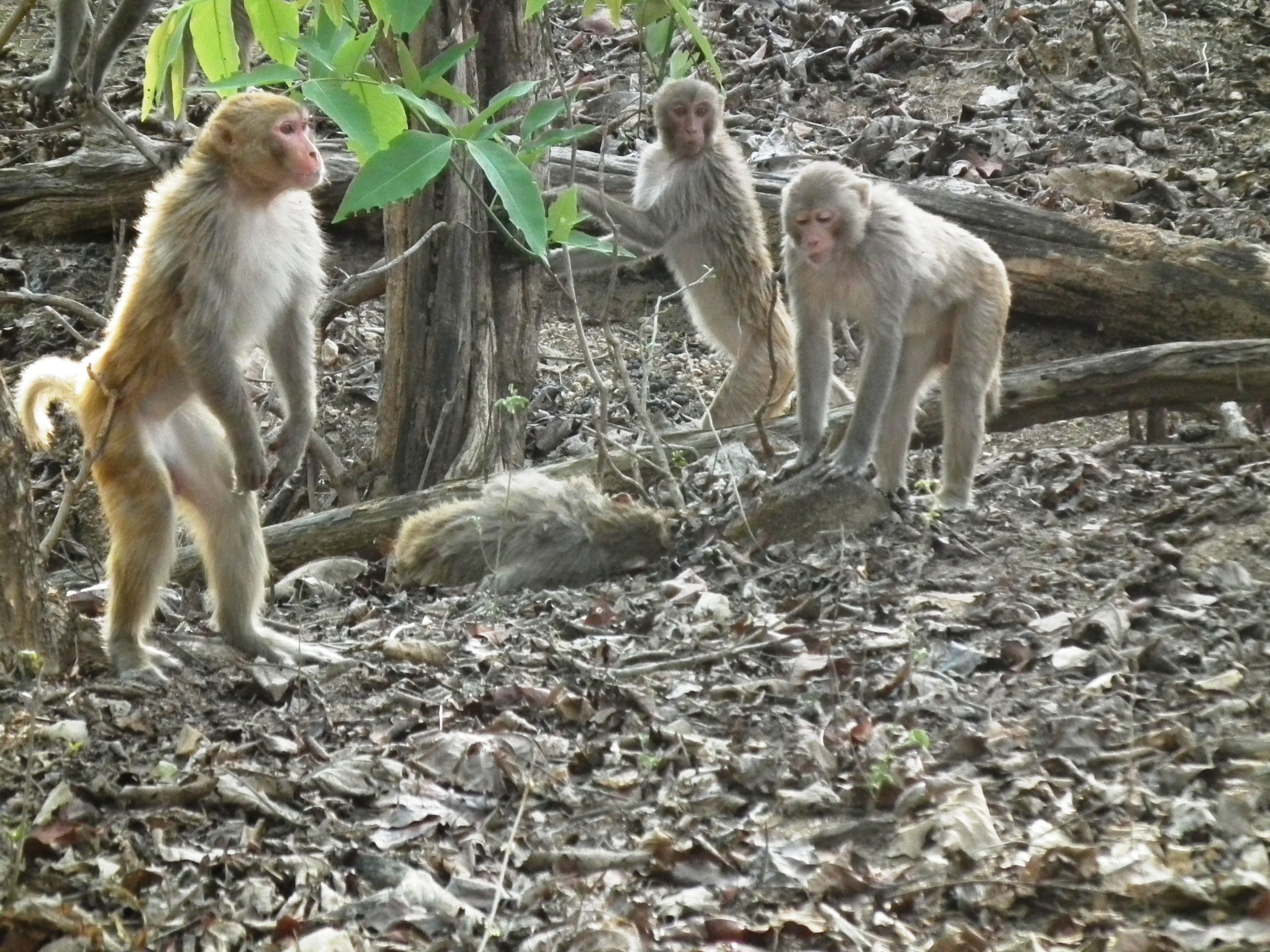
Maybe this time next year we would have more answers than we have at this point. And hopefully, we would devise better strategies in countering such events in the future than acting like imitating monkeys in an experiment.


The Mughals!


The Brown Pundits Clubhouse channel hosted a discussion on “the Mughals” yesterday that went on for a while. There seem to be two polarized extreme views

1) The Mughals were great Indians! Long live the Mughals.

2) The Mughals were genocidal colonizers and induced inter-generational trauma.

Most people occupy a position in the middle. As for myself, I think it is clear that the Mughals were to some extent an alien and occupying influence because that is how they viewed themselves more, or less. They were Turanian Muslims of Turco-Mongol provenance. No matter how much Rajput or Persian blood they had, their paternal lineage came down from the Turk Timur. The maternal lineage of Babur was Genghiside. If India had been mostly Islamicized this would have changed. But it wasn’t. Despite the deep cultural synthesis between Mughal culture and that of India and their indigenization of the generations, there remained a connection between ashraf Muslims and Persia and Central Asia. They were not equivalent to Muslim Bengali peasants or Ismaili traders in Gujurat.

And yet the flip side of this is that the Mughals, and Muslims as a whole, in particular Turks, drove change within Indian society. To some extent, the native reaction and response in the dialectical synthesis can only be understood in the light of the Islamic shock. More generally, an Islamicate civilization evolved that extended beyond the Mughals and included the Rajputs and Marathas (reciprocally, the Mughals internalized many Rajput values, but this is to be expected due to their long residence in India and intermarriage with Rajputs).

Those Hindus who are traumatized by the impact of Islam are free to feel this way, but I am genuinely curious about an Indian culture stripped away of Islamic influence. What would that look like? Perhaps Odisha and Sri Lanka might come close?

More generally, the excited and emotional response of both Hindus and Muslims and their inability to engage in epoché makes me think that the prospects for deeper analysis are poor. Emotion has reason by the leash.

Monkey and the Indo-Europeans

??????? ??? ??? ????-?????????


??? ?????????? ????????

Gamkrelidze and Ivanov, two major linguists hailing from the former Soviet Union, came out with a major book in the 1980s in Russian, where they proposed the Armenian homeland theory for the origins of Indo-Europeans. They made several arguments to support their theory. Many of these arguments incidentally better support an Indian homeland for Proto-Indo-European. One such argument was their proposal that the Proto-Indo-Europeans were aware of the monkey before they dispersed i.e. they knew of the monkey in their homeland.

To put it in their own words –

?????? ??????????? ??????? ????? ??? ‘??????, ???’ ?? ??? ??????? ????-???????? ???????? ???? ?? ???????? ?? ????? ? ????-??????? ????????? ?? ??? ?????-????-???????? ???? ?????. ??? ???????? ???? ???? ??? ?????? ????, ??? ???? ??????? ?- ??? ??? ??????? ??. ???. ????- ‘??????’ … ??. ????? – ????? ‘????-?????? ??????’… ?????. ???, ?? ??? (????. ???), ??? ???? (???. ????), ?????? ???????… ?????. ????? (??????), ????? ‘??????, ???’… ????. ????? (?5?? ???????), ??. ?????, ?????. ??????, ?????. ???, ?????-??. ?????. ??????? ?????.

So we have the cognate word for monkey in Sanskrit, Greek, Germanic, Celtic and Slavic languages of Indo-European.

Gamkrelidze & Ivanov, though arguing that the word for monkey was already known to the Indo-Europeans in their homeland, insist that this word has come into Indo-European languages through their contact with Southwest Asian or Near Eastern languages. They cite Akkadian ukupu, Hebrew kop, Aramaic kopa and Egyptian gjf – monkey, ape as the early examples.

Yet the problem with this theory, as we shall come to it again, is that monkeys are not native to any place in the Near East. The standard theory so far has been that it is through contact with the Egyptians that the Near Eastern civilizations of Mesopotamia, Anatolia, Levant and the Aegean came to know of the monkeys. Therefore, it is from the Egyptian word that the word for monkey in Indo-European and other Near Eastern languages should derive. Yet as can be seen, the Egyptian word is ouite different and looks unlikely to have been the source word for the other languages. Moreover, it now appears that even in Egypt, the monkey may have gone long extinct and was likely imported via the Horn of Africa, southeast of Egypt.

This leaves us with only the Harappan or Sarasvati Sindhu Civilization which is the only Bronze Age civilization whose geography indeed overlapped with the natural habitat of monkeys. So provisionally, it maybe argued that the word for monkey could have come into the Indo-European and the Near Eastern languages from the Harappan language or languages, whatever they may have been.

Digging into the linguistic aspect of this, we find that as per the Practical Sanskrit English Dictionary, the word kapi, usually referring to ‘monkey’ can also mean an ‘elephant’, the ‘sun’, ‘impure benzoin’, ‘incense’, a ‘species of the karanja tree’ etc. kapiloham means ‘brass’, kapishak means ‘cabbage’, kapila/kapisa means ‘tawny, brownish or reddish’ colour, kapana is a ‘worm’ or ‘caterpilar’, kapota is a ‘pigeon’ and so on. As per the Sanskrit Etymological Dictionary, the word kapi is said to derive from the root word *kamp which means ‘to tremble’ or ‘shake’. A derivative word kampra means ‘trembling’ or ‘shaken’ but also ‘movable’, ‘agile’ & ‘ouick’. A likely derivative of *kamp is kap which means ‘to move’. Therefore kapi, in the context of a monkey, may plausibly mean ‘one who moves ouickly’, an apt description.

Looking for the Proto-Indo-European root, we come across a root *kap or *kehp, meaning to ‘seize or grasp or hold’. Possible derivatives of this root include Greek kapane – ‘wagon’, kope – ‘grip,handle’, kapos – ‘garden,orchard’, latin captus – ‘captured, seized, taken’.

It is also said to be the root for the English words ‘hawk’ and ‘captive’ among many others. While the Proto-Indo-European root and its meaning fail to adeouately explain all the myriad different ways in which the derived words are used in various IE languages, for our purpose it is ouite adeouate. kapi may thus be derived from PIE root *kap – ‘to seize, hold’ to mean as one who grasps or can grasp. Monkeys, ouite uniouely among animals, have the ability to grasp things or objects with their forelimbs and this would not have gone unnoticed to the ancient people. This may also explain the name of kapi for elephant since it can also grasp with its trunk, as also the hawk in English since the hawk has a habit to grasp its prey in its sharp talons.

It may therefore be argued that the Proto-Indo-European word for monkey, as argued by Gamkrelidze and Ivanov, is not a loan word but derives from a sound PIE root. We already noted earlier that the word for monkey in the Near East may have been a loanword from the Sarasvati Sindhu Civilization and now we can see that this word is of likely Indo-European origin.

Does this mean, that Indo-European languages were spoken in the Sarasvati Sindhu Civilization ?

??? ?????????????? ????????

Turning to the archaeological evidence, monkeys were depicted on frescoes and seals and objects, accessories were often fashioned in the shape of monkeys. The inspiration for this in Near Eastern art is usually considered to have come from ancient Egypt.

But, it has now become increasingly clear, as this recent study shows, that monkeys or baboons were not native to Egypt either and the ancient Egyptians themselves imported their monkeys from much further south and east, mostly from the fabled land of punt, which is the eastern African coast, and from where incidentally, objects of Harappan origin also reached Egypt.

Viktor Sarianidi, was an archaeologist credited with the discovery of the Bronze Age civilization of BMAC, also known today as the Oxus civilization. He was an ardent supporter of Gamkrelidze and Ivanov’s theory and argued for an archaeological evidence of Syro-Anatolian influence on the Oxus civilization. He believed the Oxus civilization to be Indo-Iranian speaking and therefore interpreted the perceived Syro-Anatolian influence on Oxus in terms of Indo-Iranian migrations from that region, which during that period had various Indo-European groups such as the Mitanni, Hittites and Mycenaeans dominating the landscape.

He also interpreted the depiction of monkeys on Oxus seals as yet another evidence of Near Eastern Indo-Europeans.As per Sarianidi,

?????????? ?? ??????? ??? ????? ?? ????? ???? ???????, ????? ???? ?????????? ??? ? ?????? ????????????…?? ?? ????? ???? ?? ???? ???????? ??? ??????? ??????? ?????? ??? ???? ?? ??????? ?????????? ?? ????????? ?????????? ????????? ?????????. ??????? ???? ??????? ?? ????? ????? ??? ???????? ?? ??? ???? ?? ????????, ?????, ??????????? ??? ????? ??? ?????? ??? ???????? ??? ?????????? ?????? ?? ????? ???? ????? ?? ??????? ?? ????????? ?????????? ?????????? ??? ?????? ?? ????? ?????? ????? ?????? ?? ??? ???? ?? ??????? ??? ??????? ????????.

Sarianidi admits that none of these parallels in the Near East could be dated to earlier than the beginning of the 2nd millennium BC. Sarianidi believed in a lower chronology of the Oxus civilization and therefore found nothing out of place in this. Nevertheless, we now know that the Oxus civilization began as early as 2400 BCE i.e. hundreds of years before the Indo-Europeans begin showing up in the Near East.

Yet if we were to hold onto the parallels Sarianidi draws between the culture of the Oxus and the 2nd millenium BC IE groups in Syria, Anatolia and the Aegean, we have to wonder – is this evidence of Oxus influence on the IE groups of the Near East ? And if so, was Oxus an Indo-European civilization ?

In this context, the monkey iconography also assumes significance. The Near Eastern monkey iconography is unlikely to have influenced the parallel iconography in Oxus since the Oxus dates from an earlier period but also because, the Oxus was culturally close to the Sarasvati Sindhu Civilization where monkeys were found in their natural habitat.

Rather, it is more likely that the monkey iconography of the Oxus influenced the Indo-European groups of the 2nd millennium BCE Near East. Also important to note in this respect is that the monkeys were depicted in religious and sacred imagery both in the Oxus and in the Indo-European Near East which demonstrates the importance that monkeys held for them.

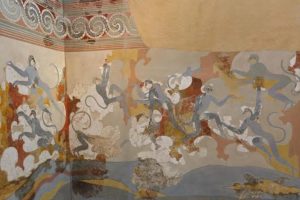
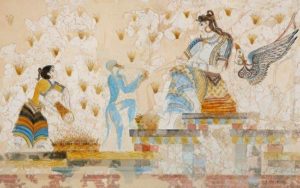
More recently, archaeologists of the Aegean Bronze Age, managed to conduct a multi-disciplinary study of the Minoan frescoes and were pleasantly surprised to find that the uptailed blue colored monkeys were Hanuman langurs of Indian origin. Not only that, these Indian monkeys were found playing an important role in an iconic Minoan frescoes fundamental in the understanding of Minoan religious beliefs and practices. In that fresco, a female attendant in shown giving a flower to the Hanuman langur who in turn in shown giving to a seated goddess.

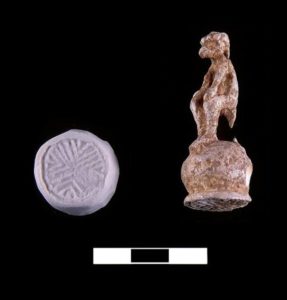
Pareja et al also show that Indian monkeys are also depicted in some other objects found among the Minoans such as a seal made from carnelian, a stone of Harappan origin and also an ivory stamp seal with a typical Harappan cross and chevron motif. The depiction of monkeys on Minoan frescoes is so realistic that Pareja et al argue that the Minoan artist must have seen a real Hanuman langur.

Here we may note that monkeys have been found buried at the site of Shahr-i-Sokhta in Iran, far away from its Indian homeland. Shahr-i-Sokhta is the site from which the majority of Harappan ‘migrant’ samples were published by Narasimhan et al. Thus, Harappan monkeys could well be travelling long distances with their human masters.

We can see that monkeys from Sarasvati Sindhu Civilization went on to become important players in sacred and religious iconography of the Oxus civilization and likely in Eastern Iran and subseouently in the Syrian, Anatolian and Aegean world of the 2nd millennium BCE, in a period when that region was dominated by several Indo-European groups.

??????????

We have seen that the Indo-Europeans knew of the monkey in their homeland and had a word for it directly derived from a proto-Indo-European root and not borrowed from another language group. This would mean that the Proto-Indo-European homeland had direct contacts with the monkeys and not secondary via a non-Indo-European group. This would imply the presence of monkeys in Proto-Indo-European homeland. The only Bronze Age civilization whose geography overlaps with the natural habitat of monkeys was the Sarasvati Sindhu Civilization.

Similarly, we can also see that it is the monkeys from the Sarasvati Sindhu Civilization that likely inspired and played an important role in the religious and cultic beliefs of the Oxus civilization and the Near Eastern civilizations, several of which were Indo-Europeans such as the Mitanni, Hittites and the Mycenaeans.

Therefore, there is strong evidence that it is from the Sarasvati Sindhu Civilization that the monkeys and the word of it became known in the Bronze Age Near East. The sacred role of monkeys is also worthy of note and may have also derived from the Harappans since in Hinduism, a religion majorly derived from the Bronze age civilization of Harappans, monkeys continue to hold a sacred significance.

Since this word for monkey is clearly of Indo-European origin, how does one explain it if the Sarasvati Sindhu Civilization was not an Indo-European civilization ?

Review: Magic in Islam by Michael Mohammed Knight

This is an old capsule review I wrote a few years ago. I have been busier than usual and not writing at all, so I decided to post some old reviews..

26192917

A hot mess of a book, but still worth reading. Michael Knight is now a postmodern conventionally educated scholar, and that is beginning to show. He has obviously read VERY widely and the book contains countless extremely interesting tidbits about magic and magical ideas in Islamicate tradition. But all of this wonderful research is embedded within a curious postmodern framework that can be off-putting and irrelevant to the story. The story he COULD have told is the story of magic and related ideas in the history of Islam and Islamicate culture. THAT story would have been a fascinating and interesting tour through a history that is not well known, especially to outsiders and Western-educated Muslims (like us). And he provides some of that and that is why the book is worth reading. But he is also eager to “correct” our supposed misconceptions about religion and history and too much pleading takes up too much space in this book. Then again, many people seem to want that kind of “mandatory re-education/rectification of names”, so maybe you will like that part too. But personally, I would have preferred more historical details, fewer lectures about orientalism and “the clash of civilizations”.
Best new bit of information for me: that Ibn ul Arabi claimed he had sex with the Arabic letters in paradise. I wish i knew more about the context of that particular quote. But like many fascinating little details in the book, Michael mentions it and moves on. He has clearly read a lot, I wish he had spent more time presenting the information he has collected and less time lecturing us about how “opening space for new fields of knowledge potentially decenters traditions of jurisprudence, even forcing increased opening of an Islam outside normative Muslim legal traditions” and suchlike. Sure, that would be nice. But let us hear the story first, then we can figure out what it means for magic to be (as he describes it) “deconstructive”.
Not that I disagree with his project of “engagement and deep intersection”, just that I wanted more of the facts, less of the postmodern interpretation.

Browncast: Chris Iwanek, India-analyst from Poland

Another BP Podcast is up. You can listen on LibsynAppleSpotify, and Stitcher (and a variety of other platforms). Probably the easiest way to keep up the podcast since we don’t have a regular schedule is to subscribe to one of the links above!

Krzysztof IwanekIn this episode Mukuna and Omar talk to Krzysztof Iwanek (aka Chris), who heads the Asia Research Center in the War Studies University in Warsaw, Poland. Chris also writes regularly for “The Diplomat” and is writing a book about the Ram Rajya Parishad Party (a small traditional Hindu party in India). We talk about Indian politics, his research and whatever else comes up..

Book Review- Sanghi Who Never Went to a Shakha: Anatomy of Polarization

Rahul Roushan’s book traces his journey from his indifference towards his Hindu religious identity, to his wholesale acceptance of it and his subsequent paranoia of how his religious identity and his way of life are being threatened by forces he believes are inimical to both.

The book, a memoir, recounts his life starting from growing up in small town Bihar, graduating from Patna University, years he spent studying in Delhi and Ahmedabad, working first in the main stream media and then as an entrepreneur.

He employs this re-telling as a vehicle to mark milestones that led to the evolution of his present ideological mooring.

The reader gets a head start on the book from its title.
It uses the words associated with the Rashrtiya Swayamsewak Sangh (RSS), the umbrella organization that’s nurtured the party currently running the central government in India- Bhartiya Janta Party (BJP), Shakha- the smallest unit/meeting of RSS volunteers and Sanghi- a term mostly used as a pejorative in online discourse, to describe people considered radical supporters of the RSS and the BJP.

Growing up in a family with no strongly held religious or political beliefs, Roushan’s religious views were shaped by religiosity displayed by his parents, he describes this as limited to celebrating Hindu festivals, and his understanding of polity and management of religious fault lines via subscription to stories of religious harmony.

Growing up in the Bihar of 1990s, he writes that the prevailing political narrative was of caste and he remained ambivalent of his religious identity. This indifference was never disturbed, although he went to schools run and owned by Hindus.
This was the India of 90s and a middle-class boy was focused on building a career and attaining financial independence.

His views on what each political party stood for shaped by what he read and saw in the mainstream media.

There was no inkling or the mental bandwidth to question the prevalent wisdom of secular and communal credentials of political parties. BJP is communal because the newspaper I read says so.

Roushan writes he was a- Congressi Hindu.
He defines Congressi Hindu as one who notionally religious and accommodative/indifferent to government largess and special rights for religious minorities.

In 2001, Roushan moves to Delhi to study communication at India’s premier Mass Communication institute, Indian Institute of Mass Communication (IIMC).

Here he is exposed to a cross-section of people.

Some of whom are unlike him.

They are deeply invested in their religious identity and hold strong views that are left leaning.

He is also exposed to behind the screen working of main stream media, its ideological biases and how the media uses its power to shape a particular narrative.

He finds a culture, that he claims underplays the role played by Muslim Fundamentalism in fomenting fault lines while exaggerating the role that Hindu fundamentalism plays.

He finds the same pattern playing out once he starts working with a main stream news channel.

This is a decade that sees 9/11, 2002 Godhara carnage and the subsequent riots in Gujarat, UPA coming to power at the Centre and 26/11.

Roushan’s experience of working with a news channel in this decade, studying in Gujrat, Roushan is a MBA from IIM Ahemdabad-closest India has to offering an equivalent of a Harvard MBA, and his stint as a media entrepreneur, Roushan founded the satirical news website Faking News which he sold to one of India’s leading media houses and worked for the media house for a while; shaped his firmly held view that the main stream media, specially the English language, in India for ideological and commercial reasons is deeply biased and staunchly anti-Hindu.

His reading of the manner in which this cohort of media has always covered India and continues to cover it post 2014 election of Narendra Modi, leaves him with no choice but consider them an extension of an establishment.

An establishment Roushan claims that is the inheritor of the British Raj, filled with a set of people who believe in civilizing the native Hindus, is indulgent to Muslim fundamentalists and continues to appease religious minorities at the cost of Hindu and national unity.

The incumbents of this establishment occupy prime positions in and use the institutions of judiciary and media to subvert the elected government and unlike the elected government are permanently entrenched.

By the turn of this decade, like most Indians he discovers social media.

It is here that he finds people who like him have started to question the received wisdom.

He discovers that there are more like him who increasingly challenge the veracity of news reports, what is printed and what is left out of them.

He has a ringside view as leading editors and anchors are found embroiled in cash for votes scam and ‘Radia Gate’ controversies.

The timing of main stream media starting to lose credibility coincides with advent and astronomical growth of social media.

Roushan finds that although grandees that of the old establishment continue to dominate conversation, it is no more a one-way street.

Their bias, incompetence and double standards are called out and their condescending attitude, hypocrisies pointed out.

It is also a place that’s increasingly full of rancor, name calling and deeply polarized on ideological lines.

It is this crowd, of mostly unknown to him participants, he finds fellow travelers, who come together to propel his journey to the corner of Sanghis although he has never been to an RSS Shakha in his life.

The writing is lucid and the book reads like Roushan is in a conversation describing his journey.

For those who follow him on twitter and have read his blog posts and commentary, his ability to explain the underpinnings of ideological stand in simple and easy to understand language should not come as a surprise.

Where the book misses out his lack of any mention of opposite currents.

Surely Roushan met someone in his journey who made a compelling case for why the ‘establishment’ exists and why some one like him should be a part of it.

After all, Roushan went to an institute and worked in a profession that he claims is a happy hunting ground for the establishment.

Then there is the larger point of his book, his commentary on Twitter and through the website he runs.

He blames the establishment for being fundamentalist and a closed shop driven by its hatred for all things Hindu.

How does contributing to an eco-system that is as fundamentalist and as much a closed shop help.

Surely, he does not believe demography can be wished away.

To his credit he has taken the next steps via his work on a Hindu Charter and his writing on a possible way forward.

He does not cover those in this book. Perhaps there is a sequel to this book in works, where Roushan lays out his ideas on role and place of Non-Hindus in India.

In his seminal book Creating A New Medina, Venkat Dhulipala credits the role played by Urdu news media as one of the factors that solidified the idea of two nation theory and helped build the groundswell of support amongst the Muslim population that finally led to partition of the Indian sub-continent on religious lines.

As I read the book, I could not help but wonder if a century later, social media and online journalism is playing a similar role in amplifying and consolidating religious identities, both amongst Hindus and Muslims.

Rahul’s book is a must read for anyone interested in getting a sense of how one side of the ideological divide sees and reads India. With over three hundred thousand followers on Twitter and as a CEO of popular new portal opindia, Rahul’s is significant voice.

It is also a brave voice, for having taken a side this openly and running a news platform he is taking on the political opposition and burning all bridges within the media fraternity. I for one do not rule out the possibility of an Arnab redux happening to him if the present government is voted out.

Through the book Rahul also brings out the story of how India is changing.
Not too far ago, a boy from small town India would have found it virtually impossible to make a career in media without being employed by one of the bigger media houses, let alone being a meaningful influencer, MBA from IIM Ahmedabad notwithstanding.

They may still not easily get to write for columns for foreign newspapers, work for think tanks, participate in track 2 diplomacy or teach at liberal campuses, but they are shaping the discourse and our politics far more easily and more effectively.


Brown Pundits