Egalitarian/Equality and mobility in Society.

Something to keep in mind, an egalitarian/equal society is equally important to happiness of society.

Excerpts from Article

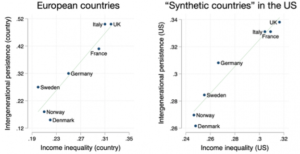
While the US ranks among the least equal and mobile countries in the developed world, recent work shows that it contains places that span the global mobility distribution.

Persistence in income from one generation to the next is higher in unequal societies like the UK and the US, and weakest in the relatively equal Scandinavian countries (the ‘Great Gatsby curve’)

Would would this map out similarly in South Asia, I think yes)

For example, equality and mobility are highest in the Midwest, where Scandinavian ancestry is common. The same goes for every group we study – for example, income mobility is lowest in areas where the population has Italian or British roots.

From Comments (read them too, please).
One should point also out the common observation that all that Scandinavian solidarity is built on a great deal of ethnic homogeneity. The US problem has always been getting the melting pot to melt.

My mother, life-long Republican and descendant of Swedish grand-parents, blamed the “socialist” bent in MN on the dumb Ole-and-Lena’s who maintained their village mind-set of caring-through-conformity post-immigration. In her opinion, worldly-wise people knew better than to just hand money out to strangers. I thought about that a little when reading Tuesday’s piece about trust in society, and cat sick’s comment that keeping business (or wealth) within networks is a way to mitigate risk.

Pakistan, the lost country-

I’ll add a very short thought here. What happens to Pakistan when they interact with other Muslims (especially Arabs, Persians & Turks) is that all of the national identity issues come to the fore.

Pakistanis obviously do not spring from those cultures and as a people virtually all of our holidays are Islamic in origin. Pakistan may seem as an Islamic culture in South Asia but it’s profound “Hinduness/Indianess” refracts in a Muslim setting.

That is a core reason as to why Pakistanis do not garner respect. For instance the Persians (who anyway are the leaders of their own sect of Islam) will always emphasize their own identity and festivals in all contexts. The Turks are supremely proud of being Turkish and the Arabs are of course the archetypal Muslims.

Pakistanis should have been incorporating the “colourful” Hindu festivals (Diwali, Holi, Cheti Chand, Basant) into our cultural matrix and even looked towards appropriating Sanskrit and the Vedas (as Bollywood has done to Urdu). Unfortunately this lack of perspective means we have only substracted from our cultural base as a “tit-for-tat” response.

Pakistan is not only an insufficiently imagined nation but furthermore a hollow one. Many gods have lived on the Indus and unless we welcome them back home, Pakistan’s psyche will be always be on the verge of psychosis (no other nation has happily condemned an innocent Mother of 5 for a decade and kept quiet about it).

Beware of Hinditvas

I love it when my point is so spectacularly proven. But I find it funny how intense these discussions take considering I prefaced the post with my own thoughts on NawRuz and Persian cultural imperialism.

Yes Islam is vulgar but so is Hindi. Just as obviously Muslim symbols wouldn’t find room in polite society neither would Hindi (hence why English is busy eviscerating it in the Desh).

I find it interesting that none of the Hinditvas condemn my constant insulting of Islam but become hysterical at my criticising of what is an ugly and artificial tongue. Just as I find Liberalstanis to be hypocritical in their silence over Islam’s deeply problematic nature; they have on the flip side these Hinditvas. QeA is probably the prototypical Liberalstani and Nehru the Hinditva; hence why the Subcontinent ended up as the disaster as it was. Both these tribes have been thoroughly colonised and participated willing in the destruction of the British Raj, a wholesale inheritance would have meant a South Asia able to be the light rather than laughter of regions.

The whole idea of the Hindi language was simply to cleanse Urdu of any Muslim association. The language policy has been a complete disaster (language played no part in 1971; I just did a debate on the topic).

It’s neither here or there; it doesn’t matter to me since my own life and choices have been able to traverse the deepening divide fairly easily (the upshot of being half-caste). However the sad bit is that India has lost it’s ur-homeland (Indthings is technically not wrong in claiming that the Vedas weren’t composed in modern day India) and AfPak is becoming a firm reality.

It’s the slow generations but these Hinditvas have driven Pakistan away into the arms of an unwilling Ummah. In that same Ummah Pakistanis will always be second or third class citizens because they’re a bit of a joke. They don’t carry much status in the Muslim world since they aren’t really proud of who they are.

To give an example the Muslim Sindhi people in trying to create a language pride day randomly chose a day in December as Sindhi Cultural Day. With a little thought the Sindhis could have instead started ressurecting the Cheti Chand tradition and actually reach out to Sindhi Hindus (especially their rich diaspora) as a way to strength Sindhi identity.

It’s a sad reality both India and Pakistan have lost out because they have squabbled like silly children, one side insisting on an absurd language and the other on an absurd religion.

I find it heart-warming that no-one agrees with me; it means that I’m actually on to something. The more I live the more I realise just how unique my own perspectives actually and being a child of the divide(s) means I’m never going to think like everybody else or make the same life choices..

THE FAITH THAT NEVER FADES: THE HISTORICAL RESILIENCE OF HINDUISM

I asked MJ to prepare a small discourse for my Cheti Chand Celebration. I wanted it to be on the survival of Hinduism through the ages, as Cheti Chand is precisely about that (in a Sindhi context). 

I was rather offended by this lovely video (made by the Baha’is for Norouz). At 00:28 the man says (in rather over-flowery Persian, I feel the Farsi used here was far too ornate, trying to sound poetic without really achieving that) that Norouz was important for Baha’is but especially important for Persians.

Baha’i faith can never be a vehicle for Iranian Imperialism since the promise of our Faith is world encompassing (let your vision be world embracing) and it vindicated my decision to stop celebrating Norouz after marriage in favour of Cheti Chand.

I had a minor disagreement with a fellow Baha’i on this who is also Desi. I didn’t attend the community celebration over the weekend because I argued that as a religious, not cultural, holiday (and so close to Cheti Chand which is in 2 weeks) I would prefer to observe it in a more solemn manner.

He had initially suggested a Hindu-Baha’i dialogue, which I thought about but decided against. Hinduism is the oldest religion on earth and Baha’i Faith is the youngest; we have much to learn from them rather than the other way around.

At any rate MJ sent me his “controversial piece”, THE FAITH THAT NEVER FADES: THE HISTORICAL RESILIENCE OF HINDUISM. 

The Holocaust brings to one’s mind deep anguish and pain, even though not many of us lived during the times when Hitler’s army ran riot over millions of Jews across Europe. It was one of the darkest hours of humanity and the barbarism of the Nazi cruelly added another chapter to the oppression that the Judaistic faith has had to face over the centuries.

What if I were to say that there is another faith (rather a `way of life’) and people who have undergone as many trial and tribulations, if not more, over millenia?

Shocking, right? I speak of Hinduism, arguably the oldest extant religion (not quite a religion though, as much as a way of life) today. Of Sanatan Dharma, or the ‘eternal way of life’ as it is usually called. The Vedic faith that developed and prospered in the Indian subcontinent before having to face wave after wave of slaughter, deprivation, insult and pain. This article is a brief walk down our civilizational memory lane to look at the story of what can be called one of the most ancient and pristine renditions of spiritual humanism, and what made it so resilient and strong to withstand these relentless storms of history.

It’s a wonderful article and his Nazi article is interesting. It reminds me of the German female presenter who said publicly that at least the Nazis brought autobahns (she was immediately fired and I can’t find the link).

It is interesting to note that there are no temples of significance in North India (the Sun Temple of Multan, Somnath) and it seems the initial Islamic conquests (Ghazni-Delhi Sultanate) were particularly destructive (was it more in line with the Turkish invasion or the Arab conquests is subject to debate).

My view is that the history of Islam in the Subcontinent is fundamentally problematic (it did not grow through conversions but was facilitate by evangelisation under the aegis of Muslim conquest). However while acknowledging that it doesn’t mean one should throw the baby out with the bathwater.

So it squares up nicely with my Islamophobia, Hinduphilia, Urdophilia and Hindiphobia.

I don’t think Islam or Hindi belong in polite society though I happily noted a hijabi women wearing a Burberry scarf this afternoon. If one is going to mar one’s looks with a hijab then at least wear a designer one. That’s why I don’t have much issue with Arabs wearing hijab since they do so with so much Elan than South Asian Muslims (they wear black hijab with a duskier skin tone- bad combination; I rarely see South Asian Muslim women wear the Hijab well, they seem to think enforced ugliness is a virtue).

As for Hindi’s vulgarity (it is probably as vulgar as Islam, if not more), this clip was just shocking:

https://www.facebook.com/watch/?v=2108525819438958

I cannot believe people talk like this. While the content is important, this sort of Hindi is crude and ugly that it lacks either the polish of Urdu or the flow of Hindustani. This is probably what they proudly call Hinglish (it’s really disturbing tbh) and then they threw in some Sanskrit word (Shahtruk or some such)..

I do feel Hindus have much misdirected rage instead of castigating, humiliating and abusing Islam at every opportunity as they should; they instead do so at Islamicate culture (and by extension the Islamicate state, Pakistan).

The lure of the Turanian triangle-

I’m following Drew Binksy, the travelloger, as he is falling in love with Pakistan. It seems to be his favourite country along with Iran. It will be a glorious day when Iran, Iraq, all the Stans (including Kurdistan) and Azerbaijan form some sort of Turanian cultural connection.

https://www.instagram.com/stories/drewbinsky/?hl=en

In this story he talks about how everyone in Peshawar (or Pakistan) has yogurt with everything. It’s funny because I must compulsively have yogurt with my food and it seems a Iranic quirk (Desi food obviously has yogurt but I’ll always have dollops of it).

The irony is that yogurt, which is so deeply associated with Iranian culture, is of course Turk-Mongolian. But I think the greatness of Iranian patriotism is that unlike say the Greek who make a point of calling it “Greek Yogurt”, Iranians don’t feel the need to Iranify everything.

https://www.instagram.com/p/BvdegnrBOJh/?utm_source=ig_web_button_share_sheet

Pakistan Zindabad!

Finally I’ve noticed that white people are never advised well when wearing desi clothes. The colour patterns and sizes of desi clothes is very different and white people being so pale need to adjust accordingly. Drew is wearing a blue shalwar kameez that’s ill-fitted.

I was looking online at white people wearing Desi clothes for examples of them wearing well and then I remember two white people who wear Indian dresses very well.

Image result for kalki koechlin indian clothes

Image result for katrina kaif indian dresses

When wearing colourful desi clothing one must present contrast. Kalki has opted for a black to offset her pallour and Katrina, I imagine, uses some foundation (and probably darkens her hair) to accentuate her desiness. Whether she’s fully European or not is beside the point what does do however is wear it well. This is another good example of a European wearing desi clothing well. Iranians for instance make a very bad job of wearing desi clothes and I get annoyed when they try to go “Ethnic” and mess it up (I may bleat about Iran online but Iranians can even get to me sometimes).

Image result for white people desi clothes
You can google “white people desi clothes” for examples where they don’t dress well. I think Desi fashion is probably one of the best in the world (obviously biased) but it’s remained, like Bollywood, remarkably indigenous and prevalent.

Will Indians become white, will India become Western?

I was pondering over this last evening since the rate of Westernisation in India is somewhat mind-boggling. Alia Bhatt’s dress to the filmfare awards is what any Hollywood siren would happily wear.  I can’t imagine a Pakistani actress wearing that in the next decade, for better or for worse.

I know it sounds hideously hypocritical but at the same time I don’t know how much would I want the Turanic triangle (AfPak+Iran) to really transform in a cultural space. While I would like to see Islam’s reform I wouldn’t want to see the base cultures become Western.

I also do not think that IndoPak will ever be a thing again; Pakistan is sailing out of South Asia and Indians have let them do so. It’s a mistake since our natural ties are within the geographic range but it’s not something I especially care about. If the Brits were able to shatter South Asia so easily perhaps it was never a real construct..

This Alia Bhatt-Ranbir Kapoor Filmfare Moment Made Neetu Kapoor 'Forget Stress'

Considering that the West is becoming more pagan and spiritual and India is becoming more Abrahamic (Hindutva is like the Bhakti movement, the Abrahamification of Hinduism).

I notice that Westerners now hold India to the same standards and don’t treat it as some “exotic” part of the world.

Contrast this to the Jewish-American travelloger, Drew Binksy:

https://www.instagram.com/p/BvXRXosBrRz/?utm_source=ig_web_button_share_sheet

He was the same chap who called China and India chaotic and his analogy of India to the EU was interesting.. Continue reading Will Indians become white, will India become Western?

Alliance with Pakistan matters more to China than terrorism

For years, many Americans and some Indians have voiced hopes of enrolling China’s support in modifying Pakistan’s behaviour in relation to Jihadi terrorism. China’s recent decision to block efforts at the United Nations Security Council to designate Jaish-e-Mohammed leader, Maulana Masood Azhar, as a terrorist in the aftermath of the Pulwama attack points to the futility of such efforts.

China’s outlook is strategic. It has invested a lot of time, energy, and resources in assuring Pakistan that Beijing is Islamabad’s ‘all-weather friend’ and international partner of last resort. Pakistan’s establishment viewed India as a permanent enemy long before assurances of China’s support helped cement that hostility.

From the perspective of Pakistan’s establishment, it can continue to confront its ‘permanent enemy’ without risk of international isolation or significant retaliation as long as China remains on its side. For China, Pakistan serves as a low-cost secondary deterrent to India. Pakistan keeps hundreds of thousands of Indian troops tied down, making it difficult for India to join American-led efforts to contain China’s growing power in the Indo-Pacific.

Alliance with Pakistan matters more to China than terrorism

All things “Brown” with the Brown Pundits – thoughts on the Carvaka Podcast

Further to Anan’s post below I thought I would share a few thoughts of my own below.

BrownCast Podcast episode 15: conversations with a Carvaka

I enjoyed doing the video cast with Kushal and Omar (Razib was unfortunately not able to join in).

I let myself “go” in this podcast since I had to get up at 4.30 in the morning to get it done so I thought I earnt a bit of a respite.

Ordinarily I’m rather reticent on the podcasts since they aren’t my guests and I also don’t want to venture too many opinions; surprisingly I’m becoming more circumspect in my old age.

At any rate it was a great discussion lots of fun and my penchant for dramatically diverging the conversation was rather welcome (Omar was very on point and it was refreshing to see that Kushal was opinionated as opposed to simply querying).

We did a fair amount of India-Pakistan but I don’t think they were the conventional perspectives. I also have to acknowledge my own biases stem from my background and life experiences.

I wrote a longer post but I decided to private blog it since I didn’t feel it was entirely relevant and I meandered (as I do).

All in I enjoyed the conversation and I found Google Hangouts a surprisingly easy interface. It’s a nice feeling to be “Live”; it was so dark that I didn’t want to switch on video but perhaps I should have and treated the audience to the dawn of a new day..

SATYASHRAMA: A CONCEPTION OF DHARMIC POLITICS

My good friend MJ wrote an interesting piece on Dharmic Politics. I debated against him last week against the Union. I really enjoyed his speech since it was so well laid out.

SATYASHRAMA: A CONCEPTION OF DHARMIC POLITICS

Gerua: Rediscovering a tinge of renunciation

The full name is bhagwani i.e. the colour of bhagwan which Forbes translates cloth dyed with geru (red ochre), another common name is jogirang i.e. the colour worn by religious mendicants. I collected a few samples and am told that they are all shades of cinnamon brown; the popularity of the colour may be judged from the blazons, seeing that tenne is in every instance only a representative of the lighter shades, and murry (sanguine) in most instances a representative of the darker.

Ṛtaniti and Satyashrama: New Age Dharmic Politics

I see the meta-dynamics of the Universe quite clearly, particularly being a student of Physics myself. A set of laws here, a manner of movement and interaction between entities and forces there. The Universe could have been a vast number of possibilities (in the multiverse picture, they all exist independently) but it is what it is. There is a certain order in the Universe, seemingly self-organizing but yet directed. This is what ancient Indian philosophers and seers called Ṛta. That which maintained this order and respected the nuances of this reality was the Truth or Satya. You may start feeling that I will embark on a detour of philosophy and spirituality next. Not quite. After a lot of reflection and meditating on the nuances of these concepts, I feel there are two core ideas and nuances that matter when one speaks of that wisdom that maintains the  universal order (Ṛtaniti).

An Economy of Social Capital, Personal Social Responsibility and e-Democracy

However, having said that, I also strongly believe in the idea of Swadharma: the tendencies and capacities of the individual, and a system that provides for opportunities and liberty to the same. Some are born with innate abilities to solve mathematical conundrums. Some are born athletes or singers or artists. Not only at the level of abilities but also comfort in undertaking certain pursuits, every person is distinct. Only when this idea and reality is respected can society remain harmonious and efficient. In today’s age, we have a rush to pursue certain kinds of activities. These are guided by aspects of remuneration and prestige many a times, over and above the comfort and interest of the individual in pursuing them.

In Conclusion

In this essay, I have looked at some core ideas of ancient Indian philosophy and tried to synthesize by reasoning and reflection a truly Indian political philosophy – Satyashrama. Today people speak of Hindu nationalism and communal politicking in the same breath. Today people talk of fascism and a culture that has always believed in tolerance and dignity of the individual since times immemorial, again, in the same breath.

Mrittunjoy Guha Majumdar – Mj to his friends – likes to be called a student of science, society and sensibilities. He is currently pursuing his postdoctoral research in Physics in the University of Cambridge and is the current Vice President of the Graduate Union of the University of Cambridge.

Having completed his PhD at 25 from the University of Cambridge, he looks forward to exploring Physics at greater depths in the future. His current work relates to studying the symmetries in physical systems and their correlation with entanglement patterns in these systems. This work, being done in collaboration with the Hitachi-Cavendish Laboratory, is all the more relevant given the industrial interest in the application of quantum entanglement in quantum computation. Mrittunjoy enjoys actively engaging with the world of science popularisation, policy and diplomacy, as much as pure research. He has worked actively with the Department of Science and Technology, Government of India, and bodies such as the Cambridge University Science Policy and Exchange (CUSPE) and BlueSci – the science magazine of Cambridge University, in these areas, both in India and the UK.

Continue reading SATYASHRAMA: A CONCEPTION OF DHARMIC POLITICS

Brown Pundits