Brown Pundits Archive · December 9, 2015 · Comments Off on Trial by Trump: Testing Times for the Republican Party
Wouldn’t you know it, Donald Trump has finally done said
something that everyone
– except
his few million supporters – finds morally
reprehensible, unhinged, un-American, deeply
bigoted, fascistic, contrary
to our values, against
everything we stand for, &c, as well as disqualifying, racist
and unconstitutional.
His dramatic
call to keep Muslims from entering the United Statesundermines national
security, puts
our soldiers and diplomats in danger, alienates
the Muslim communities we need to work with to defeat terrorists, and plays
into the hands of ISIS. All this is apt and accurate as far as it goes, and
it is good to see quite a bit of it coming from Republicans who have been complicit
in enabling their party’s slide past the rightmost fringe of reality. However,
this is a moment far more profound than a few tweets or statements can address.
For the Republican Party, it is a test of character. Is the party of Lincoln still
willing to accept Donald Trump as its Presidential nominee if he prevails
through the primary process? Republican leaders and Presidential candidates have
repeatedly been asked the question, and have either answered in the affirmative
(Ryan
and McConnell) or simply scurried away (e.g., Priebus
and Cruz).
But the question will not go away. If Trump is indeed a fascist, as the quickly
developing consensus from Stephanopoulos
to Krauthammer
seems to indicate, is the Republican Party willing to own him, and therefore
become the first major fascist party in American history? It is an issue of
character over politics. The Party has only two choices at this point: Either disown
Trump based on his views now and save the Party, or let him go on and risk the
f-label. The “strategy” seems to be to let him go on for now and hope that he
will disappear of his own accord. That is probably a vain hope, and the
consequence of this denial may well be an infinitely worse situation in a
few months, with brickbats flying at the Republican convention in Cleveland,
plus incalculable damage to the Party’s image. However, disowning Trump now
will almost certainly result in the Republicans losing the 2016 Presidential
election. Most likely, a jilted Trump will run as an independent and siphon
away the most energized part of the Republican voter base. Or he may sulk off
in a huff, leaving behind millions of furious supporters who will not vote in
2016 out of anger. Both scenarios spell disaster for the Republicans, but which
path will they take?
In spite of my utter lack of faith in the character of the
modern Republican Party, I believe they that will eventually cut Trump off – perhaps
sooner rather than later. If it isn’t his latest remark about excluding
Muslims, it will be his next remark that will be even more outrageous. And if
anyone thinks that Trump has reached the limit of his outrageousness now, I
have a
tall tower at 725 5th Ave, New York, NY to sell you! The pressure on Reince
Priebus and co. from the media and other Republicans running in 2016 will grow
so much that they will be forced to dissociate the Party from Trump – with the
aforementioned consequences. If Trump does run an independent campaign, he will
lose, as will the Republican nominee, and Hillary Rodham Clinton will return in
triumph to the White House. The only scenario in which Trump could actually win
is if other Farooks and Tashfeens decide to perpetrate fresh horrors against
innocent people. Then all bets are off. Perhaps that’s what Trump is counting
on.
It is good to remember that the Democratic Party too faced a
similar moment once on an even more important issue – equal rights for
African-Americans. When President Lyndon Johnson signed the Civil Rights Act
of 1964 ending Jim Crow laws in the South, he famously – though perhaps apocryphally
– said that this would cause the Democratic Party to lose the South for a
generation. But Johnson did not let this political calculation keep him from
doing what was right. In 2015, as Democrats still remain locked out of
political power in the South because of that fateful choice in 1964, one may
ask if it was the right one. All decent people – and history – would answer
with a famous quote from another recent Republican icon, “Ya betcha!”
Let’s see if the Republican Party meets its test of
character.
Brown Pundits Archive · December 8, 2015 · Comments Off on East Pakistan to Bangladesh, some comments
An op-ed from Brigadier Samson Sharaf published in “The Nation”, with some comments from regular contributor Dr Hamid Hussain. Well worth a read
(The comments in red italics are from Dr Hussain. Samson Sharaf’s op-ed is Pakstudies-lite/Jinnah-Institutish, so it is mostly of interest if you are curious about how a Pakistani army officer who is not totally nuts or Islamist works this out )
As West Pakistan nears the end of its 44th year of separation from the East, suffice to comment that lessons if any were ignored by the elastic conscience and political opportunism of leaders. The people absolved themselves by viewing it a fait accompli by unrepresentative ruling elites. In military terms there was no debriefing and therefore lessons not learnt are being repeated. Losing more than half the population never result in introspection. Despite this political culture and insensitivity, what remains of Pakistan holds together due to geographical contiguity that did not exist in case of East Pakistan. Pakistan’s corrupt political and socio-economic systems continue to overrule the aspirations of the people whose majority is either too lethargic or disconnected from nationhood to exercise the power of ballot. The realization and national urge for a closure and way forward thereof is missing. The style of politics adopted by politicians of the west has worsened by time. The fact that Pakistan has survived owes much to its small cadre of hardy people, geopolitics and armed forces.
Here is the debate. If from 1906 till 1947, the east and west were part of the same struggle in which the east provided the platform, intellectual inputs and direction, why they parted ways after the battle was won? In West Pakistan, this question became a taboo for far too long, while the separatist (if we call Awami Leaguers so) in Bangladesh that comprised only 24% of the electorate chose a violet route. For West, the question that this tragedy set aside the idea of a united Pakistan rots in the trash of inventive history.
As the sole self-proclaimed custodians of ‘Ideology of Pakistan’ created by a dictator, West Pakistanis cannot eclipse historical facts. After the partition of Bengal and Muslim Majority self-rule, the idea of separation came predominantly from the Muslims of East Bengal. Muhammadan Education Conference of the Aligarh modernity school changed to All India Muslim League at Dacca in 1906. The first convener was Nawab Sir Khawaja Salimullah of Dacca who mentored two stalwarts; A. K. Fazlul Haq who wrote the first Creed of the League and Choudhury Khaliquzzaman.
The thesis of separation mostly advocated by Bengali leaders with the obvious experience of history was ignored till Allama Iqbal as President of Punjab Muslim League reflected the concept in his famous Allahabad address. Though he met the Bengali leaders many times, his address referred only to India’s North West Muslim provinces and ignored East Bengal. The reason was that the league was seeking autonomy within the Indian Union and Punjabi/UP leaders resigned Bengali leaders to fight their own struggle. The fact that Pakistan’s inventive history credits Allama Iqbal more than the founders of this idea is an historical distortion. These frustrations are reflected in the many twists and turns Bengali leaders they took thereafter, and recorded in many dissenting notes and speeches of A. K. Fazlul Haq, the Sher-e-Bangla. Knowing that North West that comprised NWFP and Punjab was dominated by Unionists and Congress sympathizers (Khan Abdul Ghaffar Khan), Bengalis continued to provide the impetus for a Muslim Identity. At that point of time, Old Balochistan and the State of Khairpur in Sindh were out of contention. Punjab centrism with a shadow of the UP lobby caused irreparable damage to the federation of Pakistan; yet these are the unfortunate lines on which the West Pakistani narrative was built. (There is a historical context to the discussion. In later part of nineteenth and early part of the twentieth century, several important Muslim leaders advocated division of India on the basis of separate Muslim identity. The prejudice against Bengali Muslims was so prevalent and widespread, that nobody cared about them and did not consider them as part of Indian Muslim community. In fifty years, about 15 such schemes were proposed but not even a single one mentioned Bengal or Bengali Muslims. Sir Muhammad Iqbal who proposed the idea of Pakistan in his famous Allahabad address in 1930 did not include Bengali Muslims in his scheme. Chaudhry Rehmat Ali who coined the word ‘ Pakistan ‘ for his new country did not bother to fit the majority population of future Pakistan in his name. Generally speaking, Muslims of northern India considered themselves superior and more pure blood and despised Bengali Muslims, which they seem to equate more with Hindus rather than accepting them as brothers in faith. The Bengali leader, Fazlul Haq who presented the Pakistan Resolution in 1940 was forced to resign from Muslim League in September 1941. The Muslim League leadership never trusted Hussain Shaheed Suharwardy, who was the elected Chief Minister of United Bengal . He was not given a seat at Working Committee of All India Muslim League.)
A. K. Fazlul Haq, the Chief Minister of Bengal and Choudhury Khaliquzzaman with reluctant support from Sikandar Hayat Khan of Punjab (a Unionist whose buck stopped short of separation) managed to push through the Lahore Resolution on 24 March 1940. The final interpretation of the Resolution was left to a committee that ignored the question of States within a Union. Obviously, it was to keep Sikandar quiet. After the impromptu Cabinet Mission Plan that Congress rejected, the League pushed for a single Pakistan with two wings. This partition of India was pursued in haste to the chagrin of Bengali leaders, leaving many questions of autonomy under federalism unaddressed. The result was that within the first few years of independence, intransience on part of the west accounted for wiping away support of the League in East Pakistan. As early as 1954, the East was vying for greater autonomy within the federation. Once the 1956 constitution ignored the questions of federation, the separatist movement was a question of time.
By August 1947, differences between leaders of East Bengal and those from UP and Punjab widened. There was serious dissent in East Pakistani leaders over adoption of Urdu as the national language, Objective Resolution and non-federal constitution of 1956. Bengali leaders were particularly sensitive about relegation of religious minorities that comprised more than 15% population of East Pakistan. These were mostly Dalit who under the leadership of Jogendra Nath Mandal (Pakistan’s first law minister) had thrown their lot with Pakistan. Though after partition, Muslim League managed to form the first government; by 1954 it was edged to insignificance by United Front, Communist Party and the Awami League. The United Front ruled the province till imposition of Martial Law in 1958. (Things as they stood at the time of emergence of Pakistan in 1947: In 1947, when the new state of Pakistan emerged, there was a very unique and difficult dilemma facing the new nation. More than 1000 miles of hostile territory of India separated the two wings. East Pakistan contained more than half of the population but only one-sixth of the land. In Eastern wing, population was more homogenous ethnically and linguistically while Western wing had five clearly diverse groups (Punjabis, Sindhis, Baluch, Pushtuns and newly immigrated Muslims from India called Muhajirs). In eastern wing, the non-Muslim population was 23% while in western wing only 3 . Peasant proprietors dominated agriculture sector in Bengal compared to large feudal estates in West Pakistan . Bengalis were the most politically conscious group of Pakistan . In addition, there was a long tradition of strong leftist presence in Bengal . Literacy rate was 30% in East compared to 20% in West Pakistan . In 1950, East Bengal Provincial legislature passed a landmark bill called East Bengal State Land Acquisition and Tenancy Act of 1950. This law abolished the permanent settlement, which ended the Zamindari system that supported the landed elite. The land holding was limited to 100 Bighas (about 33 acres) which affected both Hindu and Muslim landlords. In my view this little known single piece of legislation was a crucial factor which would impact the future course of relationship between the two wings. This law rang the alarm bells in West Pakistani ruling elite, which was dominated by the landed aristocracy.)
Because leaders in West Pakistan looked at Hindus within the construct of India, Bengali leaders and prime ministers were viewed with suspicion. Due to this divergent stance East Pakistani leaders were perceived less patriotic. The conspiracy theory of the west that Hindu presence diluted the Ideology of Pakistan in the East was accepted without logic and reason. It also downgraded the famous speech of Qaid e Azam Muhaammad Ali Jinnah on 11 August 1947 on political inclusivism. While these fissures widened and League’s support in East Pakistan waned, the Governor-General of Pakistan dismissed A. K. Fazlul Haq from public office on charges of inciting secession. Later, Ayub Khan banned him from politics. Ever since, this suppression of the east and the progressive left has marred genuine political reforms in Pakistan. No lessons have ever been learnt. (Every dissent is viewed through a self righteous lens. The Punjabi Governor of East Pakistan, Sir Firoz Khan Noon described the Bengali voice of dissent as a conspiracy of ‘clever politicians and disruptionists from within the Muslim community and caste Hindus and communists from Calcutta as well as from outside Pakistan ‘. This was in 1950s and look at the statements about Baluchs today. Read the following sentences written in Intelligence Bureau (IB) report dated July 1961 about the feelings of Bengali population: ‘The people in this province will not be satisfied unless the Constitution ensures them in reality equal and effective participation in the management of the affairs of the country, equal share of development resources and, in particular, full control over the administration of this province. The intelligentsia would also like to see a directive principle in the Constitution to increase speedily East Pakistan’s share in the defense services as well as equal representation of East Pakistanis in the central service’. A mid-level police official of IB was more farsighted than the rulers of the country.)
While the West dominated the events after 1947, there was no effort or narrative to counter the political humiliation and alienation caused to leaders of the East. It was only a matter of time that the inevitable happened. Free and fair elections under a military dictator in 1970 exposed the hidden cracks. No single party emerged as a symbol of federation. Awami League (a breakaway faction of Muslim League) in the East led by Shiekh Mujeeb ur Rehman and Pakistan People’s Party led by Zulfiqar Ali Bhutto in the West emerged as two irreconcilable belligerents. Imprisoned Sheikh Mujeeb ur Rehman was flexible and insisted autonomy but not division. Bhutto’s politics were exclusive and inflexible. Exploiting the ignorance on part of the military regime and lack of communications amongst Pakistani politicians, India inserted its narrative into the void. Armed forces fell into the trap and became the fall guy. (The last sentence is a bit disingenuous. Army was in full control of the country from 1958 right up to the day of surrender in 1971. If there was a trap, it was weaved meticulously by army leadership. Just as a backgrounder of the saga to highlight how domestic and international factors coalesced in the context of East Pakistan. A complex set of factors including domestic, personal and class interests, regional and international interests came into play which impacted the nascent democratic process of the new nation. The Muslim League leadership in East Pakistan consisted of landed elite and cosmopolitans from Calcutta . Later, vernacular leadership (Fazlul Haq and Maulana Abdul Hameed Bhashani) based on support from rural masses came to limelight. 1954 provincial elections were a watershed in the history of Pakistan . The United Front (consisting of Fazlul Haq’s Krishak Sramik Party and Suharwardy’s Awami League) swept the elections. United Front won 223 of the 237 Muslim seats and had many allies among the 72 non-Muslim elected members. Muslim League was wiped out of the East Bengal during this election. West Pakistani ruling elite’s apprehensions about the new Bengali leadership were re-enforced by the international politics and Pakistan ‘s attempts to join U.S. sponsored military pacts against the Communism. When the defense treaty with United States was announced in February 1954, there was a general protest in East Bengal . Several demonstrations were held and newly elected assembly members signed a protest statement. This signature proved to be the death sentence of the provincial assembly. The ruling group in Karachi (Governor General Ghulam Muhammad, C-in-C General Ayub Khan and Defence Secretary Sikander Mirza) saw this situation as a grave threat to their vision for the country and future relationship with US, which would be a foundation stone of this policy. They concluded that to show to Washington that Pakistan was a serious ally and in full control of its house, East Pakistan ‘s political process had to be checked. On May 19, 1954 , the mutual defense agreement was signed in Karachi between US and Pakistan and eleven days later, Governor General dismissed East Bengal Provincial Assembly on the flimsy charge that Fazlul Haq had uttered separatist words to Indian media. One day before the dismissal of the assembly, Pakistani Prime Minister while confiding with the US Charge, told him that Governor rule was planned for East Pakistan to route the communists. He revealed that the matter was not even discussed with the cabinet or Chief Ministers as information may be leaked to Peking and Moscow via Fazlul Haq. The plan was not for a short- term scuttling of the political process but a long-term as General Ayub Khan confided with US ambassador that, ‘it would be necessary to keep military rule in effect in East Pakistan for a considerable length of time’. Remember this he was saying in 1954, four years before the 1958 coup. Pakistani decision makers always feel more at home with foreigners rather than with their fellow countrymen. Those who want a good dose should read Wiki Leaks cables of Pakistani civil and military leaders.
To my knowledge, no one has looked at the contribution of defense policy towards Bengali alienation. Pakistan adopted the most preposterous defense concept and publicly announced it stating that ‘the defense of East Pakistan lay in West Pakistan. All defense resources were concentrated in West Pakistan calling it the heartland. Bengalis surrounded on three sides by hostile India were told that in case of war, West Pakistan will try to conquer as much Indian territory on western border and India allowed to walk over East Pakistan. Then at negotiation table Pakistan would be able to extract concessions and get East Pakistani land back. I don’t know whether many Pakistani know the facts that for the first few years after independence, Pakistan allotted a grand total of two infantry battalions (8/12 FFR and 2/8 Punjab Regiment) for the defense of whole East Pakistan. It was not until 1950 that two infantry brigades were provided for East Pakistan. No armored regiment was thought worthy to be sent there. Pakistan Air Force stationed its sole permanent fighter jet squadron in East Pakistan in 1962. In military matters, it is normal to allocate resources depending on threat perception. However, citizens of a part of the country cannot be simply told that they are dispensable. One cannot call one region heart and soul of the country worth defending while another region as periphery and not worth defending. Even if military policy dictates such a course then two elements are essential; first the ‘periphery’ population’s representatives are involved in decision making process and second armed forces should have adequate representation from the ‘periphery’ population. This reassures them that they are equal citizens and following an agreed policy which may have some risks involved for their lands. In my view 1965 war convinced even otherwise patriotic Bengalis that their future was not with united Pakistan. They saw that country’s leadership had embarked on a major conflict with a larger India for few lakh Kashmiris and endangered the survival of half of the country’s Bengali population. To add insult to injury no one had the courtesy even to ask for Bengali opinion as they were not in the decision making process. Bengalis had no interest in Pakistan’s major quarrel with India over Kashmir.
“Great blunders are often made, like large ropes, of a multitude of fibers.” Victor Hugo’s Les Miserable
Brown Pundits Archive · December 7, 2015 · Comments Off on Book Review: The Last Warlord
Book Review – The Last
Warlord
By Dr Hamid Hussain
The Last Warlord by Brian Glyn Williams is the life
story of Abdul Rashid Dostum; a former Afghan warlord and current First Vice
President of Afghanistan. Dostum is an excellent case study specimen for any
researcher who wants to understand the sanguine history of Afghanistan of the
last three decades. No actor has performed so many roles even in movies which
Dostum has done in real life. A plumber, oil and gas rig worker, wrestler,
meteoric rise from a petty local militia commander to a general commanding a
Corps, warlord, deputy defense minister, presidential candidate, chief of staff
to President of Afghanistan and now First Vice President of Afghanistan.
Brian’s work gives a friendly account of Dostum’s life
and author admits that ‘he might be able to help Dostum get his story out’.
Many exaggerated stories about the venality of Dostum are given a thorough
scrubbing. The final story which emerges presents Dostum as a moderate secular
leader who is trying to get fair share for his ethnic Uzbek community in
Afghanistan. This is only partly true and there are hundred shades of grey.
Dostum started his career as oil and gas worker and
later joined Afghan army. He was affiliated with the Parcham (Banner) faction of
Afghan Communists. He served with 444 Commando unit. In 1970s and 80s, Dostum
fought against rebels (Mujahedeen) as local militia
commander. He was a successful commander and soon his command rapidly expanded
from a battalion (kandak) to a division
(53rd Division) and
finally a Corps (7th Corps). He led his
tough Uzbek fighters called Jowzjani
Militia (called Gilamjam or carpet thieves by
adversaries) from the front in battlefields all over Afghanistan. Dostum was
sent to every front when fighting got tough and he proved to be an able
commander in countless battles. He was known for frontal assaults that resulted
in heavy casualties and in the long run caused war weariness among his fellow
Uzbeks.
Dostum was no boy scout but his allies and opponents
were also not representatives of Jeffersonian democracy. Almost all were
unscrupulous rascals obsessed with power with no consideration for their
countrymen. They happily destroyed every standing building of their country
looting even the furniture of schools of their children as war booty. They
destroyed more mosques in thirty years than all the foreigners combined who
passed through their lands over centuries. All were responsible for unspeakable
atrocities against their own people killing and maiming hundreds of thousands
and raping boys and girls. This is the most shameful chapter of Afghan history
which every Afghan conveniently forgets.
Outsiders are perplexed at the most intriguing factor of
shifting alliances of Afghan clients. Dostum is no different than any other
Afghan leader and master of byzantine intrigues. In 1998, Dostum entertained an
American delegation in his fiefdom to be followed by a delegation of Iranian
intelligence agents. He fought alongside communists and Soviet army considered
his men as the most reliable partners in fight against Mujahedeen. In 1992, when
President Najibullah became orphan after the cessation of Soviet aid, Dostum
join hands with Ahmad Shah Massoud to overthrow Najibullah and then fought
against Gulbadin Hikmatyar. When he was not given a seat at Kabul, he waited
for the right time to strike. Two years later, he joined hands with Hikmatyar
to try to overthrow President Burhanuddin Rabbani’s government and fought
against Massoud. For a short while, he rented his air force to Taliban when
they were ousting warlord of Herat Ismail Khan. Later, he tried to stop the
rising tide of Taliban in the north and after betrayal of some fellow Uzbeks,
found refuge in Turkey. After September 11, 2001, he rushed back home and with
the help of a handful CIA paramilitary officers and Special Forces troops was
instrumental in rapid rollover of Taliban authority all over Afghanistan.
Dostum was used and discarded and he in turn used and discarded many patrons
including Russia, United Sates, Uzbekistan, Iran and Turkey.
Americans later tried to put former warlords in the pen
removing them from powerful positions and marginalizing them. However, local
power plays dictated differently. Americans wanted Dostum away from Afghanistan
during 2009 Presidential elections and asked Turkish officials to keep him in
Turkey for an extended exile. Dostum was cooling his heels as Chief of Staff to
the President but effectively under house arrest and later enjoying Turkish
hospitality. President Hamid Karzai needed Uzbek votes for 2009 elections and
despite warnings from the Americans, Karzai brought Dostum back and got his
support. The same act was repeated in 2014, when Ashraf Ghani nominated Dostum
as his running mate.
To Dostum’s credit at least he accepts his own role in
the painful recent past of his country. He told Brian that “It’s time for a new
generation who don’t have blood on their hands to build our nation. Perhaps it
is fitting that I am my people’s last warlord”. One only wish that his words
prove be true as Afghans need a peaceful future. However, current trends
suggest that a rocky road is ahead for Afghanistan. Recent ingress of Taliban in
northern Afghanistan forced Dostum to change his suit for chapan. When United States
started to wind down its operations in Afghanistan, Dostum started looking for
other sponsors. He is master of these maneuvers. In October 2014, he quietly
visited Uzbekistan and Kazakhstan but made no significant headway. In early
October 2015, he visited Moscow and Chechnya. A bit strange itinerary for
Dostum but there is reasons for the trip. Head of Chechen republic, Ramzan
Kadyrov has established himself as an intermediary between Moscow and Muslim
world. In addition, he is positioning himself to be a partner in fight against
Islamic State in Iraq and Levant (ISIL); new international villain of the Game
of Thrones. Dostum is also presenting himself as a reliable partner against
emerging threat of ISIL franchise in Afghanistan. In view of deteriorating
security situation in Afghanistan and uncertain future, Russia is hedging its
bets and planning for a northern buffer zone under a strong man like Dostum to
keep fires of extremism away from its borders. The likely instrument will be
strengthening of Commonwealth of Independent States (CIS) and nudging them to
contribute resources and supplying some heavy weapons to Afghan national army
especially strengthening helicopter forces. Russia is also reinforcing its
201st Motorized Rifle
Division based in Tajikistan and strengthening a border task force. One
sincerely hopes that Dostum lives to see the new generation of Afghans as peace
makers and not dying as a warlord on the killing fields of Afghanistan.
Brian Glyn Williams. The Last
Warlord. (Chicago: Chicago Review Press,
2013)
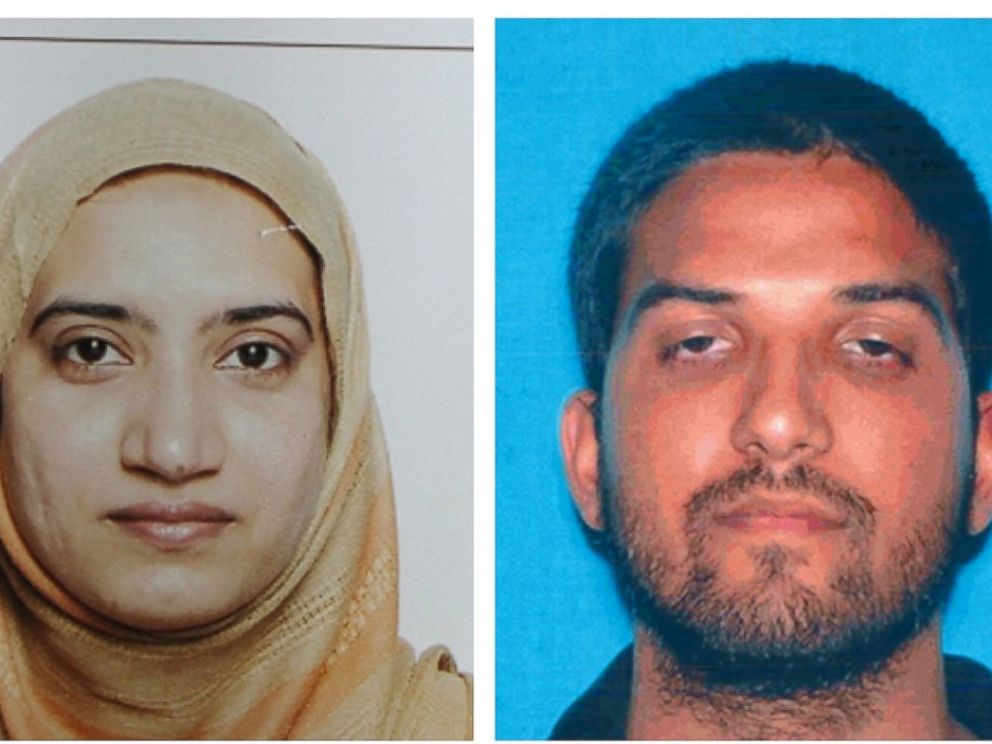
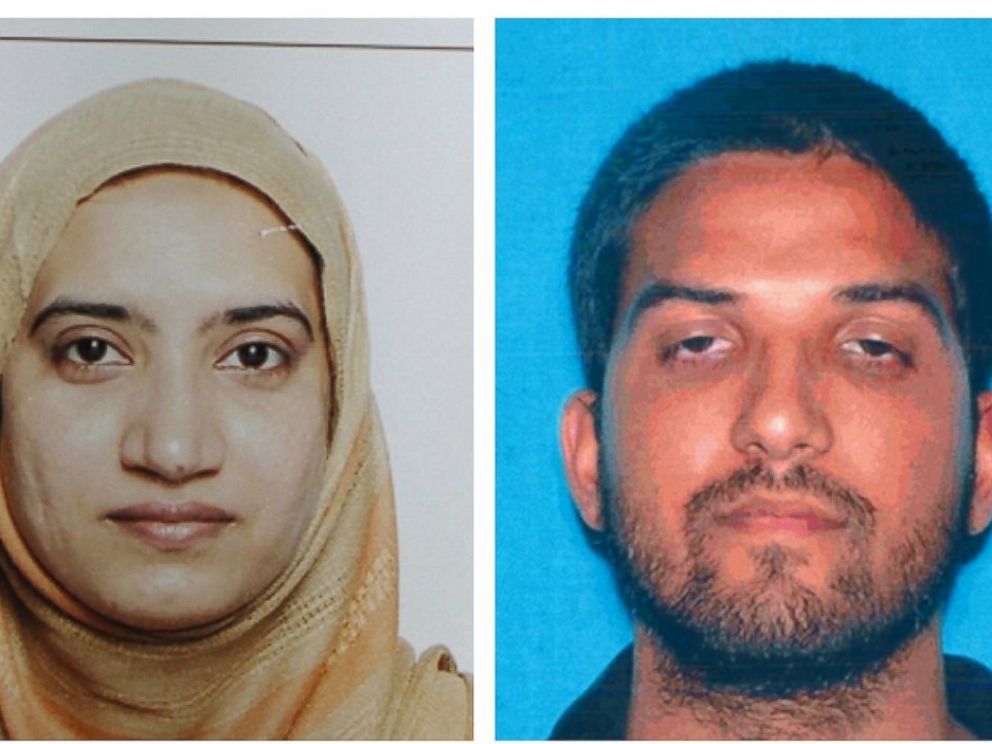
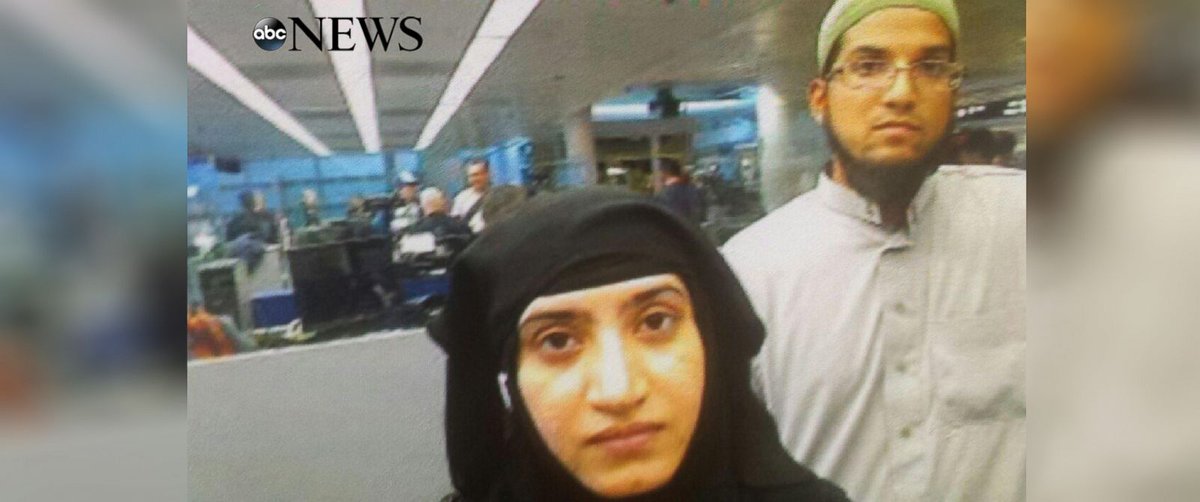
On December 2nd 2015 Syed Farooq Malik, a young
American of Pakistani origin (born in Illinois) was attending his workplace holiday party in San
Bernadino. He left the party early (it is not clear if there was an argument of
some sort before he left) and then returned with his wife, Pakistani-American
Tashfeen Malik, and the couple opened fire on his coworkers and left after 4
minutes. 14 people were killed, 21
injured. It has since emerged that the couple had 2 assault rifles, thousands
of rounds of ammo and several pipe bombs. They had also rented a Ford
Expedition SUV a few days before the attack and used it for the attack as well
as in the subsequent chase and confrontation with the police. Though they managed
to escape the scene of the crime, they were eventually shot dead after an
exchange of fire with the police. They had left their 6 month old baby girl with
her grandmother on the morning of the attack. Sometime after the shooting,
Tashfeen Malik also reportedly posted a “pledge of allegiance to ISIS” on her
facebook page.
It has since emerged that Farooq Malik had a “normally religious” upbringing but
had become “more religious” in the last two years. According
to his (estranged) dad, he was obsessed with Israel and “shared the
ideology of ISIS leader Abu Bakr al-Baghdadi”. And it seems that his wife was brought up in
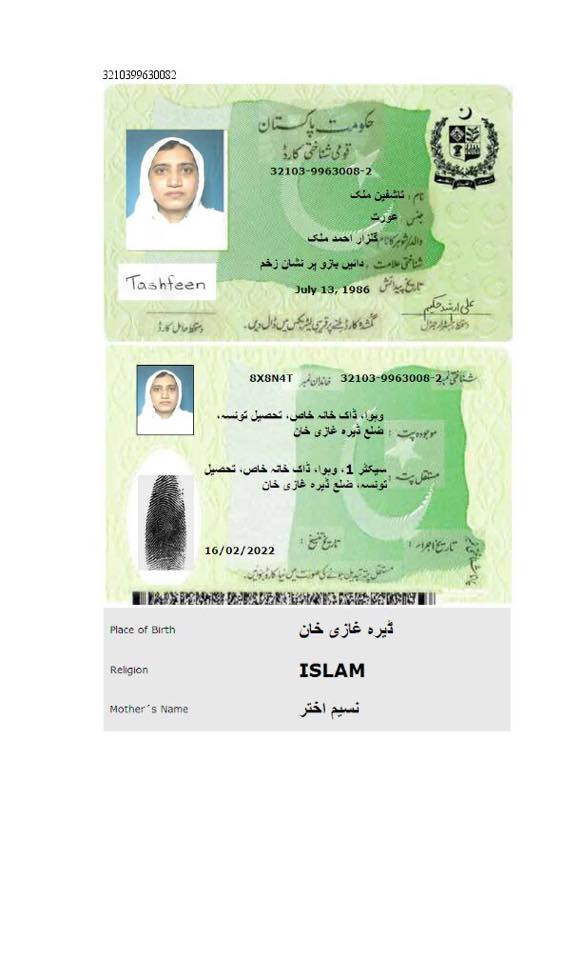
far more Islamist fashion than he was. Her father is a Pakistani who works in Saudi
Arabia and supposedly became “more religious” there. She lived in both Pakistan
and Saudi Arabia and was a full-time niqabi when she attended Bahauddin
Zakariya University’s pharmacy department.
After marriage, she did not show her face even to her father-in-law and
her brother-in-law and stayed in seclusion in her California apartment. She did
not attend the baby shower thrown by her husband’s coworkers (the same people the couple later went to
shoot) and it is very likely that she
was more “radical” than her husband. It seems likely that the two of them decided
to kill people because they wanted to strike a blow for their version of Islam,
but the actual choice of target (i.e. where a group of people would be murdered) may still have involved
some “workplace grievance” (though no convincing grievance has yet been revealed).
Reaction to the shooting has included some predictable
themes: Left-liberal Americans have tended to focus on the gun control aspect
and some (but not all) of them have downplayed the religious element (or at
least made the reasonable point that whatever the motivation for this
particular shooting, the high death toll was facilitated by the easy
availability of assault weapons in the United States). They are also pointing
out that Muslims commit a vanishingly tiny percentage of mass shootings in the US
and victims of “gun-violence” far outnumber the number of people killed in
terrorist incidents., etc. etc.
Right wingers meanwhile have focused completely on the Jihadi
terrorism aspect and deny that gun laws or the cowboy “pro-gun” culture of the
United States had ANY connection with the event. The usual suspects think Obama is “coming for
our guns” and is failing to take action against Muslim hordes bent on migrating
to America to blow it up.
“Moderate Muslims” either downplay (or deny) the Jihadist aspect, or
focus on the fact that the Jihadi-bride was “radicalized” in Saudi Arabia, the
supposed sole font of all Jihadism in contemporary Islam. Many Pakistanis back
home, mistrusting all “official accounts” and Western sources on principle, are
not even sure this happened as described and are happy to entertain conspiracy
theories that say this is probably yet another false-flag attack to “defame Islam”. Even senior anchors educated in the West are
ascribing this to “endemic American workplace violence” and “American
gun-culture”. And the Pakistani government has even tried to suppress media investigation of the Pakistani background of Tashfeen Malik. None of this is surprising, but a lot of it is wrong or only
half-true even on elementary inspection, so I thought I would try to put out
some of these facts and alternative viewpoints. I look forward to constructive criticism:
A. The Result of “American Gun-culture” or “Spontaneous Jihad”?
The short answer is “both”. I have no doubt
that Jihad was a major (in fact, primary) motive in this case, but easy
availability of guns surely helped. It is likely that a “self-starting” jihadist in a less “gun-friendly” society may
have had some difficulty obtaining 2 assault rifles and thousands of rounds of
ammunition. I emphasize “self-starting”
because (as the Paris terrorist attack makes clear), organized terrorist groups
(and organized criminals in general) can obtain very impressive arsenals even
in Europe, where gun-control is much stricter than it is in America. Mass
shootings in America are mostly “Black on Black gang violence” (and so occur
below the radar of Americans who live outside the specific neighborhoods where
such crime is commonplace. Most liberals only notice them only when they tote up the figures for “355 mass shootings in America this year”), but those that do make headlines tend to the ones
where more peaceful parts of the country are targeted by some shooter. Most of these are carried out by loners (some
motivated by right-wing militia type propaganda, most just motivated by
personal slights and paranoia, etc.) and it is possible that similar loners in
other countries may have some difficulty doing the same amount of damage
(Brevik in Norway being the obvious HUGE exception). A few have been carried out
by Muslims undergoing “spontaneous Jihad syndrome” (e.g. Fort Hood, Chattanooga) and it is possible that more gun-control may damp down the number of
casualties caused by such attackers. Certainly the London
subway stabber could have killed
more people if he had a gun, but then again, he may just have been a very
incompetent person. Muslims in China have managed to kill up to 170 people
using nothing more sophisticated than cleavers and knives. So a more detailed look does suggest that more gun-control may have made the shootings less deadly, but not
necessarily. In the short term, gun-control has very little to offer.
But in the long term it may still be
significant. Not because it will make guns disappear (it is almost impossible to
imagine that in a country with 300 million guns and porous borders), but because its
enaction would itself indicate a significant shift in America’s gun-happy culture. Countries like Canada are not gun-free, but they do
have a culture that does not glorify loners with guns and personal violence in
the way American culture frequently does. But this seems more significant if one has not yet corrected our second misconception. See next.
B. America’s rising epidemic of gun-violence.
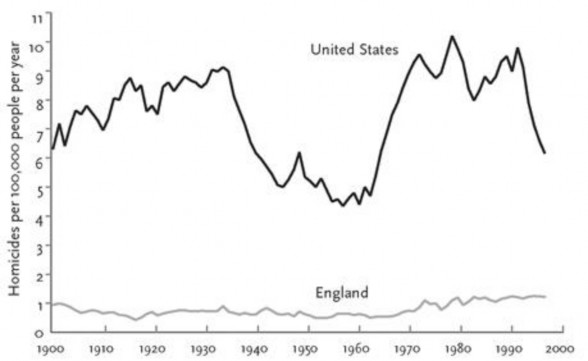
This one is obviously NOT true. Violent crime in the US
has been dropping steadily for decades and is very far below its 1970s peak (a
time no doubt remembered as the “good old days” by many people J). There are specific
areas (mostly inner cities) where violence is indeed horrifyingly endemic and
affects practically all citizens on a daily basis, but outside of those areas,
America is a relatively safe country (though this safety is associated with excessive police violence and truly horrendous incarceration policies). Even when taken as a whole (thus including
the inner cities in the figures) the US is not as safe as Denmark or Japan (poster-boy for monoculturalism by the way), but
it is not as violent as Mexico or Jamaica or even Russia and Lithuania! Especially of note, the crime
rate in “safe neighborhoods” (a large proportion of American neighborhoods) is in the much idealized European,
Canadian or Western European range. Media hype is a different matter.
C. Saudi Arabia and Wahabi Islam are the source
of Jihadism
Short answer: yes. Long answer, not
necessarily in the way you think. First for the theological issue; Wahab did
not invent the notion of pure Islam or the desire to kill in its name. The
Kharijites came up with the theological justification for killing Muslims who
are not sufficiently Islamic way back in the mid-seventh century CE. And
mainstream Sunnis of the classical age were insistent on the duty of Jihad
(though much less tolerant of the notion of killing fellow Muslims). Even the relatively
hard-line version created by Wahab owed much to the earlier writings of Ibn
Taymiyah and are not as far outside the realm of Sunni Islam as modern
apologists and Karen Armstrong-educated Westerners are prone to believe. More details in
this post I wrote earlier, but I will past some excerpts about the sources of modern Islamism here:
1.
Sunnis. These were the ones who thought the rising Arab empire was best led by the
consensus of the elite. They had a tendency to rally around whoever had managed to
fight his way to the top, provided he paid lip service to religion, patronized
the rising ulama class and (most important) kept his eyes on the ball as far as
managing and growing the empire was concerned. While Sunni clerics developed
what seems to be a theory of politics (who is a just ruler? who has the right
to rule? what do the people owe their ruler? etc.) on closer inspection it
turns out to be pretty much divorced from actual politics. Rulers and their
courts had more in common with past Roman, Persian and Central Asian traditions
than anything specifically Islamic. Rulers usually grabbed power by force. Dynasties rose and fell with little concern for theological rules.
No “Muslim church” acquired a tenth of the influence of the Roman
Catholic church. This tradition is not ISIS-like in detail, but it also paid
lip service to ISIS-like ideals that ISIS can and does fling in the face of “court
clerics” who happily go along with whoever happens to be the ruler. Sunni tradition is not ISIS in practice,
but it trains and teaches children using ideals that ISIS may aspire to more
strongly than the Sunni rulers do themselves. This hypocrisy-crisis is a recurrent
feature of modern Islamicate politics. And it is the reason why “moderate
Muslims” (aka mainstream Sunnis) regularly fall prey to “Wahabism”. They are
not falling prey to a new religion, they are falling prey to a more distilled
and internally consistent version of what they have been taught as their
own religion.
2.
Shias. Those who felt there was something special about the family of the
prophet and in particular, the family of Ali and developed theologies that
included varying combinations of the charismatic Imamate and its heritage of
revolt against Sunni authority. Since Shias are a majority in only a few
places, (most important, Iran) and their history includes long periods of
conflict with mainstream Sunni rule, they are more or less immune to the appeal
of Sunni revivalists, whether they are the milder Maudoodi types or the harsher
ISIS types. They have set up their own theocracy in Iran (much more effectively
so than any Sunni revivalist has managed to do) but they are not ISIS. For the purposes of this post
(i.e. for outsiders who dont have to live in Iran), they are “objectively
liberal”.
3.
Khwarij. The Khwarij insisted that neither the elite, nor the family of the
prophet had a special right to rule. Only the most pious, the most thoroughly
“Islamic” person could do that. Muslims who committed major sins or
failed to meet their standard of Islamic fervor were as much the enemy as any
infidel. Even more so in fact. The Khwarij were always small in number and they
were repeatedly defeated by both Shia and Sunni rulers, but their tendency has
never completely gone away. Something within Islamic tradition keeps them
alive. Mainstream Sunnis may pay only lip service to Jihad and the
harshest punishments of shariah law (particularly in modern times), but these
ideals are present in their theology.
And ideals can effect some people. True believers
arise, and in times of anarchy and state collapse, they may be the lowest
common denominator, providing a framework around which the asabiya of Islam can
cohere and in which the community can see hope for a return to a
commonly-imagined (though mostly imaginary) golden age.
Groups like the Wahabis, Lashkar e Tayaba,
the Taliban and ISIS are simply combining the waters of 1 and 3, usually with
more 3 than 1. But they are NOT relying on some new ideology invented out of
whole cloth by Wahab or some other evil Saudi. They are (in their own mind and in the mind of many idealistic Muslims)
simply purifying actually existing Sunnism.
Just as an aside: What about Sufism? In many cases Sufis can simply be described
as mainstream Sunnis with mystical or humanistic instincts; trying to get the
most good out of religion while leaving out most of the imperialist and
legalistic baggage. In some cases, they
may be more akin to a secret society (like the Freemasons), influencing much
from behind the scenes, but by definition, it is not really easy to disentangle myth (and self-promotion)
from shadowy reality in this scenario. In other cases,
they may think of themselves as the
perennial philosophy, operating within Islam as it operates in all true religions.
And in some cases, they are hardline Sunni Jihadists with a “master and novice”
framework added to it, rallying the troops for holy war and conversion of the
infidels. Take your pick. But do remember that Sufism is not really a sect with any single reasonably well-defined theology.
Second,
and equally important: the Saudi Royal family is not the source of religious ideology in Saudi Arabia. They allied with
this religious movement to gain power, but at crucial points, they have been
willing to go against the wishes of their Wahabi base. It is the people of Najd
(the wahabi heartland, so to speak) and specially their religious scholars, who
are the real fanatics in Saudi Arabia. A democratic Saudi Arabia would likely
be more Wahabist than the royal
family. Incidentally the main oil reserves are located in
the (relatively small) Shia region of Saudi Arabia. This region became part of
Saudi Arabia by conquest (not by
imperialist manipulation or “Sykes-Picot”; Brown people have agency, their leaders can
conquer people too). American companies (invited in by Al Saud because he, quite rationally, feared the British imperialists more) found oil there. Soon the world war accelerated oil demand and the US became an ally of the
Saudi Royal family, which it remains to this day. For a long time, the US ignored and
sometimes (most egregiously, in
Afghanistan and Pakistan) actively encouraged the export of Jihadist Islam
from Saudi Arabia. This was short-sighted and morally wrong, but it was based
on a serious under-estimation of the potential of jihadism as an ideology, as
well as a prioritization of anti-communism over good sense. Note that contrary to Eurocentric Left-wing propaganda, Saudi support for pan-Islamic causes was not primarily initiated by the US. It was the “push” of their own religious motivation plus the “pull” of demand for pan-Islamism in newly minted “Islamic” countries like Pakistan that drove most of this effort .
In any case, I really do not see
the US as actively encouraging this process after
9-11. The Saudi Royal family has also slowly
(too slowly for most of us) moved away from unrestrained support for the most extreme international Jihadists, but continues
to support many Islamic causes worldwide (not just Wahabi causes, but mainstream Sunni causes that it hopes to coopt) and continues to support “moderate Sunni Jihadis” in their regional war against
Shia Iran and its allies. And of course, they continue to impose ISIS-like
punishments (cutting off hands and feet, beheading etc) for crimes including the crime of apostasy
(all of which are a standard part of mainstream Sunni Shariah, and that
therefore have the theoretical, but
not always the practical, approval of mainstream Sunnis). This causes many liberals in
the West (and elsewhere) to insist that the US should break its alliance with
Saudi Arabia and even bomb them. But
what happens then? Will they become less jihadist or more? And who gets the oil?
Iran? Russia? China?
The point is this: there is a quick and direct way to
weaken Saudi power and the hardline shariah-based Islam they encourage, but it
requires taking the oil away from them (since oil wealth is the source of their
power). This can be done. The local population is historically Shia. Maybe Iran can capture the oilfields and set up a Shia-client state and defend it
against Saudi attack? Or Russia Or China can do this job? Or the US can do it
itself; but such a grab would be a naked imperialist military intervention, and it would surely require shooting any Wahabi who shows up in the oil-region. There is no pretty
way to do it. If the US just breaks off relations, the Saudis will look for a
new protector. Pakistan, China, maybe even Russia could be tempted. But Jihadism does not come solely (or now, even mostly) from the US alliance, and will not go away if that
alliance breaks. It likely can be moderated if the Royal family is pressured,
but it will be moderated against the wishes of the people of Saudi Arabia, not
on their behalf. And it will be moderated by an authoritarian regime willing to
use torture and violence to impose its will on a hardline Islamic population
(at least in the Najdi heartland). If all this is not clear, then the appeals
to “break off our alliance” are just liberal posturing and virtue-signaling,
not real policy.
By the way, any such invasion and
occupation to impose liberalism and good 21st century behavior would
also invite the ire of all pro-Shariah-true-believer Sunnis in the world. Prepare
for that too. Otherwise, the Royal family is the best bet in Saudi Arabia and
that is simply the ugly unpalatable truth.
D. Any Muslim can become radicalized and fall
victim to spontaneous jihad syndrome at any time.
This is the right-wing fringe’s mirror-image of the
liberal belief that Islam never causes jihad and all of it can be explained by “inequality”
or “Sykes-Picot” or some such story. Both
mirror-images are clearly false. The real situation is that we can look at the Muslims of the world and
see several disparate groups; Shias, Ismailis and Ahmedis are outside the Sunni
Jihadist universe and so are not going to spontaneously take up arms in the war
between shariah-based Islam and other civilizations. They are all relatively small minorities, but
they are the most obvious examples of “Muslims who will not get radicalized and
join the Sunni Jihad, foreign policy, Israel, Sykes-Picot and Picketty notwithstanding. These supposedly powerful motives for hating America will not cause these groups to go postal. There is a lesson in there somewhere.
Coming to Sunni Muslims, we have a very large number are “moderate
Muslims”, which is shorthand for Muslims who were not brought up in
shariah-compliant households and who do not practice that kind of Islam. Their numbers vary from country to country, but one
can say with a lot of confidence that they are not spontaneous jihad material
either. They can covert, but it is a slow process, it is observable and even preventable (if they are kept away from hardline preachers). Then there are the shariah-compliant Muslims who believe that the Shariah’s
orders for Jihad are meant for very specific situations where a Sunni state has
declared Jihad and those situations (fortunately) do not exist. So they get on
with life in all parts of the world. Many of them are model citizens because they
avoid intoxicants, deal honestly and follow the law. A very tiny fraction of
them may “radicalize” but most will not. The same applies to converts. So yes,
about these (small) groups one may say “they can radicalize” , but very rarely. And even then, there are warning
signs and it is never an overnight process. Finally, there are the true-believer
Jihadists. They have obvious links with Jihadist schools, groups and teachers. They are
small in number and they are not hard for the community to identify, if is so chooses. And they are indeed high risk. Liberals see none of them,
right-wingers see too many. Both are wrong.
I guess what I am saying is that notions of Muslim hordes just waiting for a chance to attack are far outside the bounds of reality. Common sense can actually be a guide here. There is
no need to throw the baby out with the bathwater and equally there is no need
to be willfully blind to warning signs. Biased agenda pushers on BOTH
sides of this debate have obscured common sense options. And while Liberals may
underestimate or misrepresent the threat from radical Muslims, conservatives frequently generalize the threat to all Muslims.
Last but not the least, all
nutcases cannot be stopped beforehand. Some surprises will always happen in a large and complex society . There
is no risk-free society, with or without Muslims. But this is not World-War
Three. Not in the United States. In parts of Europe the proportion of jihadists is likely higher (for various reasons, including racism and multiculturalist liberalism). Meanwhile, in the core of the Muslim world itself, all bets are off. There is no
well-articulated theology of liberal Sunnism. Other organizing ideologies (like
Marxism and pan-Arab nationalism) have manifestly failed. The authoritarian regimes that exist are (for now) the only game in town. These authoritarian elites, who disproportionately
benefit from the modern world, impose their will using a combination of force, persuasion and foreign support.
But they lack a deep legitimating ideology. This crisis of ideology is extremely
serious, and it may devour some of those countries (though the survival of Jordan is a good example of the fact that even the most arbitrary modern states have more strength than we sometimes imagine). Those Muslim states that are further away from the Arab heartland (and the Israeli-Palestinian conflict) may do better. They can frequently rely on other identities to maintain the legitimacy of their states and new Islams can arise in them with time. But even they will not be compltely free of Jihadist conflict. No state is completely free of conflict of course, and many conflicts unrelated to Islam or Jihad could easily kill millions and destroy whole countries. But predominantly Islamic countries do have the added burden of the conflict of Classical Islamic ideals with modern civilization (not justWestern civilization), and it will take time to resolve this conflict.
Hold on tight.
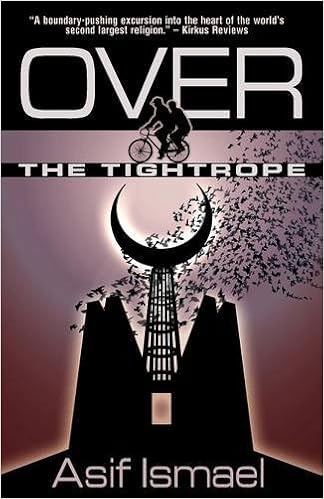
Brown Pundits Archive · November 23, 2015 · Comments Off on Review: Over the Tightrope
PS: the book is free to download on kindle on Monday and Tuesday 11-23 and 11-24
http://www.amazon.com/Over-Tightrope-Asif-Ismael-ebook/dp/B017MF6OXC/ref=sr_1_2?ie=UTF8&qid=1447012857&sr=8-2&keywords=Over+the+Tightrope+kindle
Asif Ismaeel’s debut novel mixes dystopian science fiction, sufism, politics, humor and Salafist Islam to create a stunning and unexpected joy-ride through post-apocalyptic (or is it pre-apocalypse?) Pakistan in 2050. Of course it is now called Al-Bakistan, since the blessed Arabic language does not have the letter P, and it is ruled by a Khalifa who established law and order after the proletariat rose in revolt and decapitated the ruling elite in a paroxysm of rioting and holy war a few years earlier.
When our hero flies back after 12 years to see his father, the Latvian air hostess asks if he wants to sign a Shia contract for sex during the flight or will he be flying Sunni, no paperwork needed? Naturally he replies “lets fly Sunni”. From the beard-length check at the airport to watching a murderous game of cricket between the karbala cats and the wahab squad, everything is familiar but surreal; as his driver says “not the original Western style game meant for sissies..”.
Gangs of enforcers (Commaqadis, from Commando and Qadi) patrol the streets with portable hand choppers, cats attack dogs (who are almost extinct in the Islamic state, as expected) and the hospital has a sign saying “death will come at the appointed hour”. Moved by mysterious forces (and perhaps by mind-altering substances) our hero goes to meet Pir Pul Siraat, bicycles over hell on a thin wire stretching to infinity, meets the fallen angel Fukraeel and visits paradise. As his mission unfolds he finally reaches Islamabad and attends a most unusual Friday prayer at the Faisal mosque that ends with the world’s most life-saving application of phototherapy and the redemptive power of the Quran. The book never flags and the ending, while somewhat expected, is not without its Sufic twist.
Readers familiar with Pakistan and Islam will get many of the inside jokes (from Bihishti Tea Corner in paradise to the Intiqaal lounge and the arrival of the Ababeels), but any intelligent reader can expect to laugh out loud at the most unexpected places. This is not serious literature and “complex characters and plot development” are not what it sets out to present. But what it does promise (and deliver) is a smart satire of literalist Islam and the vision of a dystopian future that is not as far from reality as we may wish. A worthy debut!
Excerpt:
If I survive
this life without
dying, I’ll be surprised.
—MULLA NASRUDDIN
“…Without saying a word, he opened his glove
box and took out a round, palm-sized object.
It was a clasped knife.
He pressed its one end and
an evil looking blade sprung out. I could tell it was razor sharp and
the thing must have been as long as my forearm. I jerked back in my seat,
eyes bugging wide open.
Wali turned toward me and grabbed a hold of
my collar. His eyes bulged; two
angry pools of black fire. Without a word he pressed the sharp cold steel against
my sweating throat.
I tried hard not to swallow.
“Wali, what’s wrong?” I sputtered. “What’s
happened to you? Take it easy buddy, relax,”
I pleaded. The whole thing was way too freaky and
had happened so fast I barely had time to register the shock.
“You have uttered the name of You Know Who without the saluta- tions; and, and—this is a
terrible crime that’s punishable by death,” he groaned, pressing the blade
harder against my throat.
“Wali, come back to your senses man!” I barked.
“What’s wrong? Come on; let’s get going, look, the light’s
green. Let’s go, please. We can
talk about this over a cup of tea in the Fortress
Stadium. I can explain.” I hoped
to have sounded
convincing and unfazed
by his sudden outburst but, inside,
I was tasting my first
dose of real fear since
I landed.
Sweat poured from my forehead as I recalled
my father’s words: ‘You’ll be safe with Wali. He’s the only one I trust who can deliver you safely to my house.’” I also recalled
his warning me not to speak with Wali about religion
under any circumstances.
“I’ve beheaded four idiots like you,” he bellowed. “I did
it right here where you sit on your stupid butt; and you will be
my fifth,” he said. The traffic
light had turned
red again.
“Aren’t you done then? I mean, four’s a
pretty decent number. Come on, Wali, be cool buddy,” I said, hoping this
nightmare would end soon. “My father’s not going to like it if you kill me.”
“Mufti Sahib says, if I can personally behead
seven kafirs in total, my place will be assured
in the highest Heaven,” he said, his eyes glazed and his face flushed with
exultation. He wasn’t the same Wali who’d picked me a few minutes ago at the
airport. He started looking crazier by the minute.
“It’s been getting
more and more difficult to encounter enemies
of faith like you,” he continued, not even looking
at me in the eyes. “As far as your father is concerned, he’d be
glad to see you killed after what you’ve done. He wouldn’t even attend your funeral.”
“Wali—please! Have mercy. I’ll do anything
you say. Remember that old hag?” I said, suddenly recalling
something that might break his concentration.
“That old woman who used to throw trash on You Know Who’s
head every time
he’d pass by her house.”
Without a word Wali withdrew
the knife from my neck and laid it
in his lap though he continued to hold his face close to mine and looked into my eyes. The terrifying fury
that seconds before distorted his face had melted like ice.
“So you know the story?” he asked, his voice
normal and composed. “Then you damn well know that the story
of the hag cost me the
seventh Heaven!” he roared with
renewed fury.
“Fifth, Wali, fifth,”
I corrected him.
“You gotta get to fifth before getting to the seventh.”
Brown Pundits Archive · November 19, 2015 · Comments Off on Why do Muslims Blow Stuff Up?
Indian secular commentator Harbir Singh Nain has a nice piece in the Nation (a Lahore newspaper that has shifted from jingoistic Islamism to hosting the most “free-thinking” blog posts of any major Pakistani paper; there is probably a story in there somewhere). The entire piece is here, but a few excerpts give you the flavor:
Again I hear talk everywhere that Islamist terrorism is a reaction to Western imperialism. It’s supposedly got nothing to do with radical Islamists. I have to wonder if why Korea and Vietnam didn’t start pumping terrorists into the world as an aftermath of the horrendous wars there, why oil producers in South America and Sub-Saharan Africa didn’t start pumping terrorists into the world in reaction to western meddling there.
The cause is Saudi Arabia, which has used its oil revenues to drive fundamentalist radicalization of Muslim societies all over the world, infesting them with mosques and seminaries that disseminate Saudi scripted fundamentalist, hateful perspectives. Every major Muslim terrorist organization in the world is connected to a web in the center of which sits Saudi Arabia..
The West is not without fault. But it is dishonest to assert that the Islamist terrorism is merely a backlash to Western foreign policy. The other party at the table is radical, oil fed fundamentalist Islamism.
In the West, after every instance of slaughter by a crazed Islamist, liberals run to call for tolerance towards ordinary Muslims innocent of the crime. It is the West that welcomes immigrants from Muslim countries and guarantees their freedom to practice their faith and to live their lives without persecution. It is the West that makes peace with its former enemies at the first opportunity. See the relations of Germany, Japan, Italy, Vietnam, and South Korea with the US. The West welcomes immigrants en mass from enemies, both former (Russians flooded into the US after the collapse of the Soviet Union) and present (so many Iranian students in the US). It is the West that takes in Muslim refugees escaping from slaughter by Muslims as has been seen by the flow of Syrians into Europe.
Meanwhile Saudi Arabia and the Emirates have not opened their own borders to the faithful fleeing the slaughter. There is no call in the Middle East for understanding and tolerance towards the West and non-Muslims. There is no voice allowed to call for moderation of Islamist hatemongering, to curtail the raging hatred that constantly spews out against the West…
These are actually fairly common sentiments among liberal Muslims and Hindus (and presumably, many others). I don’t have time for a full post, but a few comments came to mind:
South Americans, as colonial settler nations with a history of conquering Native Americans and owning more slaves than the United States, are not exactly in line for the honor of being oppressed subjects of the West. (though good branding and anti-Yankee propaganda has pretty much cleared their elites of their colonial/slave-owning past, especially amongst distant observers).
Korea was not colonized by the US. South Korea was saved from Stalinist North Korean invasion by the US and its allies. They are not exactly grateful (more anti-American than the Vietnamese, for complicated reasons) but still they are hardly expected to be in the “lets bomb America now” section.
Vietnamese holds pride of place in Desi Leftist minds as victims of America (with some justification), but the Vietnamese themselves include (and always included) significant pro-American factions, and since the Americans left, their priorities are very different from the kind of unrelenting anti-Americanism that Desis sometimes feel they should have… Details complicated, I know.
But here is the point I really wanted to make:
I heard (more than 10 years ago) from an Islamist historian (PhD U Chicago) that the correct way of looking at lack of Hindu or African Pagan blowback is to regard them as weaker civilizations, unable/unwilling to contend for world-beater status (Hindutvadis are trying, with limited success, to alter this perception btw). His point was that Islamists sending terrorists and throwing bombs maybe wrong (in his opinion, it was wrong) because it may be tactically harmful to their cause or it may be morally unsound (he was not in favor of indiscriminate slaughter), but on the general point of fighting against the West, he thought the crucial difference is that the Islamic world represents real civiliazational competition; challengers who think they can and SHOULD fight in the big leagues…while Hindus and Africans are just waiting to be converted to more successful ideologies and are “not even invited to the party”.
In short, that Muslims are different, but not in the way you think: they are not different in being more bloodthirsty (he believed, as a historian, that ALL great powers and dominant civilizations have been blood thirsty) but in thinking of themselves as a potential world power, not just “subalterns”.
I think he was wrong (i.e. the world is not best described by the kind of clash of civilizations he subscribed to, and the Muslim world is in no position to challenge as some sort of outsider civilization, distinct from what Naipaul famously dubbed “our universal civilization”).
But one should not think that sophisticated Islamists themselves have no such ambition.
Finally, the oil-kingdom and wahabiism are indeed proximate causes of the Jihadi upsurge, but they succeeded not just because they paid people (the US has paid billions for “counter-jihadist” propaganda, with little noticeable impact) but because their ideology couldbe presented as the logical culmination of classical Islamic themes. Which is why educated (therefore more susceptible to “logic” and rational argument) believing Muslims in Pakistan so frequently gravitate to Maudoodi-like figures, even if their own families were Barelvi/Sufi/grave-worshipping/Indian-inflected “moderate Muslims” just one generation ago.
I hope to write more later to expand on this point.
Brown Pundits Archive · November 16, 2015 · Comments Off on Paris, Islam, ISIS and Sykes-Picot. Random Thoughts
The latest Islamist-terrorist atrocity hit the news on Friday with a Mumbai-style attack on the city of Paris. The same group (ISIS) has recently bombed Ankara, a Russian aircraft and a civilian neighborhood in Beirut. But as expected, the strike in Paris got the most attention (not inappropriately so, in my opinion). It was a typically brutal operation. Ordinary civilians going about their pleasure in one of the world’s great cities were targeted in Restaurants, outside a football stadium (when the suicide bombers could not get in), on the streets and, most cruelly, while watching a death-metal concert. Most of the casualties occurred in the concert hall, where the terrorists managed to get into a location with a large number of innocents gathered in a confined space. They shot and killed calmly and ruthlessly and without any hint of pity or common humanity. When the police burst in, the killers blew up their suicide belts to shower those around them with ball bearings in one last atrocity before they departed to what they no doubt expect will be a land of milk and honey, suitably supplied with virgins so fair and delicate that their bone marrow will be visible. It takes all kinds.
Several interactions on twitter (@omarali50) revealed a few common themes and I thought I would expand on some of those brief comments and get some feedback. It’s one way to learn.
1. Is ISIS Islamic?
Short Answer: Yes
For a “secular observer”, this is a no-brainer. The secular (and even more so, religious) outsider obviously does not believe in any particular version of Islam as the one true faith, etc etc. To them, Islam is (or should be) whatever any Muslim claims as his religion (this obviously means that for any such observer there is no one Islam, there are many Islams). To such an observer (if he or she is well-informed), Islam is a religion that started in Arabia, took up very notable strands from Rome (aka Byzantium), Persia, Judaism, etc and evolved into many different schools and sects. An exceptionally well-informed observer could indeed comment that ISIS does not replicate the dominant Sunni theology of the Ummayads or the Abbasids and has more in common with the relatively small Kharijite tradition, but even so, it would be the height of “Whitesplaining” for, say, professor Juan Cole to step in and deign to tell Syrian and Iraqi Muslims in ISIS that they are doing it wrong and their Islam is not “real Islam”. The appropriate answer (and this is exactly the answer many different Jihadist groups have given) is “WE know what Islam is and you dont have to come down from Michigan to tell us what our religion should look like”. To sum up: well-informed outsiders can indeed note that ISIS is more like this, less like that; not representative of ALL Muslims (who is?), not representative of all Muslim states, not typical of all Islamist movements, etc. But for Bush or Blair to announce that ISIS is not really Islamic carries no weight. Islamic is what Islamists think is Islamic. THEY disagree among themselves, giving rise to many different Islams, Some represent bigger groups and larger sects, some are small cults, but all are Islamic.
For the believing Muslim, the answer depends on what sect/group/tendency they believe in. If their sect/tendency regards extremely vicious and extremely literalist Islamists as unislamic, more power to them. But some of them do indeed regard ISIS as Islamic (as is obvious from the thousands of Muslims (including neo-converts) who have flocked to the banner of ISIS in recent years. Others regard them as mostly Islamic, but occasionally doing things that a good Muslim would not do. This group is not trivial in numbers. Finally, countless others hold no firm opinion, but waiver between admiration of some acts and total opposition to others. Humans have complicated loyalties and psychologies. Would it surprise anyone (or at least, anyone not educated in the current Western postmodern left-liberal “tradition”) that a Palestinian or a Turk or a Pakistani may hold internally contradictory views on ISIS; sometimes admiring their deep faith and readiness to fight for Islam, even against overwhelming odds, other times cursing them for their cruelties, and last but not least, at other times worrying about what ISIS’ actions may do to his or her job prospects, visa status or college prospects. We are all human.
My own view: ALL of Islamic history is characterized by a struggle between three political-theolgoical camps that all appeared fairly early in the rise of the Arab empire and the Islamic religion (the two, empire and religion were obviously intertwined and interdependent):
1. Sunnis. Those who thought the rising Arab empire was best led
by the consensus of the elite, with a tendency to rally around whoever had
managed to fight his way to the top, provided he paid lip service to religion,
patronized the rising ulama class and (most important) kept his eyes on the
ball as far as managing and growing the empire was concerned. While Sunni
clerics developed what seems to be a theory of politics (who is a just ruler?
who has the right to rule? what do the people owe their ruler? etc.) on closer
inspection it turns out to be pretty much divorced from actual politics. Rulers
and their courts had more in common with past Roman, Persian and Central Asian
traditions than anything specifically Islamic. Rulers usually grabbed power by
force, then tried to pass it on to their children rather than some ideal
“just ruler”. Dynasties rose and fell with little concern for
theological rules. No “Muslim church” acquired a tenth of the
influence of the Roman Catholic church. This tradition is not ISIS-like in
detail, but it also paid lip service to ideals that ISIS can and does fling in
the face of “court clerics” who happily go along with whoever happens
to be the ruler (from King Hassan to Hussain to Salman..and even Sisi). Sunni
tradition is not ISIS, but it trains and teaches children using ideals that
ISIS may aspire to more strongly than the Sunni rulers themselves. This
hypocrisy-crisis is a recurrent feature of modern Islamicate politics. And it
is the reason why “moderate Muslims” (aka mainstream Sunnis) regularly fall
prey to “Wahabism”. They are not falling prey to a new religion, they are
falling prey to a more distilled and internally consistent version of what they
have been taught is indeed their own religion. Classical Sunni ideals overlap
with modern Jihadist ideology, their true-believers tend to find Wahabism
attractive.
2. Shias. Those
who felt there was something special about the family of the prophet and in
particular, the family of Ali and developed theologies that included varying
combinations of the charismatic Imamate and its heritage of revolt against
Sunni authority. Since Shias are a majority in only a few places, (most
important, Iran) and their history includes long periods of conflict with
mainstream Sunni rule, they are more or less immune to the appeal of Sunni
revivalists, whether they are the milder Maudoodi types or the harsher ISIS
types. They have set up their own theocracy in Iran (much more effectively so than
any Sunni revivalist has managed to do) but they are not ISIS. For the purposes of this post (i.e. for outsiders who
dont have to live in Iran), they are “objectively liberal”.
3. Khwarij. The Khwarij insisted that neither the elite, nor the
family of the prophet had a special right to rule. Only the most pious, the
most thoroughly “Islamic” person could do that. Muslims who committed
major sins or failed to meet their standard of Islamic fervor were as much the
enemy as any infidel. Even more so in fact. The Khwarij were always small in
number and they were repeatedly defeated by both Shia and Sunni rulers, but
their tendency has never completely gone away. Something within Islamic
tradition keeps them alive. Mainstream Sunnis frequently pay only lip service
to Jihad and the harshest punishments of shariah law (particularly in modern
times), but these ideals are present in
their theology. This theology that was rarely an impediment to statecraft
and its priorities in the actual golden age of Islamic imperium, but it still
paid lip service to those ideals. In fact, the more divorced it was from actual
politics, the more it could fly off into discussions about the ideal ruler,the
ideal law and the ideal Jihad, all un-encumbered by any contact with reality.
But ideals can effect some people.
True believers arise, and in times of anarchy and state collapse, they may be
the lowest common denominator, providing a framework around which the asabiya
of Islam can cohere and in which the community can see hope for a return to a
commonly-imagined (though mostly imaginary) golden age.
Groups like the Wahabis, Lashkar e Tayaba,
the Taliban and ISIS are simply combining the waters of 1 and 3, usually with
more 3 than 1. But they are NOT relying on some new ideology invented out of
whole cloth by Wahab or some other evil Saudi. They are (in their own mind and in the mind of many idealistic Muslims)
simply purifying actually existing Sunnism (with its tendency to compromise
with realities).
In fact, even reformers who have some mainstream cred can drink quite a bit from #3 in this age of Western domination (perhaps to be replaced soon with mixed Chinese AND Western domination, but still with no Islamic empire in sight); see Maudoodi, Syed Qutb and others. Not as far from ISIS as you may wish.
Just as an aside: What about Sufism?
In many cases they can simply be described as
mainstream Sunnis with mystical or humanistic instincts; trying to get the most
good out of religion while leaving out most of the imperialist and legalistic
baggage. In some cases, they may be more
akin to a secret society (like the Freemasons), influencing much from behind
the scenes, but by definition, not really
easy to disentangle myth (and self-promotion) from shadowy reality. In other cases, they may think of themselves
as the perennial philosophy, operating
within Islam as it operates in all true religions. And in some cases, they are
hardline Sunni Jihadists with a “master and novice” framework added to it,
rallying the troops for holy war and conversion of the infidels. Take your
pick. But in any case, Sufism is not really a sect with one reasonably well-defined theology.
This post is not really qualified to go too deeply into what religion (any religion) may mean (and may do) to those struck by epiphanies on the road to Damascus. That whole issue is alluded to here by the always erudite Tanner Greer. Hopefully, he will have more to say in a longer post soon.
2. Does Islamist Terrorism have anything to do with Islam?
In light of the above, one answer would be: of course not. There IS no one thing called Islam. There are many Islams. And most of them are not terrorist. Case closed.
But, again in the light of the above, one may also say that mainstream Sunni Islam is remarkably uniform in its theology and its ideals. The vast majority of the world’s Muslims are Sunnis. Within Sunni Islam, there are four recognized schools of law. In principle, the vast majority of Sunnis honor and respect these schools and their doctors. The vast majority has no idea what is IN those schools or in the writings of their doctors, but they honor them and idealize them. It is very common for educated Muslims to own a book or two of fiqh and hadith. Rarely read, but always honored. A small minority of highly westernized postmodern Muslims believe that those medieval books and their authors are no longer valid for us and Islam (like modern Christianity) is more or less “spiritual” and can (or should) be whatever a believer sincerely thinks it is. Even these postmodern Muslims frequently believe that the Quran is the inerrant, literal word of God, but given that most classical Islamic theology is not lifted straight out of the Quran, they feel they can safely reject aspects of classical theology that are no longer fashionable. That they have usually not read the Quran makes this kind of cherry-picking even easier. But as numerous public opinion polls have repeatedly shown, most Sunni Muslims do not share this postmodern view of their religion. Whatever they may do in practice (and they frequently do exactly what adherents of all other religions are doing in similar econcomic and political circumstances; the much-mentioned “Muslims who just want to have a sandwich and send their kids to good schools”), they do believe that Islam is more than just an identity token. They believe it is “a complete code of life” and if enforced in its true letter and spirit, it holds the possibility of reversing all our communal ills. And what is that letter, if not that spirit? it is the books of Shariah written by medieval Sunni theologians. Books that were composed in the midst of a warlike expanding empire by confident intellectuals of a dominant creed. Books that idealize holy war (not “inner struggle”, Karen Armstrong notwithstanding) and a society where Muslims rule and non-Muslims know their (inferior) place in society. Books that idealize pious rulers and the enforcement of shariah law (stonings and amputations included). Books that idealize martyrdom and war against the infidels. Books that prime some of them to fall for preachers who preach purity and a true Islamic state. Only some of them. But that is enough. A convert from France felt strongly enough about this to sacrifice his own life in a suicide mission that aimed to kill random innocent Frenchmen. Well, not innocent in his eyes any longer.
So yes, classical Sunni Islam tends to prime some people for joining Jihadist organizations (whether ISIS or LET or Islamic Jihad or any other of an alphabet soup of Jihadi groups) and committing atrocities with a good conscience. See the ten young men who went to Mumbai on the first “Mumbai-style attack”; what motivated them to go on that suicide mission? Nothing to do with Islam? I think is hard to say that with a straight face..
Unless you happen to be in the postmodern Western liberal elite, in which case you may suffer from what Tanner Greer calls “the limits of liberal education in the 21st century, far better at teaching platitudes than exploring the depths of the human condition; and the inability of secular elites to understand religion and the religious masses who earnestly believe in them…“
3. George Bush/Western colonialism/imperialism is responsible for this attack.
Short answer: Yes.
Long answer: Yes, But.
It is true that the rise of Western power and the defeat of the Ottomans in the first world war created the modern middle east. And it is a staple Western left-liberal talking point (picked up and used by Islamists and by other imperial powers like Russia as needed) that British and French imperialists created the modern Middle East via the Sykes-Picot agreement and messed it up, leading to all or most current problems.This is obviously not true in any strong sense. Britain and France did not look at some blank piece of paper and convert it into the modern Middle East. They grabbed and missed opportunities galore (as did the Turks, who chose the losing side in world war one when they may not have had to do any such thing), worked around existing populations and structures (many of them Imperial Ottoman in origin), argued and tried to double-cross each other before and after Sykes-Picot, were resisted by new forces, adjusted to the results of world wars and local wars, and so on..in short, history happened; not just two people meeting and making up what they wanted and determining all that has happened since then. But let us leave details for another day. Let us use Sykes-Picot as short hand for the modern post World War II Middle Eastern system of nation-states that arose after the brief British and French colonial interlude, primarily (but not always) under the control of local elites groomed or put in place by those two powers.
These elites ruled what were formally (if not very deeply), “Westphalian” nation-states on the “European model”. What that means and why that is so bad (or such an improvement) over past models is another debate we can leave for another day. But the modern Middle East came into being. The states that were created were like most postcolonial states, a mixture of past divisions and new creations, some of them more arbitrary and artificial than others (Pakistani nationalists, take a bow).
Israel was the obvious outlier. With a more Westernized/modern population and with a direct (and at least temporarily, mostly sympathetic) connection to the Western world, it was an order of magnitude more capable (in terms of knowledge, organization, sophistication, ability to fight) than it’s unfortunate neighbors and it’s own aboriginal inhabitants. Even though the physical infrastructure of the state (and the weapons it was able to acquire) were not (at least initially) much superior to those of its enemies, the software was so much better that they were able to whip larger opponents with some regularity. Even so, an order of magnitude is still only an order of magnitude. It may have reached or exceeded the limits of it’s superiority by now. Or it may not. In a battle, it does not matter who is absolutely good at fighting, just who is relatively better. In purely military terms, the Israeli advantage may yet grow; and if present trends accelerate and the Sunni-Shia-Wahabi-Whatever shit totally hits the fan, they may well annex some more territory. History can be cruel. Vae Victis and all that. But moving on..
What about the Arab states of the region?
A. Iraq has splintered after the American invasion and is unlikely to see peace in the immediate future. Some sort of three way division seemed possible, but with ISIS taking over the role of “Sunni resistance”, enough Sunnis may prefer cohabitation with Shias, so maybe the split is not totally final. On the other hand, with Saudi Arabia and the Gulf states still interested in fighting Shia-Iranian domination, anti-Shia forces may still get enough weapons and money to keep fighting for a very long time. The safest bet is “more of the same”. But whatever happens, in the near future it will not be able to contend for regional hegemon, that much is given.
2. Syria has totally crashed and burned. Neither the Assad regime nor its various opponents(including irreconcilable Sunni-Jihadists) are in a position to win completely anytime soon. Continuing violence seems to be the near and medium-term future.
3. Yemen is in flames and has now been invaded by a multi-national coalition led by Saudi Arabia (ostensibly in support of the last “elected” government of the state). Conquering North Yemen has never been an easy prospect and great powers from Rome to the Ottomans have tried and failed to impose their authority over the whole country. The British took control of Aden (all they really wanted) and managed the surrounding tribes with bribes and punitive policing, but never controlled the whole country. The Egyptian adventure in the 1960s ended up being “Egypt’s Vietnam”, so the chances that the Saudis will prevail completely are pretty much nil. Stil, in the near-term it is likely that the people of Yemen will pay the heaviest price, not the people or the elites of Saudi Arabia. Yemen is broken and no policy, no matter how sensible (a faint possibility in any case) will put it together again in the foreseeable future.
For some White or Desi (as in Indian-ish) Leftists, this is time to say “I told you so”. Some of them have reacted to these implosions with barely disguised glee, celebrating the collapse of the borders and states they had always decried as a colonial imposition, and throwing in formula appeals for a “revolutionary” or “pro-people” program to build a new future, blah blah blah. We can ignore this lot. Other Leftists (especially those with family and friends in the region, who do not have the luxury of simply enjoying being “right” about Sykes-Picot) are more confused. They know there is no leftist hegemon or potential hegemon in view that has a reasonable chance of building a new peace out of this chaos, and they have too much local knowledge to blithely generate fantasy stories about the heroic Syrian regime, or the Yemeni rebels for that matter. Between Asad and Sisi and ISIS, who is one to root for? Many of them will likely end up rooting for the existing “Sykes-Picot” states and forget the dream of erasing those hated borders? But still, that order was neo-colonial and will not return to status quo ante even if many people wish it were so. As the colonial and neo-colonial order fades, what will replace it (in the region as a whole)? With little local knowledge it is not for me to attempt a detailed prediction, but even with limited knowledge, we can say this much: as in any region, the power that imposes order will have to possess sufficient solidarity and ideological clarity to be able to ensure the loyalty of their own core and to compel the loyalty of a critical mass of those they incorporate into their system of rule. What ideal and what asabiya will provide that glue and that motivation in the middle east?
Sunni Islam is one obvious contender (Arab nationalism was another, but seems to have lost out. Marxism was never a serious contender, smaller ethnic nationalisms will save some). Western intervention has destroyed some states, but not provided an alternative (and really cannot provide an alternative). The result, in Syria and Libya and Sunni Iraq is chaos. In that chaos, ISIS has risen to power in parts of Syria and Iraq. And it has been attacked by many powers. Among them, France and Hezbollah and Russia. And all three have been hit by atrocities against soft targets in response.
Even if one does not believe conspiracy theories about the CIA and Mossad creating or helping ISIS (I don’t), one can easily say that ham-handed/short-sighted Western intervention in Iraq and Syria created the conditions that allowed ISIS to rise. They also created or supported many of the grievances (real and imagined) that local Muslims find humiliating and unjust (again, whether the anger is all justified or not, it hardly matters, this is how it feels to many people). So yes, Bush and imperialism do share the blame. But not necessarily in the total and exculpatory way the postmodern Left imagines.
The alternative to a bad situation is sometimes worse. Shit happens. There is no universal framework of liberal democracy (or socialism, or whatever you regard as ideal) and human rights that exists a priori in all places, only waiting for the overlay of imperialism or neoliberalism to be removed to allow universal peace and tranquillity to break out. Everything is hard work. Institutions take time. Ideologies matter. Humans are humans everywhere, but they do not live in the same history and the same circumstances. Within the limits of what can be done with human biology, much can vary. And sometimes, things fall apart.
Even when they don’t fall apart, one can easily see that not everyone is happy in liberal democracies. In fact, some of their best intellectuals are the most unhappy, and are willing to entertain almost any movement that threatens to overthrow this sorry scheme of things entire…Some of us may fear what will follow if the revolution actually happens, but all of us can agree that the revolutionary dream has support. In the Middle East, this dream may take some Islamicate forms. No surprise.
4. What next?
More of the same. (i.e., I am out of time. But more later I am sure 🙂 )
Do read Tanner Greer’s post about the limitations of the Western liberal worldview when it comes to Islam, or any religion for that matter.
Excerpt: The truth is that most faiths, though of course not all, possess a concept something like what the Christian Church Fathers called metanoia — usually translated as “repentance” but more properly the transformation of the soul. It is visible in the tales of Paul, Raskolnikov, and Malcolm X. It is not “people get[ting] out of [religions] what they bring into them.” Quite the opposite: it is people getting out of religion what they never had before. Max Fisher of Vox does not misunderstand this because he lacks a grasp of faith: he misunderstands this because he does not grasp the nature of man. He possesses a graduate degree in international security issues from the Johns Hopkins University, writes for a major publication, is a go-to for White House narrative promulgation, and he lacks this most basic element of the liberal education.
This is not to condemn him as any sort of unusual creature. He is not the exception. He is the rule. Our elites are well credentialed: but the danger they pose to us lies in the dismaying truth that they are not wise. Worse, they are not even smart.
Also See this from Razib Khan for another angle.
Excerpt: The power of the Islamic State derives in part from the fact that it inverts the moral order of the world. Some of its soldiers are clear psychopaths, as the most violent and brutal of international jihadis have been drawn to the Islamic State (as opposed to Al Qaeda, which is more pragmatic!). But a substantial number believe in its utopian vision of an Islamic society constructed upon narrow lines. A positive vision of a few evil goals, rather than a grand quantity of small evil pleasures. The Islamic State ushers in an evil new order, it does not unleash unbridled chaos. Though its self-conception that it is resurrecting the first decades of Islam is self-delusion in my opinion, it is still a vision which can entice some in the Islamic international. I do not think that the Islamic State is here to stay. I believe it will be gone within the next five years, torn apart by its own contradictions and its rebellion against normal human conventions, traditions, and instincts. But that does not mean it is not going to cause misery for many on its way down. The irony is that the iconoclastic Islamic State may as well be worshiping the idols conjured in the most fervid of Christian evangelical apocalyptic literature, because they shall tear the land end to end and leave it in a thousand pieces, a material sacrifice to their god. They live under the illusion that they are building utopia, but they are coming to destroy an imperfect world and leave hell in its wake. * The modern Salafis are just the latest in a particular extreme of Sunni belief, which goes back to individuals such as Ibn Taymiyyah. And Shadi Hamid’s excellent post from 2014: The roots of the Islamic State’s appeal. Excerpts:
Islam is distinctive in how it relates to politics. This isn’t necessarily bad or good. It just is. Comparing it with other religions helps illuminate what makes it so. For example, Indian Prime Minister Narendra Modi and his ruling BJP may be Hindu nationalists, but the ideological distance between them and the secular Congress Party isn’t as great as it may seem. In part, this is because traditional Hindu kingship—with its fiercely inegalitarian vision of a caste-based social order—is simply less relevant to modern, mass politics and largely incompatible with democratic decision-making. As Cook writes in his new book Ancient Religions, Modern Politics, “Christians have no law to restore while Hindus do have one but show little interest in restoring it.” Muslims, on the other hand, not only have a law but also one that is taken seriously by large majorities throughout the Middle East.
… ..If ISIS and what will surely be a growing number of imitators are to be defeated, then statehood—and, more importantly, states that are inclusive and accountable to their own people—are essential. The state-centric order in the Arab world, for all its artificiality and arbitrariness, is preferable to ungoverned chaos and permanently contested borders. But for the Westphalian system to survive in the region, Islam, or even Islamism, may be needed to legitimate it. To drive even the more pragmatic, participatory variants of Islamism out of the state system would be to doom weak, failing states and strong, brittle ones alike to a long, destructive cycle of civil conflict and political violence.
Last but not the least, from Ali Minai, unreal Islam. Which brings us back to the issue of “real Islam”. As someone in love with the cultural traditions of Islam and as a diligent student of its history, I agree that the acts of the jihadis do not represent the vast majority of Muslims today or in history. Humans are a violent species and Muslims have contributed their share, but it is completely asinine to think that Muslims have been, historically, any more violent than other groups. However, it is equally absurd to deny that the ideology underlying jihadism draws upon mainstream Islamic beliefs and is, therefore, undeniably a form of “real Islam” – albeit of a very extreme form. It is more accurate to say that this extremism is “not the only Islam”, and, by historical standards, it is a version very different from what the vast majority of Muslims have practiced. That’s why groups espousing such puritanical and rigid attitudes were traditionally called “khawarij” – the alienated ones. At the same time, Muslims should acknowledge that they have not constructed the logical and theoretical framework within which extremism can be rejected formally. If anything, the opposite has happened in the last century, with increasingly literalist attitudes gaining strength for political reasons. And that is the core problem: A literal reading of even moderate Muslim beliefs can, and does, lead to behaviors incompatible with modern society. Like Christians, Jews, Hindus and others, Muslims have to turn towards a less literal, more inspirational and humanistic reading of their sacred traditions, drawing from them principles that can stand the test of time rather than literal, ahistorical prescriptions. This does not require the invention of a “new Islam”, or the imposition of an “official Islam” by states. Nor does it require a rewriting of Muslim sacred texts any more than the Enlightenment needed a rewriting of the Old Testament – Thomas Jefferson notwithstanding. What is needed is a change of attitude, of how people relate to the texts and traditions. Strong strands of humanism, compassion, diversity of ideas and acceptance of differences already exist within the Islamic tradition – among Sufis, among poets, and even among scholars. The trick is to rediscover, re-emphasize and reinterpret them for our times. And even as we wring our hands in despair, brave individuals within Muslim societies are trying to ignite just such a change at great risk to their lives. The least we can do is to add our voices to theirs.
Oh, and Razib Khan on the poverty of multicultural discourse: Excerpts The problem with the bleeding over of academic “discourse” into the public forum is that it obfuscates real discussion, and often has had a chilling effect upon attempts at moral or ethical clarity. Unlike the individual above I am skeptical of moral or ethical truth in a deep ontological sense. But I have opinions on the proper order of things on a more human scale of existence. You don’t have to reject the wrongness of a thing if you reject the idea that that thing is wrong is some deep Platonic sense. I can, in some cases will, make the argument for why some form of the Western liberal democratic order is superior to most other forms of arranging human affairs, despite being a skeptic of what I perceive to be its egalitarian excesses. I can, and in some cases will, make the argument for why legal sexual equality is also the preferred state of human affairs. But to have this discussion I have to be forthright about my norms and presuppositions, and not apologize for them. They are what they are, and the views of those who disagree are what they are.
An academic discourse tends to totally muddy a clear and crisp discussion. The reality is that most Egyptians have barbaric attitudes on a whole host of questions (e.g., ~80 percent of Egyptians favor the death penalty for apostasy from Islam). It was not surprising at all that the majority of the Egyptian electorate supported parties with reactionary cultural political planks; because the classification of these views as “reactionary” only makes sense if you use as your point of reference the Westernized social and economic elite. The majority of Egyptians have never been part of this world, and for them upward mobility has been accompanied by a greater self-consciousness of their Islamic identity.
This reality is not comforting to many, and so there has been an evasion of this. If we accept, for example, the hegemonic superiority of sexual equality, should we not impose the right arrangement upon those who oppress women? This is a serious question, but the fear of engaging in “dangerous” analysis in the “discourse” allows us to sidestep this question. Rather, by minimizing the concrete realities of cultural difference and the depths of their origin, Egyptians are easily transformed into Czechs in 1989 with browner skins and a Muslim affiliation. This is a totally false equivalence. As Eastern Europeans go the Czech population is atypical in its secularism and historical commitment to liberal democracy (one could argue the weakness of the Catholic church goes as far back as the Hussite rebellion and the later suppression of Protestantism by the Habsburgs). While other post-World War I polities switched toward authoritarianism in the inter-war period, the Czechs retained a liberal democratic orientation until the Nazi German invasion. After the collapse of Communism they reverted back to this state. Notably, extreme nationalist parties with anti-democratic tendencies have come to the fore in most post-Communist states, but not so in the Czech Republic.
The irony here is that an academic position which espouses the deep incommensurability of different societies and cultures in terms of their values, rendering inter-cultural analysis or critique suspect, has resulted in the domain of practical discussion a tendency to recast inter-cultural differences of deep import into deviations or artificialities imposed from the outside. In this particular case that artificiality is the Egyptian military, but in most cases it is Western colonialism, which has an almost demonic power to reshape and disfigure postcolonial societies, which lack all internal agency or direction. This is simply not the true state of affairs. The paradoxical fact is that there is commensurability across very different cultures. You can understand, analyze, and critique other societies, if imperfectly. For example, I can understand, and even agree with, some of the criticisms of Western society by Salafist radicals for its materialism and excessive focus on proximate hedonism. The Salafists are not aliens, but rather one comprehensible expression of human cultural types. But that does not deny that I find their vision of human flourishing abhorrent. I understand it, therefore I reject it.
And my own comment on the multiculti question:
“One angle (not the most important one, but I think its there) could be that while many casual adherents and self-satisfied groupthink nurtured “thinkers” are just mindlessly repeating the party line there ARE a number of people who are seriously committed to what they imagine is a worldwide organized movement to overthrow the existing system (including the system in which they work and draw a salary or get grants). i.e. they may know that a lot of their bullshit is bullshit, but its useful bullshit in a higher cause. It undermines the dominant civilization and its armies and bankers (or so they think..I think the actual contribution of Tariq Ali or even the far more scholarly Vijay Prashad to bringing down Western civ is negligible compared to the contribution of wall street bankers). but there IS a hardcore of calculation and conscious propaganda mixed into the postcolonial bullshit…
Brown Pundits Archive · November 15, 2015 · Comments Off on Is the Islamic State Islamic? by Charles Cameron
[ by Charles Cameron , original at zenpundit— both answers are true in different contexts — IMO a significant point that previous discussion has tended to overlook ]
.
Were (are) the Khawarij Muslim? That’s the question I keep thinking of when discussion of whether IS (or AQ) is Islamic comes up. From a Muslim perspective, they were heretics. Joas Wagemakers identified the central distinctive opinion of the Khawarij thus:
The first of these is the Khawarij’s belief that revolt against Muslim rulers was allowed if they were deemed insufficiently pious. When ‘Ali accepted arbitration with Mu‘awiya, the people later known as Khawarij reportedly shouted ‘judgement is God’s alone’ (la hukm illa li-llah). In the context of that event, this referred to their belief that only God had the authority to arbitrate, not human beings, and that ‘Ali should not have accepted Mu‘awiya’s offer. The slogan later came to represent their broader view that all judgements and rulings should be left to God, thus applying Qur’anic rulings so strictly that they expelled Muslims guilty of major sins from their community and fought them. Because they believed sinful Muslims to be unbelievers (kuffar, singular: kafir), they directly applied passages from the Qur’an pertaining to jihad against non-Muslims to those of their co-religionists who were less than perfectly pious.
From the perspective of what I’m going to call “ongoing Islam” they were heretics — the very name Khawarij indicates those who have gone out, ie left the religion of Islam — and yet their heresy was that of “fundamentalizing” Islam, being, if you like, excessively Islamic.
Consider: according to a hadith reported in Abu Dawud:
The Messenger of Allah, peace and blessings be upon him, said, “There will be dissension and division in my nation and a people will come with beautiful words but evil deeds. They recite the Quran but it will not pass beyond their throats. They will leave the religion as an arrow leaves its target and they will not return until the arrow returns to its notch. They are the worst of the creation. Blessed are those who fight them and are killed by them. They call to the Book of Allah but they have nothing to do with it. Whoever fights them is better to Allah than them.”
As a student of religions might say, their use of the Qur’an marks them as clearly Islamic, and as a Muslim theologian might say, they have clearly departed the religion, in truth “they have nothing to do with it.”
Many contemporary Muslims would say of IS, its leader and members, that they “call to the Book of Allah but they have nothing to do with it” — and they have every right to say that. Those, however, who wish to understand what drives IS do well to understand the theology and eschatology involved, as well as the psychology of the passions they invoke — and also the Islamic context in which IS may well be viewed as having by the very nature of their excesses left the religion..
**
This post is copied wholesale from a fascinating conversation among friends (Mark Safranski, J Scott Shipman, Michael J. Lotus, Dan Tdaxp, Joshua Treviño, Lynn Rees and others) in response to Tanner Greer’s post Vox Will Never Understand Islam… Or Any Religion, Really, which is itself a response to a Vox piece by Max Fisher, The perfect response to people who blame Islam for ISIS.
Please share this post if you find it helpful.
My own (i.e. Omar’s) off-the-cuff comment on this post:
About the hadith, it does make one think that someone made it up AFTER the Khwarij had already appeared on the scene. A lot of Hadiths make good sense if they were invented after events had given rise to their need, but seem suspiciously overly-prescient if one imagines them as actually dating from the days of the nascent state of Medinah 🙂
ALL of Islamic history can be seen as the struggle between three camps that all appeared fairly early in the rise of the Arabs:
1. Sunnis. Those who thought the rising empire was best led by the consensus of the elite, with a tendency to rally around whoever had managed to fight his way to the top, provided he paid lip service to religion, partronized the rising ulama class and (most important) kept his eyes on the ball as far as managing and growing the empire was concerned. Details to follow.
2. Shias. Those who felt there was something special about the family of the prophet and in particular, the family of Ali and developed theologies that included varying combinations of the charismatic Imamate and its heritage of revolt against Sunni authority.
3 Khwarij. True believers who took it all so literally it hurts.
Everything since then can fit into one of these streams, with wahabism and ISIS etc combining the waters of 1 and 3, usually with more 3 than 1.
What about Sufism?
Mostly just Sunnis with nice instincts?
With some of them being sensitive people trying to get the most good out of religion while leaving out most of the imperial and legalistic baggage.
And sometimes a secret society, influencing much behind the scenes, but by definition, not really easy to disentangle myth (and self-promotion) from shadowy reality.
Not really a sect or a theology.
Something like that.
Of course, this post does not touch upon the whole issue of what religion may mean (and may do) to true believers and those struck by epiphanies on the road to Damascus. That whole issue is alluded to here by the always erudite Tanner Greer. Hopefully, more to come in a longer post soon.
See this from Razib Khan for another angle.
Excerpt: The power of the Islamic State derives in part from the fact that it inverts the moral order of the world. Some of its soldiers are clear psychopaths, as the most violent and brutal of international jihadis have been drawn to the Islamic State (as opposed to Al Qaeda, which is more pragmatic!). But a substantial number believe in its utopian vision of an Islamic society constructed upon narrow lines. A positive vision of a few evil goals, rather than a grand quantity of small evil pleasures. The Islamic State ushers in an evil new order, it does not unleash unbridled chaos. Though its self-conception that it is resurrecting the first decades of Islam is self-delusion in my opinion, it is still a vision which can entice some in the Islamic international.
I do not think that the Islamic State is here to stay. I believe it will be gone within the next five years, torn apart by its own contradictions and its rebellion against normal human conventions, traditions, and instincts. But that does not mean it is not going to cause misery for many on its way down. The irony is that the iconoclastic Islamic State may as well be worshiping the idols conjured in the most fervid of Christian evangelical apocalyptic literature, because they shall tear the land end to end and leave it in a thousand pieces, a material sacrifice to their god. They live under the illusion that they are building utopia, but they are coming to destroy an imperfect world and leave hell in its wake.
* The modern Salafis are just the latest in a particular extreme of Sunni belief, which goes back to individuals such as Ibn Taymiyyah.
And of course, Shadi Hamid’s excellent post from 2014: The roots of the Islamic State’s appeal. Excerpts:
Islam is distinctive in how it relates to politics. This isn’t necessarily bad or good. It just is. Comparing it with other religions helps illuminate what makes it so. For example, Indian Prime Minister Narendra Modi and his ruling BJP may be Hindu nationalists, but the ideological distance between them and the secular Congress Party isn’t as great as it may seem. In part, this is because traditional Hindu kingship—with its fiercely inegalitarian vision of a caste-based social order—is simply less relevant to modern, mass politics and largely incompatible with democratic decision-making. As Cook writes in his new book Ancient Religions, Modern Politics, “Christians have no law to restore while Hindus do have one but show little interest in restoring it.” Muslims, on the other hand, not only have a law but also one that is taken seriously by large majorities throughout the Middle East.
…
..If ISIS and what will surely be a growing number of imitators are to be defeated, then statehood—and, more importantly, states that are inclusive and accountable to their own people—are essential. The state-centric order in the Arab world, for all its artificiality and arbitrariness, is preferable to ungoverned chaos and permanently contested borders. But for the Westphalian system to survive in the region, Islam, or even Islamism, may be needed to legitimate it. To drive even the more pragmatic, participatory variants of Islamism out of the state system would be to doom weak, failing states and strong, brittle ones alike to a long, destructive cycle of civil conflict and political violence.
Brown Pundits Archive · November 5, 2015 · Comments Off on Hamid Hussain: Remembering Colonel Shuja Khanzada
Colonel ® Shuja Khanzada (28 August 1943 – 16 August 2015)
Hamid Hussain
Shuja Khanzada as a young cavalry officer.
On August 16, 2015, Punjab Home Minister Colonel ® Shuja Khanzada was killed in a suicide attack in his hometown of Shadi Khan in Attock. He belonged to a military family and several family members served in British Indian army and junior civil service. His grandfather Subedar Major and Honorary Captain Ajaib Khan had served in British Indian army. Ajaib Khan was Subedar Major of 76th Punjabis (later 3rd Battalion of Ist Punjab Regiment and now 3rd Punjab Regiment of Pakistan army). He was with his battalion during First World War in Mesopotemia and won Indian Order of Merit (IOM) in an action. On May 15, 1915, Ajab stormed a fort in Khafajiyah with six other soldiers. In this action, his orderly Sepoy Burhan Ali was killed in action and awarded posthumous IOM. Ajaib retired after a long service and was awarded OBE and OBI.
Ajaib’s one brother served in Indian Medical Service while three other brothers served in civil service in Hong Kong. Hashim Khan spent his whole career in post office department, Sardar Khan was chief clerk of harbor office and Khawas Khan was clerk at Supreme Court. Shuja’s uncle Captain ® Taj Muhammad Khanzada was one of the most decorated officer of Indian army.
Taj Muhammad Khanzada was Shuja’s uncle. In 1926, Taj joined Royal Indian Military College at Dehra Dun. After completion of his education, he was selected for Indian Military Academy Dehra Dun. He was among one of the early batches of Indian officers trained at Dehra Dun. After completion of training, he was commissioned with army number of IC-53. He joined 5th Battalion Duke of Connaught’s Own 11th Sikh Regiment (now 5 Sikh Regiment of Indian army). His battalion mates included Harbakhash Singh (later Lieutenant General), Khanolkar, Ajaib Singh, Ranjit Rai (later Lieutenant Colonel), Allahdad Khan, Hamid Hussain (later Brigadier), Muzaffar Khan, Nausherwan Khan, Hassan and Khushalpal Singh. Taj won Military Cross (MC) in 1939 in Waziristan and DSO and Bar in 1941 in Burma theatre. During Japanese captivity, he joined Indian National Army (INA) and put in charge of special service group. However, his role in INA is not clear. After Japanese defeat and surrender, members of INA now came under British captivity. INA members were designated Black, White and Grey. Taj was labeled white and was kept in cantonment in Delhi. Later, he was removed from the army when he was holding the rank of Captain. When India and Pakistan gained independence in 1947, both armies decided not to re-instate former INA officers. In 1947-48 Kashmir war, several former INA officers fought in Kashmir. In addition to Taj, Muhammad Zaman Kiani, Burhanuddin and Habibur Rahman fought on different fronts. Taj fought in Poonch sector with the temporary rank of Lieutenant Colonel.
Shuja had his early education in Khyber-Puhktunkhwa (KPK). He joined Pakistan army in 1967 and commissioned in 13th Lancers. 13th Duke of Connaught’s Own Lancers is an old cavalry regiment of British Indian army inherited by Pakistan. Shuja was with his parent regiment in 1971 Indo-Pakistan war. 13th Lancers was part of 8th Armored Brigade commanded by Brigadier Mohammad Ahmad. Other two regiments of the brigade included 27th Cavalry and 31st Cavalry. 13th Lancers participated in battle of Barapind/Jarpal in western theatre where it fought against a fine Indian cavalry regiment 17th Poona Horse. Shuja was MTO (Mechanical & Technical Officer) of the regiment and his tireless efforts helped to recover and repair many damaged tanks. Shuja lost five fellow officers in this battle and the list included Captain Ejaz Alam Khan, Lieutenant Pervez Aslam, Lieutenant Zafar Ali Akbar, Second Lieutenant Qaiser Nazir Qureshi and Second Lieutenant Khalid Masud Yaqub. All officers belonged to military families with long association with the army. Shuja commanded his parent regiment from 1983-85.
After command of his regiment, he went to Inter Service Intelligence (ISI). He was appointed head of Quetta detachment of ISI. It was here that Shuja got involved in a tussle way above his pay grade. As head of Quetta detachment of ISI, his main task was counterintelligence. In late 1980s, ISI got embroiled on several fronts and different tasks got mixed up. Counterintelligence department was used for political re-engineering in Pakistan and it also got mixed up with Afghan affairs. The result was internal turf battles within ISI. Old Afghan hands of ISI operating from the Afghan Cell who were handling Afghan clients on the ground for over a decade resented interference from new kids who were not part of Afghan Cell. Pakistan was managing a wide variety of Afghan clients. British intelligence got limited support of ISI as well as CIA to try to use Royalist commanders and traditional tribal dynamics to force a change in southern Afghanistan. Syed Ahmad Gilani’s National Islamic Front of Afghanistan was the main Royalist group among seven parties operating from Pakistan (they were not much effective on battle ground but were suave diplomats wearing expensive silk suits and brand name watches and eyeglasses. This earned them the nick name of ‘Gucci Muj”). Syed’s nephew Ismail Gilani opened up channels with 2nd Corps Commander General Nurul-Haq-Ulumi (a scion of Barakazi tribe). The plan envisaged that Gilani’s commander in Spin Boldak Asmat Muslim (member of the local influential Achackzai tribe) would capture border town of Spin Boldak and head towards Kandahar where local garrison would defect. Once major Southern town was secured then at some point former King Zahir Shah would land as titular head and march towards Kabul and on the way, major garrisons would defect. This was a highly ambitious plan based on unrealistic expectations, ignoring tribal and clan conflicts and severely underestimating the staying power of Afghan government. DGISI and head of Afghan Cell gave cautious and limited blessing to the plan but Afghan handlers on ground were not in agreement. They thought that it was a plan of British intelligence to highjack the whole Afghan project. The result was that some of the dealings with Royalists commanders were assigned now to counterintelligence division. It was in this context that Shuja came into the picture, however, his influence was very limited. ISI Afghan Cell handlers on ground for Southern Afghanistan didn’t agree with the project and launched a series of ambushes of Afghan columns which finally resulted in removal of General Ulumi (they think that their efforts were instrumental in removal of Ulumi but in my view internal Afghan dynamics and rivalries had more to do with the removal). In addition, they also supported the Achakzai’s rival Noorzoi tribe’s militia to gain control in border region of Spin Boldak. Afghan players were masters of byzantine intrigues and played one against the other to extract maximum benefits.
Shuja served as Defence Attache in Pakistan embassy in Washington from 1992 to 1994. He developed problems with Pakistani ambassador Maleeha Lodhi. It was a classic example of dysfunctional institutional relationships inside the country exported even to diplomatic posts. On Maleeha’s recommendation, Prime Minister Benazir Bhutto recalled him back on a twenty hour notice and he was later sacked from the army. It was understandable that he was very bitter about it. However, he accused Maleeha and Benazir Bhutto of working to roll back Pakistan’s nuclear program and freezing of Kashmir issue and cited this as reason for his recall. When back in Pakistan, he contacted then Chief of General Staff (CGS) Lieutenant General Jahangir Karamat, Director General Inter Services Intelligence (DGISI) Lieutenant General Javed Ashraf Qazi and Director General Military Intelligence (DGMI) then Major General Ali Quli Khan to vent his anger at un-ceremonial exit. He blamed army brass for not standing up to the civilian government and protecting him.
In addition to military service, politics was the second career adopted by the Khanzada family. Subedar Major and Honorary Captain Ajaib Khan was appointed member of Legislative Council of the Governor General of India in 1916. Contrary to popular perception in Pakistan, Muslims were patronized by British in different fields to help them advance. Seven other candidates were considered for the position which Ajaib finally filled at Viceroy’s Council and out of seven, six were Muslims (three Punjabi Muslims, three Pathans and one Deccani Muslim) while the sole non-Muslim was a Gurkha. Ajaib participated in debates on Indianisation of the officer corps of Indian army and at one time questioned by Muhammad Ali Jinnah. Later, Ajaib was appointed first British representative to Mecca and received a decoration from the King of Hejaz. He also served with British Military Mission in Meshad in Persia. Later, Ajaib also served as the nominated member of Punjab Legislative Council from 1924-26. Taj Muhammad Khanzada followed in his father’s footsteps and also had a long political career. He first became member of West Pakistan provincial assembly in 1962 and was active in politics for over three decades until late 1990s. Shuja followed in the footsteps of his ancestors and joined politics. After brief affiliations with two political parties, he joined Pakistan Muslim League of Nawaz Sharif. He was advisor to Punjab chief Minister Shahbaz Sharif especially on law and order.
Some allege that he was responsible for disbandment of the intelligence efforts to tackle terrorism. This needs some elaboration to clarify a complex situation. A Special Intelligence Agency (SIA) was created in Punjab to gather intelligence about terrorists. Around two to three hundred former Military Intelligence (MI), Inter Services Intelligence (ISI) and Special Service Group (SSG) soldiers and Non-Commissioned Officers (NCOs) were recruited on contract basis. SIA was headed by a Colonel (a cavalry officer who had also served with SSG and ISI). No intelligence agency (with intelligence gathering authorization) can be instituted at provincial level. Secondly, Criminal investigation Agency (CIA) and Special branch in Punjab police have legal authority to collect crime related intelligence. Establishment of SIA was certainly a way to short circuit the system and hence the idea was opposed by police and civil service. They saw this measure as encroachment of military in its area of operations. SIA finally became an orphan. Members were first sent to CIA Headquarters where they lingered even without a salary and finally dismissed as they were recruited on contract basis. SIA was finally disbanded under federal pressure in 2010-11.
In 2014, Shuja was appointed Home Minister of Punjab province. In this capacity, he was responsible for the law and order. His military and intelligence background helped him to work smoothly with military authorities now charged with cleaning the mess. Counter Terrorism department of police was strengthened and National Action Plan (NAP) was expanded to tame sectarian demons. Leader of a rabid anti-Shia group Lashkar-e-Jhangvi Malik Muhammad Ishaq was arrested and on July 29, 2015, counter terrorism department of police announced that he was killed in an encounter along with his two sons when his comrades tried to free him from police. Two weeks later, Lashkar-e-Jhangvi struck and claimed responsibility for killing Shuja in a suicide attack as revenge of their leader’s death.
Shuja was a very handsome man and when he died few days short of his 72nd birthday, he was still full of vigor and energy. A courageous man gave his life for the greater good. Rest in peace.
Brown Pundits Archive · November 3, 2015 · Comments Off on Hamid Hussain Reviews Cloughley’s Book about the Pakistan Army
A History of the Pakistan Army: Wars and Insurrections by Brian Cloughley
Dear All,
Some questions came my way about Brian Cloughley’s good book about Pakistan army. I put them in an unconventional book review. Regards, Hamid.
Book Review by Hamid Hussain
A History of Pakistan Army: Wars and Insurrections by Brian Cloughley, Fourth Edition. Karachi: Oxford University Press, 2014, pp. 588
Brian Cloughley’s A History of Pakistan Army is the fourth edition of a book, which was originally written in 1999. Fourth edition adds many new chapters especially tenures of General Pervez Mussharraf and General Ashfaq Pervez Kayani. Author is one of few foreigners with long association with some senior Pakistani officers going back to early 1980s. This gives the author an advantage to draw on his personal associations.
Book is a comprehensive review of history of Pakistan army starting from 1947 when country gained independence. It documents journey of Pakistan army over six decades.
On page 29 author commenting about Ayub’s actions after becoming C-in-C states that “He examined the Military Secretary’s records of every senior officer and, if in doubt about someone’s competence, he sacked them”. This needs clarification and understanding of the context. The issue was not much about competence but about reliability. In March 1951, only about two months after General Muhammad Ayub Khan took over command of Pakistan army, a conspiracy was unearthed by the local police where a group of army officers were planning to overthrow the civilian government. The leader was then Chief of General Staff (CGS) Major General Muhammad Akbar Khan. Many officers involved in the conspiracy were left leaning and avowed leftist and famous poet Faiz Ahmad Faiz was also involved peripherally. After the arrest of main culprits, Ayub used this opportunity to ease out all officers with leftist leanings. For Ayub, the issue was reliability of officers and proper orientation rather than competence. Many officers promoted by Ayub to senior ranks will never pass a competency test in any decent army.
Author complements Ayub for ‘considerable activity in all sorts of spheres’ and that constitution committee finished its work in just over a year. A little background will help readers understand the machinations behind these maneuvers to keep dominance of western wing. There were seven members of constitution committee; four from West Pakistan and three from East Pakistan. Even Ayub’s own handpicked cabinet members from East Pakistan; Muhammad Ibraheem, Abul Qasim Khan and Habib ur Rahman demanded greater autonomy during discussions on Constitution and warned of grave dangers of a highly centralized government. Several 4:3 votes during these deliberations clearly indicated a genuine different thought process and different perspective among ministers from the two wings. Ayub was clever enough to keep three Bengali members on board as he needed to show that Bengalis were at the table but in fact handicapped by being minority in the committee. After the promulgation of the constitution, he dropped all three Bengali ministers from the cabinet which clearly shows his motives.
On page 78 in remarks about Major General A. O. Mitha, author points to “withdrawal of a well earned decoration’ of the officer and suggests that Bhutto was responsible for the withdrawal. It is quite clear that then C-in-C Lieutenant General Gul Hassan recommended to the President for withdrawal of the award and even Mitha blames Gul Hassan and not Bhutto. As far as award of Hilal-e-Jurat is concerned, there are two aspects of the issue. One is whether Mitha deserved the decoration and second is the technical aspect whether proper procedure was followed. Mitha was close friend of then President and C-in-C General Agha Muhammad Yahya Khan and was serving as Quarter Master General (QMG) in 1971. Yahya sent him to East Pakistan just prior to ‘Operation Searchlight’ in March 1971. Mitha arrived on March 24 and appointed Deputy Corps Commander to Lieutenant General Tikka Khan and put in charge of the operation. This was done verbally and no official notification was issued. Mitha travelled all over East Pakistan and gave direct orders to fighting formations for operations against Bengali rebels. Mitha was in East Pakistan from March 24 to April 11, 1971 when Pakistani forces disarmed Bengali troops and fought with rebellious soldiers. After pacification, he visited East Pakistan again about two months later. Chief of Staff (COS) General Abdul Hamid initiated the citation for the award of Hilal-e-Jurat to Mitha for his role in crucial operations in March 1971 and General Yahya Khan approved it. It is strange that Mitha was upset about the withdrawal of the award as he thought that he deserved it for his crucial role in the operations. However, in his memoirs he mentions that he was retired unjustly and gives the argument that as QMG his responsibility was only to supply what was in stock and had nothing else to do with either the planning or execution of war. In his view others were responsible for the debacle.
Now the tricky issue of whether Mitha deserved the award. His role was essentially advisory and although he was not in direct command of troops, in fact he travelled all over East Pakistan and gave direct orders as well as supervised operations including infantry, artillery and Special Services Group (SSG) troops. In view of general confusion all along the chain of command, lack of clear direction from top brass and management crisis at mid-levels, Mitha’s actions were important to take the initiative back and restore the writ of the state. Looking from this angle, in my view, he probably deserved the decoration. On pure technical and administrative grounds, Mitha was not in direct command of troops and his role was essentially advisory. In addition, citation was not initiated by his direct superior Lieutenant General Tikka Khan but COS. Mitha and then CGS Lieutenant General Gul Hassan didn’t like each other and when later became C-in-C, he recommended to President to withdraw the award on technical grounds. Bhutto who was busy putting generals in the dock was happy to approve it.
On page 88, author while describing some actions of 1965 war states that “Major Aziz Bhatti thoroughly deserved the award of Nishan-i-Haider (the highest gallantry award)”. There is no question that many soldiers including Bhatti fought bravely to defend their country and deserve all praise. However, highest gallantry award is usually awarded for actions beyond the call of duty and bravery in face of enemy action. Major Raja Aziz Bhatti was company commander of Alpha Company of 17th Punjab Regiment. On September 10, Bhatti was in a three story house in Barki village along with an artillery observer Captain Mahmood Anwar Shaikh of 24th Medium Regiment commanded by Lieutenant Colonel Sial to coordinate artillery fire to stop Indian advance. He survived the action of September 10 when Barki village was captured by Indian troops. On September 11, Indian troops advanced towards the east bank of Ichhogil canal. Shaikh was replaced by a Junior Commissioned Officer (JCO) Subedar Sher Dil but he was not effective therefore Bhatti took over the important task of directing artillery fire on advancing Indian troops. Bhatti was supporting the Pakistani counter attack led by Major Habib Khan of 12th Punjab Regiment (Habib along with seven of his comrades was killed in this action). Indian artillery (7th Artillery Brigade as well as 5th and 66th Field Regiment and 82nd Light Regiment) was also very active in the theatre. Bhatti was killed by an artillery shell while manning own side. His commanding officer Lieutenant Colonel (later Brigadier) Ibrahim Qureshi had to re-write his citation three times to qualify for the highest award. Some officers are candid about the deficiencies in the system of gallantry awards in off the record conversations. Only one officer Major General ® Tajammal Hussain Malik went on record and mentioned in his memoirs that after investigations by a committee set up by General Head Quarter (GHQ) it was determined that sixty to seventy percent of gallantry awards in 1965 war were bogus. In Indian and Pakistani armies controversies about gallantry awards caused significant resentment among soldiers. In Indian army, a fine cavalry officer who gallantly fought in 1965 war was a bitter man his whole life because he was not awarded a gallantry award. He claimed that if he had won the gallantry award, he would have been an army chief. He retired at Brigadier rank and later in life took his own life.
On page 294, author points to disagreement between Prime Minister Muhammad Khan Junejo and General Zia ul Haq about promotion of two officers; Pir Dad Khan and Shamim Alam Khan referring to both of them as ‘admirable officers’. I’m sure they are wonderful chaps but promotion is based on professional competence. Major General Pir Dad Khan was commander of Force Command Northern Area (FCNA) in April 1984 when Indians occupied Siachin glacier. FCNA comes under the command of Rawalpindi based X Corps and Lieutenant General Jahandad Khan was Corps Commander from March 1980 to March 1984. I knew late General Jahan Dad Khan for several years and discussed this subject with him. I used to joke with him that he should thank Indians for taking Siachin excursion just two weeks after his handing over the charge. Pakistan was well aware of possible Indian move and this was discussed at the highest level. Pir Dad thought that due to extremely difficult terrain Indian move was not very likely. General Zia ul Haq was of the view that even if troops were involved in the area due to difficult terrain only a brigade sized force on Indian side and about battalion sized Pakistani force will be involved. Everyone missed the tough logistical question. Jahan Dad claimed that he envisaged this and informed the high command that army’s helicopter force will be needed. In addition, he advised that Military Intelligence should keep its ears and eyes open in the area and monitor Indian troop movement to give warning in time to Pakistani forces.
Pakistan’s plan was to move troops to strategic points in late April or May. Pir Dad was probably correct in his assessment about the terrain but he was proven wrong by Indians and area was lost under his command. It is not only Mr. Junejo who thought that officer didn’t deserve to be promoted but majority of Pakistani officers hold the same view. General Zia ul Haq rewarded him by promotion to Lieutenant General rank and appointed him Corps Commander.
On page 301, author while describing Benazir Bhutto’s relations with army writes that ‘on 24 May Benazir Bhutto dismissed the Director General Inter Services Intelligence, Lieutenant General Hamid Gul’. This is not correct. Benazir complained to Chief of Army Staff (COAS) General Mirza Aslam Beg about Hamid Gul and asked him to take action against him. It was not due to any differences over policy but due to the fact that Gul was directly involved in cobbling together the opposition parties against Benazir in elections and involved in intrigues against her government (Mr. Gul has admitted to this fact after his retirement). Gul was not doing it on his own initiative but carrying army high command’s decision, therefore it was no surprise that instead of taking disciplinary action, Gul was given the prestigious assignment of command of Multan based II Corps. Late Major General Naseerullah Khan Babar was a close confidant of Benazir and he was the point man as far as army was concerned. I knew General Babar for long period of time and had several very long sessions with him and he shared many intrigues of that time period with me.
On page 344 when describing General Pervez Mussharraf’s appointment as COAS, author states that he ‘brought in or moved some of his own team’ and in this regard gives the example of appointment of Lieutenant General Muhammad Akram as QMG and then concludes that ‘the chain was not controversial’. This conclusion is flawed on several grounds and a brief description will clarify the point. Immediately after the announcement of his appointment, Mussharraf settled down in Armour Mess (General Jahangir Karamat was still in Army House) and Lieutenant General Khwaja Ziauddin then serving as Adjutant General (AG) joined him. Mussharraf embarked on major changes and brought the new team of his own confidants to key positions of command of Rawalpindi, Multan, Lahore and Karachi Corps and CGS, Military Secretary (MS) and Director General Military Intelligence (DGMI) posts.
Akram was Corps Commander of Lahore-based IV Corps and has been at that post for a little over a year. When Musshrraf was Corps Commander of Mangla based I Corps, he used to come to Lahore for relaxation. Every Corps has its own intelligence and it keeps an eye on happenings in its jurisdiction. Akram gently pointed to Mussharraf to be careful as he was in the run for the position of COAS and Mussharraf was offended by this. Musshhrraf’s first action as COAS was to remove Akram from the command and posted him as QMG (QMG and Chief of Logistics Staff positions are usually used by COAS to park a senior officer on the side for a while if he can’t be removed immediately). Rawalpindi based X Corps Commander Lieutenant General Salim Haider was moved to Mangla as Mussharraf had an earlier tiff with him on a petty protocol issue. Salim was replaced at Rawalpindi by Mussharraf’s old buddy Lieutenant General Mahmud Ahmad (then serving as Commandant of National Defence College). Lieutenant General Muzzaffar Usmani was brought from Bahawalpur Corps to important Karachi Corps. Lieutenant General Muhammad Yusuf Khan was brought as Multan Corps Commander while Lieutenant General Khalid Maqbool was brought as Lahore Corps Commander. In addition, Major General Ihsan ul Haq was appointed DGMI.
All these newly appointed officers were trusted allies of Mussharraf and the trajectory of their future career clearly points to this fact. Mahmud and Ihsan served as DGISI and later Ihsan was given fourth star and appointed Chairman Joint Chiefs of Staff Committee (CJCSC). Yusuf later served as CGS and then promoted to four star rank and appointed Vice Chief of Army of Staff (VCOAS). Khalid was later appointed Governor of Punjab in 2001 and became the longest serving governor of the province until 2008 when Mussharraf saw his own sunset. More important is the fact that when in October 1999 Ziauddin was appointed COAS, one of the first orders of Ziauddin which never took effect due to coup was to bring Salim Haider back as Rawalpindi Corps Commander and appoint Akram as CGS.
There are some errors in the book which can be corrected in next edition. On page 26 author describes the assessment of Nicholas Barrington of British High Commission and British Military Attaché written in 1966 about Ayub Khan. Author has mixed Ayub’s profile with another officer. The description of ‘an aristocrat from Patudi family and highly intelligent and rather an intellectual and he is also Anglicised’ by Barrington and ‘rather shy nature and one cannot see him inspiring his officers by the force of his personality though he might inspire admiration for his integrity and intellect’ and reference to polo by British Military Attaché is description of Lieutenant General Sahabzada Yaqub Khan and not Field Marshal Ayub Khan. Ayub was from humble rural background and his father was Risaldar Mir Dad Khan of Hodson Horse. Terms like Anglicised and intellectual do not apply to Ayub and it was Ayub’s powerful personality rather than his intellect which inspired others. Ayub could ride but was not a polo player and in early 1950s during Peshawar vale hunt was thrown off his horse. British High Commissioner Sir Gilbert Laithwaite had described Ayub’s profile but about a decade earlier in 1958 in these words, “He was according to our records, a failure as a Commanding Officer (Lieutenant- Colonel) on active service and had to be relieved”. This should also clarify author’s description of Ayub on page 48 “gallant in combat”. On page 77 when mentioning Sahabzada Yaqub Khan, author states that Yaqub was awarded Military Cross for gallantry in North Africa. This is incorrect and Yaqub didn’t earn any gallantry award in Second World War. He spent most of the war as prisoner of war first as involuntary guest of Italians and later Germans. He used this time to learn Italian and German languages. Yahya was in the same theatre during that time period and successfully escaped from captivity. He is alleged to have made the remark that Yaqub declined to join them in escape stating that he was learning the Italian and German languages.
The chapter on operations in FATA gives only one point of view as author relied heavily on diaries provided by then Corps Commander of Peshawar Lieutenant General Ali Muhammad Jan Orakzai. Orakzai was Corps Commander of Peshawar based XI Corps from October 2001 to March 2004. Author edited Orakzai’s diaries for later publication and reliance on one single source narrowed the scope of analysis of a very complex situation. Personal friendship can also limit one’s ability to critically analyze and I suspect that this happened in this case. Some of Orakzai’s observations narrated by author are so incredulous that it is hard to believe that the man put in charge of the most important Corps held such views. On page 390 it is mentioned about South Waziristan that ‘No foreign fighters have been seen by independent witnesses’. Based on my own work on operations in FATA and interviews with different sources (operational as well as intelligence), I found almost consensus that tenure of Orakzai was to put it mildly paved the way of the future disaster. Mussharraf relied on Orakzai for advice about FATA thinking that being a member of a tribe was an advantage. This concept is flawed on several levels. Most educated tribesmen whose families left native lands grew up in cities and gradually lost contact with their ancestral lands. If someone has no interest then he may know few family stories about his own clan or tribe but this does not make him an authority on a different tribe. On another level, he can be less effective as other tribes will not see him as representative of the government but simply member of a tribe which could be rival for local resources (this happened when a Pakistani officer who happened to be member of Wazir tribe was a senior ISI operative in the region. He was an officer of Pakistan army representing government but to a Mahsud he was simply another Wazir and no matter how impartial he would be seen as member of the rival tribe).
According to some intelligence officers who operated in the region in that time period, Orakzai as well as then Inspector general Frontier Corp (IGFC) Major General Taj Muhammad Khattak were in complete denial and oblivious to the rapidly shifting ground right under their feet. ISI provided them details of movement of foreign fighters in FATA but their response was that there are no foreign fighters in our area of command and blaming them for generating false reports. Militants were gaining strength by the day and eliminating traditional tribal elders while other elders ran away to the safety of the cities. Orakzai like everybody and his cousin was talking about development of FATA and advocating making roads and spending money ignoring the basic fact that militants were rapidly expanding their authority, sidelining and eliminating traditional tribal leaders with government authority evaporating by the days and weeks not in years. In this context talking about building roads without first establishing the authority of the government meant that he was actually improving the logistics of militant infrastructure. This is proven by the facts that emerged later when army cleared some areas. Militants had established an elaborate underground infrastructure with extensive training facilities, industrial sized car and motorcycle bomb factories and tons of explosives neatly stacked in warehouses was found. This massive infrastructure was not put in place by ghosts but over several years right under the nose of XI Corps. In addition, in their great plans, senior brass was totally oblivious to the deep suspicion of the local population as locals were not blind and aware of double dealing of the army. Mussharraf brought Orakzai for briefing at the White House presenting him as an authority on tribal affairs. Americans had their own sources of information from inside Pakistan and were not much impressed. In 2004, when he handed over the command to his successor, militants were in full control of South Waziristan and Pakistan had lost large swaths of tribal territory. To be fair to Orakzai, he was carrying out the policy agreed by the senior brass. Now, General Mussharraf has admitted that at that time Pakistan allowed Afghan Taliban to park in Pakistani territory.
There are few things which are not important for ordinary reader but from a military history point of view need clarification. In the notes on page 49 author describing allotment of cavalry regiments in 1947 states that “The Guides Cavalry bound logically for Pakistan”. Guides Cavalry had two non-Muslim (Dogra & Sikh) and one Muslim (Pathan) squadron and initially it was allotted to India. On the other hand Scind Horse with two Muslim (Muslim Rajput & Pathan) and one non-Muslim (Sikh) squadron was allotted to Pakistan. Every regiment is proud of its regimental center but Guides center at Mardan was not an ordinary center but a shrine where legends of Raj served and stories told and re-told. It was unimaginable to think about Guides without Mardan. British officers convinced senior authorities and decision was reversed where Guides Cavalry was allotted to Pakistan and Scind Horse to India. This complicated the already confusing break up of regiments and battalions.
Author has expanded his earlier work by adding new chapters. Book is a good read for anyone interested in Pakistan army. It takes reader on a journey that spans sixty year history of Pakistan army.