Hafeez Hindu bhai bhai!!!

….”He denied all the allegations against him”….”He
said he came to know about the 26/11 Mumbai terror attacks…on television”
…. Saeed now says “he would
welcome Mr Modi in Pakistan.”

So…the Hindu Brotherhood is bromancing Hafeez
Saeed. South Asians do love drama-bazi, but if this is not ridiculous, what is?

Remember, LK Advani was pilloried for having merely praised Jinnah (a past enemy). Dr.
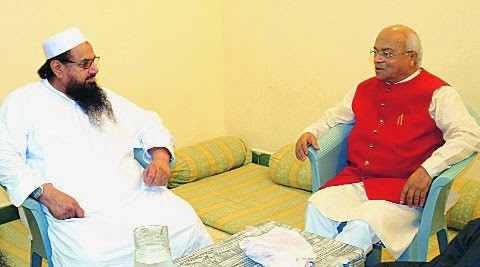
Vaidik is breaking bread (he sweetly refused sweets in honor of Ramzan) with a
living enemy, a $10 mil terrorist.
……….
Dr Ved Pratap Vaidik’s recent 20-day tour of Pakistan seems to have been
precociously productive. He met a number of former soldiers, diplomats,
experts and journalists, even Prime Minister Nawaz Sharif. 

As with any
good trip, there are photographs. None sadly are selfies — which is all
that is missing from Vaidik’s excellent adventures in Pakistan.


From Vaidik’s point of view, it was time well spent, a discovery of a
kinder, gentler ‘other’. He went looking for a big, bad Muslim state
bent on total annihilation of India, but found instead a peace-loving
padosi.


This time, the mood has changed. Nobody made any comment about Prime
Minister Narendra Modi that could have upset me. Overall, Pakistani
leaders and scholars’ opinion was that if the Indian people had accepted
Modi, then why should Pakistanis not accept it?… Pakistanis don’t
fear any longer that India can destroy Pakistan or seize ‘Azad Kashmir’
at gun-point…” Vaidik writes in his blog.


…..
Open the Wagah border, now!

….

As all dutiful self-appointed diplomats, Vaidik did not shy away from
the more daunting tasks of his goodwill tour.  He met former ‘prime
minister’ of Pakistan Occupied Kashmir Sardar Ateeq, his father, the
90-year-old Sardar Qayyum, PoK’s seniormost leader. 

And, oh yes, Hafeez
Saeed, the prime conspirator of the 26/11 attacks in Mumbai, wanted by
Indian courts, under trial in Pakistan and leader of the Jamaat-ud-Dawa,
the political arm of terror group Lashkar-e-Toiba and recently itself
named a terror outfit by the US.


Right, that guy.

….

Vaidik said the meeting was unplanned, and arranged all of a sudden.
Then again, he also says the meeting had been in the works for over a
year, arranged by the anchor of a prominent Pakistani news channel.
Whatever the case, Vaidik was in the neighbourhood…. so why not,
especially since the meet-and-greet seems to have gone so swimmingly
well.


…..

According to The Indian Express,
things were a bit chilly on the outset —  first dates can be awwk-ward
— but happily they soon broke the ice when Vaidik refused the offered
snacks in solidarity with his host who was observing roza. And things
just got better and better, especially once Saeed cleared up all those
silly misunderstandings involving bombs, hotels and dead people.


…..

“He denied all the allegations against him,” Vaidik told Times Now. “He
said he came to know about the 26/11 Mumbai terror attacks only two
hours after the attack on television news,” he added.


…..

Really? You don’t say. And here we have a warrant out for his arrest —
or more accurately, his head. It’s almost like a shuddh Bollywood
romance: warring clans, crossed wires, cue tragedy. All it takes is two
hearts filled with true aman ki asha to bring everyone together in
peace, love and understanding. 

This is why Vaidik wants the Indian
government to invite Saeed to India to “hold a large public meeting and
clarify his standpoint”.


….

There was a whole lot of clarifying going on. While Saeed got an
opportunity to ‘clear’ his name, Vaidik did his best to clear that of
his leader, as he told ANI, “Hafeez Saeed asked me about Narendra Modi.
He said Modi is dangerous and now he has become the Prime Minister of
India. He said that Modi is dangerous for the whole of South Asia. I
said that his thinking is not right. There is no need to fear Modi.”


/////

So strenuous were Vaidik’s efforts that  Saaed now says “he would
welcome Mr Modi in Pakistan.” Now that’s an invitation no Indian prime
minister can resist. Maybe Modiji can take Saeed some dhoklas.  And they
should have plenty to talk given Saeed’s keen interest in all things
Modi, including his personal life.


……..

“I don’t know why they ask such questions but when he persisted I also
asked him whether he is a brahmachari (bachelor). He said he has three
wives and I told him he is one short at which he burst out laughing,”
Vaidik told Express, fondly giving a whole new meaning to the term
‘fraternising with the enemy.’


……

We don’t know what Modi himself feels about at this unexpected
breakthrough in Indo-Pak relations. Both he and his government have
refused to comment on Vaidik,  as has his party spokesman Mukhtar Abbas
Naqvi — — other than to say that they had nothing to do with the
meeting. 

But Vaidik is an aide of a prominent supporter of the BJP and
Modi, ie Baba Ramdev. That’s a bit inconvenient for a party that created
a ruckus in Parliament back in 2012 just because then Union home
minister Sushilkumar Shinde referred to Hafeez as  “Shri Saeed” and “Mr
Saeed”.  (Though now if Vaidik has his way, it will be Hafeez Bhai from
here on out.) And yet the Modi sarkar resolutely refuses to condemn the
man.


….

In political terms, this will all be a storm in a parliamentary teacup. 
All that will be left is the enduring embarrassment of the Indian Right
who have to accept that one of their own has outdone even that
‘terrorist loving’ Arundhati Roy.  And there is no cure for that.

……..

Link (1): http://www.firstpost.com/

Link (2): http://indianexpress.com/article/india/india-others/met-jud-chief-he-wants-to-visit-india-ex-scribe-vaidik/

……

regards

Sikh-Brahmins of Chakwal

…“When I first went to a local college two years ago, students and
teachers gave me a strange look…
..They gave me a bizarre
glance because being a Hindu I was an alien to them and such a
situation always hurts me but I don’t express my feelings”…
 

Fascinating life story of the Mohyal Brahmins. When people talk about syncretic culture they should keep such examples in mind.

So….one fine day, the leaders of British India joined hands to declare that the nation-body must be partitioned (it so happens we are refugees from both East and West Pakistan) . Just like that, people were forced to abandon the lands to which they have belonged for eons.

When they arrived as refugees in a foreign country they were often bewildered and without hope. Some people turned back knowing full well that they are walking towards their funeral. Now they are just aliens in the place they used to call once call home. Nice.

We have to accept this for what it is. The successful application of two nation theory to a country of many communities who are now unable to co-exist even if they share the same faith. As a result there are people as “na ghar-ka, na ghat-ka” – those who come from nowhere and belong to no place. The poison of ideologies has made living ghosts out of all of us. The debts that are being accrued will need to be paid off with a lot of blood over a long long time.
………………….


“When I first went to a local college two years ago, students and
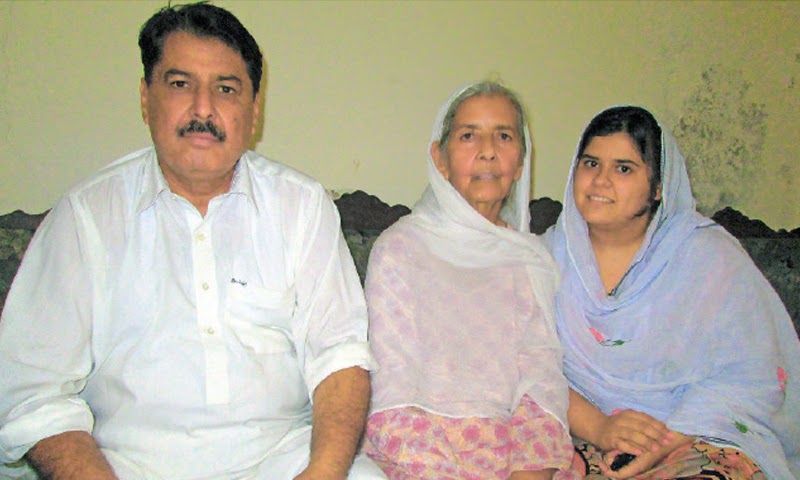
teachers gave me a strange look,” recalls 18-year-old Manisha Chhiber, a
Hindu girl whose family lives a secluded life in Kariyala village
located at the top of Surla Hill, some 10km away to the south of Chakwal
city.

Manisha’s family is one of the only two Hindu families
living in Chakwal district (the other lives in Kot Chaudhrian village
located some 40km to the west of Chakwal).

“They gave me a bizarre
glance because being a Hindu I was an alien to them and such a
situation always hurts me but I don’t express my feeling,” Manisha
continues.

But in village Kariyala she and six other members of her family live peacefully and do not feel isolated.

Manisha now waits for her BCom result and wants to become an officer by passing the Central Superior Services (CSS) exam.

“Although
we have mixed up with Muslim villagers in such a way that we do not
feel alienated, sometimes feeling of loneliness haunts us,” says
Manisha’s father Ravindar Kumar, the head of the family.

The
family of Ravindar Kumar belongs to Chhiber clan which is one of the
seven lineages of Mohyal Brahmins. Ravindar’s clan has a tumultuous
history replete with sufferings and bravery.

It was Baba Paraga
Das, a Chhiber who laid the foundation of the sleepy village Kariyala in
the 16th century and the village remained the hub of Chhibers till
partition uprooted them. 

As Mohyals were greatly influenced by the preaching of Sikh Gurus,
they played an active role during the formative years of Sikh religion.

Many notables of Mohyal Brahmin caste remained the disciples of Sikh Gurus and they still worship Sikhism along with Hinduism.

The
Aurangzeb rule was a bit hard for those Mohyals who devoted themselves
to Sikh Gurus. The three revered martyrs of Sikhism Bhai Mati Das and
his two brothers Bhai Sati Das and Bhai Dyal Das who were killed by
Aurangzeb were also Chhibers and belonged to Kariyala village.

The three brothers were the disciples of Guru Tegh Bahadur, the ninth Guru of Sikh religion.

Their
sole crime was that they supported the newly emerging Sikhism and
refused to embrace Islam. The three brothers were bestowed the title of
‘Bhai’ and Sikhs revered them.

Later, all the Chhiber men in Kariyala village added the word ‘Bhai’ to their original name.

Ravindar
Kumar’s father Bhai Jaggat Singh (who was given a Sikh name due to the
family’s devotion to Sikhism) was not only a landlord but also a Zaildar
(an officer in-charge of a Zail, an administrative unit comprising 40
villages) during British Raj.

One could imagine how one can
migrate to an alien land by relinquishing such a great social position
leaving a vast agriculture land behind.

Jaggat Singh never wished
to migrate but when his uncle Bhai Daleep Singh was assassinated by
Muslim rioters, he surrendered to other family members and set out for
Delhi.

“Life in Delhi refugee camp was painful for such a man who
lived a luxurious life. This forced my father to come back,” tells
Ravindar Kumar. But Jaggat’s two sons and wife refused to accompany him,
he said adding that he had to return alone.

After returning from
India, Jaggat resettled in Kariyala and contracted a second marriage.
Although he managed to preserve his land, the high social position which
he used to hold before partition was lost forever. He had two sons from
his second marriage – Ravindar Kumar and Surindar Kumar.

At present, Surindar Kumar lives with his elder brother Ravindar Kumar.

Living
in a thickly Muslim populated society, Ravindar Kumar and his family
members observe Muslim, Hindu and Sikh festivals. “On the occasion of
Eid, I decorate my hands with henna as my Muslim friends do. I visit
homes of my Muslim friends and they too visit my home.

On the
occasion of Diwali, my Muslim friends join me in the celebration,” says
Manisha, but she adds hastily: “Had I been able to celebrate Diwali with
my community, it would have been a different feeling.”

Being a sole Hindu family in the village, they do not celebrate Holi. Ravindar also mixes up with Muslim on their rituals.

“Whenever, any of my Muslim friends dies, I go to offer his/her funeral prayer,” Ravindar says.
“The
old people of the village treat us in a normal and friendly way but the
migrants and the youth’s behaviour is always skeptical towards us,”
Manisha explains.

Ravindar and his family members also visit Panja Sahib and Katas Raj regularly.

Being
a hub of Hindus, Kariyala had a number of Hindu temples but many of
them were damaged in riots. The state of two surviving temples was
deplorable till Musharraf’s regime.

The local bodies system came
as a blessing for Ravindar who was elected as member of the district
council on a reserved seat for minorities. He managed to get some funds
for the renovation of one of the temples where now he and his family
members worship.

But if one wants to visit the temple, heshe is
greeted by buffaloes tied in front of the temple. The buffaloes are
owned by a Muslim family who lives next to the temple.

“I
requested them many a times to find some other place for their animals
but they did not pay any attention. I could not do nothing but plead,”
says a distressed Ravindar.

The other abandoned temple has been
rented out to another Muslim family by Evacuee Trust Property Board and
this temple has become a goat pen.

“Humanity should not be slaughtered at the altar of religion and we should take care of each other’s feelings,” says Manisha.
“It is very painful to bear the desecration of our temples but we prefer silence,” says Ravindar.
……

Link: http://www.dawn.com/news/1118926/chakwals-lone-hindu-family-leads-peaceful-but-secluded-life/

……

regards

Ban on “demonic” Yoga

….nothing wrong with stretching…but when the tenets of yoga are
included…..a worship act to spirit beings other than
the God of the Bible….A faithful
Christian can no more say they are practicing yoga for Jesus than….committing adultery for Jesus…..

……. 
Not just Yoga, but also on the dislike list are…Tai Chi and Reiki. Even pilates may not be quite kosher (see below). However only Yoga is considered demonic (for a very long, detailed explanation see link below).

Best quotation from the comments: They banned yoga from the Church Hall. Then they figured out they need the money so they withdrew the ban….not quite the impact of ye olde England pubs being converted into Muslim prayer halls but still, a living, breathing example of demonic powers….

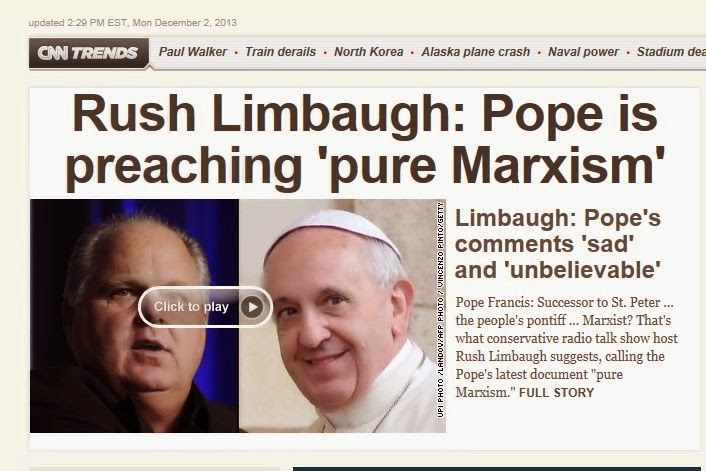
As far as Catholics are concerned, the current Pope seems to see nothing amiss with Marxism, which actually disparages religion as opium of  the masses and which has a lived record of persecuting Christians (in China and elsewhere) much more than Hindus-Buddhists have ever done.

Finally, we are not sure of how spiritual “yoga in the nude” actually is, but we recommend it strongly.
……..

In an unprecedented move against bendy people, it was reported this week that a Catholic priest has been campaigning against yoga. A missive from Father Padraig O’Baoill to his parishioners in County Donegal warns that yoga, tai chi and reiki
are “unsavoury activities”
that could endanger their souls. 

And before
there are any disparaging remarks about Donegal’s slogan being “Up here it’s different”, it should be noted that a Catholic priest in Southampton banned yoga from his church hall in 2012 because it was advertised as “spiritual”; and there is even a US pastor willing to say something extreme, outlandish and bigoted on the subject, with one spluttering, in 2010, that yoga is “demonic”.

Much
of this criticism stems from the fact that yoga has its roots in
Hinduism and Buddhism. But as anyone who has tried yoga a handful of
times knows (and it is mostly only ever a handful of times – first as a
new year’s resolution, then because you’ve spent money on the mat, and
finally, well, it’s been at least a year since you tried …), the yoga
practised in the church halls of this country comes as close to Hinduism
as your head is to your backside when you’re in an “upward facing dog”.

………..

A priest has banned yoga from a church hall because the class was “not compatible” with the Catholic faith.


Instructor Cori Withell from Hampshire said her yoga and
pilates classes at St Edmund’s Church building in Southampton were
cancelled with 10 days to go.


Father John Chandler said that the hall had to be used for
Catholic activities, and he banned it because it was advertised as
“spiritual yoga”.


Ms Withell, 37, said it “seemed terribly petty to cancel the classes”.


The ban is not Catholic Church policy and decisions are left to the discretion of individual priests.

………….


There is nothing wrong with stretching, exercising, or regulating
one’s stress through breathing. But when the tenets of yoga are
included, it’s by definition a worship act to spirit beings other than
the God of the Bible. 

By way of analogy, there is nothing inherently
wrong with intimacy, sex, and pleasure. But when the tenets of adultery
are included, it’s a sinfully idolatrous worship act. A faithful
Christian can no more say they are practicing yoga for Jesus than they
can say they are committing adultery for Jesus.


A little over a year ago, I said yoga was demonic. My stance hasn’t
changed since then, but I thought I’d take this opportunity to provide a
much fuller and comprehensive teaching on what yoga is and why it is in
fact demonic.
 

By demonic I mean it’s a spiritual act to a being other
than the God of the Bible. And, for those unfamiliar with me, I’m no
raging Christian fundamentalist. My most vocal critics tend to be from
the fundamentalist tribe as I do drink alcohol, have been known to use
strong language, and talk very frankly about the joys of married sex.
I’m no prude, but I am a pastor.


Giving sound teaching on yoga is important because there is
increasing adoption of yoga by our culture, with over 15.8 million
people practicing yoga and nearly every store you go into selling all
kinds of yoga products. 

It’s gone mainstream. As such, Christians are
also adopting it as a healthy aspect of exercise and lifestyle—complete
with things like “Holy Yoga,” which is an oxymoron. 

Saying yoga can be
Christian because you do it for Jesus is a bit like going into a mosque,
going through the worship practices, and then saying you’re not a
Muslim because you’re doing it for Jesus. They don’t mix.


When looking at the acceptance of yoga in the Christian church, I
find that there are two issues at hand: (1) People simply don’t
understand what yoga is, its roots, and its tenets; or (2) People think
that they can engage in yoga because it’s just stretching, while
ignoring the religious aspects of the practice of yoga.


As one woman who identified herself as a mainline Protestant said in
an article about my comments a year ago, “Here we go again with
fear-based, black-and-white thinking. . . . It’s not fair to say yoga is
demonic. In fact, I find it insulting. There are many ways to grow
spiritually.” To this I would reply, “No. There are not many ways to
grow spiritually. There is one way, which is through the power of the
Holy Spirit provided through Jesus’ death and resurrection on the cross,
as part of God the Father’s plan for salvation.” 

Comments like this
woman’s are the exact reason why it’s important to explore what yoga
really is and what it teaches, and to understand that the spiritual
elements of yoga make their way into our life and culture in ways we
don’t necessarily see overtly.


In this lengthy post, I’ll define what yoga is, give a history of
yoga, talk about the various forms of yoga, and take a look at yoga
through the “receive, reject, or redeem” matrix that I commonly use.

…………..

Link (1): http://www.theguardian.com/commentisfree/2014/jul/11/father-obaoill-yoga-unsavoury-irish-priest

Link (2): http://www.bbc.com/news/uk-england-hampshire-19729211

Link (3): http://pastormark.tv/2011/11/02/christian-yoga-its-a-stretch

……..

regards

Viva Afghanistan!!!!

….former Finance Minister Ashraf Ghani Ahmadzai and former
Foreign Minister Abdullah Abdullah agreed to…..internationally supervised audit of all 8 million ballots…..They vowed to form a national unity government
once the results are announced….

As we have always pointed out, democracy is not about voting, it is about the loser accepting the result in good faith and to agree to perform the role of a loyal opposition. In Afghanistan we will have to wait for democracy to mature fully, for now the compromise plan is a national unity govt. Even this is excellent news and heartiest congratulations.

It is especially good considering the nightmare that is now Iraq (after the Americans left 3 years ago on Iraqi demands).


Afghanistan will need to go a long way in order to develop robust institutions that will support individuals not tribes. As always it is critical that women get the safe harbor that they deserve.

Unfortunately for the minorities (Hindus, Sikhs….) it is high time that they leave the country. There will be no tolerance now or in the future (when the Taliban makes a comeback attempt). Here is an idea: make a direct appeal to PM Modi. After all the BJP and the Akalis are in an alliance and resettlement of migrant Hindus and Sikhs are the humane and right thing to do.
…………………….
Afghanistan’s two rival candidates reached a breakthrough agreement
Saturday to a complete audit of their contested presidential election
and, whoever the victor, a national unity government. 

…..
The deal, brokered by U.S. Secretary of State John Kerry, offers a
path out of what threatened to be a debilitating political crisis for
Afghanistan, with both candidates claiming victory and talking of
setting up competing governments.

Such a scenario could have dangerously split the fragile
country’s government and security forces at a time the U.S. is pulling
out most of its troops and the Taliban continues to wage a fierce
insurgency.

Instead, former Finance Minister Ashraf Ghani Ahmadzai and former
Foreign Minister Abdullah Abdullah agreed to abide by a 100 percent,
internationally supervised audit of all 8 million ballots in the
presidential election. They vowed to form a national unity government
once the results are announced, presumably one that includes members of
each side.

Kerry, who conducted shuttle diplomacy between the two candidates
late into the night Friday and Saturday, warned that much work still
remained.

“This will be still a difficult road because there are important
obligations required and difficult decisions to be made,” Kerry told
reporters after briefing Afghanistan’s current president, Hamid Karzai,
shortly after midnight.

The audit, which comes after widespread fraud allegations, is
expected to take several weeks, beginning with the ballot boxes in the
capital of Kabul.

Boxes from the provinces will be flown to the capital by
helicopter by U.S. and international forces and examined on a rolling
basis. Representatives from each campaign as well as international
observers will oversee the review, and the candidate with the most votes
will be declared the winner and become president.

Both candidates agreed to respect the result, and the winner
would immediately form a national unity government. The inauguration,
which had been scheduled for Aug. 2, would be postponed, with Karzai
staying on a little longer as president.

Abdullah said the election created “serious challenges.” But he
praised Ahmadzai for working toward the accord on the the audit and the
unity government.

Ahmadzai returned the compliments, lauding his competitor’s
patriotism and commitment to a dialogue that promotes national unity.

“Stability is the desire of everyone,” Ahmadzai said. “Our aim is
simple: We’ve committed to the most thorough audit” in history. Such a
process would remove any ambiguity about the result, he added.

Abdullah and Ahmadzai spoke first in English, then in Dari.
Ahmadzai also spoke in Pashto. When they were done, they shook hands and
hugged. Kerry later joined them as they raised their arms in triumph
hand-in-hand.

The announcement came as a relief to a country on edge and
worried about how the election dispute would resolve itself. Both the
full audit and the agreement to form a unity government drew praise from
television commentators immediately after the speeches.

The prolonged uncertainty about the outcome of the election had
jeopardized a central plank of President Barack Obama’s strategy to
leave behind a stable state after the withdrawal of most U.S. troops at
year’s end.

Preliminary runoff results, released earlier this week against
U.S. wishes, suggested a massive turnaround in favor of Ahmadzai, the
onetime World Bank economist. He had lagged significantly behind
Abdullah in first-round voting.

Abdullah, a top leader of the Northern Alliance that battled the
Taliban before the U.S.-led invasion in 2001, claimed massive
ballot-stuffing. He was runner-up to Karzai in a fraud-riddled 2009
presidential vote before he pulled out of that runoff, and many of his
supporters see him being cheated for a second time. Some, powerful
warlords included, have spoken of establishing a “parallel government.”

Kerry and Karzai discussed the deal past midnight Saturday. When
they emerged early Sunday, the Afghan leader endorsed the outcome.

Speaking alongside Karzai at the Presidential Palace, Kerry said
the democracy springing up in Afghanistan “deserved its full bloom.” He
offered robust U.S. support to ensure the deal holds.

The U.N. chief in Afghanistan, Jan Kubis, who will direct much of
the technical aspects of the audit, delivered his strongest praise for
Kerry. He said Kerry’s work wasn’t typical diplomacy but almost a
“miracle.”

Extended instability would have immediate consequences for
Afghanistan. If no process had been established and both Ahmadzai and
Abdullah attempted to seize power, the government and security forces
could have split along ethnic and regional lines. 

The winner amid such
chaos could be the Taliban, whose battle against the government persists
despite the United States spending hundreds of billions of dollars and
losing more than 2,000 lives since invading the country after the Sept.
11, 2001, terrorist attacks.

The Taliban have intensified their spring offensive in a bid to
undermine the Western-backed government. Saturday’s breakthrough came
after two roadside bombs killed at least 10 people, authorities said.
The Taliban was blamed for the larger attack in Kandahar province.

Kerry repeatedly stressed in his mediation that Washington isn’t taking sides.

Kubis and other officials said the talks in Kabul focused on the
technical particulars of the U.N. audit. Kerry spent significant time
hammering home the point that each side must come together at the end of
the contest for the good of the country.

With Iraq wracked by an extremist Sunni rebellion, the Obama
administration moved quickly to ensure Afghanistan’s political
instability also didn’t break out into violence. A prolonged crisis also
could have had other security implications for Washington.

Both Ahmadzai and Abdullah have vowed to seal a bilateral security pact with the U.S. that Karzai has refused to sign.

The United States says it needs the legal guarantees in order to
leave behind some 10,000 troops in Afghanistan next year. If the pact
isn’t finalized, U.S. officials say they may have to pull out all
American forces, an undesired scenario that played out three years ago
in Iraq.

……..

Link: http://www.theguardian.com/world/feedarticle/11439300

……

regards

2%

…..Francis also condemned child sex abuse as a “leprosy” in the Church…. “the level of paedophilia in the
Church is at 2%”…….”That two per cent includes priests and even bishops and cardinals”…… 

…..
An explosive truth from the representative of God on this earth (Vatican has since then refuted the quotes). 
The question remains- is this a special condition exacerbated by celibacy? Or is 2% the normal rate for paedophilia in society ??
……..
Pope
Francis promised “solutions” to the issue of priestly celibacy in an
interview on Sunday that raised the possibility the Catholic Church
could eventually lift a ban on married priests, but was quickly refuted
by the Vatican.

Interviewed by Italy’s La Repubblica daily,
Francis also condemned child sex abuse as a “leprosy” in the Church and
cited his associates as saying that “the level of paedophilia in the
Church is at two per cent”…..”That two per cent includes priests and even bishops and cardinals,” the pope was quoted as saying.


……..
Asked whether priests might one day be allowed to marry, Francis
pointed out that celibacy was instituted “900 years after Our Lord’s
death” and that clerics can marry in some Eastern Churches under Vatican
tutelage.

“There definitely is a problem but it is not a major
one. This needs time but there are solutions and I will find them,”
Francis said, without giving further details.

But Vatican
spokesman Federico Lombardi said the quotations in the newspaper on the
existence of paedophile cardinals and the possible reform of priestly
celibacy did not correspond to what the pope actually said.

“This is not at all an interview in the normal sense of the word,” he
said, accusing the newspaper of “manipulating ingenuous readers”.

The interview was the third in a series with the 90-year-old founder of
La Repubblica daily, Eugenio Scalfari, a famous journalist and known
atheist.

……..

Link: http://www.abc.net.au/news/2014-07-13/pope-promises-solutions-to-priestly-celibacy-report-says/5593408

……

regards

Aunn Zara (pitch-perfect Punjabi)

Zindagi Gulzar Hai….“I felt like I was caught in a
time warp”… Ritu can relate, she grew up in Delhi listening to
stories from the old Punjab narra­ted by her grandmother who had
mig­rated to India during the Partition.

The story of four great languages of South Asia (yes, all other languages are great as well).

Punjabi has faced tremendous head-winds following partition but is now enjoying a renaissance (one problem is that Punjabi Hindus prefer Hindi).
Bangla has benefited due to an independent Bangladesh which fought for the right to speak the language (Bengalis on both sides of the border are united in their love for the language).
Hindi marches on as the national language of India (and now preferred by the Prime Minister when speaking to foreign dignitaries), even though historically it had faced tremendous resistance in the South (and now only Tamil Nadu is proud to be an outlier). With BJP coming to power the Hindu-Hindi camp will be further strengthened.
Urdu has faced ups and downs, it is the national language of Pakistan, but it has been vilified as the language of Muslim invaders (85% of  India) and next as the mother tongue of Pakistani imperialists (50% of Bangladesh), and now it is also under threat from Sindhi and Pashto (and Punjabi).

All these one-time great languages (even Tamil) will ultimately lose out to English as it is the language of the elites…..even your (English) accent can identify your place/class in society. As an indicator- Hinglish is now officially permitted in Govt communications in India.

Thus it is wonderful to see people appreciating cultural treasures in their own language. From an Indian perspective, it points to a bygone era (similar to Mad Men). The generation that loves this stuff will gradually die away. In the meantime Pakistan is slowly losing out to the charms of Turkish TV. Ultimately we will all be drowned in the same-same hybrid culture with no meaningfulness. And worst of all, no appreciation of proper pronounciation!!!
…………….

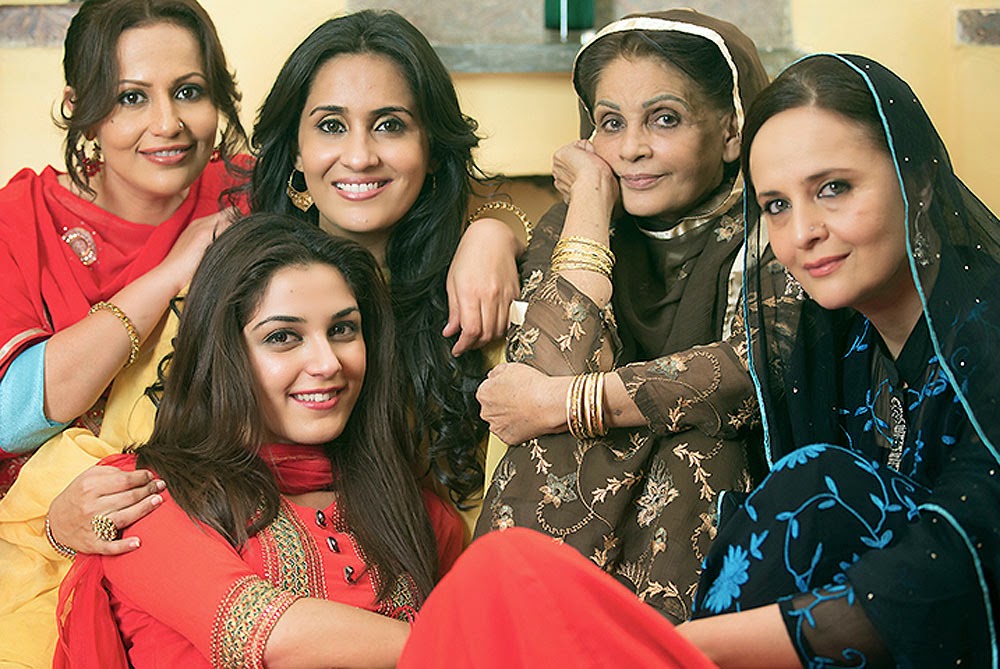
  • Zindagi Gulzar Hai
    The story is about Kashaf Murtaza and her two sisters who are
    brought up by a single mother. Kashaf marries rich boy Zaroon Junaid,
    the serial traces their ups and downs.
  • Aunn Zara
    A coming-of-age story of young couple Aunn and Zara and how they
    come to terms with family, responsibility, freedom, friendship, love.
  • Kaash Main Teri Beti Na Hoti
    The tragic tale of a young girl sold off to a married man, and her travails later.
  • Kitni Girhain Aaki Hain
    A satire based on the ironies and harsh realities of a young woman’s life in Pakistan.

……….
A young woman in her 20s sits scribbling under a fluorescent lamp in a
dimly-lit room. Her thoughts are those of any girl her age—marriage, a
career and the general struggle of getting by. Zindagi Gulzar Hai,
a Pakistani serial now being aired on Zee Zindagi, started off on this
rather mundane vein but it’s struck an instant chord with viewers, at
least in north India. 

Launched this June, Zee’s new and much-hyped
channel has four Pakistani serials capturing the mood on the other side
of the border. Shailja Kejriwal, Zee’s chief creative officer, special
projects, spent nearly two years scrolling through and handpicking
content that would resonate with Indian audiences. Next on the line is
something more substantial—Pakistani films.


….
“The basic idea was to reacquaint Indian audiences with culture from
acr­oss the border. Pakistani television has bought a lot of content
from here, including daily soaps and Bollywood films. So this is a great
way for us also to connect, both at the audience level and at an
art­istic and cultural level,” says Shailja. And it seems to be working. 

Ardent TV soap add­ict Ritu was ecstatic after watching the first
episode of Zindagi Gulzar Hai. “I felt like I was caught in a
time warp,” she says. Ritu can relate, she grew up in Delhi listening to
stories from the old Punjab narra­ted by her grandmother who had
mig­rated to India during the Partition.


The initial surge in viewership is also an indication of how parched
Indian viewers are for balanced and bona fide characters. Compared to
Indian soaps, with its women always in gaudy dresses, make-up and
jewellery (even at the breakfast table!) and its over-the-top melodrama,
the imports from across the border do seem more realistic and less
shrill. Mani Sandhu, an avid viewer from Punjab, writes on Facebook: “Aunn Zara
is a fresh kind of story. My mother, who hardly watches television, is a
big fan of the serial because of the characters, the pitch-perfect
Punjabi accent, reminiscent of ’60s Punjab.” 


Now this is no new phenomenon. For decades, Indian audiences had been hooked to Pak serials like Humsafar, Dhoop Kinare and Ankahee, before the great transition took place at home with Kyonki Saas Bhi Kabhi Bahu Thi. 

“Compared to the Indian soaps, the acting is much better in Pakistani
serials. They also look more realistic and are more slow-paced than
American soaps,” says media critic Shailaja Bajpai. “In Zindagi Gulzar Hai,
the plot is clear by the second episode. It also has a youthful appeal.
The serials talk about women empowerment and problems faced by
middle-class families…which makes it all the more relatable.”


….
But not all Pakistani serials are about strong women or progressive families. Take Kitne Girhain Baaki Hai,
which deals with honour killing. The protagonist, a young girl, is
killed by her bro­ther bec­ause she marries against the family’s
wis­hes. The serial then doesn’t quite den­­ounce this ghastly act, with
none of the male characters, especially the girl’s father, repentant
about what they have done. The female characters, though educated, still
lead a retrograde life, taunted for being divorcees. They have to
remain low-key and, of course, there are the aforementioned honour
killings.


….
The top Indian soaps, in that sense, are a lot more ‘modern’. Diya Aur Baati Hum
in fact has a heroine fighting a feudal mindset to become a top cop. So
why are Indian viewers lapping up the Pakistani stuff? “Well, the
situations shown in these serials are certainly more realistic,” says
Shashi Mittal, who has scripted Diya Aur Baati Hum. “Some of
them do have outdated themes but there is still a large audience in
India which is yet to come to terms with modernisation. Our audience is
huge, it can absorb both types of content—medieval as well as modern.”


….
Navjot Gulati, who’s penned the script for Shoojit Sircar’s runningshaadi.com,
says deep down Indian society is as reg­ressive as Pakistan’s. “But I’m
glad Paki­stani serials are being shown. At least, the Indian serial
writers will be forced to write better scripts. Back in the ’90s, Indian
TV was as good as the films, but now the focus is numbers rather than
creativity. The corporate structure is flawed and most good writers are
not interested in writing for television.” 

The best script, then, would
be if a serial pops up with the realism/nuances of a Pakis­tani soap but
with a more gutsy storyline on women and the ills of society.

……..

Link: http://www.outlookindia.com/printarticle.aspx?291364

……

regards

Inquisition, Reconquista and (World Cup) Football

“These children[converts]….Their hatred for idolatry is marvelous….whenever their own
parents practise it, they reproach them and come off to tell me at once….Whenever I hear of any act of idolatrous worship, I go to the place
with a large band of these children…The children run at the idols, upset them, dash them down, break them to pieces, spit on them, trample on them, kick them about, and in short heap on them every possible outrage” – Francis Xavier, inspiration behind the Goan inquisition

……..
The ‘national guide’ of the
HJS [Hindu Jagran Samity], Charudutta Pingle, was quoted saying that Goans supporting
Portugal in the ongoing World Cup would be “rubbing salt on injuries
suffered in history”

……….
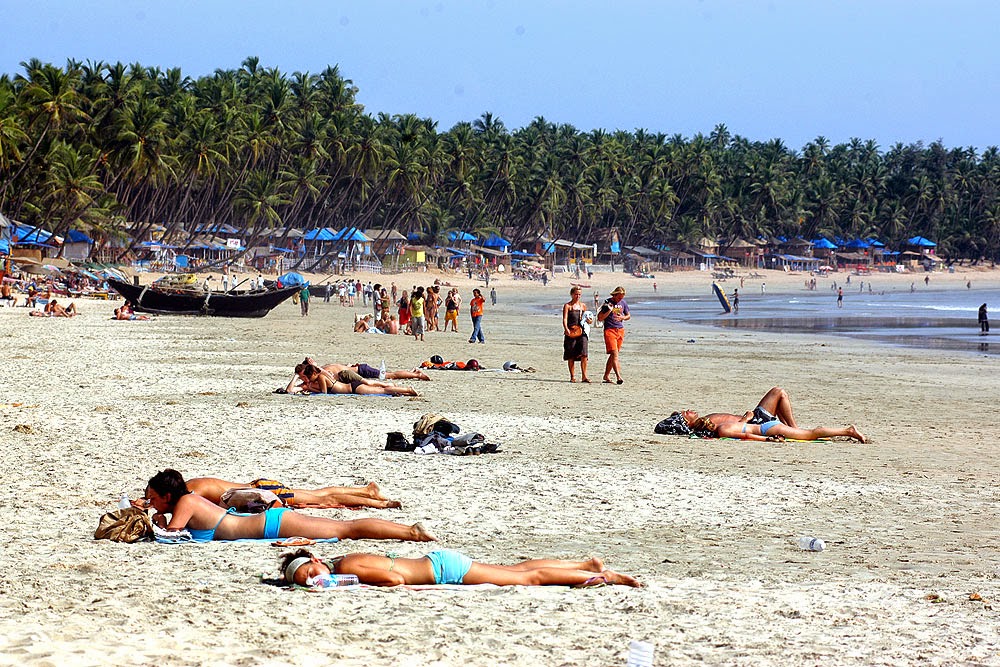
As expected, people are complaining that the burden of “history” is being unfairly foisted on their shoulders.  There are a number of outstanding issues but the Goan Inquisition ranks foremost in the minds of the people whose ancestors were mercilessly persecuted for three centuries for being idolators.

History traditionally has been written by the winners and all over India the sons of Abraham are retreating in face of a relentless onslaught by the sons of Hanuman et al. The plea (from the afflicted minorities) is for an inclusive society so that all communities can co-exist and prosper in a secular republic. 

Indeed we should aim to build an India where it is possible to celebrate the victories of Pakistan (Sunnis for Saeed Ajmal) and Portugal (Catholics for Cristiano Ronaldo). The problem is that the burden of history will not go away by pretending it does not exist. Something must be done, else the poison keeps contaminating the community well.

First and foremost, the Ram Sena and others are pathetic bullies and they do a lot of harm. They are a bit like the bumbling Shia gangs of Iraq (to use an imprecise analogy). Full of reckless bravado, they create disorder and disharmony amongst the people. When the Caliphate troops show up on the scene, they disappear out of sight. They ride on a river of historical grievances but they do not seem to be able to learn from history.

This is the most important question: why the nations that were India so weak that they allowed Portugese (and others) to terrorize from Bengal to Gujarat? The answer is obviously complicated but can be reduced to one word: CASTE (based discrimination).  

Until and unless Indians realize that it was their own fault that led to a “thousand year slavery” no historical exercise will be complete.

Now to move on to the Portugese and the Catholics of Goa.

When the Portugese empire was rising it killed off (or converted) all the Moors (muslims) in the Iberian peninsula. This was as an integral part of the reconquista campaign led by Christian armies from 711AD – 1492AD (fall of Granada). Not only were the muslims (who were considered as invaders) massacred but the Jews as well.

If the thinking is that Christian Europe has shed all barbarisms of the distant past and embraced ahimsa then it is legitimate to point out that (i) Portugal was fighting colonial wars as late as the 1970s, (ii) Christians (orthodox) have been engaged in ethnic cleansing against Muslims in Bosnia as late as 1990s (a low-intensity war is still going on in Kosovo and Bosnia), and (iii) Catholics are still fighting Protestants in Northern Ireland today. Moral authority will not come so easily to the Christian Ummah, when foot-soldiers are still fighting in its name.

Right now, a “cultural reconquista” is going on in Goa. It is happening non-violently but it nevertheless oppressive. Since many Goan Catholics have Portugese citizenship (thanks to Antonio Salazar, the dictator “prime minister” of Portugal from 1932-1968), Goans have been able to emigrate to Portugal and then on to other European countries (as allowed by the European Union). One may even say that such voluntary migration is de-facto ethnic cleansing.

All this is wrong and deeply worrying, but do the Goan Catholics have any responsibility so as not to be burdened by “history”? A “Truth and Reconciliation” commission sounds like an excellent idea. Sponsorship of an all-faiths-temple in memory of the hundreds of temples that were destroyed can help close the debate on idolatry. A museum of Inquisition on the lines of the Holocaust memorial (which is strangely enough, located in the USA and not in Europe) can be set-up with some funding from the Church.

The Inquisition files were destroyed in 1812, but then people have long memories (and they will have historians on their side). The Hindu brotherhood is the winner in Goa and elsewhere in India. It is now high time to put the religious poison back in the bottle.
…….

Well
before Narendra Modi’s advent, before his acolyte Manohar Parrikar
could become chief minister in 1994, Hindu fundamentalists have viewed
Goa’s Catholics as an impediment to their larger aim of ‘Bharat’
becoming a ‘Hindu nation’. Thanks to the asinine comments of Goa’s PWD
minister Sudhin Dhavalikar urging bikinis be banned and pubs closed
down, it helps to revisit extremist fears
—to see, if nothing else,
whether women visitors to the beach will choose to show him a thing or
two.

Goa’s elected representatives seem largely illiterate in at least
three languages, but hapless, overwhelmed and cornered though he may
have been on TV, Dhavalikar is anything but harmless. It is fitting that
he represents the BJP regime in Goa on behalf of the Maharashtrawadi
Gomantak Party (MGP), its loyal, right-wing ally. 

After all, in the
early ’60s, just freed of colonial rule and still a Union Territory, the
MGP’s founder and Goa’s first chief minister, Dayanand Bandodkar,  had
pushed through an opinion poll to see whether Goa should be merged with
Maharashtra.

Thankfully, he lost—perhaps the sole occasion when Goans came
together, setting aside their differences. 

But Bandodkar spr­ead seed.
For the first time, Goans in the north saw jeeploads of proto-Shiv
Sainiks, armed with tridents and orange flags, spoiling for a fight; or
knew that allegiance to the MGP was now being sought at village temples
in accompaniment to the tinkling of bells and slokas. Bandodkar kept the
MGP a truly populist party; he himself was a charismatic, benevolent,
Peron-like character who played all sides. Under his daughter Shashikala
Kakodkar, who inherited party and post, blatant nepotism entered
political life, but the MGP also changed.

Today, circle complete, it has degenerated into a private firm run by
Sudhin Dhavalikar and his cohorts who consciously cultivate a Hindu
votebank and worse, an ‘us versus them’ mentality—a phenomenon foreign
in the larger annals of Goan consciousness and identity. It may not be a
coincidence that the build-up to Narendra Modi’s ‘massive mandate’ has
blessed a fistful of Hindu extremist groupings in Goa and encouraged
them to move so far right that one more sideways step and they’d fall
off the cliff!

Regardless of their differences, Goans can teach the rest of the
country a thing or two about ‘secular’ traditions. Yet, ironically, for
four years running, they have hosted the All India Hindu Convention
organised by the Hindu Janajagr­uti Samiti (HJS). 

Noted for the specious
attempts to give Hinduism a ‘theology’—the lack of which,
paradoxically, only stre­ngthens India’s strong tradition of
syncretism—the convention is held at the Ramnath temple outside Ponda,
in close proximity to the Shantadurga and Mahalakshmi shrines. Is this
to create a Hindu Vatican, a place to issue fiats from?

The HJS shares bed with the Sanathan Sanstha (SS), to which
organisation Sudhin Dhavalikar swears fealty to, as does his brother and
both their wives. The SS were involved in the bomb blasts in Margao in
2009 and both groups have had fingers pointed at them for the
assassination of Dr Narendra Dabholkar, the much-admired rationalist,
and in the recent murder of the young Muslim software engineer.
Dhavalikar’s ideological men­tor is Pramod Muthalik, self-appointed
patriarch of the Sri Rama Sene, a group on the lunatic fringe of even
the extremists! 

It is sad that Hindu extremists persist with an
afflicted consciousness generated by their khaki-clad historians, adding
fuel to what most Goans, including Catholics, already knew—namely, that
the infamous Inquisition in Goa surpassed its Iberian counterparts in
horror and bloodthirsty zeal.


Those who trumpet this crime ignore Catholics in Goa who shamefully
accept this abhorrent part of their history, while coming to terms with
the fact that one of their ancestors may have converted under the sword.
Such attempts to find truth and accept reconciliation allow for one’s
past to be purged, and identity forged anew in present realities, made
larger and more inclusive.


Is this what really frightens the fundamentalists, what makes them
ferret out the Dark Ages from their history? The ‘national guide’ of the
HJS, Charudutta Pingle, was quoted saying that Goans supporting
Portugal in the ongoing World Cup would be “rubbing salt on injuries
suffered in history”.

It’s worth pondering. If that be the extent of their inclusiveness,
does one think they will stop at just banning bikinis and closing down
pubs?

………….

You were born in New York and went on
to study comparative religion. Why the decision to write about the
Portuguese inquisition in Goa — a whole other world?

About 15 years ago, while doing research for my first novel, The Last Kabbalist of Lisbon,
I discovered that the Portuguese exported the Inquisition to Goa in the
sixteenth century, and that many Indian Hindus were tortured and burnt
at the stake for continuing to practice their religion. 

Muslim Indians
were generally murdered right away or made to flee Goan territory.


I couldn’t use that information for my novel but decided, a few years
later, to do more research into that time of fundamentalist religious
persecution. I discovered that historians consider the Goa Inquisition
the most merciless and cruel ever developed. It was a machinery of
death.
A large number of Hindus were first converted and then persecuted
from 1560 all the way to 1812!

Over that period of 252 years, any man, woman, or child living in
Goa could be arrested and tortured for simply whispering a prayer or
keeping a small idol at home.
Many Hindus — and some former Jews, as
well — languished in special Inquisitional prisons, some for four,
five, or six years at a time.


I was horrified to learn about this, of course. And I was shocked
that my friends in Portugal knew nothing about it. The Portuguese tend
to think of Goa as the glorious capital of the spice trade, and they
believe — erroneously — that people of different ethnic backgrounds
lived there in tolerance and tranquility.
They know nothing about the
terror that the Portuguese brought to India. They know nothing of how
their fundamentalist religious leaders made so many suffer.

…………

[ref. Wiki] The first inquisitors, Aleixo Dias Falcão and Francisco Marques, established themselves in the palace once occupied by Goa’s Sultan, forcing the Portuguese viceroy to relocate to a smaller residence.


….
The inquisitor’s first act was to forbid any open practice of the Hindu faith on pain of death

Sephardic Jews living in Goa, many of whom had fled the Iberian Peninsula to escape the excesses of the Spanish Inquisition to begin with, were also persecuted.
The narrative of Da Fonseca describes the violence and brutality of the
inquisition. The records speak of the necessity for hundreds of prison
cells to accommodate the accused.


From 1560 to 1774, a total of 16,172 persons were tried and condemned or acquitted by the tribunals of the Inquisition.While it also included individuals of different nationalities, the
overwhelming majority—nearly three fourths were natives, almost equally
represented by Christians and non-Christians. Many of these were hauled
up merely for crossing the border and cultivating lands there.


Seventy-one autos de fé were recorded. In the first few years alone, over 4000 people were arrested.
In the first hundred years, the Inquisition burnt at stake 57 alive and
64 in effigy, 105 of them being men and 16 women. Others sentenced to
various punishments totalled 4,046, out of whom 3,034 were men and 1,012
were women.
According to the Chronista de Tissuary (Chronicles of Tiswadi), the last auto de fé was held in Goa on 7 February 1773.

……

Link(1):  http://www.outlookindia.com/printarticle.aspx?291360

Link(2): http://www.rediff.com/news/2005/sep/14inter1.htm

Link (3): http://krishidesh.wordpress.com/2011/08/13/goa-inquisition-bloodiest-conversions-by-christians/
……

regards

Yes, the first muslim president

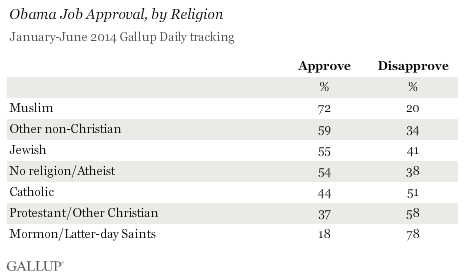
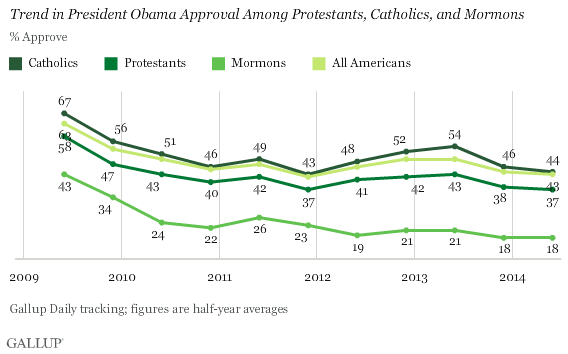
The relative rank order of the religious groups on job approval has
been consistent throughout Obama’s presidency….the current rank
order, with Muslims most approving and Mormons least, exactly matches
the order seen over the more than five years in office….

Disfavored by Protestants, Catholics and Mormons, loved by Jews, atheists and followers of other religions (presumably Hindus, Jains, Sikhs,…).

But yes, loved dearly, passionately, consistently by muslims. How much of  this is backlash from the Tea Party folks claiming that Obama is a secret muslim? We have observed an automatic -bhai attached to Obama by believers (because his dad was a muslim). Folks also fondly remember the iconic Cairo speech he gave, extending a hand in friendship to all muslims. Who was at fault for the unrealized promises? Well, make a guess, go on!!!

Obama in our opinion is too smart to be much of a believer. Earlier presidents (and their wives) have made a big show of attending the church. But after his pastor was found out to be too radical, Obama has kept his religious side under wraps. His enemies would have never forgiven him anyway. And now he has a lot of friends to choose from, mostly black and brown in skin tone. Praise be to the Lord (Allah).
………..
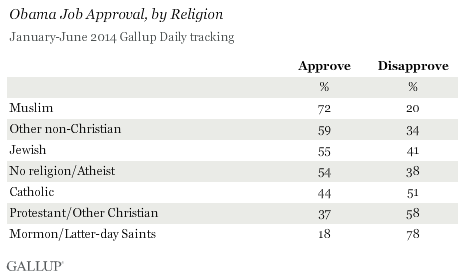
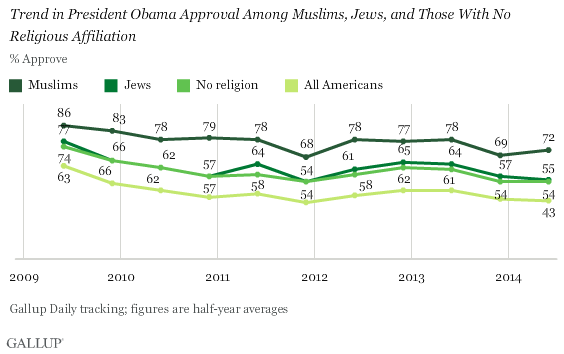
PRINCETON, NJ — Seventy-two percent of U.S.
Muslims approved of the job President Barack Obama was doing as
president during the first six months of 2014, higher than any other
U.S. religious group Gallup tracks. Mormons were least approving, at
18%.
 

In general, majorities of those in non-Christian religions —
including those who do not affiliate with any religion — approved of
Obama, while less than a majority of those in the three major Christian
religious groups did.


Obama Job Approval, by Religion, January-June 2014


The results are based on aggregated data from more than 88,000 Gallup
Daily tracking interviews conducted in the first six months of 2014 — a
time when the president averaged 43% job approval among all Americans.
Gallup interviewed 552 Muslims and at least 1,700 respondents in every
other religious group during this time.


….
The United States remains a predominantly Christian nation, with
roughly half of Americans identifying with a Protestant religion and
another quarter identifying as Catholics. Thus, the opinions of these
Christian groups are by far the most influential in determining Obama’s
overall ratings.


….
The relative rank order of the religious groups on job approval has
been consistent throughout Obama’s presidency. In fact, the current rank
order, with Muslims most approving and Mormons least, exactly matches
the order seen over the more than five years he has been in office since
January 2009.


….
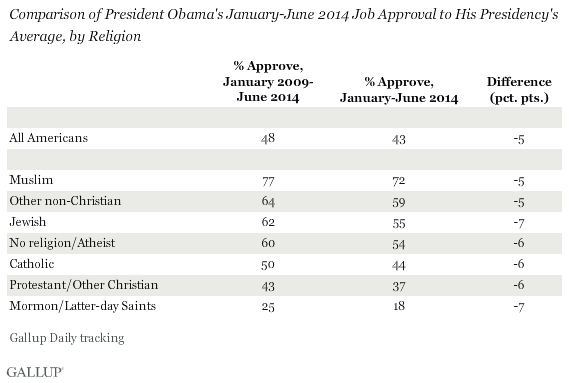
Moreover, current job approval among each religious subgroup is
between five and seven percentage points lower than the full 2009-2014
average for each. Obama’s current 43% overall job approval average is
five points lower than his 48% average so far in his presidency.


Comparison of President Obama's January-June 2014 Job Approval to His Presidency's Average, by Religion


…..
In general, when Obama’s approval rating has dropped among all
Americans, his approval rating in each religious subgroup has dropped by
a similar amount. 

The accompanying graph shows how Obama’s average
approval rating among Protestants, Catholics, and Mormons has compared
with the average among all Americans over time. Because the movement in
each religious group has shadowed the national movement, Mormons have
been least approving of Obama in each time period. Protestants have been
consistently below the national average, and Catholics slightly above
it.


Trend in President Obama Approval Among Protestants, Catholics, and Mormons


Similarly, Muslims have been the most approving among the religious
groups in each time period. Jewish Americans and Americans with no
religious preference have also exceeded the national average job
approval in each time period, tracking each other closely.


Trend in President Obama Approval Among Muslims, Jews, and Those With No Religious Affiliation


………

Link: http://www.gallup.com/poll/172442/muslims-approving-obama-mormons-least.aspx

…….

regards

Ramayana, Mahabharata true accounts, not myths

…If Ayodhya is not the place of Ram, where did he live? Looking at the
present structures in Ayodhya, we can see people still living the way
that finds a mention in the Ramayana. Historians can only give their
opinion to enlighten people.
….

The problem with left-liberal academicians (DN Jha, Sumit Sarkar and others) is that the secular fan-base in India is microscopic and there is not much love from minority communities (who are to be sure appreciative of the majority bashing).

Conservative Muslims are least interested in the “secular” record of Akbar, they hate him for his out-reach (and the plan to kick-off a new religion). 

Conservative Sikhs are repulsed by praise for “marxist-atheist” Bhagat Singh, they believe that Sardar Singh was a faithful follower of the Panth. 

The Dalits dislike the liberals intensely since the ideologues are primarily drawn from the super-caste community- red/pink Bengal has remarkably seen only Brahmin Chief Ministers for the past two decades. Even Navayana – the pro-Dalit megaphone – is led by the non-Dalit firebrand S Anand.

There are now dark clouds on the horizon, the new govt will be sympathetic towards Hindutva scholarship and will be headed by people like Rao who are convinced that “folklore is history.” Going forward, any book considered anti-saffron will not be publishable in India. That leaves only the West and the public forums afforded by the New York Times and the Guardian (and others). That will be one crowded space already occupied by super-stars.
……………………………………………………..
The media describes him as an RSS man and the author of the
Mahabharata Project, but very little is known about the mild-mannered
historian from Telangana in academic circles. 
Yellapragada Sudershan Rao,
the new chairman of the Indian Council of Historical Research (ICHR),
describes himself as a colonial historian and argues that faith and
reason can go hand in hand in the writing of history.


………
You have lashed out against Marxist historians and their
interpretation of history. Why is the writing of history a Right vs Left
debate?


I think it is time to think about India’s history from an Indian
perspective. 

For the last 60 years, our writing and understanding of
history has been influenced by the West. Indian research has been far
too dependent on the West to write its own history. We are dependent on
their translations and interpretation. And, these are my personal views,
history writing in India is Euro-centric and imperialistic. The ICHR, I
understand, is in the process of acquiring digital records from centres
of history in the US and Europe. This will not only give us access to
our own records but will also aid us in writing history from our
perspective.


You have been appointed by the BJP government. Don’t you think institutions such as the ICHR should be free of politics? 
The MoU (memorandum of understanding) prepared by the founding fathers
of ICHR gave the powers to the government to appoint heads of social and
historical institutes. I have no qualms in admitting that these
appointments are political. 

Have previous heads of social institutes
been questioned about their appointments? Why are these questions asked
only about me? The government has been formed by a democratic process.
It has been elected by the people. To question that is to question
democracy itself. Unlike other social institutes, the ICHR attracts a
lot of attention because history is an important subject. But history
belongs to the people. We have not shown or written a comprehensive
history of India to the people of India. History is by the people, for
the people and of the people.


….
You are the author of the Mahabharata project? What is the project about?

There is a certain view that the Mahabharata or the Ramayana are
myths. I don’t see them as myths because they were written at a certain
point of time in history. They are important sources of information in
the way we write history. What we write today may become an important
source of information for the fut­ure in the future. 

When analysed, of
course, they could be declared to be true or false. History is not
static. It belongs to the people, it’s made by the people. Similarly,
the Ram­ayana is true for people…it’s in the collective memory of
generations of Indians. We can’t say the Ramayana or the Mahabharata are
myths. Myths are from a western perspective.


What does that mean?

For us, the Ramayana and the Mahabharata are true accounts of the periods in which they were written.


….
But shouldn’t the writing of history be rooted in historical evidence and research?

Western schools of thought look at material evidence of history. We
can’t produce material evidence for everything. India is a continuing
civilisation. To look for evidence would mean digging right though the
hearts of villages and displacing people. We only have to look at the
people to figure out the similarities in their lives and the depiction
in the Ramayana and the Mahabharata. 

For instance, the Ramayana mentions
that Rama had traveled to Bhad­ra­chalam (in Andhra Pradesh). A look
at the people and the fact that his having lived there for a while is in
the collective memory of the people cannot be discounted in the search
for material evidence. In continuing civilisations such as ours, the
writing of history cannot depend only on archaeological evidence. We
have to depend on folklore too.


….
Are you for correcting the writing of history?

I won’t put it that way. But real history has to come through. I am a
follower of truth. The ICHR should encourage research about India and
Greater India—from Southeast Asia all the way to Afghanistan, Iraq and
Iran. There is enough archaeological evidence to show the connect of our
civilisation there.


….
What is your view on Ayodhya?

Is it not a fact that mosques as structures came to be in India in
1000 AD? Is it not a fact that the mosque was built by a lieutenant of
Babur? A historian can only enlighten people on the facts of history.
Historians can at best say evidence of earlier remains of a Hindu
structure are there. Conflicting views are created by political leaders. 

If Ayodhya is not the place of Ram, where did he live? Looking at the
present structures in Ayodhya, we can see people still living the way
that finds a mention in the Ramayana. Historians can only give their
opinion to enlighten people.


…..
Doesn’t correcting history pose a problem? Why only cast it
in the context of two communities? How about Dalits and untouchability?


The question of untouchability is relatively recent, as recent as
3,000 years. And it has its basis in the economy. It was not based on
social status. Did we hear of untouchability before this period of 3,000
years? Let me give you an example. Sage Vishwamitra went to a Dalit hut
and asked for dog’s meat as he was hungry. The Ramayana and Mahabharata
are replete with instances of different castes, did we find a mention
of untouchability there?


…..
As a historian, are you trying to give a religious interpretation to history? 
I am a Hindu and a Brahmin. To be a Hindu isn’t a religion. In my
personal practices, I can adopt religious practices of the community to
which I belong—as a Shaivite or a Vaishnavite. But that is not what
being a Hindu is about. 

Reli­gi­ons are recent manifestations. I feel
the­re’s only Sanatana Dharma. There was no conflict between communities
or on religious lines as there was only one sanatana dharma. Now there
are several reasons for conflict to take place. 

Besides, Muslims are the
only ones who have retained their distinct culture. Can Christians or
Muslims say all religions are one? A Hindu can say that. There was no
conflict when there was sanatana dharma, Conflict or contests came about
when temples were destroyed and mosques built on the sites in medieval
times.


….
Didn’t Hindus destroy Buddhist monuments?

I agree. But Buddhism was on the wane then, in decline. But were
thousands of people killed as they were in the raids to the Somnath
temple? I won’t use the word corrections here. But the real history has
to come up.

…..

Link: http://www.outlookindia.com/printarticle.aspx?291363

……

regards

The Lion Queen

“I punched the men but they wouldn’t
apologize till the crowd forced them to”……the woman then took off a boot,
filled it with muck and water, and emptied everything into the car……”I did this five to six times till the seat,
gearbox, steering, backseat and their phone were soaked in muck”….

Remember it is the lioness who hunts, not the lion. She is feared universally for her strength. 

India is a jungle that desperately needs more lion queens who have the courage to throw mud on the face of drive-by cowards. Lal salaam, madam!!!
…………..
A
27-year-old woman’s online post on how she taught two men a lesson after
they “deliberately” splashed muck on her while passing by in a car, has
gone viral on social media. 
 

While most netizens have come out in her
support, some have questioned how she could “go to such limits”. The
woman is also being trolled and threatened by a few netizens.

The incident occurred around 8pm on Wednesday when the woman was walking
home after work. She had reached Shardashram Vidyamandir in Dadar
(West) when two men arrived in a car.

“As the footpath was
water-logged, I was forced to walk on the street. The stretch was dimly
lit but safe. I heard the Honda City accelerate before it splashed muck
on me. The car swerved just in time and could have hit me. I was shocked
and fuming,”.

The motorist left without offering
an apology. “I have been robbed at knife-point and even groped in the
past, but had remained quiet then. This time, I decided I wasn’t going
to be a coward. I ran after them for nearly 700 metres or so till the
car halted at a traffic signal at Kabutarkhana.  I then went and knocked
on the front door (passenger side). The motorist’s co-passenger opened
it and realized I was the same girl they had harassed. The motorist
tried to drive away, dragging me along as I had caught hold of his
friend’s shirt collar by then,” she said.

Hearing the
commotion, cops at the junction came up to check what had happened and a
crowd of bystanders gathered. “I punched the men but they wouldn’t
apologize till the crowd forced them to,” she added. Upset at what she
had to go through and the unwanted drama, the woman then took off a
boot, filled it with muck and water, and emptied everything into the
car.

“I did this five to six times till the seat, gearbox,
steering, backseat and their phone were soaked in muck. My arm is sore
from being dragged. But I hope my act prevents the men from repeating
what they did to me with any other girl,” she added.

Her online post was ‘liked’ by nearly 3,000 people and shared numerous times on Twitter and Facebook.

…….

……..

Link: http://timesofindia.indiatimes.com/city/mumbai/Mumbai-womans-post-on-harassers-goes-viral/articleshow/38222068.cms

…..

regards

Brown Pundits