
The bisexual & the Baha’i Twins + why do Pakistanis fake it?

The Bisexual & the Baha’i Twin

As an aside I saw an instagram clip of a new show (I’ve removed the name to protect the privacy). It was directed by this budding bisexual young actress. It wasn’t hard to guess that she was Iranian-American (she doesn’t identify as Iranian though just American) but something about the name was ringing in my ear. I thought she might be a Baha’i of Zoroastrian descent.

It turns out I was partially right in that she has a doppelganger of the same exact age, location and ethnicity who happens to be a friend of a friend and more importantly a Baha’i (and a strong one at that). They are probably distantly related (the bisexual almost certainly has a lapsed Baha’i grandparent since some surnames are distinctly Baha’i and there are so many Iranians who have some hidden Babi-Baha’i ancestry) but what is shocking is too see two similar people (with an astonishingly uncommon first name that I have never ever encountered before) lead such different lives.

The two look so similar that I had to ask Vidhi for help in parsing them about; the Bisexual actress simply looked like the Vamped risque version of the Baha’i twin.

Religion certainly has the power the transform culture; the Bisexual actress is a SJW progressive on Twitter fighting for Queer rights while her Baha’i twin is on Instagram steadfast in our Faith. Continue reading The bisexual & the Baha’i Twins + why do Pakistanis fake it?
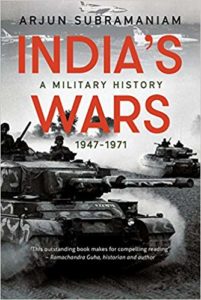
Book Review: India’s Wars. A Military History 1947-1971


India’s wars by Air Vice Marshal Arjun Subramaniam is a history of the wars (external wars, not counter-insurgencies) fought by the Indian army from 1947 to 1971. It is a pretty good summary, but does have it’s weaknesses.

The book starts with a bit of the “pre-history” of the Indian army. Interestingly Subramaniam chooses to highlight two distinct streams that he believes should get credit for the internal culture and ethos of the Indian army. One is obvious: the British Indian army, which was the parent organization that was split (unequally) between Pakistan and India to create the Indian army. The second is an angle that would not have been included by an official observer/author in 1950, but that has obviously grown since then to the point that a Pucca Air Marshal gives it near-equal billing in his book: i.e. the armies of the Marhattas and the Sikhs. I think this reflects contemporary politics and cultural arguments in India more than it reflects the reality of the Indian army from 1947 to 1971, but will be happy to be corrected by people who have better direct knowledge of the Indian army in that period. Anyway, the author gives a quick and very brief account of the British Indian army. The origins and growth of that force are dealt with very quickly and summarily, but there is more details about developments closer to 1947. This is not a book that is heavy on relevant numerical data (i.e. this is not the sort of book where you get tables showing “The caste/religious/ethnic composition of the British Indian army from X to 1947”) and this is a weakness that persists throughout the book; the author is not big on tables or data. Perhaps as someone who grew up with some of that history, I did not find it detailed or insightful enough, but most readers may not mind this omission too much. And even if you are a British Indian army brat, the sections on the origins of the Royal Indian Air Force and the Royal Indian Navy are likely to add to your knowledge. Incidentally, many of the early aviators in the Indian air force seem to have Bengali surnames; the author does not comment on this, but I wonder if anyone has more information about this. If you do, please add in the comments section.

Continue reading Book Review: India’s Wars. A Military History 1947-1971

Brown Pundits