Over the last few months, the traffic on this website has increased. The proportion of pageviews from India is now approaching parity with the proportion from the USA. To me, this suggests that perhaps it would be useful to outline a few things anyone who has read me in the past would probably know, but new readers will not know. I am in particular aiming this post to moderately above average intelligence readers, such as “Scorpion Eater.” Someone used to being the “smartest person in the room” due to the normal mediocre company of the unread or dull. The sort of person who leaves long comments on other peoples’ posts or articles. There’s a reason they aren’t writing anything original themselves.
In addition to being moderately intelligent, I also want to target the “internet Hindu” segment of the audience. I don’t mean the term pejoratively here, but more as a bracket for a wide range of people of different stances. One of the strangest things about internet Hindus in my experience is that:
1) They, like many Muslims, believe Islam is a religion of preternatural characteristics
2) Despite not being Muslim, and often hostile to Islam, they are convinced they know all about Muslims and Islam, even better than people who might be Muslim or of Muslim origin. They can get themselves inside the minds of Muslims
An analogy might be talking to a white nationalist who is convinced of the unique prowess of black people and seems inordinately confident that they know more about black history than black people themselves.
One thing that both internet Hindus and many atheists have in common is they lack a good intuitive feel for the phenomenology of religion. An internet Hindu or a village atheist will respond to the question of “what is Islam” with “read the Koran!”
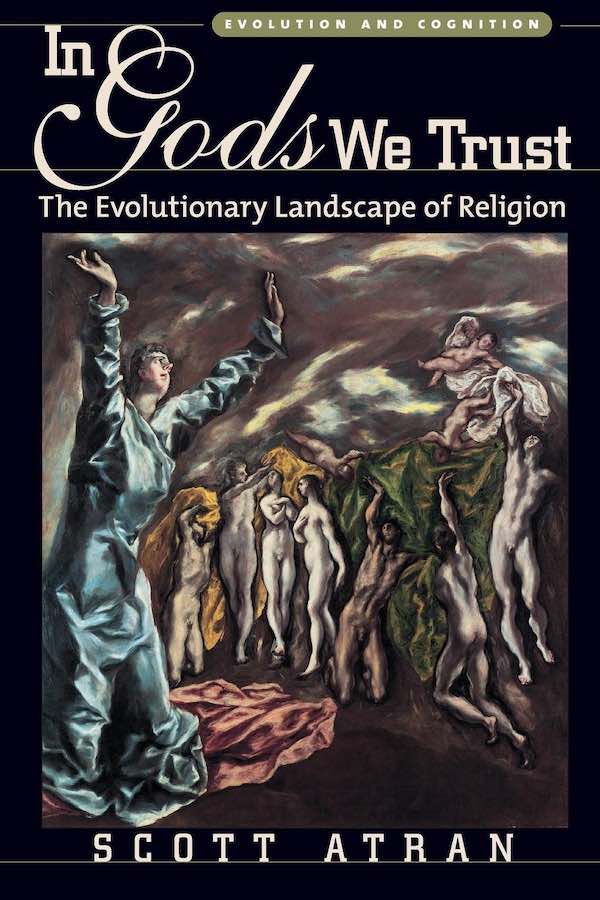
I was myself a typical village atheist, or more precisely a philosophical atheist (I had read books like Atheism: a philosophical justification and The Case Against God) in 2003 when I read Scott Atran’s In Gods We Trust: An Evolutionary Landscape of Religion. Atran is a cognitive anthropologist, who treats religion as a natural phenomenon. He is part of the “naturalistic paradigm” within anthropology. A small group of scholars, these intellectuals bring a multi-disciplinary framework to analyzing human cultures, with a strong theoretical basis in cognitive science and evolutionary biology. This is in contrast to the more common “thick description” that is the norm in much of modern anthropology, which offers few broad generalities (or a Marxist viewpoint, which offers the same generality).
In Gods We Trust is a very dense book. Religion Explained is a similar work but written a bit more accessibly for the lay audience. But you get the picture.
What is the biggest takeaway from cognitive anthropology and religion? That religious phenomenon can best be understood as a manifestation of common psychological intuitions. The reduction of religion to complex theologies is to a great extent a propagandistic narrative promoted by religious professionals, who have written the histories of religion for the past 2,500 years. Those who exhibit mastery of texts, and dispense ritual, will naturally reduce religion to texts and rituals. That’s what they control.
But the underlying psychological impulses remain. This explains why “atheistic” Communist societies so often develop personality cults of charismatic leaders. The religious impulse is simply projected upon a different target. Strip away the books and the incense, and the human mind still has as the basic fundaments of the religious phenotype.
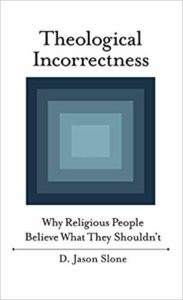 How does this apply to Islam? In the book Theological Incorrectness, the anthropologist D. Jason Slone reports on his fieldwork in Sri Lanka amongst Theravada Buddhists, Hindus, and Muslims. Using psychological experiments, which remove participants from easy to comprehend cues and scripts, he showed that all three religious groups had the same conception of god(s). This is interesting, because, in theory, Hinduism and Islam have different conceptions of gods, while Theravada Buddhism deemphasizes gods.
One reaction to these findings, which tend to be cross-cultural (that is, humans tend to have the same conceptual framework for a god despite theological distinctions), is that believers misunderstand their religion. I think a better interpretation is that religion can be thought of as two tracks, a conscious verbal track, which is quite superficial, and a deep cognitive track, which is harder to elucidate but primal and universal.
To illustrate, most Christians believe in a Trinitarian God, three persons with one substance. But this is really just a verbal script. Most Christians don’t even know the technical philosophy of substances and essences which serve as the basis for the Trinity.
All of this brings me back to Islam and the internet Hindu. Muslims are wont to promote a story of a miracle in the Arabian desert 1,400 years ago, and the emergence of the armies of Islam from that desert with Koran in hand. Soon they accomplished a conquest of Persia and much of the Roman Empire. This incredibly violent and organized religion then smashed against India and raped and assaulted the Hindu civilization. Finally, the assault ended, and India recovered, though Islam is still a specter haunting South Asia.
I have a revisionist take. I think the most probable model is one where Islam developed organically in the 7th and 8th centuries after the conquest of the Arabs. The Arabs were probably something close to what we’d recognize as heretical Christians but developed Islam to separate and elevate themselves from their subjects. More precisely, Sunni Islam cannot be understood until deep into the 9th century, after the Mu’tazilite period, and the rise of law as the dominant tradition with the Islamic sciences.
The Koran cannot explain Islam because most Muslims were and are illiterate in the Arabic of the Koran, and Islam itself did not develop in its full form until well after various elements of the Koran had already come into being. The weakness of scripture in predicting religion can be illustrated by the fact that the Hebrew Bible is more violent than the Koran, but Jews have been relatively pacific since the 2nd century A.D. (the reality of two failed rebellions left its mark on Jewish memory).
Of course, Muslim fundamentalists will tell you this is nonsense. That their religion is all about the Koran. That it’s a special religion. And the internet Hindu agrees. It is special (though in their case not a “good” way).
I am skeptical of that. I agree with Samuel Huntington’s empirical observation that “Islam has bloody borders.” At least today. But I would offer caution on chalking it up to something primal. In 1900 we might be wondering about in Jesus Christ’s message made it so that Christianity was an imperial religion of world domination and hegemony. Today we would laugh at that.
Note: I’m usually pretty lax about moderation on this blog, but if you are stupid, and you probably are, I will like trash your comment. This post exists mostly to familiarize people with books.