
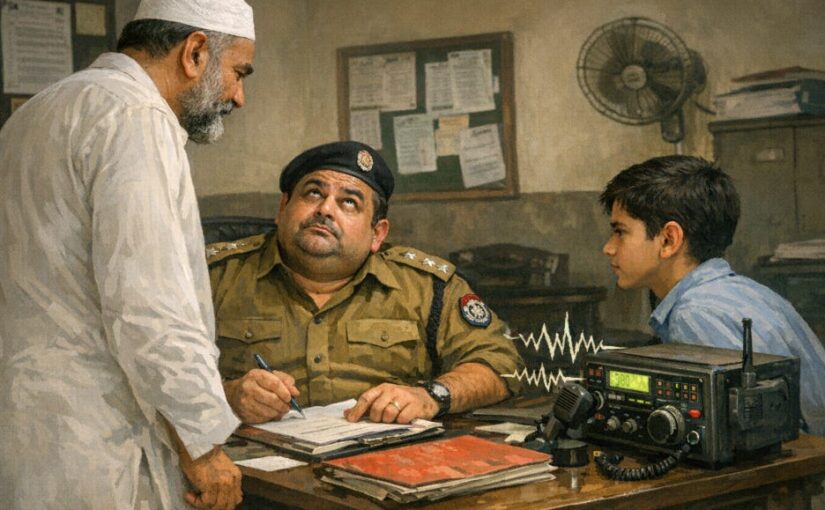
This translation was originally published in The Peshawar Review earlier this month. It is an excerpt from my translation of “Sphygmomanometer”, one of the Urdu short stories included in Bilal Hasan Minto’s collection Model Town (Sanjh Publications 2015). The collection consists of linked short stories set in Lahore in the late 1970s and early 1980s — at the beginning of General Zia ul Haq’s martial law. The narrator of these stories is an adolescent boy who comments on the hypocrisies of the adults around him.
One day, Naveed Bhai hadn’t returned from college by five o’clock. Usually, this wouldn’t have been cause for concern — a slight delay in returning home. But, over the past few days, Naveed Bhai had been behaving in a way that caused Abba to worry that he might be getting involved in something that would land him in trouble with the government of the cartoonish General Zia. Sitting at the dining table one day, Naveed Bhai had said angrily, through clenched teeth, that “we should teach these ignorant student union thugs a lesson.” On hearing this, Abba stared at him and said they had sent him there to study, not to get involved in useless things. Naveed Bhai should go straight to college and come right back. He shouldn’t even think about getting involved in union affairs and getting mixed up with dangerous people. Instead of being quiet after this reprimand, Naveed Bhai started speaking even more loudly:
“They are thugs! Their legs should be broken the way they broke Junaid’s. General Zia is behind them!”
Alarm bells had gone off in Abba’s head once before when Naveed Bhai had said he was going to join an underground group of progressive, pro-democracy students. Abba had only gently rebuked him, saying that future doctors shouldn’t get involved in such nonsense. Student unions were against the law. There was no need to get himself in trouble.
Who knows who he was, poor Junaid, whose legs had been broken. And I didn’t even know what a ‘union’ was but when Abba and Naveed Bhai started arguing loudly, I figured some dangerous people had become members of a student group sponsored by a political party, and now they were hovering around colleges and universities. The party they were affiliated with considered itself the last word on religion, and its sole champion. From Abba and Naveed Bhai’s conversation, I also gathered that these political workers used to beat students and coerce them into obeying strange orders. For example, boys and girls could not walk together on the street. If an emergency forced a boy to talk to a girl, neither of them was to be heard laughing — but such an emergency should never occur. Similar illogical things spewed from their strange minds, like the vomit from Faizan’s mouth. They had always done things like this, on behalf of that criminal general with the cartoon face and never did anything commendable just as that shameless general hadn’t either.
When Abba heard from Naveed Bhai about poor Junaid’s broken legs he became even more worried. Pointing his finger for emphasis, he warned, “Don’t you dare get involved in such things!”
So, on the day Naveed Bhai hadn’t returned by five, Abba initially feigned unconcern and said there wasn’t anything to worry about — he would come home soon. But after another half hour, he said we should go check at the college.
Naveed Bhai was not generally irresponsible. At most, he would sometimes go from college to a friend’s house but even then he would telephone us by dialing the number 50924 which caused our phone to ring. I would be very happy and curious to know who was on the other side striving to transmit his voice to us over the wires.
At 5:30, Ammi flipped open her address book and began calling all of Naveed Bhai’s friends. Only she could do that because she wrote numbers using her own system. The Habib Bank manager’s number, instead of being under ‘H’, was under ‘M’ for manager. And her tailor Ramzan’s number was under ‘T’ (for tailor) instead of ‘R.’ But there was no cause for complaint because she could find numbers at lightning speed. Sometimes when Abba had to find one, he would get frustrated and ask why she couldn’t write them in the right place.
Ammi would reply sharply that the right place was exactly where she had written the number. When Abba argued further, she would tell him to keep his own book and write everything correctly in it and give her back her flawed one. She said she would write in her way till her dying day and if, after death, there were some kind of life in which phones were available and address books were needed, she would still write the same way.
Ammi continued to dial numbers, all the time saying Allah have mercy, Allah have mercy. Abba asked her to stop being melodramatic and just make the call. Then he told me to accompany him to the college to see if we could find out anything. I asked if we should take the gun. Abba looked at me angrily and said:
“Get in the car” and muttered ‘idiot’ as well.
***
It was getting dark when we reached the college. Inside its big gate, in the tin-roofed parking lot, a guard was sitting idle in a chair. Obviously, he was slowly losing his mind because till such time as a thief, robber, or other professional criminal attacked the college, there was nothing for him to do but sit idle and those who sit idle get strange ideas from which they are in danger of losing their minds.
Abba parked the car outside and told me to go in by the small gate and ask the guard if there were any students still there. The guard replied that everyone was long gone and also that if any student needed to stay late for some reason he was informed about it in advance. He added he couldn’t say if a student was hiding inside but if that was so, the student would definitely be caught. And when he was caught, there would be serious consequences — an exemplary punishment would be meted out. He said this with clenched teeth, in anger, as if a student had been deliberately hiding in the college buildings, unafraid of him, and had just been caught.
The college buildings were faded yellow and had not been painted in a long time. The outer, lower, portions of its walls, where they met the ground, and the upper portions, where rainwater drains were placed, were covered with mold. These buildings had long, high-ceilinged corridors and big lecture halls that rang with echoes, especially when there were no people. Why would any student stay alone in such a scary college, hiding from everyone? It was a completely nonsensical idea the guard was working himself into a rage about. Clearly, he was losing his mind due to idleness.
When we reached home, Ammi had phoned all the likely friends of Naveed Bhai and not learnt anything from any of them. Asif had told her that at three, after classes were over, Naveed Bhai had left college and gone towards the bus stop. Hearing this, Ammi asked very sharply what kind of friend he was? Shouldn’t he have taken the bus with Naveed Bhai?
Asif said that he couldn’t have done that because his car came every day to take him home. Ammi huffed with disapproval and hung up immediately.
At least I didn’t remember Naveed Bhai ever having stayed out of the house till dark, without us knowing where he was. Ammi was still sitting near the phone but now she couldn’t think of anyone left to call. While serving the evening tea, Ismail said he would go see if Naveed Bhai was in the market. I was very surprised. Why would he be in the market? Naveed Bhai went to the market maybe once a week to buy something which was difficult to explain to Ismail, like a special kind of plug from the hardware store. Whenever Ismail went to buy something, he needlessly wasted at least half an hour. Still, Ammi told him to go look for Naveed Bhai, but to return quickly.
Ammi started complaining about how terrible it was that Abba didn’t know any influential person who could help us now. Abba said that there was no need yet. Ammi said, “Allah forbid we need help. Allah will be merciful and Naveed will come home by himself. But Allah helps those who help themselves and if Naveed doesn’t return home for any reason, I know we will not be able to do anything.” Abba just said finding missing people is the police’s job. We would go tell the police and they would find him.
Ammi let out a disappointed sigh. She reached for the phone so she could call Auntie Arshad and tell her that there was no news of Naveed Bhai and Abba was saying such impractical things.
Auntie Arshad immediately came running and said this was all that witch’s fault. Ammi should have listened to her. When Naveed Bhai was admitted to such a good college Auntie Arshad had told Ammi to gather the women to read the Quran so that the people burning with jealousy and casting spells upon Naveed Bhai wouldn’t succeed. She said it was important. Abba had said all that was completely unnecessary and Auntie Arshad simply wanted to have a party. If the purpose were to read the holy book, Ammi could do it by herself. Auntie Arshad disagreed, arguing that the power of all those women reading the Quran together could not be matched by poor Ammi alone.
Abba had also been irritated because he felt enrolling in college was a routine occurrence. What was so special about it that Auntie Arshad was making this suggestion? So, he didn’t allow the kind of Quran-reading that she had wanted. She had grumbled a lot. Now Auntie Arshad looked at Abba and said:
“See, that witch’s magic has worked! Hai, you didn’t listen to me, did you? You could just have served some naan, haleem and Kashmiri chai, but inviting the ladies was very important.”
Abba began to get angry. He told Auntie Arshad not to say stupid things. Nothing had happened yet that justified such lamentation. Then he told me to come with him to the police station.
It was completely dark when we left for the Model Town police station, which I had never seen from the inside. Some time ago, I had peeped over the wall, when Aqib and I were passing by and heard someone’s frightening screams from inside. We scrambled up the wall to peek inside and saw that the policemen were beating a man with their batons. He was saying:
“Aai la… Aai la… Aai la jee…” That is, “Hai Allah… Hai Allah… Hai Allah jee!”
From that day, I understood very well that I had no desire to ever go inside that building. It was like a house with yellowing walls, which meant that it was very old because most buildings like that were constructed by Hindus in their time. The time of the Hindus meant approximately the time when all these cities — Lahore, Karachi, Sargodha, etc. — were not in Pakistan but still in India. That’s not to say there were no Muslims here in those days because Muslims had long before found the opportunity to make their way to India. But there were many more Hindus here then since they had been living here long before the Muslims. Many lived right here in our Model Town, until Partition — that is till the time when Pakistan hadn’t come into existence as a result of Dr. Sahib’s dream. Dr Sahib means Allama Muhammad Iqbal, of whom it is written categorically in many books and magazines that he was a person of exalted stature and on reading whose books it becomes immediately obvious that besides his other intellectual and religious achievements he was a poet of the highest order. It’s another matter that now I don’t believe anything — even if it is in any book or magazine — until I have seen it for myself. Even then sometimes I wonder whether what I have seen might not be the result of some trick.
Anyway, whether it is true or false, we were told that Dr Muhammad Iqbal used to say that all Muslims were one nation and because for some reason he used to think about this a lot, one day it came to him in a dream that this nation should create a separate country.
Other Muslim countries didn’t pay any attention to Dr. Sahib’s suggestion that this special nation needed a country of its own. He desired that from the long river Nile in Africa to the Chinese province of Kashgar there should be one country for Muslims — that is, Pakistan, which the Arabs could continue to call ‘Bakistan’ as they do till today. But the people of Arabia, where Muslims are in a majority, consider everyone else in the universe somewhat lesser than themselves, so could never, never, agree to Dr Sahib’s proposal. It’s possible the proposal didn’t even reach them because at the time the means of communication were limited and papers could not be faxed, and so on. But even if news of Dr Sahib’s dream had reached them, I believe at most they would have laughed loudly and sniffed with contempt.
So, this police station had been built before Pakistan was created so that at least those Muslims who lived here or would come here as refugees would be saved from the influence of non-Muslims. In Pakistan they would be able to defend their beloved religion, and with its blessings progress in the world with incredible rapidity. During this whole business, many Muslims remained in India and began to turn against Pakistani Muslims because, for one, they felt there were still millions of Muslims over there while the Pakistanis were making a separate country over here. And, for another, it was salt in the wound to hear that Pakistan was being established because it was impossible to be a true Muslim in India and that Pakistani Muslims were such a special nation that they needed a country of their own, which implied that those who stayed behind were inferior Muslims because they lived in India. Indian Muslims would say (and it is possible that they still say) that they were greater believers because they continued to fly the flag of their faith right in the middle of all the Hindus, right in the middle of India, right there among the people who worshiped all these various types of gods.
At the time of Partition, the Hindus of Model Town and other places had left for India, and the ones who made it there alive put down their roots wherever they wished because like other countries, India also had lots of cities and villages where one could go and where people of different religions could settle and believe in all sorts of things. For example, some believe that there are vast numbers of gods in the universe and all these gods are busy with their own tasks like making rain, spreading or subtracting love, and allotting life and death. Others believe that there is only one God for the entire universe. And there are yet others about whom it is difficult to say what they believe in, such as Parsis who for some reason have a special attraction to fire and are not at all prepared to accept outsiders into their faith because for them it is better that more people do not join their religion.
In any case, those Hindu people went to India, in a hurry and afraid that some Muslim might murder them on the way. It has become clear that people whose religions are different become very angry when someone else doesn’t accept their true faith. Then they become even angrier that despite their telling others to believe in the true God, those others still refuse. And if nothing else, they should agree simply out of fear and at least say they would accept the true god. In this matter, these people sometimes become angry enough to start killing each other and then list with pride how many they killed — ten, twenty, hundred, five hundred, all those people whose hearts did not change immediately despite the threats and who, sincerely or not, did not switch their faith and allegiance.
Because the Hindus didn’t know India would be divided one day and they would have to leave their ancestral homes, they had erected many buildings in Lahore — such as this police station or Ganga Ram Hospital and Gulab Devi Hospital. Since buildings are fixed to the ground, it is impossible to take them here and there, and that’s the reason why one can’t say “I am going for work or pleasure to China, Japan, or Ethiopia and I’m taking my house with me.” That feat is impossible. At most, you can take a trunk or, if you really stretch it, your bedding so that you don’t have a problem sleeping when you get to the new place. And even then, the airline or railway company will clearly tell you that you can only take luggage of a certain weight and size and not more.
The Hindus had fled in a hurry and along with their buildings had left a whole lot of other things here, which the Muslims then enjoyed using, without regard for the fact that these things belonged to Hindus. Muslims would never admit that there are as many gods in the universe as they say Hindus believe, or that some of the Hindu gods have the form of animals — for example, a god the size of an elephant or as useful as a cow. The Hindus, on the other hand, cannot believe anything else.
We had parked the car and were about to enter the police station when a uniformed man stationed outside asked us our purpose. Abba told him we had come to meet the SHO. He asked why. Abba said we had come to file a report. The officer said the SHO didn’t register reports and told us to go to another room.
Abba must have thought he had been considered insignificant; perhaps he felt he should have been given more importance and escorted directly to meet the SHO — as if meeting the SHO were some kind of honor. So, Abba said “No, go tell the SHO that I am here,” and gave his name. The lowlife said that the SHO would either be very busy or he would be resting so it would not be possible to meet him. He told Abba to go back to that room and file a report there because that was the procedure. Abba kept standing for a while looking at him. Perhaps he was wondering if there was anything else he could say. Then he told me we should proceed to that room since we were here only to file a report anyway.
As we were going to the room the officer had indicated, where a yellow bulb was hanging by a dirty wire from the ceiling — we passed another room whose door was shut. The name tag on the door read “Obaidullah: Station House Officer,” i.e., SHO.
A uniformed policeman was sitting in the report filing room. On the table next to him was a radio-like instrument, from which voices emerged from time to time. It was clear that the police were using it to communicate with each other about events in various parts of the city and about their own movements. This was very good. It meant that if there were any news about Naveed Bhai’s whereabouts, it could immediately be transmitted everywhere at the speed of sound via this modern device. Even if there is a great difference between the speed of sound and the speed of light, the former is no ordinary thing either. That is why when an airplane is traveling faster than the speed of sound, there is a loud explosion — to announce the amazing happening of a machine moving at such speed.
Traveling at the speed of light is not possible in any case and even if some extraordinary people are able to do so, it is certain they would dissolve into the atmosphere or diffuse across the universe like dust into the universe or reach some exalted place that only they know. We cannot know of such a place because if there is a way of traveling at the speed of light neither we nor anyone we know has ever done it and if someone says that he can, he is lying because people who can do such things and reach such places don’t go around bragging about it .
The officer filing reports was a fat man. Abba approached him and said “As salam alaikum.” “Walaikum salam,” he replied and raised his eyebrows as if to say with this gesture, “What happened? What trouble have you brought for me?”
Abba told him where we lived and that we had come to file a report. “What report?”, he asked. Abba said: “My elder son hasn’t returned home since morning.”
The fat policeman didn’t think that was a big deal. It seemed to me he didn’t even think the voices emanating at the speed of sound from the modern radio-like instrument were important — he wasn’t paying attention to them while I, who wasn’t even a policeman, was paying close attention. If one wanted, one could say in the fat policeman’s defense that it didn’t matter that he wasn’t paying attention to the voices because it is possible they were not addressed to him. However, I could counter that the voices weren’t addressing me either but I was still listening carefully. Those transmitting didn’t even know I was standing at the other end, next to the instrument, with Abba.
“Where did he go?”, he asked.
“College,” Abba informed him.
The policeman asked some more questions about Naveed Bhai: his name, the name of his school, the year he was in, as well as his description. After listening to the answers, he opined that we were worrying needlessly and that it was no unusual thing for college-going boys to disappear at times without informing anyone.
“He must have gone somewhere with a friend,” he said. “Wait a while longer.”
It would have been futile to tell him that we had checked if Naveed Bhai had left with a friend. The policeman advised us to go home and said if Naveed Bhai did not return home by morning, we should come back and file a report.
“And what should we do until morning?” I asked, shocked.
“Wait,” he said, and then, after a moment, “or else ask around in the hospitals.”
“Where?” I was utterly amazed. “In the hospitals? Why?”
He said that if the police heard anything they would surely let us know but if we wished we could check the hospitals because it was possible Naveed Bhai had met with some accident.
That was a staggering remark. The victim of an accident? Victim? How can someone become an accident victim just like that — you go looking for someone and are told that they have become an accident ‘victim’? But then, I realized that if we had come to the police station, it was obvious we had not come to hear good news. How had I sat calmly in the car and come with Abba to the station as if we were going for a drive? How had we gone to the college? Although I knew that people could become victims of accidents and illnesses, and had lost my beloved Happy to rabies, today, in all this while, it had never even crossed my mind that we might have to look for Naveed Bhai in the hospitals suspecting he had become the victim of an accident.
Abba was convinced. He said we should go check the hospitals and if we didn’t find Naveed Bhai, we would come back in the morning. When we left after listening to the policeman’s nonsense, we saw a woman coming out of the SHO’s room. She was a plump, dark woman, rather tall and wearing a flowery outfit. She walked in front of us and reached the gate where the guard was sitting. A rickshaw was waiting there. When this tall, sturdy woman began to climb in, we saw the guard lightly pat her backside. She turned to him angrily and snapped “Don’t try this nonsense with me.” Then she got in the rickshaw and left. We both saw this incident but walked to the car in silence as if we hadn’t.
***
After leaving the police station, we first went home so we could see what the situation was like there before doing the rounds of the hospitals. Auntie Arshad was telling Ammi scary stories about missing children. In some of them, the body was found after many days in a drain. In others it was stuffed in a sack and left outside the house of the kidnapped child, although that was unnecessary since such a corpse could have been thrown anywhere.
When we got out of the car, Ismail came running and told us that Auntie Arshad was telling Ammi these sorts of things. From time to time, she would say: “The phone will ring. Just wait.”
“Who will call?”, Abba asked as he entered, for Auntie Arshad was again saying that very thing.
“Those who have taken him,” Auntie Arshad said.
“Who has taken him? Do you know them?” Abba started to get angry. “Are they friends of yours?”
“It seems like a kidnapping, no?”, Auntie Arshad said.
Ismail had also told us Auntie Arshad had suggested that when the kidnappers’ phoned, Ismail should talk to them and, if they asked for a ransom, he should say they had picked up the wrong child because this one was an orphan and no one would give any money for him. Abba wanted to send Auntie Arshad home but then Ammi would have been left alone while we went to the hospitals.
Abba told Auntie Arshad not to say such inappropriate things, which, instead of reassuring Ammi, would demoralize her. Auntie Arshad insisted she was saying helpful things — that the phone will ring and they’ll ask for money, which would mean there’d be a chance to save Naveed. She wasn’t, God forbid, saying they’ll kill him and stuff him in a sack. No, no, no, not that, God forbid.
This remark upset Abba even more, but before he could say anything the phone rang. We all froze. Auntie Arshad looked at the phone with a meaningful, triumphant smile and said under her breath:
“That’s the call.”
The phone was ringing. Everyone was looking at it without moving to pick it up, as if something very strange was happening and everyone had turned to stone. Suddenly, Abba said to Ismail, “What is it? Why don’t you pick it up?” He didn’t reach to pick it up himself. Ismail picked up the phone and after saying “Yes, Yes”, handed the receiver to Abba. Ismail was standing next to Auntie Arshad. She immediately grabbed him by his kurta and pulled him towards her:
“How much did they want?”, she asked.
Ismail said it wasn’t the kidnappers but the principal of Naveed Bhai’s college who was calling. Auntie Arshad made a face as if to ask why such irrelevant people were calling at such an important time and keeping the phone engaged when the kidnappers — who might be killers as well — could call at any time. Such dangerous people have very short tempers. It could also be that a helpless Naveed Bhai was sitting — or standing — in front of the caller and when he got a busy signal because of the principal’s call then with a single swipe of his other hand, he would separate Naveed Bhai’s head from his body or if he had a pistol, pull the trigger and let Naveed Bhai writhe to death.
“There is no shortage of weapons these days,” Auntie Arshad said.
Abba was holding the instrument to his ear and simply saying words like Yes, Yes, Okay, as if the principal were scolding him. In the middle, he asked once in a shocked voice — “Model Town?” Then, after muttering once or twice, he said Thank You and hung up.
“What happened?” Ammi asked.
Suddenly, Auntie Arshad screamed, “I’ve understood!”
“Hai! What happened?” Ammi turned to her.
“Hai! I know why the principal phoned! Hai! Nudrat jaan!”
Abba looked at Auntie Arshad in surprise. Ammi looked at Abba.
“What have you understood?”, Abba asked.
“Why did you put so much pressure, Nudrat jaan? Why? Tell me! You yourself are a hypertension patient. Why did you put so much pressure on the poor child? Why did you make him so tense that this was the result? Tell me!”
Ammi asked Abba what Auntie Arshad was saying. Abba said she was her friend, so Ami should tell him. He couldn’t figure out these histrionics.
Ammi said to Auntie Arshad, “Baaji, we are already worried. What is this drama you have started? What nonsense are you spewing?”
Then Auntie Arshad, after lamenting for a few more moments, said she wasn’t at all foolish and no one should dare think that of her. She had understood that because of the difficult studies at college and his parents’ pressure, Naveed had become fed up and hung himself from the fan or some other thing attached to the ceiling. Or, even if he hadn’t succeeded, it’s certain he had attempted it and, at the very least, because of the mental strain, a vein in his brain had burst. Then she said:
“I’m not crazy, Nudrat jaan. College principals don’t call children’s parents at home at night for no reason.”
However much Ammi was Auntie Arshad’s friend and confidante, she wasn’t about to stomach such ridiculous speculation. She angrily said that was enough! Auntie Arshad should stop at once and let the person who heard the phone call speak! Then she scolded Abba, asking if he had marbles in his mouth and whether he would say something?
Abba said that the moment was fast approaching when he would no longer be able to put up with Auntie Arshad’s talk.
“What did the principal say? Did he say anything about Naveed or not?” Ammi screamed.
“Yes, he did,” Abba said.
“Then speak up and tell us what he said.” She was almost hysterical.
“He has been arrested,” Abba said.
“Arrested??”
***
Something like this had never happened to us before. Such a grave incident — arrest. Abba was mute and unable to think of what we should do next. Ammi was urging him repeatedly to do something but he couldn’t come up with anything. Ammi asked him to think of some friend, some acquaintance, who could help. Abba listed his friends one by one and shook his head. What could they do? They were just decent, ordinary people like us. Then he opened the address book and started flipping through it, but nothing was forthcoming from there either. Some things are obvious straight away — who can or cannot help in such circumstances. It’s not like in the middle of a crisis you start consulting the telephone book expecting some savior’s name might be written there. Especially when everything is written in Ammi’s language and code. It doesn’t happen like that.
Auntie Arshad had gone home. On her way out, she had said that good health was not in her stars; Naveed Bhai’s arrest was certain to cause her blood pressure to climb. She warned Ammi to watch how hers would spike. And then, with tears in her eyes, she lamented that now poor Naveed wouldn’t even be there to check their blood pressure because she knew I couldn’t use the sphygmomanometer. Abba heard this remark and became extremely angry because she was speaking as if, God forbid, something had happened to Naveed Bhai so that he would never return — just like the policeman who told us to go check the hospitals.
“Go home. If you stay here, you will continue to speak such nonsense.”
Auntie Arshad didn’t expect to hear such a thing. She was flustered. She said she should go. It was very late. She would go, say her prayers, and pray for Naveed’s safety.
Safety? What’s this? It’s not like there was an epidemic in which some would be saved and some would succumb. What had to happen had happened.
Abba was at a loss but he was also surprised because the principal had told him that Naveed was being held in the Model Town police station.
“Could there be such low and despicable people?” Abba said. “Such low-lives. We were there and that despicable man had said he had no information. He was telling us to check the hospitals!”
“Hospitals!” Ammi was furious. “Allah send him to the hospital! You should have slapped his face.”
Ismail came to announce that dinner was on the table. Ammi said to leave it there, we would eat later because there was a crisis at the moment. But she told me to go ahead and eat. I said I was worried too. She asked if I wasn’t hungry and I said I was.
“So then? Eat.” Ammi said.
“I’m worried,” I said again. I thought that this was something special that adults did on such occasions. They couldn’t eat because they were worried — as if being worried kept the teeth from chewing.
Ammi began to grumble. “If a man works, goes somewhere, to some office, some institution, he gets to know people. If a man doesn’t do anything, he’s just isolated from everyone.”
I had never seen Abba embarrassed or angry at such remarks from Ammi because he was firm in his belief that it was despicable for people to do things they didn’t like, just to earn a living. Ammi didn’t often say such things except when something had to be done and she couldn’t think of who to ask for a favor — such as now for Naveed Bhai’s release.
“Where is it written that only I should have connections?”, Abba said.
“Why don’t you do something?”
Ammi looked at Abba in great astonishment and asked: “What kind of man are you?”
Abba replied if there was a name for the kind of man he was, Ammi should go ahead and use it, but she shouldn’t taunt him. What was the point of such resentment? Then he thought and said:
“Ok, go ahead and say what you want. What difference does it make? Words are mere sound waves.”
Ammi said if they had an impact on Abba, she would continue to say such things but since they did not, right now she would concentrate on her son. Abba replied he was also concerned about his son but it was clear Naveed wouldn’t return before morning. And in such a police station where there were such stubborn and indecent people, who lied to Abba’s face, it is pointless returning there to confront them with their lie.
Ammi ignored Abba’s remark, picked up the phone, and began to dial a number.
