
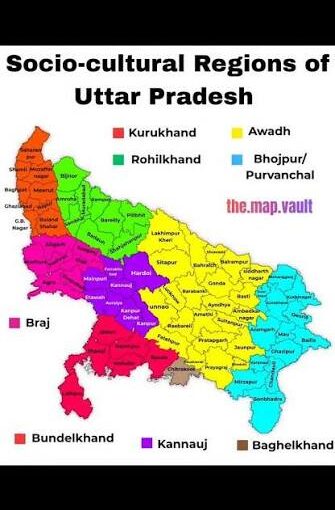
What would Braj Pradesh look like?

On the states that were never drawn, and the language of Lord Krishna’s own country

  1. Why was the linguistic principle applied everywhere except the Hindi belt?
  2. What would a Braj Pradesh look like, and which is its capital, Agra or Mathura?
  3. Can the languages be scheduled without unseating Hindi?
  4. What did Ambedkar see in 1955?

Good for the South but not the North?

The States Reorganisation Commission redrew the South along language lines and left the North alone. Andhra for Telugu, Kerala for Malayalam, Karnataka for Kannada, and one enormous Uttar Pradesh for a “Hindi” that contains multitudes. Ambedkar read the report and wrote a pamphlet, Thoughts on Linguistic States, published in December 1955. His verdict: the Commission had produced “a consolidation of the North and balkanisation of the South“, and intentionally or not, the fact was there.

His remedy was specific. Divide UP into three states of roughly two crore each, capitals at Meerut, Cawnpore and Allahabad. Divide Bihar in two, capitals at Patna and Ranchi. “The idea of having bigger linguistic states is not a democratic idea at all,” he wrote, and he added the detail that pre-empts the obvious objection: each of the resulting states would still have Hindi as its language. Division did not threaten Hindi. Forty-five years later, southern Bihar became Jharkhand with its capital at Ranchi, exactly as drawn.

In November 2011 Mayawati’s assembly passed a resolution splitting UP into four, Purvanchal, Bundelkhand, Awadh Pradesh and Paschim Pradesh, and sent it to Delhi. The UPA let it die. Uttar Pradesh today holds over 240 million people, which would rank it around the fifth largest country on earth, under one Vidhan Sabha.
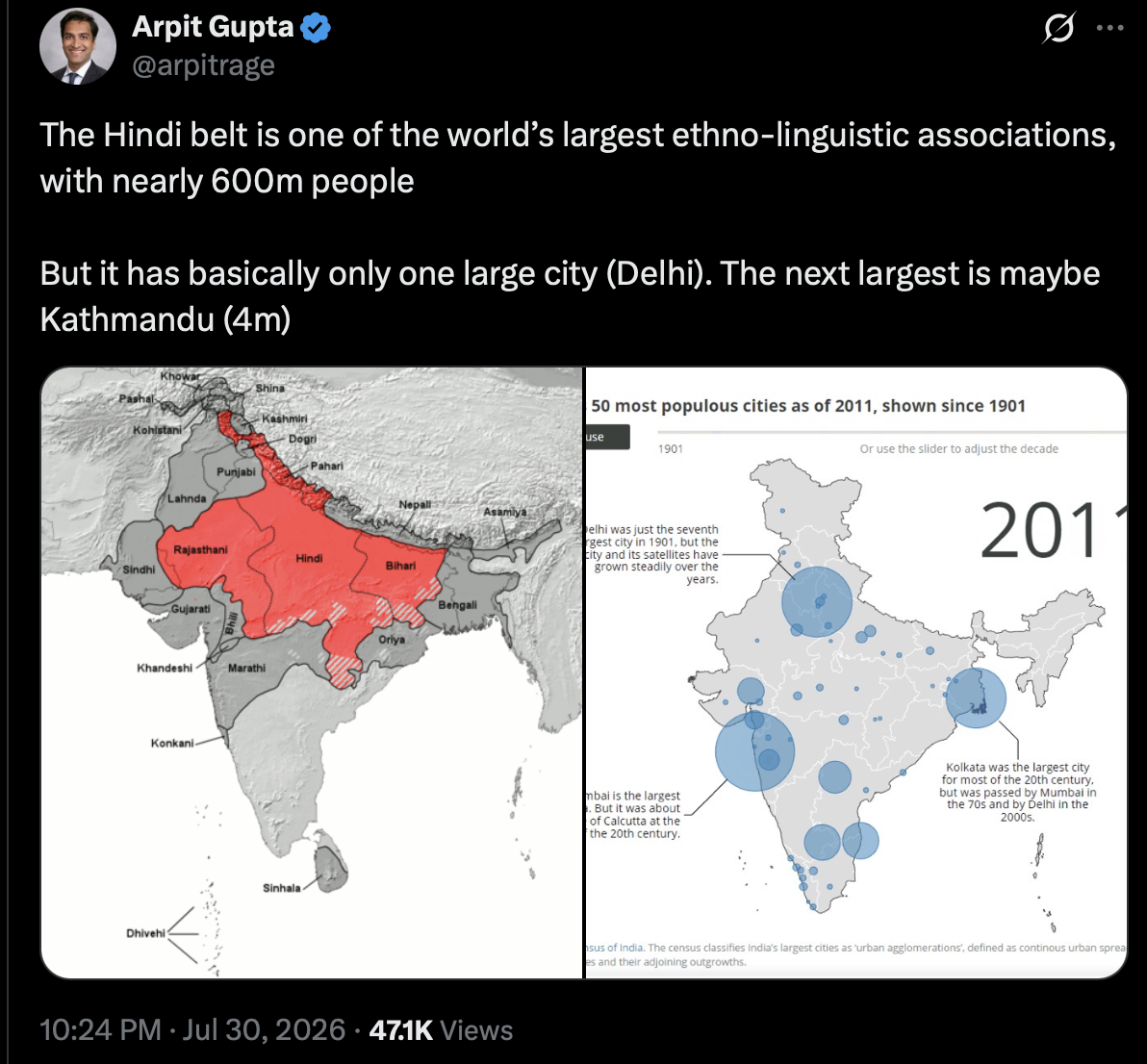
The Hindi umbrella
Continue reading What would Braj Pradesh look like?

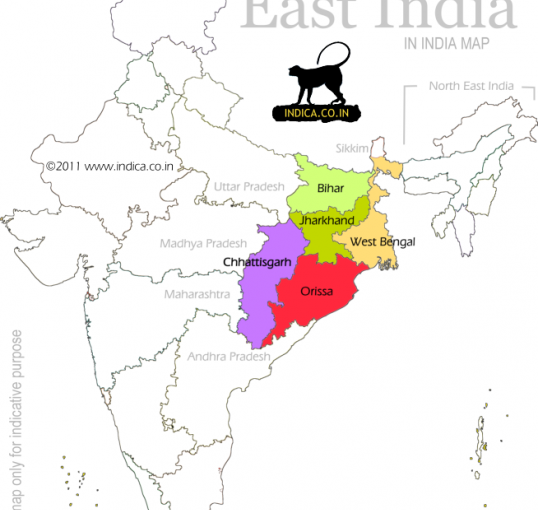
The Hindification of East India

The Saffron Block

The map of East India has changed colour. Bihar fell to the NDA in November 2025 with 202 of 243 seats, and Samrat Choudhary now sits as the first BJP Chief Minister Bihar has ever had. Odisha went saffron in 2024 under Mohan Charan Majhi. On 4 May 2026 Mamata Banerjee lost Bengal after fifteen years; the BJP took 206 seats and will form its first government in Kolkata. Himanta Biswa Sarma returned in Assam with 82 seats, a two-thirds majority and a third consecutive term. The old Bengal Presidency, once the largest province of British India, is now a single saffron block.

This is the completion, by ballot, of a partition the British attempted by map.

1905

In 1905 Curzon split Bengal. The eastern half was to be Muslim and centred on Dhaka; the western half was to be joined to Bihar and Orissa, which made the Bengalis a linguistic minority in their own province. The Bengali Hindu elite, the bhadralok who ran Bengal’s commerce and letters, fought it bitterly. They did not want to be drowned by Bihari and Oriya numbers. In 1911 the British relented and reunited Bengal.

The Biharis, for their part, had spent two decades campaigning to escape Bengali domination. The 1912 reorganisation that gave them their own province, jointly with Orissa, was their reward.

Linguistic identity then was the prime axis. Hindu and Muslim mattered, but not as much as Bengali, Bihari, Oriya.

The Historical Axis Flipped

A century on, that axis has flipped. The Bengali, the Bihari, the Oriya and the Assamese are voting as Hindus, and they are voting for the same party. The two-nation theory, which Bengal once threw off, is doing its work the long way round.

Hindi,, Hindu, Hindustan

Continue reading The Hindification of East India

Brown Pundits